
Two Countries Wearing One Name
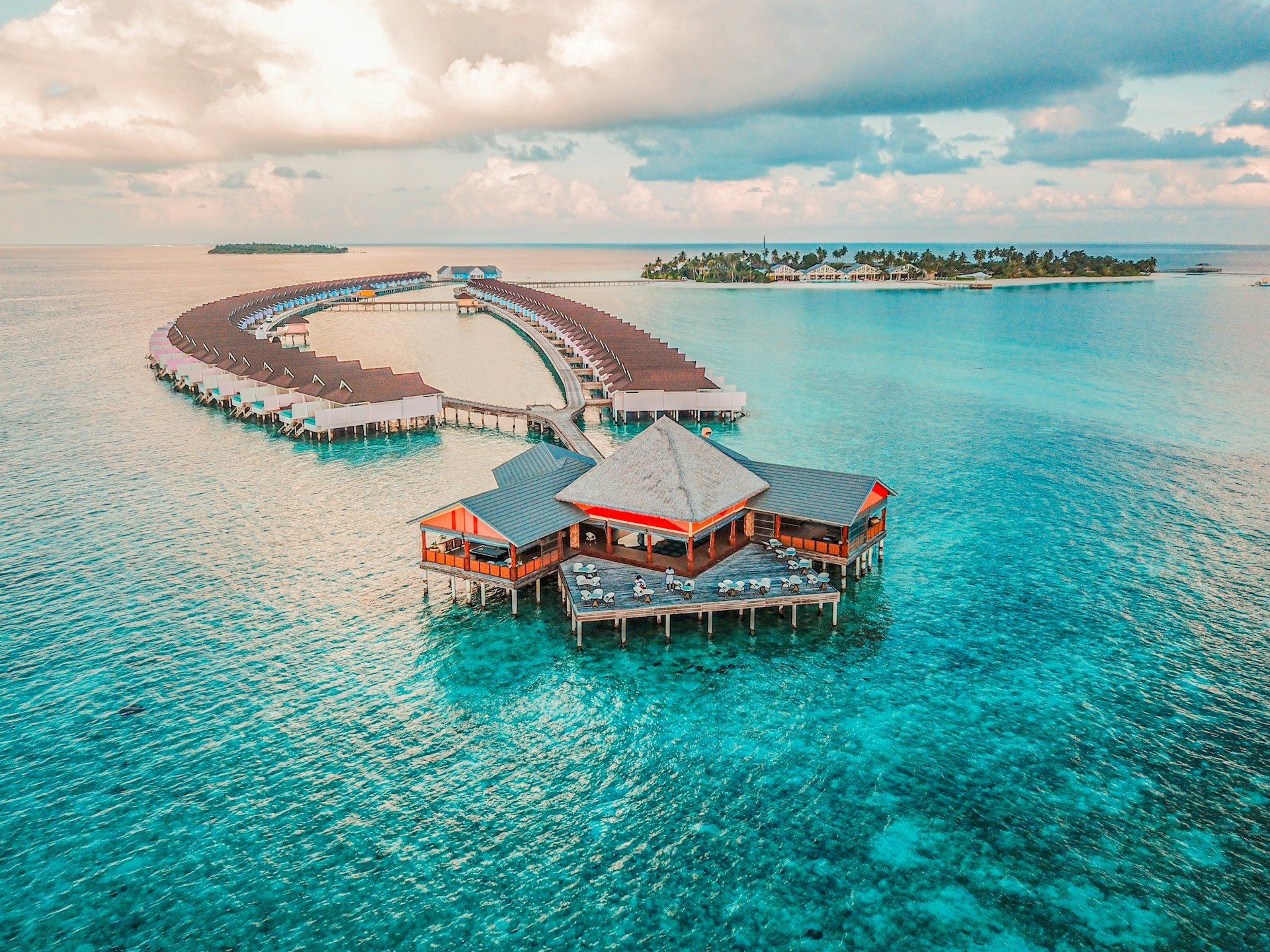
The Maldives markets itself as the overwater villa, the private plunge pool, the honeymoon photo with nobody else in frame, and for roughly 160 resort islands that image is accurate: each one is a self-contained, all-inclusive property with its own reef, its own staff, and a bill that starts around $400 a night and climbs into the thousands. What the marketing leaves out is that the country also has around 200 inhabited local islands where ordinary Maldivians live, and since 2009 a change in tourism law has let a growing number of them open guesthouses to visitors. The reef outside a $25-a-night room on Maafushi is frequently the same reef a resort three atolls over is charging $600 a night to look at.
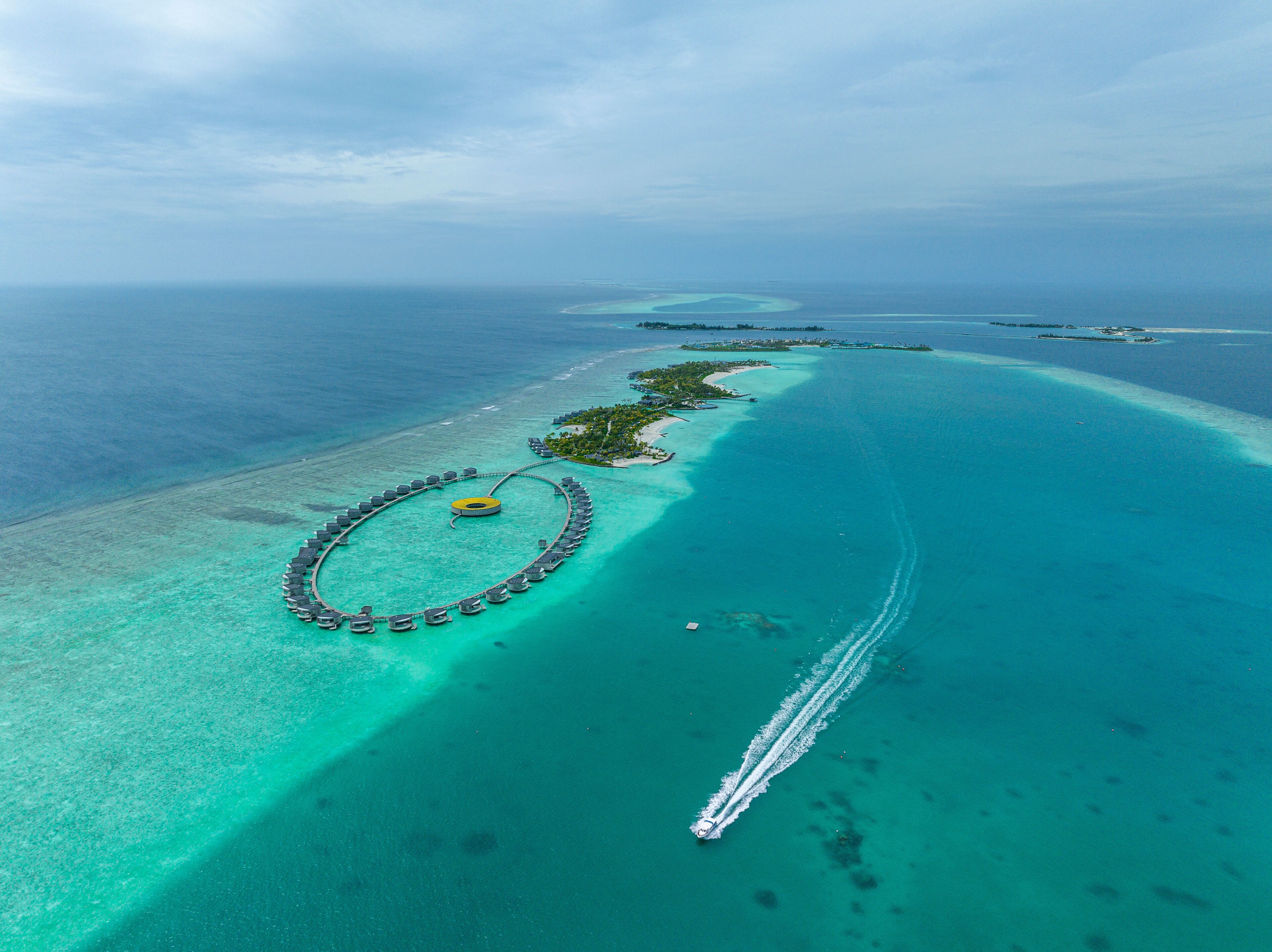
Geographically the country is almost entirely water: 1,192 coral islands grouped into 26 natural atolls, spread across roughly 90,000 square kilometers of the Indian Ocean, with a total land area smaller than Washington, D.C. Every island is flat, low and ringed by a lagoon; there are no mountains, rivers or road trips here, only boats, and the entire experience is built around what happens in and under the water.
The honest complications
The Maldives is one of the lowest-lying countries on earth: about 80% of its land sits under one meter above sea level, and its highest natural point is only around 2.4 meters. Sea levels around the archipelago have risen faster than the global average in recent decades, and the 2016 global coral bleaching event killed a large share of shallow reef in some areas, a reminder that the reef you're flying in to see is under real, ongoing stress. The government has responded with sea walls around Malé and the reclaimed island of Hulhumalé, but climate change is the defining long-term issue facing the country, not a footnote. On the ground, this is also a genuinely expensive destination if you stick to resorts, a strict Islamic local-island dress and alcohol code that surprises visitors expecting a beach free-for-all, and a transport system built entirely around boats and small planes, so plans bend to weather and departure schedules more than they do almost anywhere else in Asia.
A History Worth Knowing
The Maldives was a Buddhist kingdom for over a thousand years before converting to Islam in 1153, a sultanate that survived Portuguese raids in the 16th century and a brief Dutch and then British colonial period without ever being fully absorbed as a colony. It became a British protectorate in 1887, gained full independence on 26 July 1965, and abolished the sultanate for a republic in 1968. Tourism, now the backbone of the economy, did not exist until 1972.
- 1153
Conversion to Islam. The Buddhist kingdom converts under Sultan Muhammad ibn Abdullah; Islam has been the state religion ever since.
- 1887
British protectorate. The Maldives retains internal self-rule as a sultanate under British protection.
- 26 July 1965
Independence. Full independence from Britain, celebrated annually as Independence Day.
- 1968
Republic declared. The sultanate is abolished by referendum and replaced with a republic.
- October 1972
Tourism begins. Kurumba, the first resort, opens near Malé and starts an industry that now generates over half the country's GDP.
- 2009
Local islands open up. A change in tourism regulation allows guesthouses on inhabited local islands for the first time, creating the budget-travel option that islands like Maafushi are built on.
Read more: the sultanate, colonial period and the guesthouse law
Before Islam arrived, the islands were Buddhist and, before that, likely Hindu, reflecting trade contact across the Indian Ocean going back over two millennia; ancient coral stone mosques built in a style found nowhere else survive from the centuries just after conversion. The sultanate that followed was interrupted twice, briefly by Portuguese occupation in the 16th century and again for a short period under a Malabar chief, but otherwise ran continuously into the 20th century, a rare case of an Indian Ocean polity that avoided full colonization.
British protectorate status from 1887 left internal administration to the sultan while Britain controlled defense and foreign affairs, a relationship that persisted with a wartime RAF base on Gan, in Addu Atoll, until independence in 1965. A short-lived secessionist state, the United Suvadive Republic, broke away in the southern atolls in the 1960s before being reabsorbed.
The 2009 change that legalized guesthouse tourism on inhabited islands was as consequential to how visitors experience the country as anything since Kurumba opened in 1972: it created an entire budget and mid-range travel segment that did not exist before, decentralized tourism income beyond resort-owning conglomerates toward ordinary island communities, and is the direct reason a destination once synonymous with $1,000-a-night honeymoons now also has $25 guesthouse rooms.
Top Destinations
Choosing a Maldives trip is less about picking a place on a map and more about picking a category: the capital for a stopover, a resort atoll for the classic private-island experience, or a local island for independent, budget-friendly access to the same reefs. Most visitors combine a transit day in or near Malé with several nights in one of the categories below.
Malé, the smallest, densest capital in Asia
Malé packs roughly 200,000 people onto an island you can walk across in twenty minutes, and it is worth a half-day even for visitors headed straight to a resort transfer. The Old Friday Mosque (Hukuru Miskiy), built from carved coral stone in 1656, is the city's oldest and most striking building; dress modestly, cover your head if you're a woman, and remove your shoes. The Grand Friday Mosque and Islamic Centre, with its gold dome visible across the city, is the modern counterpart. The Malé Fish Market is liveliest early morning, when fishermen auction the day's tuna catch. Across the Sinamalé Bridge, Hulhumalé is a reclaimed island with wide streets, a long artificial beach and considerably more breathing room, worth the short taxi ride if you have a layover.
Maafushi & the guesthouse islands
Kaafu Atoll's Maafushi is the country's guesthouse-tourism capital, with over 50 properties, a designated bikini beach, dive centers and restaurants built up around independent travelers, about 30 minutes by speedboat from the airport. See our full Maafushi city guide for guesthouses, food and excursions.
Fulidhoo & Thulusdhoo
Smaller and quieter than Maafushi, Fulidhoo in Vaavu Atoll is known for its own bikini beach and a resident pod of spinner dolphins nearby, while Thulusdhoo in North Malé Atoll is the Maldives' surf hub, with the reef breaks Chickens and Cokes a short boat ride offshore and a handful of surf-focused guesthouses.
South Ari Atoll, whale sharks year-round
The South Ari Marine Protected Area holds the only documented resident population of juvenile whale sharks in the world; unlike most whale shark sites that depend on seasonal migration, operators here report sightings on 70-90% of trips in every month of the year. Snorkeling with them, never diving, is on a strict code of conduct: keep 3 meters from the head, no touching, no flash photography.
Baa Atoll & Hanifaru Bay, the manta feeding frenzy
Baa Atoll is a UNESCO Biosphere Reserve, and its Hanifaru Bay hosts the largest known manta ray feeding aggregation on the planet. From June to November, peaking in July and August, lunar tides push plankton into the bay faster than it can drain, and reef mantas, often joined by whale sharks, funnel in to feed, sometimes over a hundred at once. Entry is snorkel-only, capped by park rangers, and sessions run about 45 minutes; scuba diving in the bay itself is banned to protect the animals.
Addu Atoll, the southernmost frontier
Addu straddles the equator and feels distinct from the rest of the country: cooler, greener, and shaped by a former British RAF base on Gan that operated from World War II until 1976. The old base infrastructure, including a causeway linking several islands, makes Addu unusually walkable and cyclable by Maldivian standards, and its remoteness from Malé keeps it well off the standard resort circuit.
Culture & Etiquette
Islam is the state religion of the Maldives and, constitutionally, the only religion its citizens may practice publicly; this shapes daily life on every inhabited local island far more than it does inside a resort's bubble. Resorts operate under a separate, secular set of rules created specifically for tourism, which is why the "two countries" framing in the overview matters practically, not just conceptually: what's normal on a resort island can be genuinely inappropriate on a local one.
Do
- Dress modestly on local islands. Cover shoulders and knees away from the designated bikini beach. This applies to Malé, Maafushi and every other inhabited island, not just religious sites.
- Ask before photographing people, particularly on local islands where tourism is newer and residents did not sign up to be scenery.
- Remove shoes before entering mosques and cover your head if you're a woman visiting the Old Friday Mosque or Grand Friday Mosque in Malé.
- Learn a few Dhivehi words. Shukuriyaa (thank you) and Assalaam alaikum (hello) go a long way with guesthouse staff and boat crews.
- Respect the reef. Never stand on coral, touch marine life, or take shells or coral pieces; both damage a fragile ecosystem already under climate stress.
Don't
- Bring alcohol or pork onto a local island. Both are prohibited outside licensed resort and hotel premises; customs checks at Malé airport do enforce this.
- Wear swimwear off the bikini beach on a local island, including just walking back from the beach to your guesthouse.
- Assume every island is a resort. Confirm whether your accommodation is on a resort island or a local island before booking; the rules, prices and atmosphere differ substantially.
- Fly a drone without checking first. Many resorts and some atolls restrict or ban drones without prior permission; ask before you fly.
- Skip travel insurance with water-sports and evacuation cover. Medical evacuation from a remote atoll is expensive without it.
Deeper culture: Dhivehi, Boduberu drumming and the bodu dhoni
Dhivehi. The national language, written in the Thaana script, which reads right to left. It's an Indo-Aryan language related distantly to Sinhala, reflecting historical links to Sri Lanka and southern India, and is one of the oldest continuously used scripts of its kind in the region.
Boduberu. Traditional Maldivian drumming and dance, performed at celebrations and increasingly for tourists at resorts and guesthouse islands; the rhythm starts slow and builds to a frenzied climax, believed by some scholars to carry East African influence from historical trade and migration links.
The dhoni. The traditional Maldivian wooden boat, still used for fishing and inter-island transport alongside modern speedboats. Its distinctive curved bow appears throughout Maldivian visual culture, including on the national emblem.
Food & Drink
Maldivian food centers on fish, coconut and starch, built around what the reef and the palm trees actually provide rather than imported staples. Resort buffets lean international to suit a global clientele, but local-island restaurants and guesthouse breakfasts serve the real, spicier national cuisine at a fraction of resort prices.
Mas Huni $2-5
The national breakfast: shredded smoked tuna mixed with grated coconut, onion and chili, eaten with roshi flatbread. Found at almost every guesthouse and local cafe; ask for it if it isn't already on the breakfast table.
Garudhiya $4-8
A clear, intensely fragrant tuna broth served with rice, lime, chili and onion stirred in at the table. Simple, restorative, and the dish most Maldivians would call genuinely their own.
Hedhika $0.50-2/piece
Maldivian short eats: bite-sized fried or steamed snacks like bajiya (pastry with fish and coconut) and gulha (dumplings), traditionally served with afternoon tea at local cafes.
Fihunu Mas $6-12
Whole reef fish marinated in chili and spices, then grilled over coconut husk charcoal. A staple at local-island restaurants and beach barbecues alike.
Rihaakuru
A thick, intensely savory fish paste made by reducing tuna broth for hours, used as a condiment the way soy sauce might be elsewhere. An acquired taste that rewards a second try.
Fresh Coconut & Fruit $1-3
Young coconuts sold roadside for their water, plus papaya, watermelon and banana grown locally. The easiest, cheapest way to cool down between snorkeling trips.
When to Go, Itineraries & Getting Around
December through April is the dry, northeast monsoon season: calm seas, minimal rain and the best underwater visibility, but also the highest resort prices and busiest booking calendars. May through November brings the southwest monsoon, with brief, intense afternoon downpours that usually clear within an hour or two, noticeably lower rates, and better odds of whale sharks and mantas in Ari and Baa Atoll. Temperatures barely change year-round, sitting between 27-31°C.
Season comparison, with what each season is actually good for
| Season | Verdict | Weather | Best for |
|---|---|---|---|
| Dec-Apr | Best weather | Dry, calm seas, 27-31°C | First-time visitors, diving visibility, but peak prices |
| May-Jun | Good value | Transitional, occasional showers | Turtle nesting, lower prices before peak wet season |
| Jul-Aug | Good for wildlife | Wet season, showers clear fast | Hanifaru Bay manta season, turtle hatchlings, lower rates |
| Sep-Oct | Wettest | Heaviest rain, some swell | Surfing, continued manta and whale shark season, cheapest rates |
There is no real "cold" season anywhere in the Maldives; sea temperature stays around 28-30°C year-round, so the choice is really about rain, price and marine-life timing rather than temperature.
Getting there & between islands
Velána International Airport (MLE), on its own island just north of Malé, is the only international gateway, with direct or one-stop flights from most of Asia, the Middle East and Europe. From there, transport splits by distance: nearby atolls are a 30-90 minute speedboat ride, distant resorts rely on seaplane transfers (Trans Maldivian Airways and Manta Air both run large seaplane fleets) or a short domestic flight followed by a boat, and the roughly 200 inhabited local islands are connected by a public ferry network that is cheap but slow, plus faster shared and private speedboats aimed at tourists.
All transfer options with typical prices
| Option | Price | Notes |
|---|---|---|
| Shared speedboat | $20-30/person one way | Fixed daily departure times; used for nearby resorts and local islands like Maafushi (30-35 min). |
| Private speedboat | $150-250/boat | Any time, direct, no waiting for a scheduled slot. |
| Seaplane transfer | $300-600 round trip/person | For resorts too far for a speedboat; daylight hours only, scenic but weather-dependent. |
| Domestic flight + boat | $150-300 round trip/person | Used for the furthest atolls like Addu; a short regional flight followed by a dock transfer. |
| Public ferry | Under $5/route | Connects local islands cheaply but on limited daily schedules; fine for budget travelers with flexible plans. |
Where to stay
Resort islands
All-inclusive or half-board, overwater or beach villas, house reef access, and alcohol served on site. Price and privacy scale together; ultra-luxury properties run into the thousands per night.
Local-island guesthouses
Maafushi, Fulidhoo and Thulusdhoo have the biggest, most developed guesthouse scenes, with air conditioning, Wi-Fi and breakfast typically included. See our Maafushi guide for named picks.
Budget Planning
The Maldives has one of the widest price ranges of any single destination on earth, from a $25 guesthouse bed to a $1,000-plus overwater villa on the same trip's itinerary. Which tier you land in depends almost entirely on whether you choose a resort island or a local island, more than any other single decision.
- Guesthouse room $25-50/night
- Local cafe meals $5-10
- Shared snorkeling trips $35-80
- Public ferry or shared speedboat transport
- Upgraded guesthouse or 3-star resort
- Private excursions and dive courses
- Restaurant meals with wine/soft drinks
- Seaplane or private speedboat transfer
- Overwater villa, all-inclusive
- Private excursions, spa, underwater dining
- Seaplane transfers included
- House reef snorkeling and butler service
Quick reference prices
| Guesthouse double room (local island) | $25-50/night |
| Local cafe meal | $5-10 |
| Resort dinner buffet | $60-120/person |
| Shared snorkeling excursion | $35-80 |
| Shared speedboat transfer | $20-30 one way |
| Discover scuba diving | ~$150 |
| Whale shark day trip | $90-130 |
| Bottled water (local island) | ~$0.50-1 |
Prices reflect August 2026 research and drift over time, especially resort rates by season. Treat them as a planning baseline, not a quote.
Visa & Entry
The Maldives has one of the most open visa policies in the world: every nationality receives a free 30-day visa on arrival, with one current exception. Following a 2025 amendment to the Immigration Act, Israeli passport holders are barred from entry; dual nationals can still enter on a non-Israeli passport. Rules do change, so confirm current status with the Maldives Immigration Department before booking.
✓ Valid passport
At least 6 months validity from date of entry.
✓ Confirmed accommodation
A booking at a registered resort, hotel or guesthouse; unregistered stays can trigger questions at immigration.
✓ Return or onward ticket
Showing a specific departure date within the 30-day visa window.
✓ IMUGA Traveller Declaration
Submitted electronically via the IMUGA portal within 96 hours of your flight; sufficient funds, roughly $100/day plus accommodation costs, may also be checked.
| Maldives | Seychelles | |
|---|---|---|
| Islands | 1,192 coral islands, 26 atolls, entirely flat | 115 granite & coral islands, some with hills and rainforest |
| Budget option | Local-island guesthouses from $25/night | Fewer budget guesthouses; generally pricier across the board |
| Wildlife | Resident whale sharks, seasonal manta aggregations | Giant tortoises, endemic birds, coco de mer palms |
| Alcohol & dress | Restricted to resorts and licensed hotels off-resort | No local-island restriction; more relaxed islandwide |
| Visa | Free 30 days on arrival, most nationalities | Free 30-day visitor permit on arrival, all nationalities |
Safety, Solo Women & Family
The Maldives is safe for tourists. The US State Department rates it Level 2, "Exercise Increased Caution," its standard rating for terrorism risk that applies to dozens of mainstream destinations worldwide, not a warning against travel. Violent crime against tourists is rare, and resort islands are effectively self-contained and secure by design. The real, practical risks are water-related: currents, marine life encounters and unlicensed excursion operators, not crime.
Water safety
Currents around channels and reef drop-offs can be strong. Snorkel and dive only with a guide or licensed operator, and never alone in an unfamiliar spot.
Petty theft
Occurs occasionally in Malé and crowded local-island tourist spots. Resort islands see almost none. Keep valuables secured regardless.
Unlicensed operators
Stick to registered dive centers and tour operators for excursions, especially whale shark and manta trips, where crowding boats around wildlife has caused injuries in the past.
One more thing worth knowing: medical evacuation
Remote-island medicine. Serious medical care is concentrated in Malé and a handful of regional hospitals; a bad injury or illness on a distant atoll can mean a seaplane or speedboat evacuation costing thousands of dollars without insurance. Confirm your travel insurance explicitly covers medical evacuation by air or boat before you go, not just standard medical treatment.
Solo women travelers
Resort islands are low-risk and comfortable for solo women; the enclosed, staffed environment functions similarly to a resort anywhere else in the world. On local islands, harassment is uncommon but modest dress outside the designated bikini beach is expected and genuinely reduces unwanted attention; this is a cultural norm to work with rather than push against. Full detail on our Solo Woman Explorer pages.
Emergency numbers
Family travel & practical prep
Families: resorts with kids' clubs and shallow house reefs work well for younger children; local islands are friendly to families but have less dedicated child infrastructure. Water shoes help on reef-flat beaches at low tide.
Practical prep: buy a local SIM or an eSIM before you fly, since resort Wi-Fi can be patchy and expensive; bring reef-safe sunscreen, as some resorts and marine parks now require it; and pack a physical print of your accommodation booking and return ticket for the IMUGA arrival check.
Maldives FAQ
Is the Maldives safe to visit?
Yes. Violent crime against tourists is rare and resort islands are effectively self-contained and secure. The US government rates the Maldives Level 2, its standard terrorism-risk rating for dozens of mainstream destinations, not a warning against travel. Petty theft can occur in Malé; use licensed tour and dive operators for excursions.
Do I need a visa for the Maldives?
No. All nationalities except Israeli passport holders receive a free 30-day visa on arrival, provided you have a confirmed booking at a registered resort, hotel or guesthouse, a return ticket, and roughly $100 a day in funds. Extensions up to 90 days are possible.
Can I visit the Maldives on a budget?
Yes, by staying on inhabited local islands like Maafushi instead of a private resort. Guesthouses cost $25-60 a night, local restaurant meals $3-10, and shared snorkeling excursions $35-80, bringing a realistic daily budget to $60-100 versus $400 or more for a resort.
What is the difference between a resort island and a local island?
A resort island is a single all-inclusive property occupying its own island, with alcohol served and no local dress code. A local island is an inhabited Maldivian community where guesthouses take tourists, alcohol is banned outside a few licensed hotels, and modest dress is expected except on designated tourist beaches.
When is the best time to visit the Maldives?
December to April, the dry northeast monsoon, has the calmest seas and least rain but the highest prices. May to November brings brief afternoon showers and lower rates; it is also whale shark and manta ray season in Baa and Ari Atoll.
How do I get between islands in the Maldives?
Speedboats cover nearby atolls in 30-90 minutes, domestic flights and seaplanes reach distant resorts, and public ferries connect inhabited islands cheaply but slowly. Most resorts arrange transfers directly; local-island guesthouses typically book shared speedboats.
Is alcohol allowed in the Maldives?
Only at resort islands and a small number of licensed hotels; it is banned in public on the roughly 200 inhabited local islands, including Malé and Maafushi, in line with Islamic law.
How many days do you need in the Maldives?
Five to seven days covers one base well, whether a resort or a local island, with time for snorkeling, an island-hopping day and a sandbank trip. Ten days-plus allows combining a local island with a short resort stay.
Is the Maldives sinking?
About 80% of the country sits under one meter above sea level and the government is actively building sea walls and the reclaimed island of Hulhumalé as adaptation. It is not disappearing imminently, but climate change is the defining long-term issue facing the country.
What language is spoken in the Maldives?
Dhivehi is the official language. English is widely spoken across the tourism industry, at resorts, guesthouses and dive centers.
Is the Maldives good for solo female travelers?
Resorts are low-risk and comfortable for solo women. On local islands, harassment is uncommon but modest dress outside designated tourist beaches is expected and reduces unwanted attention.
What Stays With You
Every photo of the Maldives you've seen is real, and also only half the story. The overwater villa and the $25 guesthouse room look out at the same water, the same coral, the same impossible clarity that makes a lagoon look six inches deep when it's twenty feet. What changes is who you share the island with, how much of your budget goes to the view versus the reef itself, and whether your evening ends with a cocktail on your private deck or grilled reef fish at a plastic table on a local island's main street.
Both are worth doing. Neither is the "real" Maldives at the expense of the other. Go for the water either way, before the reef that makes both versions worth the trip finishes telling you how fragile it actually is.