
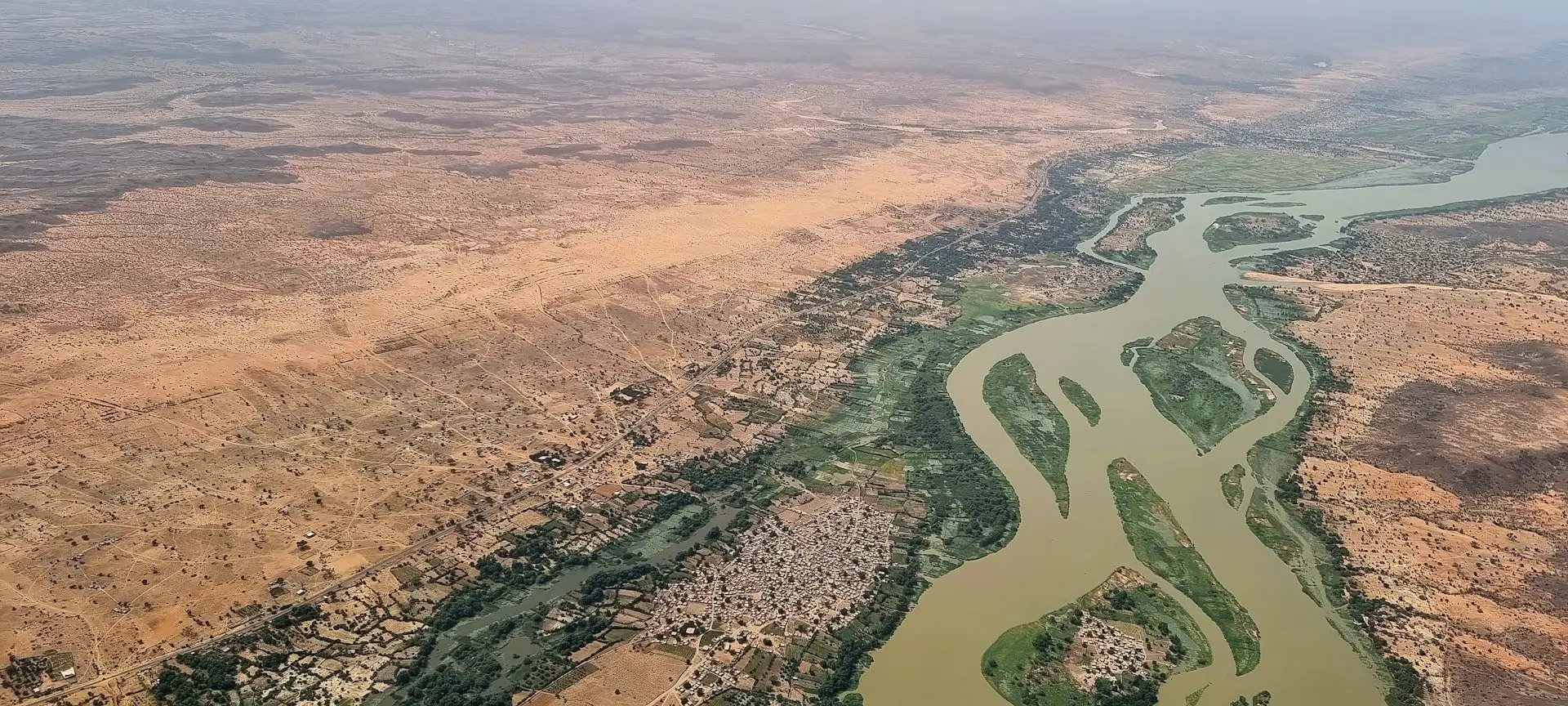
What This Guide Is, and Isn't
Niger is built on deep history: the northwest fell under the Songhai Empire from the 7th to 16th centuries, Hausa city-states like Zinder anchored trans-Saharan trade from the 14th century, and the Sultanate of Agadez, conquered and released by Songhai in turn, grew into one of the Sahara's great caravan cities. Its mud-brick Grand Mosque, rebuilt in 1844 on 16th-century foundations, has the tallest earthen minaret on earth and anchors a historic centre that earned UNESCO listing in 2013. Niger is also home to the Tuareg and the Wodaabe, whose Gerewol courtship festival at In-Gall remains one of the most distinctive living cultural traditions in the Sahel.
It is also, as of 2026, one of the most dangerous and diplomatically isolated countries on earth to visit. A jihadist insurgency linked to al-Qaeda and Islamic State-affiliated groups has spread across Niger's borderlands with Mali, Burkina Faso and Nigeria, a military government has run the country since a July 2023 coup, and Niger cut its French military partnership within months of that coup. The US State Department rates Niger Level 4, Do Not Travel, its most severe advisory tier, and the UK Foreign, Commonwealth and Development Office advises against all travel to the entire country, Niamey included.
The honest complications
This guide exists to explain what Niger is and how it got here, not to sell a trip. Atlas Guide does not recommend travel to Niger under current conditions, for any nationality, for any reason short of essential work carried out with an established security plan already in place. Everything below on culture, food and destinations is included for context and for the day conditions eventually change, not as an itinerary to book. Within the last two decades Niger had a real, if niche, overland and adventure-tourism circuit built around Agadez, the Air Mountains and Sahara expeditions to the Tenere desert; almost none of that safety picture survives intact. As of late December 2025, Niger also indefinitely barred entry to all US citizens in response to a US travel proclamation, a step beyond even Burkina Faso and Mali's reciprocal visa suspensions with Washington. Anyone reading this for research rather than an active trip should expect specific details here to age, generally in the direction of more restriction rather than less.
The Level 4 Advisory, and the 2026 Entry Ban
The US State Department renewed Niger's Level 4, Do Not Travel advisory on 9 July 2026, citing crime, civil unrest, terrorism, limited healthcare and kidnapping. Only essential US government employees are permitted to travel to Niger; non-emergency staff and their families are not assigned to the embassy in Niamey, and the US government says it cannot offer routine or emergency consular services to citizens anywhere outside the capital. The UK Foreign, Commonwealth and Development Office advises against all travel to the entire country, and specifically flags a heightened risk of attack in Niamey itself, alongside advice to avoid walking across the bridges over the Niger River on foot at any time. The UK maintains an embassy building in Niamey, but it does not provide consular services; British nationals needing help are referred to the Deputy High Commission in Lagos, Nigeria, hundreds of kilometres away.
Terrorism & kidnapping
Groups linked to al-Qaeda (JNIM) and the Islamic State, along with Boko Haram in the southeast, operate across Niger's borderlands with Mali, Burkina Faso and Nigeria. Both governments describe terrorists as actively plotting attacks and kidnappings for ransom, using foreigners and vulnerable groups as a deliberate target.
State of emergency & movement restrictions
A state of emergency and movement restrictions apply in many regions. Nigerien authorities require military escorts for foreigners travelling outside Niamey, and commercial flights from Niamey's Diori Hamani International Airport can face disruption at short notice.
A military government & a US entry ban
Niger has been ruled by a military junta since the July 2023 coup, and as of late December 2025 it has indefinitely barred entry and visa issuance to all US citizens, a reciprocal response to a US travel proclamation. This isn't a caution, it's a closed door, and it stacks on top of the Do Not Travel advisory rather than replacing it.
What "Do Not Travel" means in practice, and family travel
Both governments' advisories describe restrictions on their own staff's movements inside the country on top of the general advice to citizens. Medical care is limited even in Niamey and effectively unavailable across large parts of the country; medical evacuation, where possible at all, is slow and expensive, which is part of why both advisories sit at the "we may not be able to help you" level rather than a routine caution.
Family travel. Not realistic under current conditions. This is not a country where the usual family-travel adjustments, minimum ages, kid-friendly lodges, meaningfully change the underlying risk profile, and neither government's advisory carves out an exception for it.
Solo women travellers
Atlas Guide doesn't have a meaningful solo-women safety assessment to offer for Niger beyond the country-wide advisory above: the risks here, kidnapping, terrorism, extremely limited emergency and medical response, apply regardless of traveller profile, and solo travel of any kind isn't something either government's current advisory supports. Full general guidance is on our Solo Woman Explorer pages, but it doesn't substitute for the country-level advisory here.
Emergency numbers
These lines operate around the clock in theory but frequently go unanswered outside normal working hours, and organised ambulance dispatch is limited even in Niamey. Comprehensive insurance covering medical evacuation is essential for anyone here on essential business, and evacuation may still be slow.
A History Worth Knowing
Niger's territory sat inside the Songhai Empire in the northwest from the 7th to 16th centuries and the Bornu Empire in the east from the 8th to 18th, while Hausa city-states and the Sultanate of Agadez built their own trading power along the Saharan caravan routes. French colonisation, independence in 1960, a long run of coups, a rare democratic decade, and the 2023 coup that ended it: the short version explains a lot about the country a reader is encountering now.
- 7th-16th c.
Songhai & Bornu. The northwest falls within the Songhai Empire; the east falls within the Bornu Empire from the 8th to 18th centuries. Hausa city-states, including Zinder, rise along the southern trade routes from the 14th century.
- c. 1515
The Sultanate of Agadez. Songhai forces under Askia Muhammad I subjugate the Hausa states and capture Agadez; the sultanate regains independence after Songhai's own defeat in 1591 and grows into a major Saharan caravan hub.
- 1904-1922
French colonisation. The territory becomes part of French West Africa in 1904 and is reorganised as the separate colony of Niger in 1922.
- 1960
Independence. Niger declares independence from France on 3 August, with Hamani Diori as first president.
- 1974-1999
Military rule & coups. Lieutenant Colonel Seyni Kountéché overthrows Diori in 1974 and rules until his death in 1987; further coups and a 1999 presidential assassination follow before Mamadou Tandja takes power the same year.
- 2010-2021
A democratic decade. A 2010 coup follows Tandja's attempt to extend his term; Mahamadou Issoufou is elected in 2011, and Mohamed Bazoum's 2021 election marks Niger's first peaceful transition between two elected civilian presidents.
- 26 Jul 2023
The coup. Presidential Guard commander General Abdourahamane Tchiani detains and ousts President Bazoum, who remains held. France withdraws its ambassador and roughly 1,500 troops by the end of the year.
- Sep 2023 - Jul 2024
The Alliance of Sahel States. Niger, Mali and Burkina Faso form the AES in September 2023 after announcing their withdrawal from ECOWAS; the three governments confirm the withdrawal as irreversible in July 2024.
- 26 Mar 2025
Tchiani as president. Tchiani is sworn in as transitional president for a five-year period under a new charter that replaces the constitution, promoted to army general, and dissolves all political parties.
- Dec 2025 - Jan 2026
The US entry ban. Following a US proclamation suspending visa issuance to Nigerien nationals from 1 January 2026, Niger announces an indefinite ban on visas and entry for all US citizens in late December 2025.
Read the full history: Agadez, colonial Niger, and how the insurgency and coup took hold
The Sultanate of Agadez. A Berber-founded sultanate that controlled a key node of the trans-Saharan trade in salt, gold and slaves for centuries, absorbed briefly into the Songhai Empire around 1515 and regaining independence after Songhai's own collapse in 1591. Agadez's wealth and position made it one of the Sahara's essential caravan cities, a status its 16th-century Grand Mosque, rebuilt in its current form in 1844, still visibly reflects.
Colonial Niger. France folded the territory into French West Africa in 1904 and organised it as a distinct colony in 1922, administering it largely as a source of labour and levies with minimal investment, a pattern that left independent Niger with very little inherited infrastructure in 1960.
Coups and the democratic interlude. Niger's post-independence history is dense with military intervention: Hamani Diori's single-party government fell to Seyni Kountéché's 1974 coup, further upheaval followed his 1987 death, and President Ibrahim Baré Maïnassara was assassinated in a 1999 coup. A 2010 coup, triggered by President Mamadou Tandja's attempt to extend his term past constitutional limits, opened a genuine democratic decade under Mahamadou Issoufou (2011-2021) that culminated in Mohamed Bazoum's 2021 election, Niger's first-ever peaceful handover between two elected civilians.
The insurgency and the 2023 coup. Jihadist violence linked to al-Qaeda and Islamic State-affiliated groups spread into Niger's borderlands from Mali and the Lake Chad basin through the 2010s, while Boko Haram pressure built in the southeast near Nigeria. Frustration inside the military over the government's handling of that threat is widely cited as a driver of the July 2023 coup that ended the democratic decade, installed General Tchiani, and led within weeks to the expulsion of France's ambassador and the withdrawal of French troops that had anchored Western counterterrorism operations in the Sahel for a decade.
Destinations, For Context Rather Than an Itinerary
Under normal conditions, Niger's small tourism circuit centred on four areas: Niamey, the riverside capital; Agadez and the wider Air Mountains, the historic gateway to Saharan expeditions; Zinder, the old Hausa sultan's city in the south; and W National Park, shared with Benin and Burkina Faso on the border. All four are described below for context and background. None of them currently has a safety picture that supports a recommended visit, and this section should be read as reference material, not a suggested route.
Niamey, the capital
Niger's capital sits on the banks of the Niger River and holds the country's main international airport, its established business hotels, and the National Museum's ethnographic and palaeontological collections. See our full Niamey city guide for detail, with the same safety caveat as everywhere on this page.
Agadez & the Air Mountains
Agadez's Historic Centre, Niger's sole UNESCO cultural World Heritage Site, is built around the Grand Mosque, whose mud-brick minaret, rebuilt in 1844, is widely described as the tallest earthen structure in the world. The city was the historic launch point for camel and 4x4 expeditions into the Air Mountains and the Tenere desert beyond, and into the neighbouring Air and Tenere Natural Reserves, a vast Saharan protected area that UNESCO has listed as a World Heritage Site in Danger since 1992 because of instability. Desert tourism from Agadez has been largely dormant for years rather than months, and the wider region requires a military escort for any foreign traveller under current rules.
Zinder, the old sultan's city
Niger's second-largest city and a historic Hausa sultanate seat, Zinder's old quarter still holds the Sultan's Palace and a distinctive quarter of decorated Hausa merchant houses. It sits in the southeast, close to the Nigerian border and the area most affected by Boko Haram-linked activity, and carries the same country-wide advisories as everywhere else.
W National Park
Niger's share of the W-Arly-Pendjari transboundary complex, a protected wildlife area shared with Benin and Burkina Faso, historically known for elephants and one of the region's more intact savanna ecosystems. It sits among the areas hardest hit by the wider Sahel insurgency, and as of the 2026 entry ban, US citizens cannot visit Niger's side of the park at all regardless of other conditions.
Culture & Etiquette
Niger's population is roughly 53 percent Hausa, concentrated in the south and centre, and 21 percent Zarma/Songhai, concentrated around Niamey and the river valley, alongside Tuareg and Fulani (Peul) pastoralist communities in the north and centre, Kanuri near Lake Chad, and smaller Gourmantché, Toubou and Arab populations. French is the official language of government, but Hausa is the most widely spoken language day to day, followed by Zarma. The country is overwhelmingly Muslim, and hospitality and unhurried social courtesy are genuinely central values across these communities.
Do
- Greet properly before any request or transaction, even a brief purchase. Skipping a greeting reads as genuinely rude across most Nigerien communities.
- Use your right hand, or both hands together, for giving and receiving money, food or anything else, as a mark of respect.
- Dress modestly, covering shoulders and knees in most everyday and religious contexts.
- Ask before photographing people, especially the Tuareg and Wodaabe, whose dress and ceremonies are frequently, and disrespectfully, treated as photo opportunities by outsiders.
- Learn a few words of Hausa or Zarma alongside French; the effort is noticed and genuinely appreciated.
Don't
- Rush a greeting or a transaction. Social interaction here moves at a deliberate pace; visible impatience reads as disrespectful.
- Discuss the junta government or the security situation casually with strangers. These are sensitive, live subjects, not small talk.
- Treat Wodaabe or Tuareg ceremonies as a casual photo opportunity without checking what's appropriate first.
- Assume normal overland travel between regions is safe. It isn't, under the current advisory, regardless of how it may have worked in the past.
- Rely on assumptions from an old guidebook or a pre-2023 trip report. The security and political picture has changed enough that older accounts are unreliable for planning.
Deeper culture: the Wodaabe Gerewol, Tuareg tradition, and Nigerien music
The Gerewol and Cure Salée. Each September, at the end of the rainy season, Tuareg and Wodaabe pastoralists converge on In-Gall, north of Agadez, for the Cure Salée, a gathering built around salt-rich grazing pastures. The Wodaabe, a nomadic subgroup of the Fulani, hold their own Gerewol festival within it: young men paint their faces with ochre and white, dress elaborately, and dance for hours in a male beauty and courtship ritual judged by women. It is one of the most distinctive living cultural traditions in the Sahel.
Tuareg tradition. Saharan pastoralists historically called the "blue men of the desert" for the indigo dye that stains their skin from traditional tagelmust head wraps, the Tuareg (Kel Tamasheq) built a nomadic society around camel caravans, silverwork, including the distinctive Agadez cross, and an elaborate tea ceremony: three glasses, brewed and poured with increasing sweetness, that is a genuine social ritual rather than a quick drink.
Music. Omara Moctar, known as Bombino, is a Tuareg guitarist born near Agadez in 1980 and the first Nigerien artist nominated for a Grammy; his 2013 album "Nomad," produced by Dan Auerbach of the Black Keys, brought Nigerien Tuareg guitar music to an international audience. His work sits within a wider tradition of Tuareg desert guitar music that developed partly in exile during earlier periods of unrest.
Food & Drink
Nigerien food centres on millet and sorghum, built into filling, communal dishes, alongside rice along the Niger River and fish where the river allows it. It shares a great deal with the wider Sahel, but a few dishes and the Tuareg tea ceremony are worth knowing specifically.
Tuwo
The national staple: a thick, smooth paste of pounded millet or sorghum, eaten by hand with a vegetable, meat or peanut-based sauce rather than as a dish on its own, closely related to the tô found elsewhere in the Sahel.
Riz au gras
A one-pot rice dish cooked in a tomato, onion and spice broth with chicken, beef or mutton, standard at celebrations and one of the most widely eaten dishes in the country's south.
Capitaine (Niger River fish)
Nile perch pulled from the Niger River, grilled or fried whole, a genuine local specialty in Niamey and river towns where fresh fish is reliably available.
Brochettes
Grilled meat skewers sold as street food across Nigerien towns, a quick, inexpensive staple wherever local restaurant infrastructure exists.
Tuareg tea
Green tea brewed and poured in three successive rounds, each sweeter than the last, a genuine social ritual among the Tuareg rather than a quick drink, and a common gesture of hospitality if offered.
Moni
A millet porridge, often eaten with milk or a light sauce, common as a breakfast or light meal across Hausa and Zarma communities.
Climate, and Why There's No Suggested Itinerary Here
November through February is Niger's coolest and driest stretch, with the harmattan wind bringing Saharan dust but manageable temperatures; March to May is the hottest period, routinely exceeding 40°C in Niamey and higher in the north; and June through September is the short rainy season. That's included as reference climate information, not as a "best time to visit" recommendation, since the safety advisory doesn't have a seasonal exception.
Getting there & around
Diori Hamani International Airport (NIM) in Niamey is the country's main international gateway, historically served by carriers including Air France, Turkish Airlines, Royal Air Maroc, Ethiopian Airlines and Asky, with onward connections mostly routed through Paris, Istanbul, Casablanca or Addis Ababa; some routes and frequencies have been affected by the wider regional instability, and flight disruption at short notice is a stated UK FCDO concern. Within Niamey, shared taxis with fares agreed in advance (meters aren't standard) and hotel-arranged transfers are the normal way to move; overland travel beyond the capital requires a military escort under current rules and isn't something this guide can responsibly walk through as routine logistics.
Practical notes for essential travellers
Anyone travelling for essential, non-tourist purposes should register with their embassy or the nearest equivalent (bearing in mind the UK's Niamey embassy provides no consular services), arrange comprehensive evacuation-inclusive insurance in advance, and coordinate movement plans with a local employer, NGO security team or similarly informed contact rather than relying on general guidance like this page. A yellow fever certificate is required for entry regardless of nationality; see the Visa chapter below for the current, and unusual, entry picture.
Reference Costs, Not a Trip Budget
Niger doesn't currently have an active leisure-tourism market to price for, so the figures below are reference costs for essential travellers (diplomatic, NGO, business), gathered from Niamey specifically, not a suggested daily budget for a holiday.
Reference prices, Niamey
| Local restaurant meal (tuwo or riz au gras) | ~1,000-3,000 XOF ($1.50-5) |
| Established international hotel, e.g. Radisson Blu Niamey | Check current rates |
| Business hotel, e.g. Bravia Hotel Niamey | Check current rates |
| Smaller business hotel, e.g. Hôtel Terminus | ~$70-100/night (unverified range) |
| Niger e-visa, most eligible nationalities | Check current fee at application |
Prices reflect August 2026 research and drift over time, and several figures above are single-source estimates rather than fully corroborated. Treat this as a rough reference only.
Visa & Entry, Including the 2026 US Ban
Niger's entry picture changed sharply at the end of 2025. Following a US proclamation, issued 16 December 2025 and effective 1 January 2026, that fully suspended US visa issuance to nationals of Niger and roughly 18 other countries, Niger announced in late December 2025 that it would completely and permanently halt visa issuance to all US citizens and indefinitely bar US nationals from entering its territory. As of this writing, American citizens cannot enter Niger through normal channels at all, in addition to, not instead of, the existing Level 4 Do Not Travel advisory.
US citizens
Entry and visa issuance are indefinitely barred as of December 2025. There is currently no normal channel for US passport holders to enter Niger; confirm directly with the Nigerien government or the US Department of State before assuming any exception applies.
Other nationalities
An e-visa is available online for many nationalities, including the UK, Canada, Australia and several others, requiring a passport bio page scan, a yellow fever certificate and proof of accommodation, with roughly five working days' processing.
Yellow fever certificate
Mandatory for every traveller regardless of origin or nationality, checked on arrival.
ECOWAS & AES nationals
Niger, Mali and Burkina Faso withdrew from ECOWAS in 2024 and formed the Alliance of Sahel States. Free movement among the three AES states continues; the status of ECOWAS-wide free movement for the remaining bloc's citizens is in a stated transition and worth confirming before relying on it.
| Niger | Benin | |
|---|---|---|
| US advisory | Level 4, Do Not Travel, countrywide | Level 2 overall; Level 4 only near the Niger/Burkina Faso border |
| US entry | Entry banned for US citizens (2026) | Normal visa/entry process |
| Coastal access | Landlocked | Atlantic coastline, established beach and heritage tourism |
| Shared wildlife park | W National Park (northern share) | W-Arly-Pendjari complex (southern, more accessible share) |
| Tourism infrastructure | Largely inactive under current conditions | Active in the south; limited to closed near the northern border |
Niger FAQ
Is Niger safe to visit?
No, not under current conditions. The US State Department rates Niger Level 4, Do Not Travel, its most severe advisory level, citing crime, unrest, terrorism, health risks and kidnapping. The UK Foreign Office advises against all travel to the entire country, including the capital Niamey.
Can Americans travel to Niger right now?
No. In late December 2025, Niger announced an indefinite ban on issuing visas to US citizens and on US nationals entering the country, a reciprocal response to a US proclamation that suspended visa issuance to Nigerien nationals from 1 January 2026. This is a full entry ban, not just a Do Not Travel advisory.
What does Niger's Level 4 travel advisory actually cover?
Level 4 is the US State Department's most severe rating. For Niger it cites crime, civil unrest, terrorism, limited healthcare and kidnapping, and it applies countrywide. A state of emergency and movement restrictions are in place in many regions, and the US government says it cannot offer routine or emergency consular services to citizens outside Niamey.
Do I need a visa for Niger?
For most nationalities other than the US, yes, either through Niger's e-visa portal in advance or, for some nationalities, on arrival, and a yellow fever vaccination certificate is required of every traveller. US citizens currently cannot obtain a visa at all under the 2026 entry ban. ECOWAS and fellow Alliance of Sahel States nationals have separate arrangements.
What is the Alliance of Sahel States (AES)?
A confederation formed by Niger, Mali and Burkina Faso in September 2023 after all three announced their withdrawal from the regional bloc ECOWAS following military takeovers in each country. It functions as a security and political alliance among the three juntas, confirmed as irreversible in 2024.
Who is Abdourahamane Tchiani?
The former commander of Niger's presidential guard, who led the coup that ousted elected president Mohamed Bazoum on 26 July 2023. Tchiani was sworn in as transitional president for a five-year period under a new charter on 26 March 2025 and was promoted to army general.
What language is spoken in Niger?
French is the official language of government and formal settings, but Hausa is the most widely spoken language day to day, followed by Zarma (Songhai). Tuareg, Fulfulde, Kanuri and several other national languages are also spoken across different regions and ethnic groups.
What is the Gerewol festival?
An annual courtship and beauty ritual of the Wodaabe, a nomadic subgroup of the Fulani, held as part of the wider Cure Salée gathering at In-Gall near Agadez in the last two weeks of September. Men paint their faces and dance for hours to be judged by women, one of the Sahel's most distinctive living cultural traditions.
Is Niamey safer than the rest of Niger?
Relatively, but not safe by ordinary travel standards. Both the US and UK advisories cover Niamey along with the rest of the country without exception, and the UK notes a heightened risk of attack specifically in the capital. US government personnel outside Niamey cannot currently receive routine or emergency consular support at all.
What happened between Niger and France?
After the July 2023 coup, Niger's military government ordered French troops to leave and had France's ambassador expelled; France withdrew its roughly 1,500 troops and its ambassador by the end of 2023, ending a decades-long military partnership that had made Niger a hub for French and Western counterterrorism operations in the Sahel.
What Stays With You
Niger holds one of the Sahara's genuine architectural wonders in Agadez's mud-brick minaret, one of the Sahel's most singular living festivals in the Wodaabe's Gerewol, and a Tuareg tea ceremony that treats hospitality as something worth three unhurried glasses rather than one quick cup. None of that has stopped being true since 2023.
The honest answer to whether to visit right now is still no, and as of 2026 it isn't even a question US citizens can act on. This page exists so that history, and the specific, named places that earned it, Agadez, Zinder, the Niger River, aren't lost to the advisory and the entry ban that currently and correctly override every other answer about the country.