
Poland
A country that was wiped off the map for 123 years, had its capital city deliberately reduced to rubble, and rebuilt both from scratch with a stubbornness that is still visible in every stone. The food is better than you expect. The history is heavier. Both are worth your full attention.
What You're Actually Getting Into
Poland is one of the most underrated countries in Europe, and has been for long enough that calling it underrated is itself becoming a cliché. The practical reality: Kraków's medieval old town is one of the best-preserved in Europe and significantly less crowded than Prague. Warsaw's rebuilt baroque center is a UNESCO World Heritage site precisely because it was rebuilt from 16th-century paintings and photographs after the Nazis deliberately demolished 85% of the city. The Tatra Mountains in the south have genuine Alpine character. The Baltic coast is extensive and largely unknown to non-Polish visitors. And the food, the pierogis, the żurek, the bigos, the kotlet schabowy, is the kind of hearty, well-made cooking that rewards cold weather and appetite.
The currency is the Polish złoty, not the euro. Poland is an EU member that has not adopted the euro, and this matters practically: prices feel significantly lower than Western Europe and, when converted, they are. A sit-down restaurant lunch in Kraków's old town costs PLN 30 to 55 (€7 to €13). A craft beer in Warsaw costs PLN 15 to 22 (€3.50 to €5.50). A good mid-range hotel runs PLN 250 to 400 per night. For travelers coming from Germany, France, or the UK, Poland delivers a quality-to-cost ratio that is difficult to match elsewhere on the continent.
The thing no travel guide frames correctly enough: the weight of 20th-century history here is not optional context. It is the context. Warsaw was not damaged in WWII; it was systematically obliterated. The Jewish community that constituted a third of prewar Polish urban populations was almost entirely murdered. Auschwitz-Birkenau is 70 kilometres from Kraków. The Solidarity movement that ended communism in Poland began in Gdańsk in 1980. Understanding these realities, even at surface level, before you arrive makes Poland a fundamentally different and more meaningful place to visit.
Poland at a Glance
A History Worth Knowing
Poland's history has the quality of a story that keeps going wrong and keeps continuing anyway. The country has been invaded, partitioned, erased, occupied, liberated, and redrawn with a regularity that would have ended most nations, and yet a distinct Polish identity, the language, the literature, the Catholic faith, the particular stubbornness, persisted through every attempt to extinguish it.
The Polish state emerged in the 10th century, with the first historical ruler, Duke Mieszko I, accepting Christianity in 966 CE. The Piast dynasty built a kingdom centered initially on Gniezno, then Kraków. The medieval period saw Poland develop into a significant European power, and the Jagiellonian dynasty from the 14th to 16th centuries oversaw a cultural and political golden age. The Polish-Lithuanian Commonwealth, formed in 1569, was at its height one of the largest and most populous states in Europe, stretching from the Baltic to the Black Sea. Kraków's Wawel Cathedral and the Collegium Maius of Jagiellonian University, one of Europe's oldest universities founded in 1364, are the architectural witnesses to this period.
The 18th century was catastrophic. Poland's neighbors, Russia, Prussia, and Austria, exploited the country's internal political weaknesses and executed three successive partitions in 1772, 1793, and 1795, dividing the country between themselves and erasing Poland from the map of Europe entirely. It remained erased for 123 years. Polish language and culture were suppressed under the partitioning powers. The nation survived as a cultural and intellectual identity without a state, sustained by its literature, its music, and a Catholic Church that became inseparable from national identity during this period.
Poland re-emerged as an independent state after WWI in 1918, only to face invasion from two directions simultaneously in September 1939: Nazi Germany from the west on September 1st, and the Soviet Union from the east on September 17th, in accordance with the secret Molotov-Ribbentrop Pact. What followed was six years of occupation that killed approximately six million Polish citizens, half of them Polish Jews. The Holocaust was largely carried out on Polish territory: the six main extermination camps, Auschwitz-Birkenau, Treblinka, Sobibor, Bełżec, Chełmno, and Majdanek, were all located in Nazi-occupied Poland. Three million of the six million Polish Jews who were killed before the war were murdered in this period. The Warsaw Uprising of August to October 1944, in which Polish resistance forces fought the German occupation for 63 days with minimal external support, ended with the systematic demolition of the city on Hitler's direct order. Eighty-five percent of Warsaw was destroyed building by building.
The postwar decades brought Soviet-aligned communist rule. The Solidarity trade union movement, founded in Gdańsk in 1980 under the leadership of Lech Wałęsa, became the first independent trade union in the Soviet bloc and the catalyst for the peaceful revolutions that ended communism across Central and Eastern Europe by 1989. The Solidarity monument at the Gdańsk Shipyard and the European Solidarity Centre museum are among the most important historical sites in contemporary European political history.
Poland joined NATO in 1999 and the EU in 2004. In the three decades since communism ended, it has undergone one of the most dramatic economic transformations in European history, from one of the poorest countries in Europe to a middle-income nation with one of the continent's most robust economies. The political landscape has been turbulent, with periods of democratic backsliding under PiS government followed by a coalition shift in 2023, and ongoing proximity to the war in Ukraine lends Poland's security consciousness a seriousness that is different from most Western European countries.
Duke Mieszko I accepts Christianity. The Polish state enters recorded European history.
One of Europe's oldest universities founded in Kraków. The Polish-Lithuanian Golden Age begins.
Poland is erased from the map by Russia, Prussia, and Austria. It will not reappear for 123 years.
Poland re-emerges after WWI. The interwar period lasts only 21 years before the next catastrophe.
Six million Polish citizens killed. Warsaw deliberately demolished. Six extermination camps on Polish soil.
Lech Wałęsa leads the first independent trade union in the Soviet bloc at the Gdańsk Shipyard.
Poland's Round Table Agreement triggers the peaceful revolutions that end communism across Eastern Europe.
Top Destinations
Poland is larger than most visitors expect: roughly the size of Germany, with a north-to-south range from Baltic beaches to Tatra mountain peaks. The train network is reliable and improving, and the main cities are connected by express InterCity services. A two-week trip can cover Kraków, Warsaw, Gdańsk, and the mountains with room to breathe. A week-long trip should focus on Kraków and its surroundings, which give you the medieval city, Auschwitz, the Wieliczka salt mine, and a day in the Tatras all within a single base.
Kraków
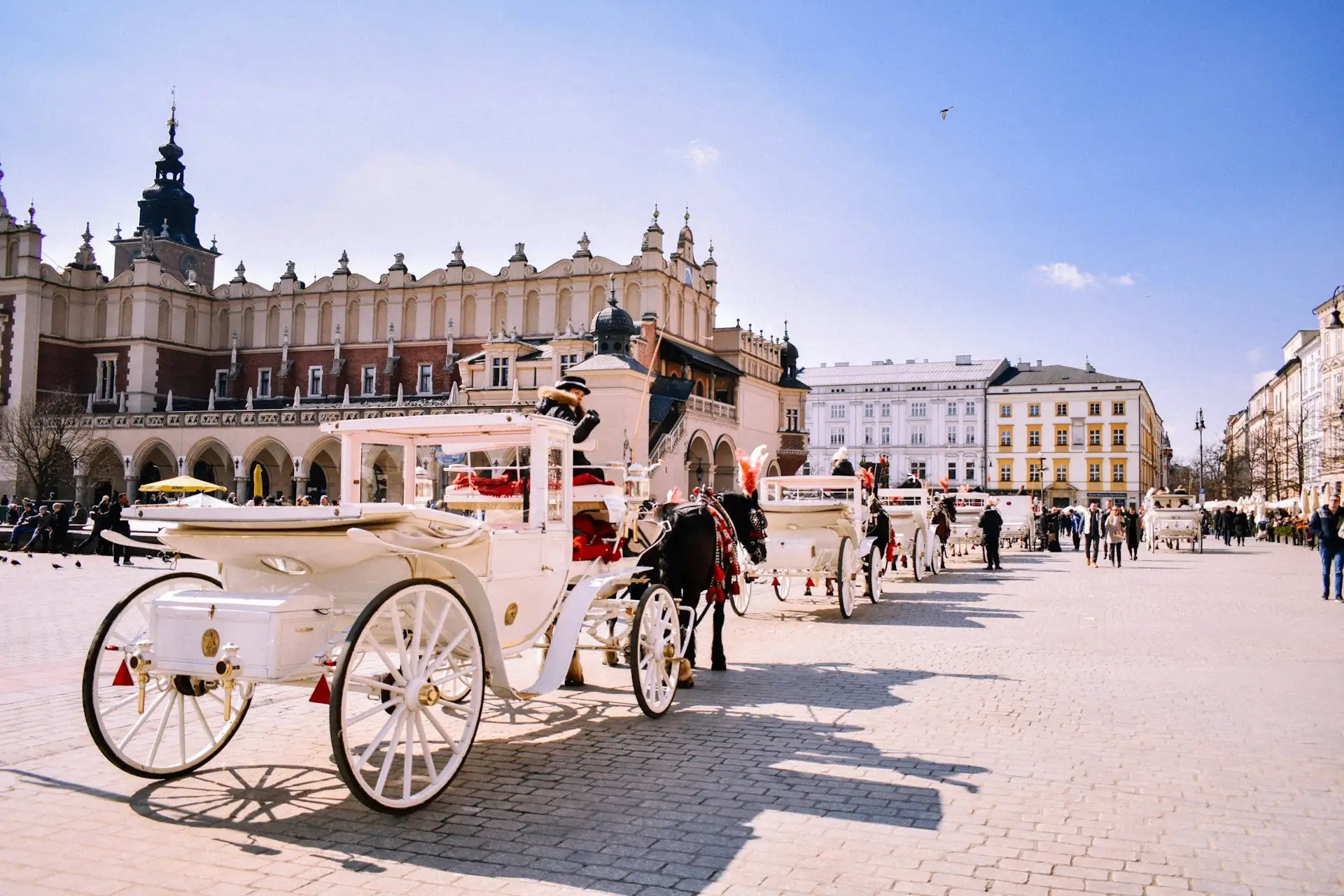
Kraków is the city that most visitors come to Poland for, and it delivers consistently. The Rynek Główny, the main market square, is genuinely one of the largest medieval market squares in Europe and lined with Gothic, Renaissance, and Baroque buildings that survived the war largely intact. Wawel Castle and Cathedral above the Vistula is where Polish kings were crowned and buried for 500 years. The Kazimierz Jewish Quarter, which was the heart of Kraków's Jewish community before the Holocaust and is now a lively neighborhood of galleries, cafes, and synagogues, has a complex layered character that rewards slow walking. Allow three to four days minimum.
Warsaw
Warsaw is one of the most extraordinary cities in Europe for reasons that require context to understand. The Old Town, which looks like a meticulously preserved 17th-century Polish city, is in fact a faithful reconstruction built between 1945 and 1984 from 18th-century paintings by Bernardo Bellotto and prewar photographs, after the Nazis demolished it building by building after the Warsaw Uprising. It was added to the UNESCO World Heritage list specifically as an example of 20th-century reconstruction. Knowing this changes the experience completely: the buildings look real because Poles made them real again, deliberately and methodically, from rubble. The Warsaw Rising Museum on Grzybowska Street is the most important museum visit in Poland.
Auschwitz-Birkenau
The Auschwitz I camp and the Auschwitz II-Birkenau extermination camp 3 kilometres away together constitute the largest and best-documented site of the Holocaust. Book a guided tour on auschwitz.org well in advance. Unguided entry is available but limited to certain hours and still requires a timed-entry booking. The visit is not comfortable. It is not meant to be. The Birkenau site, which most tour groups don't fully cover, is vast and largely open-air: walk the perimeter of the women's camp and stand at the end of the railway ramp and let the scale register without commentary.
Gdańsk
Gdańsk is where WWII began on September 1, 1939, when German warships shelled the Polish garrison at Westerplatte. It's also where communism ended, in practical terms, when Solidarity was founded at the Lenin Shipyard in 1980. The Long Market (Długi Targ) is a postwar reconstruction of the original Flemish merchant city, lined with tall narrow houses that look like Amsterdam via Poland. The European Solidarity Centre is the most architecturally significant and politically important new museum in Central Europe. Westerplatte is a short ferry ride away. Two to three days is right.
Wrocław
Wrocław sits on the Oder River across twelve islands connected by over a hundred bridges. Its past is complicated: German Breslau for most of its history, ethnically cleansed after WWII and resettled with Poles expelled from what is now Ukraine, it has a genuinely unusual cultural layering. The Market Square is one of the largest and most colorful in Poland. The city has over 300 bronze dwarfs hidden around the streets, installed by artists as a form of political satire during communism. Finding them is a legitimate reason to walk the entire city center.
Wieliczka Salt Mine
A working salt mine since the 13th century, with 300 kilometres of underground tunnels descending nine levels to 327 metres below the surface. The Tourist Route covers 3.5 kilometres and takes about two hours. The highlight is the Chapel of St. Kinga, a complete underground cathedral carved entirely from salt, including the chandeliers, which drip with salt crystals. The UNESCO listing is well-deserved. Book tickets online in advance, especially in summer. Twenty minutes from Kraków by local train.
Zakopane & the Tatras
Zakopane is a mountain resort town at the foot of the Tatra Mountains, two hours by bus from Kraków, and the base for the best hiking in Poland. Rysy, the highest peak accessible from the Polish side at 2,499 metres, is a strenuous full-day hike but achievable by anyone with reasonable fitness in good summer conditions. The Morskie Oko lake, reached by a 9-kilometre footpath from the road at Palenica Białczańska, is one of the most beautiful alpine lakes in Central Europe and accessible to all fitness levels. Zakopane itself is touristy but the surrounding landscape forgives it entirely.
Białowieża Forest
The last primeval lowland forest in Europe, straddling the Polish-Belarusian border. The Polish side is a UNESCO World Heritage site and National Park with strictly protected zones accessible only with a licensed guide. The European bison (żubr), hunted to extinction in the wild by 1927 and reintroduced from captive animals, now numbers over 1,000 in the forest. Seeing one on a guided forest walk is one of the more quietly extraordinary wildlife experiences in Europe. Remote and worth the effort: five to six hours from Warsaw by bus and local transport.
Culture & Etiquette
Polish people are warm hosts who are sometimes initially reserved with strangers. The first interaction, buying something in a shop, asking for directions, might be brief and direct without what English speakers interpret as friendliness. This is not unfriendliness. Once you're within a social context, at a dinner table, at a bar, in someone's home, Polish hospitality opens up in a way that involves food, drink, and conversation in quantities that can be genuinely hard to keep pace with.
Poles are proud of their country in a way that is rooted in survival rather than swagger. The history of being erased, occupied, and rebuilt creates a national identity that is simultaneously resilient and sensitive about being misunderstood or dismissed. Engaging genuinely with Polish history, not as tragedy tourism but as actual interest in what happened and why, is the most direct path to good conversations with Polish people.
A firm handshake with eye contact is standard when meeting Polish people in any formal or semi-formal context. Women may offer their hand first; wait for this cue rather than initiating. In informal settings among younger people, hugs and cheek kisses are common between friends.
The Polish toast means "to health" and is said before the first drink and before each subsequent drink if anyone refills. Not saying it when others are toasting is noticeable. Saying it with genuine eye contact rather than a perfunctory glance is better.
An odd number of flowers (even numbers are for funerals) and unwrapping them before presenting is standard. Wine or good vodka are equally acceptable. Arriving empty-handed to a Polish home invitation is considered rude.
Asking Poles about WWII, communism, Solidarity, and the post-1989 transformation is welcomed rather than awkward. These are not sensitive topics to be avoided; they are the subjects that define how Poles understand themselves.
Polish vodka is drunk neat, chilled, and in small shots alongside food, not as a mixer. Żubrówka (bison grass vodka), Wyborowa, and Belvedere are the quality benchmarks. Refusing a shot is acceptable; replacing it with a cocktail at a traditional dinner table is less so.
This phrase, occasionally used in international media, is deeply offensive in Poland. The extermination camps were built and operated by Nazi Germany on occupied Polish territory. Poland was a victim of the Holocaust, not its perpetrator. The distinction matters enormously here.
Russian is not widely spoken by younger Poles and many older Poles have strong feelings about it. German is often more useful. English is broadly spoken in cities among people under 40. In rural areas and with older generations, a Polish phrasebook is genuinely helpful.
Polish food has an undeserved reputation for heaviness. A well-made żurek, a proper plate of pierogis ruskie, or a bowl of bigos from a good restaurant is not stodge. It is sophisticated regional cooking that rewards the same attention you'd give French or Italian food.
It's accessible as a day trip from Kraków logistically. It requires more than logistical treatment. Go with a full day, eat beforehand, and allow time afterward to be quiet. The Birkenau section takes at least 90 minutes alone if you walk it properly.
Polish identity is specifically and emphatically not Russian. The history of Russian domination during the partition period and Soviet occupation is a major reason why. Treating Poland as generically "Eastern European" registers as both geographically imprecise and historically ignorant.
The Catholic Church
Catholicism is central to Polish identity in a way that goes beyond religiosity. During the partitions and Soviet occupation, the Church was the institutional guardian of Polish language, culture, and identity. Pope John Paul II, born Karol Wojtyła in Wadowice near Kraków, is a figure of genuine national reverence. Churches are active, observed, and should be treated accordingly: dress respectfully, speak quietly, and be aware that you may be entering a space of active devotion rather than a tourist attraction.
All Saints' Day
November 1st, All Saints' Day, is when Poles visit the graves of their relatives and light candles at memorials and cemeteries across the country. Visiting a Polish cemetery on the evening of October 31st or November 1st, Rakowicki Cemetery in Kraków or Powązki in Warsaw, and seeing thousands of candles lit across hundreds of graves, is one of the most striking cultural experiences in Poland. Not a morbid occasion: families bring flowers, children, and the light is genuinely beautiful.
Chopin, Copernicus & Marie Curie
Poland's claim on world-historical figures is stronger than most countries its size. Frédéric Chopin was born near Warsaw; his heart is literally buried in the Holy Cross Church on Nowy Świat in Warsaw. Nicolaus Copernicus was born in Toruń. Maria Skłodowska-Curie, Marie Curie, was born in Warsaw and is the only person to have won Nobel Prizes in two different sciences. The Fryderyk Chopin Museum in Warsaw is excellent. Chopin piano recitals in the Łazienki Park on Sunday afternoons in summer are free, outdoor, and genuinely moving.
Craft Beer Poland
Poland has developed one of the most interesting craft beer scenes in Central Europe since around 2012. Warsaw and Wrocław lead it. The craft beer bars on Żytnia Street in Warsaw and in Wrocław's Świdnicka corridor stock dozens of Polish microbreweries that produce IPAs, sours, and imperial stouts at PLN 12 to 20 per pint (€3 to €5). For a country whose beer culture was essentially bottled lager until 15 years ago, the transformation has been remarkable and genuinely worth exploring.
Food & Drink
Polish food has been underrated by international food media for decades, possibly because it doesn't have the marketing infrastructure that French or Italian food have, and possibly because the adjective "hearty" gets attached to it and people stop reading. The reality: Polish cuisine is regionally varied, seasonally thoughtful, technically accomplished, and extraordinarily good value. A plate of pierogis ruskie, potato and cottage cheese dumplings with fried onion and sour cream, at a good Kraków milk bar costs PLN 18 (€4.50). At a good restaurant in Kraków's old town, the same dish costs PLN 35 (€8) and is made by a chef who has thought carefully about the filling ratios and the texture of the dough. Both versions are worth eating.
Pierogi
Boiled or fried dumplings with fillings that vary by region: ruskie (potato and cottage cheese), z mięsem (meat), z kapustą i grzybami (sauerkraut and mushroom), z jagodami (blueberry, sweet). Served with fried onion, sour cream, or butter. Every Polish family has their grandmother's recipe. Every Polish restaurant argues that theirs is better. Eat them at a milk bar, at a proper restaurant, and from a street stall in Kraków's Kazimierz and form your own view. Ordering them "smażone" (fried) instead of "gotowane" (boiled) after the initial cooking is worth trying.
Żurek
Sour rye soup, typically served in a hollowed-out bread roll, with a hard-boiled egg and white sausage inside. The fermented rye base gives it a sharp, complex flavor that is immediately recognizable and impossible to confuse with anything else. This is the soup that separates people who think Polish food is interesting from people who think it's stodge. It is the former. Available at virtually every traditional restaurant in Poland year-round. Non-negotiable at least once.
Kotlet Schabowy
A breaded pork cutlet, the Polish equivalent of Wiener Schnitzel but made from pork loin and Polish in character. Served with boiled potatoes and sauerkraut or pickled cucumber salad. This is Poland's most ubiquitous restaurant main course, present on every traditional menu, and done well it's exceptionally good: thin, evenly breaded, properly fried, not greasy. A full portion costs PLN 25 to 45 in a good restaurant. This is the correct lunch after visiting Auschwitz: something simple, sustaining, and entirely without pretension.
Bigos
Poland's hunter's stew: sauerkraut, fresh cabbage, assorted meats (pork, smoked sausage, sometimes game), dried mushrooms, and a cooking process that traditionally involves multiple days of reheating, with each cycle deepening the flavor. Described by Adam Mickiewicz in the national epic Pan Tadeusz as the finest dish in Poland. The best versions are made by grandmothers who have been adjusting the recipe for 40 years. In restaurants, look for it on menus in autumn and winter when it's made with fresh seasonal ingredients.
Oscypek
Smoked sheep's milk cheese from the Tatra Mountains, made by bacas (highland shepherds) according to a method protected by EU designation of origin. Formed in patterned wooden moulds into distinctive double-pointed ovals, smoked over spruce wood until golden, and sold by highland vendors at every Zakopane stall and mountain trail head. Eaten grilled with cranberry jam, sliced on bread, or simply carved off and eaten standing in the cold. It tastes like nothing else. Buy it in Zakopane from a highland vendor, not from a city supermarket.
Vodka & Beer
Polish vodka is among the best in the world, and Poles will tell you this with the calm certainty of people who have done the testing. Żubrówka (bison grass) is the most distinctive: straw-yellow, aromatic, drunk straight or with cold apple juice as a szarlotka. Belvedere and Chopin are the premium export names. In Poland itself, good vodka costs PLN 40 to 60 for a 0.5L bottle in a shop. Craft beer scene: Warsaw and Wrocław lead; Polish IPAs and sours from breweries like Browar Artezan and AleBrowar are genuinely worth seeking out.
When to Go
Honest answer: May to June, or September to October. These shoulder months give you warm weather, manageable crowds, and the best light for walking old towns and mountains. July and August are peak season: Kraków's Rynek Główny in August is genuinely packed with tourist groups, and accommodation prices in the old town climb significantly. December in Kraków is worth considering specifically: one of Central Europe's best Christmas markets, atmospheric in the cold, and the old town is beautiful under snow.
Late Spring
May – JunWarm, long evenings, outdoor terraces opening, the Tatra trails clearing of snow by late May. Kraków's old town before the summer peak is noticeably more pleasant. Wrocław's flower market is at its best.
Early Autumn
Sep – OctSummer crowds gone, Tatra foliage turning, mushroom season in the forests. Warsaw's parks are golden in October. Hiking in the Tatras is excellent in September. Craft beer festivals in Warsaw in September.
Winter
Dec – FebKraków's Christmas market on the Rynek Główny is one of Europe's best. Zakopane and the Tatras are in full ski season. Warsaw is cold but less crowded and hotel prices drop significantly. Snow on cobblestones is genuinely beautiful.
Peak Summer
Jul – AugKraków's old town is at maximum tourist capacity in August. Auschwitz queues peak. Prices are highest. The Baltic coast is crowded with Polish holiday traffic. The Tatra trails to popular lakes are very busy. Heat in Warsaw and Kraków can be significant without shade.
Trip Planning
Ten days to two weeks works well for a first Poland trip. Three or four days in Kraków (including the Auschwitz day), two to three days in Warsaw, and then a choice of Gdańsk, Wrocław, or the mountains depending on your interests. The express InterCity trains between major cities are fast, affordable, and reliable: Warsaw to Kraków takes 2 hours 20 minutes and costs PLN 80 to 150 (€18 to €35) if booked in advance.
Kraków
Day one: Rynek Główny, St. Mary's Basilica, the Cloth Hall, walk up to Wawel Castle in the afternoon (book the State Rooms online). Day two: Kazimierz Jewish Quarter. Walk from the old synagogue through Szeroka Street and the former ghetto area to Schindler's Factory Museum. Day three: Auschwitz-Birkenau full day (pre-booked). Day four: Wieliczka Salt Mine morning, afternoon at leisure in the old town. Milk bar lunch every day.
Warsaw
Express train from Kraków (2h20m, book in advance). Day five: arrive, Old Town, Royal Castle, evening on Nowy Świat. Day six: Warsaw Rising Museum (allow three hours minimum, it is the most important museum in Poland). POLIN Museum of Polish Jews in the afternoon. Day seven: Łazienki Park Chopin recital (Sundays in summer), Palace on the Water, fly home from Warsaw Chopin Airport.
Kraków + Surroundings
Four days: Kraków old town and Wawel, Kazimierz, Schindler's Factory. Day three: Auschwitz-Birkenau full day. Day four: Wieliczka Salt Mine or a day trip to Zakopane for the Morskie Oko lake hike if the season is right.
Wrocław
Train from Kraków to Wrocław (3.5 hours). Two days in Wrocław: Market Square, Cathedral Island (Ostrów Tumski), hunting the bronze dwarfs, craft beer on Świdnicka. The Panorama of the Battle of Racławice, a vast 19th-century cyclorama painting, is one of Poland's stranger and more impressive museum experiences.
Warsaw
Train from Wrocław to Warsaw (3.5 hours). Four days: Warsaw Rising Museum and POLIN on day seven. Royal Castle and Old Town on day eight. Day nine: Praga district on the east bank of the Vistula, Warsaw's most interesting neighborhood for street art, independent cafes, and pre-war buildings that survived because the Germans didn't bother demolishing the "wrong" side of the river. Day ten: fly home.
Kraków
Four full days including Auschwitz on day three. On day four: Nowa Huta, the Soviet-era model socialist town built east of Kraków in the 1950s, is genuinely fascinating as urban history and has some unexpectedly excellent milk bars and a 1970s bar called Stylowa that has not been renovated since approximately 1974.
Zakopane & Tatras
Bus from Kraków to Zakopane (2 hours). Two days in the mountains: Morskie Oko lake on day five (9km walk). Kasprowy Wierch cable car and ridge walk on day six if conditions allow. Oscypek cheese tasting at every highland stall between Zakopane and the trailhead.
Wrocław
Bus back to Kraków, train to Wrocław. Three days: Market Square at dusk on day seven. Day eight: Cathedral Island at dawn when it's empty, then the National Museum, then the craft beer street (Świdnicka and Śrutowa). Day nine: Panorama Racławicka cyclorama, afternoon in the covered market halls.
Gdańsk & Warsaw
Train from Wrocław to Gdańsk (4.5 hours). Days ten and eleven: Long Market, Westerplatte, European Solidarity Centre. Day twelve: Sopot on the Baltic coast (15 minutes from Gdańsk by SKM commuter train), Poland's most pleasant seaside resort with a long pier and good fish restaurants. Train to Warsaw days thirteen and fourteen: Warsaw Rising Museum, POLIN, Chopin's heart in Holy Cross Church, Praga district. Fly home from Warsaw.
Vaccinations
No mandatory vaccinations required. Tick-borne encephalitis vaccine recommended for hiking in forested areas, particularly the Tatra and Bieszczady regions, from spring through autumn. Routine vaccines up to date.
Full vaccine info →Connectivity
EU roaming applies for European SIM holders. US, UK, and other non-EU visitors should get a Polish SIM (Orange, Play, and T-Mobile all have tourist options) or eSIM on arrival. Coverage is excellent in cities and main tourist areas; can be patchy in the Bieszczady mountains and rural eastern regions.
Currency (PLN, not €)
Poland uses the złoty. Exchange at kantor (exchange offices) for the best rates, never at airports or banks. Cards accepted widely in cities. Carry PLN for milk bars, markets, rural restaurants, and anywhere that looks like it predates the smartphone era. ATMs are everywhere in cities.
Language
Polish is Slavic and genuinely difficult for English speakers. However, virtually all Poles under 40 in cities speak good English. Learn dziękuję (thank you, pronounced "jen-KOO-yeh") and przepraszam (excuse me/sorry, "psheh-PRASH-am"). The effort is noticed and appreciated far out of proportion to the linguistic difficulty.
Travel Insurance
Healthcare quality is good in major cities and variable in rural areas. EU visitors with EHIC cards receive emergency treatment at local rates. Non-EU visitors should have travel insurance with medical cover. Private clinics (LuxMed, Medicover) in Warsaw and Kraków offer fast, English-language service if you need non-emergency care.
Museum Bookings
Book Auschwitz tours at auschwitz.org at least two to four weeks ahead. Book Wawel State Rooms in Kraków and the Warsaw Rising Museum in advance for peak season. Wieliczka Salt Mine tickets can usually be booked a day or two ahead online. Schindler's Factory Museum in Kraków is timed entry: pre-book via the museum website.
Transport in Poland
Poland's train network has improved significantly in the past decade. The PKP Intercity express trains between Warsaw, Kraków, Gdańsk, Wrocław, and Poznań are fast, clean, comfortable, and affordable booked in advance. The EIC Pendolino tilting trains run Warsaw to Kraków in 2 hours 20 minutes. Book tickets through the PKP Intercity website or app: early-purchase Promo fares can be 60 to 70% cheaper than walk-up prices.
Within cities, public transport (metro, tram, and bus) is comprehensive and cheap. Warsaw has two metro lines. Kraków has an extensive tram network. Both cities' public transport apps (Warsaw: Jakdojade; Kraków: MPK Kraków app) give real-time information. A 24-hour urban transport ticket costs PLN 15 to 24 (€3.50 to €5.50).
EIC/IC Express Trains
PLN 60–180/routeWarsaw to Kraków: 2h20m. Warsaw to Gdańsk: 2h40m. Warsaw to Wrocław: 3h30m. Book at intercity.pl weeks ahead for Promo fares. Comfortable, punctual, the best way between major cities.
FlixBus & PolskiBus
PLN 20–60/routeIntercity coaches are slower than trains but significantly cheaper for budget travelers. FlixBus covers all major Polish routes. Good for Kraków to Zakopane (2 hours, PLN 20) which has limited train options.
Warsaw Metro
PLN 4.40/singleTwo lines crossing central Warsaw. Clean, fast, and covers most tourist destinations. The M2 line to Centrum and Nowy Świat-Uniwersytet stations gives direct access to the Old Town and Nowy Świat areas.
Kraków Trams
PLN 4.40/singleKraków's tram network is the practical way to move around the city. Lines 1, 6, 8, and 13 connect the main station to the old town ring and Kazimierz. Buy tickets at tram stops or on the MPK app; validate on boarding.
Domestic Flights
PLN 150–400LOT Polish Airlines connects Warsaw to Kraków, Gdańsk, Wrocław, and Poznań. Generally slower than express trains when you account for airport time. Worth it only for longer distances like Warsaw to Wrocław when the train is booked out.
Taxi & Bolt
PLN 8 start + meterBolt (formerly Taxify) is the dominant ride-hailing app in Poland and significantly cheaper than street taxis. Uber also operates in Warsaw and Kraków. Always use an app rather than hailing an unmetered taxi, particularly from Kraków's main square where overcharging tourists is a known issue.
City Bikes
PLN 10/hourNextbike city bike systems operate in Warsaw (Veturilo), Kraków (Wavelo), Wrocław, and Gdańsk. Good for flat city exploration. Not practical for Kraków's hilly surroundings but excellent within the city center and along the Vistula riverside path.
Car Rental
PLN 100–200/dayUseful for Białowieża Forest, the Bieszczady mountains, the Masurian lake district, and rural areas not well-served by public transport. Not needed or recommended for Kraków or Warsaw city exploration. Roads are generally good; the Via A1/A4 motorway network is fast and reliable.
Use intercity.pl or the PKP Intercity app. Book Promo fares as early as possible (available 30 to 90 days in advance) for prices as low as PLN 39 (€9) for Warsaw to Kraków. The Bilet na Trasie (route ticket) covers unlimited journeys on regional trains for one day at PLN 49. If you're combining multiple Polish cities, buying individual Promo fares almost always beats any rail pass for domestic travel.
Accommodation in Poland
Polish accommodation offers outstanding value by Western European standards. A genuinely good mid-range hotel in Kraków's old town or Warsaw's center costs PLN 250 to 400 per night (€55 to €90). Hostels in both cities are clean, social, and well-located at PLN 80 to 140 for a dorm bed (€18 to €32). The best accommodation strategy in Kraków is to stay within the old town walls or in Kazimierz (a 15-minute walk from Rynek Główny), which gives you access to the best food and nightlife without requiring transport.
Old Town Hotel
PLN 280–600/nightKraków's old town has several genuinely excellent hotels in historic buildings within the city walls. Walking distance to everything. Wawel, the main square, and Kazimierz all within 15 minutes on foot. Book well ahead for summer.
Boutique Hotel
PLN 220–450/nightWarsaw's best accommodation scene is in the Śródmieście and Mokotów areas, with several design hotels and restored prewar townhouses. The Puro Hotel group has properties in Kraków, Warsaw, and Wrocław that offer high design quality at mid-range prices.
Hostel
PLN 80–160/nightPoland's hostel scene is strong, particularly in Kraków and Warsaw. Greg & Tom Beer House Hostel in Kraków and Oki Doki Hostel in Warsaw are consistently well-reviewed. Social atmospheres, good kitchens, and central locations. The price difference from a hotel is significant.
Apartment Rental
PLN 200–400/nightApartment rentals in Kraków's Kazimierz and Warsaw's Praga district offer the most authentically local stays. Good for families or groups. Praga especially gives you pre-war Warsaw architecture and the best restaurant density in the city at significantly lower prices than the old town.
Budget Planning
Poland is excellent value, particularly for travelers coming from Western Europe, the UK, or North America. The złoty is not the euro, and prices in PLN translate to significantly lower costs than visual similarity to Western European menus might suggest. A craft beer that costs €7 in Berlin costs PLN 15 (€3.50) in Warsaw. A three-course restaurant dinner with wine for two that would cost €80 in Paris costs PLN 150 (€35) in Kraków. The museum entry fees, tram tickets, and market shopping are all priced for a local economy that earns in złoty, not euros.
- Hostel dorm (PLN 80–140)
- Milk bar meals every day (PLN 15–35)
- Public transport (PLN 4.40/trip)
- Free market squares and parks
- Two craft beers per day (PLN 30)
- Mid-range hotel in city center
- Restaurant for dinner, milk bar for lunch
- Museum entry (PLN 20–40 each)
- Tram and occasional Bolt taxi
- One paid tour (Auschwitz, Wieliczka)
- Boutique old town hotel or apartment
- Restaurant dining for all meals
- Private Auschwitz tour with guide
- Taxis and private transfers
- Fine dining tasting menu, premium vodka
Quick Reference Prices
Visa & Entry
Poland is a full Schengen Area member. Citizens of the US, UK, Canada, Australia, New Zealand, and most Western countries can enter visa-free for up to 90 days in any 180-day period across all Schengen countries combined. The EU's ETIAS pre-travel authorization scheme, when active, will apply to eligible non-EU visitors entering any Schengen country including Poland. Check the current ETIAS status before booking.
Poland uses the złoty, not the euro, which has no impact on visa requirements but is worth confirming: Poland is Schengen but not in the eurozone, which sometimes causes confusion. Entry is straightforward with a valid passport and no prior immigration issues in the Schengen area.
Poland is Schengen. Days here count toward your 90-day Schengen allowance alongside any other Schengen countries visited in the same 180-day period. Verify your passport at the Polish Border Guard website or the official Schengen Visa pages.
Family Travel & Pets
Poland is a very good family destination with a few specific age-related considerations. Kraków's old town, the Wieliczka Salt Mine, the Tatra Mountains, the Baltic coast, and the European bison at Białowieża are all experiences that work across a wide age range. Auschwitz is the exception: the Polish Memorial's own guidance recommends it for children 14 and older. This recommendation is worth following. The exhibits include graphic material, and the scale and nature of what is depicted is not appropriate for younger children.
Wieliczka Salt Mine
The underground chapel, the salt lakes at depth, and the cathedral-sized chambers are genuinely awe-inspiring for children and adults equally. The Tourist Route is accessible for children who can walk 3.5 kilometres. Miners' outfits and the elevator descent add to the experience. Universally rated the best family day trip from Kraków.
Białowieża Bison
Seeing a European bison, the heaviest land mammal in Europe at up to 900kg, in the wild forest it was reintroduced to after extinction, makes a genuine impression on children and adults alike. The guided walks in the strict reserve section are appropriate for children aged about 8 and upward who can walk 5 to 8 kilometres. Book a licensed guide in advance.
Morskie Oko Lake
The 9-kilometre footpath from Palenica Białczańska to Morskie Oko lake in the Tatras is well-surfaced, not technically demanding, and one of the most beautiful walks in Central Europe. Horse-drawn carriages are available for younger children or tired legs on the lower sections. The lake itself, emerald-green and ringed by granite peaks, produces an automatic and genuine sense of wonder.
Wawel Castle
Kraków's Wawel Hill has a castle, a cathedral, and according to Polish legend, a dragon's cave beneath it. The Dragon's Den (Smocza Jama) is a limestone cave beneath the hill with a fire-breathing dragon sculpture at its exit. Children find this persuasive. The State Rooms and Royal Private Apartments require advance booking; the Cathedral and Dragon's Den have more flexible entry.
Pierogi Making
Pierogi-making workshops are available in Kraków and Warsaw for families with children from about age 6 upward. Learning to make the dough, fill it, and fold it, then eating the results, is a 90-minute activity that requires no prior cooking skills and produces genuinely edible outcomes. Book through GetYourGuide or directly with Kraków-based cooking schools.
Baltic Coast
The Tri-City area of Gdańsk, Gdynia, and Sopot has an extensive Baltic beach coast accessible by the SKM commuter train. Sopot's beach and pier, the longest wooden pier in Europe at 511 metres, is the most pleasant and family-accessible stretch. Water temperatures in the Baltic reach 18 to 22°C in July and August, which is genuinely swimmable. Sand dunes in the Słowiński National Park near Łeba, accessible from Gdańsk, are a genuinely unusual coastal landscape.
Traveling with Pets
Poland is an EU member state and accepts pets entering from other EU/EEA countries with a valid EU pet passport, ISO microchip, and current rabies vaccination. Pets from outside the EU require an official health certificate from an authorized vet issued within 10 days of travel, along with proof of valid rabies vaccination. The regulations follow EU standard requirements; check the Polish Main Veterinary Inspectorate for the current documentation requirements.
In practice, Poland is moderately pet-friendly. Dogs are welcome in parks, on many trains (in carriers or on a lead with a muzzle on regional services), and on some trams. Restaurant terraces in summer generally accept dogs. Indoor restaurant seating rarely does. Some guesthouses and apartments explicitly welcome pets; always confirm at booking.
The Tatra Mountains and national park areas have specific rules for dogs: they must be on a lead on all marked trails to protect wildlife, particularly the chamois and marmot populations above the treeline. Dogs are not permitted in the strict nature reserve zones of Białowieża Forest. Confirm trail regulations at the national park offices before hiking with a dog.
Safety in Poland
Poland is a safe destination for tourists. Violent crime against visitors is rare. Kraków and Warsaw consistently rank among the safer large European cities for visitors. The practical risks are the same as most major European cities: petty theft in crowded tourist areas, overcharging by unmetered taxis, and the occasional scam targeting obviously disoriented arrivals at the main train station. None of these are serious dangers with basic awareness.
General Safety
Good. Poland ranks consistently as a safe European country. Violent crime targeting tourists is very uncommon. Solo travel in cities, including at night, is generally comfortable.
Solo Women
Generally safe in cities and tourist areas. Solo women report feeling comfortable in Kraków, Warsaw, and Gdańsk. Exercise standard urban awareness in nightlife areas late at night. Harassment is uncommon but not unknown near club concentrations.
Taxi Scams
Unmetered taxis near Kraków's main square and Warsaw's central station target arriving tourists. Always use Bolt or Uber from your phone before approaching a taxi rank. Legitimate metered taxis display their license and rate card; if a driver doesn't use the meter, exit immediately.
Pickpockets
Present in crowded tourist areas: Kraków's Rynek Główny in summer, Warsaw's Old Town, busy tram lines. Keep phones and wallets in front pockets or a cross-body bag. Be aware of distraction techniques in busy market areas.
Nightlife Areas
Kraków's old town has a very active nightlife centered on ul. Sławkowska and the surrounding streets. Some bars in this area operate aggressive entry pricing or drink minimums for tourist groups. Check reviews before entering unfamiliar bars in tourist concentrations.
Healthcare
Good quality in major cities, variable in rural areas. EU visitors with EHIC cards receive emergency care at local rates. Private clinics (LuxMed, Medicover) in Warsaw and Kraków offer fast, English-language care for non-emergencies. Travel insurance recommended for non-EU visitors.
Emergency Information
Embassies in Warsaw
Most foreign embassies are located in Warsaw's Śródmieście and Saska Kępa districts.
Book Your Poland Trip
Everything in one place. These are services worth actually using.
The Stubbornness Is the Point
The thing that stays with you after Poland is not just the scale of what happened there in the 20th century, though that stays with you too, but the specific quality of the response to it. Warsaw was deliberately demolished and then, brick by brick, painting by painting, rebuilt. The Polish language survived 123 years of active suppression by three empires. Solidarity organized a workers' revolution in a police state and succeeded. The pattern is consistent enough across centuries to be something more than coincidence.
Poles have a word for this: hart ducha. Strength of spirit. Resilience of character forged by difficulty. You encounter it not as a historical abstraction but as a living quality in the rebuilt streets of Warsaw and the preserved streets of Kraków, in the way Polish people talk about their history with neither martyrdom nor detachment, but with the steady confidence of people who have come through things and know it.