
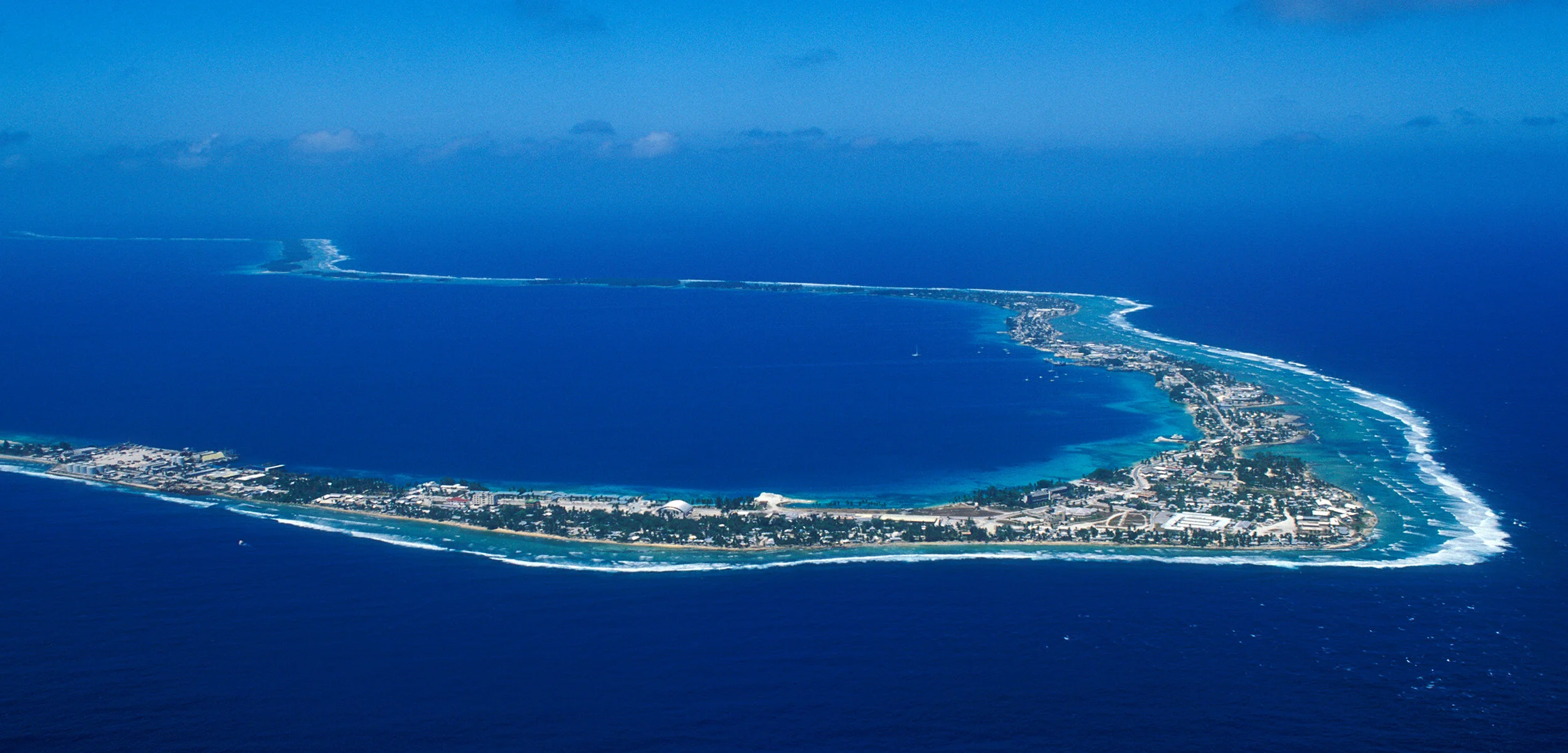
The narrowest capital you'll ever visit
Majuro Atoll is a ring of some 64 islets around a 114 km² lagoon, but the part you'll actually experience is a single developed strip in the east called DUD, where the ocean and the lagoon are sometimes only a few hundred meters apart. You can stand in the middle of the main road and see open Pacific on one side, calm lagoon on the other. It's an unusual, slightly vertiginous way to experience a capital city, and it's also the most direct possible illustration of why sea level rise here isn't an abstraction.
Majuro is not built for tourism the way Nadi or Papeete are. There's a genuine, small hotel scene, a real market, a handful of restaurants and one outstanding museum, and that's roughly it. What you're here for is context and access: the Alele Museum's stick charts and canoe collection, the WWII memorial sites on the road to Laura, and, if your budget and schedule allow, a jumping-off point for Arno Atoll or a Bikini Atoll liveaboard.
The honest complications
There's an active dengue fever outbreak in Majuro as of August 2026 (see the Safety chapter for details), so pack repellent and check current status before you travel. Restaurant options are genuinely limited, around two dozen total, leaning heavily on American fast food and Asian and Indian imports rather than a deep local dining scene. Card acceptance is patchy outside hotels, and English, while co-official and common in town, thins out fast once you leave the DUD strip. None of this makes Majuro not worth visiting; it makes it a place to plan for rather than wing.
One long road, two very different ends
Majuro Atoll runs about 37 kilometers from the urbanized DUD strip in the east to rural Laura in the west, all connected by a single main road. There is no neighbourhood-hopping the way you'd do in a normal city; where you base yourself is really a choice between "in the action" and "near the beach."
Delap
The southernmost of the three DUD islets, Delap holds much of the government administration and sits within easy walking or short-taxi distance of Uliga. It's a practical, unglamorous base with easy access to everything else in town.
Uliga
The middle islet of DUD and the commercial heart of Majuro: most of the hotels, the Tide Table Restaurant, and the main shopping strip sit here. For a first visit, this is the base that puts the market, the Alele Museum and the airport all within a short taxi ride.
Djarrit (Rita)
The northeastern end of DUD, largely residential and home to the country's largest public schools. Remnants of a US-built WWII airstrip are still visible here. Less to see for visitors, but worth knowing as the far end of the strip.
Laura
At the western tip of the atoll, about 50 kilometers by road from DUD, Laura is quieter, greener, and holds Majuro's best beach at the atoll's highest natural point. A Japanese WWII bunker sits near the beach, and the Peace Park Memorial, commemorating Pacific War dead, is on the drive out. Most visitors come for a day rather than staying here, since the hotel scene is entirely back in DUD.
A short list, because that's genuinely all there is
Majuro's hotel scene is small and mostly clustered in Uliga and Delap. There's no backpacker circuit or boutique-hotel wave here yet, so the choice comes down to a handful of established properties plus one private-island option out on the lagoon.
Hotel Robert Reimers in Uliga is Majuro's best-known address, from about $136 a night: a tropical garden setting with thatched, Marshallese-style bungalows, the premier shoreside rooms with lagoon views, and the on-site Tide Table Restaurant & Lounge serving as the closest thing Majuro has to a social hub, complete with a hand-carved wooden bar and an aquarium built into the room.
Out on the lagoon, Boutique Resort Bikendrik Island occupies a small private island about 40 minutes by boat from central Majuro, three minutes from the Kalalin Pass dive site, with a botanical-garden setting built around snorkeling rather than nightlife. It's the closest thing to a resort escape the country offers, and worth booking well ahead given how few rooms it has.
The Marshall Islands Resort is the other established option in town for travelers who want a more conventional hotel base in DUD; confirm current rates directly, as availability and pricing shift with the country's very small visitor volume.
Fish from the lagoon, everything else imported
Majuro has around two dozen restaurants total, leaning on American fast food and Asian and Indian imports alongside fresh reef and pelagic fish. It's not a food-destination city, but what's good here, the fish, is genuinely good, and the market beats every restaurant on price and freshness.
Tide Table Restaurant & Lounge
The most established dining room in Majuro: fresh seafood, traditional Marshallese dishes and international standards, with panoramic lagoon views through large windows, a hand-carved wooden bar and an in-room aquarium. Mexican night runs on Tuesdays, and it doubles as Majuro's closest thing to a proper evening-out spot.
Majuro Market
The cheapest and freshest food in the country by a wide margin over any restaurant: the day's catch, local produce and coconut goods, sold the way locals actually shop rather than the way visitors are served.
A museum, a beach, and a road lined with history
Majuro's sights are few but genuinely worthwhile, and most of them cluster at either end of the atoll: the Alele Museum and market in DUD, the beach and WWII memorials out at Laura.
Alele Museum and Public Library
Start here. The country's largest museum holds traditional outrigger canoes, stick charts used for wave-pattern navigation, tools and photographic archives spanning the German, Japanese and American administrations through the nuclear testing era. Give it an unhurried hour; almost nothing else in the country explains what you're looking at as clearly as this does.
Laura Beach and the road out
The roughly 50-kilometer drive from DUD to Laura passes the Peace Park Memorial, commemorating Pacific War dead, before reaching Laura Beach Park, the atoll's best swimming spot at its highest natural point. A Japanese WWII bunker sits near the beach itself, one of several wartime relics scattered across the island. Plan a half-day at minimum; the drive alone takes over an hour each way.
1918 Typhoon Monument
A memorial to the roughly 200 victims of one of Majuro's most devastating historical storms, a quieter but telling reminder that this atoll's relationship with the sea has always been dangerous, long before climate change entered the conversation.
Working-industry tours: Tobolar & the RRE Clam Farm
The Tobolar Copra Processing Plant runs guided tours showing coconut processed into copra oil, one of the country's oldest cash industries. The RRE Clam Farm offers guided visits to see giant clam aquaculture, a genuinely unusual stop most visitors never think to look for.
One, two or three days, planned around the one flight a week matters
Because the Island Hopper only runs Monday, Wednesday and Friday, your Majuro stay is effectively fixed to two, four or more days depending on which flights you catch. These routes assume you're building around that constraint.
- Morning
Alele Museum. An unhurried hour with the stick charts and canoe collection, then a walk through Uliga's commercial strip.
- Midday
Majuro Market. Fresh fish and local produce, the cheapest and best meal option in town.
- Afternoon
Laura Beach, if time allows. The drive out takes over an hour each way, so this only fits a full day; otherwise substitute a lagoon boat trip closer to DUD.
- Evening
Tide Table Restaurant. Dinner with lagoon views back at Hotel Robert Reimers.
- Day 1
DUD day: Alele Museum, the market, an afternoon walk along the lagoon side, dinner at the Tide Table.
- Day 2
Laura day: the full drive out, the Peace Park Memorial en route, the WWII bunker and Laura Beach itself, back to DUD by evening.
- Days 1-2
The two-day route above, at a gentler pace, adding the Tobolar Copra Plant or RRE Clam Farm tour.
- Day 3
Lagoon time or Arno. A lagoon boat trip, or, if you arranged it a few days ahead, a day trip out to Arno Atoll for the closest thing to an outer-island experience on a normal schedule.
One road, shared taxis, and a flight schedule you plan your whole trip around
Amata Kabua International Airport sits right on the DUD strip, so the trip from arrivals to your hotel in Uliga or Delap is a matter of minutes, not the hour-long transfers common elsewhere. United Airlines' Island Hopper (UA154/155) is the only air service, three times a week (Monday, Wednesday, Friday), about 4.5 hours from Honolulu; there's a $20 departure fee for travelers aged 13-59.
Within Majuro, shared taxis running the main road are the default: fixed, low fares, typically $1-5 depending on how far you're going, $8-10 between DUD and the airport. Car rental runs about $75 a day through independent local operators and requires a valid International Driving Permit; the country drives on the right. There's really only one road, so navigation is not the challenge, availability and schedule reliability are.
Best time to visit, SIM cards, and getting to Laura
December through April is the dry season and the easiest window for the Laura drive and any lagoon boat trip. May through November is wetter, and the wider region can see tropical depressions from April through December, though Majuro sees fewer full-strength typhoons than most of the Pacific given its near-equatorial location.
SIM & data: the National Telecommunications Authority (NTA) office in DUD sells prepaid SIM cards for about $15 (passport required), with data-and-minutes combo plans around $50 for 5GB over 30 days. Coverage is solid in DUD, thinner out toward Laura.
Getting to Laura: the roughly 50km drive takes over an hour each way by car or shared taxi along the atoll's single road. There's no dedicated shuttle; arrange transport through your hotel or negotiate a taxi for a half-day or full-day rate.
Not a budget Pacific city
Majuro runs well above the Pacific-island budget-travel average. There's no hostel scene to anchor a shoestring trip, and imported goods, everything beyond fish, coconut and local produce, carry a real markup from shipping costs to a remote atoll.
- Guesthouse-tier room
- Market meals, $5-10
- Shared taxis, $1-5
- Free: Laura Beach, museum entry is low-cost
- Hotel Robert Reimers, from $136/night
- Tide Table meals, $15-30/person
- Occasional car rental, ~$75/day
- Tobolar or clam farm tour
- Bikendrik Island private-island stay
- Rental car most days
- Boat charter to Arno or Laura
- Full restaurant dining
Genuinely low crime, two real things to plan around
Majuro carries the US State Department's Level 1 rating, exercise normal precautions, the safest tier there is. Violent crime against visitors is rare; the modest crime that does happen is mostly break-ins and theft from homes, hotel rooms and vehicles. Two things deserve real attention right now: an active dengue outbreak, and shared-taxi safety after dark.
The Ministry of Health and Human Services declared a dengue fever outbreak (DENV-1 strain) in Majuro on 15 August 2026, with confirmed cases concentrated in the 20-29 age group and no deaths reported as of late August. Use repellent, cover up at dawn and dusk, and if fever develops, use paracetamol rather than aspirin or NSAIDs and seek medical care. Separately, there have been reports of harassment involving shared taxi drivers or fellow passengers after dark; prefer a hotel-arranged taxi, ask to be dropped directly at your door, and avoid walking alone at night, particularly near nightclubs after about 9pm, since footpaths are limited even in central DUD.
Medical facilities are limited by international standards: Majuro Public Hospital is the country's main hospital, and serious issues typically require evacuation to Honolulu or the Philippines. Comprehensive travel insurance with medical evacuation coverage matters more here than in most destinations. Emergency number is 911; the hospital's emergency line is +692-625-4144, and the US Embassy Majuro's 24/7 line for US citizens is +692-247-4011.
Two directions out of DUD, one much further than the other
Majuro's location makes genuine day trips limited but real, and one further option turns a "day trip" into an entirely separate expedition.
Laura Beach
Technically within Majuro Atoll but far enough to feel like a real excursion: the Peace Park Memorial, a WWII bunker, and the atoll's best beach and highest point, all reachable by car or shared taxi along the single main road.
Arno Atoll
The closest outer atoll, with traditional village life and uncrowded reef well away from anything resembling a tourist trail. There's no standing ferry; arrange a boat charter through your hotel or a local operator, or catch Air Marshall Islands' irregular domestic service, and confirm it a few days out rather than booking far ahead.
Bikini Atoll
Worth naming here because Majuro is the departure point, even though it's the opposite of a day trip: a dedicated liveaboard charter, May-October season, roughly $11,000-14,000 per person, to dive the sunken Operation Crossroads fleet including the USS Saratoga at this UNESCO World Heritage site. If it's on your list, it needs its own separate booking timeline, often a year or more ahead.
Majuro FAQ
Is Majuro safe for tourists?
Yes, at a Level 1 exercise-normal-precautions rating from the US State Department. The main issues are avoiding shared taxis after dark, limited footpaths at night, and, as of August 2026, an active dengue outbreak, not violent crime against visitors.
How many days do I need in Majuro?
Two to three full days covers Majuro itself: the Alele Museum and DUD on one day, Laura Beach and the WWII sites on another. Add two more if you're combining it with a boat trip to Arno Atoll.
How much does Majuro cost per day?
Budget travelers should plan on $70-100 a day; a comfortable mid-range stay with a hotel like Robert Reimers and restaurant meals runs $150-220. Imported goods and the lack of a backpacker circuit keep prices well above the Pacific-island average.
When is the best time to visit Majuro?
December through April, the dry season, has the least rain and the most reliable conditions for a boat trip to Laura or Arno Atoll. May through November is wetter and more humid.
How do I get from the airport to central Majuro?
Amata Kabua International Airport sits right on the DUD strip. A shared or hotel taxi into Uliga or Delap costs around $8-10 and takes only a few minutes; most hotels can also arrange pickup.
What is the best area to stay in Majuro?
Uliga and Delap, the commercial heart of the DUD strip, for walkable access to the market, restaurants and the Alele Museum. Laura, at the far west end, suits travelers who want to be near the best beach and don't mind the 50km drive back into town.
Do I need to speak Marshallese in Majuro?
No. English is co-official and widely spoken in Majuro's hotels, government offices and tourism-facing businesses, though Marshallese is the everyday language, especially outside the capital.
Is there an active health alert in Majuro right now?
Yes. The Ministry of Health and Human Services declared a dengue fever outbreak (DENV-1) in Majuro on 15 August 2026, with cases concentrated in the 20-29 age group and no deaths reported as of late August. Use repellent and cover up at dawn and dusk.
Can I day-trip to Arno Atoll from Majuro?
It's possible but not guaranteed on a schedule. Arno is about 20km away with no standing ferry; you'll need to arrange a boat charter through your hotel or catch Air Marshall Islands' irregular domestic flight, confirmed a few days ahead rather than booked far in advance.
What Stays With You
Majuro doesn't perform for visitors, mostly because so few show up. What you get instead is unfiltered: a road so narrow the ocean and the lagoon are both in view at once, a museum case of navigation sticks that once carried people across open water with nothing else to guide them, a memorial to a war fought over an atoll most of the world had never heard of and a warning about the sea that keeps rising around it.
Go for the Alele Museum and the drive out to Laura, and leave with a clearer sense of a country that has survived colonization, nuclear testing and now climate change, and is still, deliberately, showing up to greet the very few people who make the trip.