
Panama
A canal that cut a continent in half. A colonial city that survived pirates, fires, and the 20th century and got UNESCO status for the trouble. Three hundred and sixty-five islands run by the people who've lived on them for centuries. And a jungle at the end of the road where the Americas run out of pavement.
What You're Actually Getting Into
Panama is the most logistically straightforward country in Central America for international travelers. It uses the US dollar, has a modern airport that is Copa Airlines' hub for the entire region, speaks a Spanish that is more influenced by North American English than any other in Central America, and has a capital city with actual working infrastructure: functional taxis, a metro system, reliable electricity, and an international hotel sector that understands what visitors expect. If you're coming from elsewhere in Central America, the relative comfort of Panama City will feel almost disorienting.
It is also genuinely one of the most geographically diverse countries in the Americas for its size. In a country slightly larger than South Carolina, you can watch a container ship the size of an apartment block slide through a narrow cut of rock and water that connects two oceans, sleep in a cabin on a Caribbean island run by the indigenous Guna people whose political autonomy has been recognized since 1938, hike through cloud forest where resplendent quetzals nest and the air genuinely smells different from anything at sea level, and stand at the end of the Pan-American Highway where the pavement runs into the Darién jungle and the Americas simply stop having a road.
Panama City itself is worth more time than most transit itineraries give it. Casco Viejo, the colonial peninsula district that was founded in 1673 and rebuilt after Henry Morgan's pirates burned the original city to the ground, is now a UNESCO World Heritage Site under active and thoughtful restoration. The juxtaposition of 17th-century Spanish colonial arcades with the glittering skyline of the banking district behind them is uniquely Panamanian and genuinely striking. The city has good food, good nightlife, and a cultural confidence that comes from being the financial center of the Americas between Miami and Bogotá.
Panama is significantly more expensive than Nicaragua or Guatemala — the dollar economy, the canal money, and the financial sector have pushed prices up relative to regional neighbors. It is still considerably cheaper than Costa Rica next door. The San Blas Islands managed by the Guna people have their own distinct cost structure and it is not comparable to resort Caribbean; it is raw, beautiful, and priced accordingly.
Panama at a Glance
A History Worth Knowing
Panama has been a crossroads since before the Europeans arrived. The Chibcha-speaking peoples of the isthmus — the Guna, Emberá, Wounaan, Ngäbe-Buglé, and others — had well-developed trade networks running north to Mesoamerica and south to the Andean civilizations long before Vasco Núñez de Balboa crossed the isthmus in 1513 and became the first European to see the Pacific Ocean from the Americas. He called it the South Sea. He was standing on a hill in Darién when he saw it, four years before he was executed by his successor Pedrarias Dávila on charges that conveniently removed a political rival.
The Spanish recognized the isthmus's strategic value immediately. Goods from the Pacific were transported overland across Panama to Portobelo on the Caribbean coast and shipped to Spain — the Camino Real, the Royal Road, was the artery of the Spanish empire's wealth for two centuries. Gold and silver from Peru and Mexico passed through Panama. Pirates like Henry Morgan, who sacked and burned the original Panama City in 1671, targeted the isthmus precisely because it concentrated so much of the empire's treasure in one narrow corridor. The rebuilt Panama City, relocated to its current site and given the nickname Casco Viejo (the old quarter), became one of the most fortified urban areas in the Caribbean.
Panama became independent from Spain as part of Gran Colombia in 1821, then became part of Colombia when Gran Colombia dissolved. The California Gold Rush in 1849 created a surge in demand for a trans-isthmian route — the Panama Railroad, completed in 1855, was the first transcontinental railroad in the Americas and briefly made Panama the most important transit point on earth. The French attempt to build a canal, led by Ferdinand de Lesseps of Suez fame, began in 1881 and collapsed in 1889 with catastrophic financial scandal, engineering failure, and approximately 22,000 deaths from yellow fever and malaria. The failure was so enormous it threatened to bring down the French Republic.
The United States, which acquired the French canal rights, helped engineer Panama's separation from Colombia in 1903. In an arrangement that was essentially a transaction — the US wanted a canal zone and a compliant new government — the US recognized Panama's independence within days of its declaration, and the Hay-Bunau-Varilla Treaty granted the US a 10-mile wide Canal Zone in perpetuity in exchange for $10 million and annual payments. Panama's first treaty was signed by Philippe Bunau-Varilla, a French canal promoter, rather than any Panamanian. The canal opened in 1914 after the US successfully eradicated yellow fever in the construction zone — a public health achievement that was both genuine and medically violent in its methods.
The Canal Zone — a strip of US-governed territory bisecting the country — remained a source of national humiliation and political tension for decades. The 1964 Flag Riots, in which Panamanian students attempted to fly the Panamanian flag alongside the American flag at Balboa High School in the Zone, resulted in the deaths of 21 Panamanians and 4 US soldiers. The riots accelerated the negotiations that led to the Torrijos-Carter Treaties of 1977, which set the timeline for full Panamanian control of the canal. General Omar Torrijos, the military ruler who negotiated the treaty, was killed in a plane crash in 1981 in circumstances that remain disputed. His successor Manuel Noriega, initially a CIA asset, became increasingly erratic and was eventually the target of Operation Just Cause — the December 1989 US invasion of Panama, the largest US military operation since Vietnam, which toppled Noriega and killed an estimated 3,000 Panamanian civilians in the El Chorrillo neighborhood adjacent to Noriega's military headquarters. El Chorrillo was largely destroyed in the operation. Noriega surrendered and was tried in the United States on drug trafficking charges.
The canal transferred to Panamanian control at noon on December 31, 1999. It was administered and expanded by Panama since that date and now includes the expanded New Panamax locks opened in 2016 that doubled the canal's capacity. Panama has been a stable democracy since the end of the Noriega period and has the highest GDP per capita in Central America by a significant margin, driven by the canal, the banking sector, and a services economy that handles container shipping logistics for the entire Americas.
First European view of the Pacific Ocean from the Americas. Balboa is executed four years later by his political successor.
The pirate sacks and burns the original Panama City. The city is rebuilt on its current site (Casco Viejo) two years later.
First transcontinental railroad in the Americas. The Gold Rush makes Panama the world's most important transit corridor for a decade.
Ferdinand de Lesseps' canal attempt collapses. ~22,000 dead. Financial scandal nearly destroys the French Republic.
US helps Panama separate from Colombia. The Hay-Bunau-Varilla Treaty grants the US a Canal Zone in perpetuity, signed by a Frenchman.
August 15. The SS Ancon makes the first official transit. The canal immediately transforms global shipping routes.
Set the timeline for Panamanian canal control. Torrijos dies in a plane crash in 1981. His successor Noriega will be toppled by US invasion in 1989.
US invades Panama. ~3,000 Panamanians killed. El Chorrillo destroyed. Noriega captured and tried in the US on drug charges.
December 31, noon. Full Panamanian control of the canal. The country has administered and expanded it since.
Top Destinations
Panama City is the entry and exit point for most visitors and deserves more than a transit night. The canal corridor from the city to Colón handles the engineering spectacle. East of Panama City on the Caribbean coast are the Guna Yala islands. West of Panama City across the country are Bocas del Toro on the Caribbean side and Boquete in the highlands. South toward Colombia is the Darién. These zones require separate planning and different logistics.
Casco Viejo
The UNESCO-listed historic quarter of Panama City occupies a small peninsula at the entrance to the Bay of Panama. Founded in 1673 after the destruction of the original city, it contains Spanish colonial buildings alongside French art nouveau townhouses from the canal construction era and Caribbean vernacular architecture in various states of restoration. The Plaza de la Independencia, the Metropolitan Cathedral, the ruins of the old Panama City's convent of Santo Domingo (whose flat arch was cited as evidence that the isthmus was earthquake-free — relevant to the canal route decision), and the Palacio Presidencial are all within walking distance. The neighborhood has excellent restaurants, bars, and rooftop terraces with views over the Pacific and the modern financial district skyline. Allow two full days.
Panama Canal
The Miraflores Locks visitor center, 10km from Panama City, is the main public viewing point for the canal. The upper observation deck puts you level with the ships as they rise and fall through the lock chambers — Panamax vessels (294m long, 32m wide) filling the lock to within 60cm on each side. Ships transit 24 hours a day. The visitor center has a good museum documenting the construction, the yellow fever eradication campaign, and the canal's mechanical operations. An alternative is the Gatún Locks on the Atlantic side, less visited but equally dramatic, and adjacent to the Gatún Dam which created the artificial Lake Gatún that forms the central portion of the transit.
Guna Yala (San Blas)
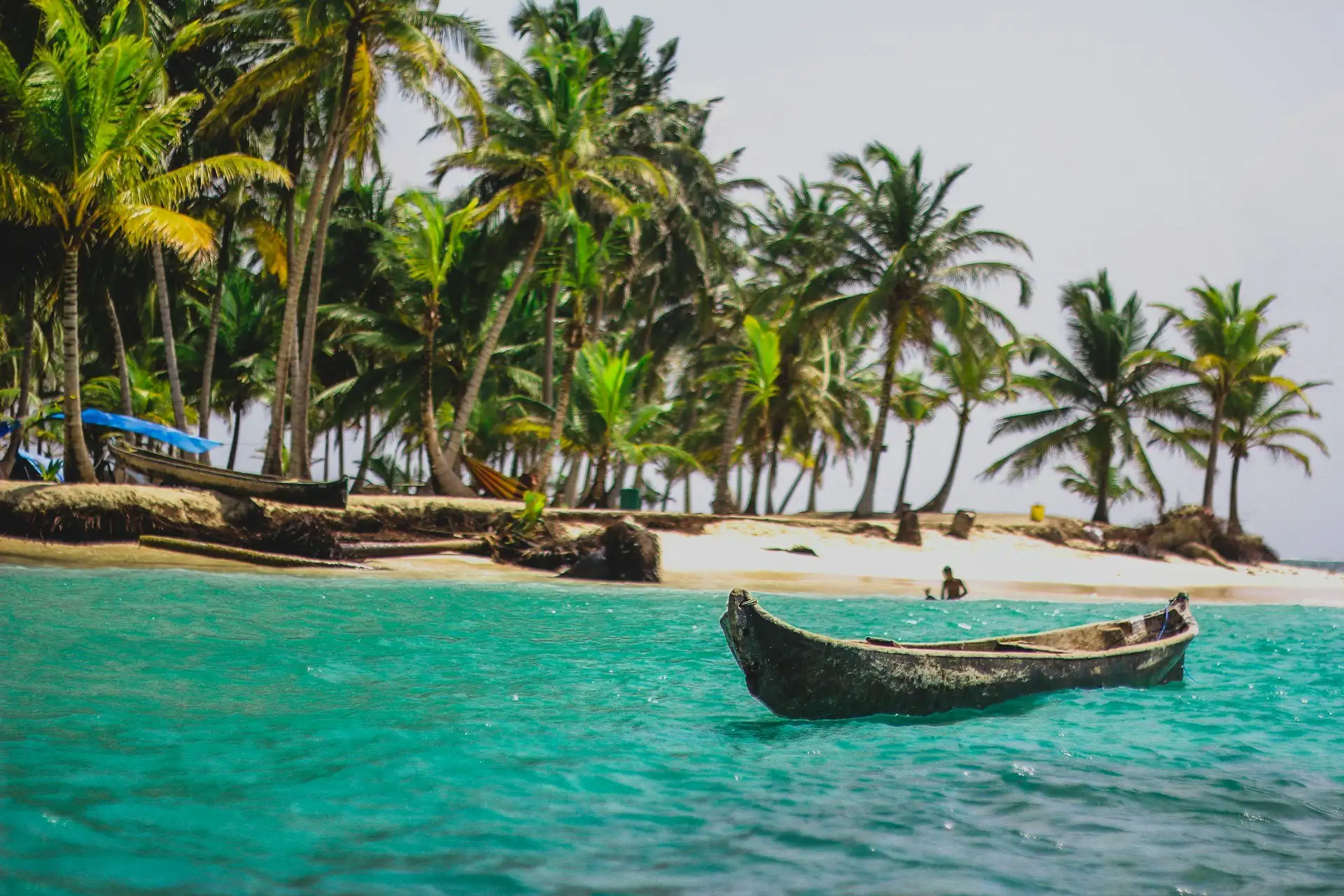
Three hundred and sixty-five islands — one for every day of the year, or so the Guna say — in the Caribbean off Panama's northeast coast. The Guna Nation has governed this territory autonomously since 1938 following an uprising against Panamanian government attempts to suppress their culture. Tourism is controlled by the Guna themselves: all accommodation is Guna-owned, boats are Guna-operated, and the mola textiles sold by women are made in the traditional reverse-appliqué technique. No large resorts, no corporate hotels. Stays are in thatched cabins with bucket showers. The water is the color blue has no business being. Accessible by a dramatic mountain road from Panama City (4WD recommended) or by domestic charter flight to small airstrips on several islands.
Bocas del Toro
An archipelago of six main islands and dozens of smaller cays off Panama's northwestern Caribbean coast, near the Costa Rican border. Bocas town on Isla Colón is the main hub: a Caribbean-vernacular painted wooden town built on stilts above the water with a backpacker and expat scene that ranges from excellent to exhausting depending on the season. The surrounding islands and cays have excellent snorkeling, accessible mangroves with sloths and red poison dart frogs, and the surf break at Isla Silverback. Bocas is a different world from Panama City — slower, wetter, more Caribbean.
Boquete & Chiriquí Highlands
The town of Boquete sits at 1,000 meters in the Chiriquí highlands near the volcanic peak of Barú (3,474m, the highest point in Panama). The surrounding cloud forest is among the most accessible resplendent quetzal habitat in Central America. The coffee grown on the slopes of Barú, particularly the geisha variety from the Hacienda La Esmeralda estate, has sold at auction for more per kilogram than almost any coffee in the world. Boquete has well-organized hiking, including the Quetzal Trail connecting Boquete to the Pacific side of the volcano, rafting on the Río Chiriquí, and ziplines for visitors who prefer adventure without mud.
Darién
The end of the Pan-American Highway. The Darién Gap — the 160km of roadless jungle between Panama and Colombia — is the only break in the road network connecting North and South America. It is also one of the most biodiverse and ecologically significant wilderness areas in Central America: jaguars, harpy eagles, Baird's tapir, and the indigenous Emberá and Wounaan communities who have lived there for centuries. The Darién is not safe for independent travel near the Colombian border due to armed groups. Organized day tours and multi-day expeditions to areas of Darién National Park away from the border zone are operated by specialist companies from Panama City.
Soberanía National Park & Pipeline Road
Minutes from Panama City, Soberanía National Park contains one of the most accessible pieces of intact tropical rainforest adjacent to any major city in the world. Pipeline Road, an unpaved track running through the park, is one of the most famous birding corridors in the world — the Christmas Bird Count record (386 species in 24 hours) was set here in 1985 and stands. Harpy eagles have been seen here. Sloths, toucans, and howler monkeys are common. The Smithsonian Tropical Research Institute on Barro Colorado Island in Gatún Lake offers visits by arrangement. Half a day from Panama City.
Panama Viejo
The ruins of the original Panama City, established in 1519 and burned by Henry Morgan in 1671, sit on the Pacific coast east of modern Panama City. The Cathedral Tower and the King's Bridge are the most visible remains. The ruins are a UNESCO World Heritage Site in conjunction with Casco Viejo. The contrast between the 500-year-old stone ruins in the foreground and the glass and steel towers of modern Panama City immediately behind them is one of the more arresting urban juxtapositions in the Americas. An hour visit in the morning, before the heat becomes oppressive.
Culture & Etiquette
Panama's national identity is more cosmopolitan and less regionally specific than most of its Central American neighbors. The canal construction brought workers from dozens of countries — Barbados, Jamaica, China, Greece, India, Colombia — and their descendants form communities that still maintain distinct cultural identities within Panamanian society. The Afro-Antillean community, descendants of Caribbean workers who built the canal, has its own cultural traditions, Creole English, and historical memory separate from both the mestizo majority and the indigenous nations.
The cultural landscape is therefore genuinely diverse in a way that is not merely demographic. The pollera, Panama's national dress — an elaborate white cotton garment with hand-embroidered flowers worn at festivals — comes from the Herrera and Los Santos provinces of the Azuero Peninsula where the most traditional mestizo Panamanian culture survives. The mola textiles of the Guna are internationally collected as art. The cumbia and tamborito music of the Azuero, and the reggaeton and dancehall coming out of Panama City's Afro-Panamanian neighborhoods, are all simultaneously Panamanian. The country is not tidy about cultural identity in a way that rewards curiosity.
The Guna have a complex relationship with photography. Some community members charge small fees for photographs and this is entirely their right. Others prefer not to be photographed at all. Ask before photographing and accept refusals without argument. The molas they create are intended for sale; the people are not props.
The Miraflores visitor center museum is genuinely excellent, but the canal means more when you understand the French failure that preceded it, the yellow fever campaign, and the political negotiations around Panamanian sovereignty. The hour you spend at the museum will be richer if you've read even a short history first.
In Guna Yala, alcohol regulations, accommodation rules, and community access are set by the Guna community leaders (sahilas). Follow them without negotiation. These are not guidelines — they are the rules of an autonomous indigenous territory that has been recognized since 1938.
Panama City taxis legally charge by distance with meters. Insist on the meter being used or agree on a price before getting in. Unregistered taxis are the most common source of tourist overcharging. Use Uber, InDriver, or pre-booked registered taxis from hotels for airport transfers.
The handmade reverse-appliqué mola panels sold by Guna women in Guna Yala and on the streets of Panama City are genuine textile art made by the same women selling them. Prices range from $15–150 depending on complexity. Buying direct from the maker means all the money reaches the artisan.
Casco Viejo is the restored, beautiful, safe tourist district. Panama City extends far beyond it in all directions with very different characters. Don't wander outside Casco Viejo without local knowledge of which neighborhoods are appropriate for visitors at which hours.
The Colombian border zone of the Darién has active armed groups — Colombian guerrilla remnants, paramilitary forces, and drug traffickers. Independently crossing the Darién Gap carries a genuine risk of death or kidnapping. Use specialist tour operators for any Darién excursion that goes near the southern third of the park.
Panama City tap water is generally safe to drink. Outside the capital, particularly in Bocas del Toro and Guna Yala, stick to bottled water. Ice in rural areas requires the usual Central American caution.
Bocas receives heavy rainfall for most of the year and the sea conditions can be rough. Some activities (island hopping tours, snorkeling) are weather-dependent. Build flexibility into any Bocas itinerary. This is not a complaint about Bocas — it is a Caribbean jungle archipelago and the rain is part of the deal.
The Panama hat (sombrero de paja toquilla) is made in Ecuador, specifically in Montecristi. It was associated with Panama because workers and diplomats visiting the canal construction bought them in Panama City. It is not made in Panama, by Panamanians, from Panamanian materials. Panamanians know this and find the confusion mildly annoying.
Mola Textiles
The mola is the central art form of Guna culture — panels of layered, hand-cut and hand-stitched fabric in complex geometric and figurative designs that are sewn onto the front and back of women's blouses. Each mola takes days to weeks to make. The designs are drawn from Guna cosmology, mythology, and observation of the natural world, and have evolved to include representational and abstract imagery of extraordinary sophistication. Molas are collected by international textile museums and sold at auction. The ones sold by Guna women for $15–30 in Guna Yala are the same tradition as the ones in museum collections.
Carnival in the Azuero
The Azuero Peninsula hosts Panama's most traditional Carnival in the towns of Las Tablas, Chitré, and Guararé in the four days before Ash Wednesday. Las Tablas Carnival, divided between the Calle Arriba and Calle Abajo factions competing with elaborate floats, fireworks, and elaborate pollera queens, is considered the finest in Central America outside of Trinidad and Barranquilla. The festival attracts Panamanians from across the country and is one of the most genuinely community-rooted celebrations on the isthmus.
Music: Tamborito to Reggaeton
Panama's musical range is extraordinary for its population size. The tamborito, a drum-and-call-response song tradition from the Azuero peninsula, is the national folk music and UNESCO Intangible Cultural Heritage. Salsa in Panama — influenced by Cuban and Colombian traditions and reshaped by the Afro-Panamanian musicians who played in the canal zone entertainment clubs — is a distinct regional style. And Panama City's Afro-Panamanian neighborhoods, particularly El Chorrillo and Calidonia, produced some of the earliest reggaeton in the Spanish-speaking world through artists like Nando Boom and El General in the late 1980s.
Bird Diversity
Panama has 978 recorded bird species — more than the United States and Canada combined. This is the result of the country functioning as a biological bridge between North and South America, creating a corridor through which species from both continents mix. The Christmas Bird Count record on Pipeline Road — 386 species in 24 hours — reflects the density possible here. Birding in Panama, from Soberanía National Park to Darién to Boquete's cloud forest, attracts serious ornithologists from around the world. Even non-birders find the density and color of bird life here striking.
Food & Drink
Panamanian food is the crossroads of the Americas on a plate. The national cooking is built on rice, beans, and corn in combinations that reflect Spanish, African, and indigenous contributions. But the canal brought workers from the Caribbean, from China, from India, and from dozens of other places, and their food traditions embedded in Panamanian cooking in ways that still show up. Chinatown (Barrio Chino) in Panama City has been operating since the 1850s. The Afro-Antillean community brought Caribbean cooking traditions including rice and peas cooked in coconut milk. The result is a food culture more varied than most Central American nations.
Ceviche de Corvina
Sea bass (corvina) marinated in lime juice with onion, ají chombo (Panama's scotch bonnet equivalent), cilantro, and salt — Panama's national ceviche. Served cold in small cups from street carts and cevicherías throughout the country. The lime-cooked texture of freshly prepared corvina, which has a firmer, cleaner flavor than the tilapia used in some versions, is genuinely excellent. A portion costs $2–4. Eat it from a cart near the fish market on Cinta Costera on a Saturday morning.
Sancocho de Gallina
Panama's national dish. A chicken and root vegetable stew that every Panamanian considers their grandmother's the definitive version. Slow-cooked with yuca, otoe (taro), ñame (yam), corn, and the herb culantro (not cilantro — different leaf, stronger flavor). The broth is clear and deeply flavored, the chicken falls from the bone. Eaten for Sunday lunch, at celebrations, and at Carnival. Available at fondas and restaurants throughout the country from about 11am until it runs out.
Hojaldres & Carimañolas
Breakfast in Panama. Hojaldres are fried flour puffs — light, slightly chewy, eaten plain or with natilla (sour cream). Carimañolas are yuca fritters stuffed with seasoned ground beef or cheese, fried crisp. Both appear at breakfast counters from 6am throughout the country and cost $0.50–1 each. The combination of hojaldres, carimañolas, and a cup of strong Panamanian coffee at a market fonda is the best $3 you will spend in the country.
Guna Yala Seafood
The seafood at island homestays in Guna Yala is the freshest in Panama: lobster, crab, and fish pulled from the reef that morning and cooked simply over wood fire. The Guna cooking itself uses coconut milk in rice and in soups. Ulu (oloput) — a traditional Guna corn-based drink — is served at community events. The lobster prices in Guna Yala are lower than anywhere else in Panama and the quality is higher. Order it for every meal. The season closes for lobster from March to July to allow the population to recover.
Boquete Geisha Coffee
Hacienda La Esmeralda's geisha variety coffee from the slopes of Barú volcano holds the record for the highest price paid at the Best of Panama auction — over $1,000 per pound at peak. The flavor profile is floral, bergamot-inflected, and lighter-bodied than most Central American coffees. Estate tours in Boquete let you taste the coffee at the farm and buy directly for significantly less than international prices. A bag of Boquete geisha at the farm costs $20–40. At a London specialty shop it costs four times that.
Seco Herrerano
The national spirit of Panama. Seco is a sugar cane spirit produced primarily in the Herrera province of the Azuero Peninsula. Clear, slightly sweet, and potent — think of it as the rum that never got the marketing budget. Seco con leche (seco with milk — don't judge it until you've tried it) is the traditional Azuero way of drinking it. In Panama City, seco sours and seco-based cocktails have become fashionable in the better bars of Casco Viejo. A bottle costs $5–10 at a grocery store. Take two home.
When to Go
Panama has two climate zones with different seasonal patterns. The Pacific side (Panama City, the Azuero Peninsula, Boquete) has a clear dry season from December to April. The Caribbean side (Bocas del Toro, Guna Yala, Colón) is wet year-round, with the least rain between September and October and from February to March. If you're combining both sides, January to March is the overlap window with the best conditions across the country.
Pacific Dry Season
Dec – AprThe best conditions for Panama City, the canal, Boquete hiking, and Azuero Peninsula cultural events. January through March has Carnival in the Azuero and is the most comfortable period across the Pacific side. Guna Yala conditions are also generally good during these months. Book accommodation ahead — this is peak season and a small country.
Caribbean Calm Windows
Sep–Oct, Feb–MarIf Bocas del Toro or Guna Yala are primary goals, these are the windows with lowest rainfall on the Caribbean side. September and October are the driest months in Bocas. The trade-off is that this overlaps with the Pacific wet season, so combining both sides requires flexibility.
Shoulder Wet
May, NovTransitional months. Pacific side sees some rain but mornings are usually clear. Prices drop, fewer tourists, and the canal is just as active. Good for budget-conscious visitors who can be flexible about afternoon activities.
Pacific Wet Season
Jun – AugHeavy afternoon rains on the Pacific side. Canal visits and Panama City are still fine — the rain is afternoon rather than all-day. Boquete hiking trails become muddy. Beaches on the Pacific coast are rougher. The canal operates year-round. This is not a reason to avoid Panama City; it is a reason to reconsider a Darién or Boquete hiking focus.
Trip Planning
Ten days is the minimum for Panama to feel complete. Less and you'll do Panama City and either Bocas or Boquete or Guna Yala — all excellent, but only one face of the country. Two weeks lets you do Panama City, Guna Yala, and either Bocas del Toro or Boquete comfortably. Three weeks covers the full itinerary with the Darién added for the serious traveler.
Panama is not in the CA-4 agreement, which simplifies visa planning significantly. Your 180-day allowance is exclusively Panamanian. The dollar economy eliminates currency exchange — you use the same notes you carry from home if you're American, and withdrawing dollars from ATMs is straightforward for everyone else.
Panama City
Two full days in Panama City. Day one: Casco Viejo on foot — all four main plazas, the Cathedral, the roof of the Palacio Municipal for the view. Panama Viejo ruins in the late afternoon, then sunset on the Cinta Costera. Day two: Miraflores Locks for the canal in the morning (arrive before 9am for the first ships), Pipeline Road at Soberanía for birding in the afternoon. Day three: Mercado de Mariscos for ceviche breakfast, Barrio Chino, the Ancon hill for the city view with a harpy eagle nest nearby.
Guna Yala
Early morning drive or charter flight to Guna Yala. Four nights on the islands. Swimming, snorkeling, watching the sunset from an island that is genuinely flat and surrounded by water in every direction. Buy molas directly from the women making them. Eat lobster every meal while it's in season. Return to Panama City for the flight home.
Panama City
Three days: Casco Viejo, the canal, Pipeline Road birding, Panama Viejo, the Mercado de Mariscos, the Metropolitan Nature Park (rainforest inside the city limits — 265 bird species recorded within the park), and an evening at the Casco Viejo restaurants.
Guna Yala
Four days in the islands. Include a snorkeling day at the outer reef where the coral is undisturbed and the fish density is extraordinary. Visit a Guna community meeting (sahila-arranged) to understand how the autonomous governance works.
Bocas del Toro
Fly from Panama City to Bocas del Toro (1 hour). Four days: a snorkel tour of the outer islands and the Zapatilla Cays marine park on day one (the coral gardens here are excellent), Playa Bluff's powerful Pacific surf on day two, the Ngäbe community of Salt Creek on day three, and a full day doing nothing in a hammock above the water on day four.
Boquete (Optional)
Fly from Bocas to David, transfer to Boquete (45 min). Three days: the Quetzal Trail for the bird, a coffee estate tour, and the Barú volcano hike (requires a pre-dawn start and is serious — do it on day two after acclimatizing to altitude). Return to Panama City for the flight.
Panama City Deep
Four days: all the Panama City essentials plus the Smithsonian Tropical Research Institute on Barro Colorado Island (arrange in advance), a full-day birding tour on Pipeline Road with an expert guide, and one evening on the canal itself — the partial transit tours from Gamboa are expensive but put you on the water.
Guna Yala
Five days in the islands. Island-hop between different communities. Buy molas slowly, negotiating genuinely rather than rushing. One day kayaking between the smaller cays. Learn a few words of Dulegaya (Guna language) — they are received with extraordinary warmth.
Bocas del Toro
Four days: Zapatilla Cays marine park, the chocolate farm tour at Finca Tranquilo (single-origin cacao grown by Ngäbe farmers, chocolate made on-site), and one full day doing absolutely nothing on a deserted beach that the boat drops you at and returns for at 4pm.
Boquete & Chiriquí
Four days: Barú volcano summit (3,474m, both Pacific and Caribbean visible on clear days), the Quetzal Trail, a full-day white-water rafting on the Río Chiriquí Viejo, and an estate dinner at one of the coffee farms that also does accommodation.
Darién (Specialist)
Four days with a specialist Darién operator from Panama City. The village of La Palma, the river systems of the Mogue watershed, and an Emberá community visit. Not the Colombian border zone — the accessible northern Darién where the national park is intact and community-managed ecotourism operates.
Vaccinations
No mandatory vaccinations except yellow fever if arriving from an endemic country. Recommended: Hepatitis A, Hepatitis B, Typhoid, and up-to-date routine vaccines. Malaria prophylaxis recommended for the Darién region. Dengue is present throughout Panama; mosquito protection is advisable.
Full vaccine info →Dollar Economy
Panama uses the US dollar (called the balboa locally) as its currency. US dollar bills are used everywhere; Panama mints its own coins in the same dimensions as US coins. No currency exchange is needed for US visitors. ATMs dispense dollars throughout the country. Credit cards are widely accepted in Panama City and tourist areas.
Connectivity
Cable & Wireless and Claro are the main providers. Excellent coverage in Panama City, along the canal corridor, in Bocas del Toro town, and in Boquete. Very limited in Guna Yala — most islands have no cell coverage. This is intentional on the part of the Guna. Download offline maps and any needed information before leaving the mainland.
Get a Panama eSIM →Guna Yala Cash
There are no ATMs in Guna Yala. No card payments. Every transaction is cash. Calculate your entire Guna Yala budget — accommodation, food, boat transport, mola purchases, day tours — and bring it all in dollars before you leave Panama City. The standard advice is to add 30% for unexpected expenses. Run out of cash and you leave early.
Travel Insurance
Strongly recommended. Panama City has good private hospitals. Bocas del Toro and Guna Yala require medical evacuation for serious incidents. The Darién requires evacuation insurance above what standard policies cover. Include adventure activity coverage if hiking Barú or doing white-water rafting.
Darién Rules
Do not approach the Colombian border area of the Darién independently. Use only established specialist operators with current in-country knowledge. The area between the Darién community villages and the Colombian border is not safe. The northern Darién (Darién National Park access via La Palma and the Mogue area) is accessible with specialist operators and has experienced guides.
Transport in Panama
Panama has significantly better transport infrastructure than any of its Central American neighbors. Panama City has a functioning metro (the first in Central America, opened in 2014), Uber and InDriver both operate, registered taxis are metered or have agreed-rate routes, and intercity bus connections to David (Boquete gateway), Colón (Atlantic canal terminus), and the Azuero Peninsula run on fixed schedules from Albrook terminal. Domestic flights on Air Panama connect to Bocas del Toro, David, and the Guna Yala airstrips in under an hour.
Tocumen International
Regional hubTocumen International Airport (PTY) is the Copa Airlines hub and one of the most connected airports in Latin America. Direct flights from North America, Europe, and throughout South America. The airport is 35km from Panama City — allow 45–60 minutes in normal traffic, 90+ in rush hour. Use Uber or pre-booked transfer rather than unmarked taxis.
Domestic Flights
$60–150 per routeAir Panama connects Panama City to Bocas del Toro (1 hour), David (1 hour, gateway for Boquete), and the Guna Yala airstrips on El Porvenir, Achutupo, and several other islands. Small propeller aircraft, limited cargo space, and schedules that depend on weather. Book in advance for peak season. Baggage limits are strict.
Panama City Metro
$0.35 per rideTwo lines covering the main east-west and north-south corridors of Panama City. Fast, air-conditioned, reliable, and an extraordinary bargain. Not useful for Casco Viejo (not on the metro) but practical for getting from the Albrook terminal to Miraflores or between the financial district and the university area. Use the Metro Card (tarjeta) for multiple journeys.
Uber & InDriver
Cheaper than taxisBoth operate in Panama City and are significantly cheaper and more reliable than street taxis for airport runs and long city journeys. Uber is the main platform. InDriver allows fare negotiation. Both require smartphone and data. Use these rather than unmarked street taxis for all Panama City airport transfers.
Albrook Terminal Buses
$5–18 per routeAlbrook Gran Terminal de Transporte is the main intercity bus hub, adjacent to the domestic airport. Air-conditioned coaches to David ($18, 6 hours), Chitre ($8, 4 hours), Colón ($4, 1.5 hours), and all major cities. Significantly better than Guatemala or Nicaragua's chicken buses — comfortable, scheduled, and reliable.
Guna Yala Pangas
$5–25 per hopSmall motorized boats connect the Guna Yala islands. Your accommodation arranges all inter-island transport. The boats are open and splash is inevitable. Keep electronics in dry bags. The crossing from the mainland coastal road end to the first island is typically included in Guna Yala accommodation packages.
Accommodation in Panama
Panama's accommodation ranges from Guna-owned thatched cabins in Guna Yala (no electricity, bucket showers, hammocks, extraordinary setting) to the Casco Viejo boutique hotels in restored colonial buildings to international chain hotels in the financial district. The most distinctive accommodation in Panama is not the international hotels — it is at the extremes of authenticity: the Guna island cabins and the small Boquete coffee estate lodges.
Casco Viejo Boutique
$100–300/nightThe most appealing accommodation in Panama City. Restored colonial buildings on the narrow streets of the UNESCO district, with rooftop terraces, interior courtyards, and staff who know the neighbourhood. American Trade Hotel (the most famous, most expensive, and most beautiful), Casa del Horno, and Tantalo are the key properties. Book early for dry season.
Guna Island Cabin
$50–100/night (all meals)Guna-owned thatched cabins over the water or on beach islands, almost always with meals included. No electricity (some have solar for phone charging). Hammocks. The sound of the Caribbean through palm-thatched walls. The meals are simple and fresh. The experience is irreplaceable. Book through Guna-owned operators or community tourism websites — avoid non-Guna intermediaries.
Coffee Estate Lodge (Boquete)
$80–200/nightSeveral Boquete coffee estates offer accommodation on the farm, including coffee tasting, highland hiking, and meals using estate-grown produce. Finca Lerida and Tinamou Cottage are consistently well-regarded. The morning cloud forest walk through the farm with the coffee bushes fruiting in the fog is the correct way to start a day at altitude.
Bocas del Toro Overwater
$40–150/nightBocas has a good range from budget backpacker hostels to overwater bungalows built on stilts above the lagoon. Hacienda del Toro and La Loma Jungle Lodge (in the rainforest interior of Isla Bastimentos) are the most distinctive options. For budget: the hostels and guesthouses in Bocas town are functional and social.
Budget Planning
Panama is significantly more expensive than Nicaragua or Guatemala but cheaper than Costa Rica. The dollar economy means prices are transparent and comparable to North American references. Budget travelers can manage but Panama rewards mid-range budgets more than other Central American countries — the boutique hotels in Casco Viejo are worth the premium, the canal transit tour is worth the $165, and the geisha coffee is worth the $25 a bag. Panama punishes budget-only approaches by denying access to some of the country's best experiences.
- Hostel or basic guesthouse
- Mercado ceviche and fondas
- Metro and bus for city transport
- Free canal viewing from Miraflores
- Beer at local bars ($2–3)
- Casco Viejo boutique or guesthouse
- Guna Yala all-in island package
- Bocas del Toro island tours
- Boquete coffee estate stay
- Canal transit partial tour
- American Trade Hotel or equivalent
- Fine dining in Casco Viejo
- Private guide for canal and wildlife
- Full canal transit tour
- Hacienda La Esmeralda geisha tasting
Quick Reference Prices
Visa & Entry
Panama is one of the most generous visa regimes in the Americas for Western passport holders. Citizens of the United States, Canada, United Kingdom, all EU member states, Australia, New Zealand, and most other Western nations enter visa-free for up to 180 days. This is six months — considerably more generous than most Caribbean destinations and more than any other Central American country. Panama is not part of the CA-4 agreement, so this allowance is exclusively Panamanian and does not count against time spent in Guatemala, Honduras, El Salvador, or Nicaragua.
You need a valid passport, a return or onward ticket, and proof of sufficient funds or accommodation. The Tocumen airport immigration process is efficient by regional standards. Your passport is scanned at entry and the 180-day stamp is applied automatically for qualifying nationalities.
Most Western passport holders enter without a visa for up to 180 days. Not part of CA-4 — the allowance is exclusively Panamanian. One of the most generous tourist visa regimes in the Americas.
Family Travel & Pets
Panama is one of the best family destinations in Central America. The dollar economy eliminates currency confusion, the English proficiency in Panama City is higher than anywhere else in the region, the canal is an immediately comprehensible and genuinely impressive spectacle for children of almost any age, and the country has a diverse enough set of experiences that different family members will find their interest engaged.
The main family travel consideration is logistics: Guna Yala requires significant advance preparation and is best for older children (10+) who can handle boats, basic facilities, and the absence of electricity. Bocas del Toro is more family-accessible. Boquete works well for active families with children old enough for moderate hiking.
Panama Canal
The Miraflores Locks visitor center is one of the most accessible major infrastructure experiences for children anywhere in the world. The scale of the ships, the mechanics of the locks, and the museum explaining how it was built provide the kind of genuine awe that most children respond to immediately. Engineers in the making particularly love it. Allow a full morning and buy the full museum ticket rather than just the viewing deck.
Rainforest Wildlife
Soberanía National Park's Pipeline Road, 30 minutes from Panama City, is one of the most accessible wildlife experiences in the Americas. Toucans, sloths, howler monkeys, and over 500 bird species are regularly seen within 5km of the road entrance. A half-day birding walk with a guide works well for children old enough to walk for two to three hours. The density of wildlife — animals visible rather than theoretical — produces genuine reactions from children who've grown up in cities.
Guna Yala (Older Kids)
For families with children 10 and above who are comfortable with boats and basic facilities, Guna Yala provides an experience of autonomous indigenous governance, traditional textile making, and Caribbean island life that no resort can replicate. The Guna communities are welcoming to families who approach with genuine respect. Children tend to make friends across the language barrier quickly. Bring playing cards.
Bocas del Toro Wildlife
The mangrove channels around Bocas del Toro have three-toed sloths moving slowly through the branches above your boat, red poison dart frogs on the forest floor around Playa Bluff, and the dolphin pods that feed in the channels between islands. A guided snorkel tour at the Zapatilla Cays shows children reef fish in quantities and proximity that genuinely astonish. The archipelago works well for families with children of most ages.
Coffee Farm (Curious Kids)
The coffee farm tours around Boquete explain food origin in entirely concrete, sensory terms: you pick the cherry, see the pulping machine, watch the drying beds, smell the roasting, and taste the result within five minutes. For children who have never thought about where coffee comes from beyond the jar or pod, it's a genuinely useful revelation. The altitude (1,000m in Boquete) and the mountain scenery are effective change-of-pace from coast activities.
Casco Viejo History
Panama Viejo ruins — the 500-year-old stone remains of the original city burned by pirates — immediately communicate history to children in a way that abstract descriptions cannot. Standing next to a 16th-century cathedral tower while a modern skyline looms behind it produces the kind of temporal disorientation that makes children ask real questions about the past. The Casco Viejo streets are walkable, safe, and interesting at the visual level that works for children with short attention spans.
Traveling with Pets
Bringing pets to Panama requires a veterinary health certificate issued within 7 days of travel, proof of current rabies vaccination, and authorization from Panama's MIDA (Ministerio de Desarrollo Agropecuario). All documentation must be authenticated by a Panamanian consulate before departure. Dogs additionally require vaccination against distemper, parvovirus, and hepatitis.
In practical terms, Panama City has a functioning pet-friendly urban culture — many apartment-dwellers have dogs and the Cinta Costera seafront promenade is regularly used for dog walking. However, the Guna Yala islands, Bocas del Toro archipelago, and jungle areas like Soberanía and Darién are not appropriate environments for domestic animals. For a trip that includes any significant nature travel, leaving pets at home is the practical approach.
Safety in Panama
Panama is one of the safer countries in Central America for tourists, though the same zone-based nuance applies: Panama City has neighborhoods that are genuinely dangerous outside the tourist districts, and the Darién border zone has risks that are in a different category from street crime. The main tourist areas — Casco Viejo, the canal zone, Bocas del Toro, Boquete, and Guna Yala — are broadly safe with standard precautions.
Casco Viejo & Tourist Areas
Casco Viejo is well-policed and the tourist infrastructure is well-established. Petty theft is the main risk — don't leave valuables visible in cars, keep phones in pockets in crowded areas, and use Uber or registered taxis after dark rather than walking unfamiliar routes.
Bocas del Toro & Boquete
Both tourist areas are broadly safe. Bocas town has some nightlife incidents in season — standard evening precautions apply. Boquete is very low crime. The islands of Bocas del Toro are safe; use sunscreen because the UV at equatorial latitude is brutal even on cloudy days.
Panama City Urban Areas
Outside Casco Viejo, Miraflores, and the financial district, Panama City has neighborhoods with significant crime. El Chorrillo (adjacent to Casco Viejo, destroyed in 1989 and still impoverished) and the Curundú area are not places to walk without local knowledge. Use Uber between destinations rather than walking unfamiliar routes.
Darién Border Zone
The Colombian border area of the Darién has armed groups (guerrilla remnants, paramilitaries, drug traffickers) that make independent travel genuinely dangerous. People have been killed and kidnapped in this area. Use only specialist tour operators for any Darién excursion and avoid the southern third of the national park entirely without professional security guidance.
Guna Yala Safety
Guna Yala is safe — the autonomous governance and community structure create accountability that makes it very low crime for visitors. The safety considerations are natural rather than human: ocean conditions can be rough, the panga crossings are in open water, and dehydration and sun exposure are real risks. Follow the community's rules about which areas of reef and sea are safe to swim in.
Solo Women
Panama is one of the more comfortable Central American countries for solo female travelers, particularly in Panama City and Boquete. Street harassment is present but less aggressive than in some regional neighbors. Use registered transport after dark, stay in established guesthouses, and trust your instincts. The canal zone and Guna Yala are both comfortable for solo women.
Emergency Information
Your Embassy in Panama City
Most embassies are in the Clayton and Bella Vista districts of Panama City.
Book Your Panama Trip
Everything in one place. Panama rewards preparation.
Where the Americas Meet
Stand at the end of the Pan-American Highway in Yaviza, Darién Province, where the pavement stops and the jungle begins. Behind you: 48,000 kilometers of road running unbroken through North and South America, through every biome and climate zone, past every significant city on two continents. Ahead: 160 kilometers of roadless jungle, then Colombia, then the road starts again and runs all the way to Tierra del Fuego.
Panama is the place where the Americas chose to be connected and chose to remain apart. The canal connected two oceans and transformed global trade. The Darién keeps two continents separated. The Guna Nation chose, in 1938, to remain politically autonomous within a country that had theoretically sovereignty over them, and kept that choice. The canal workers brought here from dozens of countries in the early 1900s stayed and made something new from their mixing. The French failed here spectacularly and the Americans succeeded by understanding yellow fever in ways the French had refused to believe.
The Guna word for their homeland and their people is Abya Yala — "land of vital blood," their name for the entire American continent before anyone else named it. When the Guna sold molas on the islands or fought for their autonomy in the 1920s, they were doing so in Abya Yala, which is the name that was here first. That continuity — from the pre-Columbian to the contemporary, across five centuries of colonialism and canal and invasion and recovery — is what Panama carries in its small, remarkable, crossroads body.