
What You're Actually Getting Into
Dominica gets confused with the Dominican Republic constantly, and the two could hardly be more different. This is a single mountainous island of about 751 square kilometers between the French territories of Guadeloupe and Martinique, roughly 60 percent covered in rainforest, with more rivers (365, by the traditional count of one for every day of the year) than almost anywhere its size on Earth. It calls itself the Nature Island, and unlike most tourism-board slogans, this one undersells it: nine active or dormant volcanoes, a boiling lake, a UNESCO World Heritage national park, and offshore waters where sperm whales live year-round rather than passing through.
What Dominica does not have is the infrastructure that makes its neighbors easy: no direct long-haul flights from the US or Europe, a runway too short for most jets, and a coastline that's mostly volcanic black or grey sand rather than the white beaches of Antigua or the Bahamas. That absence of easy access is precisely why the rainforest, the rivers and the reefs are still largely intact. This is a trip for people who want to hike to a fumarole lake with a licensed guide, snorkel where the sea floor fizzes with volcanic gas, and watch a whale surface a few hundred meters offshore, not for people who want a swim-up bar.
The honest complications
Getting to Dominica takes real planning: you will connect through San Juan, Antigua, Barbados, St. Maarten, Guadeloupe or Martinique on a small turboprop, and bad weather can delay those regional flights. Roads outside the main routes are steep, narrow and winding, cruise-ship days can crowd Roseau and the busiest trailheads, and the island's best-known hike, Boiling Lake, legally requires a paid guide and 6 to 8 hours of strenuous walking. Hurricane season runs June to November, and Dominica took a direct, catastrophic hit from Category 5 Hurricane Maria in September 2017; the island has rebuilt substantially since, but this history is worth knowing rather than glossing over.
A History Worth Knowing
Dominica is the only island in the Caribbean where the Kalinago people, whom Europeans called Caribs and after whom the entire Caribbean is named, still hold their own territory and trace unbroken descent from the region's original inhabitants. That fact alone sets the island's history apart from most of its neighbors, and it starts long before any European ship arrived.
- c. 400–1200 AD
Early settlement. Arawak-speaking peoples arrive from South America; the Kalinago follow by around 1200 AD and become the dominant population.
- 1493
European sighting. Christopher Columbus sights the island on a Sunday and names it for the Latin "dies Dominica." Kalinago resistance keeps European settlement out for nearly two centuries afterward.
- 1660
Neutral territory. Britain and France formally recognize Dominica as neutral ground reserved for the Kalinago, an unusual acknowledgment of Indigenous sovereignty for the era.
- 1763
Ceded to Britain. The Treaty of Paris hands Dominica to Britain after decades of French and British contest; French place names and a French-based Creole patois persist from the earlier period regardless.
- 1903
Kalinago Territory established. British colonial authorities formally set aside a reserve on the rugged Atlantic coast, still home to an estimated 3,000-plus Kalinago people today.
- 1978
Independence. Dominica becomes a republic within the Commonwealth on 3 November.
- 1979 & 2017
Hurricanes David and Maria. Category 5 storms 38 years apart devastate the island; Maria alone caused an estimated $1.3 billion in damage and killed 65 people, damaging up to 98 percent of buildings.
Read the full history: Kalinago resistance, the colonial tug-of-war, and rebuilding after Maria
The Kalinago earned a reputation among early European colonizers as unusually effective at defending their territory, and Dominica's rugged, volcanic interior gave them terrain the French and British struggled to penetrate. That resistance is why the island became a refuge for Indigenous people fleeing conquest elsewhere in the region, and why the 1660 Anglo-French neutrality agreement, however imperfectly honored afterward, happened here specifically.
France established the first permanent settlements in the 18th century, and the island changed hands between France and Britain more than once during the Seven Years' War and its aftermath before the 1763 Treaty of Paris formally ceded it to Britain; France briefly recaptured it in 1778 before Britain regained control by the 1783 Treaty of Versailles. The French period is why Dominica's Creole patois, Kwéyòl, and many place names, Soufrière and Grand Bay among them, are French in origin even though English has been the colonial and official language since. Plantation slavery followed the usual brutal Caribbean pattern until emancipation in 1834, and the Kalinago Territory, formalized in 1903, is the direct institutional descendant of the 1660 neutrality arrangement.
The hurricanes. Hurricane David struck in 1979, shortly after independence, destroying much of Roseau including the fort that is today the Fort Young Hotel. Hurricane Maria followed in September 2017 as a Category 5 storm with winds exceeding 260 km/h, killing 65 people and damaging or destroying nearly every building on the island; roughly 40 percent of hotel rooms were lost and visitor arrivals collapsed by more than 88 percent in the first half of 2018. Recovery has been steady rather than fast: tourism officials reported strong gains through 2025, tied to continued investment in access ports, accommodation and marketing, alongside an ongoing, government-led push toward "climate resilience" in how the island rebuilds.
Top Destinations
Dominica divides into four practical zones: the capital and south, the central UNESCO national park, the north around Portsmouth, and the Kalinago Territory on the Atlantic coast. The island is small (about 47km north to south), but the roads are slow and mountainous, so plan by driving time, not straight-line distance.
Roseau, the small capital
Roseau is compact, low-rise and busy with cruise-ship traffic several mornings a week: the Old Market, the 40-acre Botanical Gardens with their aviaries of native parrots, and the waterfront Fort Young, built in 1770 and now a hotel. It's the practical base for most first-time visitors, and the launch point for the south's two signature experiences.
Scotts Head & Soufrière
At the island's southern tip, the Soufrière-Scotts Head Marine Reserve sits inside a submerged volcanic crater: warm water still bubbles up from the sea floor, and the reserve is the base for both diving and Dominica's best-known experience, boat trips to see the resident sperm whales that live in these waters year-round, the only place on Earth where that's true.
Boiling Lake & the Valley of Desolation
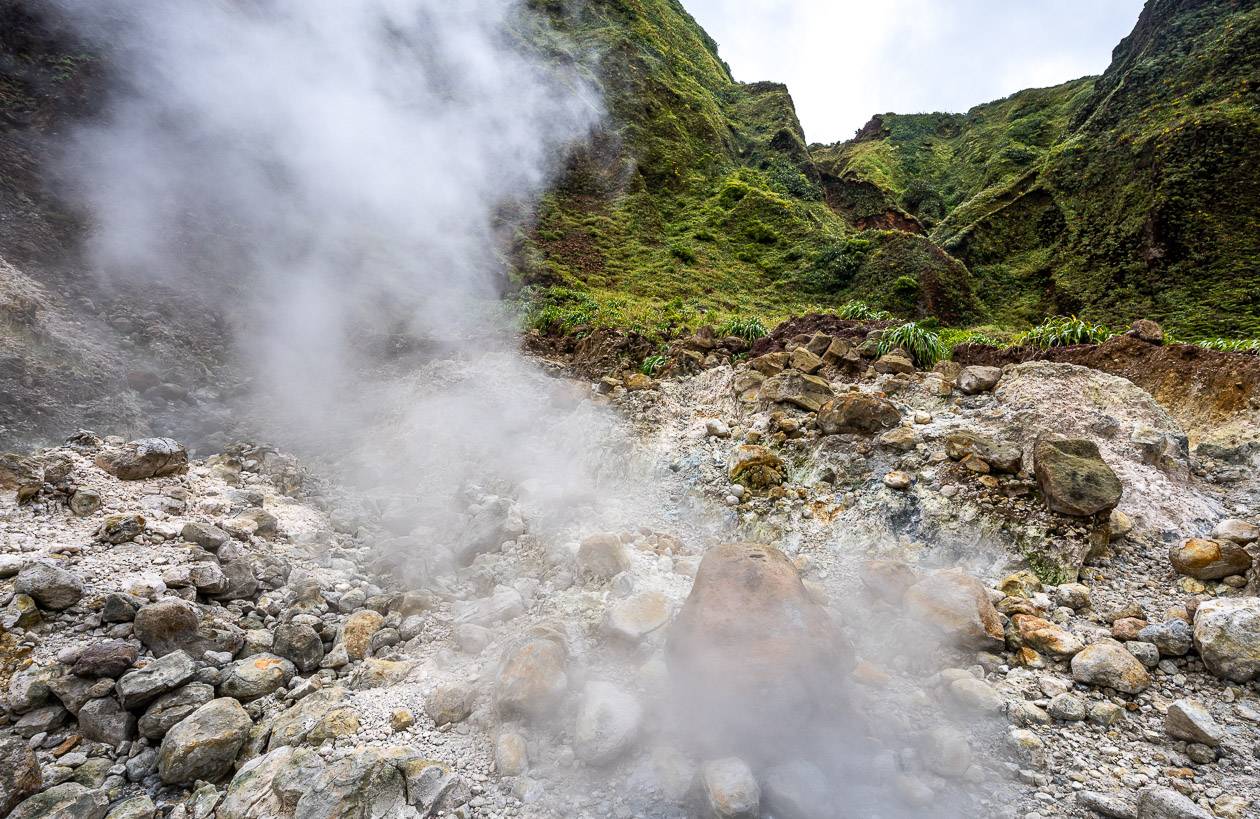
Morne Trois Pitons National Park, Dominica's UNESCO World Heritage Site, holds the country's most demanding and most rewarding hike: a 6 to 8 hour round trip through the Valley of Desolation, a barren, steaming geothermal field, to the shore of Boiling Lake, the world's second-largest hot spring, a flooded fumarole in a constant state of bubbling agitation. A licensed guide is a legal requirement, not a suggestion.
Emerald Pool & Trafalgar Falls
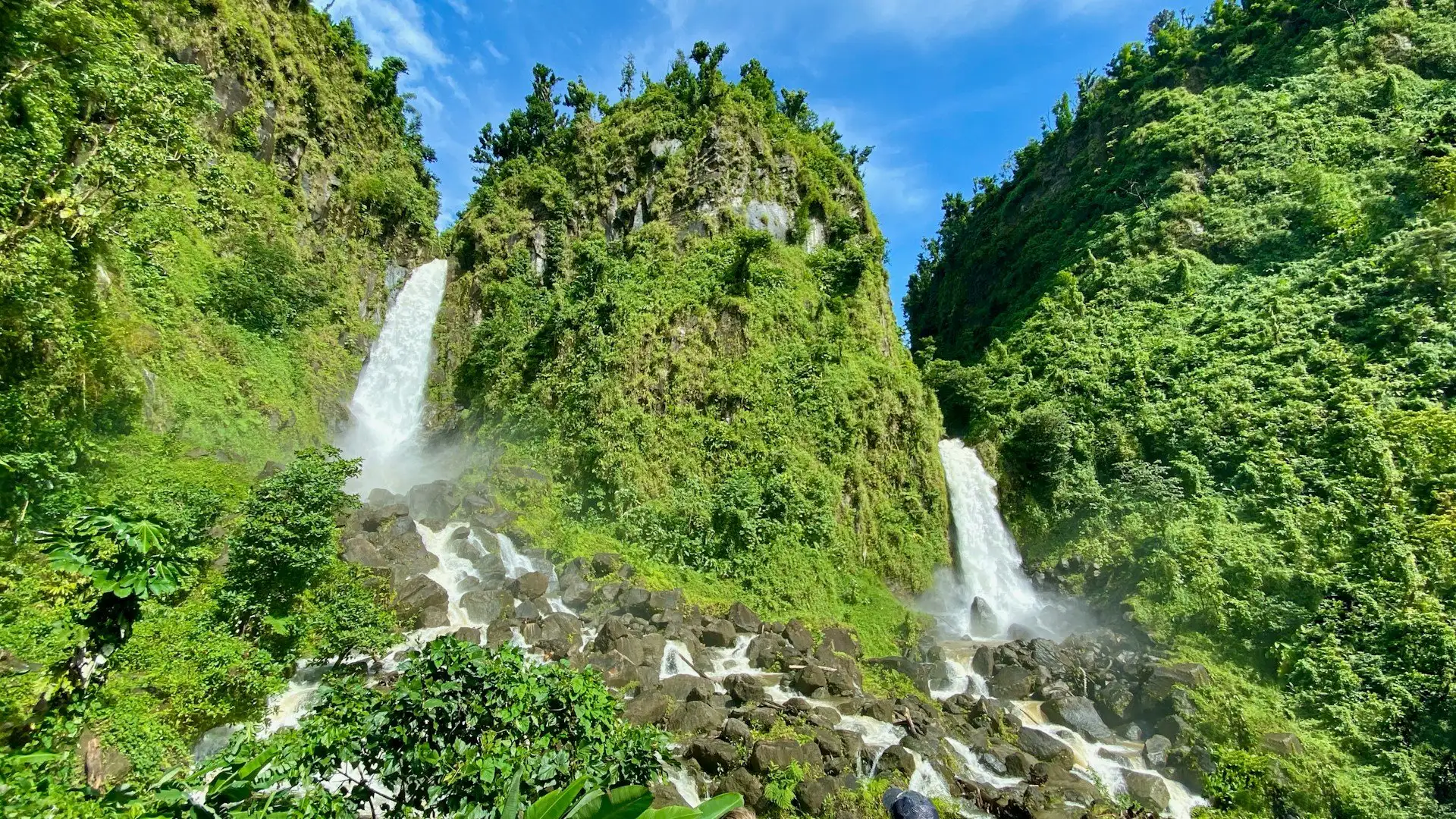
For a far easier outing in the same park, the Emerald Pool is a 20-minute round-trip walk to a bright green pool fed by a 15-meter waterfall. Near Roseau, Trafalgar Falls' twin cascades, known locally as Father and Mother, drop into pools reachable on a short forest trail scented with wild ginger, with a natural hot spring nearby to soak tired legs afterward.
Indian River & Cabrits National Park
Portsmouth, Dominica's second town, sits on Prince Rupert Bay in the island's north. From here, hand-oared (motors are banned to protect the ecosystem) boat trips glide up the Indian River, the widest of the island's 365 rivers and a former Kalinago settlement site, through mangrove and swamp forest that's one of the best birdwatching spots on the island; guides can be arranged at the Portsmouth Visitor's Centre. Cabrits National Park, on the headland above the bay, holds the ruins of Fort Shirley, an 18th-century British garrison being restored in stages.
The Kalinago Territory
On the rugged Atlantic coast, the Kalinago Territory is home to an estimated 3,000-plus people, the largest community of Kalinago descent in the Caribbean, on land formally set aside since 1903. The Kalinago Barana Autê, a reconstructed model village at Salybia, walks visitors through traditional building styles, basket weaving, dugout canoe carving and cassava bread baking, with a craft gallery selling work directly from the artisans who make it.
Hidden gems beyond the main circuit
The four zones above cover a first trip well. With extra days or a second visit, these reward the detour.
Middleham Falls
At around 65 meters, one of the tallest waterfalls on the island, reached by a moderate 90-minute forest hike from the Cocoa Cottages trailhead near Laudat, with far fewer visitors than Trafalgar.
Titou Gorge
A narrow volcanic river gorge you swim into rather than walk, used as a filming location for the Pirates of the Caribbean sequels; the water is cold and the current can be strong after rain.
Layou River & Mero Beach
Freshwater tubing down the Layou River pairs naturally with an afternoon at Mero, one of the island's few genuinely swimmable dark-sand beaches.
The 14-segment island trail
The Caribbean's first long-distance hiking trail runs roughly 185km end to end across all 14 segments, from Scotts Head in the south to the Cabrits in the north. Most visitors walk a single segment rather than the whole route.
Boeri & Freshwater Lakes
Two crater lakes in the cooler central highlands, reachable on shorter, less strenuous trails than Boiling Lake, with views across the interior on a clear day.
Macoucherie Rum Distillery
Dominica's only fully homegrown commercial rum, founded in 1763 and still using water-powered cane crushing on the Shillingford Estate; casual visits can be arranged to see the historic equipment.
Culture & Etiquette
Dominica's identity runs through two threads visitors won't find together anywhere else in the Caribbean: an unbroken Kalinago presence on land set aside since 1903, and a French Creole layer, Kwéyòl, that survived a colonial handover to Britain more than 250 years ago. English is the official language everywhere, but Kwéyòl is still spoken widely outside Roseau, and both threads show up constantly, in place names, in festival music, in the craft you'll see demonstrated in the Kalinago Territory.
Do
- Hire a licensed guide for hikes. It's legally required for Boiling Lake and simply wise everywhere else in the national parks; trails are unmarked in places and weather changes fast at altitude.
- Greet people first. A "good morning" or "good afternoon" before any request, even to a shopkeeper or a stranger for directions, is expected and its absence is noticed.
- Dress modestly away from the beach. Cover up in Roseau, the villages and the Kalinago Territory; swimwear is for the coast and the rivers, not the street.
- Book whale trips through licensed operators. Swim-with-whales tours require a government permit; going through an established operator keeps both you and the whales within the rules.
- Carry cash outside Roseau. US dollars are widely accepted, but small villages, market stalls and guesthouses often prefer or only take EC$.
Don't
- Attempt Boiling Lake without a guide. Beyond the legal requirement, the Valley of Desolation is genuinely hazardous terrain: unstable ground, scalding water and fast-changing weather.
- Order mountain chicken (crapaud). The frog once considered a national dish is now critically endangered, its population collapsed by a chytrid fungus outbreak, and hunting it has been banned since 2002. It shouldn't appear on a menu at all; if it does, that's a red flag, not a delicacy.
- Expect a resort beach vacation. Most of the coastline is volcanic black or grey sand and the sea can be rough on the Atlantic side; this is a hiking and diving trip, not a sunbed trip.
- Touch or stand on coral at Champagne Reef. The geothermal bubbles are the draw, and the reef beneath them is fragile.
- Assume ride-hailing apps work here. Arrange taxis through your hotel or a recommended driver in advance, especially outside Roseau.
Deeper culture: the Kalinago Barana Autê, Carnival and the World Creole Music Festival
The Kalinago Barana Autê. Built in 2006 in the Kalinago Territory village of Salybia, this reconstructed model village is run by and employs Kalinago residents, with guided walks through demonstration huts covering basket weaving, dugout canoe construction and cassava bread baking, plus a herbal medicine garden and a craft shop selling directly from artisans.
Mas Domnik. Dominica's pre-Lenten Carnival, held in February, is widely regarded by Caribbean carnival-goers as one of the more traditional, homegrown celebrations in the region, built around local mas bands and music rather than imported costume traditions.
World Creole Music Festival. Held each October (23-25 in 2026) in Roseau, this multi-day festival celebrates Creole and Caribbean music from across the French, English and Spanish-speaking islands, timed to coincide with Dominica's Independence celebrations in early November.
Food & Drink
Dominican Creole food leans on what the rainforest and the sea actually provide: root vegetables ("provision") grown on small hillside plots, fresh-caught fish, and a fry-up tradition, accras and bakes, that shows up at breakfast stalls across the island. It's simpler and less internationally known than Jamaican or Trinidadian food, and better for it if you find the right stall.
Callaloo Soup
A thick, dark green soup built on dasheen (taro) leaves, coconut milk and often crab or salted meat: Dominica's most distinctive dish and the one most worth seeking out at a proper Creole kitchen rather than a hotel buffet.
Provision & Saltfish
Breadfruit, dasheen, plantain and yam, boiled or fried, served alongside saltfish or fresh fish: the everyday plate across the island, filling and cheap at any local kitchen.
Accras & Bakes ~$1-2
Fried saltfish fritters (accras) and fried dough (bakes), the market-stall breakfast standard, best eaten hot and fresh from a Saturday morning stand in Roseau's Old Market.
Kubuli Beer
Dominica's own lager, brewed with water from the island's Loubière Springs and holding roughly two-thirds of the local beer market; the name comes from Wai'tu kubuli, the Kalinago name for the island.
Macoucherie Rum
Dominica's only fully homegrown commercial rum, distilled on the Shillingford Estate near Mero using a water-powered cane mill dating to the 1770s: a rare working link to the island's plantation-era past.
Cocoa Tea & Bush Tea
A spiced, chocolate-forward hot drink made from grated local cocoa sticks, traditionally a Saturday breakfast pairing with accras and bakes across Creole kitchens island-wide.
When to Go & Itineraries
February through April is Dominica's dry season and the most popular time to visit: lowest rainfall, easiest hiking conditions, best odds of clear views at the waterfalls. The rainy season runs May through December, and hurricane season officially spans June through November, peaking in late August and early September; that same window (outside of an active storm) is also the island's quietest and cheapest, and whale sightings are actually best from November through March regardless of rain.
All seasons compared, with rainfall and hurricane risk
| Season | Verdict | Conditions | Crowds & risk |
|---|---|---|---|
| Feb-Apr | Best | Driest, ~31°C average, easiest trails | Busiest and priciest; no storm risk |
| Dec-Jan | Good | Warm, occasional rain | Holiday season crowds and prices |
| May-Jun & Oct-Nov | Mixed | Rain increasing or easing | Shoulder pricing; low hurricane risk at the edges |
| Jul-Sep | Caution | Wettest, most humid | Peak hurricane season (late Aug-early Sep); cheapest rates but monitor forecasts |
Whale sightings run year-round but cluster closest to shore November through March. The Wai'tukubuli Trail and the national park hikes are all significantly harder and more dangerous in heavy rain; check conditions with your guide before setting out in shoulder or hurricane season.
Itineraries
Dominica rewards a slower pace than its small size suggests, since almost every hike or boat trip takes half a day and the roads between regions are slow. Five days covers the essentials; ten allows the whole island without rushing.
- Day 1
Roseau. Old Market, Botanical Gardens, Fort Young, settle in.
- Day 2
Trafalgar Falls & Emerald Pool. Two easy waterfalls in one day, hot spring soak afterward.
- Day 3
Boiling Lake. Full-day guided hike through the Valley of Desolation; an early night after.
- Day 4
Soufrière & Scotts Head. Whale watching or diving in the marine reserve.
- Day 5
Champagne Reef for a final snorkel before departure.
- Days 1-4
The five-day route above, compressed slightly.
- Day 5
Portsmouth & the Indian River. Drive north, hand-oared river tour, Cabrits National Park and Fort Shirley.
- Day 6
Middleham Falls & Titou Gorge. Quieter alternatives to the main-circuit waterfalls.
- Day 7
Layou River & Mero Beach. Tubing and a relaxed beach afternoon before departure.
- Days 1-7
The seven-day route above, at a gentler pace.
- Days 8-9
Kalinago Territory. Two days on the Atlantic coast: the Barana Autê model village, craft shopping direct from artisans, and the rougher, wilder east-coast scenery.
- Day 10
Boeri & Freshwater Lakes or the Macoucherie Rum Distillery, whichever pace suits, before departure.
Getting there & around
There is no direct long-haul flight to Dominica. Most visitors connect through San Juan, Antigua, Barbados, St. Maarten, Guadeloupe or Martinique on regional turboprops into Douglas-Charles Airport (DOM), about an hour from Roseau on the island's northeast side. The smaller Canefield Airport (DCF), 15 minutes from Roseau, has a short runway limited to small aircraft, mainly inter-island hops to Guadeloupe and Martinique. Contour Airlines is scheduled to add direct flights from San Juan and St. Thomas in fall 2026, which would be the first direct US service. An alternative for a multi-island trip is the L'Express des Îles / FRS ferry, connecting Roseau with Fort-de-France (Martinique) and Pointe-à-Pitre (Guadeloupe) in about 2 to 2.5 hours.
All transport options with prices: rental cars, ferries, buses
| Option | Price | Notes |
|---|---|---|
| Rental car | ~$50/day+ | Left-hand drive; a temporary visitor's driving permit (~$12/EC$30) is required regardless of your home license or IDP. |
| L'Express des Îles ferry | $70-110 | Roseau to Fort-de-France or Pointe-à-Pitre, 2-2.5 hrs; a departure tax of roughly EC$89 (~$33) applies when leaving by sea. |
| Airport transfer (Douglas-Charles to Roseau) | ~$25-40 | About an hour by taxi; arrange through your hotel or the airport taxi stand. |
| Local buses | EC$2-10 | Privately operated minibuses cover main routes between towns; informal schedules, cash only. |
Driving in Dominica: roads are steep, narrow and winding outside the main coastal routes, with hairpin turns common on the way to interior villages like Laudat and Wotten Waven. Drive defensively, use low gear on descents, and don't rely on ride-hailing apps, which do not operate here; arrange taxis through your accommodation instead.
Where to stay
Capital base
Most first-time visitors base in or near Roseau for the shortest drives to the national park trailheads and the Soufrière whale-watching boats. See the full Roseau city guide for specific hotel picks.
Rainforest guesthouses
Small inns near Trafalgar Falls, some attached to restaurants like Papillote, put you inside the rainforest itself, a short drive rather than a long one from the Boiling Lake trailhead at Titou Gorge.
Eco-luxury on Prince Rupert Bay
The north's small hotel scene leans upscale and design-forward, built into the hillside forest above the bay rather than competing with it; a good base if the Indian River and Cabrits National Park are the priority.
Community-run guesthouses
A handful of small, family-run guesthouses in the Kalinago Territory put visitors directly in the community rather than passing through on a day tour; ask at the Barana Autê for current recommendations.
Budget Planning
Dominica is pricier day-to-day than the Caribbean's mass-tourism beach islands: there's less competition among hotels and tour operators, and its two headline experiences, the Boiling Lake hike and whale watching, both require paid, licensed guides rather than being free or self-guided. US dollars are accepted almost everywhere alongside the Eastern Caribbean dollar, which is pegged at a fixed EC$2.70 to US$1.
- Guesthouse room $30-60/night
- Market meals & local kitchens $5-10
- Local minibuses between towns
- Single-site national park entry EC$14 (~$5)
- Boutique hotel or guesthouse $80-180
- Rental car ~$50-70/day
- Boiling Lake guided hike $100-150/person
- Whale watching tour $65-100/person
- Eco-luxury resorts, Portsmouth or Roseau Valley
- Private guides for hiking & diving
- Private whale-watching charters
- Fine dining & imported wine
Quick reference prices: park fees, guides, ferries
| Accras & bakes, market stall | ~$1-2 |
| Kubuli beer, local bar | ~$2-3 |
| Restaurant meal, Creole kitchen | $8-18 |
| Single national park entry | EC$14 (~$5) |
| Week national park pass | EC$33 (~$12) |
| Boiling Lake guided hike | $100-150/person |
| Ferry to Martinique or Guadeloupe | $70-110 one way |
| Temporary driving permit | ~$12 (EC$30) |
Prices reflect August 2026 research and drift over time. Treat them as a planning baseline, not a quote.
Visa & Entry
Citizens of the US, UK, EU, Canada, Australia and New Zealand, along with most Commonwealth and Caribbean nationalities, do not need a visa in advance to visit Dominica. The length of stay granted on arrival varies by nationality and by the immigration officer's discretion, so check the stamp or entry record in your passport at the border and confirm current terms with Dominica's official immigration authority before you travel, rather than relying on any single third-party source.
✓ Valid passport
At least 6 months validity from your date of entry is the standard requirement.
✓ Return/onward ticket
Immigration can ask to see proof you'll be leaving the country.
✓ Proof of accommodation
A hotel booking, guesthouse address or invitation letter; have it ready at the border.
✓ Not always a full 90 days
Some sources cite up to 90 days or more; others report shorter stamped periods. Don't assume; check your passport stamp on arrival.
| Dominica | Costa Rica | |
|---|---|---|
| Rainforest & hiking | One volcanic island, ~60% forest cover, uncrowded trails | Far larger, more developed park infrastructure and trail network |
| Signature wildlife | Resident sperm whales, year-round, the only place on Earth | Sloths, monkeys, greater overall biodiversity by land area |
| Getting there | No direct long-haul flights; connect via regional hubs | Direct flights from most major US and European gateways |
| Daily budget | $50-100 gets you far, but guides for the best sites cost extra | Comparable at the budget end, cheaper at scale given more competition |
| Crowds | Genuinely uncrowded outside cruise-ship mornings in Roseau | Well-established eco-tourism circuit, busier at flagship parks |
Safety, Solo Women & Family
Dominica is safe for tourists. The US State Department rates it Level 1, exercise normal precautions, its lowest advisory tier, as of a May 2026 update, and violent crime against visitors is rare. The practical risks are petty theft in cruise-ship-heavy areas, opportunistic overcharging, and the genuine physical hazards of hiking in a mountainous, geothermally active landscape, not crime.
Hiking hazards
Boiling Lake's terrain includes scalding water and unstable ground; a licensed guide is legally required there and strongly advised on any other unmarked trail, especially after rain.
Hurricane season
June through November, peaking late August into early September. Monitor forecasts if traveling in this window, and confirm your accommodation's storm protocols in advance.
Petty theft & overcharging
Concentrated around Roseau and Portsmouth on cruise-ship days and at busy trailheads. Agree prices before a taxi ride or informal tour, and keep valuables secured at accommodation.
Solo women travelers
Dominica is a reasonable choice for solo female travelers with ordinary precautions: avoid walking alone at night, use licensed taxis rather than hailing unmarked cars, and hike with a guide rather than solo, which is a legal requirement on Boiling Lake regardless. Locals are generally described as friendly and willing to help with directions or advice.
Emergency numbers
Embassy access and family travel
Dominica has no resident US embassy; American citizens are served by the US Embassy in Bridgetown, Barbados (main line +1-246-227-4399, after-hours emergency +1-246-227-4000). Most other Western nations' nearest missions are also in Barbados, or in nearby Martinique and Guadeloupe for French and EU citizens; check your government's travel advisory site for the specific office covering Dominica before you travel.
Family travel: Dominica works well for families with older children and teenagers who can manage moderate hikes, boat trips and the excitement of whale watching, less well for very young children given the lack of resort-style infrastructure and the physical demands of the best sites. Trafalgar Falls and the Emerald Pool are gentle enough for most kids; save Boiling Lake for a family of confident hikers.
Dominica FAQ
Is Dominica safe to visit?
Yes. The US State Department rates Dominica Level 1, exercise normal precautions, its lowest advisory tier, as of May 2026. Violent crime against visitors is rare; petty theft in cruise-heavy areas and scams over-quoting prices are the main practical risks.
Does Dominica have direct international flights?
No. There are no direct long-haul flights. Most visitors connect through San Juan, Antigua, Barbados, St. Maarten, Guadeloupe or Martinique on regional turboprop carriers into Douglas-Charles Airport. Contour Airlines is scheduled to start direct flights from San Juan and St. Thomas in fall 2026.
Do I need a visa for Dominica?
Citizens of the US, UK, EU, Canada, Australia and New Zealand don't need a visa in advance. Immigration grants a stay on arrival that varies by nationality and officer discretion, so check the stamp in your passport and confirm current terms with Dominica's immigration authority before you travel.
How much does Dominica cost per day?
Budget travelers manage on $50-100 a day using guesthouses, market food and buses. Mid-range runs $100-250 a day. Dominica is pricier than most Caribbean beach islands because its best experiences require paid, licensed guides.
What is the best time to visit Dominica?
February through April is driest and most popular. May through December is the rainy season, and hurricane season runs June through November, peaking in late August and early September. Whale sightings are best November through March.
What is Boiling Lake?
The world's second-largest hot spring lake, a flooded fumarole inside Morne Trois Pitons National Park. Reaching it is a strenuous 6 to 8 hour round-trip hike that requires a licensed guide by law.
Can I see whales in Dominica?
Yes. Dominica is the only country where resident sperm whales can be seen year-round, with sightings closest to shore from November to March. Swim-with-whales trips require a government permit and a licensed operator.
How many days do you need in Dominica?
Five days covers Roseau, the south and one national park hike. A week adds Portsmouth and the north. Ten days allows an unhurried loop of the whole island including the Kalinago Territory.
Is it better to rent a car in Dominica?
Yes for most itineraries. Driving is on the left and requires a temporary visitor's permit from the rental agency. A car makes reaching trailheads, Portsmouth and the Kalinago Territory far easier than relying on buses or taxis.
What language is spoken in Dominica?
English is the official language. Many Dominicans also speak Kwéyòl, a French-based Creole, especially outside Roseau, a legacy of French colonization before the island passed to Britain.
Is Dominica good for a beach vacation?
Not primarily. Most of the coastline is volcanic black or grey sand rather than the white-sand beaches of Antigua or the Bahamas. It's a rainforest, hiking and diving destination first.
Is Dominica safe for solo female travelers?
Generally yes, with the usual precautions: avoid walking alone at night, use licensed taxis, and hike with a guide rather than alone, which is required by law on Boiling Lake in any case.
What Stays With You
Dominica doesn't try to compete with its neighbors on beaches, nightlife or ease of access, and that refusal is the whole point. What it has instead is a lake that boils, a river system too dense to fully map by a casual visitor, whales that never leave, and a Kalinago community that has held the same stretch of coastline since before any of the ships arrived. None of it is staged for a cruise-ship afternoon, which is exactly why the cruise-ship afternoon isn't enough time for it.
Go for the hike to Boiling Lake if your legs can take it, or the boat trip to the whales if they can't. Either way, go before the direct flights arrive and change what this island has managed to stay, almost by accident, for this long.