
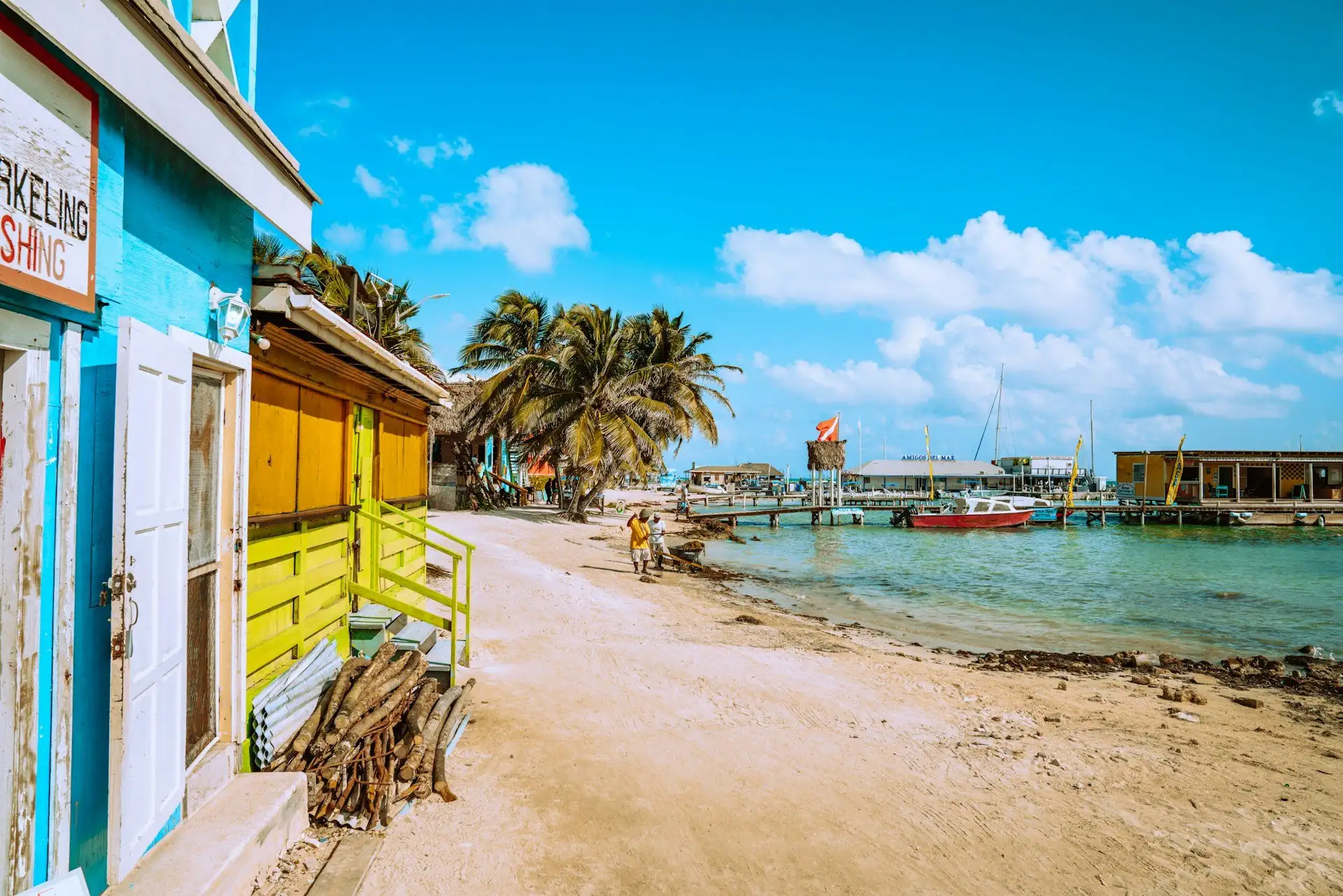
Belize
The second-largest barrier reef on earth, Maya temples dissolving back into the jungle, and a country small enough that you can swim in the Caribbean in the morning and be watching jaguars by nightfall.
What You're Actually Getting Into
Belize is tiny. The whole country would fit inside the state of Massachusetts, with room to spare. There are fewer than 450,000 people. English is the official language. The Belize Dollar has been pegged at exactly 2:1 to the US dollar since 1978, which means every price calculation you'll ever do here takes three seconds. In a region that can feel logistically complicated, Belize has a certain ease about it.
What Belize trades on, and what it delivers, is a combination almost nowhere else on earth manages: the Mesoamerican Barrier Reef directly offshore, one of the most biodiverse stretches of water in the Western Hemisphere, and an interior thick with primary jungle, Maya archaeological sites, and wildlife that includes jaguars, tapirs, and howler monkeys who will wake you up at 5am from a distance that makes you wonder if you've made a serious error in accommodation choice.
The honest caveat: Belize is not cheap by Central American standards. It's positioned itself squarely at the eco-tourism market, which means that jungle lodges and dive operators have priced accordingly. You can do it on a budget, but you'll feel the gap between what Belize offers and what you're spending more acutely here than in Guatemala or Honduras. The barrier reef alone can justify the cost entirely if diving or snorkeling is your thing. If it isn't, you may want to recalibrate your expectations.
The other thing worth knowing upfront: Belize City is not the heart of the country. It's the transport hub and the largest city, and it has a crime problem that most guidebooks either overstate dramatically or understate completely. The places you actually want to be — Caye Caulker, San Ignacio, Placencia, Hopkins, the cayes — are genuinely excellent. Spend as little time in Belize City as your flight schedule demands.
Belize at a Glance
A History Worth Knowing
The land that is now Belize was at the heart of the Maya world for over a thousand years. During the Classic Period, roughly 250 to 900 CE, the Maya built cities across what is now the Cayo District and the southern lowlands that would have held tens of thousands of people. Caracol, deep in the jungle near the Guatemalan border, was one of the most powerful Maya cities in the entire region. At its peak it had a population larger than modern-day Belize City and defeated the city-state of Tikal in 562 CE, a victory recorded in stone that archaeologists only deciphered in the 1980s. The jungle swallowed most of this. Excavations are still ongoing.
By the time the Spanish arrived in the 16th century, the Maya population had already declined dramatically due to drought, warfare, and societal collapse that archaeologists are still arguing about. The Spanish, unusually, largely bypassed this territory. They found it wet, difficult, and lacking the immediately extractable gold that drove their interests elsewhere. Belize became instead the domain of British pirates and logwood cutters, men who settled along the coast in the 17th century and began cutting logwood for European textile dyes. This is the origin of the country's unofficial history as a British colonial territory that was never formally colonized until much later.
The Battle of St. George's Caye in 1798 is the founding myth of the Belizean national identity. A small group of British settlers and Baymen, heavily outnumbered by a Spanish fleet, repelled an attack and secured British control of the territory. The Belizean flag still bears the motto "Sub Umbra Floreo" — I flourish in the shade. The mahogany trade that followed brought enslaved Africans and later indentured laborers from various corners of the British Empire, which explains the extraordinary ethnic mix of the country today: Creole, Garifuna, Mestizo, Maya, Mennonite, East Indian, Chinese, and Lebanese communities all coexist within a country the size of a small US state.
British Honduras, as it was known, gained independence in 1981 — one of the last colonies in the Western Hemisphere to do so. The transition was complicated primarily by Guatemala, which has claimed the entire territory of Belize as its own since the 19th century. That territorial dispute technically still exists and was only formally brought to the International Court of Justice for resolution in 2019. For practical purposes, the border has been peaceful for decades, and most visitors cross it without incident when traveling between Belize and Tikal. But the history of that dispute shaped Belize's politics and explains why Belmopan, the inland capital built in 1970 after Belize City was devastated by Hurricane Hattie, sits where it does rather than on the vulnerable coast.
Caracol, Lamanai, and Xunantunich flourish. The jungle holds cities that won't be rediscovered for a millennium.
Pirates and logwood cutters establish the first permanent European presence along the coast.
British settlers and Baymen repel a Spanish fleet. The founding moment of Belizean national identity.
Officially declared a British colony. Mahogany trade dominates. The coast develops, the jungle remains largely untouched.
Devastates Belize City. The decision is made to build a new inland capital: Belmopan.
Belize becomes independent from Britain. One of the last colonies in the Western Hemisphere to gain sovereignty.
Over 40% of Belize's territory is protected. The barrier reef and jungle are the economic engine. The territorial dispute with Guatemala heads to the ICJ.
Top Destinations
Belize divides cleanly into two zones: the coast and cayes (islands) to the east, and the Cayo District and jungle interior to the west. Most visitors pick one or the other depending on whether they came for water or wildlife. The best trips do both, though the logistics of getting between them require a little planning.
Ambergris Caye
Belize's most visited destination and the launching pad for most barrier reef dives and snorkel trips. San Pedro Town on the south end of the island has enough restaurants, bars, and tour operators to keep any trip busy. It's genuinely lively without having tipped into full resort chaos, at least for now. Rent a golf cart — cars are banned from most of the island — and drive north to find the reef access points where the crowds thin out. Shark Ray Alley, a 20-minute boat ride, is full of nurse sharks and stingrays at a density that surprises every first-time visitor.
Caye Caulker
The unwritten motto of Caye Caulker is "go slow," and that's not just for tourists. The island is six kilometers long, the main street is sandy and largely car-free, and the vibe is somewhere between backpacker paradise and Caribbean village that forgot to stress out. It's cheaper than Ambergris Caye by a meaningful margin. Manatees gather just off the southern tip at a spot called the Split, where the island was literally cut in two by Hurricane Hattie and locals have been swimming in the gap ever since. Two to three days here is the perfect reset.
San Ignacio
The heart of the Cayo District and the base for most inland Belize adventures. San Ignacio sits on the Macal River near the Guatemalan border and has a genuine market town energy that Belize City lacks. Burns Avenue on a Saturday morning, with the market running at full capacity and the smell of fry jacks and stewed beans drifting from the food stalls, is one of the better starts to a day you can have in Central America. From here you can reach Caracol, Xunantunich, Actun Tunichil Muknal cave, and the Belize Botanic Gardens all within 90 minutes.
The Great Blue Hole
A 300-meter wide, 125-meter deep marine sinkhole at the center of Lighthouse Reef Atoll, about 70 kilometers offshore. Jacques Cousteau declared it one of the best diving sites in the world in 1971 and the title has stuck. The dive itself is an advanced one: you drop to 40 meters to see the stalactites that form the cavern's ancient cave system. The boat trip is two hours each way. It is genuinely spectacular and worth doing exactly once if you're a certified diver with the qualifications. From the air it's one of the most arresting natural formations on earth.
Cockscomb Basin
The world's first jaguar wildlife sanctuary covers 400 square kilometers of dense rainforest in the Maya Mountains. You won't see a jaguar on a short visit, and anyone who tells you otherwise is managing your expectations badly. What you will see: tapir tracks, scarlet macaws, keel-billed toucans, and one of the denser concentrations of Mesoamerican wildlife outside a David Attenborough documentary. The hiking trails are well-marked and the night walks with a guide are the highlight.
Hopkins
A Garifuna fishing village on the southern coast that has managed to attract a trickle of independent travelers without losing what makes it worth visiting. Drumming on the beach on weekend nights is not a performance for tourists. It's community life. The cassava bread and hudut (fish stew in coconut milk) at one of the waterfront spots is the best food in Belize by a significant margin. Pairs well with a day trip to Cockscomb Basin, 30 minutes inland.
Placencia
A narrow peninsula in southern Belize with a 26-kilometer beach and an atmosphere somewhere between fishing village and boutique resort strip. The Sidewalk, a 5-kilometer concrete path along the water that the Guinness Book once listed as the world's narrowest main street, connects the village at the tip to the rest of the peninsula. Whale shark aggregations offshore in the spring (March to May) around the Gladden Spit are one of Belize's most extraordinary wildlife experiences and attract divers from around the world for the full moon dives.
Lamanai
Most Maya sites in Belize require clearing the vegetation to access. Lamanai, in the north, still has trees growing over the temples and is best reached by a 35-kilometer boat ride up the New River Lagoon, passing dense mangroves, spectacled caimans, and Morelet's crocodiles watching from the banks. The name translates roughly as "submerged crocodile." The site was continuously inhabited from roughly 1500 BCE all the way to the 19th century, which makes it almost uniquely long-lived for the Maya world.
Culture & Etiquette
Belize is one of the most ethnically diverse countries in the Western Hemisphere for its size. Creole, Garifuna, Maya (Yucatec, Mopan, and Kekchi communities all exist separately), Mestizo, Mennonite, East Indian, and Chinese Belizeans all share the same small country with distinct languages, food traditions, and community identities. The Garifuna, descendants of African and Arawak/Carib ancestors who were deported to Central America by the British in 1797, have a UNESCO-recognized culture that is unlike anything else in the Caribbean. The Mennonite communities in Orange Walk and Cayo Districts live almost entirely apart from the rest of the country, still speaking Low German and farming without modern equipment, and supply a significant portion of Belize's dairy and produce.
What this means in practice: Belize doesn't have a single dominant social script the way more ethnically homogeneous countries do. What you will encounter throughout is an easygoing warmth combined with a directness that English-speaking travelers find refreshing. Belizeans generally say what they mean. "Go slow" isn't just the motto of Caye Caulker. It describes a broader approach to life here that can frustrate visitors who are used to faster service rhythms and reward those who adjust.
A proper "good morning" or "good afternoon" before asking anything from a shopkeeper or guesthouse owner goes a genuinely long way here. Starting with a transaction without a greeting is considered rude.
Some Maya villages and Garifuna communities offer cultural visits. Behave as a guest, not a spectator. Ask before photographing people. These are lived communities, not exhibits.
Belize has strict reef protection laws. Chemical sunscreens containing oxybenzone and octinoxate are harmful to coral and increasingly regulated around the barrier reef. Mineral sunscreens only near the water.
Haggling is acceptable in craft markets and with informal vendors, but prices in local Belizean stalls are often already tight. Don't be aggressive about prices on a $3 item.
Zero tolerance applies at every dive and snorkel site. A single touch can kill coral that took decades to grow. Buoyancy control before you enter the water, not after.
The crime risk in Belize City is real, particularly in the south side. Don't walk around with your phone out, don't display expensive jewelry, and be back at your accommodation before dark if you're staying near the market area.
Belize Creole (Kriol) is a complete and distinct language with its own grammar and vocabulary. The similarity to English is deceptive. Treat it as the separate language it is.
This seems obvious. People do it. The Cockscomb Basin Wildlife Sanctuary after dark without a licensed guide is genuinely inadvisable for reasons that don't need elaborating.
Garifuna Settlement Day
November 19th commemorates the arrival of the Garifuna people in Belize in 1823. In Hopkins, Dangriga, and Punta Gorda it's a full day of drumming, paranda music, canoe re-enactments, and cassava bread distribution. If your dates align with it, structure your trip around attending. Nothing else gives you access to Garifuna culture at this intensity.
Mennonite Communities
The Mennonite villages around Spanish Lookout and Orange Walk supply much of the country's cheese, furniture, and produce. They are not tourist attractions, but if you pass through you'll encounter horse-drawn carts alongside pickup trucks in a juxtaposition that still surprises. Buy their cheese and their fresh bread. Both are excellent.
Carnival & Lobster Fest
September is the main carnival month, particularly in Belize City and Belmopan around Independence Day on September 21st. The Lobster Festival on Ambergris Caye in late June is exactly what it sounds like: several days of cooking competitions, music, and freshly caught Caribbean spiny lobster at prices you won't find for the rest of the year.
Conservation Culture
More than 40% of Belize's total land area is under protected status, which is extraordinary for a developing nation. This is not accidental. There is a genuine national pride in the reef and the jungle, and a corresponding expectation that visitors treat them accordingly. Rangers take violations seriously. Follow the rules at protected sites without needing to be asked twice.
Food & Drink
Belizean food doesn't get the credit it deserves. The country's ethnic mix has produced a cuisine that draws from Maya, Garifuna, Creole, and Mestizo traditions simultaneously, and the best examples of each are genuinely excellent. The problem is finding them. Tourist restaurants on Ambergris Caye and Caye Caulker serve an international menu padded out with mediocre versions of local dishes at inflated prices. The real Belizean food is at the small breakfast spots, the market stalls, and the roadside comedors that locals actually use.
The national breakfast is rice and beans cooked in coconut milk, served with stewed chicken and a slice of fried plantain. You can get this for BZD $5 to $8 at any local breakfast spot and it will keep you going until mid-afternoon. Fry jacks, deep-fried dough pillows served sweet or savory, are the other essential morning food. Find them at any market or roadside stall. Both are significantly better than anything described as "breakfast" on a tourist menu at twice the price.
Hudut
The flagship dish of Garifuna cuisine. A rich coconut milk fish stew served with mashed plantain called fufu. Snapper or barracuda, cooked with coconut, spices, and time. Hopkins is the best place to eat it, ideally at Miss Lola's on the main road where the portions are large and the cook's grandmother's recipe predates tourism in Belize by several decades.
Rice & Beans
Not to be confused with "beans and rice" which is a different dish. Rice and beans in Belize means coconut rice cooked with kidney beans, served as the base for everything from stewed chicken to escabeche to fried fish. The coconut version is what distinguishes it from the same dish across the border. Don't skip it because it looks simple.
Lobster
Caribbean spiny lobster is in season from June 15th to February 15th. During lobster season on Ambergris Caye and Placencia you can eat it grilled, stuffed, in burritos, and in ceviche for prices that would be considered theatrical in any coastal restaurant in Europe or North America. Order it simply: butter, garlic, a squeeze of lime. Don't overthink it.
Garnaches & Salbutes
Street food staples from the Mestizo tradition. Garnaches are small fried tortillas topped with refried beans, cabbage, and cheese. Salbutes are puffed fried tortillas loaded with chicken or turkey, pickled onion, and habanero. Both cost BZD $1 to $2 each at market stalls. Breakfast on BZD $5 is entirely possible and more satisfying than it has any right to be.
Ceviche
Belizean ceviche uses conch, shrimp, or fish cured in lime juice with habanero, cilantro, and onion. The habanero is the difference from other ceviche traditions. It's not used for decoration; it's in the marinade and it shows. The conch ceviche at the beach bars on Caye Caulker next to the Split is a reliable afternoon ritual for good reason.
Belikin Beer & Rum
Belikin is the national beer, a slightly sweet lager that tastes better than it should when you're sitting in a palapa bar after a morning in the water. It's everywhere and costs BZD $3 to $4 a bottle. One Barrel rum, made in Belize from locally grown sugarcane, is genuinely underrated for its price. Rum and coconut water from a machete-opened green coconut is the unofficial drink of the cayes.
When to Go
The honest answer: late November through April is the clear window. Dry season skies, calm seas, excellent visibility underwater, and temperatures that sit around 26 to 30 degrees without the wet-season humidity that makes midday in the jungle feel like you're breathing warm soup. February and March are the sweet spot for diving — visibility at Lighthouse Reef can reach 40 meters on a good day.
Dry Season
Dec – AprClear skies, calm Caribbean seas, best diving visibility. Peak tourist season with correspondingly higher prices on the cayes. Book accommodation for Ambergris Caye and Caye Caulker well in advance in February and March.
Shoulder Wet
May – JunWhale shark season at Gladden Spit (March through June) peaks around the full moons in April and May. Rain comes in shorter bursts and the jungle is at its most verdant. Prices drop noticeably on the cayes.
Hurricane Season
Jul – NovSeptember and October carry the highest hurricane risk. Tropical storms can make the cayes genuinely inaccessible and diving is suspended. That said, most years pass without direct hits and the interior Cayo District is much less affected. Travel insurance with cancellation cover is essential if you visit during this window.
Late Dry
Nov – DecGarifuna Settlement Day on November 19th is worth building a trip around. The rainy season is ending, prices haven't yet reached peak season levels, and the country feels alive with cultural energy. Christmas week brings a price spike and strong domestic tourism.
Trip Planning
Ten to fourteen days is the right window for a first Belize trip. Less than a week and you'll spend a disproportionate amount of time on boats and buses without absorbing the places you're actually passing through. Three days on the cayes and four to five in the Cayo District is the classic split that works, with a day in the south (Hopkins or Placencia) if the schedule allows.
Caye Caulker
Fly into Belize City and take a 45-minute water taxi directly to Caye Caulker. Settle in, rent a snorkel, and spend three days at the Split and Hol Chan Marine Reserve. Don't rush. This is "go slow" territory and the reef rewards patience more than schedule.
San Ignacio & Cayo
Water taxi back to Belize City, then a 2.5-hour bus or shuttle to San Ignacio. Day four at the Saturday market. Day five: Actun Tunichil Muknal cave with a licensed guide (book this in advance — group sizes are capped and it sells out in dry season). Day six: Caracol ruins. Day seven: Xunantunich before heading back to the airport.
Ambergris Caye
Fly into Belize City and take a 20-minute domestic prop plane to San Pedro (BZD $50 each way, worth every dollar). Rent a golf cart and spend four days: Shark Ray Alley, Hol Chan Marine Reserve, a full-day trip to Turneffe Atoll if your budget allows, and evenings on the Barrier Reef Bar pier watching the sun go down over a Belikin.
Caye Caulker
A 45-minute ferry connects the two cayes. Slow down here after Ambergris Caye. The manatees, the conch ceviche at the Split, and the lack of golf cart traffic are all reasons to stay two nights.
San Ignacio & Cayo District
Five days in the jungle gives you time to do Caracol properly, visit Actun Tunichil Muknal cave (book ahead), tube the Barton Creek Cave, and spend a night at a jungle lodge in the Mountain Pine Ridge. The Ian Anderson's Caves Branch lodge or Crystal Paradise Resort are both excellent for different budgets.
Hopkins & the South
Three hours south from San Ignacio. Two nights in Hopkins for the Garifuna culture and the hudut. Optional day trip to Cockscomb Basin jaguar sanctuary. Fly out from Dangriga or backtrack to Belize City.
Northern Cayes: Ambergris + Lighthouse Reef
Four nights on Ambergris Caye, then a boat trip to Lighthouse Reef for the Blue Hole dive. Stay overnight at the Lighthouse Reef Resort if budget allows — waking up on a remote atoll with no other sounds than reef birds is genuinely worth it.
Caye Caulker + Lamanai
Two nights on Caye Caulker then a day trip north to Lamanai, the Maya site accessible by river boat through crocodile-lined lagoons. The combination of water taxi, river boat, and jungle temple in one day is quintessential Belize logistics.
San Ignacio & Cayo District Deep Dive
Six days gives you space for everything: ATM cave, Caracol, Xunantunich, river tubing, a night at a proper jungle lodge, a day in Belmopan for the government market, and a full afternoon watching howler monkeys from the deck of your accommodation before dinner.
Southern Belize: Hopkins, Placencia, Punta Gorda
Hopkins for two nights, Cockscomb Basin for a day hike, then down to Placencia for a full moon whale shark dive if timing aligns. End in Punta Gorda, the most authentically un-touristed corner of the country. Take a boat to the Toledo Maya villages for a home stay. Fly home from Placencia or bus back to Belize City.
Vaccinations
No mandatory vaccinations, but hepatitis A, typhoid, and routine vaccines are strongly recommended. Consider hepatitis B and rabies if spending extended time in rural areas. Malaria risk exists in the Toledo and Stann Creek districts — consult a travel clinic.
Full vaccine info →Mosquitoes
DEET-based repellent is essential in the jungle and on the coast during dusk and dawn. Dengue fever is present in Belize. Long sleeves and pants after dark in jungle areas are recommended. Zika risk exists — relevant for pregnant travelers or those planning pregnancy.
Connectivity
Digicel and BTL are the main networks. Coverage is good on the cayes and in San Ignacio, patchy in remote jungle areas. An international SIM or eSIM from Airalo will cover you across the mainland and coast. Download offline maps before heading into the Cayo.
Get Belize eSIM →Cash & Currency
The Belize Dollar is pegged 2:1 to the USD, which means US dollars are accepted almost everywhere and you'll often receive change in a mix of BZD and USD. ATMs are available in Belize City, San Pedro, and San Ignacio. Cash is essential in villages and rural areas where card readers don't exist.
Travel Insurance
Non-negotiable for Belize. Medical evacuation from a remote area can cost tens of thousands of dollars. Dive accident insurance (DAN is the standard provider) is strongly recommended if you plan to dive. Hurricane cancellation cover is essential for visits from July through November.
Sun & Water
The Caribbean sun at this latitude is severe. Reef-safe mineral sunscreen (no oxybenzone or octinoxate), a rash guard for full days on the reef, and rehydration salts for jungle days. The water in Belize City and most towns is technically treated but bottled water is universally available and recommended for drinking.
Transport in Belize
Getting around Belize requires adjusting your expectations about speed and predictability. This is not Japan. Buses run on schedules that are approximations rather than commitments, roads in the south range from decent to deeply challenging in wet season, and the distinction between "on time" and "soon" is cultural rather than precise. None of this is insurmountable, and once you accept the rhythm it stops being frustrating and starts being part of the experience.
The one genuinely excellent transport option: domestic aviation. Tropic Air and Maya Island Air run prop planes between Belize City, San Pedro, Caye Caulker, Placencia, Dangriga, and Punta Gorda on schedules that actually hold. A 20-minute flight versus a 4-hour bus plus a water taxi is worth the BZD $100 cost difference on any route you're debating.
Domestic Flights
BZD $70–180/routeTropic Air and Maya Island Air are reliable and the only sensible way to reach southern Belize quickly. Book online in advance during dry season. Prop planes, 8–19 seats, weight limits on luggage.
Water Taxis
BZD $20–30The San Pedro Belize Express and Ocean Ferry Belize run between Belize City, Caye Caulker, and San Pedro multiple times daily. 45 minutes to Caye Caulker, 75 minutes to San Pedro. Rough in high winds; take a seasickness tablet if you're prone.
Local Buses
BZD $4–15Novelo's and James buses run the Western and Northern Highways reliably enough. Air-conditioned express coaches on the main routes. The Belize City to San Ignacio bus takes 2.5 hours and costs BZD $5. Village buses run less frequently and more approximately.
Shared Shuttles
BZD $30–80Tourist shuttle services run between the main destinations and cross into Guatemala to Flores/Tikal. More comfortable than the bus, less flexible than a rental, and the driver usually knows the best spots for a roadside snack stop.
Car Rental
BZD $100–180/dayGenuinely useful for the Cayo District. The road to Caracol and the Mountain Pine Ridge requires a 4WD — a standard car in rainy season is not advisable. International driving permit recognized. Fuel is significantly more expensive than in the USA.
Golf Carts (Cayes)
BZD $70–100/dayThe default transport on both Ambergris Caye and Caye Caulker. Cars are largely banned. Rent for the day, drive north on the beach road past San Pedro, and you'll find the reef access points and beach bars that the tour groups miss entirely.
Taxis
BZD $8–20 in townsLicensed taxis use green license plates. Always agree on a price before getting in — meters are rare. In Belize City, taxis are the recommended way to get around rather than walking in unfamiliar areas.
River Boats
Varies by routeRiver boats access remote sites that roads don't reach. The Lamanai approach via the New River Lagoon is the most famous. Trips through the Cave Branch River are offered by jungle lodges near San Ignacio. Book through lodges or local guides rather than through Belize City operators.
Accommodation in Belize
Belize does two things well in accommodation: jungle lodges and simple guesthouses. The mid-range in between is the least inspired tier. The jungle lodges — proper eco-lodges in the Mountain Pine Ridge and Cayo District — are some of the best forest accommodation in Central America, combining genuine environmental commitment with comfort that doesn't ask you to sacrifice anything. A night at Ian Anderson's Caves Branch or the Blancaneaux Lodge is different from a night at any hotel in any city.
On the cayes, budget travelers do very well. Simple cabanas on Caye Caulker start at BZD $50 a night and most are clean, fan-cooled, and within walking distance of the water. Ambergris Caye runs more expensive but has a wider range from local guesthouses to boutique beachfront resorts.
Jungle Lodge
BZD $300–900/nightThe defining Belize accommodation experience. Solar-powered, wildlife-rich, meals often included, and built by operators who have been here for decades. Blancaneaux Lodge (Francis Ford Coppola's property in the Mountain Pine Ridge) is the most famous. Ian Anderson's Caves Branch near Belmopan is the most adventure-focused.
Caye Cabana
BZD $80–250/nightSimple wooden cabanas on the cayes, some with private docks, most with hammocks. Caye Caulker has the best budget-to-character ratio in Belize. Airalo Guesthouse and Popeye's Beach Resort on Caye Caulker are consistent standards for mid-range.
Beachfront Resort
BZD $400–1,200/nightAmbergris Caye has the best selection of boutique beach resorts. Victoria House and Ramon's Village are well-established. Rates are significantly higher during peak season (Feb–Mar). Many operate their own dive operators, which simplifies logistics considerably.
Guesthouse
BZD $50–120/nightSan Ignacio has a solid range of family-run guesthouses within walking distance of the market and bus terminal. Casa Blanca Guest House and Elvira's Guest House offer clean rooms and local knowledge that no resort can replicate. The owners will tell you exactly which guide to book for Caracol.
Budget Planning
Belize is the most expensive country in Central America, and the gap is meaningful. A week here costs roughly double what the same trip would cost in Guatemala or Honduras. That said, the costs are predictable and the quality of what you're paying for — the reef, the jungle, the wildlife — generally justifies it. The sting is mainly in accommodation on the cayes and in the cost of activities like diving and snorkeling tours, which are priced for the North American market.
- Hostel or simple guesthouse
- Local market meals (rice, beans, fry jacks)
- Public buses between destinations
- One snorkel trip every few days
- Belikin beers rather than cocktails
- Mid-range cabana or guesthouse
- Mix of local and tourist restaurants
- Shuttles and water taxis
- 2–3 activities per week (cave, ruins, dive)
- One jungle lodge night
- Boutique resort or proper jungle lodge
- Full restaurant dining
- Domestic flights between destinations
- Private guided tours (Caracol, ATM cave)
- Multi-day dive packages
Quick Reference Prices (BZD / USD)
Visa & Entry
Belize keeps its entry requirements reasonably simple for most Western passport holders. Citizens of the USA, UK, EU member states, Canada, Australia, New Zealand, and many other countries enter visa-free for an initial 30 days. Extensions are available at the immigration office in Belmopan in 30-day increments, up to a maximum of one year, for a fee of BZD $50 per extension.
One thing that catches visitors off guard: Belize charges a USD $19 exit tax at the airport, which must be paid in cash at the departure counter. This is separate from the airport security fee (often included in your airline ticket). Have USD $20 in cash accessible when you check in for your departure flight. Border crossings by land to Guatemala and Mexico have their own exit and entry fees that vary.
US, UK, EU, Canadian, Australian, and New Zealand passport holders among many others. Extensions available at immigration. Check the Belize Immigration Department for the current full list.
Family Travel & Pets
Belize is better for families than most people realize. The English language removes a significant layer of stress that exists in other Central American countries. The cayes are genuinely safe, calm, and easy to navigate with children. The wildlife is extraordinary for kids of almost any age — the moment your child sees a keel-billed toucan sitting two meters away from them on a jungle lodge railing is the kind of thing that redirects a young person's sense of what the world contains.
The practical challenge is logistics. The combination of water taxis, small domestic planes, and rough back roads can be tiring for very young children. The Cayo District, with its abundance of jungle lodges and day activities that include cave tubing, wildlife spotting, and river swimming, is arguably the best family base in the country. The cayes are better suited to families with older children who can swim confidently.
Wildlife Spotting
Howler monkeys at dawn from a jungle lodge veranda, toucans at the breakfast table, manatees visible from a snorkel mask: Belize delivers wildlife encounters that would take a week of organized game drives in Africa to match. The Belize Zoo on the Western Highway outside Belize City is a legitimate first stop for families with young children, housing rescued native animals in large enclosures.
Snorkeling for Kids
Hol Chan Marine Reserve and Shark Ray Alley outside San Pedro are ideal for children who can swim. The nurse sharks at Shark Ray Alley are docile and accustomed to snorkelers. For younger children, the shallow flats near the Split on Caye Caulker are calm enough for beginners with adult supervision and a life jacket.
Cave Tubing
Tubing through the Nohoch Che'en caves near San Ignacio involves floating on rubber tubes through underground Maya ceremonial caves with a headlamp. It sounds dramatic; children find it extraordinary. The minimum age is typically around 8, and operators are experienced with mixed-ability family groups.
Community Baboon Sanctuary
The misnomer of the century — they're actually black howler monkeys — but the sanctuary north of Belize City on the Belize River is a genuine conservation success story and one of the most accessible wildlife experiences in the country. The howler monkeys approach at close range and the guided walks are well-designed for families.
Food for Children
Belize is easier for children's food preferences than most of Central America. Grilled fish, rice and beans, fried chicken, and fresh fruit are universally available. The cayes have enough international options (pizza, burgers) to handle the pickiest eaters. The one thing to prepare kids for: heat. Eating outside in the midday sun takes adjustment.
Maya Ruins
Xunantunich, the tall pyramid accessible from San Ignacio by hand-cranked river ferry, is the most child-friendly Maya site in Belize. The climb to the top is achievable for most children over 6 and the view from El Castillo across the Guatemalan jungle is unobstructed and genuinely spectacular. It's significantly less logistically demanding than Caracol.
Traveling with Pets
Belize has strict entry requirements for pets and they are enforced at the border. Dogs and cats require a health certificate issued by an accredited veterinarian within 14 days of travel, proof of current rabies vaccination, a microchip, and proof of treatment for internal and external parasites within 14 days of entry. All documents must be endorsed by the relevant government authority in your country of origin.
Once in Belize, the practical reality is that the country is not particularly pet-travel-friendly in terms of accommodation options. Most jungle lodges and beachfront properties do not accept pets due to the proximity of wildlife. Dogs near jaguar or crocodile territory require active management. Tick-borne diseases are present in rural areas and veterinary care outside Belize City is limited. Traveling with pets to Belize is possible but requires significantly more pre-trip research than most destinations.
Safety in Belize
Belize has a genuine crime problem, and any guide that doesn't acknowledge it is not being straight with you. Belize City, particularly the south side, has one of the highest per-capita murder rates in the Western Hemisphere, driven by gang-related violence concentrated in specific neighborhoods. This is an urban problem rather than a national one, and it almost never involves tourists. But the concern is real and the advice to pass through Belize City quickly is not paranoia — it's what most Belizeans themselves will tell you.
Outside Belize City, the picture changes dramatically. San Ignacio, Caye Caulker, Ambergris Caye, Hopkins, and Placencia are genuinely safe for independent travelers including women traveling solo. The communities that rely on tourism take safety seriously. The country is not Guatemala or Honduras in terms of risk profile for visitors.
Belize City
Don't linger. The Fort George neighborhood near the cruise terminal and the Water Taxi terminal is manageable in daylight. The south side after dark is not somewhere to be. Store your bag, take a taxi between the airport and your onward transport, and leave.
Tourist Destinations
San Ignacio, the cayes, Placencia, and Hopkins are safe by the standards of any Caribbean or Central American destination. Standard travel awareness applies: don't leave valuables visible, be aware of your surroundings at night, and trust your gut about situations that feel off.
Solo Women
Belize is workable for solo women with appropriate awareness, though it ranks below many other Caribbean destinations. Caye Caulker and San Ignacio have active backpacker scenes with plenty of other travelers. Avoid walking alone after dark in less-trafficked areas. Use your guesthouse owner as a local resource for current advice.
Wildlife Hazards
Belize has real wildlife risks that require awareness: crocodiles in rivers and lagoons (don't swim in unlabeled freshwater), fer-de-lance pit vipers on jungle trails (wear proper footwear and watch where you step), and box jellyfish in coastal waters seasonally. Ask locally before swimming in any river.
Water Safety
The Caribbean side of the reef is generally calm with good visibility. The outer atolls can have strong currents. Always dive and snorkel with a licensed operator who knows the conditions. Riptides are uncommon on the leeward caye beaches but exist on exposed southern coast beaches.
Health
Medical care in Belize City is adequate for most needs. Karl Heusner Memorial Hospital is the main public facility. San Ignacio has the Western Regional Hospital. For serious emergencies, medical evacuation to Mexico or the USA is the standard protocol, which is why travel insurance with evacuation cover is non-negotiable.
Emergency Information
Embassies in Belize City
Most embassies are in Belize City. The US Embassy is the dominant foreign presence and also assists some other nationalities in emergencies.
Book Your Belize Trip
Everything in one place. These are services worth actually using.
Go Slow
The two words you'll hear most often in Belize are also the most useful advice you can take away from any amount of trip planning. The country rewards people who stop trying to optimize their itinerary and start paying attention to what's immediately in front of them: the color of the water over the reef at 7am before the tour boats arrive, the drum circle on the beach in Hopkins on a Friday evening that nobody advertised, the woman at the market stall in San Ignacio who's been making the same fry jack recipe since 1974 and is happy to tell you about it if you sit down and eat slowly.
The Belizean phrase for this is simply go slow. It's written on signs. People say it instead of goodbye. It is both a greeting and a philosophy, and by the second day you'll understand why.