
What You're Actually Getting Into
Switzerland is 41,285 square kilometers of mountains, lakes, medieval old towns, and infrastructure that functions with a precision that makes visitors from other countries feel vaguely embarrassed on behalf of their own. The trains are famous not because they run on time — that's the minimum — but because the nationwide timetable is engineered so that connections between trains, buses, boats, and cable cars work with margins that elsewhere would be considered reckless. You change trains in four minutes in Bern and your luggage, sent ahead separately, is waiting at your hotel. This is a real service. It costs money.
That is the essential Switzerland fact: it is one of the most expensive countries on earth for travelers, and the cost is not extractive — it reflects genuine quality, a high standard of living, and a functional public sector that maintains 65,000 km of marked hiking trails, 26 UNESCO World Heritage Sites, and mountain rescue services that operate on glaciers at 4,000 meters. You are paying for something real.
The country has four official languages — German, French, Italian, and Romansh — and the culture shifts noticeably as you cross between linguistic regions. German-speaking Switzerland (Zürich, Bern, Basel) runs on efficiency, precision, and a Protestant sense of restraint. French-speaking Switzerland (Geneva, Lausanne, Fribourg) is more relaxed, more cafe-oriented, and carries something of France's relationship with pleasure without quite the same attitude about it. Italian-speaking Ticino in the south is another country again: palm trees, piazzas, espresso that costs CHF 4 and tastes exactly like it does in Milan two hours south. The linguistic journey through a country the size of Maryland is one of the stranger travel experiences in Europe.
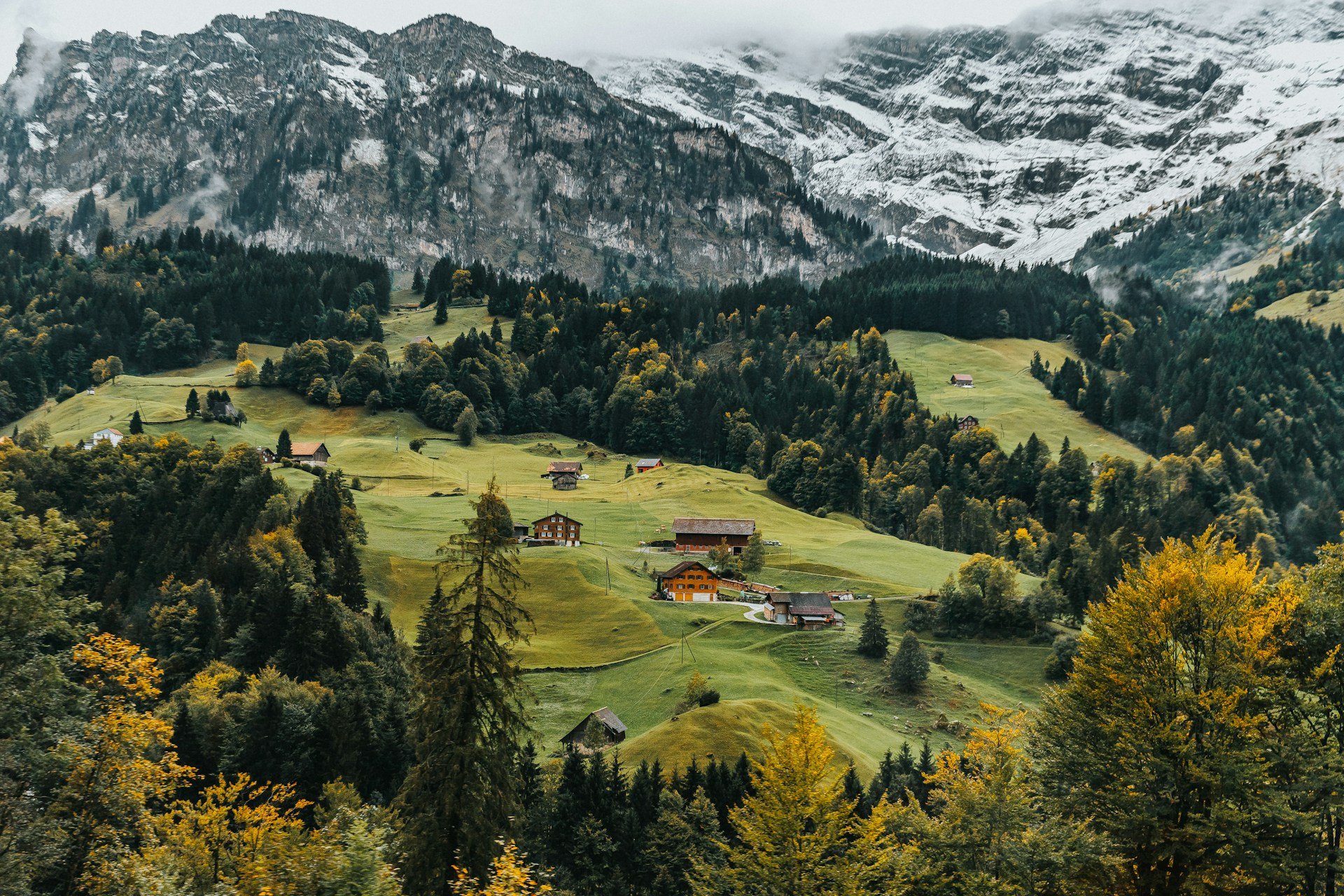
The mountains are not optional. The Alps cover 60% of Switzerland's territory and are the reason the country exists in its present form — the passes and valleys shaped the trade routes, the political alliances, and the defensive geography that made an independent Switzerland possible. Walking through an Alpine valley and looking at the scale of what surrounds you makes the price of the cable car ticket feel logical.
Switzerland at a Glance
A History Worth Knowing
Switzerland's existence as an independent state is, from a certain angle, a geographic argument. The Alps created natural barriers that made the territory difficult to conquer and easy to defend, and the communities that developed in the Alpine valleys found that cooperation with neighboring valleys was more useful than competition. The Federal Charter of 1291 — the founding document of the Swiss Confederation, signed by three forest cantons around Lake Lucerne — is celebrated on August 1 as the national holiday, though historians note that the actual consolidation of anything recognizable as Switzerland took several more centuries.
The Swiss Confederation spent the 14th and 15th centuries expanding through military alliance and decisive battlefield victories against the Habsburgs and the Burgundians under Charles the Bold. Swiss infantry — disciplined, pike-armed, and willing to fight pitched battles with professional armies — became the most feared military force in Europe. Swiss mercenaries served the French crown, the papacy, and every other power willing to pay. The Papal Swiss Guard, established in 1506, still guards the Vatican today — 135 men in Renaissance uniforms, which is simultaneously one of history's oldest continuous military deployments and one of its most visually incongruous.
The Reformation split the Confederation in the 16th century. Zürich had Ulrich Zwingli, who carried Protestant reform further than Luther and died in battle defending it in 1531. Geneva had John Calvin, whose theocratic city-state became the most influential Protestant model for the English Puritans, the Scottish Presbyterians, and the Dutch Reformed Church. The religious wars that tore Germany apart largely spared Switzerland through pragmatic compromise between Protestant and Catholic cantons — an early demonstration of the Swiss talent for managing internal difference without destroying the whole structure.
Swiss neutrality as a formal principle dates to the Congress of Vienna in 1815, when the European powers recognized Swiss permanent neutrality as a stabilizing element in the post-Napoleonic order. It has been maintained through two World Wars, through the Cold War, and into the present — though it has never been entirely neutral in character. Switzerland's banking secrecy laws, developed in the 1930s partly to protect Jewish assets from Nazi confiscation, later became a mechanism for tax evasion and money laundering by governments, corporations, and individuals across the world, a history that Swiss banks and the Swiss government are still reckoning with. The country joined the United Nations only in 2002 — late enough that it was the last European nation to do so.
The 19th and 20th centuries brought industrialization, watchmaking, chemicals, precision engineering, and banking to produce one of the world's highest standards of living. The Red Cross was founded in Geneva in 1863 by Henry Dunant, a Swiss businessman horrified by the treatment of wounded soldiers at the Battle of Solferino. The Geneva Conventions, the international humanitarian law that governs armed conflict, were negotiated here. The World Health Organization, the World Trade Organization, and dozens of other international bodies are headquartered in Geneva — making a small landlocked country one of the centers of global governance by accident of history and strategic neutrality.
Switzerland's political system is one of the most direct democracies in the world. Citizens vote on referendums multiple times per year at federal, cantonal, and municipal levels on everything from infrastructure spending to constitutional amendments. The system requires genuine civic engagement and produces a political culture that is simultaneously conservative (change happens slowly) and genuinely responsive (if enough citizens sign a petition, the question goes to a national vote). The result is a country that is extremely well-managed, moderately resistant to rapid change, and deeply invested in the idea that governance is a civic responsibility shared by all.
Three forest cantons sign the founding document of the Swiss Confederation at Lake Lucerne. August 1 becomes the national holiday.
Pope Julius II establishes the Swiss Guard to protect the Vatican. The same institution, in similar uniforms, still functions today.
Zwingli in Zürich, Calvin in Geneva. Switzerland becomes Protestant reform's most influential laboratory. The religious split is managed without destroying the Confederation.
Congress of Vienna formally recognizes Swiss neutrality. The principle that will guide Swiss foreign policy through two world wars is codified.
Henry Dunant establishes the International Committee of the Red Cross in Geneva. The Geneva Conventions follow. International humanitarian law is born here.
Swiss women gain the federal right to vote — one of the last countries in Europe to do so. The last canton to extend cantonal voting rights to women did so in 1990.
Switzerland joins the United Nations — the last European nation to do so, after a referendum. The world's most prominent neutral state finally joins the main international body.
Top Destinations
Switzerland is small enough to cross by train in four hours but varied enough that a two-week trip can feel like visiting several countries. The linguistic regions genuinely shift the experience: German-speaking Zürich and Bern feel like a different country from French-speaking Geneva and Lausanne, which feels different again from Italian Lugano and Locarno in the south. Build a route that crosses these boundaries intentionally rather than staying in one region and missing the others.
Zürich
Switzerland's largest city is not the official capital (that's Bern) but functions as the country's economic and cultural heart. The old town — Altstadt — runs along both banks of the Limmat River on a medieval street plan that resists efficiency in the best way. The Kunsthaus Zürich, recently expanded, has one of Europe's finest collections of modern art. The lake — Zürichsee — stretches 40 km south and is swimmable from the city's public lidos (Flussbad) from May to September, which is exactly as civilized as it sounds. The bahnhofstrasse shopping street is one of the world's most expensive commercial strips; the Bürkliplatz flea market on Saturday mornings at the bottom of it costs nothing. Allow two to three days. The city is denser and more interesting than its financial reputation suggests.
Zermatt
The Matterhorn is 4,478 meters of pyramidal rock that looks exactly like a mountain is supposed to look, which is why it appears on Swiss chocolate boxes, on the logo of Toblerone, and in the mental image of "Alps" for most of the world. The town of Zermatt below it is car-free — electric taxis only — which keeps the air clear and the sound level down in a way that amplifies the sense that you are somewhere genuinely different. The Gornergrat railway takes you to 3,089 meters with the Matterhorn directly in front. The hiking from the Klein Matterhorn cable car (Europe's highest at 3,883m) in summer covers terrain that will recalibrate your sense of scale. Book accommodation and cable cars months ahead in summer and winter season.
Interlaken & the Bernese Oberland
The town of Interlaken sits between Lake Thun and Lake Brienz and is the gateway to the most photographed mountain scenery in Switzerland: the Eiger, Mönch, and Jungfrau. The Jungfraujoch — "Top of Europe" at 3,454m, reached by cogwheel railway through the mountain — is genuinely extraordinary and genuinely expensive (CHF 200+). The hiking from Grindelwald and Wengen below the north face of the Eiger is accessible to any reasonably fit walker and produces views that the cable car delivers faster but less satisfyingly. The Lauterbrunnen valley — 72 waterfalls including the 300m Staubbach — is one of the most dramatic valley walks in the Alps. It also inspired J.R.R. Tolkien's vision of Rivendell, which is relevant context for the feeling it produces.
Geneva
Geneva is where Switzerland's neutrality became institutional: the Red Cross, the UN European headquarters, 40 international organizations, and 180 diplomatic missions occupy a city of 200,000 people. The Jet d'Eau — a 140-meter water jet in the middle of the lake — is the most visible landmark and completely inexplicable to first-time visitors. The Old Town is built on a hill above the lake with the Cathedral of St. Pierre (where Calvin preached) at its center. The CERN particle physics laboratory, where the World Wide Web was invented in 1989 and the Higgs boson was discovered in 2012, is on the French border 8 km from the city center and runs free public tours.
Bern
The official Swiss capital is a UNESCO-listed medieval old town built on a peninsula in the River Aare — a horseshoe bend that made the city naturally defensible and gives it a dramatic topography. The covered arcades (Lauben) run for 6 km along the main streets, meaning you can walk from one end of the old town to the other in the rain without an umbrella. The Zytglogge clock tower, built in the early 13th century, has an elaborate astronomical clock mechanism that performs at four minutes before each hour. The Federal Palace (Bundeshaus) is open for guided tours and the roof terrace has the best view of the Alps from any Swiss city. The Bärenpark (Bear Park) keeps live bears — the heraldic animal of Bern — in a riverside enclosure that is more naturalistic than its name suggests.
Lucerne
The most visited city in Switzerland after Zürich, and with good reason. The Chapel Bridge (Kapellbrücke), a 14th century covered wooden footbridge across the Reuss, is the country's most photographed structure — partly burned and rebuilt, still largely original. The old town above it is genuinely intact medieval architecture. The mountains around Lake Lucerne — Pilatus, Rigi, Titlis — are all accessible by boat and cable car or cogwheel railway. The combination of lake, medieval city, and immediate Alpine access makes Lucerne a useful base for a three-day exploration of the region. It is also very crowded with day-trippers from Zürich and Basel — arrive by 8am or stay overnight to experience the city without the tour groups.
Ticino: Lugano & Locarno
Cross the Gotthard Pass and Switzerland becomes Italy without the complications of actually being Italy. Lugano on its lake, Locarno at the northern end of Lake Maggiore, palm trees on Swiss soil, piazzettas, espresso at CHF 4, risotto, polenta, and a pace of life several notches more relaxed than German-speaking Switzerland. The Bernina Express enters from the north through one of the most dramatic alpine rail routes in the world. The Verzasca Valley — the one from the James Bond film bungee jump scene — is 30 minutes from Locarno by bus and has the clearest river water in Europe. The Locarno Film Festival in August is the third-oldest in the world and screens outdoors on the Piazza Grande for 8,000 people.
Glacier Express: Zermatt to St. Moritz
The Glacier Express is marketed as "the world's slowest express train" — 291 km in 8 hours at an average speed of 36 km/h through 291 bridges, 91 tunnels, and the Oberalp Pass at 2,033m. The dining car serves three-course meals with panoramic windows. The scenery passes from the Matterhorn's valley through the Rhine Gorge and the Engadin valley to St. Moritz in Graubünden. It is expensive (CHF 100–150 supplement on top of the pass, table reservation required), genuinely spectacular, and one of the great train journeys on earth. The parallel Bernina Express from Chur or St. Moritz to Tirano in Italy is shorter (4 hours), UNESCO-listed, and many people find more dramatic.
Culture & Etiquette
Switzerland's social culture is formal, punctual, and quiet in ways that visitors from more expressive cultures can initially read as coldness. It isn't — it's a culture that values privacy, respects personal space, and maintains clear distinctions between public and private behavior. Neighbors who have lived next to each other for years may not be on first-name terms. Conversations between strangers on trains are not the norm. The Swiss are neither unfriendly nor warm in the way that Italian or Spanish culture is warm. They are correct and reliable, which turns out to be its own form of hospitality once you calibrate to it.
The language situation requires a note: Swiss German speakers do not speak standard German in daily life. They speak Schweizerdütsch — a collection of regional dialects so distinct from standard German that many Germans from Germany struggle to understand them. The written language is standard German. The spoken language is something else. If you speak German, the Swiss will switch to standard German (Hochdeutsch) for you, but it will feel slightly formal to them — the same way speaking very carefully enunciated English would feel to a native English speaker.
Not five minutes early. Not three minutes late. On time. Swiss trains are on time; Swiss social arrangements are on time; Swiss business meetings are on time. Arriving late without warning is treated as a statement rather than an oversight. The Swiss have a phrase: to be punctual is to show respect.
In German-speaking Switzerland: "Grüezi" to individuals, "Grüezi mitenand" to groups. In French-speaking Switzerland: "Bonjour." In Italian: "Buongiorno." The greeting when entering a small shop, a cable car gondola, or a mountain restaurant is not optional — it is the social baseline of acknowledging shared space.
Sunday is genuinely quiet in Switzerland. No lawn mowing, no power tools, no loud parties. Recycling centers and bottle banks have specific hours. The noise ordinances are taken seriously by neighbors who have lived next to each other for 30 years and intend to for 30 more.
The Swiss Travel Pass or regional day pass covers trains, buses, boats, and many cable cars on a single ticket. Buying single tickets for every journey is significantly more expensive and wastes time at machines. Get the pass before your first journey.
Service charges are included in Swiss restaurant bills. A round-up of the bill (rounding CHF 47 to CHF 50) is the standard tip and is perfectly appropriate. Leaving nothing is fine; leaving 15–20% is unusual and unnecessary.
It is not. Switzerland has bilateral agreements with the EU and is part of Schengen, but it is not an EU member. It uses the Swiss franc, not the euro. Euros are accepted at some tourist facilities and in border areas, but at unfavorable exchange rates. Use francs or card for all purchases.
Switzerland uses the Type J plug — three round pins in a triangular arrangement — which is not compatible with the standard European Type F (Schuko) plug. You need a specific Swiss adapter. Most hotels provide them; check before packing only a standard European adapter.
The cable car to the Jungfraujoch on a clear summer day has a waiting time. The Glacier Express dining car is fully booked. The mountain hotel with the view was reserved three months ago. Switzerland rewards planning and punishes the assumption that things will work out on the day.
Swiss hiking trails are color-coded: yellow posts for easy walks, white-red-white for mountain trails (Bergwege), and white-blue-white for high alpine routes requiring scrambling experience. The color codes are meaningful. Wandering onto a white-blue-white route in hiking shoes rather than mountain boots is how rescues happen.
Driving on Swiss motorways requires an annual vignette (CHF 40, valid for the calendar year). It's available at border crossings, petrol stations, and online. Cameras automatically check for it. The fine for missing it is CHF 200 plus the cost of the vignette.
Watchmaking Culture
Switzerland produces about 60% of the world's watch exports by value. The Jura mountains between Geneva and Basel — the "Watch Valley" — contain towns where every other building is connected to horology: Neuchâtel, La Chaux-de-Fonds (UNESCO-listed as a planned watchmaking city), Le Locle. The Musée International d'Horlogerie in La Chaux-de-Fonds is the best watch museum in the world. The precision culture extends beyond timekeeping — it is a national aesthetic and a professional standard applied to engineering, transport, and banking alike.
Direct Democracy
Switzerland votes several times a year on binding referendums at every level of government. Citizens can force a vote on any law passed by parliament (with 50,000 signatures) or propose constitutional amendments (100,000 signatures). This means Swiss political culture is one of the most participatory in the world. It also means change is slow, contested, and requires genuine public consensus. The postal ballot papers that Swiss citizens receive multiple times annually represent genuine legislative power in private hands.
Hiking Culture
Hiking (Wandern in German, randonnée in French) is the national outdoor pursuit at a level that makes Allemansrätten-focused Sweden look casual. The 65,000 km of marked trail network is maintained at national expense. Hiking guides, maps, and trail apps are produced to a quality standard. The mountain postbuses connect trailheads to towns on a timetable that assumes people are walking between them. Joining this culture as a visitor — even on a short afternoon walk — is one of the best decisions you can make in Switzerland.
Swiss Festivals
The Fasnacht carnival in Basel (February/March) is the largest and most elaborate carnival in Switzerland — three days of continuous costumed processions beginning at 4am with a total darkness ceremony (Morgestraich) that is one of the most extraordinary public rituals in Europe. The Montreux Jazz Festival in July is one of the world's great music festivals. The Paléo festival in Nyon (July) attracts 230,000 people. The Fête de l'Escalade in Geneva (December) commemorates a 1602 Savoyard attack repelled by a housewife with a pot of hot soup. All of these are genuinely worth timing a trip around.
Food & Drink
Swiss cuisine suffers from an international image problem that the actual food does not deserve. "Swiss food" in most people's minds means fondue and chocolate and not much else. The reality is a country of four culinary cultures with distinct regional traditions: the hearty Alpine cooking of German-speaking Switzerland, the French bistro culture of the west, the full Italian kitchen of Ticino, and the Romansh valley traditions of Graubünden that date to pre-Roman times.
The fondue and raclette are not marketing constructs — they are genuinely good, deeply communal, and make complete sense in the Alpine context. Cheese fondue shared around a pot on a mountain restaurant terrace at 2,000 meters after a morning's hiking is one of the specific pleasures that Switzerland offers and that cannot be replicated elsewhere. Order it in October through April. In July, it is still available and still good but feels slightly off-season.
Fondue & Raclette
Fondue: Gruyère and Vacherin Fribourgeois melted in a caquelon with white wine and kirsch, eaten by dipping bread on long forks. Raclette: a half-wheel of raclette cheese melted under a grill or on a special device, scraped onto boiled potatoes with pickled onions and gherkins. Both are communal, warming, and correct. The Café de Grütli on the Rue de l'Hôtel-de-Ville in Gruyères makes fondue in the village where the cheese is produced. This is the canonical version.
Rösti
The Swiss German potato dish — grated potato, pan-fried in butter until crispy outside and tender within — is so central to Swiss German identity that the linguistic divide between German and French Switzerland is called the Röstigraben (rösti ditch). At its simplest it is a side dish. At its best, served with eggs, applesauce, and bacon in a mountain restaurant at 9am after the first chairlift, it is a complete experience. The version at Kronenhalle in Zürich — where Picasso, Joyce, and Chagall used to eat — costs CHF 28 and is flawless.
Zürcher Geschnetzeltes
Zürich's signature dish: thinly sliced veal in a cream and white wine sauce with mushrooms, served with rösti. Available throughout German-speaking Switzerland at every price point. The version at Zeughauskeller — a cavernous cellar restaurant under the Zürich armory, founded in 1487 — is served in portions that require planning the afternoon around them and costs CHF 42. Worth it entirely.
Lake Fish
The Swiss lakes produce perch (egli), pike-perch (zander), trout (forelle), and whitefish (felchen) that are served fried in butter in lakeside restaurants from Lucerne to Geneva. The perch fillets at a lake restaurant in Estavayer-le-Lac on Lake Neuchâtel — small, firm, lightly floured and fried in butter, eaten with a glass of local chasselas white wine and a view of the Bernese Alps — is one of the specific pleasures of Swiss food culture at a price (CHF 35–45 for a portion) that seems high until you're eating it.
Chocolate
Swiss chocolate — Lindt, Sprüngli, Läderach, Cailler — is not a souvenir industry. The Sprüngli confiserie in Zürich's Paradeplatz (the same family as Lindt, split in 1845) makes fresh truffles (Luxemburgerli) that need to be eaten within days and cannot be shipped. Läderach, founded in the Glarus canton, does single-origin bars from specific cacao origins at a quality level that tastes like an argument against supermarket chocolate. The Maison Cailler factory in Broc, near Gruyères, offers tours and has an educational exhibition on Swiss chocolate history that is excellent even for non-children.
Swiss Wine
Switzerland produces about 100 million liters of wine per year, exports almost none of it, and drinks nearly all of it domestically — which is why Swiss wine is almost unknown internationally and almost universally good. The Chasselas white from Vaud and the Valais (served as Fendant in the German-speaking region) is the default wine in western Switzerland: pale gold, slightly petillant, bone dry, and calibrated to the lake fish and fondue it accompanies. Pinot Noir (Blauburgunder) from Graubünden and the shores of Lake Zurich is elegant and restrained. Both are available in every supermarket for CHF 8–15. Both are better than you'd expect for that price.
When to Go
Switzerland is a four-season destination with genuinely different experiences in each season, and the question of when to go is really a question of what you want. Summer hiking, winter skiing, spring wildflowers under snow, and autumn color in the valleys all make separate cases. The one thing to avoid: the shoulder months of November and early December, when the ski season hasn't started, the hiking is limited by snow on the high passes, and many mountain facilities close. Come in summer, winter, or early autumn — not between them.
Summer
Jun – SepHiking, lake swimming, Alpine meadows in flower, mountain cable cars running full schedules, outdoor restaurant terraces above glaciers. The cities are excellent and the crowds, while present, are manageable before 9am at any major attraction. July and August are fully booked for accommodation — plan early.
Winter
Dec – MarSkiing at Zermatt, Verbier, St. Moritz, Davos. Snow-covered villages. Fondue in front of fireplaces. The Fasnacht carnival in Basel in February/March. The winter light on the Matterhorn and Eiger is different from summer — sharper, cleaner, and more dramatic. Book December–January well in advance. February half-term is when European ski crowds peak.
Spring
Late Apr – MaySnow still on the high peaks while wildflowers bloom in the valley meadows — one of the most dramatic visual contrasts in Alpine scenery. Fewer crowds than summer. Lower prices. Many cable cars resume from late May. The Geneva lake is mirror-flat and the mountains reflect in it on clear mornings in a way that is slightly unreal.
Autumn
Sep – OctSeptember is essentially still summer at lower elevations with thinner crowds. October brings color to the valley forests and the first snow dusting on the peaks. The wine harvest is in October in the Valais and Vaud regions. Most hiking routes are open until mid-October. Cable cars begin closing from late October.
Trip Planning
One week is the minimum to see Switzerland with any depth. Two weeks allows a proper linguistic and geographic journey: Zürich to Bern to the Bernese Oberland to Zermatt to Geneva to Ticino and back. The Swiss Travel Pass covers all of this on one ticket and is almost certainly worth buying for any trip of four or more days. Do the math at swisstravelsystem.com before purchasing — some regional passes for specific areas (the Bernese Oberland pass, the Tell-Pass for the Lucerne region) are cheaper for shorter stays in one area. The key rule: always calculate your expected journeys before buying, because the pass is genuinely cheaper for most multi-city itineraries and genuinely not worth it for a single-city stay.
Zürich
Day one: old town in the morning, Kunsthaus in the afternoon, Flussbad river swim if summer. Dinner at Zeughauskeller or Kronenhalle for the institution. Day two: day trip to Rhine Falls at Schaffhausen (the largest waterfall in Europe by volume, 30 minutes by train) and medieval Stein am Rhein. Return to Zürich for the night.
Jungfrau Region
Train to Interlaken (2h). Base in Grindelwald or Wengen. Day one: Jungfraujoch (book ahead, clear morning essential — check forecast the night before and be prepared to reschedule). Day two: Lauterbrunnen valley walk or the Eiger Trail from Eigergletscher. Fondue at the mountain restaurant above the village in the evening.
Zermatt
Train from Interlaken via Brig (2.5h). Arrival in Zermatt by early afternoon. Walk up to the Gornergrat station for the first Matterhorn view. Day two: Gornergrat railway for the panoramic sunrise, Klein Matterhorn cable car for altitude, afternoon walk on the Five Lakes Trail (Fünf-Seenweg) — a 3-hour circular route with a different reflection of the Matterhorn in each of five Alpine lakes.
Return to Zürich
Train back via Visp and Bern (3.5h). Stop in Bern for 2 hours: walk the Lauben arcades, the Zytglogge clock, the Federal Palace terrace for the Bernese Alps view. Evening train to Zürich for the flight home.
Zürich & Eastern Switzerland
Three days in Zürich and surroundings. Day trip to Appenzell — the smallest canton, famous for Appenzeller cheese, traditional folk art, and the last place in Switzerland to give women cantonal voting rights (1990). The landscape around Appenzell, with its rolling hills and decorated facades, is one of the most distinctive in Switzerland.
Lucerne
Two days at Lake Lucerne. Day one: Kapellbrücke at 7am, Lake Lucerne steamer to Vitznau, Rigi mountain railway to the summit (Queen Victoria ascended here in 1868 on the first rack railway in Europe). Day two: Mount Pilatus cable car from Kriens, circular route down by cogwheel railway to Alpnachstad and boat back. Dinner at the Bürgenstock resort if splurging.
Bernese Oberland
Interlaken base, three days: Jungfraujoch on a clear morning, Lauterbrunnen valley, the mountain village of Mürren (car-free, 1,650m, accessible only by cable car and mountain train). Hike the Allmendhubel circuit above Mürren for the best Eiger north face view without a cable car supplement. Fondue dinner at a farmhouse restaurant if the host is willing.
Valais: Zermatt & Saas-Fee
Zermatt for two nights with the Five Lakes Trail and Gornergrat. Day trip by postbus to Saas-Fee — Zermatt's less-visited neighbor, also car-free, ringed by thirteen 4,000m peaks and with a quieter atmosphere than Zermatt's ski resort intensity. The glacier walk from the Mittelallalin revolving restaurant (highest in the world at 3,500m) is extraordinary.
Geneva & Vaud
Train from Zermatt via Brig to Geneva (3h). Two nights in Geneva: CERN tour (book ahead, free), ICRC Museum, Old Town. Day trip to Montreux (Freddie Mercury statue, Chillon Castle on the lake — occupied continuously since the Bronze Age and the basis of Byron's "Prisoner of Chillon"). Wine tasting in the Lavaux vineyard terraces (UNESCO-listed) between Lausanne and Montreux. Fly home from Geneva.
German-Speaking Switzerland
Zürich, Basel (the Art Basel city, with the Kunstmuseum Basel having one of Switzerland's finest collections), and Bern. Basel's Fasnacht in February/March if timing allows. The Aare swim through Bern's old town in summer. Day trip to the Emmental valley — the actual place where Emmental cheese is made, with wooden farmhouses and rolling hills that look like a children's book illustration.
Alpine Heart: Lucerne, Interlaken, Zermatt
Four days covering the central Alpine circuit: Lucerne and Rigi, Interlaken and the Jungfraujoch, Grindelwald and the Eiger Trail, Zermatt and the Five Lakes Walk. The Glacier Express from Zermatt to St. Moritz on the last day — book the dining car reservation (CHF 30–50 per person). Dinner in St. Moritz as an act of anthropological research.
Graubünden
St. Moritz and the Engadin valley. The Bernina Express from St. Moritz to Tirano (UNESCO World Heritage rail journey, 4 hours, bring a camera for the Brusio Viaduct spiral). The Via Engiadina long-distance hiking trail. Mustair monastery with its 9th century Carolingian frescoes — one of the least-visited UNESCO sites in Switzerland and one of the most extraordinary.
Italian Switzerland: Ticino
Four days in the Italian-speaking south. Locarno, Lugano, the Verzasca Valley river swimming, the Centovalli railway to Domodossola in Italy (round trip, one of Europe's most beautiful narrow-gauge journeys). The Locarno Film Festival in August with its open-air screenings for 8,000 people on the Piazza Grande.
French Switzerland: Geneva, Lausanne, Valais
Geneva and CERN, Lausanne and the Olympic Museum, the Lavaux vineyard terraces by bicycle, Gruyères for cheese fondue in the village, Château de Chillon. One night at a lakeside hotel in Montreux or Vevey — Charlie Chaplin is buried in Corsier-sur-Vevey, 3 km from Montreux, and the Chaplin's World museum in his former home is one of the best museum experiences in Switzerland. Fly home from Geneva.
Vaccinations
No mandatory vaccinations to enter Switzerland. Tick-borne encephalitis (TBE) vaccination is recommended for hikers spending significant time in forested areas below 1,500m — Switzerland has TBE risk in certain woodland areas. Routine vaccines should be up to date. No malaria risk.
Full vaccine info →Connectivity
Switzerland is not in the EU, so EU roaming may not apply automatically — check your operator before traveling. Swiss SIM cards (Sunrise, Salt, Swisscom) are available at airports and railway stations. The SwitzerlandMobility app is essential for hiking: offline maps, trail difficulty ratings, and public transport connections to trailheads.
Get Europe eSIM →Power & Plugs
Switzerland uses the Type J plug — three round pins unique to Switzerland. Standard European Type F (Schuko) adapters do not fit. Buy a Swiss adapter before you travel or at Zürich Airport on arrival. Some hotels provide them; confirm when booking. Most power strips in Switzerland accept both Type J and Type F.
Language
German east, French west, Italian south. English is widely spoken throughout — Switzerland's multilingual culture makes English a common bridge language. In tourist areas and cities, you'll have no communication difficulties. In remote mountain villages, the local language (often a Swiss German dialect) may be the only option. Google Translate handles it.
Swiss Travel Pass
The Swiss Travel Pass covers all SBB trains, PostBus routes, urban transit, most lake boats, and free entry to 500+ museums. Prices run CHF 244 (3 days) to CHF 689 (15 days) for 2nd class. Calculate at swisstravelsystem.com. Almost always worth it for trips of 5+ days covering multiple regions. Panoramic train supplements (Glacier Express, Bernina Express) require separate reservation.
Travel Insurance
Mountain rescue helicopter evacuation in Switzerland costs CHF 3,000–10,000 without insurance. Swiss mountain rescue (Rettungsflugwacht REGA) is excellent and operates across the Alps year-round. Travel insurance with mountain rescue cover is strongly recommended for any hiking trip above the valley floor. REGA memberships (CHF 40/year) cover rescue costs for Swiss residents — visitors need insurance.
Transport in Switzerland
Switzerland's transport system is the defining feature of traveling here and the clearest expression of the country's values. The trains are never late in the way other countries' trains are never late — they are on time at the second, and connections timed at 4 minutes work because the system is designed for them to work. The PostBus network connects villages that trains don't reach. The lake steamers connect lakeside towns on timetables coordinated with the trains. The mountain cable cars connect to the postbuses at the valley station. The whole system is one integrated network governed by a single timetable. It is the best public transport system in the world.
The Swiss Travel Pass is the traveler's key to this system. Buy it before you arrive (it's available through SBB's international partners). Calculate whether it's worth it at swisstravelsystem.com. For any trip covering more than two or three destinations, it almost always is.
SBB Intercity & IC Trains
CHF 30–120/routeThe main rail network connecting Zürich, Bern, Basel, Geneva, Lucerne, and regional centers. Fast, comfortable, on time. Book at sbb.ch. Superfare tickets (non-refundable, limited availability) are significantly cheaper than full-price tickets if bought in advance.
Mountain Railways & Cable Cars
CHF 30–200/returnCogwheel railways, funiculars, aerial gondolas, and cable cars reach almost every Alpine destination. The Jungfraujoch railway (CHF 200+), Gornergrat (CHF 90+ return from Zermatt), and Pilatus cogwheel (CHF 72 from Kriens) are the most famous. All are covered by or discounted with the Swiss Travel Pass.
PostBus (Postauto)
CHF 5–30/routeThe yellow PostBus network reaches 900 communities that trains don't serve — Alpine villages, trailheads, valley farms. Fully integrated with the rail timetable. Covered by Swiss Travel Pass. The postbus driver waits at the station for arriving trains. This is not metaphor.
Lake Steamers
CHF 15–60/routePaddle steamers and motor boats connect lakeside towns on Lakes Lucerne, Geneva, Zürich, Constance, Brienz, Thun, and Maggiore. Covered by Swiss Travel Pass. The Lake Lucerne full day steamer tour (Vierwaldstättersee) is the most scenic. Lake Geneva crossings add options for Montreux, Lausanne, and the Lavaux vineyards.
Scenic Railways
CHF 100–200 supplementGlacier Express (Zermatt to St. Moritz, 8h), Bernina Express (Chur/St. Moritz to Tirano, 4h UNESCO route), Goldenpass (Montreux to Interlaken to Lucerne). All require seat reservations (CHF 10–50) on top of the travel pass. Book at sbb.ch weeks ahead in summer.
Car Rental
CHF 60–120/dayRarely worth it for most Switzerland trips — public transport reaches nearly everywhere. Useful for rural Graubünden, the Jura, and if you're entering or exiting Switzerland by road. Motorway vignette required: CHF 40, available at border crossings and petrol stations. Mountain passes close in winter.
Cycling
CHF 20–40/day rentalSwitzerland Mobility (schweizmobil.ch) runs a national cycle route network across the country. PubliBike city bikes operate in most Swiss cities. The Lavaux vineyard route and the Rhone Valley cycling path are the most scenic lowland routes. Mountain biking trails are extensive and difficulty-rated.
Taxi / Uber
CHF 3–5/kmUber operates in Zürich, Geneva, Basel, and Bern. Standard taxis are metered and expensive by any comparison — CHF 20–35 for a short city journey is normal. In Zermatt and other car-free villages, electric taxi prices are set rates worth confirming before getting in.
Accommodation in Switzerland
Switzerland's accommodation reflects the same quality-to-price relationship as everything else: it costs significantly more than equivalent quality elsewhere in Europe, and the quality is genuinely higher. A CHF 200/night hotel in Zermatt gives you something materially better than a €100/night hotel in Prague. The mountain hotels are the particular Swiss contribution to hospitality — a category that includes rustic mountain huts at 2,000 meters with panoramic windows and a wood-paneled dining room serving three-course dinners, and belle époque grand hotels on lake shores that have been hosting European aristocracy since the 1870s. Both categories are worth experiencing.
Mountain Hotels
CHF 150–500/nightThe Swiss mountain hotel tradition runs from simple Alpine inns (Berggasthäuser) with shared facilities at CHF 50–80/person to full-service resort hotels above the snowline. Staying at altitude — in Mürren, Wengen, Zermatt, or above Davos — adds the experience of waking to mountain views and walking to the gondola without transport. The best often book out months ahead.
Grand Hotels
CHF 400–1,200/nightThe 19th century grand hotel tradition — Beau-Rivage in Geneva (1865), Palace Hotel in Lucerne (1906), Kulm Hotel in St. Moritz (1856, where curling was reputedly invented) — still functions. These are genuinely historic buildings that hosted Queen Victoria, Tolstoy, and half of Europe's royalty. The prices reflect the history. The quality generally justifies them.
City Hotels
CHF 130–350/nightZürich, Geneva, Basel, and Bern all have solid mid-range hotel options in the CHF 150–250 range. Design hotels dominate in Zürich (25hours Hotel Zürich West, Marktgasse Hotel in the old town). Business hotels near main stations serve the financial industry. Book at least three weeks ahead for summer and major conference weeks.
SAC Huts & Budget
CHF 40–90/personThe Swiss Alpine Club (SAC) operates 150+ mountain huts across the Alps, offering dormitory accommodation and dinner at genuinely reasonable prices for Switzerland. They are primarily for multi-day hikers and climbers. The Swiss Youth Hostel network (SJH) runs well-maintained hostels in major cities and some scenic locations. Both categories require advance booking in summer.
Budget Planning
Switzerland is the most expensive country in this travel guide series, and there is no strategy that makes it cheap. A beer costs CHF 7–10. A sit-down restaurant lunch is CHF 22–40. A one-way train from Zürich to Bern is CHF 51 full price. There is no budget Switzerland — only more and less expensive ways to experience an expensive country. The Migros/Coop supermarket strategy, SAC huts, and the Swiss Travel Pass are the primary cost-management tools. Camping (well-developed network) is viable in summer. Self-catering reduces food costs significantly. But the cable cars, the mountain railways, and the hotels near the iconic views cost what they cost.
Note on currency: Switzerland uses the Swiss franc (CHF), which trades close to but not identically to the euro. As of 2026, approximately 1 EUR = 0.94 CHF and 1 USD = 0.89 CHF — meaning the Swiss franc is stronger than both. All prices in Switzerland are in CHF.
- Youth hostel dorm or SAC mountain hut
- Migros/Coop self-catering most meals
- Swiss Travel Pass for all transport
- Free hiking under trail network
- One restaurant meal every other day
- 3-star hotel or mountain guesthouse
- Restaurant lunch, self-catered dinners
- Swiss Travel Pass + cable car supplements
- Major attraction entries (Jungfraujoch, etc.)
- Wine and occasional evening out
- 4-star hotel or mountain resort
- Full restaurant dining, Swiss wine
- Glacier Express dining car
- Private guided experiences
- Scenic rail panorama supplements
Quick Reference Prices (CHF and approx. €)
Visa & Entry
Switzerland is a Schengen Area member but not an EU member. This means EU citizens enter freely with a national ID card, and visa-exempt non-EU nationals (US, UK, Canada, Australia, New Zealand) can enter without a visa for up to 90 days within any 180-day Schengen period. The 90-day Schengen allowance is shared across all 27 Schengen countries — days in France, Germany, or Italy count toward your total, even though those are EU countries and Switzerland is not.
ETIAS is required from 2025 for visa-exempt non-EU nationals entering any Schengen country including Switzerland. Apply online before travel — it costs €7, is valid for three years, and takes minutes to complete. Airlines may deny boarding without it.
Switzerland is Schengen but not EU. Most Western passport holders qualify for visa-free entry. ETIAS required from 2025. Check your specific nationality at the Swiss State Secretariat for Migration before booking.
Family Travel & Pets
Switzerland is an excellent family destination for any family that is prepared for the cost and excited by mountains, trains, and outdoor experiences. The combination of cogwheel railways, cable cars, mountain panoramas, and genuinely swimmable Alpine lakes produces an experience that holds children's attention in a way that city-focused trips often don't. Swiss children grow up hiking and skiing and the infrastructure assumes active outdoor families — trail difficulty ratings, children's ski schools, and family ticket pricing (children under 6 travel free on most Swiss transport) all reflect a culture organized around outdoor family life.
Mountain Railways
For children, the experience of a cogwheel train climbing at improbable angles into the mountains, or a cable car rising over a glacier, is inherently compelling at any age. The Pilatus cogwheel railway (the steepest in the world at 48% gradient) and the Jungfraujoch journey through the mountain interior are engineering spectacles that generate genuine awe. Plan one or two signature mountain transport experiences per trip and the children will remember them longer than any city museum.
Lake Swimming
Switzerland's lakes — Zürich, Geneva, Lucerne, Thun, Brienz, Maggiore — are swimmable in summer from public beaches (Strandbäder) and free municipal lidos scattered along every shore. The water is clear, cold (18–22°C in July), and safe. The Zürichsee public pools at Strandbad Tiefenbrunnen or Mythenquai cost CHF 8 for adults, under 16 free, and are operational from May to September. Children swim in the shallow sections while adults watch the Alps reflect in the water.
Chocolate & Cheese
The Maison Cailler chocolate factory in Broc, near Gruyères (30 min by train from Fribourg), runs daily tours that end with unlimited tasting and costs CHF 15 for adults, CHF 8 for children under 12. The Gruyères cheese demonstration at the Maison du Gruyère in the village itself costs CHF 10/adult and shows the cheesemaking process live. Combining both in a day trip from Fribourg is a reliable family itinerary that ends with everyone's pockets full of samples.
Ski Schools
Zermatt, Grindelwald, Davos, Verbier, and Crans-Montana all have Swiss Ski School (SSS) programs with English-speaking instructors, dedicated beginner areas, and group lessons for children from age 4. Swiss ski school instruction is among the best in the world — patient, methodical, and accustomed to teaching in multiple languages. The cost (CHF 50–80/half-day group lesson) is high; the quality justifies it. Book before arrival, particularly in February.
Glacier Experiences
The Jungfraujoch Plateau Rosé gives children the experience of walking on a glacier at 3,454m. The Klein Matterhorn cable car at 3,883m has a glacier palace (Glacier Palace) carved inside the ice, with sculptures, ice crystals, and tunnels. Titlis glacier above Engelberg has a Glacier Cave and the world's first rotating cable car (Rotair). All are expensive. All are genuinely extraordinary for children who have never stood on a glacier.
Knie's Kinderzoo
Knie's Swiss National Circus runs the Kinderzoo in Rapperswil on Lake Zürich — a children's zoo specifically designed for close animal interaction. The circus troupe performs in Swiss cities on a rotating schedule. The Papiliorama tropical butterfly garden in Kerzers near Bern is an excellent wet-weather option. The Swiss Museum of Transport (Verkehrshaus) in Lucerne is the most visited museum in Switzerland and makes an excellent family day.
Traveling with Pets
Switzerland has clear and consistently enforced pet entry requirements. Switzerland is not an EU member, but it has bilateral agreements that make the EU pet passport valid for entry. Dogs require a microchip (ISO 15-digit), a valid EU pet passport or third-country health certificate, and up-to-date rabies vaccination. Cats and ferrets have the same requirements. Non-EU documentation needs to be checked at the border — arrive with all paperwork in order.
Within Switzerland, dogs are welcome in many outdoor spaces and on public transport. Dogs travel on trains in a carrier for free or on a leash (half price child ticket for larger dogs). The specific rules are: dogs under 30cm shoulder height travel free in carriers; dogs over 30cm on a leash pay a half-fare child ticket. Dogs are permitted on most PostBus routes and lake steamers. Many Swiss hotels, restaurants with terraces, and Alpine huts welcome dogs — confirm when booking.
Swiss hiking: dogs on leash are permitted on most marked trails. Some protected nature reserves and specific wildlife zones prohibit dogs during breeding seasons (typically April to June). Mountain pastures with grazing cattle are an issue — Swiss farmers have the legal right to shoot dogs that approach their herds without a leash. This is not theoretical. Keep dogs leashed near any livestock, always, in Switzerland.
Tick risk: TBE and Lyme disease are present in Swiss forests below about 1,500m. Apply veterinary tick prevention before any forested walk and check your dog thoroughly afterward.
Safety in Switzerland
Switzerland is one of the safest countries in the world. Violent crime rates are among the lowest in Europe. Solo women travel throughout the country — including in remote Alpine areas — without concern. The cities are safe at any hour. The main risks are environmental: mountain weather, altitude, glacial terrain, and the specific hazard of underestimating what Alpine hiking requires. These are genuinely serious risks that Swiss mountain rescue responds to hundreds of times per year, but they are entirely manageable with preparation.
Urban Safety
Zürich, Geneva, Bern, and Basel are extremely safe cities. Petty theft in tourist areas and at major train stations is the only relevant urban risk — standard precautions apply. The nightlife districts in Zürich's Langstrasse area require the same awareness as any European city after midnight.
Solo Women
Switzerland consistently ranks among the top two or three countries in the world for safety for women. Solo female travel throughout the country is comfortable at all hours. Night transport is safe and reliable.
Mountain Hazards
Weather changes fast. Altitude sickness is possible above 3,000m for some people. Glacier terrain requires experience and appropriate footwear. The Swiss color-coded trail system (yellow, white-red-white, white-blue-white) is meaningful — follow it. White-blue-white routes require mountain boots, experience, and ideally a guide for inexperienced hikers.
Altitude
The Jungfraujoch (3,454m) and Klein Matterhorn (3,883m) can cause headaches, nausea, and breathlessness in susceptible people, particularly if the ascent is rapid via cable car. Take it slowly on arrival at altitude. Drink water. If symptoms are severe, descend. Children are not more susceptible than adults but less communicative about symptoms — watch them carefully.
Avalanche Risk
In winter and spring, avalanche risk in backcountry skiing and off-piste areas is serious and managed through a daily bulletin from SLF (slf.ch). Stick to marked pistes and marked hiking routes in winter. Off-piste skiing without a local guide and avalanche safety equipment is genuinely dangerous. Swiss rescue services respond professionally; prevention is better.
Healthcare
Excellent universal healthcare system. EU citizens with EHIC have access to emergency care at Swiss public hospital rates — which are still expensive by European standards, as Switzerland's healthcare costs are high. Travel insurance with comprehensive medical and mountain rescue cover is essential for non-EU visitors and strongly recommended for EU visitors doing any Alpine activities.
Emergency Information
Your Embassy in Switzerland
Most embassies are in Bern (the federal capital). Geneva hosts UN missions and consulates for many nations.
Book Your Switzerland Trip
Everything in one place. These are services worth actually using.
The Country That Justifies the Invoice
The bill for a week in Switzerland will be higher than the bill for a week almost anywhere else you could have gone. This is fact. What is also fact: you will be looking at the Matterhorn in morning light from Riffelberg, and the invoice will seem like a reasonable negotiation. The train will arrive at 07:43:00 and depart at 07:47:00 and you will think: someone engineered this. The fondue in the mountain restaurant above the clouds will taste exactly right. The lake will be mirror-flat at 7am and you'll find yourself taking photographs you know don't adequately convey what you're seeing.
The Swiss have a concept baked into their political and social culture: Konkordanz — consensus, the system of governing by agreement across all groups rather than by the victory of one over another. It applies to their constitution, their national council, their civic life. It is also, perhaps inadvertently, a description of what Switzerland manages between its four languages, its 26 cantons, its Alpine geography, and the rest of the world: something that shouldn't work by the logic of scale or diversity, but works, quietly and exactly, every time.