
Slovenia
Alps, emerald rivers, a karst underworld, and a coast. All in a country smaller than Switzerland. You will not find a better ratio of landscape to square kilometer anywhere in Europe.
What You're Actually Getting Into
Slovenia is 20,273 square kilometers. Austria is four times larger. Switzerland is three times larger. And yet somehow, within those dimensions, Slovenia has managed to fit the Julian Alps, a karst plateau riddled with some of Europe's most spectacular caves, an emerald-green river valley that looks color-corrected in photographs but isn't, a stretch of Adriatic coastline, rolling wine hills, and a capital city compact enough to walk entirely in an afternoon. The density of genuinely different landscapes in a short drive is almost unreasonable.
The honest caveat: Slovenia has figured out it's beautiful, and so has everyone else. Lake Bled in July is not the serene Alpine escape it's marketed as. The parking lots fill by 9am. The rowing boats queue. The kremšnita cream cake costs €5 at the cafe with the best view. None of this ruins Bled — it's still extraordinary — but managing expectations around visitor volume in summer is part of planning a trip well here.
The solution is easy: go early, go in shoulder season, or go somewhere else in the same country that is just as beautiful and receives a fraction of the attention. Lake Bohinj, 30 minutes from Bled by bus, is larger, quieter, and sits directly beneath the Triglav massif. The Soča Valley, an hour west, has water so improbably turquoise that first-time visitors stop the car to confirm it's real. The Karst plateau south of Ljubljana has some of the most dramatic cave systems in Europe and a wine region that barely registers on international radar.
The biggest trip-planning mistake people make is treating Slovenia as a Lake Bled day trip from Vienna. It deserves a week, minimum.
Slovenia at a Glance
A History Worth Knowing
Slovenia's modern existence is recent enough that many of its older residents remember a different country on the same map. But the Slovenian people and their language are far older than the state. Slavic tribes settled the eastern Alpine region in the 6th century, and the Slovenian language — distinct, stubbornly preserved, and spoken by about 2.5 million people worldwide — has been continuous since then. That's a long time for a small nation to hold its linguistic ground against German, Latin, Italian, and Hungarian neighbors.
For most of the medieval and early modern period, the territory was part of the Habsburg Empire as the Duchy of Carniola, with Ljubljana as its capital. The Habsburgs left a visible imprint: Ljubljana's old town architecture, the Baroque fountains, and the practical efficiency that Slovenians still bring to infrastructure and organization all carry some of that Central European administrative DNA.
The early 19th century brought a Slovenian national awakening. The poet France Prešeren, writing in Slovenian in the 1830s and 1840s when German was the prestige language of the region, produced work of genuine literary power. His poem Zdravljica — a toast to freedom, brotherhood, and the hope that all nations might live in peace — became the national anthem after independence. The final verse, selected as the anthem, does not mention God, king, or military glory. It is a toast. This says something about Slovenia.
After WWI, Slovenia became part of the Kingdom of Serbs, Croats and Slovenes, which became Yugoslavia in 1929. The WWII years brought German and Italian occupation of different parts of the country, resistance movements, and significant casualties. After the war, Slovenia was the most prosperous and westward-looking of Yugoslavia's republics — geographically and culturally closest to Austria and Italy, with a higher standard of living than the other Yugoslav nations and a degree of openness to Western ideas that made it somewhat different from the rest of the federation.
When Yugoslavia began to fracture in 1991, Slovenia was the first to go. On June 25, 1991, it declared independence. The Yugoslav People's Army sent in tanks. What followed was the Ten-Day War — brief, relatively low-casualty by the standard of what was coming elsewhere in Yugoslavia, and resolved by negotiation. Slovenia withdrew from the federation with its infrastructure intact and its borders essentially unchanged. It was, in the grim context of the Yugoslav dissolution, an almost tidy exit.
Slovenia joined NATO and the EU in 2004 and adopted the euro in 2007, the first former Yugoslav republic to do so. It has spent the years since building an identity as a stable, green, well-organized small nation that punches well above its size in outdoor tourism, food culture, and environmental policy. It was named the first Green Destination of the World by Green Destinations in 2016. Ljubljana has been car-free in its city center since 2007. The country runs on about 35% renewable energy and continues to increase that figure. Whether or not you care about these things, they shape what the country feels like to visit.
Slavic tribes settle the eastern Alpine region. The Slovenian language takes root and never leaves.
The Duchy of Carniola falls under Habsburg control. The empire will hold it for nearly 600 years.
France Prešeren writes the poem that will become the national anthem. A toast to peace and human brotherhood.
After WWI, Slovenia joins the Kingdom of Serbs, Croats and Slovenes. The most prosperous republic in the federation.
Ten-Day War. Yugoslavia sends tanks; Slovenia negotiates an exit. Infrastructure intact, borders unchanged.
Slovenia joins both in the same year. Three years later, the first former Yugoslav republic to adopt the euro.
Car-free city center in Ljubljana. Triglav National Park. One of the continent's most sustainable and visited small nations.
Top Destinations
Slovenia is compact enough that you can reach almost anywhere from Ljubljana within two hours by car. The country divides naturally into four zones: the Alpine northwest (Bled, Bohinj, Triglav, Soča), the central city (Ljubljana and surroundings), the Karst southwest (caves, Predjama Castle, wine, coast), and the eastern wine and thermal spa regions. Cover two or three of these in a week and you'll have seen more variety than many countries three times the size.
Ljubljana
Europe's most manageable capital city, and one of its most livable. The old town fits entirely within a half-hour walk. Jože Plečnik — the Slovenian architect who spent decades redesigning Ljubljana between the wars — left his mark on nearly every public space: the Triple Bridge, the covered market along the Ljubljanica River, the National Library, the cemetery at Žale. It's a city designed at human scale by someone who actually cared about pedestrians. The castle sits on a hill above it all and is worth the climb primarily for the view, not the exhibition inside. Allow two full days. If you're only passing through, do the riverside market on Saturday morning between 8am and 1pm and you'll understand the city in a few hours.
Lake Bled
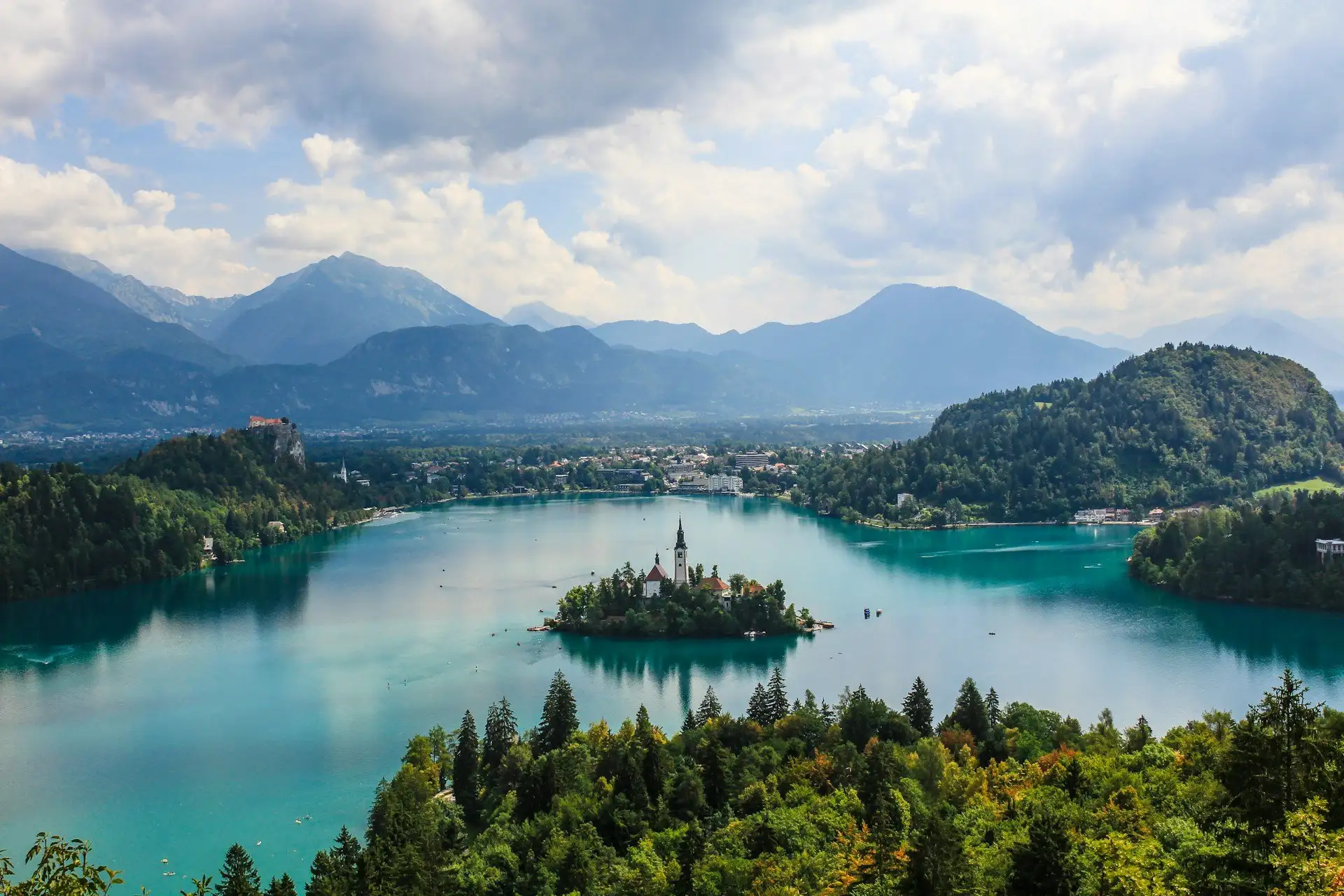
The island church, the cliff-top castle, the ring of Alpine peaks behind it. This is not a case of a place being over-photographed and then disappointing in person. Bled is genuinely as beautiful as it looks. The problem is that about 1.5 million people per year have come to the same conclusion, and most of them arrive between 10am and 4pm in July and August. The fix is simple: be at the water by 7am when the mist still sits on the surface and you can hear the oarlocks of a single rowing boat. Stay until the light changes. Then walk the 6km circular trail around the lake before the crowds find their rhythm. The kremšnita — vanilla cream cake — at the Bled Castle cafe afterward is worth the €5.50.
Lake Bohinj
Thirty minutes by bus from Bled, four times the size, and a fraction of the visitors. Triglav's north face rises directly above the lake's western end. The water is cleaner, cooler, and more swimmable. The village of Ribčev Laz on the eastern shore has a 13th century church, a handful of restaurants, and no sense of being a tourist set piece. Take the cable car from Vogel for the panoramic view across both lakes. This is where Slovenians themselves come to swim and kayak. That tells you most of what you need to know.
Soča Valley
The Soča River runs through a valley carved by glaciers and is an improbable shade of blue-green that stops first-time visitors in their tracks. The color comes from finely suspended limestone particles in the glacier meltwater and cannot be adequately photographed. You need to stand beside it. The Soča trail (Soška pot) follows the river for 25 km from the village of Trenta to Bovec. The valley was a WWI front line — the Isonzo Battles killed 300,000 people on this terrain — and the history is present in every village museum and military cemetery. Bovec at the valley's head is the adventure sports base: rafting, kayaking, canyoning, paragliding. None of it is overpriced by Alpine standards.
Postojna Cave
One of the largest and most visited cave systems in Europe, and the hype is justified. A narrow-gauge train takes you 2 km into the cave complex before you disembark to walk through concert-hall-sized chambers of stalactites and stalagmites. The resident olm — Proteus anguinus, a blind cave salamander that breathes through external gills, navigates by electrosensation, and lives for up to 100 years — is kept in an aquarium inside the cave and is one of the stranger animals you will ever see. Book tickets online. Summer queues without advance booking are substantial.
Predjama Castle
Twelve km from Postojna and the most architecturally improbable structure in Slovenia: a Renaissance castle built into the mouth of a cave partway up a 123-meter cliff face. It was built in the 13th century and extended over subsequent centuries by owners who apparently saw no reason a cave should be wasted. The story of Erazem Lueger, the robber baron who used the cave passages behind the castle to resupply while besieged for a year, is told inside with appropriate drama. Combine with Postojna Cave on the same day.
Piran & the Slovenian Riviera
Slovenia has 47 km of Adriatic coast, most of which is either industrial (Koper) or developed (Portorož). The exception is Piran: a Venetian medieval town on a peninsula that juts into the sea and looks exactly like a smaller, quieter version of Dubrovnik, without the cruise ships. Tartinijev trg, the main square named after the Baroque composer born here, is one of the best public spaces on the Adriatic coast. The salt pans at Sečovlje, 6 km south, have been producing salt by traditional methods since the 13th century. The fleur de sel is excellent and costs €3 for a bag.
Brda & Vipava Valley
The Brda hills along the Italian border produce Rebula and Sauvignon Blanc at quality levels that would command triple the price with a Friulian address. The valley resembles Tuscany with better wine prices and nobody else around. The neighboring Vipava Valley is the home of natural wine in Slovenia — small producers making orange and skin-contact whites that have built an international reputation considerably larger than the region's size. Visit in September or October during harvest. The drive from Ljubljana takes 90 minutes.
Culture & Etiquette
Slovenians are Central European in their baseline formality and Mediterranean in their relationship with food and outdoor life, which is a combination that works well. They are generally private people who don't volunteer information about themselves to strangers but respond warmly when approached directly. English is widely spoken, especially by anyone under 50 in the cities and tourist regions. In remote villages and among older residents, German is often more useful.
The country has a strong civic culture around outdoor recreation and nature. Trail etiquette is taken seriously: greet other hikers on the path, leave nothing behind, and stay on marked routes in national park terrain. This is not performative environmentalism. It's how people actually behave, and matching it is both respectful and expected.
"Dober dan" (good day) or a simple nod to other hikers. On mountain paths this is not optional etiquette — it is how the culture works. Ignoring other hikers on a trail is considered unusual and mildly rude.
In restaurants, ordering the house Rebula or Teran over an Italian import is both cheaper and genuinely better. The wine list will almost always have local options at every price point. Use them.
The city has a handful of restaurants that are genuinely world-class and genuinely fully booked two to three weeks out in summer. If you want a table at JB, Strelec, or Monstera Bistro, plan before you arrive.
The e-vinjeta (electronic motorway vignette) is mandatory on Slovenian highways. Buy it online before departure or at any petrol station. Driving without one results in a fine of €300+.
Slovenia's rivers are clean and cold and the culture of outdoor swimming is strong. Join it. The Soča River swimming holes near Kobarid are some of the best wild swimming in Europe.
They are different countries. Slovenia is in the western Balkans, bordering Italy and Austria. Slovakia is in Central Europe, bordering Austria and Hungary. The mix-up is so common that both countries have permanent diplomatic awareness of it. Neither is amused.
This is not an etiquette issue so much as an act of self-harm. The parking lots are full. The boats are queuing. The path around the lake is a procession. Plan for very early morning, late afternoon, or a different season entirely.
The Julian Alps generate their own weather patterns. A morning that is sunny in Ljubljana can be thunderstorming on Triglav by early afternoon. Check the forecast at the ARSO meteorological service before any high-altitude hike.
The rules are real and the ecosystem is fragile. National park wardens do patrol. The fines for off-trail behavior in restricted zones are not nominal. Stick to marked routes.
Radovljica, 7 km from Bled, has a perfectly preserved medieval old town and one of the best beekeeping museums in the world (beekeeping is a national cultural tradition here). It gets a fraction of Bled's visitors. This imbalance is unjust.
Beekeeping Culture
Slovenia is the only country in the world to have its own indigenous bee subspecies: the Carniolan honey bee (Apis mellifera carnica), renowned for its gentleness and productivity. Beekeeping panels — painted wooden boards that decorate beehive fronts — are a recognized folk art tradition. The Beekeeping Museum in Radovljica tells this story far better than you'd expect a beekeeping museum to.
Mountain Hut Culture
Slovenia has over 170 staffed mountain huts (planinska koča) operated by the Alpine Association of Slovenia. They serve hot food, sell beer, offer basic overnight accommodation, and function as genuine community institutions for Slovenian hikers. Staying in one costs €15–30 a person for a dorm bed. The goulash is always available and always good.
Kurentovanje Festival
The Kurent is a traditional Slovenian carnival figure: a costumed figure with a mask, feathers, and cowbells, meant to chase away winter. The Ptuj carnival in February is the oldest and largest, with processions through the town's medieval streets. Ptuj itself — Slovenia's oldest city, with a hilltop castle above the Drava River — deserves a visit at any time of year.
Literary Pride
France Prešeren is to Slovenians what Burns is to Scots: the poet who gave the nation its literary language and its sense of cultural identity. His statue stands in Prešernov trg in Ljubljana and is the central gathering point of the city. The date of his death, February 8, is Slovenian Culture Day and a national holiday. Bookshops in Ljubljana are excellent and well-stocked in English translation.
Food & Drink
Slovenian cuisine sits at the intersection of Alpine, Mediterranean, and Central European cooking, which produces something genuinely its own. The food is seasonal in a way that is not a marketing phrase but a practical reality: you eat what the region produces at that time of year. In spring, asparagus from the Kras plateau. In summer, stone fruit and tomatoes from the Vipava Valley. In autumn, porcini mushrooms from the forests, chestnuts from the Kras hills, and wine harvest from every direction.
Ljubljana's restaurant scene has improved more rapidly than most people outside the country have noticed. The city has two Michelin-starred restaurants — Hiša Franko in Kobarid (Ana Roš, awarded World's Best Female Chef in 2017) and JB in Ljubljana — and a wave of younger chefs doing serious things with Slovenian ingredients. For €15–25 you can eat very well at lunch. For €50–80 at dinner you can eat at a level that surprises visitors who were not expecting this from a country of two million people.
Kranjska Klobasa
The Carniolan sausage. Pork, bacon, garlic, salt. Cooked and served with sauerkraut and horseradish. It's been a protected designation of origin product since 2015 and is made to a specific traditional recipe. Every good butcher in Slovenia makes their own version. The correct way to eat it is standing up, at a market, with mustard, between 10 and 11am. This is not a rule. It's just the right way.
Štruklji
Rolled dumplings filled with cottage cheese, walnuts, tarragon, or apple. Found in versions both savory (as a side dish) and sweet (as dessert). One of Slovenia's oldest dishes, documented back to the 16th century, and still served at every traditional restaurant. The tarragon version is the most distinctively Slovenian and worth ordering if it appears on the menu.
Kremšnita
The Lake Bled cream cake. Layers of vanilla custard and whipped cream between two sheets of puff pastry. Invented at the Park Hotel in Bled in 1953 and still made to the same recipe. You can get it elsewhere in Slovenia, but eating it at the Bled Castle cafe with the lake below is part of the experience. Accounts of it being overrated are usually written by people who had it at the wrong place.
Mushroom & Forest Dishes
September and October bring porcini (jurčki) season and Slovenian cooks take it seriously. Mushroom risotto, mushroom soup, mushrooms on polenta. Foraged chanterelles and bay boletes appear on menus across the Alpine region. Restaurants in Kranjska Gora and Bohinj do particularly good versions. Ordering the seasonal mushroom special is almost always correct in autumn.
Slovenian Wine
Three main regions: Podravje in the northeast (Šipon, Laški Rizling), Posavje in the southeast (Cviček, a light blended red), and Primorska in the west (Rebula, Teran, Malvazija, and the natural wines of the Vipava Valley). Primorska is where the interesting things are happening. Movia in Brda, Kabaj, Tilia Estate, and Burja Estate are the names to look for. Teran — a Karst red made from Refosco grapes grown on iron-rich terra rossa soil — is unlike anything from anywhere else.
Beer & Spirits
Union and Laško are the national lagers — both perfectly adequate. Ljubljana's craft scene has expanded significantly: Reservoir Dogs, HuBar, and Majda are among the better craft beer bars. Slovenian schnapps (žganje) comes in plum, pear, quince, and apricot versions. The pear version (hruškovac) produced by small farmhouses in the Koroška region is the right thing to end a meal with if someone offers it.
When to Go
Honest answer: June and September. June gives you full daylight, open mountain huts, running rivers, and visitor numbers that haven't reached peak intensity. September drops the crowds sharply, turns the forests gold, opens the wine harvest in Brda and the Vipava Valley, and keeps the weather warm enough for river swimming through mid-month. Either beats July and August in the mountains if your priority is space and quiet rather than guaranteed sunshine.
Early Summer
Jun – early JulMountain huts open, rivers at their most vibrant, crowds manageable. Long days for hiking. Wildflowers across the Alpine meadows. Ljubljana at peak outdoor cafe season. Triglav summit accessible from late June.
Autumn
Sep – OctWine harvest, forest colors, thin crowds. September still warm for the coast and rivers. October for serious hikers and wine country. Mountain huts begin to close by mid-October. The Soča Valley in September light is one of the best outdoor experiences in Central Europe.
Winter
Dec – MarKranjska Gora and Krvavec ski resorts are reliable and cheaper than Austrian alternatives. Ljubljana's Christmas market on Kongresni trg is atmospheric. Postojna Cave maintains a constant 10°C regardless of season — actually better in winter when caves warm relative to outside. Crowds are minimal everywhere.
Peak Summer
Mid-Jul – AugLake Bled becomes very crowded. Accommodation books months ahead. Prices peak. The mountains are genuinely beautiful and the weather is warm, but if you're going to Bled specifically, be aware of what you're walking into. The coast at Piran is equally busy. Book everything early or shift your dates.
Trip Planning
One week is enough to cover Slovenia's highlights without feeling rushed. Two weeks lets you slow down in places that reward it — a second night in the Soča Valley, a wine tasting day in Brda, a full Triglav summit attempt. Slovenia works well as a combination trip with Croatia (Zagreb is 2.5 hours by bus) or Austria (Vienna is 4 hours, Graz is 2 hours). Flying into Ljubljana and out of Trieste or Zagreb eliminates backtracking entirely.
Ljubljana
Arrive, walk the old town, cross the Triple Bridge, climb to the castle at dusk. Day two: Saturday market if timing works, Plečnik's National Library and covered market along the Ljubljanica, dinner at a riverside restaurant. Book ahead for anywhere you actually want to eat.
Lake Bled & Bohinj
Early morning at Bled — be at the lake by 7am. Ojstrica viewpoint before the crowds. Row to the island. Kremšnita. Afternoon bus to Bohinj (30 minutes), swim off the dock in the afternoon. Vogel cable car the next morning for the mountain view.
Soča Valley
Drive or bus over the Vršič Pass (the highest mountain pass in Slovenia, open May to November) into the Soča Valley. Two days in Bovec or Kobarid: rafting, the Kozjak waterfall hike, the WWI Kobarid museum, swimming in the river at sunset.
Postojna & Predjama
Drive south to Postojna Cave (book the morning slot online). Walk through in 90 minutes. Drive 12 km to Predjama Castle in the afternoon. Return to Ljubljana for your flight. This is a long but entirely doable final day.
Ljubljana
Three days gives you Ljubljana properly. Day trip to Škocjan Caves (UNESCO-listed, arguably more dramatic than Postojna, and far less visited). Radovljica old town and the Beekeeping Museum on day three.
Alpine Lakes
Bled early morning, then three nights based at Bohinj. Day hike along the Triglav Lakes Valley. Savica Waterfall. Cable car to Vogel. Evening dinner at a mountain hut above the lake. This is the Slovenia that Slovenians take their holidays in.
Soča Valley
Drive over Vršič Pass. Three days in the valley: one for rafting and adventure sports, one for the Kobarid loop walk and museum, one slow day for swimming and eating. Hiša Franko in Kobarid if budget allows — book months in advance.
Karst & Coast
Postojna and Predjama. Then Piran for two nights: walk the town walls, eat fresh fish, watch the salt pan workers in the late afternoon light. Day trip to Lipica to see the Lipizzaner horses if you have children (or if you don't).
Wine Country
Drive into the Brda hills. Stop at Dobrovo Castle for tasting. Cross into the Vipava Valley for a natural wine producer visit. Return to Ljubljana via Škocjan Caves on the final afternoon. Fly home from Ljubljana.
Ljubljana & Central Slovenia
Four days exploring Ljubljana's neighborhoods and surroundings: Tivoli Park, the Metelkova alternative culture center, day trip to the Kamnik Alps north of the city (Velika Planina high plateau, accessible by cable car, has traditional herder huts that look like they belong in a fairy tale).
Julian Alps: Bled, Bohinj, Kranjska Gora
Four days in the northwest corner. Attempt the Triglav summit (two-day hike, guide recommended for first-timers, the mountain hut stay is the point as much as the summit). Rest day in Kranjska Gora with evening in a local restaurant.
Soča Valley & Vipava
Vršič Pass into the Soča. Four days: rafting, hiking, the Napoleonic road walk, the Kobarid museum. Day four: drive south into the Vipava Valley for natural wine producer visits — Burja, Tilia, Guerila. Overnight in Vipava town.
Brda Wine Region
Two nights in the Brda hills. Dobrovo Castle tasting, Movia winery, evening dinners in farmhouse restaurants overlooking the Italian border. The food and wine quality at this price point is quietly extraordinary.
Karst & Coast
Škocjan Caves (the underground canyon is one of Europe's great natural spectacles). Lipica. Piran for two nights. Sečovlje salt pans by bicycle in the morning.
Eastern Slovenia
Ptuj — Slovenia's oldest city with a castle above the Drava River and the Kurentovanje carnival tradition. Maribor wine region (the world's oldest living grapevine is here, still producing, over 400 years old). Rogaška Slatina thermal spa for a final recovery day before flying home.
Vaccinations
No mandatory vaccinations for Slovenia. Routine vaccines recommended. Tick-borne encephalitis (TBE) vaccination is worth considering for anyone hiking in forested areas between March and November — TBE risk is genuine in Slovenian forests. Check with your doctor at least two weeks before departure.
Full vaccine info →Connectivity
EU roaming applies for EU citizens. Non-EU visitors should get a Slovenian SIM or European eSIM. A1 and Telekom Slovenije have good coverage across most of the country. Mountain valleys can lose signal — download offline maps before leaving urban areas.
Get Europe eSIM →Power & Plugs
Type F (Schuko) plugs at 230V/50Hz, standard for continental Europe. North American visitors need an adapter and voltage-aware devices. Most modern electronics handle EU voltage automatically without a converter.
Language
Slovenian is the official language. English is widely spoken in Ljubljana, tourist areas, and by younger Slovenians throughout the country. German is useful in the northwest near Austria. Italian is helpful along the coast. Very few translation barriers for most visitors.
Highway Vignette
The e-vinjeta (electronic motorway vignette) is mandatory for driving on Slovenian motorways. Buy online at evinjeta.dars.si or at petrol stations near the border. A 7-day vignette costs €16. Driving without one triggers an automatic fine via cameras.
Travel Insurance
EU citizens can use the EHIC for emergency care. Non-EU visitors need comprehensive travel insurance with medical and mountain rescue cover. Mountain rescue in Triglav National Park costs significantly without insurance. The Gorska reševalna služba (mountain rescue) is excellent but not free.
Transport in Slovenia
The honest truth about transport in Slovenia: a rental car makes everything better. The country's bus network covers the main routes adequately, and Ljubljana to Bled runs regularly enough. But reaching the Soča Valley from Bohinj, exploring the wine hills of Brda, getting to Predjama Castle after Postojna, or visiting a farmhouse winery off a gravel track in the Karst — all of these require either a car or a very patient arrangement with taxis and rural buses. For any trip that goes beyond the obvious tourist circuit, rent a car for at least part of it.
Intercity Buses
€5–15/routeLjubljana to Bled (1h20m, hourly), Ljubljana to Koper and Piran (2h30m), Ljubljana to Postojna (1h). Arriva and Nomago operate the main routes. Book at ap-ljubljana.si. Reliable and cheaper than trains on most routes.
National Rail (SŽ)
€5–20/routeTrains connect Ljubljana to Maribor, Koper, and Jesenice (for Bled, with a bus connection). Scenic but slow. The Ljubljana to Koper coastal line through the Karst is worth taking at least once for the views. Book at potniski.sz.si.
Car Rental
€35–70/dayThe single best transport decision for a Slovenian trip. Required for the Soča Valley, wine regions, and Karst caves. Roads are good and well-signed. Buy the motorway vignette online before you pick up the car. Parking in Ljubljana old town is minimal; stay outside the ZOC and walk or cycle in.
Cycling
€10–20/day rentalLjubljana has an excellent city bike-share scheme (BicikeLJ, €1/hour). The Soča Valley, Brda hills, and the Piran coastline are all popular cycling routes with established infrastructure. Several companies offer guided cycling tours with luggage transfer. Slovenia is a genuinely good cycling country.
Taxi / Bolt
€1.20/km approx.Bolt operates in Ljubljana and is reliable. Standard taxis are metered and honest by Central European standards. From Ljubljana Airport, a taxi to the city center costs €20–30 fixed rate. The airport bus costs €4.10 and runs hourly.
Rowing Boats (Bled)
€20/hourThe traditional way to reach Bled Island. Rent a wooden rowing boat from the eastern shore (about €20/hour) or take the pletna — a traditional flat-bottomed boat with a gondolier — for €18 round trip. Both include time on the island to ring the bell in the church tower.
Ljubljana Airport
26 km from centerSlovenia's main international airport connects to major European hubs. The airport bus (GoOpti or Arriva) runs to the city center for €4–9 and takes 45 minutes. Trieste Airport in Italy is 90 minutes away and adds additional low-cost options.
Cable Cars
€15–25 returnVogel above Lake Bohinj, Kanin above Bovec (access to summer glacier hiking), and Krvavec near Kranj are the main cable car systems. Seasonal — check operating schedules before building a day around them.
Accommodation in Slovenia
Slovenia's accommodation has improved significantly in the last decade, tracking the country's rise as a serious tourism destination. Ljubljana has genuine boutique hotels now, not just converted pensions. The mountain areas have excellent family-run guesthouses and high-altitude huts that are part of the hiking culture. If you're on a budget, the hostel network is good — particularly Celica Hostel in Ljubljana, a converted former prison that is genuinely one of the more distinctive hostel buildings in Europe.
Boutique Hotels
€80–200/nightLjubljana has a solid boutique hotel scene in the old town and riverside neighborhoods. Bled has several lake-view properties ranging from the grand Park Hotel to smaller family-run pensions. Book Bled accommodation three to four months ahead for July and August.
Tourist Farm (Turizem na Kmetiji)
€40–80/nightWorking farms that take paying guests. Home-cooked meals from their own produce, farm animals, fruit orchards, wine cellars. Particularly strong in the Karst region, the Vipava Valley, and the Brda hills. The best way to experience Slovenian rural life. Book via the Slovenia tourist board's farm tourism database.
Mountain Huts (Planinska Koča)
€15–35/personOver 170 staffed huts across the Alpine region, operated by the Alpine Association of Slovenia. Dorm beds, basic washing facilities, hot meals, beer. The Triglav Lakes Valley hut and Dom Planika beneath the Triglav summit are the most famous. Book via pzs.si for summer weekends — they fill.
Unique Stays
€25–50/nightCelica Hostel in Ljubljana — a former Yugoslav military prison with cells converted by 80 different designers — is worth staying in once for the experience alone. Treehouses in the Soča Valley region. Several castle-hotel conversions exist in eastern Slovenia at surprisingly accessible prices.
Budget Planning
Slovenia sits in the mid-range of European costs. It's cheaper than Austria or Italy — a meal that would cost €25 in Vienna costs €12 in Ljubljana. But it's more expensive than Croatia or Slovakia, and tourist-zone prices around Bled in particular have been rising steadily. The best value is in smaller towns, on tourist farms, and anywhere you eat where the menu isn't translated into five languages.
- Hostel dorm or mountain hut bed
- Self-catering and market lunches
- Bus transport throughout
- Free hiking and lakes
- One restaurant dinner every other day
- Guesthouse or 3-star hotel
- Lunch and dinner at restaurants
- Rental car for alpine regions
- Paid caves and adventure activities
- Wine tasting and local experiences
- Boutique hotel or lake-view property
- Full restaurant dining including wine
- Rental car throughout
- Guided hikes and private experiences
- One Michelin or fine dining evening
Quick Reference Prices
Visa & Entry
Slovenia is a full Schengen Area member. EU citizens enter with a national ID card. Citizens of the US, UK, Canada, Australia, New Zealand, and most other Western countries enter visa-free for up to 90 days within any 180-day Schengen period. Your 90-day allowance is shared across all 27 Schengen countries — days spent in Italy, Austria, or France before Slovenia count toward your total.
ETIAS (European Travel Information and Authorization System) registration is required for visa-exempt non-EU nationals from 2025. It's an online pre-travel authorization, not a visa — simple to complete and valid for multiple trips over three years. Apply at the official ETIAS website before departure.
Most Western passport holders qualify. ETIAS required from 2025. Check the official Schengen list for your specific nationality before booking.
Family Travel & Pets
Slovenia is a natural fit for families. The country is safe, clean, compact, and oriented around outdoor activities that work at every age. Children are welcomed genuinely rather than tolerantly at most restaurants and accommodation. The lakes, caves, and mountains offer experiences that don't require explanation or cultural framing — they're simply spectacular in a way that translates across every age group.
The caves are the particular standout for families. Postojna's cave train ride into the Earth, the vast chambers of stalactites, and the olm in the aquarium combine into an experience that children describe accurately for weeks afterward. Škocjan Cave — UNESCO-listed and less visited — has a dramatic underground canyon and waterfall that many parents find more awe-inspiring than Postojna. Both in the same day is a long day. Pick one and do it well.
Postojna Cave
The cave train, the underground concert hall, and the olm in its aquarium. Children respond to this experience with a level of genuine awe that screens rarely produce. Book morning tickets online to avoid the queue. The cave is a constant 10°C regardless of outside temperature — bring a layer for young children.
Lake Bled
Rowing to the island church, ringing the bell (three rings brings your wish), and eating cream cake at the castle afterward is a complete and self-contained family day. The swimming area at Mlino on the southern shore is shallow and warm in July and August. The 6km lake walk takes 90 minutes at a leisurely pace and is entirely flat.
Lipica Stud Farm
The original home of the Lipizzaner horse, where the breed has been raised continuously since 1580. Guided tours of the stables and riding arena run daily. The performance shows, where riders put horses through classical dressage movements, hold children's attention better than most equestrian events aimed at adult audiences.
Soča River Rafting
Gentle family rafting trips on the lower Soča sections run from Bovec and are suitable for children aged six and above. The water is cold year-round (glacier-fed, rarely above 15°C) but the guided trips include wetsuits and the experience of being on the most beautiful river in Central Europe makes the cold irrelevant.
Cable Cars & Viewpoints
The Vogel cable car above Lake Bohinj gives children a genuinely Alpine experience with minimal hiking effort. On clear days, Triglav is visible directly. The Kanin cable car above Bovec reaches a summer glacier and is one of the highest accessible points in Slovenia. Both have self-service mountain restaurants at the top.
Velika Planina
A high plateau above Kamnik, accessible by cable car and foot, with a settlement of traditional herder huts that looks architecturally unchanged for centuries. The cable car ride, the plateau walk among the huts, and lunch at a mountain dairy serving home cheese takes a full morning. It is completely unlike anywhere else in Slovenia and receives a fraction of the crowds that descend on Bled.
Traveling with Pets
Slovenia is one of the more pet-friendly EU destinations. Dogs require a microchip (ISO 15-digit standard), EU pet passport, and up-to-date rabies vaccination to enter and move freely within Schengen. Non-EU issued pet documentation needs to be verified by an authorized Slovenian veterinarian on arrival, which is a practical process but takes time — budget for it on arrival day.
Within Slovenia, dogs are welcome in most outdoor spaces, on hiking trails, and in many guesthouses and tourist farms (confirm when booking). Dogs are permitted on trains in a carrier or with muzzle and leash, and on local buses in carriers. Most outdoor dining areas in smaller towns and rural settings accept well-behaved dogs without hesitation.
Triglav National Park permits dogs on most trails on a leash. Some sensitive ecological zones have seasonal restrictions — check the national park authority (triglav-np.si) before entering restricted areas with a dog. The tick season in forested areas runs March through November; ensure your dog is on veterinary-grade tick prevention before hiking.
Safety in Slovenia
Slovenia is one of the safest countries in Europe by any measure. Violent crime rates are among the lowest on the continent. Solo travelers — including women — report consistently feeling safe throughout the country, in cities and in rural areas at any hour. Petty theft exists in Ljubljana's tourist areas, as it does in any European city, but at levels that don't require particular vigilance beyond the ordinary.
The real risks in Slovenia are mountain-related. The Julian Alps generate serious weather, the terrain is genuinely alpine, and every summer the mountain rescue service responds to preventable incidents involving hikers who underestimated the conditions. Good preparation eliminates almost all of this risk.
Urban Safety
Ljubljana is very safe. Petty theft in tourist areas is the only realistic urban concern. The city center, including the area around the castle and Metelkova, is walkable at night without incident.
Solo Women
Consistently rated among the most comfortable European destinations for solo female travelers. The culture of respect for personal space is high. No areas of Ljubljana require avoidance at night.
Mountain Hazards
Weather in the Julian Alps changes fast. Summer afternoon thunderstorms develop quickly above the treeline. Check ARSO (meteo.si) before any high-altitude hike. Start early. Descend before noon if the forecast is uncertain.
Swimming in Rivers
The Soča and other glacier-fed rivers are cold (10–15°C even in summer) and can have powerful currents. Swim at designated swimming areas. Do not enter moving water near waterfalls or in sections marked as dangerous. The cold is a genuine hazard for children.
Ticks
Tick-borne encephalitis risk is real in Slovenian forests, particularly in the sub-alpine areas, from March through November. Use DEET repellent, check after hikes, and consider TBE vaccination if spending significant time in forested areas.
Road Safety
Roads are well-maintained. Zero blood alcohol limit for driving. Speed cameras operate on motorways. Winter tires legally required from November 15 to March 15, or when conditions require them. Mountain roads require care and appropriate tires in shoulder seasons.
Emergency Information
Your Embassy in Ljubljana
Most embassies are in Ljubljana's Bežigrad and Center districts. Some smaller nations are covered from Vienna or Zagreb.
Book Your Trip
Everything in one place. These are services worth actually using.
The Country That Leaves People Speechless
What surprises most visitors is not that Slovenia is beautiful — the photographs prepared them for that — but that it is beautiful in so many different ways within such a small space. The turquoise river and the limestone cave and the lake and the medieval town and the wine hill are all within two hours of each other. There is something almost implausible about the concentration.
The Slovenian word for home place — domovina — carries a weight that simple translation loses. It means homeland, native ground, the place you carry with you. Spend enough time here and you begin to understand why Slovenians hold their landscape with such particular care. The trails are maintained, the rivers are clean, the old towns are preserved, not as tourist infrastructure but because they are genuinely lived in and valued. That quality is what you feel walking through Ljubljana at 8am or sitting beside the Soča at sunset. The place is loved. It shows.