
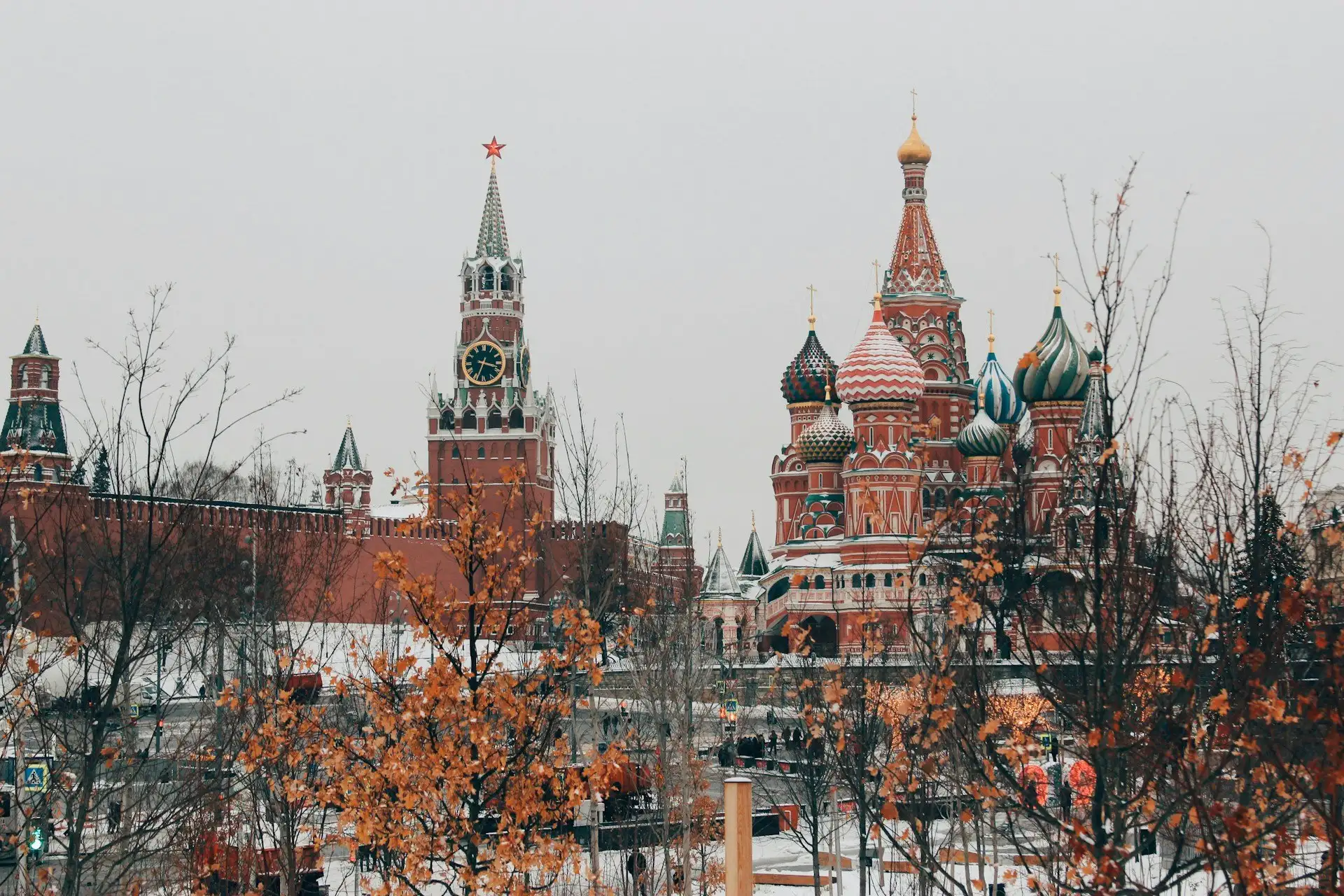
Russia
The largest country on earth, spanning eleven time zones from the Baltic to the Pacific. The Hermitage. Red Square. Lake Baikal. The Trans-Siberian. Before you plan anything, read the current travel warnings. They are serious.
Current Travel Warnings
🚨 Do Not Travel — Level 4 Advisory
The United States, United Kingdom, Canada, Australia, New Zealand, and all EU member states maintain their highest-level travel warning for Russia as of 2026. The specific reasons cited include: the ongoing war in Ukraine; the risk of arbitrary detention of foreign nationals on espionage, drug, or other charges; severely restricted consular access for citizens of "unfriendly" states if detained; and the risk that dual nationals or those who have previously expressed critical views of the Russian government face heightened scrutiny at borders. These warnings are not routine cautions. They reflect documented cases of Western nationals being detained and held for extended periods with limited or no consular assistance.
🛫 Visa Access Is Severely Restricted
Russia has designated the US, UK, EU member states, Canada, Australia, and other countries as "unfriendly states." Tourist visa issuance to citizens of these countries has been severely restricted or suspended. The e-Visa program, previously available for 52 countries, has not been available to most Western nationals since 2022. Obtaining a tourist visa as a US, UK, or EU citizen is currently not possible through normal channels in most cases. Citizens of other countries should check with the Russian embassy in their home country for current requirements, as these change.
💳 Western Payment Cards Don't Work
Visa, Mastercard, and American Express all suspended operations in Russia in March 2022 following sanctions. Western debit and credit cards do not function at Russian ATMs or in Russian shops, restaurants, hotels, or online. International travelers must bring cash (US dollars or euros can be exchanged for rubles at Russian banks or exchange offices) or use UnionPay cards. The practical inability to access money through normal channels is a significant logistical constraint beyond the safety issues.
✈️ Direct Flights Are Suspended
Most Western airlines suspended flights to Russia in 2022. There are no direct flights from the US, UK, most EU countries, Canada, or Australia to Russia as of 2026. Travel requires routing through countries that maintain Russia connections: Turkey, UAE, Armenia, Azerbaijan, Serbia, and others. This significantly increases travel time and cost.
📵 Digital Security Risks
Russian authorities can inspect electronic devices at the border and at checkpoints. Content that could be interpreted as critical of the Russian government, military, or the war in Ukraine — including social media posts, messaging app histories, and photographs — can lead to detention. VPN use while in Russia, while practiced, is technically restricted and carries legal risk. If traveling despite warnings, specialists recommend bringing a fresh device with no sensitive content.
⚖️ Arbitrary Detention
Multiple Western nationals, including American journalist Evan Gershkovich and former Marine Paul Whelan, have been detained in Russia on charges widely criticized internationally as politically motivated. Russian law does not guarantee due process rights that Western nationals are accustomed to. If a Western citizen is detained, their government's ability to provide consular assistance is severely limited and in some cases effectively blocked. This risk applies to journalists, researchers, activists, and in principle any Western national who attracts official attention.
The rest of this guide covers Russia as a destination: its history, culture, cities, landscape, food, and what travel there looks like for those who do go — whether because they hold passports not subject to current restrictions, because conditions have changed by the time you read this, or because you're researching the country rather than planning to visit immediately. The historical and cultural content below is accurate. The practical sections reflect the reality of traveling to Russia in 2026 as honestly as possible.
What Russia Actually Is
Russia is the largest country on earth by land area: 17.1 million square kilometres, spanning eleven time zones from the Baltic enclave of Kaliningrad to Kamchatka and the Bering Sea, which sits 88 kilometres from Alaska. It is simultaneously a European country, an Asian country, an Arctic country, and a Pacific country, and it contains within its borders a diversity of landscape that no single description can hold: the taiga forest that covers more of the earth's surface than any other single biome; the Ural Mountains that mark the traditional boundary between Europe and Asia; the steppe grasslands of Siberia; Kamchatka's active volcanoes; and Lake Baikal, the world's deepest lake at 1,642 metres and the world's largest freshwater lake by volume, containing approximately 20% of the earth's unfrozen surface freshwater.
The cultural weight is equally immense. Russian literature, from Pushkin to Tolstoy to Dostoevsky to Chekhov to Bulgakov, constitutes one of the richest national literary traditions in existence. Russian classical music, from Tchaikovsky to Shostakovich, is performed on stages worldwide every night. The Hermitage Museum in St. Petersburg is consistently ranked among the five greatest art museums in the world. Moscow's Kremlin and Red Square form one of the most significant architectural and historical complexes in Europe.
For most Western visitors in 2026, these things are not currently accessible for the reasons described above. For visitors from countries without current travel restrictions, or for travelers reading this in a different political moment, what follows is a genuine guide to one of the world's most extraordinary destinations.
Russia at a Glance
Ratings reflect conditions for travelers who are currently able to visit. For most Western passport holders, entry is not currently possible through normal channels.
A History Worth Knowing
Russia's emergence as a distinct civilization traces to the medieval Kievan Rus, a federation of East Slavic and Finnic peoples centered on Kyiv from the 9th to 13th centuries. The Mongol invasion in 1237 to 1242 destroyed most major Kievan Rus cities and established the Golden Horde's dominance over the region for the next two and a half centuries. Moscow emerged as the dominant principality during this period, partly through its cooperation with Mongol overlords, and the Grand Duchy of Moscow gradually consolidated power until Ivan the Terrible declared himself Tsar of All Russia in 1547.
Peter the Great, who reigned from 1682 to 1725, undertook the most ambitious program of forced modernization in Russian history. He traveled to Western Europe incognito, worked in Dutch shipyards under an assumed name, and returned determined to reshape Russia along Western lines. He founded St. Petersburg in 1703 on land wrested from Sweden, building the city on marshland using forced peasant labor at enormous human cost, and moved the capital there from Moscow in 1712. The city he created, neoclassical palaces, canals, European street plans, is called the "Venice of the North" with some justice and is one of the great urban achievements of the 18th century.
Catherine the Great, who reigned from 1762 to 1796, continued Peter's westernization and expanded Russian territory massively — northward, southward, and eastward. She founded the Hermitage collection in 1764, initially to house paintings she purchased from a Berlin dealer; it has not stopped growing since. The 19th century produced Russia's literary golden age: Pushkin, Gogol, Tolstoy, Dostoevsky, Turgenev, and Chekhov were all writing within an 80-year window. Their work directly addressed the central tension of Russian life: the gap between the European-educated elite and the vast peasant majority, and the question of what Russia actually was and wanted to become.
The 1905 and 1917 revolutions dismantled the Romanov dynasty. The October 1917 Bolshevik Revolution established the Soviet state, which under Lenin and then Stalin reshaped Russian society through collectivization, industrialization, and political terror of an almost incomprehensible scale. Stalin's purges of the 1930s killed between 700,000 and 1.2 million people in formally documented executions, with millions more dying in the Gulag labor camp system. The Great Patriotic War, as Russia calls WWII, killed approximately 27 million Soviet citizens, the largest national death toll of any country in the conflict.
The Cold War era shaped the 20th century's global order. The Soviet Union's collapse in 1991, largely peaceful and historically astonishing in its speed, produced fifteen new independent states. Russia itself went through the chaotic 1990s, a period of economic collapse, oligarchic consolidation of state assets, and democratic uncertainty, before Vladimir Putin's gradual consolidation of authority from 2000 onward. Russia's invasion of Georgia in 2008, annexation of Crimea in 2014, and full-scale invasion of Ukraine on February 24, 2022, have placed Russia in fundamental conflict with the Western order it had partially integrated into after 1991.
Understanding this history is not separate from understanding contemporary Russia. The specific weight that concepts of empire, national humiliation, and existential threat carry in Russian political culture, and the genuine popular support that nationalistic narratives command alongside genuine opposition to the war that exists within Russian society, are both legible through the historical record. Russia is not the Soviet Union. It is also not what it was in 2013. Understanding what it actually is requires engaging with more than either simplification.
East Slavic federation centered on Kyiv. Destroyed by the Mongol invasion of 1237–1242.
First Tsar of All Russia. The Kremlin and St. Basil's Cathedral completed. Russia's imperial era begins.
Peter the Great builds a new European capital on marshland. Russia's "window to the West" opens.
Pushkin, Tolstoy, Dostoevsky, Chekhov, Turgenev. Russian literature becomes one of the world's greatest.
Romanov dynasty ends. Soviet state established. Lenin, then Stalin. Terror and transformation on an enormous scale.
27 million Soviet citizens killed. Siege of Leningrad lasts 872 days. WWII shapes Russian national identity profoundly.
The USSR dissolves. Fifteen new states emerge. The 1990s bring economic chaos and democratic fragility.
February 24, 2022. Russia invades Ukraine. Western sanctions follow. Travel for most Western nationals effectively ends.
Top Destinations
Russia's scale means the choice of destination is not just about preference but about a completely different travel experience. St. Petersburg and Moscow are European cities in character. The Trans-Siberian crosses a continent. Lake Baikal is a vast wilderness. Kamchatka is a volcanic frontier that is operationally closer to Alaska than to Moscow. What follows covers the country's main destinations for the day when visiting is again feasible for Western travelers, or for those who can currently visit.
St. Petersburg
Peter the Great's European city, built on the Neva delta at enormous human cost, is one of the most architecturally coherent and culturally dense cities on earth. The Hermitage, spread across the Winter Palace and five connected buildings on the embankment, holds three million objects and requires multiple full days to see adequately. The Russian Museum has the world's largest collection of Russian art. The Church of the Savior on Spilled Blood, built on the spot where Tsar Alexander II was assassinated in 1881, is a riot of mosaic that rivals any interior in Europe. In summer, the White Nights bring continuous twilight and a festival season that fills the city with music. In winter, the frozen Neva and snow-covered baroque facades create something that photographs cannot quite capture. Allow a minimum of five days. Many people extend their stay indefinitely.
Moscow
Moscow is not St. Petersburg, and this comparison, which everyone makes, does both cities a disservice. Moscow is vast, intense, and entirely its own thing: Stalin's seven skyscrapers (the "Seven Sisters") rising above the city on an implausible scale; Red Square flanked by the Kremlin's red walls, Lenin's Mausoleum, St. Basil's Cathedral in its polychrome domes, and the State Historical Museum; the Tretyakov Gallery housing Russia's great national art collection including Rublev's Trinity icon. Moscow's metro is itself a destination: Stalin's stations with their chandeliers, marble, and socialist-realist mosaics were built as "palaces for the people" and are the most beautiful underground railway system in the world. Three to four days minimum.
Trans-Siberian Railway
The world's longest railway at 9,289 kilometres, running from Moscow's Yaroslavsky Station to Vladivostok on the Pacific. The full journey by the Rossiya express takes just under six days with no stops. Most travelers break it into segments with stops at Yekaterinburg (where Nicholas II and his family were executed in 1918), Novosibirsk (Siberia's largest city), Irkutsk (the gateway to Lake Baikal), and Vladivostok. The Trans-Mongolian branch diverts through Mongolia and into Beijing, making it one of the world's great overland routes.
Lake Baikal
Baikal is 636 kilometres long, 1,642 metres deep, and contains more water than all of North America's Great Lakes combined. It is 25 to 30 million years old, the world's oldest lake, and its endemic fauna includes the nerpa (Baikal seal), the only seal species to live in freshwater, and over 2,500 species found nowhere else. The water is transparent to 40 metres. In winter the ice, sometimes two metres thick and beautifully clear, carries ice roads used by local trucks. The Circumbaikal Railway, a historic branch of the Trans-Siberian that runs along the south shore through tunnels and around cliffsides, is one of the great scenic rail journeys in Asia.
Kamchatka
A peninsula the size of California projecting south from Russia's Far East, with 160 volcanoes of which 30 are active, and a brown bear population of roughly 17,000 — approximately one bear per eight square kilometres. The Valley of Geysers, one of the world's largest geyser fields, can be reached only by helicopter. The rivers fill with sockeye salmon in summer, and the bears that come to fish them provide wildlife photography opportunities that rival anything in Alaska. Almost no roads. Accessible primarily by helicopter from Petropavlovsk-Kamchatsky. Genuinely one of the earth's last great wilderness areas.
The Golden Ring
A circuit of medieval Russian towns northeast of Moscow — Sergiev Posad, Pereslavl-Zalessky, Rostov Veliky, Yaroslavl, Kostroma, Ivanovo, Suzdal, and Vladimir — that contain the oldest Russian Orthodox churches, monasteries, and kremlins in existence. Suzdal in particular, a UNESCO World Heritage site that was preserved from development by its very insignificance in Soviet times, looks almost exactly as it did in the 18th century: wooden houses, monastery walls, and domed churches above the Kamenka River. Vladimir's 12th-century Cathedral of the Assumption contains frescoes by Andrei Rublev.
Kazan
Kazan is the capital of the Republic of Tatarstan, where Russian Orthodox and Tatar Muslim culture genuinely coexist: a Kremlin with both a white-walled cathedral and a functioning mosque side by side, Tatar cuisine sold alongside Russian dishes, and a bilingual city that expresses the ethnic and religious complexity that constitutes the real Russia, far from the homogeneous image that Moscow sometimes projects. A direct overnight train from Moscow takes about twelve hours.
Altai Republic
The Altai Mountains in southern Siberia, where Russia, China, Kazakhstan, and Mongolia meet, are among the most dramatic and least visited mountain landscapes in the world. The Katun River valley, the Chuya Highway (considered one of the world's great scenic drives), and the Belukha peak at 4,506 metres draw trekkers who want Himalayan-scale scenery without the Himalayan crowds. The indigenous Altaians have maintained their culture and shamanic traditions alongside Russian settlement. Accessible by flying to Gorno-Altaysk from Moscow or Novosibirsk.
Culture & Etiquette
Russian directness is the first thing visitors notice. Russians do not perform warmth for strangers. A shop assistant who doesn't smile is not being rude; the Russian cultural convention is that smiling at strangers implies either stupidity or insincerity. Once you are within a social context — invited to someone's home, sharing a train compartment for a day and a half, sitting at the same table, the warmth appears and is genuinely overwhelming. Russian hospitality in a private home means food, drink, and conversation without end, with every refusal treated as false modesty and overridden by the host.
Russian literary and artistic culture is both a genuine national pride and an everyday reference point in a way that surprises many Western visitors. Pushkin is quoted in ordinary conversation. Chekhov's lines are used to describe daily situations. Classical music, ballet, and theater are attended across class lines in a way that has no equivalent in most Western countries. The Bolshoi and Mariinsky ballet companies are both world-class and, outside of tourist-facing performances, affordable for local audiences.
Universal and non-negotiable. A row of shoes at the entrance is the signal. Slippers (tapochki) are often provided. Entering a Russian home in outdoor shoes is a genuine social violation.
Flowers (odd numbers only; even numbers are for funerals), wine, chocolates, or something from your home country. Arriving empty-handed to a Russian home invitation is culturally awkward. The gift is the acknowledgment of the effort made.
Za zdorovye ("to health") is the standard toast. Eye contact during the toast is expected; avoiding it is considered rude or shifty. Russians take the toasting ritual seriously, particularly the first glass.
Even basic Cyrillic reading (learnable in about two hours) transforms navigability dramatically. Metro stations, street signs, and menus become accessible. Many words are familiar once you can sound them out: pectopaH is restoran, кофе is kofe.
In 2026, expressing views on the war in Ukraine, Russian politics, or criticism of the government in public or semi-public settings carries real risk. This is not a social nicety — it is a legal reality. Foreign nationals have been detained for social media posts. Be aware of your digital footprint.
Photographing military facilities, police, border infrastructure, or government buildings can result in detention and confiscation of your camera and phone. The definition of "restricted" is broad and applied inconsistently. When in doubt, don't photograph.
Russian authorities have broad legal access to communications infrastructure. VPNs are technically restricted. Do not communicate in ways you would consider sensitive on devices or networks accessible within Russia.
Considered to bring financial bad luck. A genuinely held superstition in many Russian households. Stepping on the threshold rather than over it is also considered bad luck. These are not jokes.
The Soviet-era service culture, where the customer was not a priority, has partly but not entirely given way to Western-style service norms. Being greeted warmly by a waiter who clearly doesn't want to be there is still common outside tourist-facing establishments. This is not directed at you personally.
Displaying large amounts of cash, while less dangerous in Russia than in some countries, attracts unwanted attention. Russia's cash economy makes carrying some necessary; keep amounts modest and distributed across different pockets.
Russian Literature
Reading before you go transforms Russia. Tolstoy's Anna Karenina and War and Peace, Dostoevsky's Crime and Punishment and The Brothers Karamazov, Chekhov's short stories, Bulgakov's The Master and Margarita (set in Moscow, full of recognizable locations), and Pushkin's poems in translation all provide a layer of understanding that no guidebook can give. The Master and Margarita in particular, with its satirical portrait of Soviet literary bureaucracy, is set in places you'll walk past on Patriarch's Ponds in Moscow. Reading it before the trip is the correct preparation.
Ballet & Classical Music
The Bolshoi Theatre in Moscow and the Mariinsky Theatre in St. Petersburg are two of the world's greatest performing arts institutions. Both present opera and ballet at the highest level. Tickets for non-tourist performances at both houses, bought through the official websites rather than scalpers or hotel concierges, are priced for Russian audiences and significantly cheaper than equivalent performances in London, New York, or Vienna. The standard is the same.
The Banya
The Russian bathhouse (banya) occupies a central place in social and physical culture. A public banya visit involves alternating between a steam room heated to 80 to 100°C, a cold plunge or snow roll, and a rest with tea and conversation. The venik, a bundle of dried birch or oak branches, is used to slap the skin, improving circulation. Visiting a banya with Russians is one of the more immersive cultural experiences available. The tradition is ancient, genuinely restorative, and unlike most things you've done.
White Nights
St. Petersburg sits at 60°N, and from late May through mid-July the sun barely sets: twilight persists through the night and it never gets fully dark. The "White Nights" produce a specific disorientation where you emerge from a concert or restaurant at midnight into daylight and the city feels entirely different from its winter self. The Scarlet Sails festival in late June, when a tall ship with crimson sails enters the Neva at midnight to fireworks and hundreds of thousands of people lining the embankments, is one of Europe's most spectacular public celebrations.
Food & Drink
Russian food is honest, seasonal, and designed for a country that spends half the year cold. The soups are extraordinary: borscht (beet, cabbage, and pork in a sweet-sour broth that the Ukrainians and Russians both claim), shchi (cabbage soup that has been the daily meal of Russian peasants for over a thousand years), solyanka (a sour-spicy meat and pickle soup that is one of Russia's great culinary achievements), and ukha (clear fish broth). The salads, despite the name, are cold assembled dishes held together by mayonnaise: Olivier (what the world knows as Russian salad, invented at a Moscow restaurant in the 1860s) and selyodka pod shuboy ("herring under a fur coat," a layered construction of pickled herring, potato, beet, and mayonnaise that is a staple of every New Year's table).
Russian bread deserves separate mention. Dark rye bread, dense and slightly sour, is not the same product as Western rye bread and is incomparably good. Borodinsky bread, with its coriander seeds and slightly sweet undertone, was supposedly created in 1812 after the Battle of Borodino. Whether or not this is true, it is extraordinary and you should eat it at every opportunity.
Pelmeni
Siberian meat dumplings: unleavened dough filled with a mixture of minced beef, pork, and onion, boiled and eaten with sour cream, butter, or vinegar. The Siberian origin is not incidental: pelmeni were the traditional food of hunters and travelers precisely because they freeze well and are easy to carry. A bowl of pelmeni with sour cream in a railway car buffet somewhere east of the Ural Mountains is the correct context. They're available everywhere in Russia and at their best at a proper pelmennaya (dumpling house).
Solyanka
A thick, sour, slightly spicy soup of mixed meats (beef, sausage, ham), salted cucumber, capers, olives, and tomato, finished with a slice of lemon and sour cream. There is no equivalent of this soup in Western cuisine. It evolved from Russian pickling and preservation traditions and has a complexity that rewards attention. Order it as a first course in any traditional Russian restaurant. It is the soup that makes people stop underestimating Russian food.
Blini
Thin crepes, eaten with sour cream, jam, honey, smoked salmon, or caviar (red salmon roe is affordable; black sturgeon caviar is expensive even in Russia). Blini are the traditional food of Maslenitsa, the pre-Lent festival, where they represent the sun and are consumed in vast quantities. At a Moscow or St. Petersburg blinaya (blini cafe) you can eat them correctly for breakfast, lunch, and dinner without anyone judging you.
Pickles & Preserved Foods
The Russian relationship with pickling and fermentation is deep and practical: in a country where winter lasts six months, preserving summer's abundance was survival. Pickled cucumbers (not sweet, sharply brined with dill and garlic), sauerkraut, pickled mushrooms, marinated berries. A table of zakuski (appetizers) at a Russian celebration is essentially an anthology of preservation techniques, and the quality at a good home table is different in kind from anything you'll find in a supermarket.
Fish & Seafood
Russia has the world's longest coastline and some of its best fisheries. Smoked and salted fish, from Baikal omul (a Baikal-endemic whitefish smoked on the shore and sold at every market near the lake) to Pacific salmon from Kamchatka to Baltic sprats, constitute a significant part of everyday eating. Caviar, both red (ikra) from Pacific salmon and black (ikra) from sturgeon, is consumed casually on blini or rye bread at a level of frequency that is startling if you're accustomed to its export pricing.
Vodka, Tea & Kvas
Russian vodka drunk correctly is very cold, very pure, and consumed in small glasses alongside food rather than as cocktail ingredient. The practice of drinking it with a pickle or a bite of black bread between shots has a physiological logic. Tea is drunk from glasses in metal holders (podstakanniki), strong and sweet, and is the beverage of the Trans-Siberian and the banya and the kitchen table at any hour. Kvas, a mildly fermented drink made from bread, sold in summer from yellow tanks on street corners, is non-alcoholic, earthy, and genuinely refreshing in a way that nothing else quite replicates.
When to Go
Russia's scale means the ideal timing varies dramatically by region. For St. Petersburg, the White Nights of late June are the famous choice: continuous twilight, festivals, and the city at its most alive. For Lake Baikal, February offers frozen lake clarity and ice roads; July offers swimmable water and visible fish at depth. For Kamchatka, July to September is the only practical window. For Moscow and the Golden Ring, autumn, September to October, brings golden birch forests and the Moscow streets emptied of summer tourists.
White Nights
Jun – JulSt. Petersburg's White Nights festival season. Continuous twilight. The Scarlet Sails celebration. Warmest temperatures of the year. Best time for city tourism in the northwest. Book months ahead.
Summer
Jul – AugKamchatka is accessible. Baikal is swimmable. The taiga is green. Long days across Siberia. The best window for outdoor Russia, though mosquito season in swampy areas requires preparation.
Autumn
Sep – OctGolden birch forests across Russia. Mushroom season. Moscow at its most handsome before winter. The Golden Ring towns in September with the leaves turning. Fewer tourists than summer.
Deep Winter
Jan – FebLake Baikal's frozen surface in February. Moscow and St. Petersburg under snow. New Year celebrations (Russia's biggest holiday, celebrated lavishly January 1–7). Extreme cold in Siberia requires serious preparation but rewards it.
Trip Planning
Planning a Russia trip in 2026 requires checking several things before investing any significant time or money in itinerary planning. The visa situation and travel warnings should be your first stop, not your last. The information below is current at time of writing; verify everything independently before booking.
Check Your Visa Status First
Before any planning, verify whether your passport nationality can currently obtain a Russian tourist visa. This varies by nationality and changes. Check the Russian Ministry of Foreign Affairs website and the Russian embassy in your country for current requirements. Do not assume your previous Russia visit experience applies.
Payment Strategy
Western Visa, Mastercard, and American Express do not work in Russia. Plan to bring cash (USD or EUR, exchangeable in Russia) or obtain a UnionPay card before travel. Determine how much cash you'll need for your entire trip and carry it securely. ATMs for international cards essentially do not exist.
Digital Preparation
Consider a travel device rather than your primary phone. Remove or archive social media apps and content before crossing the border. Download offline maps. Install Yandex Maps (Russia's best navigation tool) before arrival. Be aware that border officials can and do inspect electronic devices.
Routing to Russia
Direct flights from Western countries do not exist. Current connections go via Istanbul (Turkish Airlines), Dubai (flydubai, Emirates), Yerevan (Armenia), Baku (Azerbaijan), Belgrade (Air Serbia), and others. Journey times from Western Europe or North America are significantly longer than pre-2022. Book flexibility into your schedule.
Travel Insurance
Many standard travel insurance policies exclude Russia from coverage due to the Do Not Travel advisory, or have exclusions for government-advisory-level risks. Check your policy specifically. Some specialist insurers cover Russia; shop accordingly. Medical evacuation cover is particularly important given the distances in Siberia.
Registration
Foreign nationals in Russia are required to register with local authorities within seven days of arrival. Hotels do this automatically. Private apartment stays require the host to register you. This is a legal requirement and non-compliance can cause problems at departure. Verify your registration is complete wherever you stay.
Moscow
Day one: arrive, navigate to hotel, walk Red Square in the evening when the crowds thin and the Kremlin towers are lit. Day two: Kremlin and Armoury (book timed entry in advance). Tretyakov Gallery in the afternoon. Day three: Moscow metro station tour — Komsomolskaya, Mayakovskaya, Kievskaya, Novoslobodskaya are the most spectacular. Pushkin Museum of Fine Arts. Day four: Patriarch's Ponds (Bulgakov territory), Gorky Park, evening at the Bolshoi if available.
Golden Ring
Day trip or overnight to Suzdal via Vladimir (3.5 hours from Moscow by train and bus). Vladimir for the Cathedral of the Assumption and Rublev frescoes. Overnight in Suzdal, which has more monasteries and kremlins per square kilometre than any town in Russia. Morning walk before the day visitors arrive.
St. Petersburg
Overnight train from Moscow (8 hours, the Sapsan express takes 3h45m). Day seven: Nevsky Prospekt, Kazan Cathedral, the Church of the Savior on Spilled Blood, Mikhailovsky Garden. Day eight: Hermitage. Allow the full day; arrive when it opens. Day nine: Peterhof palace and fountains by hydrofoil from the city, or the Russian Museum. Day ten: Vasilyevsky Island, the Kunstkamera (Peter the Great's cabinet of curiosities), evening walk along the embankment.
Moscow & Surroundings
Five full days: three in Moscow and a two-day Golden Ring circuit covering Sergiev Posad (the most important Russian Orthodox monastery), Pereslavl-Zalessky, and Suzdal. Rent a car or hire a driver for the ring; public transport connections between the towns are slow.
St. Petersburg
Sapsan express from Moscow. Five days: Hermitage over two sessions (it genuinely requires this), the Russian Museum, Peterhof, the Peter and Paul Fortress where all Romanov tsars from Peter the Great onward are buried, Pushkin's apartment museum on the Moika embankment where he died in 1837.
Kazan & Volga Region
Overnight train from Moscow to Kazan. Three days in Kazan for the Kremlin, Tatar cuisine, and the experience of a genuinely multi-cultural Russian city. Side trip to Sviyazhsk, a small island-town in the Volga with extraordinary churches and a strange feeling of being outside time.
Lake Baikal
Fly from Moscow or Kazan to Irkutsk. Lake Baikal is one hour from the city. Three days minimum on the lake: Listvyanka village, a boat trip to Olkhon Island (the sacred island at the lake's center), and ideally a night on the Circumbaikal Railway. Fly home from Irkutsk or continue east on the Trans-Siberian.
Yaroslavsky Station
Board the Rossiya train at Moscow's Yaroslavsky Station. The journey officially begins. Get your compartment organized, introduce yourself to your provodnitsa (train attendant), and watch the Moscow suburbs give way to birch forest. This is what Russia looks like for a very long time.
Yekaterinburg
Stop at Yekaterinburg: the obelisk marking the Europe-Asia boundary on the city's outskirts, the Church on the Blood built on the site where Nicholas II and his family were shot in the basement of the Ipatiev House in July 1918. Half a day is enough before re-boarding.
The Taiga
Two days of mostly unbroken birch and pine taiga. The train rhythm takes over: tea in a glass from the samovar, conversations with compartment neighbors that go deep because the scenery provides no distractions, meals in the restaurant car, sleep measured by time zones you've crossed. Novosibirsk, Siberia's largest city, passes in the night or morning depending on your timing.
Irkutsk Detour
Most travelers disembark at Irkutsk for a Lake Baikal detour of two to four days before re-boarding. This is the correct decision. The full Trans-Siberian without stopping at Baikal is technically possible and experientially incomplete.
Vladivostok
The train descends toward the Pacific coast. Vladivostok, the terminus, sits in a setting of hills and bays that would be considered beautiful anywhere. The railway museum on the embankment, the submarine K-531 opened as a museum, and the views from the Eagle's Nest hill over the Golden Horn Bay are the correct final chapter. You are now 9,289 kilometres from where you started.
Transport in Russia
Russia's domestic transport infrastructure is, within the European part of the country and along the Trans-Siberian corridor, genuinely good. The Sapsan high-speed train between Moscow and St. Petersburg takes 3 hours 45 minutes. The overnight train between the two cities is a Russian institution. Domestic flights connect the vast distances of Siberia at prices that, for Russian residents paying in rubles, are more affordable than the distances suggest. The Moscow and St. Petersburg metros are world-class. Beyond the main corridors, the train network slows significantly and the road network in Siberia is limited to a few major arteries.
Sapsan Train
~₽4,000–8,000Moscow to St. Petersburg in 3h45m on the Sapsan high-speed train. The overnight Krasnaya Strela is a Russian classic: white tablecloths in the restaurant car, tea in glasses, arriving in the other city at dawn. Book at rzd.ru or the RZD app.
Trans-Siberian
₽7,000–30,000+The Rossiya (Train 1/2) is the premier Trans-Siberian service. Compartment classes range from platzkart (open berths, the social and affordable option beloved by travelers) to coupe (4-berth compartment) to SV (2-berth luxury). Book months ahead for summer journeys.
Domestic Flights
₽3,000–12,000Aeroflot, S7, Ural Airlines, and others connect Russian cities. Moscow to Irkutsk: 5.5 hours. Moscow to Vladivostok: 9 hours. Moscow to Petropavlovsk-Kamchatsky: 8.5 hours. The only realistic way to cover Siberian distances without a week on a train.
Moscow Metro
₽57/tripThe most beautiful urban underground railway system in the world. 260 stations, 15 lines. The Stalin-era stations are genuine architectural monuments. A Troika card (₽50) loaded with credit is the practical option. The newer Circle Line stations are also spectacular.
St. Pete Metro
₽70/tripFive lines, 72 stations. The St. Petersburg metro runs very deep due to the city's geology: some stations are 80 metres underground, reached by the world's longest escalators. Avtovo station on Line 1 is considered one of the most beautiful metro stations in the world.
Yandex Taxi
₽200+ startYandex Taxi (Russia's equivalent of Uber) operates in all major Russian cities and is the most practical urban transport option. Requires a Russian phone number or Yandex account to set up. No Western payment cards: use the cash payment option when booking.
Car Rental
₽2,000–4,000/dayAvailable in major cities. Western rental companies largely withdrew in 2022; local companies operate. An international driving permit is required. Roads in European Russia are good; Siberian roads are often unpaved and require 4WD for anything off the main Trans-Siberian highway.
Helicopter (Kamchatka)
₽30,000–80,000/tripThe only practical way to access Kamchatka's interior: the Valley of Geysers, the caldera of Uzon, the volcanoes of the southern group. Charter helicopter operators in Petropavlovsk-Kamchatsky organize full-day excursions. Expensive; non-negotiable for the experience.
Accommodation in Russia
Russian accommodation has improved dramatically since 2000. Moscow and St. Petersburg have genuinely excellent hotels at every price point, and the hostel scene in both cities is strong. Booking.com remains accessible within Russia for booking purposes, though payment via Western cards requires workarounds. Many hotels offer cash payment on arrival. The specific challenge for international travelers is that standard booking platforms and payment methods have become more complicated; pre-booking and arranging payment before travel is advisable.
City Hotel
₽4,000–15,000/nightMoscow and St. Petersburg have a full range from budget Soviet-era hotels (functional, cheap, and often well-located) to international luxury properties on the embankments. Mid-range international chain hotels offer predictable quality and some payment flexibility for international travelers.
Hostel
₽800–2,000/nightRussia has an excellent and well-developed hostel culture, particularly in St. Petersburg, which has some of Europe's best. Soul Kitchen Hostel in St. Petersburg has been one of the world's highest-rated hostels for years. Cash payment on arrival is standard.
Train Platzkart
₽1,500–3,000/nightOn the Trans-Siberian, the open-berth platzkart car is the authentic, affordable, and sociable option. You share with 53 other travelers in open berths. Conversations happen. Shared food appears. It is the correct way to experience the train for anyone without a strong need for privacy.
Homestay & Guesthouse
₽2,000–5,000/nightParticularly in Siberia, the Baikal region, and Kamchatka, private homestays with local families provide the most immediate and genuine access to Russian daily life. Meals included. Communication by gesture and gesture-plus-phone-translation if necessary. The quality is variable; the experience is not.
Budget Planning
Russia is relatively affordable for travelers paying at ruble prices. The ruble's exchange rate has been volatile since sanctions; check current rates before calculating a budget. For travelers who can currently visit, the daily costs in Moscow and St. Petersburg are significantly lower than equivalent Western European capital cities. Siberia is even cheaper. The main financial planning challenge in 2026 is the payment infrastructure: with Western cards inoperative, travelers need to plan their entire cash requirement in advance.
- Hostel dorm or budget hotel
- Stolovaya canteen meals (₽200–400)
- Metro for all city transport
- Free metro stations, parks, embankments
- Beer at a local bar (₽150–300)
- Mid-range hotel in good location
- Restaurant dining for all meals
- Museum entry (Hermitage: ₽600)
- Overnight train between cities
- One theatre or concert performance
- Quality hotels in city centers
- Bolshoi or Mariinsky theatre tickets
- Sapsan high-speed train travel
- Private guides for Kremlin/Hermitage
- Domestic flights to Siberia/Kamchatka
Quick Reference Prices
Visa & Entry
The visa situation for Russia in 2026 is fundamentally different from what it was before February 2022, and requires honest treatment rather than a standard overview.
Citizens of the US, UK, EU member states, Canada, Australia, New Zealand, Japan, South Korea, and other countries Russia designates as "unfriendly" face severe restrictions on obtaining Russian tourist visas. The e-Visa program has been suspended for these nationalities since 2022. Check with the Russian Embassy in your country for the current status — it changes.
Safety in Russia
The conventional tourist safety picture of Russia, which for most of the period from 2000 to 2022 was "safe for ordinary tourism with standard urban precautions," has fundamentally changed for Western nationals since February 2022. The risks described in the warnings section at the top of this page are real. The everyday petty crime situation in Russian cities is largely unchanged; the political and legal risks are categorically different.
🚨 Arbitrary Detention (Western Nationals)
The risk of arbitrary detention for Western nationals is real and documented. Evan Gershkovich, the Wall Street Journal reporter, spent 16 months in Russian detention on espionage charges his employer and the US government denied. He was released in a prisoner exchange in August 2024. The risk is not confined to journalists. Any Western national who comes to official attention for any reason faces a system with limited due process protections and severely restricted consular access.
Everyday Crime
Petty theft in Moscow and St. Petersburg tourist areas follows the same pattern as other major European cities. Pickpockets operate on tourist routes. Scams targeting visitors (taxi overcharging, bar scams) exist and should be managed with standard precautions. Violent crime against tourists is not a primary concern in major cities.
LGBTQ+ Travelers
Russia's "gay propaganda" law, which effectively criminalizes positive public depiction of same-sex relationships, was significantly expanded in 2023. The Supreme Court designated the "international LGBT movement" as extremist in November 2023. LGBTQ+ travelers face genuine legal risk and should exercise extreme caution regarding visible expression of identity in public.
Digital Security
Russian authorities have broad legal access to communications infrastructure. Your phone can be inspected at the border or at checkpoints. Social media accounts critical of the Russian government or the war in Ukraine have resulted in detention. Treat all digital activity as potentially monitored.
Natural Risks
Siberia's cold presents genuine survival risk for poorly-prepared travelers. Kamchatka's volcanoes require guides. Lake Baikal's ice road season brings drowning risk from thin ice and falling through in vehicles. These are real hazards requiring specific preparation, not generic cautions.
Healthcare
Healthcare quality in Russia is adequate in major cities and limited in rural Siberia. Private clinics in Moscow and St. Petersburg offer reasonable quality. The distances in Siberia mean that a serious medical emergency far from a city is a life-threatening situation. Travel insurance with medical evacuation cover is essential. Western medical insurance is often not accepted; cash payment or Russian-compatible insurance is required.
Emergency Information
Western Embassies in Moscow
Most Western embassies remain open in Moscow despite reduced diplomatic relations, though they have significantly reduced staff and may have limited capacity to assist detained nationals.
Note: Several Western countries downgraded their Moscow embassy operations following 2022. In some cases, the ambassador has been recalled. Verify your embassy's current operational status and emergency contact procedure before travel.
The Country and the Moment
Russia is not the same thing as its current government, and the millions of Russians who opposed the war, who left the country, who stayed and navigated an impossible situation with whatever integrity they could preserve, are not the same thing as the decisions made in the Kremlin. This is worth saying because it is easy to conflate them and wrong to do so. The literature, the music, the banya, the bread, the borscht, the particular quality of a White Night on the Neva embankment — these exist independently of current political realities and will outlast them.
There is a Russian concept: nichego. It means "nothing," but Russians use it in the way some people use "never mind" or "it'll be fine" — a gesture toward acceptance in the face of circumstances beyond your control. It is neither despair nor naivety; it is the specific Russian equanimity that comes from centuries of practice at enduring what cannot be changed while waiting for what can. The country will be here, the Hermitage will be here, Lake Baikal will be here. Some things wait.