
Luxembourg
A capital city split by a dramatic gorge, with 23 kilometers of medieval tunnels beneath it. A country where the public transport is free, the wine comes from riverside Riesling slopes, the castles are genuine, and the entire national territory fits inside greater London with room to spare. More interesting than its reputation suggests.
What You're Actually Getting Into
Luxembourg is 2,586 square kilometers — smaller than Rhode Island, about the size of greater London. It borders Belgium to the west, France to the south, and Germany to the east. The population is 680,000, of which roughly 47% are non-Luxembourgish residents, making it the most internationally diverse country in Europe by proportion. More than 200,000 workers commute in daily from France, Germany, and Belgium — one of the largest cross-border workforces in the world. The GDP per capita is, depending on the year, either the first or second highest in the world. This wealth is visible in the quality of infrastructure, the absence of visible poverty, and the price of dinner.
Most travelers treat Luxembourg as a transit stop or a day trip from Brussels, which is understandable but leaves them having seen the main square and the medieval walls without descending into what makes the country actually interesting. That is the gorge. Luxembourg City is built on a dramatic sandstone plateau carved by two river gorges — the Alzette and the Pétrusse — and the medieval fortress that exploited this natural defensibility was once considered the most impregnable in Europe, known as "the Gibraltar of the North." The 1867 Treaty of London required the dismantlement of the fortress under a neutrality deal, but 23 kilometers of underground casemates carved through the sandstone cliffs could not practically be removed and remain today as the most extraordinary urban underground in Western Europe. The Bock Casemates beneath the old city are open to the public and are worth two hours of genuine underground exploration.
The Chemin de la Corniche — a cliff-edge promenade running along the top of the Alzette gorge, called "Europe's most beautiful balcony" by Victor Hugo (who may or may not have actually said this; the attribution is disputed but the view is not) — gives you the view from above. The walk down to Grund, the village-like neighborhood at the bottom of the gorge, gives you the view from below. These two perspectives on the same city are as different as any two perspectives on the same city can be, and most day-trippers don't do the second one.
Outside the capital, the country divides into distinct regions. The Moselle Valley along the eastern border with Germany produces some of the best Riesling and Crémant (sparkling wine) in Europe — the gentle slopes face south and west, the climate is warmer than you expect, and the wine estates welcome visitors at prices that are modest by comparison with Alsace or the Mosel across the river. The Ardennes region in the north is genuine hill country with stone villages, forested walking trails, and Vianden — possibly the most perfectly situated castle in the Benelux region, perching above a river valley on a rock outcrop that seems specifically designed to support a medieval fortress. The Mullerthal region in the east — marketed as "Little Switzerland" — has sandstone rock formations, narrow gorges, and a 112km trail system that is among the best hiking in the Low Countries.
Luxembourg at a Glance
A History Worth Knowing
Luxembourg's history is inseparable from its geography. The narrow sandstone plateau at the confluence of the Alzette and Pétrusse rivers — easily defended on three sides by natural cliffs, accessible only by controlled approach from the northwest — made the location strategic from the moment anyone with military ambitions noticed it. Siegfried, Count of the Ardennes, acquired a Roman-era fortification on this rock in 963 CE and began building what would become the County of Luxembourg. The date is considered the founding moment of the Luxembourg state, and Siegfried is its founding figure, though the exact circumstances of his acquiring the rock — a trade for properties in the Moselle valley — are somewhat prosaic for a founding myth.
Over the following centuries, the fortress was expanded, improved, and extended underground as successive rulers carved casemates — fortified tunnels and chambers — through the sandstone bedrock. By the time the Spanish Habsburgs completed their version of the defenses in the 17th century, the fortress had approximately 40,000 soldiers, 35,000 civilians, and the capacity to withstand extended siege. The phrase "Gibraltar of the North" entered common European usage to describe a fortification considered effectively impregnable. The French military engineer Vauban — who built or redesigned dozens of European fortresses and is the name behind the modern term "Vauban fortifications" — worked on Luxembourg's defenses and reportedly said he had never seen a more naturally strong position.
The County of Luxembourg grew into a Duchy in 1354 under Emperor Charles IV, who elevated it in recognition of its strategic importance. The Duchy passed through the hands of the Burgundians (under Philip the Good), the Spanish Habsburgs, the Austrian Habsburgs, the French (under Louis XIV and again under Napoleon), the Dutch, and eventually became a Grand Duchy in 1815 under the Congress of Vienna, which awarded it to the King of the Netherlands as a personal possession while simultaneously admitting it to the German Confederation. This produced a peculiar constitutional arrangement that continued for decades: Luxembourg was simultaneously Dutch, German, and increasingly developing its own distinct identity.
The 1867 Treaty of London resolved the "Luxembourg Crisis" — a dispute between Prussia and France over who controlled the fortress — by declaring Luxembourg perpetually neutral and requiring the dismantlement of its fortress. The Prussian garrison left. The fortress walls came down. The 23 kilometers of underground casemates were too extensive and too integrated with the rock to demolish and were left in place. Luxembourg lost its military significance and found a different kind of importance: as a neutral territory, it became a natural seat for international institutions. The International Court of Arbitration met here. The founding meeting of the European Coal and Steel Community — the direct predecessor of the European Union — was held here in 1951. Three of the EU's major institutions remain headquartered in Luxembourg today: the Court of Justice, the General Court, and the Court of Auditors.
The Nazi German occupation from 1940 to 1944 was brutal by the standards of a country that had not been occupied since Napoleon. The Grand Duchy was absorbed into the Third Reich as part of the attempted Germanization of the population — the Luxembourg language was banned, French names were replaced with German ones, and Luxembourgers were conscripted into the Wehrmacht. Around 10,000 Luxembourgers were killed during the occupation. The National Memorial of the Military Deportation in the capital documents this history with direct clarity. Liberation by American forces under General Patton in September 1944 was followed immediately by the Battle of the Bulge — Germany's last major offensive, launched through Luxembourg's Ardennes in December 1944. The American Cemetery at Hamm on the outskirts of Luxembourg City contains 5,076 graves, including that of General Patton himself.
Post-war Luxembourg became a founding member of NATO in 1949 and of the European Coal and Steel Community in 1951. The steel industry that had dominated the country's economy since the late 19th century (Luxembourg was once the fifth-largest steel producer in the world) contracted dramatically from the 1970s and was replaced by financial services — Luxembourg became the largest investment fund center in the world after the US, and the second-largest private banking center in Europe after Switzerland. This transformation produced the wealth that now makes Luxembourg the highest or second-highest GDP per capita country in the world.
The linguistic history is specific and worth noting. Luxembourgish — Lëtzebuergesch — is a Moselle Franconian dialect that evolved alongside the standard German and French that surrounded it, absorbing elements of both into a distinct language that is the mother tongue of most Luxembourgers but was not officially recognized as a national language until 1984. The country's three-language policy produces a specific cognitive environment: school lessons begin in Luxembourgish, transition to German, and then to French; government documents are in French; the media uses all three; most conversations switch between languages mid-sentence as a matter of course. The result is a population that is casually multilingual in a way that makes the linguistic gymnastics of other multilingual countries look labored by comparison.
Siegfried of the Ardennes acquires the rock fortress on the Alzette. Luxembourg's founding date.
Emperor Charles IV creates the Duchy of Luxembourg. The fortress continues expanding underground.
Burgundian, Spanish Habsburg, Austrian Habsburg, French, Dutch. The fortress changes hands repeatedly while the population maintains its distinct identity.
Congress of Vienna creates the Grand Duchy of Luxembourg. A founding member of the German Confederation, simultaneously Dutch crown property.
Perpetual neutrality declared. Fortress dismantled — except 23km of underground casemates too embedded in rock to remove.
Absorbed into the Third Reich. Luxembourg language banned. Conscription into the Wehrmacht. 10,000 Luxembourgers killed. Liberation by Patton's forces in September 1944.
Germany's last major offensive launched through Luxembourg's Ardennes. American Cemetery at Hamm — 5,076 graves including General Patton's.
Founding member of the European Coal and Steel Community — the EU's direct predecessor. Three EU institutions still headquartered in Luxembourg today.
March 1: Luxembourg becomes the first country in the world to make all national public transport completely fare-free.
What to See
Luxembourg's smallness is an advantage for visitors: the entire country can be seen in four to five days with a car, and all of it is accessible by the free public transport from Luxembourg City. The country divides naturally into the capital and its gorge, the Moselle wine region to the east, the Mullerthal rock formations in the center-east, and the Ardennes hills and castles in the north.
Luxembourg City
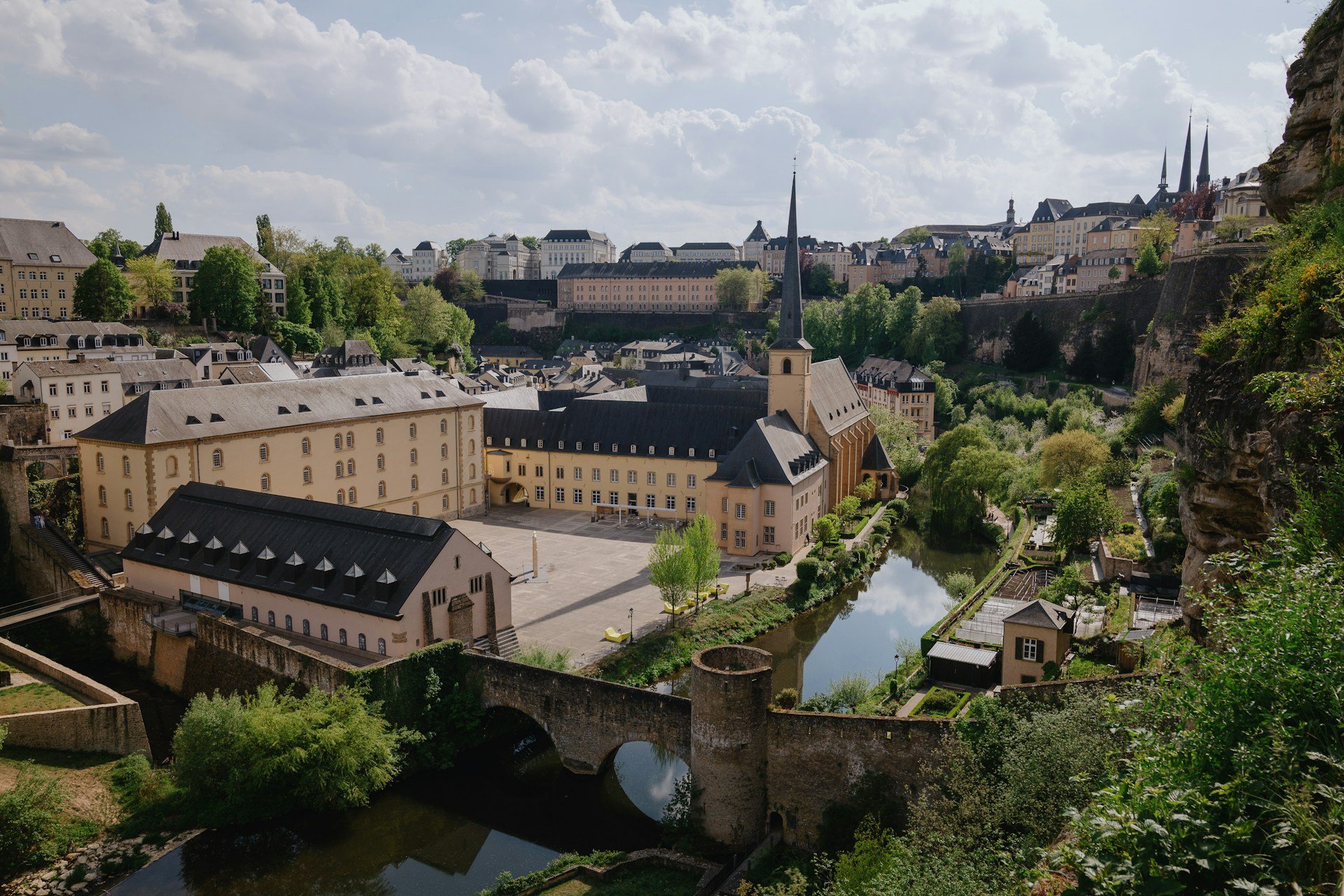
Luxembourg City is built on and around a sandstone plateau cut by two gorges and has three distinct levels: the upper plateau (Ville Haute) with the Grand Ducal Palace, Cathedral, and Place d'Armes; the gorge district (Grund and Clausen) at the bottom of the Alzette valley; and the Kirchberg plateau to the northeast where the EU institutions and banking sector cluster. The UNESCO-listed Old Town covers the Ville Haute and Chemin de la Corniche. The Bock Casemates — 23km of tunnels cut through the rock — are entered from Montée de Clausen and descend through multiple gallery levels. The view from the Corniche across the Alzette gorge to the towers of the Grund church is the canonical Luxembourg image. Allow three days to do it properly, not the two hours that most transit visitors spend.
Vianden
The most impressive castle in Luxembourg and one of the most beautifully situated in the entire Benelux region. Vianden Castle perches on a rocky outcrop above the Our River valley in the northern Ardennes, visible from several kilometers away and approached by a road that winds up through a village that seems to exist primarily as a scenic foreground for the castle above it. The castle is largely a Romanesque and Gothic construction from the 10th–14th centuries, heavily but authentically restored in the 20th century. Victor Hugo lived in a house in Vianden for several summers in exile and wrote extensively about the valley — the Victor Hugo House museum on the main street is small and genuine. The chairlift above the town gives the best elevated view of the castle and river below.
Moselle Valley
The Luxembourg Moselle runs 42km along the border with Germany, its south-facing slopes producing Riesling, Pinot Gris, Auxerrois, and Crémant de Luxembourg that are systematically underrated because they don't have the name recognition of Alsace or the German Mosel. The wine route from Schengen (where the Schengen Agreement was signed in 1985 on a boat) north through Remich, Stadtbredimus, Grevenmacher, and Wormeldange has estate wineries welcoming visitors for tastings at modest prices. The Caves Bernard-Massard in Grevenmacher has tours of its Crémant production facility. The Caves Viticoles de Greiveldange produces what many consider Luxembourg's finest Riesling. Cycle the river-level path and stop at estates as you go.
Mullerthal — Little Switzerland
The Mullerthal region in eastern Luxembourg has sandstone rock formations worn into fantastical shapes by millions of years of erosion — narrow gorges, balanced boulders, mossy overhangs, and forest trails threading between geological features that do genuinely resemble the Swiss Jura. The Mullerthal Trail is a 112km marked hiking route divided into three main loops, with shorter day sections accessible without committing to the full route. The village of Echternach — Luxembourg's oldest town, with a 7th-century Benedictine abbey founded by the Anglo-Saxon missionary Willibrord — is the trail's main base. The Schiessentümpel waterfall is 20 minutes' walk from the car park and the most photographed feature on the trail.
Grund & Clausen
Most visitors to Luxembourg City see the Corniche view of the gorge from above and never descend into it. This is the wrong choice. Grund, at the bottom of the Alzette valley below the Old Town plateau, is a neighborhood of stone houses, a parish church, riverside walks, and several of the city's better bars and restaurants, with the cliff walls rising dramatically on both sides and the Alzette running through the center. The descent from the Old Town through the Montée du Pfaffenthal (stairs and lift) takes 15 minutes. The Clausen district slightly downstream has craft breweries and the entrance to the Bock Casemates from below. Walking up and down the gorge in both directions is the essential Luxembourg City experience.
Bourscheid, Esch-sur-Sûre & the North
The northern Ardennes region has several castle ruins that are considerably less visited than Vianden but equally dramatic in their settings. Bourscheid Castle, built on a 150m rocky spur above the Sûre river, is the largest castle ruin in Luxembourg and has been partially restored with walkable ramparts. The village of Esch-sur-Sûre sits inside a near-complete loop of the Sûre river with a castle tower above and the kind of topographic setting that makes it feel like a natural fortress even without the medieval walls. The entire Ardennes region is hill-walking territory with marked trail networks connecting villages through beech forest.
Luxembourg American Cemetery & National Museum of Military History
The American Cemetery at Hamm on the eastern edge of Luxembourg City has 5,076 graves, all from the Battle of the Bulge (December 1944 – January 1945). General George S. Patton is buried here — his grave is slightly set apart from the others and receives a continuous stream of visitors. The National Museum of Military History in Diekirch, an hour north by bus, is considered one of the finest WWII ground-war museums in Europe: dioramas of extraordinary quality, original equipment including Sherman tanks, and a full documentation of the Bulge fighting in the Luxembourg Ardennes.
Kirchberg Plateau
The Kirchberg plateau northeast of the old city is where Luxembourg's role as an EU institutional hub is physically expressed: the Court of Justice of the EU, the Court of Auditors, the Secretariat of the European Parliament, and a dense cluster of banking and financial institutions occupy a purpose-built district that is architecturally ambitious and entirely different from the medieval old city below. The Luxembourg European Quarter bus stop (free, as everything is) connects Kirchberg to the center in 20 minutes. For architecture enthusiasts, the Court of Justice buildings by Dominique Perrault are worth seeing.
Culture & Etiquette
Luxembourg's social character reflects its position at the intersection of Germanic and Latin cultures and its extraordinary degree of internationalization. A country where 47% of residents are non-Luxembourgish, where the majority of the workforce commutes in from three foreign countries, and where three languages are official produces a social environment that is genuinely cosmopolitan without making a performance of it. The casual multilingualism is real — a conversation that begins in Luxembourgish may switch to French for a technical point, German for a reference, and English when a visitor appears. Nobody apologizes for this or announces it.
The national character tends toward the reserved end of the spectrum — closer to Germanic formality than French sociability in initial encounters — but with a relaxed quality in social settings that reflects the confidence of a small country that is very good at getting on with very different neighbors. Luxembourgers have strong opinions about their distinctiveness and are mildly irritated by the frequency with which visitors assume the country is "just like Belgium" or "basically French."
"Moien" (MOY-en) is "hello" — used throughout the day, the closest thing Luxembourg has to a universal greeting. "Merci" (French) is used for thank you in most everyday contexts. "Äddi" (AH-dee) is goodbye. The effort of using even one Luxembourgish word is received with disproportionate warmth from a population that is used to visitors assuming they're in Belgium.
The complete absence of fares on all buses, trains, and trams since 2020 is the world's most visitor-friendly public transport policy. Use it without guilt. Simply board any bus or train without buying a ticket or validating anything. This applies equally to tourists and residents. The occasional confusion from visitors looking for a ticket machine is itself a small cultural observation.
The single most common visitor mistake in Luxembourg City is admiring the Chemin de la Corniche view from the cliff edge and returning to the main square without descending into Grund. Walk down. The city looks completely different from the gorge floor. The Alzette river, the cliff walls rising on both sides, and the medieval church tower visible above are an entirely different experience from the plateau version.
The Luxembourg American Cemetery at Hamm is one of the most well-kept and emotionally significant WWII memorial sites in Europe. General Patton is buried here by his own request. The Battle of the Bulge — the largest American battle of WWII — was fought across the country where you are standing. The connection between the physical landscape of the Ardennes and the graves at Hamm is worth making in person.
Luxembourg Crémant and Moselle Riesling are genuinely excellent and genuinely unknown outside the country. Ordering "un Crémant de Luxembourg" in a restaurant or going to a Moselle estate for a tasting is both a good wine decision and a cultural engagement with what the country is actually proud of. The wines are lighter and more mineral than their German Mosel counterparts — the cooler conditions on the Luxembourg side produce elegant rather than rich wines.
Luxembourg is linguistically German-inflected where Belgium is Flemish-inflected; historically a Grand Duchy rather than a kingdom; economically based on finance and steel rather than manufacturing and services; politically a different constitutional tradition entirely; and culturally positioned between three European cultures in a way Belgium is not. The comparison is understandable and irritating in equal measure to Luxembourgers.
French is one of three official languages and is used for formal government purposes, but Luxembourgish is the mother tongue of most citizens and German is used in schools and media. Starting a conversation in French is reasonable, but assuming the country functions primarily in French misreads the linguistic reality. English is often the most efficient language for visitors.
Luxembourg's financial sector generates significant political controversy and the country's tax policies have been the subject of legitimate international criticism (the LuxLeaks scandal of 2014 revealed sweetheart tax deals that shocked European partners). This is real and worth knowing. It is also one dimension of a country with a genuine history, culture, landscape, and identity that predates the financial sector by a thousand years. Reducing it to "tax haven" is both reductive and boring.
Luxembourg City deserves at least two nights. The Moselle, Mullerthal, and Vianden all deserve separate days. Visitors who come for six hours, see the Corniche and the grand ducal palace from outside, and leave having "done Luxembourg" have done no such thing. The Bock Casemates alone take two hours. The gorge walk takes most of a morning. Two nights minimum.
The Battle of the Bulge — the largest American battle of the entire war — was fought across the Ardennes hills that you are driving through on the way to Vianden. The American Cemetery at Hamm is on the outskirts of the capital. The National Museum of Military History in Diekirch is an hour north. Passing through this landscape without engaging with what happened here in December 1944 and January 1945 is a missed connection.
Echternach Dancing Procession
The Hopping Procession of Echternach — a Catholic pilgrimage held on Whit Tuesday (the Tuesday after Pentecost) in which participants dance through the town in a two-steps-forward-one-step-back pattern for several kilometers — is one of the strangest and most ancient religious traditions in Europe. It honors Saint Willibrord (658–739), the Northumbrian missionary who founded Echternach's abbey. The procession has been performed since the Middle Ages and was inscribed on UNESCO's Representative List of the Intangible Cultural Heritage of Humanity in 2010. It draws tens of thousands of participants and observers every year.
The Grand Ducal Family
Luxembourg is a constitutional monarchy — a Grand Duchy — currently ruled by Grand Duke Henri, who ascended in 2000. The Grand Ducal Palace in Luxembourg City's old town is the official residence and working palace. The family is publicly visible and relatively accessible by royal family standards — Grand Duke Henri is known to walk in the city without extensive security. The annual National Day on June 23rd includes a military parade and the Grand Duke's balcony appearance. The family's profile is lower than the British royal family but the institution is genuinely popular with the population.
The Most International Country in Europe
Luxembourg's 47% non-Luxembourgish resident population is the highest proportion in Europe by a significant margin. The cross-border workforce adds another 200,000+ daily commuters from France, Germany, and Belgium. This produces a city where a lunch table of four might have people from five different countries without anyone considering this unusual. The EU institutions on Kirchberg concentrate this internationalism further — a walk through the European Quarter encounters dozens of languages in ordinary street conversations. This is not tourism multiculturalism. It is the daily social reality of the country.
Sport & the Vëlosummer
Luxembourg punches above its weight in cycling — the Tour de France and other major races frequently pass through, and the Vëlosummer (Bike Summer) festival in July makes the country's cycling infrastructure more visible. Andy Schleck won the 2010 Tour de France, Charly Gaul won in 1958 — an extraordinary record for a country of 680,000. Cycling the Moselle valley or the Mullerthal trail system is the most recommended sport activity for visitors. The free public transport also carries bicycles on the trains — the combination of cycling and free rail is the ideal country exploration method.
Food & Drink
Luxembourg's food tradition sits at the intersection of French cooking technique and Germanic ingredients — a hearty, satisfying cuisine of freshwater fish, game, pork preparations, and produce from the Moselle and Ardennes regions that is better than its reputation among food-focused travelers suggests. The wine, as noted, is genuinely excellent and systematically underrated. The restaurant scene in Luxembourg City has a sophistication that reflects the purchasing power of its financial sector workforce: there are more Michelin stars per capita here than in most European cities.
The distinctive national dishes are not fashionable or photogenic — they are honest, filling preparations of the kind that sustained people through hard winters in hill country. This is not Italian or French in its relationship to gastronomy. It is Alpine-Germanic with Gallic refinement, and it is very good.
Friture de la Moselle
The small fried fish (typically gudgeon, smelt, or small perch) pulled from the Moselle river and fried in batter until crispy — served with tartar sauce and a glass of local Riesling. It is the canonical Moselle meal, available at every riverside restaurant from Schengen to Grevenmacher, eaten by families on summer Sunday afternoons for as long as the Moselle has been fished. Simple, specific, and impossible to replicate in landlocked cities without the river context. Order it at a waterfront terrace in June or September.
Judd mat Gaardebounen
Luxembourg's national dish: smoked collar of pork (Judd) slow-braised until tender, served with broad beans (Gaardebounen) in a cream sauce, and typically accompanied by boiled potatoes. The pork is cured and smoked in a specific Luxembourgish way that gives it a flavor different from German or French equivalents — more delicate smoke, more balanced salt. It appears on restaurant menus throughout the year and at its best at traditional Luxembourgish restaurants in the Grund neighborhood.
Bouneschlupp & Soups
Bouneschlupp is the Luxembourgish green bean soup — a substantial affair with green beans, onions, potatoes, and smoked bacon in a clear broth that is the comfort food of the Ardennes. Traditional Luxembourgish cooking is soup-heavy in a way that reflects the hill country's cold winters. Gromperenzopp (potato soup) and Kniddelen (potato dumplings in broth) appear in the same register — honest, warm, filling, and genuinely good at their best.
Kachkéis
Kachkéis — "cooked cheese" — is a spreadable processed cheese made from quark, butter, egg yolk, and caraway seeds that is the specific taste of Luxembourgish childhood breakfasts and communal eating. It is stronger and more complex than it sounds, with the caraway giving it a distinct aniseed quality. Spread on dark bread with a glass of local white wine, it is the most specifically Luxembourgish food available. Available at any Luxembourgish supermarket or the Saturday market — take some home.
Crémant de Luxembourg
Luxembourg's sparkling wine — made by the same méthode champenoise as Champagne but from Pinot Blanc, Riesling, Auxerrois, and Pinot Noir grapes grown on the Moselle slopes. The result is a lighter, more delicate sparkling wine than most Champagnes, with a mineral quality that comes from the river's clay and limestone soils. A bottle costs €10–15 at the winery, €18–25 in a restaurant. Bernard-Massard in Grevenmacher is the largest producer and runs tours. It is served at the Grand Ducal Palace for state occasions and deserves to be better known outside Luxembourg.
Bofferding & Local Beer
Luxembourg has two main domestic breweries — Bofferding and Diekirch — whose lagers are the national beers in the way that Heineken is Dutch or Stella is Belgian. Bofferding is the more characterful of the two, a clean 5% pilsner-style lager that drinks well with Judd and friture. The craft beer movement has reached Luxembourg — La Chévre brewery near Echternach and Brasserie Simon in Wiltz produce more interesting options. In Luxembourg City, Liquid Bar on Rue du Saint-Esprit has the most comprehensive selection of local and imported craft beer in the country.
When to Go
May through October is the main travel window, with June and September the most comfortable months for the combination of walking, cycling, wine tasting, and outdoor dining that constitute the best of Luxembourg. The Moselle wine route is at its most beautiful during harvest (late September through October) when the vineyards are gold and the press houses are running. December brings one of the best Christmas markets in the Benelux region to Luxembourg City's old town squares.
Late Spring / Early Summer
May – JunLong days, comfortable temperatures for walking the Mullerthal trail and the gorge, the Moselle vineyards green and flowering. Echternach's Hopping Procession on Whit Tuesday falls in May or June. National Day on June 23rd in Luxembourg City. Outdoor restaurants and Corniche terrace cafés fully open.
Autumn
Sep – OctWine harvest on the Moselle — the most atmospheric time on the wine route. Forests of the Ardennes and Mullerthal in autumn color. Cooler temperatures ideal for walking. Summer crowds gone from the capital. October light on the gorge is specifically beautiful. Vianden in October: fewer tourists, full fall color.
Christmas Season
Late Nov – DecLuxembourg City's Christmas markets on Place d'Armes and Place de la Constitution are among the best in the Benelux. The UNESCO-listed old town in winter lighting is genuinely atmospheric. Cold (0–8°C), occasionally icy on the Corniche, but the covered market stalls and Glühwein provide warmth. Hotels fill for weekend market visits — book ahead.
Peak Summer
Jul – AugLuxembourg City is busy with European day-trippers in July and August. The Corniche and Bock Casemates have queues. The old town restaurants fill. The Moselle and Mullerthal are accessible but have the most visitors. The capital also empties somewhat in August as Luxembourgers take their own holidays. The weather is warm (22–28°C) but the experience is less intimate than June or September.
Trip Planning
The free public transport changes the planning equation significantly. Luxembourg City to Vianden by free train and bus takes about 1.5 hours each way — making it a realistic day trip without a car. The Moselle wine route towns are reachable by train from the city in 30–45 minutes. Echternach and the Mullerthal trailhead are 45 minutes by bus. A car is still faster and more flexible, particularly for the northern Ardennes and the castle circuit, but is not essential for a city-plus-one-or-two-regions visit.
Luxembourg works well as a standalone destination or as a Benelux combination with Brussels (2.5 hours by direct train) and Amsterdam (3.5 hours). The train connections are excellent and free within Luxembourg — you only pay for the Belgian and Dutch portions.
Luxembourg City: Plateau & Gorge
Morning: Chemin de la Corniche walk from Place du St-Esprit to the Bock promontory — the full cliff-edge promenade. Bock Casemates entry from Montée de Clausen (allow 90 minutes minimum for the upper and lower galleries). Lunch at the Saturday market if it's Saturday, or in the Grund neighborhood below the cliff. Afternoon: descend to Grund via the Montée du Pfaffenthal lift and walk along the Alzette riverbank to Clausen. Grand Ducal Palace exterior (interior open in summer by timed entry). Evening dinner in the Bonnevoie neighborhood.
American Cemetery & Moselle
Morning: Bus 19 from the city to the American Cemetery at Hamm (30 minutes, free). Allow an hour — find Patton's grave, walk the full field of crosses, visit the visitor center. Late morning: train to Remich on the Moselle (45 minutes, free). Walk the riverside promenade, lunch at a restaurant with Moselle view. Afternoon: wine tasting at an estate in Remich or Stadtbredimus — just walk in and ask; they are accustomed to visitors. Return train to Luxembourg City. Evening: Crémant at a wine bar on Rue des Capucins.
Luxembourg City Fully
Two full days including the Bock Casemates, the Corniche, the Grund and Clausen gorge floor, the Pétrusse valley (the other gorge — accessed from Place de la Constitution), the MUDAM contemporary art museum on Kirchberg (take the free bus — 20 minutes from the old town), and the National Museum of History and Art on Marché-aux-Poissons. Evening in the Clausen craft brewery district. The Luxembourg City Card (€18/48 hours or €23/72 hours) gives free museum entry on top of the free transport — worth it for a full city stay.
Vianden & the North
Free train from Luxembourg City to Ettelbruck (45 minutes), then bus to Vianden (30 minutes). Full morning at Vianden Castle. Victor Hugo house museum in the village. Chairlift for the aerial view. Lunch in one of the Vianden riverside restaurants. Afternoon walk along the Our River south of the village, or take the bus to Diekirch for the National Museum of Military History — the finest Battle of the Bulge museum in Europe. Return to Luxembourg City by bus and train.
Moselle & Mullerthal
Day four: full Moselle cycle from Remich to Grevenmacher (25km, flat) with wine estate stops — Caves Bernard-Massard in Grevenmacher for the Crémant tour. Lunch at a riverside friture restaurant. Free train back to the city. Day five: bus to Echternach (45 minutes, free), walk the Mullerthal trail Gorge du Loup section (3km, 90 minutes, the most dramatic section), continue to the Schiessentümpel waterfall, explore Echternach's old abbey town, return by bus.
Luxembourg City Deeply
Three days including the full WWII circuit: American Cemetery at Hamm, the National Memorial of the Military Deportation on Place de la Constitution (covering the Nazi occupation, small and essential), and a day trip to Diekirch for the Military History Museum. The third day: Kirchberg for the EU architecture and MUDAM, followed by Clausen's craft brewery walk in the evening. Rent a bicycle on day three for the Pétrusse valley greenway and the Alzette riverside cycle path north of the city.
Northern Ardennes Castle Circuit
Rent a car for two days. Day four: Vianden for the morning, then drive to Bourscheid Castle (the largest ruin in Luxembourg, dramatically set above the Sûre river), then Esch-sur-Sûre village for the evening. Day five: drive the Upper Sûre lake circuit, stop at the village of Clervaux in the far north (the Family of Man UNESCO photography exhibition is in the castle — the most comprehensive humanist photography collection in the world, assembled by Edward Steichen in 1955). Return to Luxembourg City.
Moselle Fully & Schengen
Day six: the full Moselle cycling route from Schengen (southernmost point) to Wasserbillig (northernmost point) — 42km flat, fully equipped cycling infrastructure, with stops at Remich, Stadtbredimus, Ahn, Wormeldange, and Grevenmacher. The Caves de Greiveldange in Ahn produces what is often called Luxembourg's finest Riesling — ask for the Palmberg cru. Day seven: Mullerthal trail full loop 2 (the Berdorf section, 22km, full day hiking). Return to Luxembourg City for the evening flight or continue by train to Brussels or Amsterdam.
Free Transport — How It Works
All buses, trains (first class costs extra; second class is free), and trams are completely free since March 1, 2020. Simply board. No ticket needed, no validation, no app. The national rail system (CFL — Chemins de Fer Luxembourgeois) and the bus network both covered. First-class rail costs €2/trip or €4/day. The Luxembourg City Card also covers first-class rail in addition to museum entries.
Luxembourg City Card
The Luxembourg City Card (€18/48 hours, €23/72 hours) gives free entry to over 50 museums and attractions including the Bock Casemates, MUDAM, and the National Museum of History and Art, plus unlimited free public transport (which is already free, so the card value is entirely in the museum entries). Worth buying for a two-to-three day city stay if you plan multiple museums.
Vaccinations
No mandatory vaccinations for Luxembourg. Routine vaccines recommended. Tick-borne encephalitis risk is low but present in forested Ardennes and Mullerthal areas — standard European tick precautions apply for forest hiking. No specific health risks beyond normal Western Europe standards.
Full vaccine info →Connectivity
EU roaming applies for European carriers. Non-EU visitors should get an EU eSIM via Airalo. Luxembourg has excellent 4G/5G coverage across the entire country including rural Ardennes and the Moselle Valley. Free WiFi is available on all CFL trains. Luxembourg City has public WiFi across the old town.
Get Luxembourg eSIM →Car Rental Notes
A car unlocks the northern Ardennes, the full Moselle route at your own pace, and the castle circuit. Rental companies at Luxembourg Airport and the city center. Parking in Luxembourg City is metered and expensive (€2–4/hour). The free park-and-ride facilities at city outskirts connected by free transit are better than paying for city center parking. No specific driving requirements beyond a standard EU or international license.
Mullerthal Trail Preparation
The Mullerthal trail's more challenging sections (particularly the gorge passages) require proper walking shoes with grip — the sandstone is slippery when wet and some sections require stepping over rocks and roots. Day sections are accessible without overnight preparation. The full 112km trail needs advance hut booking (auberges in Echternach and trail villages accept bookings at visitmullerthal.lu).
Transport in Luxembourg
Luxembourg's free public transport system is the most visitor-friendly in Europe. Every CFL train (second class), every bus, and every tram in the country has been completely free since March 1, 2020. There is nothing to buy, validate, or tap. Simply board. The network covers the entire country — every town, every village, every major tourist destination. Trains to Vianden, buses to Echternach, trains to the Moselle — all free. The only exception is first-class rail (€2/trip or €4/day), which is purely optional.
CFL Train (Free)
Free (2nd class)The national rail network connects Luxembourg City to all major towns. Key routes: Luxembourg City to Ettelbruck (for Vianden connection) in 45 minutes; to Wasserbillig (Moselle start) in 30 minutes; to Diekirch in 50 minutes. Trains run every 30–60 minutes on most routes. Check timetables at cfl.lu or the CFL app.
Regional Bus (Free)
FreeBuses reach every town and village not on the rail network. The bus to Vianden (via Ettelbruck train connection) runs regularly. The bus to Echternach from Luxembourg City takes 45 minutes. The entire national bus network schedule is on cfl.lu. The app also gives real-time information on bus positions.
Luxembourg City Tram (Free)
FreeThe city tram runs from Cloche d'Or in the south through the city center to the airport and Kirchberg. Useful for connecting the airport to the city center (20 minutes, free) and for reaching Kirchberg from the old town. The tram is being extended — check current route at mobiliteit.lu.
Car Rental
€35–70/dayHertz, Europcar, Avis, and Budget at Luxembourg Airport and city center. A car gives flexibility for the Ardennes castle circuit, the full Moselle route at your own pace, and the Mullerthal region. Most major castle sites have free parking. Luxembourg City center parking is expensive — use the park-and-ride at Bouillon or Howald and take the free tram in.
Cycling
€15–25/day rentalVeloh! is Luxembourg City's bike share scheme (€1/30 minutes, reduced for members). The Moselle cycle path is the country's best cycling infrastructure — flat, paved, with the river on one side and vineyards on the other. Bikes travel free on CFL trains. Rental available at the tourism office in the city center. The Vëlosummer festival in July highlights the cycling infrastructure.
Taxi & Webtaxi
€2.50/kmTaxis are available but expensive at Luxembourg prices. The Webtaxi app is the most reliable option in the city. The airport taxis run on a meter — a journey from the airport to the Old Town costs €25–35. For most purposes, the free tram from the airport to the city center is the better option unless you have heavy luggage or arrive very late.
Luxembourg Findel Airport
6km from centerLuxembourg Airport (LUX) is 6km northeast of the city center. The tram (Line T1 from Luxexpo stop, 5 minutes walk from the terminal) reaches the city center in 20 minutes — free. Luxair is the national carrier. Ryanair, Easyjet, and major European carriers serve the airport with connections across Europe.
International Trains
€25–60 to Brussels/ParisLuxembourg City is a major rail hub. Direct trains to Brussels Midi (2.5 hours), Paris Est (2h10m on TGV), Frankfurt (3.5 hours), and Metz (45 minutes). The free transport stops at the Luxembourg border — you pay for Belgian, French, and German portions. Inter-Rail and Eurail passes are valid. Luxembourg City's main station is 20 minutes' walk from the Old Town center.
No ticket. No app required. No validation. Just board the train or bus. This applies to CFL trains (second class), all regional buses, and the Luxembourg City tram. The network covers the entire country. Your hotel is in the Old Town and you want to go to Vianden? Walk to the station, take the train to Ettelbruck (45 minutes), take the bus to Vianden (30 minutes). Both entirely free. Return the same way. Total cost: €0. This is real and applies to tourists exactly as it applies to residents. First class costs €2 per trip if you want a more spacious seat — entirely optional.
Accommodation in Luxembourg
Luxembourg City's accommodation market skews expensive — it is a business travel destination with international institutions and a financial sector, and prices reflect this. Budget travelers will find hostels and modest guesthouses; mid-range accommodation is equivalent to Western European prices rather than Eastern European affordability. Staying in the Old Town or Grund puts you in the most atmospheric areas. Kirchberg is convenient for EU visitors. Outside the capital, prices drop significantly.
Old Town Boutique
€100–250/nightThe Hotel Le Place d'Armes on the main square is the most characterful luxury option — a converted historic building with excellent service and one of the best restaurant tables in the city. Simmons Hotel on Rue du Curé and the Sofitel Le Grand Ducal offer comparable quality. The neighborhood puts you five minutes from the Corniche and ten from the Casemates entrance.
Grund Guesthouse
€80–150/nightStaying in Grund, at the bottom of the gorge, gives you the most atmospheric Luxembourg City experience — waking up in the valley with the cliff walls above you and the sound of the Alzette river outside. Auberge du Coin de la Terre and several smaller B&Bs in Grund offer this. Slightly inconvenient for the plateau attractions (a 15-minute walk or lift) but worth it for the setting.
Ardennes Country Hotel
€70–140/nightThe northern Ardennes has a scattering of family-run country hotels in stone buildings with forested views. The Hôtel de la Sûre in Esch-sur-Sûre is the most distinctive — inside the river loop with the castle tower above. Hotels in Vianden overlook the Our valley and castle. Noticeably cheaper than Luxembourg City and better placed for the north.
Hostel
€25–40/nightLuxembourg City Youth Hostel (Auberge de Jeunesse) on Rue du Fort Olisy is the main option — well-maintained, in the Pfaffenthal area near the gorge, accessible by the free Pfaffenthal lift from the Old Town. Cheaper than any hotel and with a reasonable common area. Book ahead in summer as Luxembourg attracts young European travelers despite its reputation for expense.
Budget Planning
Luxembourg is expensive but not Swiss-level. The free transport dramatically reduces one of the usual major expenses of travel, but accommodation, restaurants, and museum entries are priced at high Western European rates. The Luxembourg City Card (€18/48 hours or €23/72 hours) with free museum entry is worth buying if you plan more than three paid attractions in 48 hours — the Bock Casemates alone cost €8 entry, so the card pays for itself quickly.
- Youth hostel dorm
- Saturday market breakfast (€5–7)
- Supermarket lunch (Delhaize, Auchan)
- One restaurant dinner (€15–25)
- All transport free — zero transport costs
- Boutique hotel or comfortable guesthouse
- Restaurant lunch and dinner
- Luxembourg City Card for museum entries
- Moselle wine tasting (€8–15 per session)
- Crémant in a wine bar
- Hotel Le Place d'Armes or Sofitel
- Michelin-starred or fine dining restaurants
- Rental car for the Ardennes and Moselle
- Private wine estate tasting with food pairing
- Guided WWII landscape tour with historian
Quick Reference Prices
Visa & Entry
Luxembourg is a full EU and Schengen member. EU citizens can enter and stay indefinitely. Citizens of the US, UK, Canada, Australia, New Zealand, Japan, and most Western nations get 90 days visa-free within any 180-day Schengen period. The Schengen clock runs across all member states — time spent in France, Germany, Belgium, or any other Schengen country before Luxembourg counts against the same 90-day allowance.
ETIAS (European Travel Information and Authorisation System) is now in operation and required for most non-EU nationals who previously entered visa-free. This includes UK, US, Canadian, Australian, and New Zealand passport holders. It is a short online pre-registration (not a visa), costs €7, valid for three years, and takes minutes to complete.
Luxembourg is full EU and Schengen. Most Western passport holders enter visa-free. ETIAS required for UK, US, Canadian, Australian, New Zealand, and other non-EU visitors. The 90-day count runs across all Schengen countries combined.
Family Travel & Pets
Luxembourg is an excellent family destination — safe, clean, accessible by free public transport, and with a range of activities that engage children of different ages without requiring extensive preparation. The Bock Casemates are the universal Luxembourg family highlight: underground tunnels, multiple levels, the drama of emerging at a lower gallery level with a view across the gorge far below. The combination of medieval castle (Vianden) and free transport to get there is a straightforward family win.
The free public transport deserves special emphasis for families: traveling with children that would normally generate significant transport costs travels entirely free, making Luxembourg's relative expense more manageable than the headline hotel prices suggest.
Bock Casemates
Children find the underground fortress tunnels immediately engaging — multiple levels, occasional dramatic openings onto the gorge far below, cramped passages that require ducking, and the historical story of how 40,000 people once sheltered here. The descent and the underground galleries work for children from about six upward. The cool temperature (bring a layer) adds to the sense of genuine underground adventure.
Vianden Castle & Chairlift
Vianden Castle is the most accessible grand medieval fortress in Luxembourg, with a comprehensive interior museum and a chairlift above the town that gives the best aerial view of the castle and the Our river valley. The chairlift alone is worth the trip for children. The Victor Hugo house museum in the village is small enough to work as a 20-minute stop. The free train and bus from Luxembourg City make the day trip possible without a car.
Mullerthal Rock Formations
The sandstone rock formations of the Mullerthal Trail — balanced boulders, narrow gorges, mossy overhangs — engage children's imagination in the same way that natural playgrounds do, but at geological scale. The Schiessentümpel waterfall is a 20-minute flat walk from the car park and works for any age. The Gorge du Loup section requires some rock-hopping and is suitable for children over eight with reasonable coordination.
Moselle Cycle Path
The flat Moselle cycle path is one of the most family-friendly cycling routes in Western Europe. The terrain is completely flat, the path is separated from road traffic, the scenery is consistently beautiful, and the wine villages along the route have cafés with outdoor seating where the adults stop for a glass of Riesling while children run in the vineyard. Bikes travel free on CFL trains for the return journey.
American Cemetery for Older Children
For children old enough to engage with WWII history — typically twelve and above — the American Cemetery at Hamm and the National Museum of Military History in Diekirch together provide one of the most humanly graspable accounts of that conflict available in Europe. The dioramas at Diekirch are extraordinary. General Patton's grave at Hamm makes the human cost specific in a way that statistics alone cannot.
The Free Transport Adventure
For families with children, the free public transport is more than a practical convenience — it is a novelty that becomes an adventure in its own right. Explaining to children that every train and bus in the country is completely free, then actually using it to get from the city to a medieval castle and back, produces a specific kind of engagement with a country that straightforward sightseeing doesn't. Simply board. Free. This is genuinely exciting for children who understand the concept of tickets.
Traveling with Pets
Luxembourg follows EU Pet Travel Scheme rules. Dogs and cats from EU countries need a microchip, valid rabies vaccination, and an EU pet passport. Pets from non-EU countries (including post-Brexit UK) need a health certificate from an accredited vet. Standard EU pet travel documentation applies — the same as for Belgium, France, or Germany.
Luxembourg is moderately pet-friendly. Dogs are welcome in many outdoor spaces, on the Moselle riverside paths, on the Mullerthal trail (leads required in nature reserve sections), and in some restaurants with outdoor terraces. The Alzette gorge walks and the Ardennes forest trails are all dog-accessible. Most rural guesthouses and smaller hotels accept dogs with advance notice. Urban Luxembourg City hotels vary — verify before booking.
Dogs travel free on CFL trains and buses, providing they are on a lead and, for larger dogs, wearing a muzzle in enclosed carriages during rush hour. This is the same regulation as in neighboring Belgium and Germany. The free transport applies equally to pets accompanying their owners.
Safety in Luxembourg
Luxembourg is one of the safest countries in Europe by all available metrics. Violent crime against tourists is essentially absent. The main practical concern for visitors is pickpocketing in the Luxembourg City Old Town during peak tourist season — a modest risk by major European city standards. The country's wealth, small size, and efficient policing produce a genuinely low-crime environment.
General Safety
Luxembourg ranks among the very safest countries in the world. Walking the Chemin de la Corniche at midnight, walking through Grund alone at any hour, taking the free train at any time — all of these are as safe as any urban environment in Europe gets. Standard common sense is all that applies.
Solo Women
Exceptional safety for solo female travelers. Street harassment is very uncommon. The city is well-lit, well-policed, and thoroughly comfortable at all hours. The gorge neighborhoods (Grund, Clausen) are pleasant evening destinations without the concerns that equivalent locations in larger cities might produce.
Casemates Safety
The Bock Casemates have some sections with low ceilings and uneven surfaces. The lower galleries have genuine drops visible through openings in the rock. Normal awareness is all that's needed — the paths are marked and the dangerous edges are indicated. Wear sensible shoes with grip. Children should be supervised near the open gallery views onto the gorge.
Corniche in Icy Conditions
The Chemin de la Corniche is paved stone that becomes extremely slippery in frost or ice — a genuine hazard in December through February. The cliff edge is immediately adjacent to the path. In icy conditions, wear shoes with grip or avoid the Corniche until it clears. The city grits the path but early morning ice before gritting trucks arrive can be treacherous.
Ardennes Trail Weather
The Ardennes hills can have rapidly changing weather, particularly in autumn and winter. The Mullerthal sandstone is slippery when wet. Check forecasts before long hikes and carry a waterproof layer regardless of morning sunshine — afternoon rain is common. The trails are well-marked but forest GPS coverage can be patchy.
Healthcare
Luxembourg has excellent healthcare. The Centre Hospitalier de Luxembourg (CHL) is the main hospital in the capital. Emergency departments are accessible to all. EU EHIC is accepted. Non-EU visitors should have travel insurance. A pharmacy (Pharmacie) on every major street in Luxembourg City handles minor concerns. Pharmacists speak French, German, Luxembourgish, and usually English.
Emergency Information
Your Embassy in Luxembourg City
Most Western embassies are located in Luxembourg City's residential districts.
Book Your Luxembourg Trip
Everything in one place. These are services worth actually using.
The Country That Quietly Gets Everything Right
Every country in this series teaches something. Latvia teaches what it means to keep a culture alive through song. Lithuania teaches active remembrance. Kosovo teaches the cost of building a state from nothing. Luxembourg teaches something quieter: what happens when a small country, with no particular drama in its recent history, simply gets on with the business of being very good at being a place.
The free public transport is the most visible expression of this. The world's wealthiest country per capita chose to make getting around completely free for everyone — visitor and resident alike — not as a political statement but as a practical decision that the money was there and the benefit was obvious. The care taken with the UNESCO old city. The American Cemetery maintained to a standard that exceeds most national war memorials. The Moselle wine estates producing excellent wine that nobody outside the country knows about. The 23 kilometers of medieval tunnel beneath the capital that could have been sealed and forgotten but were instead opened and lit and made accessible for everyone who wants to understand what the city is built on.
In Luxembourgish, the word for this kind of quiet competence is harder to find because the language doesn't make a virtue of advertising its own qualities. But the thing itself is there: in the gorge, in the Casemates, in the free train to Vianden, in a glass of Crémant on the Corniche with the Alzette 100 meters below. Mir wëlle bleiwen wat mir sin — we want to remain what we are — is the country's unofficial motto, a line from its national anthem. From a place this small, that has been occupied this many times, the statement is both modest and quietly extraordinary.