
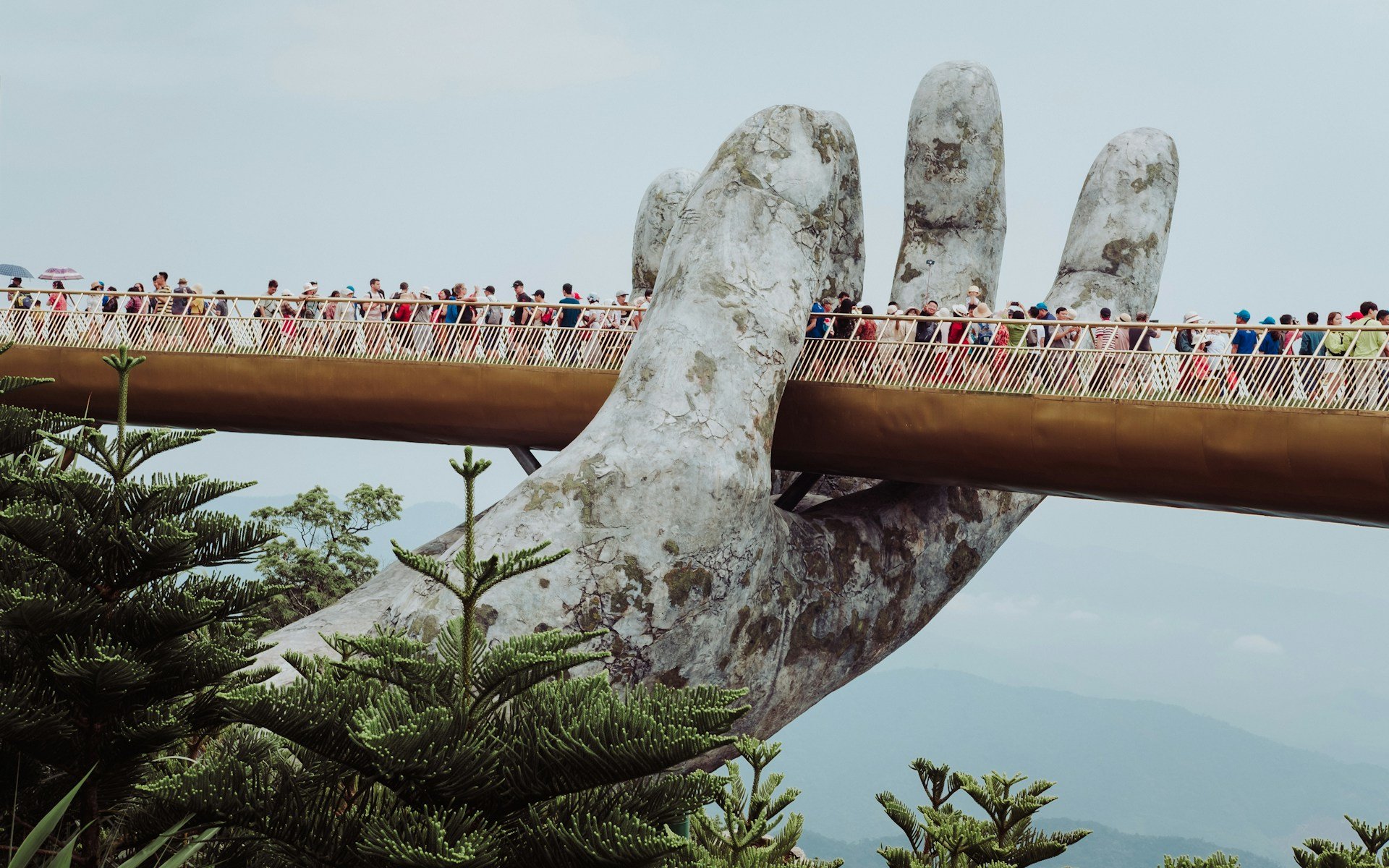
Vietnam
A country shaped like a dragon's spine running 1,650 kilometers from mountain border to tropical delta. The north and south barely share a cuisine. The food alone is worth the flight. The history makes you stand still in the middle of a street.
What You're Actually Getting Into
Vietnam is long and thin and deeply regional in a way that most visitors don't account for in their planning. The country stretches 1,650 kilometers from the Chinese border in the north to the Mekong Delta in the south. Hanoi and Ho Chi Minh City are not just different cities with different accents. They are different temperaments: the north cautious, formal, proud, the food cleaner and more austere; the south louder, warmer, more entrepreneurial, the food sweeter and more abundant. Hoi An in the middle is something else entirely, a preserved trading-port town that looks like a film set and functions like one in July and August, and like a genuinely beautiful small city every other month.
The food is the thing everyone talks about on the way home and the thing that most reliably holds up to expectation. A bowl of pho from a Hanoi street stall at 6am, the broth clear and deep, the beef barely cooked by the pour, with a plate of fresh herbs and bean sprouts on the side, is one of the great breakfast experiences in Asia. It costs about a dollar and a half. The banh mi from the cart outside Banh Mi Phuong in Hoi An, which Anthony Bourdain once described as a symphony in a sandwich, is 35,000 dong and worth every one of them. The coffee, sweetened condensed milk over ice with drip-brewed robusta, is non-negotiable from day one.
What surprises most first-time visitors: how modern and forward-moving the country feels. Vietnam's economy has been growing at six to seven percent annually for most of the past decade. Ho Chi Minh City is a city of glass towers and rooftop bars and traffic that makes Bangkok look calm. The coffee shop culture is extraordinary: every neighborhood has three competing cafes where young Vietnamese professionals sit for hours with laptops and iced drinks. The country the American War left in 1975 is not recognizable in the country you arrive at today.
The practical reality: Vietnam is one of Southeast Asia's best-run tourist routes. The north-to-south corridor from Hanoi to Ho Chi Minh City is well-served by budget flights, a working sleeper train, and open-bus services for those who want to go slowly. The infrastructure for travelers is good without being sanitized. You can still get genuinely lost, genuinely local, genuinely surprised. That balance is harder to find in Southeast Asia than it used to be.
Vietnam at a Glance
A History Worth Knowing
Vietnam's history is fundamentally a story about resistance. Not because the Vietnamese are defined by conflict, but because the country's geography, a long thin coastal strip at the junction of Chinese, Indian, and Southeast Asian cultural spheres, made it perpetually attractive to larger powers and made its people perpetually practiced at surviving them.
The Chinese ruled Vietnam for almost a thousand years, from 111 BCE to 938 CE. A thousand years. The Vietnamese absorbed Chinese writing systems, administrative structures, Confucian social values, and Buddhism while simultaneously maintaining a distinct cultural identity that reasserted itself the moment Chinese control weakened. When the general Ngo Quyen defeated a Chinese fleet on the Bach Dang River in 938 using a tactic of iron-tipped stakes hidden beneath the tide, it was the beginning of a millennium of independent Vietnamese dynasties. The Bach Dang tactic was used again, with variations, against Mongol invasions in the 13th century. The Vietnamese are very patient and very good at rivers.
The Cham civilization, which dominated what is now central Vietnam for over a thousand years, left behind the temple complex of My Son outside Hoi An: red-brick towers built between the 4th and 14th centuries that are Vietnam's answer to Angkor Wat. Most tourists spend three hours there and wish they had spent more. The Cham were a Hindu maritime civilization whose influence stretched across Southeast Asia, and their architecture has almost nothing in common with anything else in Vietnam.
French colonialism arrived in the mid-19th century, beginning with the capture of Saigon in 1859 and consolidating into French Indochina by 1887. The French built railways, universities, wide boulevards, and the Notre-Dame Cathedral in Saigon. They also ran a brutal extraction economy, monopolized rice exports during famines, and taxed opium and alcohol sales that they made mandatory at local level. The architecture remained. The resentment accumulated.
Ho Chi Minh, who had spent years in Paris, London, New York, and Moscow before returning to lead the independence movement, declared Vietnamese independence in September 1945, quoting the American Declaration of Independence in the opening lines of his speech. The French, backed by American money, tried to reassert colonial control. The First Indochina War ended in 1954 at Dien Bien Phu with a Vietnamese victory that shocked the world and effectively ended French colonialism in Asia.
The country was divided at the 17th parallel by the Geneva Accords, temporarily, pending elections that never came. What followed, the American War as the Vietnamese call it, lasted twenty years, killed between two and three million Vietnamese, and ended in April 1975 when North Vietnamese tanks rolled into Saigon. The last American helicopter left the US Embassy roof. The image is in every history book.
Reunification in 1976 brought a decade of poverty, isolation, and the trauma of the Cambodian border war. The Doi Moi economic reforms of 1986 opened the economy to foreign investment and market forces. The result was one of the most rapid economic transformations in modern Asian history. Vietnam today exports electronics, textiles, and coffee in volumes that would have been unimaginable to the generation that fought the war. The country that defeated three major world powers in thirty years turned out to be equally good at capitalism.
What this history means on the ground: the War Remnants Museum in Ho Chi Minh City is the most important museum you'll visit in Vietnam and one of the most difficult anywhere. The Cu Chi Tunnels an hour from the city tell the war from the Vietnamese side with a clarity that no American account quite matches. Hue's Imperial Citadel carries the weight of the Tet Offensive in 1968. My Lai is two hours from Hoi An. The history is not distant. It is twenty minutes from whatever you're doing.
Han China annexes the Red River Delta. Nearly a thousand years of Chinese administration follow, during which Vietnam absorbs Chinese culture while never fully becoming Chinese.
Ngo Quyen defeats a Chinese fleet on the Bach Dang River using submerged iron stakes. Vietnam's first millennium of independence begins.
The Hindu Cham kingdom dominates central Vietnam, building the temple complex of My Son near present-day Hoi An.
France captures Saigon. By 1887, French Indochina covers all of present-day Vietnam, Laos, and Cambodia.
Vietnamese forces defeat the French army in a siege that ends French colonialism in Asia. The country is divided at the 17th parallel.
North Vietnamese forces enter Saigon on April 30th. The American War ends. The country reunifies in 1976.
Vietnam opens its economy to foreign investment and market forces. One of Asia's most rapid economic transformations begins.
97 million people, one of Southeast Asia's fastest-growing economies, and a coffee culture that deserves its own chapter.
Top Destinations
Vietnam's logical travel sequence runs north to south or south to north. Most people fly into Hanoi and out of Ho Chi Minh City, stopping at Ha Long Bay, Hue, and Hoi An along the way. This works well. What the standard itinerary misses: Ninh Binh's limestone landscape is Ha Long Bay on land and significantly less crowded. The Ha Giang Loop in the far north is one of Southeast Asia's great motorbike routes and almost entirely off the main tourist trail. Phong Nha in central Vietnam has the world's largest cave systems. Pick the standard route, then add one thing nobody told you about.
Hanoi
Hanoi is a city that requires time to like. The Old Quarter's 36 ancient guild streets, each historically named for the trade practiced there, are chaotic and alive and full of contradictions: street pho vendors operating under French colonial balconies, motorbikes threading alleys too narrow for a car, a woman carrying a bamboo pole with baskets of fruit moving through it all at a pace that suggests she's done it ten thousand times. The Hoan Kiem Lake at 6am when Hanoi's elderly population does tai chi on the banks is one of those city moments that stay. Ho Tay, the West Lake, has the best cafe culture in the country. Give Hanoi two full days at minimum and don't spend either of them in the Old Quarter alone.
Ha Long Bay & Lan Ha Bay
Ha Long Bay is one of those places where the reality matches the photograph in a way that's actually slightly alarming. Nearly 2,000 limestone karst islands rising straight from water so green it looks digitally altered, with fishing villages built on floating platforms between them. The problem is everyone knows this. In peak season the bay fills with tour boats to a degree that undermines the whole thing. The solution: book a cruise to Lan Ha Bay, the less-visited southern section, or push further to Bai Tu Long Bay. Spend two nights on the boat rather than one. The second morning, after the day-trip boats have gone back to the port, is when you get Ha Long Bay to yourself.
Hue
Vietnam's last imperial capital, a walled citadel on the Perfume River that was the seat of the Nguyen dynasty from 1802 until 1945. The Imperial Citadel and its Forbidden Purple City inside it were heavily damaged in the 1968 Tet Offensive and restoration has been ongoing ever since. The Thien Mu Pagoda seven floors tall on the river bend. The royal tombs in the hills outside the city, each emperor having built his own complex during his lifetime. The food, specifically bun bo Hue, is different from anywhere else in Vietnam and many people consider it the best noodle soup in the country. The argument is legitimate.
Hoi An
Hoi An is the most visually coherent town in Vietnam: a preserved 15th-century trading port where Japanese merchant houses, Chinese assembly halls, and French colonial facades exist on the same street without any of them looking like a reconstruction. At night the lanterns come on and the Thu Bon River reflects them and it looks exactly like every photo you've seen. This is also its problem in July and August when tour groups pack the Ancient Town to a level that makes it feel like a theme park. Go in February, March, or November. Stay at least three nights. Rent a bicycle. The beach at An Bang is 4 kilometers away and significantly better than Cua Dai, which has erosion issues.
Ho Chi Minh City
Saigon, which is what everyone still calls it, is the fastest-moving city in Vietnam. Glass towers, rooftop bars, traffic that flows like a river and requires the same approach as wading into one (commit, move steadily, don't stop), and a street food culture that operates on a different scale from anywhere in the north. The War Remnants Museum. The Reunification Palace, frozen in 1975 on the day the tanks drove through its gates. Ben Thanh Market for orientation. The French colonial district around the old post office for architecture. District 3 for coffee and the best independent restaurants. Two full days and an evening on a rooftop watching the motorbike river below.
Sapa & the Ha Giang Loop
Sapa in the northwest, accessible by overnight sleeper train from Hanoi, sits at 1,500 meters in the Hoang Lien Son mountains. The rice terraces cascading down Muong Hoa Valley are Vietnam's most photographed landscape after Ha Long Bay. The town itself has been significantly overtouristed and overbuilt, but the villages of the Black Hmong, Red Dao, and Flower Hmong communities in the surrounding valleys are worth the journey. For something more remote and more rewarding: the Ha Giang Loop, a 300-kilometer motorbike circuit through karst mountains on the Chinese border that most visitors to Vietnam never reach and that those who do never stop talking about.
Ninh Binh
Two hours south of Hanoi, Ninh Binh is what Ha Long Bay looks like when it's on land. The Trang An landscape complex, a UNESCO site of karst mountains and river systems threading through rice paddies, is explored by rowing boat through cave tunnels and past monastery complexes. Bich Dong Pagoda is built into a cliff face. Hoa Lu was Vietnam's capital in the 10th century and its ancient temples are visited by almost nobody because every tourist on the bus went to Ha Long Bay instead. This is entirely their loss and, temporarily, your gain.
Phong Nha
Son Doong, the largest cave in the world, is here. So is Hang En, the third largest, and Phong Nha Cave, and Tu Lan, and over 300 other cave systems in the Phong Nha-Ke Bang National Park. Son Doong expeditions sell out a year in advance, cost $3,000, and are worth every dollar for the people who do them. The more accessible options, Phong Nha Cave by boat, Paradise Cave's stunning five-kilometer-long chamber, Hang Toi's underground river swimming, are all extraordinary in their own right. Getting here requires effort: a flight to Dong Hoi or a stop on the Reunification Express train. Nobody regrets it.
Culture & Etiquette
Vietnam is a Communist single-party state with a deeply Confucian social structure and a population that is simultaneously one of the most entrepreneurially energetic in Asia. The apparent contradictions resolve themselves quickly once you spend time there: the official political framework and the daily reality of how people live, trade, and interact operate somewhat independently of each other. What visitors need to understand is the social framework rather than the political one.
Vietnamese society places enormous emphasis on family, age, hierarchy, and face. Causing someone embarrassment in public, being visibly rude, or losing your temper carries social consequences that outlast the moment. Conversely, displaying patience, respect for elders, and genuine interest in local life opens doors at a speed that continues to surprise visitors who didn't expect it.
Cover shoulders and knees. Most sites have cloth available at the entrance. The Perfume Pagoda outside Hanoi and the Thien Mu in Hue are particularly strict. Arriving visibly underdressed at a religious site is noticed and commented on.
At pagodas, private homes, and some traditional restaurants. The pile of shoes at the entrance is the universal signal. Follow it without being asked.
Market prices are negotiable, particularly for clothing and souvenirs. Restaurant prices are not, even at street stalls. Attempting to bargain over a bowl of pho that costs 40,000 dong (less than $2) is not a cultural norm. It's just embarrassing.
Particularly elderly Vietnamese, ethnic minority communities in the north, and people at work. A gesture toward your camera and a questioning expression is understood everywhere. Most people will agree; some won't. Respect the ones who don't.
Xin chào (hello), cảm ơn (thank you), and ngon quá (delicious) are enough to get genuine smiles at every meal. Vietnamese is tonal and genuinely difficult to speak correctly, but the attempt is always appreciated more than the accuracy.
The head is considered the most sacred part of the body across Vietnamese and Buddhist tradition. Don't touch anyone's head, including children, regardless of how affectionate the intent.
Passing food, money, or objects over a person's head is considered very rude. Always pass at waist level or below.
Feet are considered the least sacred part of the body. Don't point them at an altar, a Buddha image, or the person you're speaking with when sitting on the floor.
Vietnam is a one-party state with active military sensitivities about certain installations, borders, and government buildings. Don't photograph uniformed officials or military facilities. The consequences are unpredictable and not worth any photograph.
Foreigner prices at tourist markets and with some taxi drivers are real and significant. This isn't animosity; it's economics. Use Grab for transport, check prices with your accommodation before going anywhere, and don't take the first price offered at any market.
Tet: The Big One
Tet Nguyen Dan, the Vietnamese Lunar New Year, is the most important event in the Vietnamese calendar. The entire country travels home simultaneously in the week before and after, which means transport books out completely, businesses shut, and the streets of Hanoi and Ho Chi Minh City become genuinely quiet for perhaps the only time all year. Experiencing Tet in Vietnam is extraordinary. Trying to travel during Tet without pre-booked transport and accommodation is not. Plan one or the other, not both.
Crossing the Street
Vietnamese traffic, particularly in Hanoi and Ho Chi Minh City, does not stop for pedestrian crossings. The correct technique for crossing a busy street: step off the curb slowly and move at a steady, predictable pace. The motorbikes flow around you. Do not run, do not stop suddenly, do not wait for a gap that will never arrive. This feels insane for approximately two days and then becomes intuitive. It is the single most important practical skill you will develop in Vietnam.
Bia Hoi Culture
Bia hoi, fresh draft beer brewed daily and sold from plastic kegs at street-corner stalls for about 5,000 to 10,000 dong a glass (less than 50 cents), is one of Vietnam's great social institutions. The bia hoi junction in Hanoi's Old Quarter at Dinh Liet and Luong Ngoc Quyen, where perhaps a dozen bia hoi vendors converge on one intersection, is not the most atmospheric but it's the most famous. Any plastic-stool corner in any city at 6pm with cold bia hoi and a plate of fried morning glory and strangers willing to share their evening is the correct context.
Ancestor Veneration
Vietnamese households almost universally have an ancestor altar: a shelf or table with photographs of deceased family members, incense holders, offerings of fruit and flowers, and often a glass of water or tea. These are active, daily focal points of family life, not decorative objects. If you are invited into a Vietnamese home, treat the altar with the same respectful distance you would a religious object anywhere, which is to say: don't touch it, don't photograph it without permission, and don't stand with your back to it.
Food & Drink
Vietnamese food has a cleaner, lighter quality than most of its Southeast Asian neighbors, built on clear broths, fresh herbs, and a balance between cooked and raw that produces something more restrained than Thai food and more vivid than Chinese. The rule of the fresh herb plate, the pile of mint, perilla, bean sprouts, and sometimes banana flower that arrives alongside almost every noodle soup, is the key to understanding the cuisine: you are finishing the dish yourself, adjusting the balance to your own taste. Nobody tells you how to eat your pho.
The regional variation is extreme and genuine. Hanoi's pho is different from Saigon's: the north version is cleaner and simpler, the south version richer and served with more accompaniments. Hue's bun bo is entirely distinct from both. The cao lau of Hoi An can only be made with water from a specific local well, which is why it tastes different everywhere else it's attempted. These are not marketing claims. They are the actual reasons to eat the food in the place it comes from.
Pho
The national dish, though Hanoians will tell you Saigon's version is wrong and Saigon will tell you Hanoi's is too plain. The broth, simmered for hours with charred ginger and onion and star anise and cinnamon, is the point. The noodles and beef or chicken are almost secondary. Eat it at 6am at a street stall that's been open since 5. The steam alone is worth getting up for.
Banh Mi
The French baguette, adapted over a century into something entirely Vietnamese: a shorter, crispier roll filled with pâté, Vietnamese cold cuts, pickled daikon and carrot, cucumber, fresh chili, and cilantro. The ratio of crust to crumb is different from a French baguette. The rice flour in the mix makes it lighter. It costs between 15,000 and 35,000 dong. It is one of the great street foods on earth and it is available everywhere in Vietnam at all hours.
Goi Cuon & Bun Cha
Goi cuon, fresh spring rolls with shrimp, pork, rice vermicelli, and herbs in translucent rice paper, served with peanut dipping sauce. Bun cha, Hanoi's grilled pork patties and sliced belly served with cold vermicelli noodles and a clear dipping broth full of herbs and pickled vegetables: the dish Barack Obama and Anthony Bourdain ate on plastic stools in a Hanoi alley in 2016 for a segment that became one of the most watched food television moments of the decade. The place they went, Bun Cha Huong Lien on Le Van Huu, now has a framed photo of the moment on the wall and still makes the same dish for the same price.
Regional Dishes
Bun bo Hue: the spicy lemongrass beef noodle soup that many Vietnamese consider better than pho, rarely found outside Hue at its best. Cao lau: Hoi An's chewy thick noodles with pork crackling and char siu, made with local well water that cannot be replicated. Mi Quang: Danang's turmeric-tinted noodles with shrimp, pork, and a partial broth topped with a rice cracker. Banh xeo: the sizzling crepe of rice flour and turmeric filled with shrimp, pork, and bean sprouts, eaten wrapped in mustard leaf with dipping sauce.
Vietnamese Coffee
Ca phe sua da: Vietnamese drip coffee through a small metal phin filter over a glass of sweetened condensed milk and ice. Ca phe trung: egg coffee, Hanoi's invention, a thick egg yolk and sugar cream whipped over a shot of strong coffee that tastes like a liquid tiramisu and is served in a cup inside a bowl of hot water to keep it at temperature. Ca phe cot dua: coconut coffee from Ho Chi Minh City that is sweet and cold and has replaced bubble tea as the queue-inducing trend item of the south. All three are extraordinary. Order all three on day one.
Drinks
Bia hoi, the fresh-brewed street draft beer, for less than 50 cents a glass. Bia Saigon and Bia Hanoi in bottles for slightly more. Ruou can, the communal rice wine drunk through long bamboo straws from a clay jar at ethnic minority gatherings in the north, for once in your life if the occasion arises. Fresh coconut water everywhere in the south for 15,000 dong. And nuoc mia, fresh sugarcane juice pressed in front of you at roadside stalls and served over ice with a kumquat squeezed in, for the mornings when coffee hasn't yet resolved the situation.
When to Go
Vietnam's length means the weather question has no single answer. The country has three distinct climate zones and the rain and dry seasons run in opposite directions between north and south. The practical summary: February to April is the closest thing to a nationwide sweet spot, with reasonable weather from Hanoi to Ho Chi Minh City. Outside this window, you're optimizing for specific regions. The central coast including Hoi An and Hue gets its heaviest rain in October and November, precisely when the north and south are at their best. Plan accordingly.
Spring
Feb – AprThe best window for the entire country. Hanoi is warming up after winter. The central coast is dry and clear. Ho Chi Minh City is pre-monsoon and manageable. Hoi An is at its most beautiful. The national sweet spot that doesn't require regional planning.
Winter (South)
Nov – JanPeak season for Ho Chi Minh City, the Mekong Delta, and Phu Quoc Island. Dry, warm, and comfortable in the south. Ha Long Bay and Hanoi in the north are cold and misty, which is actually atmospheric for the bay if you dress for it.
Summer
May – AugPeak season for Hoi An's beaches and central Vietnam. Hot and occasionally rainy everywhere, but predictably so. Ha Long Bay is warm. The north is humid. The south is monsoon season but the rain usually comes in afternoon downpours rather than all-day greyness.
Central Rainy Season
Oct – Nov (Central only)October and November bring significant flooding to Hoi An and Hue. The streets of Hoi An's Ancient Town can flood to knee height. The north and south are excellent in this window, but the central coast takes the brunt of the autumn typhoon season. If you're doing a full north-to-south route, either rush through or swap the order.
Trip Planning
Two weeks covers the classic north-to-south route comfortably: Hanoi, Ha Long Bay or Ninh Binh, Hue, Hoi An, Ho Chi Minh City, with budget flights connecting the longer jumps. Three weeks lets you add Sapa, Phong Nha, or the Mekong Delta. For a motorbike journey along the coast or the Ha Giang Loop, budget at least three weeks just for the riding portion.
Vietnam is one of Southeast Asia's most logistically straightforward countries for independent travel. Budget flights on VietJet and Bamboo Airways connect all major cities for $20 to $50. The Reunification Express train runs the length of the country and is a genuinely good overnight option between Hanoi and Hue, or Danang and Saigon. Open-bus tickets sold by Sinh Tourist and similar operators let you hop on and off between cities on a single flexible ticket.
Hanoi
Land, eat pho within the first hour, and accept that jet lag is going to be handled through coffee. Day two: Old Quarter walking, Hoan Kiem Lake at dawn, Temple of Literature in the morning, Ho Chi Minh Mausoleum complex in the afternoon, egg coffee at Giang Ca Phe on Nguyen Huu Huan as the light fades.
Ha Long Bay
Two-day, one-night cruise on the bay. Book with Indochina Junk or Era Cruises for boats that go to the less-trafficked areas. Kayak through cave lagoons, swim off the deck, eat seafood at sunset. Return to Hanoi on day four afternoon.
Hoi An
Fly Hanoi to Danang (one hour), transfer to Hoi An (30 minutes). Three days: ancient town by night on a bicycle, An Bang beach in the morning, cooking class at Red Bridge, tailored clothing if that's your thing (allow 48 hours for fittings). Fly home from Danang.
Hanoi + Ninh Binh
Two days in Hanoi properly. Day three: take the early bus to Ninh Binh (two hours), spend the day on the Trang An rowing boat circuit and cycling to Hoa Lu. Return to Hanoi for the overnight train south, or stay one night in Ninh Binh and catch an early bus to the train station at Ninh Binh town.
Hue
Overnight train or flight from Hanoi. Three days: Imperial Citadel, the royal tombs by bicycle or scooter (Tu Duc and Khai Dinh are the strongest architecturally), the Thien Mu Pagoda, and at least two meals of bun bo Hue at a local stall in the market area.
Hoi An
Bus or taxi over the Hai Van Pass (the coastal mountain pass with views that justify the extra time over the tunnel). Four days in Hoi An: the ancient town, An Bang beach, My Son Cham ruins as a half-day trip, and a day cooking class. Get something made at a tailor if you have 48 hours to spare before flying out.
Ho Chi Minh City
Fly Danang to Saigon (one hour). Four days: War Remnants Museum and Reunification Palace on day one. Cu Chi Tunnels day trip on day two. District 3 food exploration and Ben Thanh Market area on day three. Mekong Delta day trip on day four. Fly home from Tan Son Nhat.
Hanoi + Ha Giang Loop
Two days in Hanoi then north by bus to Ha Giang for the three-day motorbike loop through Dong Van Karst Plateau Geopark. This is the part of Vietnam that changes how you think about the country. Return to Hanoi by bus on day five.
Ha Long Bay + Ninh Binh
Two-night Ha Long Bay cruise (Lan Ha Bay section). Then a day in Ninh Binh on the return south, which you now have time for because you're not rushing to Hue.
Hue + Phong Nha
Overnight train to Hue (two days) then bus to Phong Nha (three hours) for two days of cave exploration. Paradise Cave and the jungle trails. This is the part of the itinerary most people skip and most people regret skipping.
Hoi An + HCMC + Mekong
Bus over the Hai Van Pass to Hoi An for three days. Fly to Ho Chi Minh City for three days including the War Remnants Museum and Cu Chi Tunnels. End with two nights in the Mekong Delta, specifically Can Tho for the floating markets at dawn. Fly home from Saigon.
Vaccinations
Hepatitis A and Typhoid are recommended for all visitors. Japanese Encephalitis for rural travel and stays longer than a month. Rabies pre-exposure for motorbike travelers and those spending time in rural areas. Dengue is present year-round in urban and rural areas. Malaria risk is low in tourist areas but present in some border and forested regions.
Full vaccine info →Connectivity
Vietnamese SIM cards (Viettel or Vietnamobile) are available at airports and city phone shops for about $5 with generous data allowances. Viettel has the best rural coverage. Alternatively, a Vietnamese eSIM from Airalo can be activated before landing. 4G coverage is excellent across the tourist corridor.
Get Vietnam eSIM →Power & Plugs
Vietnam uses Type A, C, and F plugs at 220V. American two-pin flat plugs (Type A) work in some outlets. European round-pin plugs (Type C) work in most modern sockets. A universal adapter covers all cases. Power is generally reliable in cities and tourist areas.
Language
Vietnamese is a tonal language with six tones and is genuinely difficult to speak correctly for most Western visitors. English is widely spoken in tourist areas, guesthouses, and restaurants on the main tourist route. In rural areas and local markets, translation apps are essential. Google Translate with Vietnamese offline works well for written text and menus.
Travel Insurance
Essential and not expensive. Private hospitals in major cities are good; rural facilities are basic. Motorbike accidents are a significant cause of tourist injuries and hospitalizations. If you plan to ride a motorbike, ensure your policy explicitly covers this: many standard policies exclude motorbike riding. Read the small print before departure.
Health Precautions
Don't drink tap water. Street food is generally safe when cooked hot and freshly made in front of you, but be cautious with raw vegetables and ice from unknown sources. Stomach issues are common among first-time visitors and manageable. Pack oral rehydration sachets and an antibiotic prescription from your doctor for severe cases. Mosquito repellent with DEET is essential at dawn and dusk in rural areas.
Transport in Vietnam
Vietnam's north-to-south corridor is one of Southeast Asia's best-connected tourist routes. Budget airlines cover the major city jumps for $20 to $60. The Reunification Express train runs the 1,726-kilometer length of the country in roughly 30 hours and is worth taking at least one section of for the landscape alone. Between cities in the south, sleeper buses are cheap and functional. In cities, Grab handles everything from motorbike taxis to cars to food delivery and is the single most useful app you'll use in Vietnam.
Domestic Flights
$20–60/routeVietJet, Bamboo Airways, and Vietnam Airlines connect Hanoi, Danang, Hoi An (via Danang), and Ho Chi Minh City frequently. The Hanoi to Danang flight is one hour and saves nine hours of train or bus. Book two to three weeks out for the best fares.
Reunification Express
$20–50/segmentThe train that runs the length of Vietnam from Hanoi to Ho Chi Minh City. Soft sleeper cabins (four bunks, air-conditioned) are comfortable for overnight sections. The Hanoi to Hue segment is particularly scenic. Book on the Vietnam Railways website or through Baolau.com.
Sleeper Bus
$10–25/routeThe flat-bed sleeper buses running the tourist corridor are genuinely comfortable for overnight journeys. Futa Bus and Phung Trang are the most reliable operators. Book online or through your guesthouse. Good option between Hoi An, Nha Trang, and Ho Chi Minh City.
Grab Motorbike
25,000–80,000₫/tripThe fastest way to get around Vietnamese cities. A Grab motorbike navigates traffic that would stop a car. Helmet provided. Put the destination in the app before stepping outside. The fare is fixed before you get on. This is the correct way to cross Ho Chi Minh City.
Grab Car
80,000–300,000₫/tripAir-conditioned, metered, and significantly more predictable than street taxis. Use Grab for all car journeys in Vietnam. Street taxis in major cities, particularly the ones near tourist areas, use meters that run at non-standard speeds. Grab eliminates this entirely.
Motorbike Rental
$5–15/dayFor experienced riders, renting a semi-automatic or manual motorbike unlocks the entire country. The coastal road from Hue to Hoi An over the Hai Van Pass. The Ha Giang Loop. The Ho Chi Minh Highway through the mountains. Only do this if you can already ride. Vietnam is not a learning environment for motorbikes.
Bicycle
$2–5/dayEssential in Hoi An, useful in Hue, manageable in Hanoi's quieter districts. Most guesthouses rent bicycles. The Ancient Town in Hoi An is best explored by bicycle at dusk when the lanes are narrowing and the lanterns are coming on. This is not a metaphor. Do it literally.
Boat
Varies by routeEssential for Ha Long Bay, Ninh Binh's Trang An, the Mekong Delta, and the cave systems of Phong Nha. The Ha Long Bay cruise boats range from budget party boats to genuinely excellent smaller vessels. Research your operator before booking. The difference in experience between a good boat and a bad one is significant.
Vietnam's motorbike culture is not a tourist activity bolted onto the country. It is how the country moves. Riding your own bike from Hanoi to Ho Chi Minh City, or doing the Ha Giang Loop in the north, or the coastal highway between Hue and Hoi An, are experiences that put you in Vietnam at a completely different level from anything a bus or car can provide. They are also genuinely dangerous for anyone who cannot already ride confidently. Traffic in Ho Chi Minh City specifically requires experience and full attention. The coastal road is beautiful and has sections with no guardrail above serious drops. Wear a proper helmet, not a tourist souvenir. Wear it at all times.
Accommodation in Vietnam
Vietnam's accommodation sector has expanded and improved dramatically over the past decade. The boutique hotel and homestay category in particular is now excellent: converted tube houses in Hanoi's Old Quarter, French colonial villas in Hoi An, hilltribe homestays in Sapa, and rice-barge houseboats in the Mekong Delta. The gap between budget and comfort is less about quality and more about experience: a $15 guesthouse in Hoi An's old town can be more atmospheric than a $100 modern hotel two kilometers away.
Boutique Hotel
$40–150/nightVietnam's boutique hotel scene punches well above its price point. Converted French colonial properties in Hanoi, restored merchant houses in Hoi An's ancient town lanes, and small design hotels in Ho Chi Minh City's District 3 offer atmosphere that international chain hotels at three times the price cannot buy.
Guesthouse
$8–30/nightFamily-run guesthouses remain the backbone of Vietnamese budget travel. The best ones in Hoi An's back streets and Hanoi's Old Quarter offer clean rooms, good local advice, and breakfasts that are worth the night's cost in banh mi alone. Read recent reviews: quality varies and the gap between a good guesthouse and a bad one matters.
Ha Long Bay Cruise
$100–400/2 nightsFor Ha Long Bay, your accommodation and your transport are the same decision. Budget boats pack too many cabins. Mid-range operators like Era Cruises and Indochina Junk offer a genuinely good experience at a reasonable price. Avoid the cheapest options: the bay looks the same from every boat but the experience of being on the boat does not.
Homestay
$15–50/nightParticularly good in Sapa, the Mekong Delta, and the Ha Giang region. Staying with a Black Hmong family in the hills above Sapa, eating the same meal they eat, watching the morning fog lift over the rice terraces from a wooden balcony, is a different quality of experience from any hotel and costs considerably less.
Budget Planning
Vietnam is one of Southeast Asia's best-value destinations and has remained so despite significant tourism development over the past decade. A bowl of pho at a street stall is still 40,000 to 60,000 dong. A Grab motorbike across the city is 25,000 dong. A guesthouse bed in Hoi An's back streets is $10 to $15. The money goes somewhere if you let it: Ha Long Bay cruises, tailor-made clothing, spa treatments, and boutique hotels will absorb a mid-range budget quickly. But the floor is genuinely low and genuinely good.
- Guesthouse or budget hotel
- Street food and local restaurants for all meals
- Grab motorbike and sleeper buses between cities
- Free parks, pagodas, and walking
- Bia hoi at 10,000 dong a glass
- Boutique guesthouse or small hotel
- Mix of street food and mid-range restaurants
- Budget domestic flights between cities
- Ha Long Bay mid-range cruise
- Cooking class, guided tours, day trips
- Boutique hotels and converted colonial properties
- Restaurant dining every meal
- Premium Ha Long Bay cruise operator
- Private car transfers between destinations
- Spa, tailoring, and curated experiences
Quick Reference Prices
Visa & Entry
Vietnam introduced a significantly improved e-Visa system in 2023 that covers most nationalities. Citizens of the US, UK, EU countries, Australia, Canada, and most Western nations can apply for an e-Visa online valid for 90 days with either single or multiple entry. The fee is approximately $25 USD. Apply at the official Vietnamese government e-Visa portal at evisa.xuatnhapcanh.gov.vn. Processing takes one to three business days. Print or screenshot the approval for immigration.
Some nationalities including citizens of certain Asian and European countries receive visa-free access for 15 to 45 days depending on diplomatic agreements. Check the current list at the Vietnam Immigration Department website as the visa-free agreements change periodically and have been expanded in recent years.
Available for most Western passport holders. Apply at evisa.xuatnhapcanh.gov.vn. Approval in 1–3 business days. Valid for 90 days, single or multiple entry. Approximately $25 USD.
Family Travel & Pets
Vietnam is a good family destination with the right base choices. Vietnamese culture is warm toward children in a genuinely unaffected way: children are noticed, engaged with, and often fed by complete strangers at a rate that surprises Western visitors. The main practical challenges are the traffic in major cities, the heat from April to October, and food safety for young children who are more vulnerable to stomach bugs than adults.
Hoi An is the strongest family base in Vietnam: small enough to navigate easily, with beaches nearby, calm enough for young children to walk the ancient town without traffic anxiety, and with enough good food and activities for parents who also want something from the trip. Ha Long Bay cruises are universally enjoyed by children. Sapa's homestays work well for older children and teenagers who can manage the trekking.
Hoi An for Families
The single best family base in Vietnam. The ancient town is walkable and relatively traffic-free in the evenings. An Bang beach is 4 kilometers away and calm. The cooking classes at Red Bridge and Morning Glory are genuinely engaging for older children. The lantern-making workshops on the river are universally enjoyed by kids of every age. Three nights minimum.
Ha Long Bay
The bay cruise is one of those family travel experiences where everyone, from 8 to 80, ends up staring over the rail at the same karst islands with the same expression. Kayaking through cave lagoons, swimming off the boat deck, and spotting fishing villages from the upper deck are child-appropriate and genuinely memorable. Choose a mid-range operator with a safe swimming platform and a proper life jacket setup.
Sapa for Older Kids
The rice terrace trekking in the Muong Hoa Valley is manageable for children over ten who like walking. A night in a Black Hmong homestay with a family who cooks dinner over a wood fire is an experience that tends to register more deeply with children than museum visits. The train journey overnight from Hanoi is an adventure in itself.
Mekong Delta
The floating markets at dawn in Can Tho, the river sampan rides through coconut groves, the crocodile farms (not everyone's idea of a good time but children are rarely indifferent), and the whole amphibious quality of delta life where roads become rivers and boats become streets is a genuinely unique experience that holds children's attention without requiring any cultural context to appreciate.
Food for Kids
Pho, banh mi, fresh spring rolls, and rice dishes are broadly accessible to non-adventurous eaters. The sweetness of southern Vietnamese food makes it particularly approachable for children who haven't encountered Asian cuisine before. Fresh fruit shakes from market stalls are universally loved. Avoid giving children tap water or unknown ice. Carry oral rehydration sachets. Most Vietnamese restaurants are accommodating of children's portions and mild-spice requests.
Traffic & Safety
Vietnamese city traffic is the main practical challenge for families. Ho Chi Minh City in particular is not a city to navigate on foot with young children without full attention. Use Grab cars rather than motorbike taxis when traveling with children. The street-crossing technique that works for adults (steady pace, don't stop) is harder to execute safely with a child in hand. Identify crossings with traffic lights and use them.
Traveling with Pets
Bringing pets to Vietnam is technically possible but practically challenging and rarely recommended for a tourist visit. Dogs and cats require a health certificate from an accredited veterinarian issued within 10 days of travel, a valid rabies vaccination with certificate, microchipping to ISO standard, and import permits from the Vietnamese Department of Animal Health. Pets arrive as cargo rather than in-cabin on most airlines serving Vietnam.
Rabies is present in Vietnam. If you are bitten or scratched by any animal in Vietnam, including a dog, cat, or monkey, seek immediate post-exposure treatment. Do not wait to see if symptoms develop. Rabies is invariably fatal once symptomatic and treatment is effective only when started promptly. Post-exposure treatment is available at international hospitals in Hanoi and Ho Chi Minh City.
Pet-friendly accommodation is limited in Vietnam. Most guesthouses and hotels do not accept pets. Luxury hotels and private villa rentals are the most likely to have pet policies. Confirm in writing before booking any property.
Safety in Vietnam
Vietnam is a safe country for travelers by regional and global standards. Violent crime targeting tourists is rare. The main issues are traffic, motorbike bag snatching in the major cities, and a predictable set of tourist scams that are well-documented and avoidable. Standard urban caution and a Grab app handle most of the practical risks.
General Safety
Vietnam is generally safe for all types of travelers. Violent crime against tourists is uncommon. Petty theft exists in major cities. The overall risk profile is lower than most of Southeast Asia and significantly lower than India or parts of South America.
Solo Women
Vietnam is one of Southeast Asia's more comfortable countries for solo female travelers. Harassment is less prevalent than in parts of South and West Asia. Hoi An, Hue, and the north are particularly relaxed. Exercise standard caution at night in Ho Chi Minh City's tourist districts and avoid poorly lit streets after midnight in unfamiliar areas.
Traffic
Vietnam's traffic is the most significant safety risk for tourists, particularly motorbike accidents. Road traffic injuries are a leading cause of tourist hospitalizations. If riding a motorbike, wear a proper helmet always. If crossing streets, use the steady-pace technique rather than waiting for a gap that won't arrive. Use Grab cars with seatbelts for longer city journeys.
Bag Snatching
Motorbike bag snatching from pedestrians is a genuine issue in Ho Chi Minh City and, to a lesser extent, Hanoi. Walk with bags on the interior side away from the road. Don't have your phone visibly in your hand while walking near traffic. Keep valuables in a crossbody bag worn across the front in busy areas.
Scams
The cyclo overcharge (agree the price per person before getting in, not per cyclo), the taxi with a rigged meter, the shoe cleaner who starts polishing before you've agreed a price, and the overpriced beer at tourist bars where attractive locals suggest you join them for a drink: all well-documented and all avoidable. Use Grab for all transport and read menus before ordering anywhere near a tourist street.
Healthcare
International-standard private hospitals in Hanoi and Ho Chi Minh City: SOS International, Family Medical Practice, and Vinmec. District hospitals outside major cities are basic. Medical evacuation from remote areas (Ha Giang, rural Mekong) requires helicopter and costs serious money without insurance. Travel insurance with motorbike coverage if you plan to ride.
Emergency Information
Your Embassy in Hanoi
Most embassies are in the Ba Dinh and Dong Da districts of Hanoi. Many also maintain consulates in Ho Chi Minh City.
Book Your Vietnam Trip
Everything in one place. These are services worth actually using.
You'll Be Back for the Food
Most people who go to Vietnam once go back. Not because it's the most comfortable destination or the easiest to navigate, but because something about the combination of food, landscape, and the energy of a country moving very fast in a very specific direction is genuinely hard to find anywhere else. The bun cha at Bun Cha Huong Lien in Hanoi. The morning light on Ha Long Bay from the boat deck before anyone else is awake. The lanterns of Hoi An coming on at dusk on a warm February evening when the crowds are thin and the river reflects everything.
There's a Vietnamese expression, ăn chắc mặc bền, which translates roughly as "eat well, dress to last": the practical wisdom that the fundamentals, good food, durable things, done properly, are what sustain you. It's not a bad philosophy for travel either. Eat at the right stall. Take the slow road when you can. Stay long enough for the place to stop being new and start being somewhere you know. Vietnam rewards the people who give it time.