
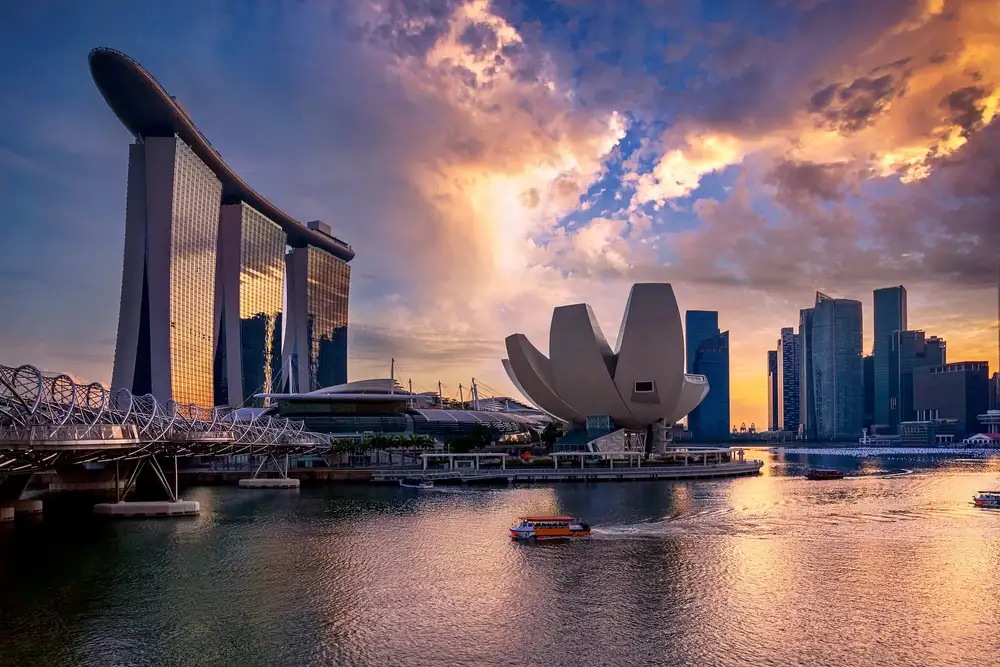
A city, an island and a country, all in one place
Singapore is small enough that the whole island fits inside a forty-minute MRT ride, and dense enough that it holds a genuinely wide range of experiences in that space: a futuristic bay-front skyline, three historic ethnic quarters still functioning as real neighborhoods, a rainforest reserve with wild macaques, and a resort island built for theme-park days. It rewards visitors who move through it deliberately rather than treating it as a stopover to rush past on the way to somewhere else.
What surprises most first-time visitors is the food. Hawker centres, open-air complexes of independent stalls, put Michelin-recognized cooking within reach of anyone for a few dollars a plate, a genuine rarity anywhere in the world. Pair that with a transit system precise enough to set a watch by and a level of order and cleanliness that borders on the remarkable, and Singapore earns its reputation as one of the easiest cities on earth to visit well.
The honest complications
Singapore is expensive once you step outside hawker food: hotel rooms, alcohol and Western-style dining cost roughly what they cost in London, New York or Tokyo. The heat and humidity are constant, 24 to 32°C essentially year-round, and wear down visitors who don't pace themselves. And the country's famous strictness is genuinely enforced, not a tourist-brochure exaggeration: fines for littering, jaywalking, eating on the MRT and importing chewing gum in bulk are real, and vaping and drug offenses carry serious consequences that apply to tourists exactly as they apply to residents.
Seven neighbourhoods, one small island
Singapore's neighbourhoods are compact and MRT-connected enough that where you base yourself matters less than it would in a larger city, but each has a distinct character worth knowing before you book.
Marina Bay & Downtown Core
The postcard Singapore: Marina Bay Sands, Gardens by the Bay, the CBD skyscrapers and the Merlion, all facing each other across reclaimed waterfront. It's the most convenient base for the headline sights, and also the priciest and most tourist-facing pocket of the city.
Chinatown & Tanjong Pagar
Chinatown mixes heritage shophouses, hawker food and, up the hill on Club Street and Ann Siang Hill, some of Singapore's best bars and restaurants, all a short MRT ride or walk from Marina Bay. For a first visit, this is the base that puts everything within easy reach without Marina Bay's price premium.
Bugis & Kampong Glam
The historic Malay-Muslim quarter, home to the Sultan Mosque, Haji Lane's indie boutiques and Arab Street's textile shops, sits next to Bugis, a busy shopping and MRT interchange hub with Singapore's best concentration of budget capsule hotels.
Little India
Streets thick with the smell of spices and jasmine garlands, curry houses, gold shops and the Sri Veeramakaliamman Temple. Less polished than the rest of central Singapore and all the more interesting for it; the Tekka Centre hawker market is a highlight in its own right.
Tiong Bahru
Singapore's most hipster-friendly neighbourhood: 1930s Art Deco housing blocks now home to independent bookshops and specialty coffee, wrapped around a hawker market locals actually use. Quieter and more residential than the historic centre, a short MRT ride south.
Katong & Joo Chiat
The heartland of Peranakan culture, with the pastel-tiled shophouses of Koon Seng Road and some of the city's best laksa. Further from the MRT than the central neighbourhoods, best combined with East Coast Park for a slower, more residential day.
Orchard Road
Singapore's shopping spine, a long stretch of malls and hotel towers connecting to the Botanic Gardens at its western end. Convenient and comfortable but the least distinctly Singaporean of the central neighbourhoods.
From capsule pods to the hotel on the money
Singapore's capsule hotels turned budget travel into something genuinely comfortable, private, air-conditioned pods rather than open dorms, and the top end includes some of the most recognizable hotels in the world. These picks cover every budget and each earns its place.
At the top, Marina Bay Sands is Singapore's icon: three towers linked by the SkyPark and its famous infinity pool 57 floors up, from around S$600 a night and worth it for the view and the sheer scale of the place. Raffles Singapore (from around S$1,450) is the colonial classic, open since 1887, birthplace of the Singapore Sling, all white arcades and old-world service.
In the boutique bracket, Six Senses Duxton (from around S$310) occupies a row of restored Chinatown shophouses with a design-forward, slightly theatrical interior, while The Warehouse Hotel (from around S$280) on the Robertson Quay riverfront converts a 19th-century spice warehouse into a moody, minimalist stay with a strong cocktail bar.
At the budget end, The Pod Boutique Capsule Hotel (from around S$50-90) near Kampong Glam and Met A Space Pod on Arab Street are two of the properties that built Singapore's capsule-hotel reputation: private pods, real air conditioning, shared bathrooms, and rates a fraction of anything on Orchard Road or Marina Bay.
Michelin-starred noodles for the price of a coffee
Singapore's food scene runs on the hawker centre, an open-air hall of independent stalls, and on the fusion of Chinese, Malay, Indian and Peranakan cooking that four cultures on one small island have refined for two centuries. Some of the best meals of your trip will cost less than a bottle of water at Marina Bay Sands.
Bak chor mee at Hill Street Tai Hwa
The only hawker stall in Singapore holding a Michelin star: minced pork noodles with a dark vinegar kick, made by the same family for decades. Go 9-11am or after 1:30pm; the queue outside peak hours is still real but manageable.
Soy sauce chicken at Chinatown Complex
Liao Fan Hawker Chan, the stall that first put hawker food on the global Michelin map, holds Bib Gourmand recognition today at its Chinatown Complex location. A closely related soy sauce chicken stall a few units down in the same complex, from the same lineage, is worth trying if the main queue looks discouraging.
Chili crab
Singapore's signature sit-down dish: whole crab in a sweet, savory tomato-chili sauce, eaten with fried mantou for mopping up the sauce. Jumbo Seafood and Long Beach Seafood are the two names most associated with it; the dish is priced by weight, so confirm the per-kilo rate and the crab's weight before it's cooked, at any restaurant.
Kaya toast & kopi
The Singaporean breakfast: toast with coconut jam and cold butter, soft-boiled eggs with dark soy and white pepper, and kopi, coffee brewed with condensed milk. Ya Kun Kaya Toast and Toast Box are the two big, reliable chains found across the city.
A compact city that rewards a full three days
Singapore's sights cluster tightly enough that a well-planned day covers a lot of ground without feeling rushed. A few things benefit from advance booking; this chapter walks through the city roughly the way a good three days would.
Marina Bay and Gardens by the Bay
Start at Gardens by the Bay, walking the free outdoor Supertree Grove before the afternoon heat peaks, then ducking into the climate-controlled Cloud Forest and Flower Dome conservatories (combo ticket roughly S$28-48, confirm current pricing) for the hottest part of the day. Ride up the Marina Bay Sands SkyPark Observation Deck (57th floor) for the classic skyline shot, then walk the waterfront promenade past the Merlion toward the colonial-era Fullerton Building. Time your evening around the free Garden Rhapsody light show at the Supertree Grove and the Spectra water-and-light show at Marina Bay Sands, both nightly and both free.
The heritage districts
Chinatown's Buddha Tooth Relic Temple is free and genuinely impressive; pair it with the Chinatown Complex hawker centre for lunch. Little India's Sri Veeramakaliamman Temple and the Tekka Centre market are a short MRT ride away, followed by Kampong Glam's golden-domed Sultan Mosque and the boutique-lined lanes of Haji Lane and Arab Street for the afternoon. Finish uphill on Club Street and Ann Siang Hill, restored shophouses now holding some of the city's best small bars, with almost none of the tourist traffic on the main Chinatown streets below.
Sentosa & the south
A short cable car ride from Mount Faber or HarbourFront (or a walk across the boardwalk) reaches Sentosa, built around Universal Studios Singapore (roughly S$80-90), the S.E.A. Aquarium, and several manmade beaches. It's a full day if you want the rides, a half day if you're mainly there for the cable car views and a beach walk.
Green Singapore
The Singapore Botanic Gardens, the country's only UNESCO World Heritage Site, is free to enter and includes the paid National Orchid Garden with over a thousand orchid varieties. For something wilder, MacRitchie Reservoir's TreeTop Walk, a 250-metre suspension bridge through rainforest canopy, is a short drive from the CBD and a reminder that all of this was jungle within living memory. Long-tailed macaques are common on the trails; don't feed them.
One, two or three days, planned neighbourhood by neighbourhood
Three full days covers Singapore properly; a single well-planned day still delivers the essentials for a stopover. These routes are transit-friendly and sequenced to dodge the worst midday heat.
- Morning
Marina Bay. Gardens by the Bay outdoor gardens early, then the Cloud Forest conservatory once the heat builds.
- Midday
Hawker lunch. Maxwell Food Centre or Chinatown Complex, then a walk through Chinatown's shophouse streets.
- Afternoon
SkyPark and the Merlion. The Marina Bay Sands Observation Deck, then the waterfront walk past the Merlion.
- Evening
Supertree Grove light show. Free, nightly, and the best way to end a single Singapore day.
- Day 1
The one-day route: Gardens by the Bay, Chinatown, the SkyPark, Supertree light show.
- Day 2 morning
Little India and Kampong Glam. The Sri Veeramakaliamman Temple and Tekka Centre, then the Sultan Mosque and Haji Lane.
- Day 2 afternoon
Club Street. A slow uphill wander through Ann Siang Hill's restored shophouses.
- Day 2 evening
Chili crab. A proper sit-down seafood dinner to close out the trip.
- Days 1-2
The two-day route above, at a gentler pace.
- Day 3, option A
Sentosa. A full day at Universal Studios and the beaches, cable car over and back.
- Day 3, option B
Green Singapore. The Botanic Gardens in the morning, MacRitchie's TreeTop Walk in the afternoon, a slower, cooler day away from the crowds.
Small enough to cross in forty minutes, hot enough to want the MRT anyway
Changi Airport (SIN) connects Singapore to most of the world, and getting into town is simple: the MRT reaches the city centre in 30-40 minutes for around S$2-2.50, while Grab or a taxi costs roughly S$25-35 and takes 20-30 minutes depending on traffic. In the city, SimplyGo lets you tap a contactless bank card or phone directly on MRT and bus gantries, no separate transit card needed for most visits; an EZ-Link or NETS FlashPay card (about S$5 plus top-up, sold at any MRT station) or a Singapore Tourist Pass (from S$17 for one day, unlimited MRT/LRT/basic bus, refundable card deposit on return) both work well too.
Grab and taxis are cheap by Western standards (S$8-25 for most central trips) and worth using late at night or in the worst midday heat. Walking covers the historic core well, but the humidity makes long stretches tiring; break up walking days with air-conditioned MRT hops and mall detours, a genuinely normal way to cool down that locals use constantly.
Best time to visit and the monsoon seasons
Singapore sits one degree north of the equator, so temperature barely shifts across the year, 24 to 32°C with high humidity throughout. February to April is the driest window and the closest thing to a "best" season; the Northeast Monsoon (December to March) brings the heaviest rain, December the wettest month, while the milder Southwest Monsoon (June to September) brings shorter afternoon storms. Because so much of Singapore's best sightseeing is indoor or covered, rain rarely derails a trip; pack a light rain jacket and carry on.
Regional haze, drifting from agricultural burning in parts of Indonesia, occasionally affects Singapore in the September-October window in some years. Check the National Environment Agency's PSI reading if traveling during this period.
Expensive by regional standards, cheap where it counts
Singapore is noticeably pricier than the rest of Southeast Asia once you move beyond hawker food. The capsule hotel scene keeps the budget tier genuinely workable, and hawker centres mean even a tight food budget still delivers excellent meals.
- Capsule hotel or hostel S$35-70
- Hawker meals S$12-20 total
- MRT and buses S$5-10
- Free gardens, temples and viewpoints
- Boutique hotel S$180-320
- Mix of hawker and restaurant meals
- Occasional Grab rides
- Cloud Forest, SkyPark, a Sentosa day
- Marina Bay Sands or Raffles
- Chili crab dinners and rooftop bars
- Private guides and drivers
- No budget-watching required
One of the world's safest cities, with rules worth knowing
Singapore rates 9.5/10 on our safety scale. Violent crime against tourists is extremely rare, the city is safe at night in essentially every neighborhood, and the MRT runs late with visible staff and security. Singapore is also excellent for solo female travelers: harassment is uncommon and walking alone after dark is unremarkable across most of the city.
The thing that actually catches visitors here isn't crime, it's the law. Vaping is fully illegal with real on-the-spot fines that rise sharply from May 2026; importing bulk chewing gum, littering, jaywalking and eating or drinking on the MRT are all fined; and drug offenses, including small personal amounts, carry severe penalties up to the death penalty for trafficking. These rules apply to visitors exactly as they apply to residents, no exceptions. Beyond that, watch for heat and dehydration in the constant 24-32°C humidity, and confirm chili crab pricing by weight before it's cooked at any seafood restaurant. Emergency numbers are 999 for police and 995 for ambulance and fire, both free and English-speaking 24/7; the tourist hotline is +65 6325 9911.
Two countries and one rustic island, all within reach
Singapore's position at the tip of the Malay Peninsula makes it an easy base for quick escapes across the water or the Causeway, all noticeably cheaper than Singapore itself.
Johor Bahru, Malaysia
Malaysia's southernmost city, a short bus ride across the Causeway from Woodlands, offers cheaper shopping, food and a noticeably more relaxed pace than Singapore, a genuinely different experience for the short distance involved. Immigration queues can be long at peak times, especially weekends; the Causeway Link bus and KTM shuttle both run regularly. A new cross-border train, the RTS Link, connecting Woodlands North to Bukit Chagar in about five minutes, is targeted to open by the end of 2026 but was not yet running at the time of this guide.
Batam, Indonesia
Cheap spas, golf courses, seafood and duty-free shopping make Batam a popular quick escape. Less polished than Bintan but noticeably closer and cheaper; most nationalities that can enter Singapore visa-free also enter Indonesia visa-free for short stays.
Bintan, Indonesia
A step up from Batam for travelers wanting a proper resort beach day: better sand, more polished resorts, and a slightly longer crossing. Better suited to an overnight than a rushed day trip if you can spare the time.
Pulau Ubin
A rustic island kept deliberately undeveloped: kampong houses, rubber plantations and mountain-biking trails a world away from the mainland ten minutes across the water. The closest thing Singapore has to a step back in time, and worth a half day for the contrast alone.
Singapore FAQ
Is Singapore safe for tourists?
Singapore is one of the safest cities in the world. Violent crime against tourists is extremely rare; the main things to know are the strict local laws, not personal safety. Standard city awareness plus reading up on the rules is all you need.
How many days do I need in Singapore?
Three full days covers the city well: one for Marina Bay and Gardens by the Bay, one for the heritage districts, one for Sentosa or the Botanic Gardens. A fourth day fits a Johor Bahru or Batam day trip and is worth adding.
How much does Singapore cost per day?
Budget travellers manage on S$70-100 a day eating at hawker centres and staying in capsule hotels; mid-range runs S$180-280. Singapore is noticeably pricier than most of Southeast Asia outside its hawker food.
When is the best time to visit Singapore?
Singapore is hot and humid year-round with no bad season. February to April is driest with the least rain; December is wettest with frequent afternoon downpours during the Northeast Monsoon.
What is the best area to stay in Singapore?
Chinatown or Bugis/Kampong Glam for first-timers: central, walkable, close to hawker centres and the MRT. Marina Bay for the skyline views and landmark hotels. Tiong Bahru or Katong for a quieter, more residential base.
How do I get from Changi Airport to the city centre?
The MRT runs from Changi Airport station to the city centre in 30-40 minutes for about S$2-2.50. Grab or a taxi costs roughly S$25-35 and takes 20-30 minutes depending on traffic.
Do I need to speak Mandarin or Malay in Singapore?
No. English is an official language and the language of business, government and schooling; it's spoken everywhere, including at hawker stalls and on public transport.
Is Singapore walkable?
The historic core is walkable, but the heat and humidity make long walks tiring. The MRT covers longer distances quickly and affordably, and most visitors mix walking with short train hops.
What should I know about Singapore's strict laws before I go?
Vaping is illegal with real on-the-spot fines, importing bulk chewing gum is banned, littering and jaywalking are fined, eating or drinking on the MRT is fined, and drug offenses carry severe penalties including the death penalty for trafficking. These apply to visitors exactly as they apply to residents.
Can I day trip to Johor Bahru or Batam from Singapore?
Yes, both are popular day trips. Johor Bahru, Malaysia, is a short bus ride across the Causeway; Batam, Indonesia, is a 45-70 minute ferry from HarbourFront Ferry Terminal. Both are noticeably cheaper than Singapore.
What Stays With You
Singapore doesn't announce itself the way some cities do. It just works, the trains arrive when they say they will, the streets are clean enough that you stop noticing, and somehow that quiet competence becomes the thing you can't stop mentioning to people back home. Then there's the food: the Michelin-starred noodles that cost less than a coffee, the chili crab shared at a communal hawker table with strangers because every seat was taken, the kaya toast that turned into the best five minutes of an otherwise rushed morning.
Go up to the Supertree Grove on your last evening, watch the lights come on over Marina Bay, and understand how a swampy trading post with no natural resources built all of this in two generations, on purpose.