
The gateway city most people rush through, and shouldn't entirely
Manila is Metro Manila's dense, chaotic historic core: a city of roughly 1.8 million people inside a metropolitan area of well over 13 million, built on land that Spanish colonizers, American administrators and, finally, invading and retreating Japanese forces in 1945 all fought over. The result is a place with genuine, if scattered, historical depth, Intramuros' rebuilt Spanish walls, the free National Museum Complex, Binondo's centuries-old Chinatown, next to some of the most relentless traffic and heat in Southeast Asia.
Most itineraries treat Manila as the airport you land at before flying on to Palawan, Cebu or Boracay, and there's real logic to that: island-hopping is why most people come. But writing off the capital entirely skips genuinely good food, in Makati's restaurant scene and Binondo's Chinatown eateries alike, and a walk through Intramuros in the late afternoon that earns its reputation.
The honest complications
Manila's traffic is some of the worst on earth; a trip that looks like 20 minutes on a map can take an hour or more at rush hour (roughly 7-9am and 5-8pm), so plan around it rather than assuming you'll beat it. The heat and humidity are intense nearly year-round, and air quality in the traffic-heaviest corridors is genuinely poor on bad days. The city is also large and unevenly developed: wealth in Makati and BGC sits close to significant poverty in other districts, which some visitors find jarring. None of this makes Manila unpleasant to visit, but it rewards picking a base in Makati or BGC and being deliberate about what you try to see in a short stay rather than attempting to cover the whole sprawl.
Metro Manila's districts that actually matter to visitors
"Manila" in travel conversation usually means Metro Manila, a collection of cities including Manila proper, Makati, Taguig (home to BGC) and Pasay, all functioning as one sprawling metropolis. Where you base yourself has more effect on how much you enjoy the trip than in almost any other city in this guide.
Makati
The financial district and the default first-timer choice: wide, walkable blocks, the highest concentration of good hotels and restaurants, upscale malls like Ayala Center, and the Ayala Museum. Poblacion, Makati's nightlife pocket, has the city's best bar-hopping density. If you only pick one base, this is it.
Bonifacio Global City (BGC)
Makati's newer neighbor, a planned district of wide sidewalks, international restaurants, street art and a genuinely pleasant evening atmosphere. Slightly more modern and less chaotic than Makati, at the cost of feeling a touch more corporate and less textured.
Malate & Ermita
The older, more budget-friendly districts along Manila Bay, walking distance from Intramuros and Rizal Park. Home to long-running institutions like The Aristocrat Restaurant and a solid hostel scene, including Z Hostel, but noticeably rougher around the edges than Makati or BGC after dark.
Intramuros
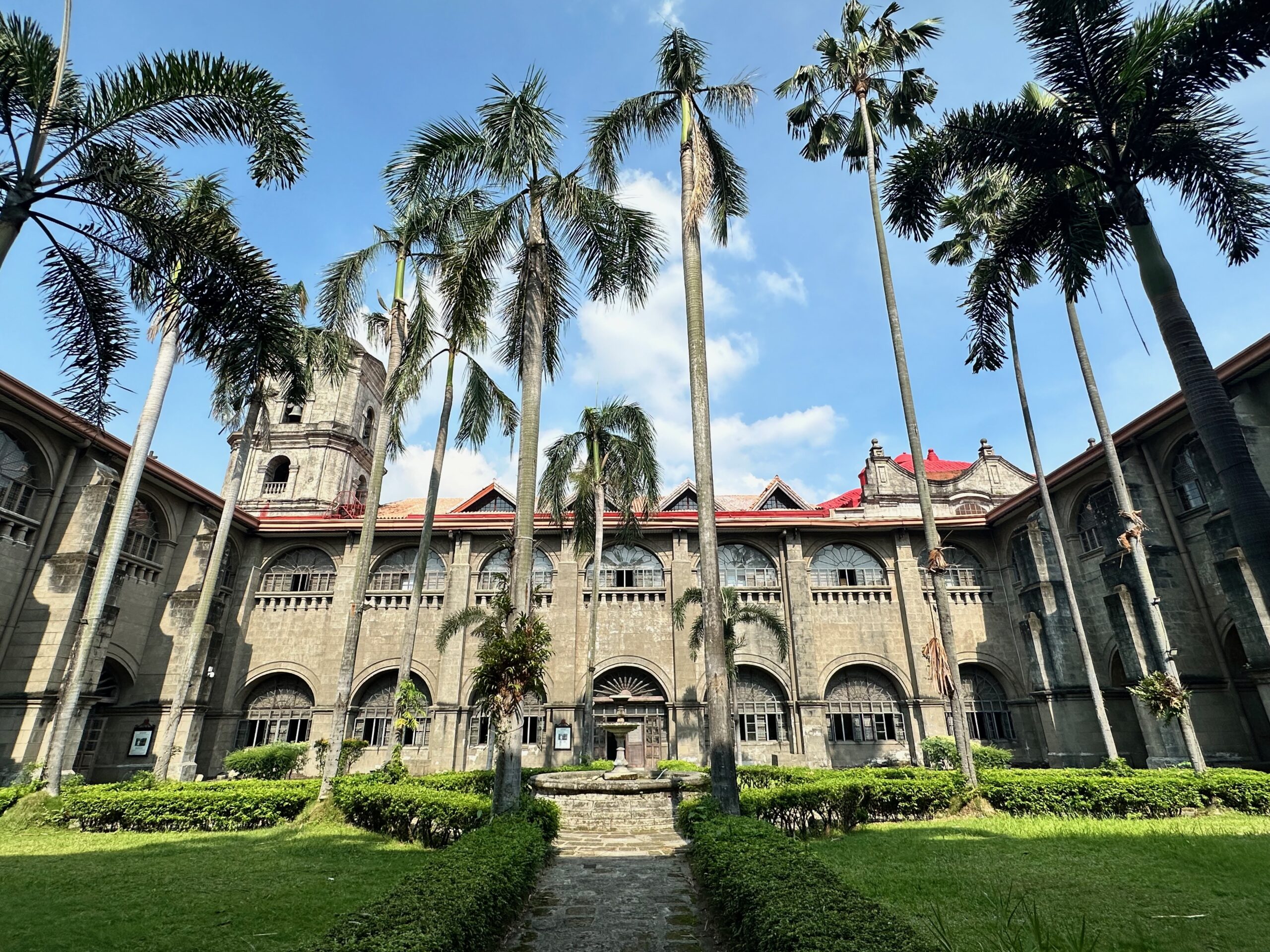
The walled Spanish colonial old town: cobbled streets, horse-drawn kalesa rides, San Agustin Church and Fort Santiago. Worth a full half-day but thin on accommodation and nightlife, best visited from a Makati, BGC or Malate base rather than stayed in.
Binondo
Established in the 16th century and widely cited as one of the oldest Chinatowns in the world, Binondo is dense, chaotic and one of the best food destinations in the city, not a place to base yourself but essential for an afternoon of eating your way down its narrow streets.
From five-star towers to social hostels in Makati
Manila's hotel range runs from genuine five-star luxury to backpacker hostels with rooftop bars, concentrated overwhelmingly in Makati and BGC. These picks cover the range and each earns its place.
At the top, The Peninsula Manila in Makati is one of the city's longest-standing five-star addresses, known for its central location, full-service facilities and consistently high service standard. In the upper-mid bracket, Fairmont Makati offers a gym, spa, outdoor pool and modern rooms in a central Makati location, while Seda BGC puts you steps from BGC's High Street with free WiFi and an outdoor pool.
For solid mid-range value, City Garden Hotel Makati is a well-rated four-star option popular with business travelers and shoppers alike. And at the budget end, Z Hostel in Makati is a social hostel with a rooftop bar overlooking the skyline, a genuinely good pick for solo travelers wanting to meet people before heading to the islands.
Sisig, adobo and a Chinatown older than most countries
Manila's food scene spans humble carinderia counters where a full meal costs under ₱150, to modern Filipino tasting menus, to Binondo's centuries-deep Chinese-Filipino cooking. It's less internationally hyped than Bangkok or Hanoi, which most people who've eaten here consider a genuine oversight.
Sisig
Chopped pork face and ears, seasoned with calamansi and chili, served sizzling on a hot plate with a raw egg cracked on top to stir through. Manam, with its flagship location at the Triangle in Makati, does a widely admired modern version alongside sinigang and kaldereta, and earned a Bib Gourmand in the inaugural 2026 Michelin Guide Philippines.
Adobo
Meat, usually chicken or pork, braised in vinegar, soy sauce, garlic and bay leaf until deeply savory: the closest thing the country has to a national dish. The Aristocrat Restaurant in Malate, a Manila institution for decades on Roxas Boulevard facing Manila Bay, does dependable classic versions alongside its famous chicken barbecue with java rice.
Binondo Chinatown eating
Established in the 16th century, Binondo is one of the oldest Chinatowns in the world and the single best few hours of eating in Manila: hopia pastries, fresh lumpia, siopao and noodle stalls packed tightly along narrow streets. Go hungry and go on foot; this is not a sit-down-restaurant afternoon.
Halo-Halo
Shaved ice layered with sweetened beans, jellies, fruit, leche flan and ube ice cream, mixed together before eating. The definitive answer to Manila's heat, sold everywhere from mall food courts to dedicated dessert shops.
A compact list, because Manila rewards focus over sprawl
Manila isn't a wander-and-get-lost city the way some historic capitals are; the sights that matter are concentrated in a few pockets, and the smart approach is to see them properly rather than rush a longer list. This chapter walks through the city roughly the way a good day or two would.
Intramuros, properly
The walled Spanish colonial old town, largely rebuilt after the devastating 1945 Battle of Manila, is worth a full half-day rather than a drive-through. San Agustin Church, the oldest stone church in the Philippines and a UNESCO World Heritage Site, has an ornate Baroque interior worth the unhurried visit. Fort Santiago (entry around ₱75) holds the Rizal Shrine, marking the cell where national hero José Rizal spent his final days before his 1896 execution. A kalesa horse-drawn carriage ride through the cobbled streets is touristy but genuinely fun, and the walls themselves, walkable in sections, give the best overview of the old town's layout.
Rizal Park and the National Museum Complex
Rizal Park (Luneta) marks the site of José Rizal's execution and anchors a broad green space popular with local families on weekends. Immediately adjacent, the National Museum Complex, comprising the National Museum of Fine Arts, Anthropology and Natural History, is completely free (daily 9am-6pm, last entry 5:30pm) and easily the best value few hours in the city; the Natural History building's dome-lit atrium alone is worth the visit.
Binondo on foot
Manila's Chinatown rewards an unstructured afternoon of eating and wandering more than any formal itinerary. Combine it with Quiapo Church nearby, home to the Black Nazarene and one of the city's most fervently visited religious sites, for a half-day that covers food, history and living faith in one compact area.
Evenings in Makati and BGC
Poblacion, Makati's nightlife pocket, has the city's densest concentration of bars and late-night eating, from speakeasies to street-food alleys. BGC's High Street and Uptown Mall areas are calmer and more polished, with rooftop bars looking out over the skyline; either makes a good end to a day spent in Intramuros or Binondo.
One, two or three days before you fly on to the islands
Most visitors give Manila one to two days on the way to Palawan, Cebu or Boracay, and that's enough to see the essentials properly. Three days adds real breathing room and a day trip.
- Morning
Intramuros. San Agustin Church, Fort Santiago and the Rizal Shrine, a kalesa ride through the walls.
- Midday
Rizal Park & the National Museum Complex. Free entry, easily two unhurried hours across the three museum buildings.
- Afternoon
Binondo. Grab or taxi over, eat your way down the Chinatown streets, stop at Quiapo Church nearby.
- Evening
Makati or BGC. Sisig and dinner, then Poblacion's bars or a BGC rooftop.
- Day 1
The one-day route: Intramuros, the National Museum Complex, Binondo, dinner in Makati or BGC.
- Day 2 morning
Ayala Museum & Makati. A slower look at Makati's own sights and Greenbelt/Ayala Center, coffee in Poblacion.
- Day 2 afternoon
BGC. High Street, Uptown Mall, the street art along the district's main avenues.
- Day 2 evening
Dinner and pack for the islands. A final Filipino meal before an early flight or ferry connection.
- Days 1-2
The two-day route above, at a gentler pace.
- Day 3
Tagaytay day trip. The Taal Lake viewpoint and a boat trip, roughly two hours each way; back in Manila by evening for a final night out.
Vast, trafficked, and best navigated by Grab
Ninoy Aquino International Airport (NAIA) is the main gateway. Grab is the easiest way into the city at roughly ₱300-500 with fixed, upfront pricing, 20-30 minutes to Makati via the Skyway off-peak or up to an hour during rush hour (7-9am and 5-8pm). Metered yellow airport taxis run ₱150-350 to Makati under normal conditions; avoid unofficial touts working the curb outside arrivals, who quote inflated flat fares before you reach the licensed queue. The UBE Express P2P bus to One Ayala costs around ₱150 and is a reasonable middle option.
Within the city, get a reloadable Beep card for the LRT and MRT lines, the fastest option for fixed corridors (₱20-60 a ride). Jeepneys are the cheapest way to move (₱13-20) and a genuine cultural experience, but crowded ones are where pickpocketing happens most; keep bags zipped and in front of you. Tricycles handle last-mile trips in older districts like Intramuros and Binondo (₱20-50). For anything door to door, Grab remains the simplest and safest default, especially at night.
Best time to visit and avoiding the worst of the heat
Manila runs hot and humid nearly year-round, averaging 27-33°C. December to February is the most comfortable stretch for walking Intramuros and Rizal Park; March to May gets hotter still before the June-to-November rainy and typhoon season, when sudden downpours can make an unplanned afternoon outdoors uncomfortable fast.
Avoiding rush hour: Metro Manila traffic peaks roughly 7-9am and 5-8pm. Schedule NAIA transfers and cross-city Grab trips outside these windows where your flight times allow it; the difference between a 20-minute and 90-minute trip is entirely about timing.
One of Southeast Asia's more affordable capitals
Manila is inexpensive for food and local transport by international standards, though hotel prices in Makati and BGC can run higher than the rest of the city suggests. The main cost trap is airport-adjacent overcharging, not the city itself.
- Hostel dorm $10-20
- Carinderia meals ₱80-150
- Jeepneys, LRT/MRT and walking
- Free museums plus one paid sight
- Makati or BGC hotel $60-120
- Restaurant meals ₱300-600
- Grab for most trips
- Fort Santiago, a museum, a night out
- The Peninsula Manila or equivalent
- Fine dining in Makati
- Private Tagaytay day trip
- Rooftop bars and spa treatments
Fine in the districts that matter, with a short list to know
Manila rates 6.5/10 on our safety scale, reasonable but not exceptional, with the gap almost entirely explained by petty crime and scams rather than violent crime against tourists. Makati and BGC are genuinely safe with normal city awareness, including at night; other districts warrant more standard caution after dark, as in any large city. Metro Manila's overall crime rate has been trending down through 2026 under city-level safety initiatives, though the baseline was high enough that "trending down" doesn't yet mean "low."
The three things that actually catch visitors: NAIA taxi touts, who intercept arrivals with inflated flat fares before the official queue, avoided entirely by pre-booking Grab or using the licensed yellow-cab rank; taxi meter tampering, rigged or unused meters on some metered cabs, solved the same way, by using Grab; and jeepney pickpocketing, opportunistic theft during the crush of boarding at busy stops, avoided by keeping bags zipped and in front of you. Emergency number is the national 911, and dedicated tourist police units operate at NAIA and in Intramuros.
Volcano views, war history and rapids, all within two hours
Manila's position on Luzon makes it a reasonable base for a single extra day before flying on to the islands. Three trips are worth the time, each roughly a half or full day.
Tagaytay & Taal Lake
Tagaytay's ridge gives sweeping views over Taal Lake and the small volcano at its center, one of the most photographed views near Manila. The volcano's crater and main island trail have been closed to visitors since January 2020 and remain an active PHIVOLCS exclusion zone as of 2026, following continued minor eruptive activity; the viewpoint and lake boat trips are the way to experience it responsibly. Bulalo (beef marrow soup) at one of the ridge restaurants is the local lunch tradition.
Corregidor Island
The fortified island at the mouth of Manila Bay that held out against the Japanese invasion in WWII before its fall in 1942. Guided tram tours cover the gun batteries, the Pacific War Memorial and the Malinta Tunnel; a genuinely moving half-day for anyone with an interest in the Philippines' WWII history.
Pagsanjan Falls
A dugout-canoe paddle upriver through rapids to a waterfall you can swim beneath and, with the right guide, raft directly behind. Often combined with Tagaytay into a single long day tour from Manila; book through a tour operator rather than attempting the logistics independently.
Manila FAQ
Is Manila safe for tourists?
Manila's business districts, Makati and BGC especially, are reasonably safe with normal city awareness. The real risks are petty theft on crowded jeepneys and taxi or NAIA airport overcharging, not violent crime against tourists.
How many days do I need in Manila?
One to two full days covers the city's highlights well: Intramuros and the National Museum on one day, Binondo and a Makati or BGC evening on the second. Most visitors treat Manila as a stopover before flying on to Palawan, Cebu or Boracay.
How much does Manila cost per day?
Budget travelers manage on $26-35 a day with hostels and carinderia meals; mid-range runs $80-100. Manila is one of the more affordable Southeast Asian capitals for food and local transport.
What is the best area to stay in Manila?
Makati for first-timers: it's the safest, most central district with the best hotel range, dining and nightlife. Bonifacio Global City (BGC) is a modern, walkable alternative right next door. Malate and Ermita suit budget travelers who want to be near Intramuros and Rizal Park.
How do I get from Manila airport to Makati?
Grab is the easiest option at roughly ₱300-500 with fixed upfront pricing, taking 20-30 minutes off-peak via the Skyway or up to an hour during rush hour. Metered yellow airport taxis run ₱150-350 to Makati under normal conditions.
What should I eat in Manila?
Sisig, sizzling chopped pork seasoned with calamansi and chili, and adobo, meat braised in vinegar, soy and garlic, are the two dishes to prioritize. Manam in Makati and the decades-old Aristocrat Restaurant in Malate both do well-regarded, accessible versions.
Is Manila walkable?
In pockets. Makati, BGC and Intramuros are walkable within themselves, but the city overall is vast and heavily trafficked, so Grab, the LRT/MRT or a hired driver connect the neighborhoods that matter to a first-time visitor.
What is the Beep card and do I need one?
Manila's reloadable contactless transit card, used on the LRT and MRT lines and some modern buses. Buy one at any station and top it up; it saves queuing for single tickets on a multi-day visit.
Can I visit Taal Volcano from Manila?
You can see it from the Tagaytay viewpoint and take boat trips on Taal Lake, both about two hours from Manila. The volcano's crater and main island trail have been closed to visitors since January 2020 and remain an active exclusion zone.
What Stays With You
Manila doesn't ask to be liked the way a smaller, prettier capital might. It's too big, too hot and too trafficked to perform for visitors, and that's precisely why the parts that do land, the quiet of San Agustin Church after the tour groups leave, a plate of sisig eaten standing up in Binondo, the view from a Poblacion rooftop as the city's lights come on, stick harder than they would somewhere designed for tourism from the ground up.
Give it a real day or two before you fly on to the islands. It earns more of your attention than the stopover reputation suggests.