
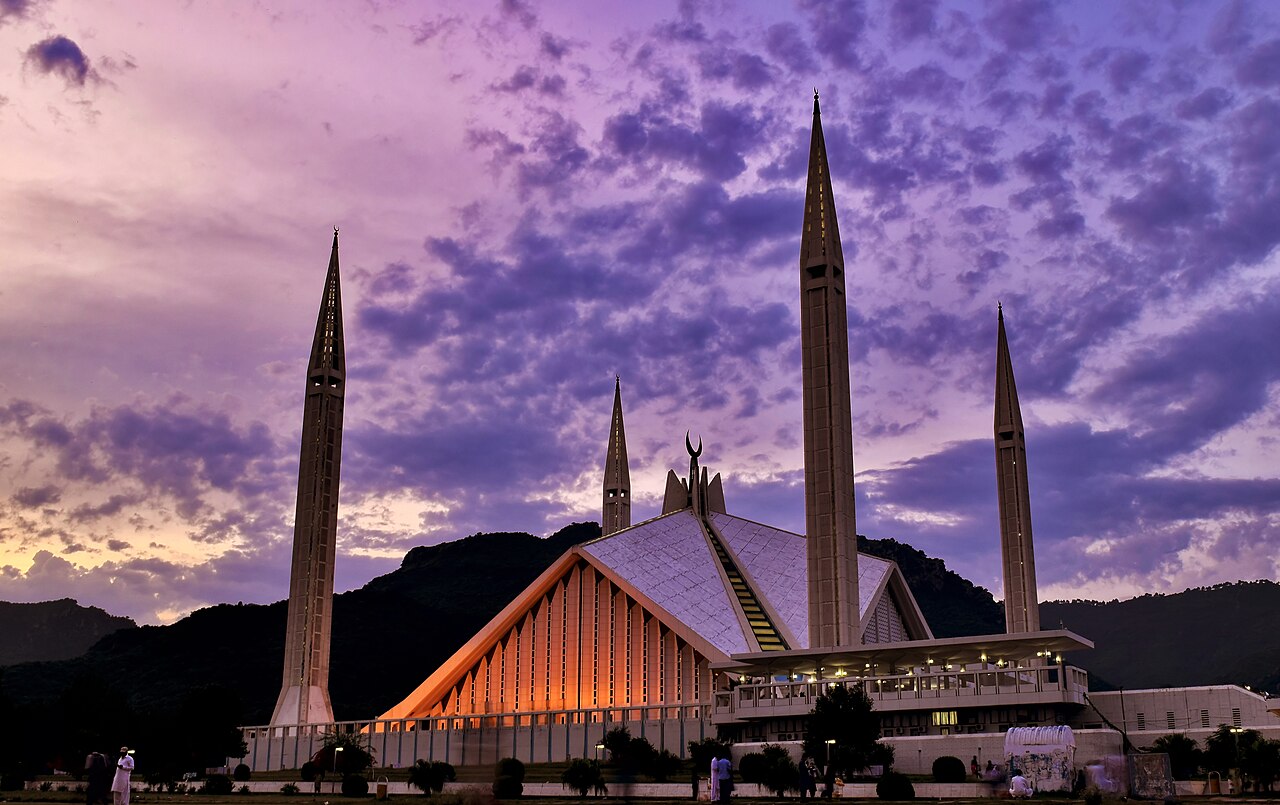
Pakistan's capital plays it calm on purpose
Islamabad was built from farmland starting in the 1960s specifically to be Pakistan's capital, replacing Karachi in that role, and it still reads like a planned city: numbered and lettered sectors, wide tree-lined roads, and a level of green space and order that surprises visitors expecting the density of Lahore or Karachi. The Margalla Hills, the last foothills of the Himalaya, rise directly behind the northern edge of the city, close enough that a short taxi ride gets you to a genuine hiking trail with a skyline view.
What Islamabad lacks in old-city atmosphere, it makes up for as a genuinely relaxed, walkable base: the Blue Area's restaurants and malls, the Faisal Mosque's calm grounds, and twin city Rawalpindi's much older, denser bazaar just fifteen minutes away for travelers who want the contrast. Most itineraries treat Islamabad as a one-night stopover before Lahore or a flight north to Gilgit; two or three days actually spent here is a better use of the capital than most guides suggest.
The honest complications
Islamabad is spread out and not especially walkable between sectors, so budget for taxis or Careem rather than assuming you'll stroll between sights the way you might in a denser city. The Diplomatic Enclave and Red Zone, home to parliament and most embassies, are heavily secured and occasionally affected by demonstrations; check local news before heading that direction if there's political tension in the news. And Islamabad's restaurant and hotel prices run noticeably higher than the rest of Pakistan, closer to a mid-tier international capital than to Lahore's more typically South Asian pricing.
Sectors, not neighbourhoods, and one twin city
Islamabad is organized into lettered, numbered sectors rather than named neighbourhoods, which takes a day to get used to. Where you base yourself comes down to how central you want to be and how much you want to spend.
Blue Area (F-6/F-7)
Islamabad's commercial spine, Jinnah Avenue, runs through here, lined with restaurants, malls including the Centaurus, and mid-to-upper-range hotels. Central enough to reach the Diplomatic Enclave, Faisal Mosque and most restaurants within a short taxi ride, and the natural first-time base.
F-7 & F-8
Just west of the Blue Area, these sectors hold Islamabad's best-value guesthouses, close to Allama Iqbal Open University and the Safa Gold Mall, and a short drive from everywhere else worth reaching.
Margalla foothills & Diplomatic Enclave
Islamabad's top hotels, including the Serena, sit at the foot of the Margalla Hills near the heavily secured Diplomatic Enclave, with gardens and hill views that no other part of the city can match. Quieter at night than the Blue Area, at the cost of needing a taxi for most restaurants.
Rawalpindi
Technically a separate, much older city, Rawalpindi sits immediately southwest of Islamabad and holds the dense, traditional bazaar atmosphere the planned capital doesn't have: Raja Bazaar's spice and cloth lanes, Committee Chowk's food stalls, and a genuinely different pace than five minutes away in the Blue Area.
From hillside gardens to F-7 guesthouses
Islamabad's hotel prices run higher than the rest of Pakistan, closer to a mid-tier international capital, but the range still covers every budget, from garden resorts at the foot of the Margalla Hills to simple guesthouses in the university sectors.
At the top, Islamabad Serena Hotel occupies six acres of gardens at the foot of the Margalla Hills next to the Diplomatic Enclave, with a full-service spa, an outdoor pool and 387 rooms, from around $180 a night. Islamabad Marriott Hotel (from $120) offers a more central, modern alternative in the Blue Area, walking distance to Jinnah Avenue's restaurants and popular with business travelers.
For value in the university district, Glade House and Capetown Guest House, both in F-7, are the two names backpackers and solo travellers consistently land on: simple, clean rooms from around $15-25 a night, roughly 15 minutes from the Blue Area and Safa Gold Mall by taxi or Careem.
Nihari at dawn, chai all day, dinner with a skyline view
Islamabad's food scene splits cleanly between the modern restaurants of the Blue Area and Margalla foothills, and the older, cheaper, arguably more authentic dhaba culture across the boundary in Rawalpindi. Both are worth your time on different nights.
Monal
Islamabad's best-known view restaurant spent years perched directly on the Margalla Hills before a Supreme Court order over protected parkland forced its closure in 2024; it reopened in March 2026 on the rooftop of the Mall of IMARAT at IMARAT Downtown, with sweeping city views that locals say rival the old hilltop setting. The menu covers Pakistani barbecue, continental dishes and open-air seating under the stars, much as before, just at a new address.
Des Pardes & Kabul Restaurant
Des Pardes is a long-standing Islamabad favourite for Pakistani and Mughlai classics in comfortable, mid-range surroundings. A few minutes away, Kabul Restaurant serves Afghan specialties, kebabs, naan and generous rice dishes, in a city with a substantial Afghan community and food scene to match.
Nihari at Rawalpindi's dhabas
The small, no-frills dhabas around Raja Bazaar and Committee Chowk in Rawalpindi serve Islamabad's best nihari, the slow-cooked beef stew traditionally eaten at breakfast, for a fraction of a restaurant price. Go before noon, when it's freshest and the crowd is almost entirely local.
A mosque, a mountain range, and a bazaar next door
Islamabad's list of major sights is short by capital-city standards, which is exactly why two or three unhurried days work better here than a rushed single stopover.
Faisal Mosque & the Margalla Hills
Faisal Mosque, Pakistan's largest and among the world's biggest, breaks from the traditional dome entirely: its main hall is shaped like a Bedouin tent, with four minarets and a capacity for 100,000 worshippers inside and 200,000 more in the courtyard. Entry is free and it's open to visitors of all faiths outside prayer times; modest dress is expected and headscarves are available at the entrance. From the mosque, it's a short drive up into the Margalla Hills to Daman-e-Koh, the classic viewpoint over the mosque, the city and Rawal Lake, busiest at sunset. Hikers can continue on Trail 3 or Trail 5, both well-marked routes into Margalla Hills National Park with views that improve the higher you climb.
Pakistan Monument & Lok Virsa Museum
The Pakistan Monument, a flower-shaped structure atop Shakarparian Hill representing the country's four provinces, gives a second panoramic view over Islamabad and Rawalpindi and houses a small museum on the country's founding. Immediately below it, Lok Virsa Museum, the National Institute of Folk and Traditional Heritage, is the best single stop for understanding Pakistan's regional diversity, with crafts, textiles and instruments from every province under one roof.
Rawalpindi's old bazaar
Fifteen minutes from the Blue Area by taxi, Rawalpindi is Islamabad's opposite: dense, old, chaotic in a way the planned capital never is. Raja Bazaar is the main draw, narrow lanes of spice merchants, cloth traders and jewellers that have operated for generations, best explored slowly in the late afternoon before the dinner rush at Committee Chowk's food stalls.
Saidpur Village
A restored Mughal-era village in the Margalla foothills, Saidpur mixes an old temple, a mosque and stone houses with a handful of cafes and craft shops. Small enough for an hour, atmospheric enough that many visitors linger longer, especially in the late afternoon light.
One, two or three days, planned sector by sector
Two to three days covers Islamabad properly; even a single well-planned day hits the essentials before an onward flight or drive.
- Morning
Faisal Mosque. Visit before the midday heat, then a short drive up to Daman-e-Koh for the skyline view.
- Midday
Pakistan Monument & Lok Virsa. Shakarparian Hill's second viewpoint and the folk heritage museum.
- Afternoon
Rawalpindi's Raja Bazaar. A change of pace in the old twin city, fifteen minutes away.
- Evening
Dinner in the Blue Area. Des Pardes or Kabul Restaurant, or Monal's rooftop at IMARAT Downtown for the view.
- Day 1
The one-day route: Faisal Mosque, Daman-e-Koh, Pakistan Monument, Lok Virsa, Rawalpindi's Raja Bazaar.
- Day 2 morning
A Margalla Hills trail. Trail 3 or Trail 5 for a proper hike with a view, before the day heats up.
- Day 2 afternoon
Saidpur Village. The restored Mughal-era village and its cafes, an easy, unhurried stop.
- Day 2 evening
Nihari in Rawalpindi or a full dinner back in the Blue Area.
- Days 1-2
The two-day route above, at a gentler pace.
- Day 3
Taxila or Murree. A half or full day trip: the UNESCO Buddhist ruins at Taxila, or the hill station at Murree, both under two hours from the city.
Spread out, so budget for taxis
Islamabad International Airport (ISB), about 35km southwest of the centre, is the main gateway, with flights from the Gulf, Europe and East Asia and domestic connections to Lahore, Karachi, Gilgit and Skardu. A taxi to the Blue Area runs roughly PKR 1,800-2,500 ($6-9) and takes about 30 minutes in normal traffic; Metro Taxi, the official airport operator, runs on set pricing. The Islamabad Metro Bus Orange Line also connects the airport to the city centre for around PKR 100, running 6:15am to 10pm daily, though it's a slower option with luggage.
Careem is the dominant ride-hailing app in Pakistan and by far the most convenient way to get around Islamabad's spread-out sectors; fares within the city are inexpensive by international standards. Traditional taxis and auto-rickshaws work too, but agree the fare before getting in if the meter isn't used. Walking works within a sector but not much beyond it; the road network is built for cars.
Best time to visit and seasonal notes
April-May and September-October are the sweet spots: warm, dry days and the Margalla Hills at their greenest just after the monsoon. June-August brings real heat and monsoon rain, though the hills stay a few degrees cooler than the city below. December-February is mild during the day, cool at night, and occasionally foggy, which can delay flights.
Cheaper than most capitals, pricier than the rest of Pakistan
Islamabad costs more than Lahore or the north for hotels and restaurants, but it's still inexpensive by international capital-city standards, and dhaba meals keep the food budget low regardless of where you sleep.
- F-7 guesthouse $15-25
- Dhaba meals and street food $2-5
- Careem rides and the Metro Bus
- Free mosque and viewpoints
- Marriott or equivalent hotel $100-150
- Restaurant meals $10-20
- Private driver for a half-day
- Taxila or Murree day trip
- Islamabad Serena or equivalent
- Private car and driver throughout
- Fine dining and rooftop restaurants
- Guided city and Margalla Hills tour
One of the calmer capitals in the region
Islamabad is a planned, heavily policed capital, and day-to-day it feels calmer than most cities its size in the region. Violent crime against tourists is rare, and the biggest practical annoyances are the same ones any capital has: petty overcharging by unmetered taxis and the occasional pushy tout near tourist sites. The Diplomatic Enclave and the surrounding Red Zone are the most heavily secured part of the city and can be affected by demonstrations with little notice; if there's political tension in the news, check before heading that direction.
The three practical things to know: agree taxi and rickshaw fares upfront or use Careem, which sets the price automatically; carry a photocopy of your passport and visa rather than the originals for daily use; and dress modestly, which matters more for how you're treated than for any specific safety risk. Solo female travellers should expect more staring and occasional unwanted attention than in Southeast Asia, manageable with conservative dress and the same street awareness you'd use in any large city. Emergency numbers are police on 15 and the well-regarded 1122 Rescue ambulance service.
Ancient ruins and a hill station, both under two hours
Islamabad's position at the edge of the Punjab plains and the Himalayan foothills makes it a good base for two very different day trips.
Taxila
About 35km northwest of the city, Taxila was a major Silk Road centre of Buddhist learning and trade from the 1st to 5th centuries CE. The ruins, monasteries, stupas and an on-site museum, earned UNESCO World Heritage status in 1980 and are among the more accessible ancient sites in South Asia: a half-day trip by taxi or rented car covers the main areas comfortably.
Murree
About 68km northeast of Islamabad, Murree is a British colonial-era hill station at roughly 2,300 meters, with pine forests, cooler air than the city below, and Mall Road's shops and viewpoints. Popular with Islamabad residents on weekends rather than an undiscovered secret, but a pleasant escape and, in winter, one of the closest places to see snow from the capital.
Islamabad FAQ
Is Islamabad safe for tourists?
Yes. Islamabad is a planned, well-policed capital and one of the calmer cities in the region day to day. Standard urban precautions, awareness at night, agreeing taxi fares, avoiding demonstrations near the Red Zone, cover most of what you need.
How many days do I need in Islamabad?
Two to three days covers the city well: one for Faisal Mosque and the Margalla Hills, one for Rawalpindi's old bazaar and the museums, and a half-day for Saidpur Village or a hike. A fourth day fits Taxila or Murree as a day trip.
How much does Islamabad cost per day?
Budget travellers manage on $20-30 a day with guesthouses and dhaba meals; mid-range runs $50-90. Islamabad is noticeably cheaper than most world capitals, though its hotel rates run higher than the rest of Pakistan.
When is the best time to visit Islamabad?
April-May and September-October: warm, dry and clear, with the Margalla Hills at their greenest just after monsoon. June-August is hot and humid with monsoon rain; December-February is mild but can be foggy.
Is Islamabad better than Lahore?
They serve different purposes. Islamabad is calmer, greener and more orderly, with the Margalla Hills on its doorstep; Lahore has the historic depth, the Mughal architecture and the food scene. Most itineraries do both rather than choosing.
How do I get from Islamabad airport to the centre?
A taxi from Islamabad International Airport (ISB) to the Blue Area runs roughly PKR 1,800-2,500 ($6-9) and takes about 30 minutes in normal traffic. The Metro Bus Orange Line also connects the airport to the city for about PKR 100.
What is the best area to stay in Islamabad?
The Blue Area and F-6/F-7 sectors for first-timers: central, walkable to the diplomatic and business district, and close to restaurants. F-7 and F-8 for budget guesthouses. The Margalla foothills near the Diplomatic Enclave for upper-end hotels.
Do I need to speak Urdu in Islamabad?
No. English is widely spoken in Islamabad's hotels, restaurants and business district, more so than almost anywhere else in Pakistan. A few Urdu phrases go a long way with guesthouse staff and taxi drivers.
Is Faisal Mosque free to visit?
Yes, entry is free and the mosque is open to visitors of all faiths outside prayer times. Modest dress is expected; headscarves for women are available at the entrance if needed.
What Stays With You
Islamabad doesn't try to be Lahore, and that's exactly why it works as a first stop. The mosque at dusk with the Margalla Hills going pink behind it, the sudden switch from the capital's wide empty avenues to Rawalpindi's packed bazaar lanes fifteen minutes later, the chai offered by a shopkeeper who wants nothing from you but a few minutes of conversation: none of it announces itself the way older, more famous capitals do, which is why most visitors leave more impressed than they expected to be.
Go up to Daman-e-Koh on your last evening, watch the mosque and the city catch the last light, and give the capital the two full days most itineraries skip past.