
Mongolia
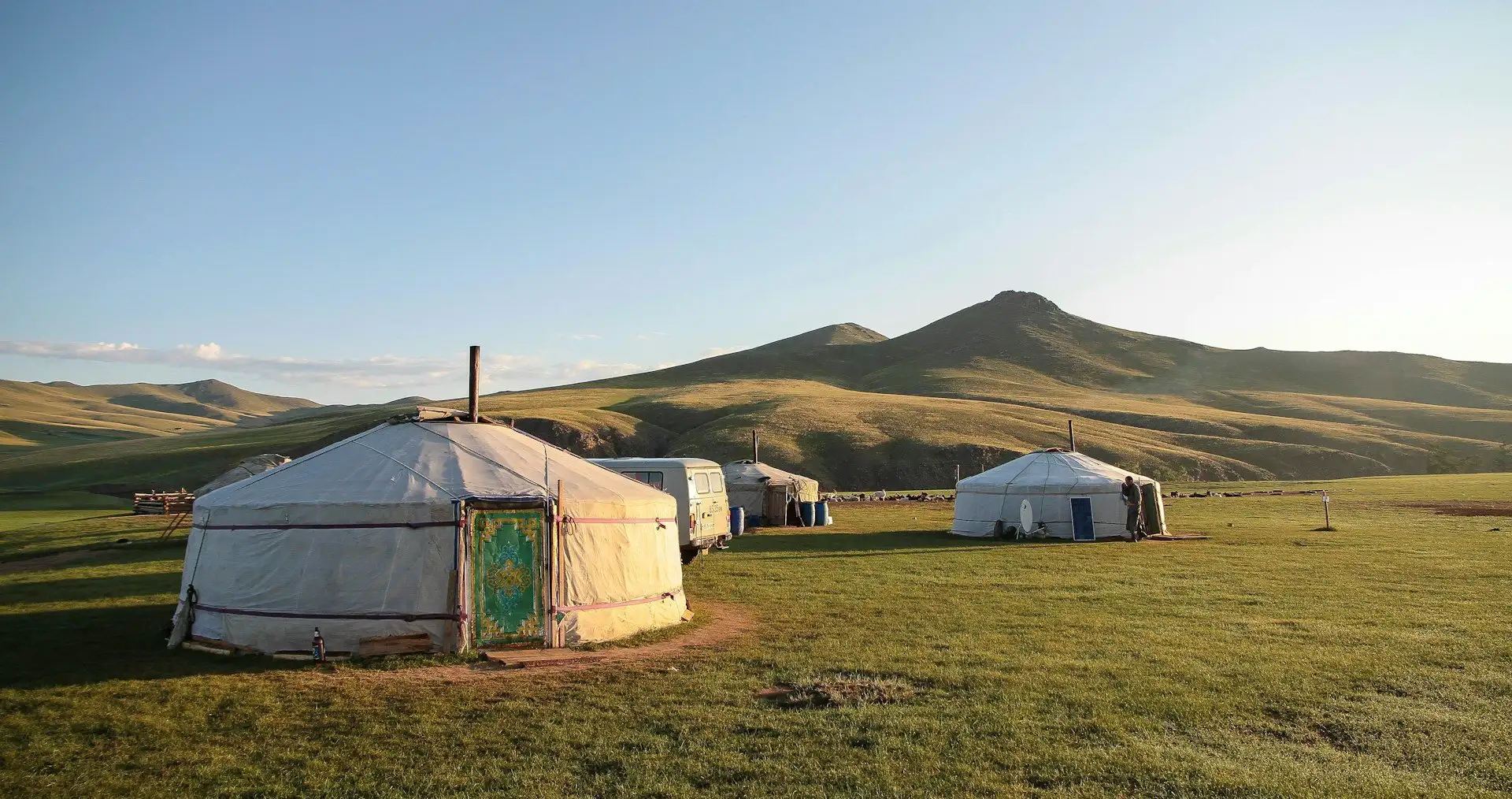
The largest landlocked country on earth after Kazakhstan, and one of the least densely populated. Three million people in a territory the size of Western Europe. The steppe rolls to every horizon without a fence, a road sign, or a building — just grass, sky, and the occasional ger that appears like a white dot and becomes a home with a fire and a family who will feed you before you finish introducing yourself. This is what the world looked like before it was organized.
What You're Actually Getting Into
Mongolia does not come with the infrastructure that most travel experiences are built on. There are no road signs on most of the country's terrain. Addresses, in the Western sense, do not exist outside Ulaanbaatar — a location is described by landmarks, compass direction, and approximation. The distances between anything and anything else are measured in hours of driving on tracks that may or may not follow what a map shows. The nearest hospital to where you will be camping on the steppe could be four hours away over terrain that a standard vehicle cannot cross. This is not a problem. It is what Mongolia is, and understanding it before you arrive is the difference between a difficult trip and an extraordinary one.
What Mongolia offers in exchange for this infrastructure gap is the closest thing to genuine wilderness travel available to a visitor without mountaineering training. The steppe in summer — an unbroken green plain under a sky so vast it makes the word "sky" feel inadequate — is one of the great natural landscapes on earth. The Gobi Desert in the south is not the sand-dune Sahara that tourism brochures picture; it is a cold, rocky, austere landscape of saxaul forests, dinosaur fossil beds, and the Khongoryn Els dunes that rise 300 meters from the desert floor. Lake Khövsgöl in the north, a freshwater lake so clear you can drink from it, surrounded by taiga forest and reindeer-herding Tsaatan communities, looks like what Siberia was before Siberia became Siberia.
The nomadic culture that persists here — three million people of whom nearly half still live a traditional herding lifestyle moving between seasonal pastures — is the other extraordinary thing. A visit to a nomadic family's ger (the circular felt tent that is the home of the steppe) involves entering a domestic space where the hospitality rules are intricate and genuine, where you are fed from whatever has been prepared that day, where children examine you with enormous curiosity and without self-consciousness, and where the evening conversation, via translation if necessary, covers the same human topics that conversations everywhere cover: the quality of the grass this year, the health of the horses, the business of the children, the weather coming from the north. It is one of the least performative cultural exchanges available to a traveler anywhere in Asia.
Ulaanbaatar — the capital, known as UB — is where most travelers begin and return to, and it is not Mongolia. It is a Soviet-planned city that is chaotically absorbing a rural-urban migration that it has no infrastructure to accommodate, producing a settlement of half a million people in its outer ger districts that is simultaneously fascinating and difficult. Go, understand it, see the excellent museums, eat the surprisingly good international food, and then get out into the country as fast as your itinerary allows. That is where Mongolia is.
Mongolia at a Glance
A History Worth Knowing
In the year 1206, a man named Temüjin united the warring Mongolian tribes under his leadership at a great assembly on the banks of the Onon River and was proclaimed Genghis Khan — Universal Ruler. What followed over the next seventy years is the most rapid territorial expansion in human history. The Mongol Empire that Genghis Khan and his successors built stretched, at its peak, from the Korean peninsula to the Danube River in Hungary, from Siberia to the Persian Gulf — the largest contiguous land empire ever created by a single political entity. An estimated 40 million people were killed in the conquests, and the civilizational disruption caused by the Mongol campaigns — the destruction of Baghdad in 1258, the end of the Abbasid Caliphate, the collapse of the Central Asian Silk Road cities — reshaped the entire Eurasian world.
The same empire that destroyed created the Pax Mongolica — a period of relative stability and enforced peace across the trade routes connecting China to Europe that allowed goods, ideas, diseases, and people to move across Eurasia at a scale previously impossible. The Black Death almost certainly traveled west along the Mongol trade routes. So did pasta, gunpowder, and the printing press. Marco Polo's journeys to the court of Kublai Khan — Genghis's grandson, who ruled China as the Yuan Dynasty — are possible because the Mongol trade networks functioned. The Mongol Empire was simultaneously the most destructive and most connective force in the medieval world, and the tension between those two facts is what makes Mongolian history genuinely complex rather than simply triumphant or simply catastrophic.
The empire fragmented after Kublai Khan's death in 1294. Mongolia fell under Qing Chinese domination in the 17th century and remained a peripheral province of China for nearly three centuries. Independence — of a sort — came in 1911 when China's Qing Dynasty collapsed, and full Soviet-backed independence as the Mongolian People's Republic was established in 1924. The Soviet period brought literacy campaigns, hospitals, roads, and collectivization that shattered the nomadic economy — and the repression of Buddhism, which had been Mongolia's primary cultural institution since the 16th century. An estimated 18,000 monks were executed in the late 1930s and hundreds of monasteries were destroyed. The trauma of this period is still present in Mongolia's cultural memory.
Democracy arrived peacefully in 1990 as the Soviet Union disintegrated, and Mongolia transitioned without violence. The country has been a functioning democracy since, and the discovery of massive copper, coal, and gold deposits has produced an economic boom of chaotic intensity — Ulaanbaatar's construction frenzy is its visible expression. The contrast between the ancient nomadic steppe culture and the mining boom transformation is the defining tension of contemporary Mongolia, and it makes the country genuinely interesting to think about while you're there.
Temüjin unites the Mongolian tribes and is proclaimed Genghis Khan. The Mongol Empire begins its astonishing expansion.
The Mongol Empire expands to cover 24 million square kilometers — from Korea to Hungary, from Siberia to the Persian Gulf. The largest contiguous land empire in history.
The Mongols destroy Baghdad and end the Abbasid Caliphate. An estimated 800,000 people killed. The intellectual center of the Islamic world obliterated in days.
Kublai Khan rules China as the Yuan Dynasty. Marco Polo visits the Mongol court. The Pax Mongolica enables Silk Road trade at unprecedented scale.
Mongolia submits to the Qing Dynasty. Nearly three centuries of Chinese domination follow.
Soviet-backed communist government established. The second communist state in the world after the USSR.
Stalinist purges kill an estimated 18,000 monks and destroy hundreds of monasteries. Buddhism is suppressed for fifty years.
Peaceful transition to democracy as the Soviet Union collapses. Mongolia becomes a multiparty democracy without violence.
Massive copper, coal, and gold deposits discovered. Economic transformation and urbanization accelerate. Ulaanbaatar absorbs unprecedented rural migration.
Top Destinations
Mongolia's destinations are defined less by specific sites and more by landscapes, and the distances between them require accepting that getting somewhere is part of being there. A two-week trip covers two or three regions properly. Trying to see the Gobi, the central steppe, the northern taiga, and Lake Khövsgöl in a single trip without feeling perpetually in transit requires at least three weeks and a guide who knows where they're going. Pick your landscape, give it time, and let Mongolia work at its own pace.
The Gobi Desert
The Gobi is not what most people picture when they hear desert. It is cold, rocky, and immense — a high-altitude plateau where the temperature drops to freezing at night even in summer and the landscape shifts between gravel plains, sandstone formations, and the saxaul forests that provide the only shade for hundreds of kilometers. The Khongoryn Els — the Singing Dunes — are the exception: 180 kilometers of sand dunes that rise 300 meters from the desert floor and produce a low resonant hum when the wind moves the sand. The Bayanzag Flaming Cliffs are where Roy Chapman Andrews discovered the first dinosaur eggs in 1923, and the fossils are still eroding out of the red sandstone after rainstorms. Yolin Am canyon, even in late summer, holds a remnant glacier in its shaded depths. Allow five to six days minimum and a guide with local knowledge.
Lake Khövsgöl
In the far north near the Russian border, Lake Khövsgöl holds 1% of the world's fresh surface water — a lake so clear and so cold that it is considered sacred by the local Dukha (Tsaatan) people, a reindeer-herding community descended from Siberian Turkic groups who live in tepees in the taiga above the lake and can be visited by horseback from the nearby town of Mörön. The lake itself is ringed by forest and mountains and provides what is, in summer, some of the finest horse trekking in Asia: multi-day rides through taiga and meadow with a nomad family as guide, camp by the lake each evening, and the stars above the northern forest at night without a source of artificial light in any direction.
Karakorum & Erdene Zuu
Karakorum was the capital of the Mongol Empire from 1235 to 1260 — a city described by contemporary visitors as containing two mosques, a Christian church, Buddhist and Taoist temples, and merchants from across the known world, all within a walled city in the middle of the steppe. Almost nothing remains above ground, but the Erdene Zuu Monastery built on the site in 1586 — using stones from the ruined capital's walls — survives as one of the most important Buddhist sites in Mongolia, its white outer walls punctuated by 108 stupas. Karakorum is three to four hours from Ulaanbaatar by paved road and is often combined with the Orkhon Valley waterfalls and the Orkhon Heritage UNESCO site.
Naadam, Ulaanbaatar
The Naadam Festival on July 11 to 13 is Mongolia's national celebration and one of the great cultural events in Asia. The Three Games of Men — wrestling, horse racing, and archery — are performed at the national stadium and across the surrounding steppe with a ceremony and crowd enthusiasm that makes the Olympic opening ceremony feel restrained. The horse racing is the centrepiece: horses ridden by children aged 5 to 13 across open steppe courses of 15 to 30 kilometers, with the winning horse's rider reciting a traditional poem to the crowd. Book accommodation for Naadam at least three to four months ahead. The city fills completely.
Chinggis Khan Statue Complex
Fifty-four kilometers east of Ulaanbaatar at Tsonjin Boldog, a 40-meter stainless steel statue of Genghis Khan on horseback — the largest equestrian statue in the world — rises from the steppe beside the Tuul River. The site marks the location where, according to legend, a young Temüjin found a golden whip that foretold his destiny. You can take an elevator to a viewing platform inside the horse's head, then climb to the horse's mane for a panoramic view of the surrounding steppe. It is simultaneously audacious and moving, and more interesting than the description makes it sound.
Central Steppe & Orkhon Valley
The central Mongolian steppe — the heartland of nomadic culture, accessible from Ulaanbaatar via the paved road west toward Karakorum — is where horse trekking, ger stays with nomadic families, and the experience of genuine open landscape are most readily accessible. The Orkhon Valley, a UNESCO World Heritage site, encompasses the ruins of Karakorum, ancient Turkic stone monuments, the Orkhon waterfall, and the seasonal pastures where nomadic families move their herds between summer and autumn camps. Three to five days here, with a good guide and horses, covers the essential experience of what Mongolia is at its most accessible.
Ulaanbaatar
Ulaanbaatar is the city where you begin and return to, and it is worth understanding rather than merely transiting through. The National Museum of Mongolia and the Gandan Monastery — the largest functioning Buddhist monastery in the country, which survived the Soviet purges by operating as a permitted "showcase" institution — are the essential cultural visits. The Zaisan Memorial on the hill south of the city offers a panoramic view of the valley and the surrounding mountains. The city's outer ger districts — where rural migrants live in traditional gers within fenced urban plots, often without running water — are a visible record of the urbanization pressure the country is under, and the most honest thing about Ulaanbaatar.
Bayan-Ölgii, Western Mongolia
The westernmost province of Mongolia, bordering Russia, China, and Kazakhstan, is home to the Kazakh eagle hunters — one of the world's most visually extraordinary traditions. Mongolian Kazakhs train golden eagles to hunt foxes and rabbits across the winter steppe, a practice passed from father to child over generations. The Golden Eagle Festival in October (usually the first weekend) is the most accessible window for visitors: hundreds of hunters in traditional Kazakh dress bring their eagles to a competition of skill and spectacle against the backdrop of the Altai mountains. Getting there requires a domestic flight or multi-day overland journey, and the experience is worth every logistical complication.
Culture & Etiquette
Mongolian hospitality — particularly nomadic hospitality — operates on a set of rules that have evolved over centuries of a culture where strangers arrive at your home needing shelter and food in a landscape where the alternative to hospitality is danger. The rules are intricate, the warmth is genuine, and understanding them before you arrive at a nomadic ger makes the difference between an awkward performance and a real human exchange.
The ger itself has a spatial organization with spiritual meaning: the north side (khoimor) is the honored place facing the door, where guests sit and important objects are kept. Men traditionally sit on the west side, women on the east. The fire in the center is sacred and must not be stepped over, pointed at, or have rubbish thrown into it. These rules are not abstract cultural trivia — they are active in any traditional household.
When offered anything — tea, food, snuff — receive it with both hands or the right hand supported at the elbow by the left. Accepting with one hand alone is impolite. The first sip of milk tea should touch your lips even if you don't drink the whole bowl.
Leave shoes at the door of any ger before entering. Step over the threshold — do not step on it. The threshold has spiritual significance and stepping on it is considered bad luck.
When entering a ger, move to the left (east side) — do not walk between the fire and the khoimor (the honored north side). The movement inside a ger follows a clockwise direction that mirrors the sun's path.
When visiting a nomadic family — particularly if arranged through a tour — bring something practical: dried fruit, biscuits, sweets for children, or a small amount of rice or flour. Vodka is traditional but confirm with your guide whether the family drinks before bringing it. The gift is not about the object; it is about the acknowledgment.
Fermented mare's milk — airag — is the national drink, mildly alcoholic, slightly sour, and offered to every guest as a gesture of welcome. Refusing it outright is impolite. You don't have to drink deeply, but touching it to your lips and expressing appreciation is expected. It tastes like yogurt that has been in argument with beer.
Stepping on the door threshold is a serious breach of etiquette in nomadic culture — equivalent to stepping on the host's threshold of good fortune. Step over it, always.
The two central support poles (uni and toono) of a ger are structurally and spiritually significant. Don't lean against them, hang things from them without permission, or walk between them unnecessarily.
Whistling inside a ger is considered to invite evil spirits. Don't do it regardless of how you feel about the spirits in question.
Most gers have a small shrine or altar on the north side. Don't turn your back to it or show it disrespect in any way.
This is the practical rule that supersedes all cultural ones. The Mongolian steppe has no landmarks and no GPS signal in many areas. Getting separated from your guide, your vehicle, or your camp without a reliable means of navigation and communication is genuinely dangerous. Don't do it.
Buddhism Returns
Buddhism was introduced to Mongolia from Tibet in the 16th century and became the dominant cultural and social force until the Soviet purges of the 1930s killed thousands of monks and destroyed most of the country's monasteries. After 1990, Buddhism has been steadily recovering — Gandan Monastery in Ulaanbaatar, which was permitted to operate as a Soviet-era showcase, became the center of the revival. Young men are once again becoming monks, new monasteries are being built, and the Tibetan Buddhist tradition is being re-learned from surviving elders and Tibetan teachers. The revival is genuine and sometimes uncomfortable alongside the commercial development that is happening simultaneously.
Throat Singing (Khoomii)
Mongolian throat singing — khoomii — is a technique in which a single singer produces multiple pitches simultaneously, creating harmonics that sound like overtones layered on top of a fundamental note. The effect is somewhere between a flute and a chord and something that has no equivalent in Western music. It developed on the steppe as an imitation of natural sounds — wind, water, the sound of horses — and it is genuinely extraordinary to hear performed live. Gandan Monastery occasionally has performances; the State Philharmonic and various cultural centers in UB have regular shows.
The Horse in Mongolian Culture
The Mongolian relationship with horses is not equestrian sport or rural tradition in the Western sense — it is a cultural identity so fundamental that Mongolian children learn to ride before they learn to walk, and a man who cannot ride is understood in traditional communities as not fully equipped for adult life. The national proverb — "A Mongol without a horse is like a bird without wings" — is not metaphor. The five animals of traditional Mongolian herding culture (horse, camel, cattle, sheep, goat) are enumerated with the horse first for a reason. Respecting this when you ride a Mongolian horse — which is a working animal, not a tourist prop — is the correct approach.
Shamanism
Before Buddhism arrived and alongside it since, shamanism has been a presence in Mongolian spiritual life — particularly in the western provinces and among certain communities. The shaman (böö for men, udgan for women) is an intermediary between the human world and the spirit world, conducting rituals for healing, blessing, and mediation with ancestors. The sacred mountain Burkhan Khaldun in the northeast, where Genghis Khan is believed to be buried, remains a site of shamanic veneration. Visitors occasionally encounter shamanic ritual — approach with respect, photograph only with permission, and do not treat it as performance.
Food & Drink
Mongolian food is honest, calorie-dense, and built almost entirely around mutton and dairy — the two things the steppe reliably produces in abundance. The cuisine has not been touched by the spice trade, the agricultural revolution, or twenty centuries of urban refinement. It is the food of people who live outdoors in a climate that kills you if you don't stay warm, and it nourishes accordingly. Vegetarians need to plan carefully: genuine meat-free options are essentially absent outside Ulaanbaatar's international restaurant scene, and in a nomadic ger it would be unusual and slightly complicated to refuse the meat entirely.
Ulaanbaatar has a good international food scene — Korean restaurants particularly, reflecting Mongolia's significant Korean influence; Japanese; and some surprisingly good Central Asian and European options. In the countryside, you eat what the nomadic family prepares, which is almost certainly mutton in some form and is almost certainly generous.
Buuz
Steamed dumplings filled with minced mutton and onion — the closest thing Mongolia has to a national food. Every household makes them for Tsagaan Sar (Lunar New Year), where thousands are prepared days in advance. The best buuz are made in small workshops around Ulaanbaatar, served in stacks of ten, and eaten at a plastic table with hot sauce and milk tea. They are simple, filling, and entirely correct as a meal at any time of day.
Khorkhog
The nomadic feast preparation: mutton (or goat) cooked in a sealed metal container with heated stones and water, producing an intense broth and fall-off-the-bone meat that has absorbed the heat of the stones from the inside. The hot cooking stones are passed between guests before the meal — they are believed to have curative properties and the act of holding them is social as much as practical. Khorkhog is made for celebrations and guests and is the version of Mongolian cooking that most clearly demonstrates what happens when good ingredients are cooked slowly and honestly.
Tsuivan
Hand-pulled noodles fried with mutton and vegetables — the everyday meal at any Mongolian canteen, cheap, filling, and produced in quantities that suggest optimism about appetite. The noodles are made fresh and have a texture that clearly separates them from anything packaged. Add the house chilli sauce, a cup of milk tea, and a chair that faces the door so you can watch the street. This is what Mongolia eats for lunch.
Airag (Fermented Mare's Milk)
The national drink of summer: slightly fizzy, mildly alcoholic (around 2%), sour in the way that yogurt is sour, and produced in enormous leather pouches (khukhuur) by the fermentation of fresh mare's milk with a starter culture. The production season runs from June through September — the same months when mares are lactating. It is offered to every guest in every nomadic household during these months. Drinking a bowl of fresh airag on a summer evening in a nomadic ger while the family's horses graze visible through the open door is the Mongolian beverage experience that has no equivalent.
Suutei Tsai (Milk Tea)
The daily drink of the entire country, year-round: weak black tea boiled with water and a generous proportion of whole milk, sometimes with a pinch of salt. It is the first thing offered to any guest and the constant presence of any Mongolian kitchen, from a nomadic ger to a government ministry's break room. The salted version is acquired but quickly becomes the correct context for everything else. Sweet tea is available in Ulaanbaatar restaurants but marks you as urban and probably foreign.
Boodog (Whole Animal)
Boodog is khorkhog's more dramatic version: an entire marmot or goat cooked from the inside by hot stones inserted into the cleaned carcass, which is then sealed and heated over a flame on the outside simultaneously. The result is a whole animal cooked from both directions at once, producing meat of an intensity that nothing else quite matches. It is a summer and celebration dish, prepared for groups, and if you encounter the opportunity to eat boodog prepared by a family for a specific occasion, accept it without hesitation.
When to Go
Mongolia's climate is continental in the most extreme sense: the temperature range between the coldest winter night (minus 40°C in the countryside) and the hottest summer afternoon (plus 38°C in the Gobi) can exceed 70 degrees Celsius. The visitor window is narrow: June through September covers the full summer season, with July being the cultural peak (Naadam) and August being the warmest and most stable. May and early October are excellent shoulder months for experienced independent travelers. Winter travel is real but requires serious cold-weather preparation and is not suitable for general tourists.
Summer Peak
Jun – AugThe steppe is green, rivers are passable, nomadic families are at their summer pastures, airag is being produced, and Naadam is in July. The Gobi is hot by day and cool by night. Lake Khövsgöl is at its most accessible. The Tsaatan reindeer herders are in the taiga above the lake. This is Mongolia at its most complete and most visited.
Shoulder Season
May & SepMay brings the steppe back to life before the summer crowds. September is the transition to autumn: the steppe turns gold, the light is extraordinary, herding families begin moving to winter pastures, and the tourist numbers drop significantly. Experienced travelers often prefer September for the landscape and the quiet.
Golden Eagle Festival
Oct (first weekend)The Golden Eagle Festival in Bayan-Ölgii province is the single best reason to visit Mongolia in autumn. Kazakh eagle hunters in traditional dress, golden eagles on their fists, competing against the Altai mountain backdrop. Requires advance planning, a domestic flight, and acceptance of October steppe temperatures (0 to minus 10°C at night). Entirely worth it for the experience.
Winter
Nov – MarWinter in Mongolia is a genuine survival challenge. Temperatures regularly reach minus 30 to minus 40°C across the steppe and the Gobi. Roads are impassable, nomadic families are in winter camps with minimal visitor access, and the logistics of staying warm and mobile require experience and equipment that most general tourists don't have. Some specialist operators run winter expeditions. They are not casual tourism.
Trip Planning
Mongolia requires more planning than most destinations in this series. The infrastructure gap is real and the distances are vast: UB to the Gobi is 600 kilometers on a combination of paved and unpaved road that takes eight to ten hours in a well-equipped 4WD. UB to Lake Khövsgöl is similar. These are not drive-and-stop routes — they are expeditions that require a guide, a driver, a vehicle with spare parts, camping or ger camp accommodation booked ahead for each night, and a flexible schedule that accommodates the reality of Mongolian terrain. Booking a reputable tour operator from home, or using a well-reviewed local operator in UB, is the practical infrastructure of any countryside visit.
Ulaanbaatar
Day one: arrive, recover from the time zone shift if coming from Europe, walk Sukhbaatar Square in the evening and understand the city's scale. Day two: National Museum of Mongolia (essential, full morning), Gandan Monastery at dawn if the timing works, Zaisan Memorial for the city panorama at sunset. Buy supplies for the countryside: snacks, sunscreen, layers, any camping gear you're missing.
Central Steppe & Karakorum
Drive west with your guide in a Russian 4WD toward the Orkhon Valley (six hours on partially paved road). Two nights at a ger camp or with a nomadic family in the Orkhon Valley area. Horse riding across the open steppe on day four. Day five: Erdene Zuu Monastery at Karakorum, the Orkhon waterfall, and the drive back toward UB or eastward toward the Chinggis Khan statue.
Gobi Desert
Fly from UB to Dalanzadgad (1 hour, far preferable to the 10-hour drive) and meet your Gobi guide. Four days in the Gobi: day six for the Bayanzag Flaming Cliffs and the fossil beds, sunset over the red sandstone. Day seven: Yolin Am canyon, the remnant glacier in the shaded depths. Day eight: Khongoryn Els dunes — sunrise over the dunes, camel ride across the base, the optional hike to the 300-meter summit for the view. Day nine: drive to the Gobi airport for the afternoon flight back to UB.
Ulaanbaatar + Departure
Final morning in UB: the Narantuul Black Market (a vast open-air market selling everything from Mongolian cashmere to Soviet military surplus — the most authentic shopping experience in the country). Afternoon flight or overnight train to Beijing on the Trans-Mongolian if your itinerary continues south.
Ulaanbaatar
Two full days for UB: both major museums (National Museum and the Mongolian Natural History Museum which has a full Tarbosaurus skeleton), Gandan Monastery at morning prayers, and an evening at one of the better UB restaurants for Korean-Mongolian food before the countryside trip begins.
Central Steppe & Orkhon Valley
Five days in the central heartland: the Chinggis Khan statue complex on the way west, Karakorum and Erdene Zuu, two nights with a nomadic family in the Orkhon Valley, two days of horse trekking across the open steppe with the family's horses and a family member as informal guide, the Orkhon waterfall, and the drive back via the Hustai National Park for takhi (Przewalski's horse) sighting.
Gobi Desert
Fly to Dalanzadgad. Five days: the full Gobi circuit — Bayanzag, Yolin Am, Khongoryn Els, and the less-visited Moltsog Els sand dunes and the Tsagaan Suvarga (White Stupa) chalk formation — with nights alternating between tourist ger camps and one night wildcamped under the Gobi sky, which has no light pollution of any kind and produces a star field that the word "spectacular" entirely fails to cover.
Return + Departure
Fly back to UB. Final day for cashmere shopping (Gobi cashmere factory outlet on Peace Avenue has the best prices in the country for genuine Mongolian cashmere), last buuz, and departure. Or continue by Trans-Mongolian train to Beijing.
Ulaanbaatar
Two full days in UB. Include the Ganden Monastery at dawn, both museums, and an evening at the State Opera (an extraordinary Soviet-era building with genuinely good Mongolian folk and classical performances) if the schedule allows.
Lake Khövsgöl
Fly to Mörön (Murun) in the north. Six days at Lake Khövsgöl: two days by horseback to the Tsaatan (Dukha) reindeer herder community in the taiga above the lake — one of the most remote human communities accessible to visitors in Mongolia. Two days kayaking or boat on the lake itself. Final night at a ger camp on the lakeside with the forest coming to the water's edge. Fly back to UB.
Central Steppe
Five days of horse trekking in the Orkhon Valley and the surrounding central steppe — the longest horse-trekking segment of any itinerary in this guide, and the one that most completely delivers on the promise of Mongolia. Overnights with nomadic families at their summer camps, real airag from the family's leather pouch, evenings around the fire while the herd settles outside.
Gobi Desert
Fly to Dalanzadgad. Six days in the Gobi with a full circuit including the sites above and the Gurvan Saikhan National Park, with one dedicated wildcamped night at the base of the Khongoryn Els to hear the dunes "sing" in the morning wind before the tourist groups arrive.
UB + Departure or Trans-Mongolian
Final days in UB for recovery, cashmere purchases, and the Trans-Mongolian train south to Beijing (30 hours) if continuing onward, or fly home from Chinggis Khaan International Airport.
Vaccinations
Recommended: Hepatitis A, Hepatitis B, Typhoid, and routine vaccines. Rabies is worth considering for anyone spending significant time in rural areas — Mongolia has dog and bat populations with rabies and treatment far from UB requires evacuation. Tick-borne encephalitis if trekking in the northern taiga forests around Khövsgöl. Japanese Encephalitis for extended rural stays.
Full vaccine info →Connectivity
Reasonable 4G in UB and main towns. Sporadic coverage on major routes. Zero coverage across most of the countryside, the Gobi, and the Lake Khövsgöl area. Download offline maps (Maps.me covers Mongolia's tracks reasonably well), save GPS coordinates for all planned camps, and carry a satellite communicator (Garmin inReach) for any serious countryside expedition. Your guide will have experience with the navigation — trust them.
Get Mongolia eSIM →Temperature Range
Even in July, steppe nights can drop to 5°C. The Gobi temperature swings 25°C between midday and midnight. Pack a proper sleeping bag rated to at least minus 10°C for any camping, a warm midlayer for evenings regardless of the daytime temperature, and sun protection rated for high-altitude UV exposure. The Gobi's solar radiation at altitude is significantly more intense than the temperature suggests.
Guide & Driver
For any countryside travel: a guide who speaks English and Mongolian and a driver with a reliable Russian 4WD (typically a UAZ or a Toyota Land Cruiser) is the practical infrastructure of your trip. This is not optional comfort — it is how travel in rural Mongolia functions. Budget around $100–150/day for the combined guide-driver-vehicle package. Book through a reputable UB-based operator at least a month ahead in peak season.
Travel Insurance
Comprehensive travel insurance including medical evacuation is essential for Mongolia. The distance from adequate medical facilities in the countryside is real. Helicopter evacuation from a remote steppe location to UB costs thousands of dollars — your insurance must cover it. Check that the policy specifically covers horse riding if you plan to ride (many standard policies exclude equestrian activities).
Cash
Mongolian tögrög is the currency. USD cash is useful as backup and accepted at tourist-facing ger camps and some operators. ATMs exist in UB and provincial capitals — very rarely in small towns or countryside. Carry sufficient cash for your entire countryside portion before leaving UB, as there will be no ATMs where you're going. Credit cards work in UB hotels and the better restaurants, nowhere else.
Transport in Mongolia
Mongolia's transport reality is simple and should be understood before arrival: outside Ulaanbaatar and the main paved corridors, there are no roads in any meaningful sense. There are tracks — some established by decades of vehicles following the same line across the steppe, some improvised by the driver's judgment about the least bad route given current ground conditions. Getting from where you are to where you're going is the guide-driver's expertise and the Russian 4WD's job, and both need to be good. The distances involved mean that a day's travel is genuinely a day's travel, and everything requiring flexibility needs to be built in from the start.
Russian 4WD (UAZ / Land Cruiser)
$100–150/day incl. driverThe primary vehicle of Mongolian countryside travel. The UAZ (pronounced "waz") is a Soviet-era 4WD of legendary reliability in poor conditions — it breaks down regularly but is repairable in the field with basic tools. Land Cruisers are more comfortable and less likely to break down. Your guide-driver combination is the most important logistical decision of your countryside trip.
Domestic Flights
$80–200 one-wayMIAT Mongolian Airlines and Hunnu Air connect UB to Dalanzadgad (Gobi), Mörön (Khövsgöl), Ölgii (Bayan-Ölgii/Eagle Hunters), and other provincial centers. The alternative to a domestic flight for the Gobi is an eight to ten-hour drive each way — the flight is almost always worth it. Book early; planes are small and fill quickly in peak season.
Trans-Mongolian Railway
$80–250 UB to BeijingThe Trans-Mongolian passes through UB connecting Moscow (five days) to Beijing (30 hours south of UB). A spectacular and historically significant journey — the train crosses the Gobi Desert from north to south over two days, passing through terrain that takes ten hours by road in far less comfort. Book well ahead for the Beijing–UB–Moscow corridor, particularly in summer.
Shared Minivan (Mikr)
5,000–20,000 MNT/tripShared minivans (mikr) run from the Dragon Centre (the main intercity bus hub) in UB to provincial capitals on fixed routes. Cheap, crowded, and unpredictable on timing — they leave when full rather than on schedule. Fine for reaching the Karakorum corridor; less practical for remote destinations where you need a dedicated vehicle anyway.
Apps in UB
5,000–15,000 MNT/tripYandex Go and the local Taxi app work in Ulaanbaatar and are significantly safer and more reliable than street taxis. Download before arrival. Uber does not operate in Mongolia. Street taxis in UB have a long history of overcharging tourists and occasional worse incidents — use the apps.
Horse
$15–25/day hireIn the countryside, horses are arranged through your nomadic host or ger camp and typically come with the camp or guide package. For multi-day treks, horses carry both riders and camping gear. Mongolian horses are compact, hardy, and accustomed to the terrain in ways that European riding horses are not. They are also not domesticated in the same way — they are working animals with independent minds, and riding them requires engagement rather than passive instruction.
Camel
$10–20/hour or included in tourTwo-humped Bactrian camels — the double-humped species native to Central Asia — are used in the Gobi for tourist rides and, more practically, for carrying gear between camp locations. The camel ride up to the Khongoryn Els base is the standard activity; it is unhurried, slightly surreal, and produces a completely different perspective on the dune scale than walking. Camels have strong opinions about pace. These opinions will be expressed.
UB City Transport
500 MNT/rideUlaanbaatar has a bus network and trolleybus system that covers the main city corridors cheaply. Useful for the central area; less so for reaching the outer ger districts or major tourist sites. The traffic in UB is serious — factor an extra 30 minutes for any city movement during morning and evening rush hours.
Accommodation in Mongolia
Mongolia's accommodation divides cleanly into two worlds: Ulaanbaatar, which has everything from backpacker hostels to internationally branded hotels, and the countryside, where the options are tourist ger camps, nomadic family stays, and wildcamping. The ger camp — a cluster of traditional circular felt tents set up as tourist accommodation, typically including meals and sometimes activities — is the standard countryside accommodation and ranges from very basic (shared outdoor toilet, solar-charged phone, no shower) to genuinely comfortable (en-suite facilities, hot water, dining yurt). The nomadic family stay is different and better: you sleep in an actual household's ger, eat what they eat, and the cultural exchange is genuine rather than staged.
Tourist Ger Camps
$30–80/night incl. mealsThe standard countryside accommodation: clusters of white gers set up near a scenic location, with a central dining ger, shared or private facilities, and usually a camp owner who speaks some English. Quality varies enormously — the best have wood-fired heaters that actually work, decent food, and knowledgeable local staff; the worst have cold gers, bad food, and facilities that don't function. Your tour operator's ger camp choices are worth asking about specifically.
Nomadic Family Stays
$20–40/night incl. mealsThe most honest and most interesting accommodation in Mongolia: staying in a nomadic family's actual ger, eating their food, watching the morning milking and the evening horse gathering, and participating in whatever the day requires. Arranged through your guide or tour operator. The cultural exchange is reciprocal and real in a way that tourist ger camps, however comfortable, cannot replicate.
Wildcamping
Free (with gear)Mongolia has no restriction on wildcamping across its steppe and desert landscape — you can sleep essentially anywhere that isn't cultivated land or a designated protected area. The Gobi under a full absence of light pollution at night, with the Milky Way as a complete arch from horizon to horizon, is the experience that makes the sleeping bag investment pay off. Your guide handles location selection and setup; you bring the quality bag.
UB Hotels
$20–200/nightUlaanbaatar has a reasonable hotel range. The Shangri-La is the current luxury benchmark. The Tuushin and the Blue Sky Hotel represent solid mid-range. Budget hostels cluster around the Peace Avenue area and around the central market — Khongor Guesthouse and Sunpath Mongolia are well-reviewed for backpackers. Book Naadam period accommodation three to four months ahead without exception.
Budget Planning
Mongolia sits at an interesting middle point in the budget spectrum: food and accommodation are cheap, but the transport infrastructure that makes the country accessible — the guide, the driver, the vehicle, the domestic flights — is a significant fixed cost that is hard to avoid for countryside travel. A traveler who stays entirely in UB will find it affordable. A traveler who wants the Gobi and the steppe, which is the whole point of coming, needs to factor in the guided transport cost which inflates the daily average considerably. Budget for the experience you actually want rather than the accommodation and food cost alone.
- UB hostel or guesthouse
- Local canteen meals (buuz, tsuivan)
- Shared minivan for main routes
- Budget ger camps in countryside
- Self-guided steppe near UB only
- UB mid-range hotel or private room
- Mix of restaurants and local canteens
- Guide + driver + 4WD shared with others
- Standard tourist ger camps
- Domestic flights to Gobi and Khövsgöl
- UB quality hotel
- Private guide + driver
- Better ger camps with private facilities
- Multi-day horse trekking programs
- All domestic flights, no overland grinds
Quick Reference Prices
Visa & Entry
Citizens of approximately 50 countries — including the US, EU member states, UK, Australia, Canada, Japan, and South Korea — can enter Mongolia visa-free for 30 days. The specific list changes periodically and should be verified at the Mongolian Ministry of Foreign Affairs website before travel. Most Western visitors will not need a visa.
For stays beyond 30 days, a visa must be obtained — either in advance from a Mongolian embassy or upon extension at the Mongolian Immigration Agency in Ulaanbaatar. The e-visa system (evisa.mn) is available for nationalities not on the visa-free list.
~50 nationalities including US, UK, EU, Australia, Canada. Check the current list at the Mongolian Ministry of Foreign Affairs. e-Visa available at evisa.mn for other nationalities.
Family Travel & Pets
Mongolia is an excellent destination for families with children who are ready for genuine adventure — and a demanding one for families expecting comfort and convenience. The landscape, the wildlife, and the nomadic culture are universally compelling for children of any age; the infrastructure is what requires parental tolerance. Long drives on rough tracks, variable bathroom situations, food that is unfamiliar and meat-heavy, and the absence of anything resembling a tourist-facing child amenity are the realities. Families who approach this correctly — with children who have been prepared for the experience rather than managed through it — typically find Mongolia one of the most memorable trips of any family's travel history.
Horse Riding
Mongolian children learn to ride before they walk. Seeing your own children on Mongolian horses in the open steppe, with a nomadic child alongside them demonstrating the same skill at twice the speed and half the concern, is one of those parenting moments that are simultaneously terrifying and extraordinary. Most ger camps and nomadic family stays can arrange horses appropriate to the age and experience of child riders.
Dinosaur Fossils (Gobi)
The Bayanzag Flaming Cliffs in the Gobi are where the first dinosaur eggs were discovered, and fossil fragments — bone chips, shell pieces — still erode from the red sandstone after rainstorms. For children with any interest in prehistoric life, standing on a site where Protoceratops and Velociraptor material is literally washing out of the cliff face after rain is not something any museum can replicate. The Natural History Museum in UB has full skeletons including a Tarbosaurus (the Asian T. Rex) as preparation.
Nomadic Family Exchange
The most compelling thing for most children in Mongolia is the nomadic family experience: being genuinely inside a household where children their age have a daily life that is completely different from anything they've seen, where there are animals outside and a fire inside and a mother cooking on that fire, and where the cross-cultural curiosity flows equally in both directions. No amount of cultural preparation conveys this as effectively as an hour in a nomadic ger.
Stars Without Limits
The Mongolian steppe at night, far from any artificial light source, has the most complete star field accessible to most travelers anywhere in the world. The Milky Way as a complete band, the individual stars at a density that makes the sky feel crowded, the occasional shooting meteor — this is a specific experience that changes how children think about the scale of things, and it costs nothing and requires only a clear night and the willingness to go outside and lie on your back in the grass.
Naadam for Families
The Naadam Festival is naturally family-appropriate: the wrestling is theatrical and child-engaging, the archery can be watched from close range, and the horse racing — with child jockeys your children's age or younger racing across open steppe — is unlike anything else. The festival atmosphere in UB during Naadam is celebratory in a way that is completely inclusive of children. Book the local Naadam events in the countryside rather than just the UB stadium for the more intimate version.
Camel Rides in the Gobi
Two-humped Bactrian camels in the Gobi are available for rides at the base of the Khongoryn Els dunes and at other Gobi tourist sites. The camel's pace is geological — it moves when it wants to and not particularly faster when asked. Children find this comic and then mesmerizing. The view from a camel's back across the dune field is different from standing level and worth the slight comedy of the mounting process.
Traveling with Pets
Pet travel to Mongolia is theoretically possible but practically inadvisable for most visitors. Import requires a veterinary health certificate, a rabies vaccination certificate, a microchip, and a health certificate from an official government veterinarian issued within 30 days of travel. The permit is issued by Mongolia's State Veterinary Service.
The practical reality is more significant than the paperwork. Mongolia has large and sometimes aggressive stray dog populations around nomadic encampments and in provincial towns — encounters between visitor pets and these dogs can be dangerous. Nomadic ger camps and family stays are not set up to accommodate pets. The countryside travel infrastructure (shared vehicles, camping) makes pet management significantly more complicated. Rabies is present in Mongolia and any dog bite requires immediate treatment — the distance from adequate veterinary care in the countryside is the same distance from human medical care, which is already a concern without adding an animal to the logistics.
Leave pets at home for Mongolia. This is one of those destinations where the answer is uncomplicated.
Safety in Mongolia
Mongolia is generally safe for travelers and the nomadic culture's hospitality tradition means that most interaction in the countryside is characterized by genuine warmth rather than threat. The risks worth preparing for are environmental and logistical rather than criminal: the terrain, the distances, the weather, and the remoteness from medical care are the actual hazards. In Ulaanbaatar, petty theft and taxi safety are the realistic concerns.
Crime in the Countryside
Very low. The nomadic hospitality code creates a social environment where visitors are protected. Theft from ger camps or in nomadic communities is rare. The main threat to personal security in the countryside is environmental, not human.
UB Petty Theft
Pickpocketing around the Narantuul Market, the central train station, and crowded festival events is the main crime concern for visitors. Keep valuables secure, don't carry your passport unnecessarily, and use the app-based taxis rather than street taxis which have a well-documented history of targeting foreigners.
Getting Lost in the Countryside
Genuinely dangerous. The Mongolian steppe has no landmarks, no phone signal, and no passing traffic that might help you. Never leave your camp, vehicle, or group without a satellite communicator, GPS coordinates of your camp, and a clear plan agreed with your guide. This rule is not overcautious — it is the minimum.
Weather Extremes
Summer afternoon storms on the steppe can turn tracks to mud and make river crossings impassable within an hour. The Gobi temperature swing between noon and midnight is 25°C. Winter is genuinely life-threatening for unprepared visitors. Your guide handles weather judgment — respect their assessments of when to stop or change plans.
Dogs
Mongolian steppe and nomadic camp dogs are not pets in the Western sense — they are working guard animals and can be aggressive toward strangers. When approaching a ger, wait at a distance and call out ("Nokhoi khor!" — "Hold the dog!") before entering the compound. Your guide will handle this; follow their lead on every dog encounter.
Healthcare
Ulaanbaatar has adequate private hospitals for most conditions — SOS Medica Mongolia and the Intermed Hospital are the main international-standard options. Countryside medical care is limited to provincial hospital facilities of varying quality. Serious injuries or illness in remote areas require helicopter evacuation to UB. Travel insurance with medical evacuation is not optional.
Emergency Information
Your Embassy in Ulaanbaatar
Most major embassies are in the Zaisan and Sukhbaatar districts of Ulaanbaatar.
Book Your Mongolia Trip
Everything in one place. These are services worth actually using.
The Steppe Has No Edges
There is a moment that happens to most people somewhere in the Mongolian countryside. You are standing — on the steppe, in the Gobi, on the shore of Khövsgöl — and you become aware that there is nothing between you and the horizon in any direction. No building, no fence, no road, no sign. Just the land and the sky in a ratio that favors the sky, and the sound of the wind in the grass, and perhaps a horse standing thirty meters away regarding you with complete equanimity.
The Mongolian concept of Tengri — the Eternal Blue Sky, the highest spiritual force in traditional Mongolian belief — is not abstract theology when you're standing in it. It is the literal sky above you, going to the edges of everything. The nomadic people who have lived under this sky for three thousand years understand something about space and time and the relationship between humans and landscape that our organized, fenced, addressed world has largely stopped teaching. Three weeks in Mongolia is enough to begin to understand it. It is not enough to stop thinking about it once you're home.