
Kyrgyzstan
Ninety percent mountains. No tourist crowds worth speaking of. A nomadic hospitality culture so genuinely warm it makes you reconsider what welcoming a stranger actually means. The trekking is world-class and costs a fraction of Nepal. The rest of the world hasn't caught on yet, which is precisely your window.
What You're Actually Getting Into
Kyrgyzstan is the country that outdoor travelers who've done Nepal, Patagonia, and the Alps eventually find their way to when they start asking whether there's somewhere equally spectacular where you don't share the trail with a hundred other people. The answer is yes. It's here. The Tian Shan range covers ninety percent of the country's territory in peaks that run to 7,439 meters, with glacial lakes sitting in high bowls, alpine meadows called jailoo that turn impossibly green in July, and mountain passes that cross at 3,800 meters between valleys where nomadic families have been bringing their herds for centuries. You can trek for two weeks in Kyrgyzstan and see virtually no one who isn't local.
The infrastructure is thin compared to established mountain destinations, and that's entirely the trade you're making. Roads to trailheads are rough. Guesthouses in mountain villages run to the basic end of basic. Mobile signal disappears an hour outside Bishkek and doesn't return until you come back. Guides are not always fluent in English. None of this is a problem if you come prepared — and it is entirely the problem if you come expecting Himalayan-standard trekking infrastructure at Central Asian prices, which is a mistake a surprising number of people make.
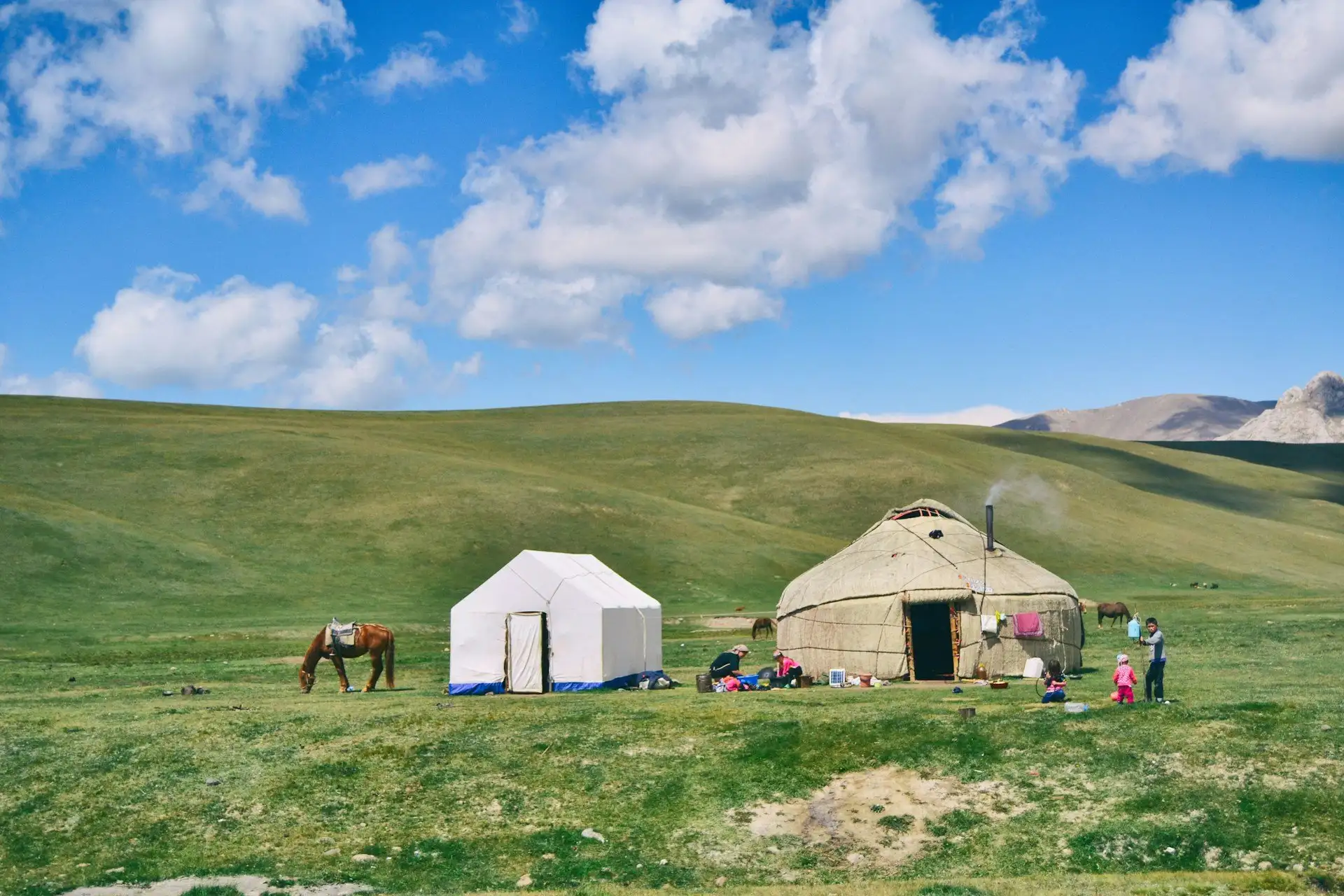
What works magnificently: the community-based tourism network CBT (Community Based Tourism) has guesthouses, horse rental, and guide services in most of the main trekking areas, bookable in advance and remarkably good value. A night in a local family's yurt at Song-Kol plateau — 3,016 meters, surrounded by a herd of horses, the lake flat and silver at dawn, your host bringing fermented mare's milk and bread at 6am — costs around $20 all-in and is one of the most memorable nights available to any traveler at any price point in the world.
Bishkek, the capital, is the city you pass through rather than the city you come for — pleasant, manageable, with a few genuine pleasures including a market scene and café culture that has improved considerably in recent years. Give it two days at the start or end of a mountain trip. Osh in the south, on the Silk Road, is more interesting than Bishkek by some distance and deserves more time than most itineraries give it.
Kyrgyzstan at a Glance
A History Worth Knowing
The Kyrgyz people are one of the oldest continuously identified ethnic groups in Central Asia. Chinese chronicles mention the Kyrgyz as early as 201 BCE, which puts them among the earliest named peoples of the entire region. For most of recorded history they were nomadic pastoralists: moving seasonally between lowland winter pastures and high mountain summer jailoos with their herds, living in yurts that could be assembled or dismantled in an hour, building a culture that valued oral tradition, horsemanship, and hospitality to strangers with a consistency that has survived every empire that ever tried to absorb them.
The Silk Road threaded through the Fergana Valley in what is now southern Kyrgyzstan, and the city of Osh — still the country's second city today — was a significant trading stop for caravans moving between China and the Mediterranean. The ruins of the Uzgen minaret and the Burana Tower in the Chui Valley north of Bishkek are physical remnants of the Karakhanid dynasty that controlled this territory in the 10th and 11th centuries, when the region was wealthy, literate, and architecturally sophisticated in ways that are easy to underestimate today.
The Mongols came in the 13th century, as they came for everyone, and were followed by the Timurids, the Khanates of Kokand and Bukhara, and eventually the Russian Empire, which absorbed Kyrgyz territory in the second half of the 19th century without much ceremony. What followed — Russian settlement, the catastrophic 1916 uprising in which Russian suppression killed tens of thousands of Kyrgyz and drove perhaps a third of the population into exile in China — is a chapter of history that is not well known outside the region and should be.
Soviet Kyrgyzstan brought literacy, infrastructure, and collective farms, and cost the nomadic way of life at scale. The jailoos emptied into apartment blocks. The yurt gave way to the prefabricated housing block. Independence arrived in 1991 with the Soviet dissolution, and the subsequent decades have been more politically turbulent than most of Central Asia — Kyrgyzstan has had three presidents removed by popular uprising (2005, 2010, 2020) and is often described as the most democratic country in the region, which is accurate if you adjust your definition of democratic to fit the Central Asian context.
What you carry with you from this history into the mountains: the nomadic culture that the Soviets compressed but did not destroy has revived with genuine energy since independence. Families who spend summers at Song-Kol plateau or in the Tian Shan jailoos are not performing tradition for tourists. They are living it because it survived, and because it is their inheritance. Treat it accordingly.
Chinese Han Dynasty chronicles mention the Kyrgyz people. One of the earliest named peoples in Central Asian history.
The Kyrgyz defeat the Uyghur Khaganate and briefly control a significant stretch of Central Asia.
Silk Road cities flourish. The Burana Tower and Uzgen minaret built. Islam spreads through the region.
The Kyrgyz submit to Genghis Khan. The region absorbed into the Mongol Empire.
Russia absorbs Kyrgyz territory. Russian settlement and colonial administration begin.
A Kyrgyz uprising against Russian conscription is brutally suppressed. Tens of thousands killed; up to 40% of the Kyrgyz population flees to China. One of Central Asia's great unremembered catastrophes.
Kyrgyzstan declares independence from the Soviet Union on August 31. The nomadic revival begins.
Central Asia's most politically open state. A growing adventure tourism industry built on genuine mountain wilderness and nomadic culture.
Top Destinations
Kyrgyzstan divides naturally into the north (Bishkek, Lake Issyk-Kul, the Karakol area, and the central mountains) and the south (Osh, the Fergana Valley, and the Alay range). Most first-time visitors focus on the north, which has the best trekking infrastructure and the most dramatic mountain scenery. The south rewards the extra time with Silk Road history and a cultural character distinctly different from the north — more Uzbek in its architecture and rhythm, more ancient in its feel.
Ala-Kul Lake & Karakol Valley
The Ala-Kul circuit starting from Karakol town is the trek that serious hikers come to Kyrgyzstan for. Two to three days through the Karakol Valley — larch and spruce forest giving way to bare alpine rock as you gain altitude — crossing a 3,860-meter pass and descending to a glacial lake of improbable turquoise sitting in a bowl of permanent snowfields. The lake is named Ala-Kul: Spotted Lake. The color changes with the light in a way that makes you stop and stand still for longer than you meant to. Fit hikers can do it independently with a good map. Everyone else should hire a guide through CBT Karakol.
Song-Kol Lake
At 3,016 meters, Song-Kol is the second-largest lake in Kyrgyzstan and the most dramatic — a wide, shallow body of water sitting in a treeless plateau surrounded by rolling jailoos where Kyrgyz families bring their horses and cattle every summer from June to September. Yurt camps ring the lake. The evenings involve horses grazing in the foreground with the lake going silver behind them and the sky doing things that make landscape photographers lose all professional composure. Come for at least two nights. The dawn light on the water on a clear morning is the best argument for getting out of your sleeping bag at 5am that exists anywhere in Central Asia.
Bishkek
A Soviet city that has been getting more interesting since independence, without fully shaking the wide boulevard, large monument aesthetic that the Soviets left behind. Osh Bazaar is the reason to come: an enormous market on the western edge of the city that has been operating continuously since before anyone alive can remember, selling everything from dried fruits and spices to Soviet-era tools to fresh horse meat, in a density and authenticity that the more tourist-facing Dordoi Bazaar doesn't replicate. Two days is enough for Bishkek. Don't let it eat your mountain time.
Lake Issyk-Kul
The world's second-largest alpine lake after Titicaca: 180 kilometers long, never freezes despite sitting at 1,607 meters altitude (the name means Warm Lake in Kyrgyz), and ringed by the Tian Shan on every side. The north shore is where most tourism concentrates — beach resorts, Soviet sanatoriums converted into guesthouses, families on summer holiday. The south shore is quieter, wilder, and leads to the Karakol area and the mountain trailheads. The lake itself is extraordinary regardless of which shore you're on.
Osh
Kyrgyzstan's oldest city and its most culturally layered. Osh Bazaar — the actual one in Osh, not the market in Bishkek named after it — is one of the great Central Asian markets, spilling across several blocks in a way that no map fully captures and operating at a frequency that is entirely its own. The Sulayman Mountain (Sulaiman-Too) at the city's heart is a UNESCO World Heritage Site and active pilgrimage place for Central Asian Muslims. Silk Road history is in the stone here in a way it isn't quite in Bishkek. Come from the south and leave time for it.
Burana Tower & Chui Valley
An hour east of Bishkek, the Burana Tower is the surviving minaret of the 10th-century city of Balasagun — truncated by an earthquake centuries ago, still 21 meters high, surrounded by a field of stone balbals (ancient Turkic grave markers) that stand in the grass like a surreal outdoor gallery. The Chui Valley below was the highway of Silk Road trade and the surrounding landscape is dotted with archaeological sites that receive almost no visitors. A half-day from Bishkek; entirely worth it as an introduction to the pre-Russian, pre-nomadic deep history of the region.
Alay Valley & Lenin Peak Base Camp
The Alay Valley in the far south of Kyrgyzstan is where the Pamir mountains begin and the landscape shifts from Tian Shan alpine green to high-altitude desert plateau in a transition that happens over a single mountain pass. Lenin Peak, at 7,134 meters one of the most accessible seven-thousanders in the world, has its base camp here. The valley itself — wide, flat, bisected by the Kyzylsu River, ringed by peaks above 5,000 meters — is one of Kyrgyzstan's most dramatic landscapes and sees perhaps five percent of the visitors that Issyk-Kul receives.
Arslanbob & Jalal-Abad
In the foothills of the Fergana range in southwest Kyrgyzstan, Arslanbob sits inside the world's largest natural walnut forest — ancient trees covering the hillsides in a density that turns the slopes completely dark in late summer when the canopy closes. The village is a Uzbek-speaking community whose hospitality is exceptional and whose guesthouses through CBT are among the best-value rural stays in the country. The waterfall above the village is a half-day walk through the forest. Come in October when the walnuts fall and the whole village smells of fresh walnut shells.
Culture & Etiquette
Kyrgyz hospitality is one of the genuine wonders of the country and it operates on a logic that is worth understanding before you encounter it. The tradition of welcoming strangers — particularly travelers — runs deep enough in nomadic culture that it was once considered a near-sacred obligation. Someone who arrives at a yurt asking for shelter and food will be given both, without prior arrangement, without expectation of payment, because that is what you do. This tradition survives in modified form throughout rural Kyrgyzstan today. When a family invites you in for tea, they mean it. When they add bread, dried fruit, and eventually a full meal to the table, they mean that too.
The country is Muslim but practices Islam with a flexibility shaped by centuries of nomadic Tengrist (sky worship) tradition predating the religion's arrival. You will see people pray and you will see people drink vodka, sometimes within the same extended family and sometimes within a few hours of each other. Religious conservatism is higher in the south near Osh than in Bishkek or the mountain areas. Dress modestly in southern cities; in the mountains, trekking clothes are entirely appropriate.
When a Kyrgyz family offers you kumiss (fermented mare's milk), tea, bread, or food, accept it. Refusing repeatedly is genuinely impolite. If you don't like kumiss, take a small sip and hold the bowl — that signals respect without requiring you to finish it.
The traditional entry is right foot first. Don't step on the threshold. Move to the right inside the yurt if you're a guest — the left side is traditionally the women's domain, the right the men's and guests'. Your host will guide you if you're uncertain.
Sweets, chocolate, or fruit from a city market are appreciated by rural guesthouse hosts who have fewer options than urban shops. This is not required, but it shifts the dynamic from transaction to genuine exchange in a way that matters.
Many Kyrgyz people are happy to be photographed; some are not. Ask. In traditional settings — yurts, religious sites, village markets — the request shows respect that is noticed. Show the photo afterward if it's good. People like seeing themselves.
"Rakhmat" is thank you in Kyrgyz. "Salam" is hello. "Jakshi" means good or fine. These three words will get you a smile at every guesthouse, yurt, and market stall in the country. Russian "spasibo" (thank you) works everywhere too.
Bread — non or lepyoshka — is treated with particular reverence in Kyrgyz culture. Don't step over it, don't place it face down, don't throw it away in front of your hosts. If bread is offered, take it with both hands.
In a yurt, pointing the soles of your feet at another person or at the central hearth is impolite. Sit cross-legged or with your legs to the side. This is worth knowing before you find yourself casually stretching out.
Song-Kol is at 3,016m. Ala-Kul pass is at 3,860m. Altitude sickness is real, comes on quickly, and can escalate seriously in remote areas. Ascend gradually, drink water constantly, and descend immediately if symptoms develop beyond mild headache.
Kyrgyzstan's backcountry is genuinely remote. Mountain rescue exists but response times are long. Tell your guesthouse host or CBT contact where you're going and when you expect to return. This is not paranoia; it is the standard practice of people who know the terrain.
Guesthouse bathrooms in mountain villages are basic. Trails are sometimes unmarked. Road surfaces degrade rapidly beyond main routes. This is the trade for empty trails and genuine wilderness. Adjust expectations before you arrive, not after you're frustrated.
Horse Culture
Kyrgyz horse culture is to Central Asia what Japanese tea ceremony is to Japan — the thing that encodes everything important about the culture into a single practice. Ulak Tartysh (the headless goat polo that also goes by buzkashi), at-chabysh long-distance horse racing, and oodarysh wrestling on horseback are national sports practiced with complete seriousness at festivals and family celebrations. If you're invited to watch any of these events, you are being shown the most distinctly Kyrgyz thing that exists.
World Nomad Games
The World Nomad Games, held every two years in Kyrgyzstan, gathers traditional nomadic athletes from forty countries to compete in archery, eagle hunting, falconry, horse games, and traditional wrestling. If your visit coincides with the games (check dates before planning), it is one of the most extraordinary spectacles anywhere in Central Asia. Even if the games aren't running, the Ethno-Cultural Complex Kyrchyn near Cholpon-Ata has year-round demonstrations.
Felt Craft
Kyrgyz felt craft — shyrdak (embroidered felt rugs) and ala-kiyiz (pressed felt carpets) — is a tradition with UNESCO Intangible Cultural Heritage status. The geometric patterns encode regional identity in ways that are specific enough that practitioners can identify which valley a piece comes from. Buying a shyrdak from a village artisan through CBT means buying something that is both beautiful and genuinely made by someone whose family has been making it for generations.
Eagle Hunting (Berkutchi)
Golden eagle hunting in the Tian Shan mountains is one of the last places on earth where this practice is maintained as a working tradition rather than a cultural performance. The annual hunting season runs from October to February. The eagle hunters of the Issyk-Kul region, particularly around Bokonbayevo village, offer guided experiences through CBT that involve genuine working eagles, not trained display birds. This distinction matters and is worth specifically asking about.
Food & Drink
Kyrgyz food is mountain food: dense, warming, heavy on meat and dairy, designed for people who have been on horseback for six hours at altitude and need to actually eat something. It is not the world's most refined cuisine and makes no claim to be. What it is, at a family table in a mountain guesthouse, is exactly what you need after a day on a trail: nourishing, generous, made with ingredients that came from the surrounding valley, and accompanied by tea that is refilled before you've finished your cup.
Bishkek and Osh have grown genuine restaurant scenes that go well beyond traditional Kyrgyz cooking — Uzbek, Russian, Korean (the Koryo-saram community deported to Central Asia by Stalin has left a significant culinary footprint), and increasingly modern Central Asian restaurants run by a younger generation. The city food is noticeably better than it was five years ago and significantly better than most visitors expect.
Beshbarmak
Shared with Kazakhstan and prepared identically: flat hand-cut pasta with slow-braised lamb or horse meat, served on a communal platter with onion broth poured over it and drunk separately from a bowl. The name means five fingers — you eat with your hands. At a family celebration in a yurt it arrives in a quantity that requires commitment. The horse meat version (zhamby) is the more ceremonially significant, richer, and more interesting of the two. Try it if offered.
Manti & Samsa
Large steamed dumplings filled with spiced lamb and onion, served in most guesthouses and restaurants across the country. Samsa — baked pastry parcels from tandoor ovens — are the street food of Bishkek's markets and the correct thing to eat while walking through Osh Bazaar. Both cost almost nothing and are almost always good. The samsa at the bazaar stalls near Osh's main square at 8am — just pulled from the tandoor, burning your fingers, worth every second — is the best version.
Laghman
Hand-pulled noodles in a spiced lamb and vegetable broth, arrived via the Silk Road from Chinese cooking and entirely adopted. Every guesthouse makes it, every bazaar canteen serves it, and the versions vary enormously — some watery and forgettable, some rich and deep and the best thing on the menu. Order it everywhere and form your own ranking. The Dungan (Chinese Muslim) village of Tokmok near Bishkek makes a version that is noticeably different from and better than most others.
Kumiss & Maksym
Fermented mare's milk — kumiss — is the national drink and a genuine cultural institution. In summer it is sold from roadside stalls along every major road in the country, from plastic bottles and ceramic jugs, cold and slightly fizzy, with a sour tang that your palate will need to negotiate. It is mildly alcoholic (1–3%), considered medicinal, and offered to every guest. Maksym is a fermented grain drink, non-alcoholic, thicker, drunk cold from street stalls in Bishkek. Both are worth your honest engagement.
Bread & Dairy
The bread — tandir non, baked in a clay tandoor, round, flat, slightly charred on the outside and soft inside — is among the most satisfying simple breads in the world. It arrives at every table. It goes with everything. Kaymak (clotted cream) and freshly churned butter from yurt camp herds are served at breakfast with the bread and local honey, and this combination, eaten in a yurt with mountains outside the smoke hole, constitutes one of the simple pleasures that travel exists to find.
Drinks
Kyrgyzstan is a Muslim country but not a dry one — alcohol is widely available in restaurants, guesthouses, and shops across the country, including in tourist areas. Local beer brands (Arpa, Sim-Sim) are cheap and drinkable. Russian and Kazakh vodka is everywhere. The tea culture is strong: black tea with milk and salt is the traditional form, though sugared tea has mostly taken over in modern guesthouses. Fresh apricot and berry juices in summer, particularly around Issyk-Kul, are genuinely excellent and free if you're walking near orchards.
When to Go
June through September is the season. Before June the high mountain passes are still under snow, yurt camps haven't opened, and roads to remote areas can be impassable. After September the weather at altitude becomes unpredictable in ways that are beautiful in photographs and genuinely unpleasant in a tent. July and August are peak season — which in Kyrgyzstan means you might share a mountain lake with five other trekkers instead of zero. This is not a problem.
Summer
Jun – AugAll passes open, all yurt camps operating, jailoos at peak green, Song-Kol full of nomadic families with herds. July and August are warm at altitude and the days are long. This is when Kyrgyzstan is fully itself.
Early Autumn
Sep – OctSeptember is the finest month for trekking — clearer skies than summer, fewer people on trails, and the beginning of autumn color in the walnut forests and larch valleys. October brings the walnut harvest at Arslanbob and the start of eagle hunting season. High passes can close with early snow from mid-October.
Late Spring
MayLower valleys are accessible and the wildflowers at mid-altitude are extraordinary. High passes still closed. Good for Bishkek, Osh, the Chui Valley, and lower Issyk-Kul. Not yet right for Ala-Kul or Song-Kol. Worth considering if your itinerary focuses on cities and cultural sites over high-mountain trekking.
Winter
Nov – AprThe mountains are closed. Roads to most significant sites are impassable. Yurt camps gone. Temperatures in Bishkek drop to -15°C. There is almost no tourist infrastructure operating. Extreme cold-weather trekkers come for winter mountaineering on Lenin Peak — that is the only compelling reason to visit in this window.
Trip Planning
Two weeks is the minimum to do Kyrgyzstan properly — long enough to do the Ala-Kul trek, spend time at Song-Kol, explore Bishkek and Osh, and still have the slow days that make mountain travel restorative rather than exhausting. Three weeks allows you to add the Alay Valley or Arslanbob without the trip feeling rushed. The CBT network — Community Based Tourism — is the single most important logistical resource in the country: book guides, horses, yurt stays, and guesthouse accommodation through them before you arrive.
Bishkek
Land, sort logistics (CBT main office is on Togolok Moldo Street and worth visiting in person on day one to book guides and guesthouses for the mountain sections). Osh Bazaar on the morning of day two. Burana Tower in the afternoon on a rental car or marshrutka. Evening on Chui Avenue.
Song-Kol
Marshrutka or hired car to Song-Kol via the Kochkor pass road. Two nights at a yurt camp on the lake. Dawn on day four — non-negotiable, no excuses. Horseback ride around the shoreline. Return to Kochkor or continue east toward Karakol.
Karakol & Ala-Kul Trek
Base yourself in Karakol town (good guesthouses, CBT office, excellent banya). Three days on the Ala-Kul circuit: Karakol Valley to first camp, up to the pass and down to the lake, return via the Altyn-Arashan valley with its hot springs. End at Ak-Suu village. Take the banya in Altyn-Arashan after crossing the pass. It is the correct decision.
Issyk-Kul + Bishkek
Drive the north shore of Issyk-Kul back to Bishkek — the lake visible from the road the whole way, mountains behind it, the scale gradually becoming comprehensible. Evening in Bishkek. Morning flight home.
Bishkek
Full two days: State History Museum for the pre-Russian nomadic history, Osh Bazaar, Burana Tower day trip, and a proper dinner at a Kyrgyz restaurant on Erkindik Boulevard to calibrate what beshbarmak can be when it's done well.
Song-Kol
Three nights at Song-Kol gives you two full days on the plateau: one for exploring on horseback, one for a longer hiking circuit above the lake to a viewpoint that puts the full 29-kilometer length of the water into perspective. The extra night means you catch both a sunset and a dawn rather than choosing between them.
Karakol & Extended Trek
Four nights allows the full Ala-Kul circuit plus a rest day in Karakol town between legs. The Przhevalsk Museum (dedicated to the Russian explorer Nikolai Przhevalsky who died near Karakol in 1888 and has a town named after him) is worth an hour on a rest day. The Sunday livestock market on the outskirts of Karakol is one of the most authentic market experiences in Kyrgyzstan.
Osh & Southern Kyrgyzstan
Fly from Bishkek to Osh (1 hour) rather than the 12-hour drive. Two full days: Osh Bazaar, Sulayman Mountain, the afternoon light on the old city from the peak above it, dinner at an Uzbek plov restaurant. Day trip to Uzgen for the minaret and mausoleum complex. Fly home from Osh Airport.
Bishkek + Surroundings
Three days in and around Bishkek: the city itself, Burana Tower, and a day hike into the Ala-Archa National Park gorge just 40 minutes south of the city — a glacier-fed canyon with a waterfall and a refugio that gives you serious mountain terrain before you've even started the main trek circuit.
Song-Kol + Kochkor Valley
Four days in the Song-Kol area: three on the plateau plus a day in Kochkor village watching shyrdak felt carpets being made and visiting the CBT cooperative where the artisans work. The drive from Kochkor to Song-Kol via the Kalmak-Ashuu pass is one of the finest mountain roads in Central Asia.
Karakol Extended & Issyk-Kul
Six days in the Karakol area: the Ala-Kul circuit over three days, a rest in Altyn-Arashan hot springs, a day at Jeti-Oguz (Seven Bulls red rock canyon, a short drive from Karakol) and a half-day at Bokonbayevo for an eagle hunter demonstration on the south shore of Issyk-Kul. The lake south shore road is significantly more beautiful and less touristed than the north.
Osh + Arslanbob + Alay Valley
Fly to Osh. Full two days in the city. Drive west to Arslanbob for two nights in the walnut forest. Return to Osh and drive south to the Alay Valley via the Chyrchyk Pass — one of the great drives in Central Asia, arriving at the flat plateau with Lenin Peak visible ahead at 7,134 meters. One night at base camp approach, return via Osh, fly home.
CBT — Book Before You Go
Community Based Tourism (cbtkyrgyzstan.kg) operates guesthouses, yurt stays, guide and horse hire across the country. Book the Song-Kol and Ala-Kul sections in advance — yurt camps fill in July and August. The Bishkek office coordinates everything and responds to email in English.
Visit CBT Kyrgyzstan →Connectivity
Good 4G in Bishkek and Osh. Patchy along Issyk-Kul's north shore. Nonexistent in the mountains. Download Maps.me with Kyrgyzstan offline before leaving the city — it is more complete than Google Maps for mountain tracks. A local SIM from Beeline or MegaCom is cheap and gives you city coverage.
Get Kyrgyzstan eSIM →Gear
Bring your own trekking gear. Equipment hire in Karakol and Bishkek exists but quality is variable. Essentials: waterproof shell, warm mid-layer (fleece or down), trekking poles (the passes are steep with loose rock), sleeping bag rated to -5°C minimum for mountain yurt stays, and headlamp. Altitude medicine (Diamox) is worth discussing with your doctor before departure.
Language
Russian is your working language for anything outside CBT and tourist guesthouses. Kyrgyz is the national language and widely spoken in rural areas. English exists in Bishkek and among younger guides but not reliably elsewhere. A Russian phrasebook app with offline mode is essential. Google Translate handles Kyrgyz Cyrillic reasonably well.
Travel Insurance
Mountain rescue in Kyrgyzstan exists but response times are long and costs are significant without coverage. You need comprehensive insurance that specifically covers trekking at altitude, helicopter rescue, and emergency medical evacuation. Read the policy fine print — some adventure sports coverage excludes anything above 4,000 meters.
Cash Is Essential
Cards are accepted in Bishkek hotels and some restaurants, nowhere else. Guesthouses, yurt camps, CBT services, markets, and all rural transactions are cash-only. Withdraw som before leaving Bishkek or Karakol. ATMs in small towns are unreliable. Carry more cash than you think you need — there's no ATM at 3,016 meters.
Transport in Kyrgyzstan
Getting around Kyrgyzstan requires accepting that the infrastructure is limited and building flexibility into your plans accordingly. The main transport modes are shared minibuses (marshrutkas), hired taxis and private cars, the domestic flight between Bishkek and Osh, and horse — which is neither a joke nor a last resort in much of the mountain country but the appropriate and often only practical way to cover terrain that has no road.
Marshrutkas connect all the major towns along the Issyk-Kul coast and between Bishkek and most regional centers. They leave when full rather than on a schedule, which means early departures from bus stations to get a seat on the first run. For anything off the main routes — Song-Kol, Arslanbob, the Alay Valley, any mountain trailhead — you need to hire a car with a driver or arrange through CBT.
Marshrutka
50–400 KGS/routeThe shared minibus is the backbone of Kyrgyz intercity travel. Cheap, frequent on main routes, and entirely how locals get around. Depart from specific stations (Bishkek Western Bus Station for routes west and south; Eastern for Issyk-Kul and Karakol). Leave when full. Bring a snack and a book.
Hired Car & Driver
3,000–8,000 KGS/dayFor anything off the marshrutka network — Song-Kol, mountain trailheads, rural guesthouses — hire a driver through your hotel, CBT, or a Bishkek agency. A good driver knows the roads, handles the inevitable breakdowns, and often becomes genuinely useful as a guide. Negotiate the day rate in advance, including any fuel surcharge for remote routes.
Bishkek to Osh (Domestic Flight)
3,000–8,000 KGSThe domestic flight takes 1 hour versus 10–12 hours by road. Avia Traffic Company and Air Manas operate the route. Book in advance in peak season. The flight itself is spectacular — the entire Tian Shan visible below from takeoff to landing. Take a window seat on either side.
Horse
800–2,000 KGS/dayFor approaching Song-Kol, accessing remote jailoos, and multi-day trekking circuits in the Tian Shan foothills, horse hire through CBT is the appropriate and genuinely excellent option. Kyrgyz horses are smaller than Western breeds, sure-footed on mountain terrain, and handled by guides who have ridden since childhood. Trust the horse more than you trust your instincts on steep ground.
Yandex Go (Bishkek)
80–400 KGS/tripThe ride-hailing app works well in Bishkek and covers most city journeys reliably. Download before arrival. Requires a local or international phone number for registration. For anything outside Bishkek, it doesn't operate and you need a hired car or marshrutka.
Car Rental (Self-Drive)
3,000–7,000 KGS/dayAvailable in Bishkek from several agencies. Entirely practical for the Issyk-Kul ring road, the Chui Valley, and routes within reasonable distance of the main roads. The roads to Song-Kol and remote trailheads require a 4WD and confidence on unpaved mountain tracks. If you're uncertain, hire the car with the driver who knows the road.
Long-Distance Bus (Bishkek–Osh)
700–1,200 KGSThe overnight bus between Bishkek and Osh crosses the Tian Shan via the Torugart Pass route and takes 10–12 hours. Cheap but hard on the body. The scenery at dawn through the mountain sections is extraordinary if you're awake for it. Worth doing once for the experience; the domestic flight is worth it on the return.
Bicycle
Own equipment recommendedCycle touring in Kyrgyzstan has a dedicated following for good reason: the roads are quiet outside the main routes, the scenery is continuous, and the Issyk-Kul ring road is one of the great multiday cycling routes in Central Asia. Bring your own equipment — hire options in Bishkek exist but quality is inconsistent for serious touring.
Accommodation in Kyrgyzstan
Kyrgyzstan's accommodation divides cleanly between the cities, where standard hotel options exist across the budget range, and everywhere else, where the choice is between CBT guesthouses (local family homes with a spare room, breakfast included, dinner available on request), yurt camps at mountain sites, and wild camping. The CBT guesthouse network is the single best accommodation system in Central Asia for independent travelers: bookable in advance, quality-controlled, priced honestly, and operated by families who feed you well and often tell you things about the area that no guidebook contains.
Yurt Camps
600–2,500 KGS/night incl. mealsThe Song-Kol plateau yurt camps are the experience Kyrgyzstan is known for: traditional felt yurts operated by nomadic families, with horses tethered outside, dinner cooked on a wood fire, and no electricity. Book through CBT. The camps fill in July and August — book at least three weeks in advance for peak season.
CBT Guesthouses
800–2,000 KGS/night incl. breakfastFamily homes in mountain villages — Karakol, Kochkor, Arslanbob, and dozens of smaller settlements — with a room in the family home, breakfast included and dinner available. The quality varies but the hospitality is consistent. The standard CBT guesthouse dinner is one of the better meals you'll have in the country at any price.
Bishkek Hotels & Hostels
800–6,000 KGS/nightBishkek has a functioning range from well-reviewed backpacker hostels (Nomads Hostel is consistently good and centrally located) to mid-range business hotels to the Hyatt Regency at the top end. Location matters: stay on or near Chui Avenue for walking access to the main city sites and transport connections.
Wild Camping
FreeCamping in Kyrgyzstan's mountains is legal, unrestricted, and entirely normal. The jailoos are open to camping; the lake shores are open; the mountain valleys are open. Bring your own equipment, leave no trace, and note the standard mountain rules about water sources and waste. The freedom to camp anywhere in this landscape is part of what makes Kyrgyzstan extraordinary for serious outdoor travelers.
Budget Planning
Kyrgyzstan is one of the world's most remarkable value propositions for adventure travel. The combination of world-class mountain terrain, genuine nomadic culture experiences, and prices that are a fraction of equivalent destinations in Nepal, Patagonia, or the Alps makes it extraordinary value for what you get. The main costs to budget for are transport between sites (hired cars add up on a multi-stop itinerary) and any professional guiding or horse hire — both of which are still cheap by any Western standard.
- CBT guesthouses and yurt camps
- Canteen and guesthouse meals
- Marshrutkas for transport
- Self-guided trekking with maps
- Wild camping where possible
- CBT guesthouses with meals + Bishkek hotel
- Hired car for mountain routes
- Local guide for key treks
- Horse hire for Song-Kol approach
- Restaurant dining in cities
- Better guesthouses and city hotels
- Private car with driver throughout
- Dedicated English-speaking guide
- All meals included at guesthouses
- Domestic flights to save time
Quick Reference Prices
Visa & Entry
Kyrgyzstan has expanded visa-free access significantly and the process for most Western travelers is straightforward. Citizens of over 60 countries including the US, UK, EU member states, Australia, Canada, Japan, and South Korea can enter visa-free for between 30 and 60 days depending on nationality. Most other nationalities can apply for an e-visa at the official portal evisa.e-gov.kg — the process takes three to five working days and costs $25–35 USD.
The border with Kazakhstan near Bishkek is the most commonly used land crossing and is straightforward for most nationalities. The Osh–Fergana crossing into Uzbekistan is used by travelers continuing the Silk Road circuit. Some border crossings into China and Tajikistan have specific permit requirements for foreign nationals — confirm before planning any cross-border excursion.
60+ nationalities including US, UK, EU, Australia, Canada. E-visa available for most others at evisa.e-gov.kg.
Family Travel & Pets
Kyrgyzstan is a genuinely excellent destination for families with children old enough for outdoor adventure — roughly 8 and up for trekking, younger for the cultural experiences and gentle horse riding. Kyrgyz families are warm toward children in the way that societies where extended family is the social unit tend to be: spontaneously, practically, and with the assumption that children belong in the company of adults rather than managed separately from it.
The CBT guesthouse network works particularly well for families: you stay in a home rather than a hotel, share meals with the host family, and children interact naturally with local children in a way that hotel travel rarely produces. The logistics require more planning than destinations with developed tourist infrastructure — transport, gear, altitude awareness — but the experience is proportionally richer.
Horse Riding
Kyrgyz horses are smaller and more manageable than many breeds, and children over 6 can ride with a guide from CBT guesthouses across the country. The Song-Kol horseback circuit is suitable for families with children 10 and older. The approach rides to mountain jailoos from valley villages are shorter and appropriate for younger riders. This is horse riding as actual transport, not a tourist activity.
Yurt Stay
Children find the yurt experience completely absorbing: the circular structure, the central smoke hole open to the sky, the felt walls, the horses outside. The family that hosts you will likely have children of their own and the social barriers dissolve faster than in any hotel environment. Two nights at Song-Kol is the version that works best for families — enough time to feel the rhythm without the logistics becoming a challenge.
Eagle Hunting
A golden eagle on a falconer's glove at close range is one of the most impressive wildlife encounters available anywhere. The eagle hunter demonstrations at Bokonbayevo village on Lake Issyk-Kul south shore through CBT are arranged specifically for visitors and work for children of any age old enough to stand still for thirty seconds when the bird lands. The eagles are working hunting birds, not trained performers.
Lake Issyk-Kul
The world's second-largest alpine lake at 1,607 meters is warm enough to swim in summer, calm enough for children on the north shore beaches, and visually extraordinary — mountains reflected in still water, visible from every point on the shore. The north shore beach resorts near Cholpon-Ata are the family-friendly base; the south shore is quieter and wilder and leads to the Karakol trailheads.
Burana Tower
The 10th-century minaret and its surrounding field of stone balbals (Turkic grave markers carved as human figures) is accessible, visual, and holds children's attention in a way that most archaeological sites don't. The climb inside the tower to the top is a narrow spiral stair that older children find satisfying. The field of balbals standing silently in grass is legitimately strange and interesting at any age.
Arslanbob Walnut Forest
The world's largest natural walnut forest, accessible via easy forest trails from the village, is one of those places that captures the imagination of adults and children simultaneously. In October the walnuts fall and the whole village smells of fresh walnut shells. The waterfall hike from the village is suitable for families with children old enough to walk three to four hours at a gentle gradient.
Traveling with Pets
Kyrgyzstan permits the import of pets with appropriate documentation. Dogs and cats require a microchip compliant with ISO standards, a valid rabies vaccination, a veterinary health certificate issued within five days of travel, and a certificate from your country's official veterinary authority. Documents should be in Russian or accompanied by a certified Russian translation.
The process requires advance planning — start at least six weeks before travel and contact the Kyrgyz State Inspection for Veterinary and Phytosanitary Safety to confirm current requirements. The rules are broadly similar to those of other Central Asian states but have specific documentation requirements that differ from Kazakhstan and Uzbekistan.
Practically: Bishkek has veterinary clinics and pet-friendly infrastructure at a basic level. Rural Kyrgyzstan is another matter entirely — guesthouses and yurt camps are not set up for pets, mountain terrain and altitude are demanding for animals, and the working dogs in mountain villages are not domesticated in the Western sense and can be aggressive. If you bring a dog to Kyrgyzstan, confine it to city-based activities and be aware that encountering herding dogs in mountain areas requires caution.
Safety in Kyrgyzstan
Kyrgyzstan is generally safe for tourists in the main travel areas and has a low rate of violent crime against visitors. The country's political history — three presidential removals by popular uprising in twenty years — produces occasional civil unrest in Bishkek that is worth monitoring through your government's travel advisory if it occurs during your visit. These episodes have not historically affected tourists directly but warrant awareness.
The genuine risks in Kyrgyzstan are environmental rather than criminal: altitude sickness, mountain weather, remoteness from medical facilities, and the terrain itself. These are manageable with preparation and the application of standard mountain safety practices that anyone doing serious trekking should already know.
Crime Against Tourists
Low. Petty theft in Bishkek's markets and bus stations occurs but is not common. Violent crime against tourists is rare. The country's small-city social dynamics mean that a foreigner in trouble typically gets help faster than they would in a large anonymous city.
Solo Travel
Kyrgyzstan is one of the more manageable solo travel destinations in Central Asia. The CBT network provides a social infrastructure of trusted guesthouses that solo travelers rely on. Solo trekking in the backcountry requires more caution — always inform your guesthouse of your route and expected return.
Altitude Sickness
Song-Kol (3,016m) and the Ala-Kul pass (3,860m) are high enough to produce altitude sickness in unacclimatized visitors. Symptoms — headache, nausea, dizziness — that don't resolve with rest and water require descent. Above 3,500m, High Altitude Cerebral Edema (HACE) is a real possibility if you push through symptoms. Descend immediately and completely if symptoms worsen.
Mountain Weather
Afternoon thunderstorms in the Tian Shan are fast-moving and severe. Be at or below your pass crossing by midday. Lightning above treeline is dangerous with no shelter available. If a storm is building and you're exposed, descend to a valley as quickly as safely possible.
Political Unrest
Bishkek has a history of political demonstrations that occasionally escalate. Monitor your government's travel advisory during your visit. The affected areas are typically around the main government square in central Bishkek — avoid large crowds if unrest is reported and follow local guidance.
Healthcare
Good private clinics in Bishkek. Basic medical facilities in Karakol and Osh. Nothing resembling medical care in the backcountry. Mountain rescue exists (the Alpine Fund of Kyrgyzstan operates SAR) but response times in remote areas are measured in hours. Travel insurance with helicopter evacuation is not optional for serious mountain activity.
Emergency Information
Your Embassy in Bishkek
Most embassies are in the Chui district of Bishkek.
Book Your Kyrgyzstan Trip
Everything in one place. These are services worth actually using.
The Window Is Still Open
In ten years, Kyrgyzstan will be on the radar the way Nepal was before the 1990s trekking boom changed it permanently. The trails will still be extraordinary — the mountains are not going anywhere — but the solitude, the village guesthouses without a laminated menu in four languages, the yurt family who invites you in because that is simply what you do when a traveler arrives at your door, all of that is contingent on the present moment. The present moment is now.
There is a Kyrgyz concept called Ak Jol — White Road — which is the blessing offered to travelers departing on a journey. It means something like: may your path be clear, may luck travel with you, may you return safely. It's said with the warmth of a culture that has been sending people into the mountains for centuries and knows that the road is genuinely uncertain and genuinely worth taking. Ak Jol.