
Iraq
The cradle of civilization, where writing was invented, cities were first built, and laws were first codified. The ziggurat at Ur is 4,100 years old and still standing. The security situation requires honest assessment before any visit — and for Iraqi Kurdistan specifically, that assessment is considerably more positive than most people expect.
What You Need to Know First
Iraq is ancient Mesopotamia. Between the Tigris and Euphrates rivers, in the flat alluvial plain that is now largely southern and central Iraq, the Sumerians invented writing around 3500 BCE, built the world's first cities around 4000 BCE, developed the first code of laws under Hammurabi around 1750 BCE, and created the agricultural and administrative systems that became the template for every subsequent civilization in the Middle East and Europe. The ziggurat at Ur, built around 2100 BCE near modern Nasiriyah, is one of the oldest standing structures in the world. The ruins of Babylon are outside Hillah, an hour south of Baghdad. Nineveh, the Assyrian capital that was the largest city in the world around 700 BCE, is across the Tigris from modern Mosul. This is not the accumulated heritage of centuries. It is the heritage of millennia, and it is in Iraq, and most of it has been visited by fewer tourists in the past two decades than a mid-sized European museum receives in a week.
The practical picture in 2026: Iraqi Kurdistan, the autonomous region comprising Erbil, Sulaymaniyah, and Dohuk governorates and extending to the borders with Turkey and Iran, is genuinely accessible and increasingly visited. Erbil's Citadel, the oldest continuously inhabited city on earth, is a UNESCO World Heritage Site with a functioning hotel and café scene around its base. The mountain landscapes of the Amadiya district and the Rawanduz gorge are extraordinary. The Kurdistan Regional Government actively promotes tourism and issues visas on arrival at Erbil airport independently from the Iraqi federal government. For anyone primarily interested in the Kurdistan experience, this is a straightforward destination by regional standards.
Baghdad is more complicated. The city has stabilized significantly since the ISIS territorial defeat in 2017 and the 2003–2010 period of maximum violence is past. A small but growing number of adventurous tourists visit the capital, its National Museum, the Abbasid-era architecture in the old city, and the new restaurant and café scene that has emerged in the relative stability. Most Western governments still issue Level 3 (Reconsider Travel) or Level 4 (Do Not Travel) advisories for most of Iraq including Baghdad, reflecting ongoing risks from armed groups and political instability. These advisories are not bureaucratic overcaution: the risks are real. Visiting Baghdad requires specific preparation, ideally a local contact or operator, and clear-eyed risk acceptance.
The south — Najaf, Karbala, Basra, and the site of Ur near Nasiriyah — is primarily a pilgrimage destination for Shia Muslims and sees millions of visitors annually. Non-Muslim tourists are theoretically welcome but rare and the infrastructure assumes pilgrims rather than cultural tourists. The area around Mosul in the north, heavily damaged during the ISIS occupation and now undergoing reconstruction, is accessible for visitors interested in the post-conflict recovery but requires care and current security assessment.
Iraq at a Glance
Note: Ratings above reflect Iraqi Kurdistan's significantly better scores in most categories. Baghdad and south Iraq score lower on safety-related metrics. Ratings are country averages only.
A History Worth Knowing
No other country on earth holds the earliest evidence for so many of civilization's foundational innovations. The alluvial plain between the Tigris and Euphrates, called Mesopotamia by the Greeks (from the Greek for "between the rivers"), was where human beings first figured out how to organize themselves at sufficient scale to require writing, permanent cities, and codified law. Understanding this is not an academic exercise when you are standing at the base of the ziggurat at Ur: it is the difference between looking at a pile of ancient bricks and understanding that you are standing at the place where the modern world began.
The Sumerians, who dominated southern Mesopotamia from roughly 4500 to 2000 BCE, built the world's first cities at Ur, Uruk, Eridu, and Nippur. The city of Uruk at its height around 3000 BCE may have had a population of 50,000 to 80,000 people in an era when most of humanity lived in small settlements. To administer a city of that size, to track the ownership of livestock and grain and debt, the Sumerians developed cuneiform writing on clay tablets around 3500 BCE. The earliest known written texts, accounting records and administrative documents from Uruk, are in the British Museum, where they sit in a glass case that most visitors walk past without recognizing them as the beginning of recorded human history.
The Akkadian Empire under Sargon of Akkad (c. 2334–2279 BCE) created the world's first multiethnic empire, unifying the Sumerian city-states with the Semitic Akkadian speakers of the north. The Babylonian Empire under Hammurabi (r. 1792–1750 BCE) produced the Code of Hammurabi, 282 laws inscribed on a basalt stele now in the Louvre, which established principles of evidence, presumption of innocence, and proportional punishment that influenced legal systems for three thousand years. The city of Babylon under Nebuchadnezzar II (r. 605–562 BCE) was probably the largest city in the world, enclosed by walls so massive that Herodotus described them with dimensions that archaeologists have since confirmed were largely accurate. The Hanging Gardens of Babylon, if they existed as the ancient sources described, were one of the Seven Wonders of the Ancient World.
The Assyrian Empire from its capital at Nineveh (near modern Mosul) was one of the most militarily sophisticated and culturally complex states of the ancient world, producing the library of Ashurbanipal — 30,000 clay tablets containing the collected knowledge of Mesopotamian civilization — and the carved stone relief panels of royal hunts and military campaigns that are now in the British Museum and the Iraq Museum and are among the greatest works of narrative sculpture in the ancient world. The Assyrian civilization was destroyed by a coalition of Babylonians and Medes in 612 BCE with a thoroughness from which it never recovered.
The Persian Achaemenid conquest in 539 BCE incorporated Mesopotamia into an empire that stretched to India. Alexander the Great took Babylon in 331 BCE and died there in 323 BCE. The Parthian and Sassanid Persian empires controlled the region until the Arab Muslim conquest in 636–637 CE, which brought Islam and the Arabic language and transformed the region's cultural identity permanently.
The Abbasid Caliphate, established in 750 CE with its capital at the newly founded city of Baghdad, created the most intellectually productive period in medieval Islamic history: the House of Wisdom (Bayt al-Hikma) in Baghdad was the world's greatest center of learning from the 8th to 13th centuries, translating Greek scientific and philosophical texts into Arabic, producing original mathematical and astronomical work, and hosting scholars from across the Islamic world and beyond. The mathematician al-Khwarizmi, who worked at the House of Wisdom, developed algebra and gave his name to the concept of algorithms. The physician Ibn Sina (Avicenna) produced medical encyclopedias that were standard references in European universities until the 17th century. Baghdad in 900 CE was the largest city in the world, with a population estimated at one million.
The Mongol invasion under Hulagu Khan in 1258 destroyed Baghdad with a thoroughness that shocked even the medieval world. The House of Wisdom was destroyed, its books reportedly thrown into the Tigris until the river ran black with ink. An estimated 200,000 to 800,000 people were killed. Baghdad never fully recovered its medieval dominance. The subsequent Ottoman period from the 16th to early 20th century was one of relative stagnation and periodic conflict.
The British Mandate following World War I created the modern state of Iraq by drawing lines that combined three former Ottoman provinces — the Kurdish north, the Sunni Arab center, and the Shia Arab south — into a single political entity with a Hashemite king installed by Britain. The discovery of oil in the 1920s and 1930s defined the subsequent century. The 1958 coup ended the monarchy. The Ba'ath Party seized power in 1968, bringing Saddam Hussein to dominance by 1979. The Iran-Iraq War from 1980 to 1988, the invasion of Kuwait in 1990, the Gulf War of 1991, twelve years of sanctions, and the US-led invasion of 2003 are the sequence of events that produced the Iraq of today: a country with extraordinary historical depth, significant oil wealth, persistent political instability, and a security situation that has fluctuated between periods of extreme violence and cautious stabilization.
The ISIS occupation of Mosul and large parts of northern and western Iraq from 2014 to 2017 was the most recent catastrophe. The deliberate destruction of the Mosul Museum's ancient Assyrian and Mesopotamian collections, the dynamiting of the site of Nimrud, and the burning of Mosul's main library were acts of iconoclasm that removed irreplaceable artifacts from human civilization. The liberation of Mosul in 2017 and the subsequent defeat of ISIS territorial control did not end all security threats but created the conditions in which some form of recovery and visitor access became possible.
The Sumerians build the world's first urban centers at Ur, Uruk, and Eridu in southern Mesopotamia. Populations of tens of thousands require new administrative systems.
Cuneiform writing on clay tablets developed at Uruk to track grain and livestock. The oldest known written texts in human history are Sumerian administrative records.
The Third Dynasty of Ur constructs the Great Ziggurat at Ur, a three-tiered mudbrick temple platform still standing today near Nasiriyah. One of the oldest structures in the world.
Babylon's king Hammurabi inscribes 282 laws establishing evidence-based justice and proportional punishment. Influences legal systems for three thousand years.
The Abbasid Caliphate makes Baghdad the largest city on earth and the intellectual center of the medieval world. The House of Wisdom translates Greek knowledge and produces algebra and medicine.
Hulagu Khan destroys Baghdad and the House of Wisdom. Hundreds of thousands killed. The city never fully recovers its medieval dominance.
The US invasion, years of sectarian conflict, and the ISIS occupation and defeat shape the modern country. The Mosul Museum's Assyrian collections are deliberately destroyed by ISIS in 2015.
Kurdistan thrives and receives tourists. Baghdad stabilizes and a small tourist infrastructure emerges. The ancient sites — Ur, Babylon, Nineveh — are accessible with appropriate planning. The Iraq Museum reopens and begins welcoming visitors.
Top Destinations
Iraq's destinations fall into four distinct categories requiring different preparations: the Kurdistan Region (accessible and increasingly touristed), Baghdad and central Iraq (accessible with security awareness), southern Iraq's pilgrimage sites (primarily for Muslim visitors), and the ancient archaeological sites (spread across all regions, each requiring current access assessment). This section describes the destinations by region with honest notes on accessibility.
Erbil (Kurdistan)
Erbil's Citadel, the Qala, is a UNESCO World Heritage Site and the oldest continuously inhabited city on earth: the mound on which the citadel sits has been occupied without interruption for at least 6,000 years. The mudbrick houses that cover it have been inhabited by families whose lineage in the same location traces back generations beyond anyone's memory. The citadel rises dramatically above the modern city and the bazaar at its base, and the view from the top across the Kurdish plain toward the Zagros Mountains is significant. The city around it has developed a good hotel and restaurant infrastructure, with a growing café scene in the Ankawa Christian quarter and along the Kurdistan bazaar lanes. Erbil is the easiest entry point to Iraq for most visitors and the logical base for exploring the Kurdistan region.
Baghdad & Babylon
Baghdad is not the destroyed city of news coverage images. Parts of it are working, functional, even vibrant: the Mutanabbi Street book market, the intellectual and cultural heart of the city, was rebuilt after a 2007 car bombing and now operates again as a weekly book fair and gathering point for writers and readers. The Abbasid Palace, the last standing remnant of the medieval Abbasid Caliphate, is a 13th-century structure in the Rusafa district. The Iraq Museum holds the greatest collection of Mesopotamian artifacts in the world and was open to visitors as of late 2025. Babylon, 85 kilometers south of Baghdad near Hillah, is a UNESCO World Heritage Site: the ruins of the outer walls, the Ishtar Gate (mostly in the Pergamon Museum in Berlin, but the site remains dramatic), and Nebuchadnezzar's palace can be walked with a guide. The current condition of the site, which includes Saddam-era reconstruction over ancient foundations, is contested by archaeologists but what remains is still substantial.
Kurdistan Mountains & Amadiya
The Kurdistan Region's northern highlands along the Turkish and Iranian borders contain some of the most dramatic mountain scenery in the Middle East: the Hamilton Road through the Rawanduz Gorge is a 1920s British engineering project cut into vertical cliff faces above a turquoise river canyon that should be more famous than it is. The ancient town of Amadiya, built on a natural mesa 1,400 meters above the surrounding valleys with a single road cut through the rock as the only access, looks as if someone placed a medieval town on a cloud. The Akre district's traditional houses and its dramatic hilltop position. The mountain resort of Soran for summer weekenders. Kurdistan's mountain tourism is the country's most developed and most infrastructure-supported visitor experience outside of Erbil city.
Ur & the Southern Sites
The Great Ziggurat of Ur, built by Ur-Nammu around 2100 BCE and partially restored by Saddam Hussein in the 1980s, is one of the most emotionally affecting archaeological sites in the world precisely because of its ordinariness of context: a massive stepped mudbrick platform rising from a flat desert plain near a US military base, surrounded by scattered archaeological mounds, under a sky that has not changed in four thousand years. The Royal Tombs of Ur, excavated by Leonard Woolley in the 1920s and 1930s, produced the gold jewelry and musical instruments now in the Iraq Museum and the British Museum that provide the most direct evidence of Sumerian royal culture. Access from Nasiriyah, 15 kilometers away, requires a local fixer or organized tour. The site is near a military installation and requires permission, typically arranged in advance.
Najaf & Karbala
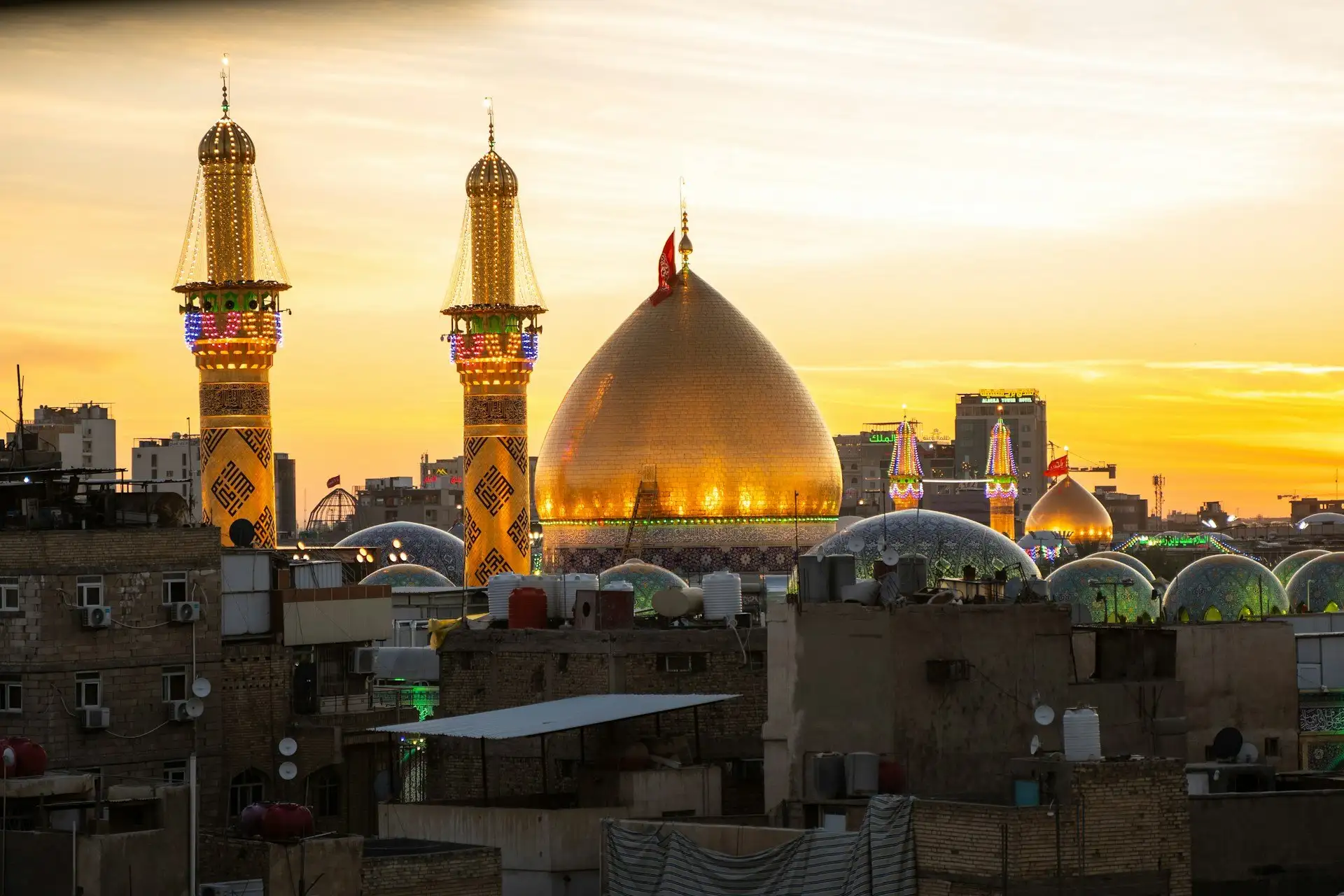
Najaf and Karbala are among the holiest cities in Shia Islam and attract millions of pilgrims annually. Najaf contains the Imam Ali Shrine, the mausoleum of Ali ibn Abi Talib (the first Shia Imam and son-in-law of the Prophet Muhammad), one of the most sacred sites in the Shia world. Karbala contains the shrines of Imam Husayn ibn Ali and his half-brother Abbas, the sites of the 680 CE Battle of Karbala whose significance is central to Shia theology. The Arbaeen pilgrimage to Karbala forty days after Ashura draws an estimated 15 to 20 million people and is the largest peaceful gathering on earth. For Shia Muslim visitors these are mandatory pilgrimage sites of profound religious significance. For non-Muslim visitors they are accessible but require complete dress modesty and respectful behavior. Travel with a local contact familiar with the protocol.
Sulaymaniyah
Sulaymaniyah, the second-largest city in Iraqi Kurdistan and in many ways its cultural heart, has a literary and artistic tradition that punches well above its size: the city has produced more Kurdish poets and intellectuals per capita than any other in the region. The Amna Suraka Red Security Building, the former Ba'athist intelligence headquarters converted into a museum and memorial for the victims of the Anfal campaign (the Iraqi government's 1986–1989 genocide against the Kurdish people), is one of the most important memorial museums in the Middle East. The Bazaar is more authentic and less tourist-oriented than Erbil's. The surrounding landscape of hills and valleys and the Iranian border proximity make Sulaymaniyah a gateway for those crossing into Iran's Kurdistan Province.
Mosul & Nineveh Plains
Mosul, the second-largest city in Iraq, was partially destroyed during the 2014–2017 ISIS occupation and has been undergoing reconstruction since. The old city, which contained some of the finest Ottoman-era architecture in Iraq, was heavily damaged. Al-Nuri Mosque with its famous leaning minaret was destroyed by ISIS in 2017; UNESCO-funded reconstruction is underway. The Nineveh ruins across the river include the walls and gates of the Assyrian capital and some of the city's ancient fabric. The Assyrian Christian villages of the Nineveh Plains, many of which were displaced during the ISIS period and are slowly being repopulated, are accessible and contain some of the oldest Christian communities in the world. Mosul requires current security assessment and is not casual tourism territory in 2026 but is accessible for those with specific interest and appropriate preparation.
The Mesopotamian Marshes
The Mesopotamian Marshlands of southern Iraq, the vast wetlands at the confluence of the Tigris and Euphrates that are the probable location of the biblical Garden of Eden and that the Marsh Arabs (Ma'dan) have inhabited on floating reed islands for at least 5,000 years, are a UNESCO World Heritage Site and one of the most unusual landscapes in the Middle East. Saddam Hussein drained most of the marshes in the 1990s to destroy Shia opposition networks. Reflood efforts since 2003 have restored a significant portion. The reed island communities and their distinctive mudhif (guest house) architecture made entirely of bundled reeds are accessible by boat from Chibayish near Nasiriyah. The area is remote and requires a local guide and a boat operator, but the landscape and the Ma'dan communities are extraordinary.
Culture & Etiquette
Iraq is predominantly Muslim with a roughly equal split between Shia and Sunni communities, a Kurdish population (largely Sunni) in the north, and small communities of Christians, Yazidis, Mandaeans, and others. The cultural norms differ somewhat between these communities and between urban and rural settings, but some practices are consistent throughout.
Iraqi hospitality, like Iranian hospitality, is one of the most generous in the Middle East: the obligation to provide for a guest is a deeply felt cultural value, and being invited to share food or tea by someone you have just met is a normal expression of welcome rather than an unusual occurrence. The Iraqi phrase ahlan wa sahlan (you are welcome, you are family) is not mere politeness. Receiving it in good spirit and reciprocating with genuine curiosity and respect is the social compact that underlies most positive visitor experiences in Iraq.
Men should wear long trousers and shirts with sleeves. Women should cover arms, legs, and hair in all religious sites and in traditional areas. In Erbil and Sulaymaniyah's more cosmopolitan districts, dress standards are more relaxed but conservative dress is still respectful. At Najaf and Karbala specifically, women must wear abaya and cover completely; this is mandatory for non-Muslim visitors too.
Tea will be offered constantly. Food may be pressed on you. Accepting, at least the tea and a small amount of food, is the appropriate response. Declining hospitality is socially awkward in a way that the host will absorb politely but will feel. You are more comfortable receiving than they are having their offer refused.
As-salamu alaykum (Arabic — peace be upon you), spas (Kurdish — thank you), shukran (Arabic — thank you). In Kurdistan, using Kurdish words is warmly received: Kurds are proud of their language and its distinction from Arabic. Using the wrong language in the wrong region (Arabic in strongly Kurdish areas) can be sensitive.
Photograph landscapes, ruins, mosques, and bazaars freely (where permitted). Always ask before photographing people, especially women and at religious sites. A gesture toward your camera with an inquiring expression is understood everywhere. Photographs of military personnel, checkpoints, and official infrastructure should never be taken.
Keep photocopies of your passport, visa, and any permits separate from the originals. In Kurdistan, your Erbil KRG visa may not be accepted as sufficient documentation in federal Iraq territory. Know which visa applies to which area and carry the appropriate documentation for each region you enter.
Iraq's political landscape is complex, factional, and sensitive. Opinions about the US invasion, Iranian influence, Kurdish independence, the Saddam Hussein period, inter-communal relations, and current government leadership are all topics where a casual tourist remark can create serious offense or genuine danger depending on who is in the conversation. Listen more than you speak on political subjects.
This applies everywhere in Iraq but is especially serious at checkpoints, military bases, and anything resembling a government security installation. The consequences range from having your phone confiscated and photos deleted to detention. Do not photograph anything official even casually. The checkpoints you pass through on any road journey in Iraq should be treated as camera-free zones.
At the Shia shrines of Najaf and Karbala, non-Muslims are permitted in the outer courtyards but not always in the inner sanctuary areas. Women must wear abaya regardless of faith. Men must be fully covered. Follow instructions from shrine staff precisely. The pilgrimage context means behavior that seems harmlessly curious to a tourist reads very differently in a space of intense religious significance.
In areas outside Kurdistan, having a local contact, a vetted driver, or a tour operator is not optional extra comfort. It is the mechanism by which you navigate checkpoints, understand which areas are currently problematic, get help if something goes wrong, and communicate in Arabic. Independent travel in Baghdad without any local network is significantly riskier than travel with one.
Iraq is majority Muslim and alcohol is widely restricted in practice regardless of the legal status in different areas. Kurdistan is more relaxed — Erbil and Sulaymaniyah have bars and licensed shops — but in Baghdad and especially in the south, carrying or consuming alcohol in public is inappropriate and potentially dangerous depending on the neighborhood and the political climate at the time of your visit.
Kurdish Culture
The Kurdish people of northern Iraq have a distinct cultural tradition centered on their language (several mutually intelligible dialects, of which Sorani and Kurmanji are the main ones in Iraq), their folk music and dance (the communal circle dance called the halparke), and a historical memory of oppression — the Anfal genocide of the 1980s, the Halabja chemical attack in 1988 — that is present in everyday conversation with older Kurds with the immediacy of something recent rather than historical. Kurdish cultural pride is genuine, strong, and not directed at foreigners: visitors are received warmly and the curiosity about the outside world runs in both directions.
The Iraqi Intellectual Tradition
Baghdad's claim to have been the intellectual capital of the medieval world is not exaggeration: the Abbasid period produced foundational texts in mathematics, medicine, astronomy, philosophy, and poetry that shaped both Islamic and European civilization. The Mutanabbi Street book market, named for the greatest classical Arabic poet (himself born in Kufa, Iraq, in 915 CE), represents the surviving thread of this tradition: a weekly gathering of booksellers, writers, and readers that continued through every period of violence and has persisted as a statement of cultural identity that Baghdadis take genuine pride in.
Date Culture
Iraq was historically the world's largest producer of dates, and the Mesopotamian date palm has been cultivated since at least 4000 BCE: it appears in Sumerian texts and in the carved stone reliefs of Assyrian royal gardens. The date palms that line the Shatt al-Arab waterway in Basra and the Tigris and Euphrates banks are not ornamental: the dates they produce are a significant part of the local diet and economy, and the varieties grown in Iraq, especially around Basra, include some of the finest in the world. Medjool, Sayer, and Zahdi dates from Basra are a specific Iraqi culinary tradition and a reasonable souvenir.
Ashura and Arbaeen
The annual commemoration of the martyrdom of Imam Husayn at Karbala, the event at the center of Shia theology, produces two major pilgrimage gatherings: Ashura on the 10th of Muharram, and Arbaeen forty days later. The Arbaeen walk from Najaf to Karbala (80 kilometers) draws an estimated 15 to 20 million people and is the largest annual peaceful gathering in the world, dwarfing the Hajj. Millions of volunteers set up free food and drink stations along the route. For Muslim visitors the experience is deeply significant; for respectful non-Muslim observers it is one of the most extraordinary expressions of communal faith and shared service on earth.
Food & Drink
Iraqi cuisine has deep roots: the agricultural revolution in Mesopotamia meant that wheat, barley, lentils, and sesame have been grown here since 8000 BCE, and the cooking that developed from these ingredients over thousands of years is reflected in dishes that appear in some form in every culture that descends from the Fertile Crescent. Iraqi food is not spicy but it is deeply flavored: the use of dried lime (loomi) in stews, the particular preparation of lamb and fish over open fires, the herb-heavy rice dishes, and the bread culture built around samoon (the boat-shaped Baghdad loaf) are all distinctively Iraqi.
Alcohol is available in Kurdish areas (Erbil and Sulaymaniyah have functioning bars and liquor shops), in Christian-owned establishments in Baghdad's Karada district, and in some upmarket hotels. In most of Baghdad and throughout the south, alcohol is practically unavailable. The drinks culture runs on tea (chai), strong, sweet, and served in small glasses throughout the day, and on fresh fruit juices.
Masgouf
Iraq's national dish: a whole Tigris carp split open along the belly and grilled vertically on wooden stakes over an open fire of tamarind wood, skin side toward the fire, for two to three hours. The result is fish with charred, crispy skin, smoky flesh, and a specific flavor from the combination of fish variety, wood smoke, and river water that does not exist anywhere else. Served with flatbread, chopped tomato, and onion salad. The best versions are cooked at riverside establishments where the fish was in the Tigris within the past few hours. This is one of the great grilling traditions in the world.
Kubba & Kebabs
Kubba is the Iraqi dumpling tradition: oval shells of bulghur wheat or rice stuffed with minced lamb, onion, herbs, and nuts, then fried, baked, or simmered in soups. Kubba Mosul (fried, large, with a bulgur shell) is the Mosul specialty. Kubba Halab (with a rice shell, named for Aleppo) is common across the country. Iraqi kebabs, like those of neighboring countries, are primarily minced lamb on flat skewers or cubed meat, cooked over charcoal and eaten with flatbread and pickles.
Timman (Rice) Dishes
Timman is the Iraqi word for rice, and Iraqi rice preparation has its own distinct character: the rice is typically parboiled and then finished with saffron, dried fruits, or meat to create dishes like timman wa maraq (rice with lamb broth stew) or the festive quzi (whole lamb stuffed with rice, nuts, and dried fruit, slow-roasted and served over a mountain of fragrant rice). The rice dishes of southern Iraq use dried limes and pomegranate in ways similar to Persian cooking, reflecting centuries of cultural exchange across the shared border.
Samoon & Bread
The samoon, Baghdad's boat-shaped bread baked in a clay oven, is the city's most distinctive food: puffy, hollow, with a chewy crust and a light interior, eaten for breakfast with cream cheese, jam, or simply with olive oil. The bread culture of Iraq is as diverse as its ethnic composition: Kurdish çörek in the north, thin lavash baked on a dome-shaped oven in rural areas, the flatbreads of the south. Bread at every meal, always fresh from a neighborhood bakery, is one of the most consistent pleasures of eating in Iraq.
Sweets & Kleicha
Kleicha, the Iraqi date-filled cookie, is the national sweet: a pastry dough filled with a paste of fresh dates, cardamom, and sometimes rose water, baked until golden. It is made at home for Eid celebrations and bought year-round from bakeries in every city. The Baghdad version uses a more refined dough than the rural versions; both are excellent. Halawiyat (sweets) shops across Iraq sell a range of Arabic sweets including baklava, but the kleicha with its specifically Iraqi date filling is the one that tastes of the place.
Chai & Drinks
Chai (tea) is the social glue of Iraqi daily life: strong, very sweet, and served in small glasses constantly and everywhere. Refusing tea is a social gesture that requires explanation. The tea culture in Iraq resembles Iran's: the chai khaneh (tea house) is the traditional male social space and the place where news travels fastest. Fresh juices from pomegranate, orange, and lemon. In Kurdistan, the beer and arak (anise spirit) culture reflects the region's more relaxed attitude toward alcohol: Erbil and Sulaymaniyah have functioning bars and alcohol is available in restaurants in a way it is not in the south.
When to Go
Iraq's climate splits between the extreme desert heat of the south and center and the cooler mountain conditions of Kurdistan. The optimal window for most of the country is October to April. Summer in Baghdad and the south regularly exceeds 50°C and outdoor activity becomes dangerous. Kurdistan's mountain areas are pleasant in summer when the rest of the country is unbearable. Religious calendar timing affects both the crowds and the experience at pilgrimage sites significantly.
Autumn
Oct – NovThe optimal window for the whole country including Baghdad and the south. Temperatures comfortable for outdoor site visits (20–30°C in Baghdad). The date harvest in Basra. Clear skies for photography at the ancient sites. The Arbaeen pilgrimage falls in this window depending on the lunar calendar, which either creates an extraordinary spectacle or makes travel toward Karbala extremely congested.
Spring
Mar – MayWarm and pleasant across the country before the summer heat builds. The marshes of southern Iraq are most lush in spring. Kurdistan's mountain wildflowers bloom. Nowruz, the Kurdish and wider Middle Eastern New Year on March 21, is celebrated with particular intensity in Iraqi Kurdistan with outdoor gatherings and music. Rising temperatures in May can be managed with early starts.
Summer
Jun – AugUnbearable in Baghdad and the south (45–50°C). Kurdistan's highlands (above 1,000m) are comparatively pleasant at 25–35°C and become a summer escape for Iraqis and regional visitors. The mountain resorts are busy in summer. For Kurdistan-only visits, summer is fine. For the archaeological sites in the south and central Iraq, avoid entirely.
Winter
Dec – FebCold and wet in Baghdad (5–15°C with rain). Kurdistan can have snow above 1,000 meters and the mountain roads may be closed. The southern sites are cold and grey. Ashura, the most intense Shia mourning period, falls in this window and creates massive crowds and very restricted movement near Karbala and Najaf. Not the most comfortable or practical time for most visitor purposes.
Trip Planning
Planning an Iraq trip requires dividing the country into distinct regions and planning each separately. A Kurdistan-only trip is the most straightforward: fly into Erbil (direct from many European and Middle Eastern cities), obtain the Kurdistan Regional Government visa on arrival, and explore Erbil, Sulaymaniyah, and the mountain landscapes with standard tourist infrastructure. A Baghdad-and-south trip requires significantly more preparation: local contacts, current security briefings, and ideally a vetted local operator or fixer.
The single most important preparation beyond the logistics: read your government's current travel advisory in full and understand what it does and doesn't cover. Most Western government advisories treat Iraq as a single entity with a Do Not Travel or Reconsider Travel advisory. The reality is more nuanced — Kurdistan is treated differently from federal Iraq by most experienced travelers — but the advisories are the baseline you need to understand before you can assess where the reality diverges from them.
Security Preparation
For Baghdad and beyond Kurdistan: contact a reputable security consultancy or experienced Iraq tour operator before booking anything. Organizations including the International SOS, Control Risks, and specialized Iraq tourism companies offer current security assessments and can advise on viable itineraries. Do not rely on any guide published more than a few months ago for security information: the situation changes. Register your trip with your embassy's traveler registration program before departure.
Cash — Essential Everywhere
International bank cards have very limited or no acceptance in most of Iraq. In Kurdistan, some ATMs accept foreign cards (primarily Visa) and some hotels accept cards, but cash is essential. In Baghdad and the south, assume cash only for everything. Bring USD or Euros in sufficient quantity for your entire trip plus a substantial emergency buffer. USD is widely accepted directly in Kurdistan; exchange to Iraqi Dinar elsewhere at licensed money changers.
Vaccinations & Health
Hepatitis A and Typhoid recommended. Ensure routine vaccines are current. Malaria exists in some rural areas along the Tigris and Euphrates: consult a travel medicine clinic about prophylaxis for planned rural visits. Dust storms (haboob) are common in summer and reduce visibility and air quality dramatically: carry a dust mask for outdoor activity. Medical facilities in Kurdistan are reasonable; in Baghdad they are functional for emergencies but below Western standards. In rural south Iraq they are very limited.
Full vaccine info →Connectivity
Zain Iraq and AsiaCell are the main operators. Tourist SIMs are available at Erbil and Baghdad airports. Coverage is good in cities and along main routes; limited in rural and mountain areas. Download offline maps before leaving any city. A VPN is useful as some content is restricted in Iraq. WhatsApp and Telegram are the primary communication tools for local contacts.
Get Iraq eSIM →Language
Arabic is the language of Baghdad and the south. Kurdish (Sorani dialect primarily) is the language of Erbil and the KRG area. English is spoken in Kurdistan's tourism sector and by some educated Iraqis in Baghdad. Outside these contexts, Arabic or Kurdish is necessary. Google Translate with Arabic downloaded offline works reasonably well. Having your hotel address, key destinations, and emergency phrases written in Arabic and Kurdish on your phone or on paper is essential for independent movement.
Permits & Local Fixers
Access to some archaeological sites (Ur, some areas of Nineveh) requires advance permits from the State Board of Antiquities and Heritage. Access to areas near military installations, sensitive borders, or former conflict zones may require police or military escort. A local fixer — an Iraqi resident who arranges logistics, handles checkpoints, and provides local knowledge — is the most valuable investment for any visit beyond Kurdistan. Organizations and individuals offering this service can be found through reputable tour operators and expatriate networks.
Transport in Iraq
Transport in Iraq varies as dramatically by region as everything else. Kurdistan has a functioning taxi, minibus, and road network that is increasingly accessible to visitors. Baghdad has taxis and shared minibuses but requires local knowledge for navigation. Intercity transport in the rest of Iraq is by road with checkpoints on every major route. There is no functioning passenger rail for tourists. Domestic flights connect Baghdad with Erbil and Basra. Private car with driver is the standard for any organized tourist itinerary outside the cities.
Domestic Flights
USD 60–150/routeIraqi Airways and private carriers connect Baghdad with Erbil, Basra, Najaf, and Sulaymaniyah. The Baghdad to Erbil route (1 hour vs 5 hours by road through multiple checkpoints) is by far the most practical for any itinerary combining the two. Book through Iraqi Airways or local travel agencies. Airport security is thorough and time-consuming: arrive 2.5 hours before domestic departures.
Private Car & Driver
USD 80–200/dayThe standard for organized tourism throughout Iraq. Your driver provides local knowledge, checkpoint navigation, and the Arabic or Kurdish language skills that independent movement requires. In Kurdistan, drivers can be arranged through hotels and guesthouses. In Baghdad and south Iraq, arrangement through a vetted local operator or contact is strongly recommended. Agree a full day rate and itinerary in advance.
Taxi (Kurdistan)
USD 5–20/tripTaxis in Erbil and Sulaymaniyah are cheap, available, and navigable with a phone showing your destination. There are no metered taxis: agree the fare before getting in. The standard from Erbil Citadel to the hotel strip is roughly USD 3–5. InDriver (similar to Uber) operates in Kurdistan cities. For archaeological day trips from Erbil, negotiate a full-day rate.
Shared Minibus
USD 5–15/routeShared taxis and minibuses (called "bus" locally) run between Kurdish cities and towns from shared taxi stations. The Erbil to Sulaymaniyah route takes 2.5 hours and costs around USD 10. Comfortable for short regional journeys. Language barrier is significant; having your destination written in Arabic script helps enormously.
Boat (Southern Marshes)
USD 20–50/tripThe only way to access the Mesopotamian Marshlands is by boat from Chibayish or Al-Chibayish. Local boat operators charge by the hour or by circuit. Your hotel in Nasiriyah or a local tour operator can arrange this. The traditional wooden boats used by the Ma'dan are still in use. A half-day circuit visiting reed islands and channels is the standard tourist experience.
International Airports
Erbil best connectedErbil International Airport (EBL) has direct connections to Istanbul, Dubai, Doha, Amsterdam, Frankfurt, Vienna, and other European and Gulf cities. Baghdad International Airport (BGW) is well-connected to the Gulf and regional capitals but has fewer direct European routes. Najaf Airport serves pilgrimage traffic. For most international tourists, entering via Erbil is significantly more convenient and logistically simpler.
Road travel in Iraq outside Kurdistan involves passing through multiple military and police checkpoints. The density of checkpoints varies by security conditions and location; on the Baghdad to Najaf road you may pass through a dozen. The experience is almost always routine and takes under a minute per checkpoint when you have a local driver who handles the Arabic communication. The practical advice: never photograph checkpoints, never reach into bags without being asked, follow your driver's instructions without hesitation, and do not engage security personnel in extended conversation. Your driver has done this journey many times. You haven't. Let them manage it.
Accommodation in Iraq
Accommodation quality in Iraq divides sharply by region. Kurdistan has a developed hotel sector with international chain properties in Erbil (Rotana, Marriott, Divan) and a growing boutique guesthouse scene. Baghdad has a small number of functional international-standard hotels catering to the business and NGO sector, and an increasingly diverse range of options in the more stable neighborhoods. Outside these cities, accommodation is basic: pilgrim guesthouses in Najaf and Karbala, functional hotels in Basra, limited options elsewhere.
International Hotel (Erbil/Baghdad)
USD 80–200/nightThe Divan Hotel in Erbil, the Rotana and Marriott, are the most reliable international-standard properties in Kurdistan. In Baghdad, the Babylon Warwick and the Al Rasheed Hotel (historic, used by journalists and diplomats since the 1980s) are the most established options for visitors. Security considerations often dictate staying in the most secure hotels even if price is not the primary concern.
Guesthouse (Kurdistan)
USD 25–60/nightKurdistan's mountain regions have a growing network of family guesthouses, particularly around Amadiya, Akre, and Soran. These offer the most authentic experience of Kurdish hospitality and are significantly cheaper than the Erbil city hotels. Most are arranged through tour operators rather than booking platforms. In Sulaymaniyah, several boutique guesthouses in the old city area are good value and well-located.
Pilgrim Guesthouse (South)
USD 10–40/nightNajaf and Karbala have an extensive network of pilgrim accommodation managed by the shrines and by private operators. These are functional and cheap, designed for religious pilgrims rather than cultural tourists: basic rooms, shared facilities, no alcohol. For Shia Muslim visitors or those specifically visiting the shrines, the pilgrim guesthouses closest to the shrines are the most convenient. For cultural tourists in the area, they provide an authentic if Spartan experience.
Desert & Marsh Camp
USD 30–80/nightThe Mesopotamian Marshes near Nasiriyah have a small number of eco-camp operators offering accommodation on or near the reed islands. These are basic and remote and require advance booking through local operators. The experience of spending a night in the marshes among the Ma'dan communities, with no light pollution and the sound of water birds at dawn, is unlike anything else in Iraq.
Budget Planning
Iraq is cheap by Middle Eastern standards, though the cost of security (vetted drivers, local operators, sometimes security consultants) adds substantially to the budget for Baghdad and south Iraq. Kurdistan is more straightforwardly cheap for independent travel without these additional costs. The Iraqi Dinar (IQD) is the official currency; 1 USD = approximately 1,300–1,400 IQD at current rates. USD is accepted directly in Kurdistan and in many tourist-facing contexts in Baghdad.
- Budget guesthouse or family homestay
- Local Kurdish restaurants
- Shared taxis between cities
- Citadel, bazaars (free to walk)
- Chai from street stands throughout
- International hotel or good guesthouse
- Restaurant dining with occasional beer
- Private car for day trips to mountains
- Local guide for archaeological sites
- Mountain resort activities
- Secure hotel (security is a cost driver)
- Vetted driver/fixer for full days
- Security consultant assessment
- Local operator for ancient site access
- Emergency evacuation insurance coverage
Quick Reference Prices
Visa & Entry
Iraq's visa situation has two parallel systems: the Kurdistan Regional Government (KRG) issues its own visas on arrival at Erbil International Airport independently of the federal Iraqi government. The federal Iraq visa is issued on arrival at Baghdad International Airport. The two systems are separate, and holding a KRG Erbil visa does not automatically grant access to federal Iraq territory. If you plan to visit both Kurdistan and Baghdad, you need both or a federal Iraq visa that covers both (current practice is evolving: confirm with the Iraqi embassy nearest you before travel).
Most Western passport holders can obtain either visa on arrival. The federal Iraq visa fee is typically USD 75–80. The KRG visa fee is around USD 75. Some nationalities are refused entry to Iraq regardless of circumstances: Israeli passport holders cannot enter. Passports with Israeli stamps are generally refused at the federal Iraq level though Kurdistan has been more permissive.
Most Western passport holders qualify. USD 75–80 cash on arrival. KRG and federal Iraq visas are separate systems — clarify which regions you plan to visit and bring USD cash for the appropriate visa fee(s).
Safety in Iraq
Iraqi Kurdistan has been the most stable part of Iraq for many years, protected by the Kurdish Peshmerga forces and by a political arrangement with the federal government that has held since 1991. The region has its own functioning government, security apparatus, and tourist infrastructure. Incidents of violence affecting tourists in the KRG area have been minimal. That said, the region is not entirely without risk: periodic tensions between the KRG and the federal government, occasional cross-border shelling from Turkey and Iran targeting Kurdish militant groups, and the general regional instability that affects the entire Middle East mean that no categorical statement of safety is appropriate. The practical assessment: Kurdistan is safer than many popular tourist destinations and the risks are manageable with awareness.
Baghdad is more complicated. The city has stabilized significantly since the 2003–2010 period and the ISIS defeat in 2017. Tourism to Baghdad, while still very limited by global standards, exists: the Iraq Museum is open, Mutanabbi Street functions, restaurants and cafes have reopened, and a small cohort of adventurous travelers visits each year with broadly positive outcomes. However: periodic rocket attacks, armed group activity, kidnapping risk for Westerners in some areas, and the general unpredictability of Iraqi political violence mean that Baghdad carries elevated risk that Kurdistan does not. Most Western governments maintain Level 3 (Reconsider Travel) or Level 4 (Do Not Travel) advisories for Baghdad and most of federal Iraq. These advisories reflect real risks. Visitors who choose to visit Baghdad are accepting those risks, not dismissing them.
The southern governorates (Najaf, Karbala, Basra, Nasiriyah) are governed by a mix of Iraqi security forces and Iran-aligned militia who control significant territory and infrastructure. The risks here are different from Baghdad: less concern about random violence against tourists but more concern about the legal and security implications of interactions with militias, and specific risks related to geopolitical tensions between the US and Iran that have at times produced direct military confrontations on Iraqi soil.
The areas that should be avoided entirely by any tourist without specialized security training and extreme operational preparation: areas near the Syrian border in Anbar Province, areas with recent conflict history including parts of Salah ad-Din and Diyala Provinces, and any area with active ISIS remnant presence (which as of 2026 is primarily in rural and desert areas of central and western Iraq, not in the tourist circuit cities).
Iraqi Kurdistan
Relatively safe for tourism. Functioning government and security forces. Growing tourist infrastructure. Manageable risks from regional instability and occasional cross-border incidents. The most accessible and rewarding part of Iraq for most tourists. Standard travel precautions apply.
Baghdad
Stabilized considerably but elevated risk remains. Occasional security incidents. Kidnapping risk exists, particularly for Westerners without local cover. Visit with a vetted local operator or contact, stay in secure accommodation, avoid crowds and demonstrations, and maintain low-profile movement. Most Western governments advise against travel. People who visit with appropriate preparation generally have positive experiences; this does not mean the risks are dismissed.
Southern Iraq
The pilgrimage cities (Najaf, Karbala) see millions of visitors annually and are functional with Iranian-aligned militia alongside official security forces. Risk for Western tourists is specific and different from Baghdad: less random violence, more political complexity. Visit only with local contact and awareness of the militia presence. Basra has improved significantly since the worst years but still carries elevated risk.
Mosul & Nineveh Plains
Accessible for visits to the reconstruction effort and Nineveh ruins but requires current security assessment. The area has improved since the ISIS period but has not returned to pre-2014 conditions. Visit only with a vetted local contact and current security briefing. Not casual tourism territory in 2026.
Evacuation Planning
Anyone visiting Baghdad or south Iraq should have a specific emergency evacuation plan: which embassy to contact (many Western embassies operate with reduced staff or from the heavily fortified Green Zone), which emergency line to call, and how to reach the airport or the Kurdish border if overland exit is required. Hostile Environment First Aid Training (HEFAT) is recommended for anyone visiting outside Kurdistan. Your travel insurance must explicitly cover Iraq and helicopter evacuation.
Solo Women
Solo female travel in Iraqi Kurdistan is possible and a small number of women do it with positive outcomes. Baghdad and the south are not practical solo female travel destinations for most Western women in 2026: the combination of security risks, conservative social norms, and the absence of the tourist infrastructure that provides ambient safety in other destinations makes this combination one that requires specific expertise and preparation rather than standard independent traveler skills.
Emergency Information
Your Embassy in Baghdad
Most Western embassies are in the International Zone (Green Zone) in Baghdad. Access for non-official visitors is restricted. Many embassies have reduced staffing or limited consular services. Verify your country's current consular representation and emergency procedures before travel.
Where Everything Began
Somewhere in the flat plain near the Euphrates, in a place that is now southern Iraq, a Sumerian clerk pressed a stylus into a wet clay tablet around 3500 BCE and made marks that represented sound rather than image for the first time. This was writing. The tablets that survive describe the receipt of grain and the transfer of livestock and the administrative records of a granary. They are the most mundane possible objects to have changed human history so completely. Everything that has been written since, in every language on every surface in every form — including this guide — descends from that clay tablet and from the nameless clerk who pressed marks into it on a warm day in ancient Mesopotamia.
The country that contains that plain, and the ziggurat built above it two thousand years later, and the ruins of Babylon further north, and the Assyrian carved reliefs in Mosul that ISIS tried to destroy and largely failed, and the medieval Baghdad that was once the intellectual center of the world, and the mountain citadel at Erbil that has been inhabited without interruption for six thousand years — that country is Iraq. It is also the country of the past twenty years' news coverage, and those two Iraqs exist in the same geography and require separate but not incompatible ways of thinking about them. Visiting the first requires engaging with the second. People who have made that engagement — who have stood at Ur at dawn before the military base wakes up, who have walked the Erbil Citadel at sunset, who have eaten masgouf on the banks of the Tigris — describe something that cannot quite be put into words: the specific weight of standing at the beginning of things. That is what Iraq offers. The beginning of everything that came after, still there and still standing, waiting for the people willing to make the journey.