
Cambodia
A country that built the largest religious monument in the world in the 12th century, endured one of the worst genocides of the 20th century fifty years ago, and is now figuring out who it is in the space between those two facts. The Khmer people are still here. The temples are still standing. The food is extraordinary and underrated. Come with your eyes open.
What You're Actually Getting Into
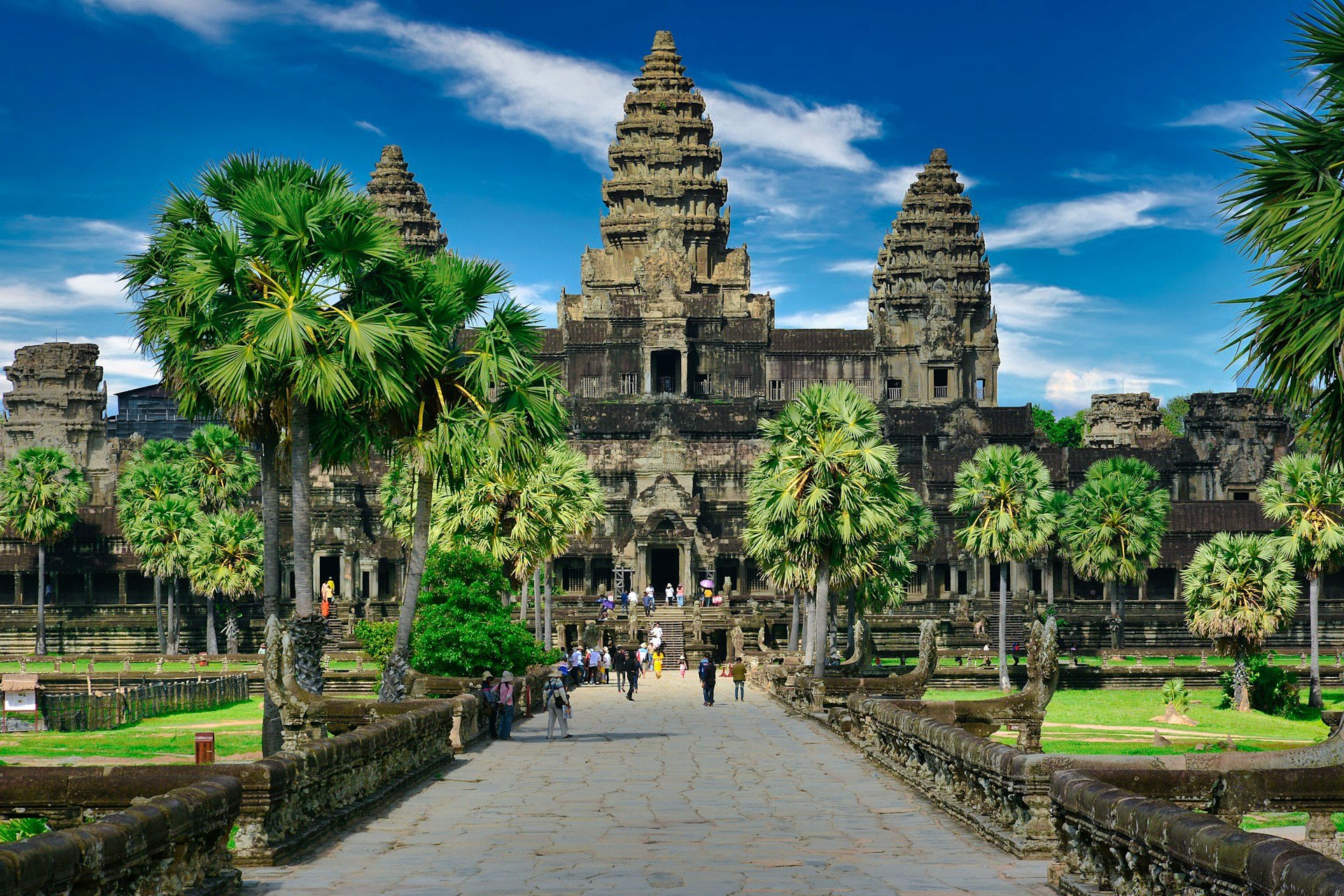
Cambodia sits between Thailand and Vietnam in mainland Southeast Asia, on the southern end of the Indochina peninsula, and shares with both neighbors a reputation for cheap travel and extraordinary food while having a history that is its own and unlike either. The Khmer Empire that built Angkor Wat between the 9th and 15th centuries was the dominant power in the region for five centuries and produced a temple complex of such scale and ambition that it remains, a thousand years later, the largest religious monument on earth. Standing in front of the western entrance of Angkor Wat at the moment the sun clears the horizon and the reflection of the five towers appears in the moat, you understand why this is a country that puts its most famous building on its national flag.
Then there is the other history. The Khmer Rouge regime that governed Cambodia from 1975 to 1979 killed an estimated 1.7 to 2.5 million people, roughly a quarter of the country's population, in a program of ideological mass murder that remains one of the most extreme examples of state violence in the 20th century. Virtually every family in Cambodia has direct experience of this loss. The Tuol Sleng Genocide Museum in Phnom Penh, the former Khmer Rouge interrogation center, and the Choeung Ek Killing Fields outside the capital are the places where this history is most directly confronted, and visiting them is not optional if you want to understand the country you are in. This is not tourism as entertainment. It is tourism as responsibility.
These two histories, the glory of the Khmer Empire and the horror of the Khmer Rouge, are the poles between which Cambodia navigates its present. The country is poor by Southeast Asian standards, increasingly popular with tourists, politically authoritarian under Hun Manet who succeeded his father Hun Sen after one of the longest uninterrupted tenures in government in the world, and inhabited by people of extraordinary resilience and warmth who have every reason not to be either. The Khmer smile, which is a real thing and not a tourism board invention, comes from a culture that places enormous value on social harmony and face-saving and has found ways to maintain warmth across a history that would have broken it in many other places.
Practically: Cambodia is very affordable, increasingly well-connected by both air and road, and manageable as an independent destination with minimal planning. The main tourist circuit (Siem Reap for Angkor, Phnom Penh for the capital and its history, Kampot for the coast) covers the essential experience in two weeks and can be extended in all directions.
Cambodia at a Glance
A History Worth Knowing
The Khmer Empire began in the 9th century when Jayavarman II established the concept of the god-king, the devaraja, at a consecration ceremony on the summit of Phnom Kulen in 802 CE that declared Cambodia independent from Javanese influence and positioned the Khmer king as the earthly manifestation of the Hindu god Shiva. Over the next four centuries, the kings who followed built a hydraulic civilization around the Tonle Sap lake in northwestern Cambodia, engineering a network of reservoirs and canals that turned the seasonal flooding of the lake into a year-round agricultural system capable of feeding a city of perhaps a million people, the largest pre-industrial urban complex in the world.
The temples they built to house their god-king legacy are what remains most visibly. Angkor Wat, built by Suryavarman II in the 12th century as both a Hindu temple and a mortuary monument, covers 1.6 million square meters. Its five towers represent the five peaks of Mount Meru, the Hindu cosmic mountain at the center of the universe. The outer wall represents the mountains at the edge of the world. The moat represents the ocean. The bas-relief galleries that run for nearly 600 meters around the inner wall depict the battle of Kurukshetra from the Mahabharata, scenes from Cambodian court life, and the churning of the sea of milk from Hindu cosmology, all carved with a precision and density of detail that makes the longest of them feel like a frozen film. Angkor Thom, the subsequent capital built by Jayavarman VII in the late 12th century, contained the Bayon temple with its 216 enormous stone faces gazing in all directions, a theological statement in compressed sandstone about the Buddha's omniscience. These are not ruins in the usual sense. They are an argument about the nature of the universe made in stone.
The empire declined from the 14th century onward, pressured by the expansion of the Thai kingdoms to the west, the shift of trade routes toward coastal cities that the inland hydraulic empire was not positioned to exploit, and the apparently significant ecological damage done to the hydraulic system itself by over-extension. The capital moved south to Phnom Penh and the great Angkor complex was gradually reclaimed by the forest.
The French colonial period from 1863 to 1953 was the era in which Western scholars rediscovered Angkor Wat, which had never been fully abandoned, and in which Cambodia's relationship to its Thai and Vietnamese neighbors was managed by French administrators who drew borders with the specific logic of colonial convenience rather than ethnic geography. The borders created during this period remain the source of occasional friction today.
Independence came in 1953 under King Norodom Sihanouk, who navigated the Cold War with a studied neutrality that collapsed when the United States began bombing Cambodian territory in 1969 and 1970 as part of the Vietnam War strategy, hitting Communist supply routes that ran through eastern Cambodia. The bombing destabilized the Sihanouk government, strengthened the Khmer Rouge insurgency that had been building in the countryside, and set the stage for what followed.
The Khmer Rouge, led by Saloth Sar who adopted the name Pol Pot, took Phnom Penh on April 17, 1975 and immediately began implementing a political program of almost unimaginable severity. Cities were evacuated at gunpoint. Money was abolished. Hospitals were closed. Schools were shuttered. Religion was banned. The country was renamed Democratic Kampuchea. Year Zero was declared: history was to begin again from nothing. The educated, the urban, those who wore glasses, those who spoke a foreign language, former soldiers, Buddhist monks, ethnic Vietnamese and Chinese minorities: all were targeted in waves of killing that varied in their intensity but never stopped for four years. The killing fields outside Phnom Penh and across the country, where victims were executed and buried in mass graves, are the most direct physical record of what happened. The Tuol Sleng (S-21) prison in Phnom Penh, converted from a school, processed an estimated 17,000 prisoners with meticulous documentation. Perhaps twelve to fourteen of them survived.
The Vietnamese invasion in December 1978 ended the Khmer Rouge government within weeks. The regime's own violence had created the conditions for its collapse: former Khmer Rouge soldiers who defected to Vietnam because of intra-party purges were among the leaders of the invading force. A Vietnamese-backed government governed Cambodia through the 1980s. The UN-sponsored peace settlement of 1991 led to elections in 1993. Hun Sen, who had governed under the Vietnamese-backed regime and retained power through elections, coups, and political maneuvering for the next thirty years, stepped down in 2023 in favor of his son Hun Manet. The dynasty of governance continues.
Cambodia is still processing 1975 to 1979. The Extraordinary Chambers in the Courts of Cambodia, the hybrid tribunal established in 2006 to try Khmer Rouge leadership, has achieved three convictions after decades of proceedings. Most of the perpetrators died of old age before facing justice. Most Cambodians have made a kind of peace with this outcome that does not mean they have forgotten it.
Jayavarman II declares Cambodian independence at Phnom Kulen and establishes the god-king tradition that will drive five centuries of temple construction.
Suryavarman II builds Angkor Wat as a Hindu temple and mortuary monument. The largest religious monument ever constructed.
The Buddhist king builds Angkor Thom, the Bayon, and Ta Prohm. The empire reaches its greatest territorial extent.
France governs Cambodia. Western scholars "rediscover" Angkor. Colonial borders drawn. Independence achieved on November 9, 1953.
Operation Menu and Operation Freedom Deal drop more bombs on Cambodia than were used in all of World War II. Estimates of civilian deaths range from tens of thousands to hundreds of thousands.
Pol Pot's Democratic Kampuchea regime kills an estimated 1.7 to 2.5 million people. One of the worst genocides of the 20th century ends with the Vietnamese invasion in January 1979.
Hun Sen, the longest-serving non-royal head of government in the world at the time of his resignation, transfers power to his son. Governance continues under the Cambodian People's Party.
Top Destinations
The standard Cambodia circuit hits Siem Reap for Angkor, Phnom Penh for the capital and its history, and either the coast or the northeast for natural landscapes. Two weeks covers this at a pace that allows genuine engagement rather than just transit. The destinations below can be combined in multiple sequences; the Phnom Penh to Siem Reap to coast routing is the most logical geographic flow.
Angkor Archaeological Park
The Angkor Archaeological Park covers over 400 square kilometers and contains hundreds of temples ranging from the spectacular main complexes to isolated stones in the forest that mark where smaller shrines once stood. The three essential temples are Angkor Wat itself, Angkor Thom with the Bayon and its 216 stone faces, and Ta Prohm, the jungle temple where the strangler fig roots and the temple walls have grown into each other in an arrangement so theatrically dramatic that it looks like a film set and is the reason cinematographers keep coming back to it. A serious three-day pass covers these plus Banteay Srei (the pink sandstone women's temple 25 kilometers north), Preah Khan, Neak Poan, and the Baphuon. A single day gives you the three main temples but not the depth. Hire a licensed guide for the first day at least: the iconography of the bas-reliefs, which contain the entire Hindu cosmological system compressed into hundreds of meters of carved stone, is not self-explanatory and a guide who knows them transforms what would otherwise be beautiful walls into a readable text.
Phnom Penh
Phnom Penh is a city that carries its history in its body. The Royal Palace and its Silver Pagoda, the riverfront along the Tonle Sap where it meets the Mekong, the French colonial architecture that survived the Khmer Rouge years of abandonment and is now being demolished for glass towers, and the two sites that define the city's relationship to its recent past: Tuol Sleng (S-21) Genocide Museum and the Choeung Ek Killing Fields memorial, 15 kilometers south of the city. The National Museum of Cambodia in a terracotta French colonial building has the world's finest collection of Khmer sculpture, including pieces from Angkor that are more easily examined here than at the temple sites. The Phsar Thmei Central Market, a 1930s art deco dome over a food and goods bazaar, is the best covered market in Southeast Asia for sheer architectural drama. The city's restaurant and bar scene has expanded significantly and the Foreign Correspondents' Club on the riverfront, one of the institutional landmarks of Southeast Asia journalism, continues to function as a restaurant and gathering point.
Kampot
Kampot sits on the Kampot River in the southwest, backed by the Cardamom Mountains and facing south toward the coast. It is one of the most pleasant towns in Southeast Asia for the specific purpose of not doing very much: staying in a guesthouse on the river, eating excellent food, renting a bicycle to ride through the pepper farms in the surrounding hills, and watching the light change over the mountains at dusk. The Kampot pepper, grown on the volcanic red soil of the surrounding hills and certified as one of the finest in the world, is reason enough to visit the farms: the dried black pepper from here has a complexity and heat that supermarket pepper does not approach. The salt fields north of Kampot, where the sea water evaporates in shallow pans to leave white salt crystals harvested by hand, are one of the most photogenic working landscapes in Cambodia.
Kep
Kep is a ghost of a resort town, 25 kilometers east of Kampot on the Gulf of Thailand coast, which was the playground of Phnom Penh's French colonial elite and of Cambodian city dwellers through the 1960s. The Khmer Rouge destroyed the villas and the town was abandoned. What remains is a collection of ruined modernist houses being consumed by vegetation, a small crab market on the seafront where the catch arrives each morning and is cooked immediately in a cluster of open sheds, and the specific atmosphere of a place that has not yet been redeveloped. The Kep crab with Kampot pepper, a dish of blue swimmer crabs stir-fried with fresh green peppercorns from the surrounding farms, is one of the great dishes of Southeast Asian coastal cooking. It justifies the journey independently.
Koh Rong & Koh Rong Sanloem
The islands off Sihanoukville in the Gulf of Thailand are Cambodia's beach destination. Koh Rong, the larger island, has developed significantly and now has the full range from party beach to quiet guesthouse depending on which part of the island you stay on. Koh Rong Sanloem, the smaller adjacent island, is quieter and better suited to people who want clear water and minimal noise. Both islands have bioluminescent plankton in the water at night, visible on any dark night from any beach without a tide pool: a feature that Koh Rong's beach bars have figured out is worth staying up for. The main ferries run from Sihanoukville, which has declined significantly as a destination following extensive Chinese development in the 2010s; go directly to the islands and treat Sihanoukville as the ferry hub.
Battambang
Battambang is Cambodia's second-largest city and has more intact French colonial architecture than anywhere in the country except Phnom Penh. The Battambang Bamboo Train, a flat bamboo platform on rail wheels powered by a small engine that runs on an old railway line through the countryside, became a tourist attraction as the railway fell out of use and still operates as a short joy ride through the rice fields. The town is the center of Cambodian arts and circus, with Phare Ponleu Selpak, a social circus school that grew out of the refugee camp tradition, producing some of the most technically accomplished circus performances in Southeast Asia. The surrounding countryside has rice fields, ruined Angkor-era temples, and bat caves where millions of bats pour out at dusk in a stream that takes twenty minutes to clear the hilltop.
Tonle Sap Lake
The Tonle Sap is the largest freshwater lake in Southeast Asia and the ecological engine that powered the Khmer Empire's agricultural surplus. In the wet season it expands to six times its dry-season size, flooding the surrounding forest and creating the richest freshwater fishing grounds in the world. The floating villages on the lake, where entire communities live on houseboats that move with the water level, are accessible from Siem Reap by tuk-tuk and boat. The village of Kompong Phluk, with its stilted houses rising above the dry-season waterline and surrounded by flooded forest, is more authentic and less tourist-processed than the closer Chong Khneas village. A boat trip through the flooded forest in the wet season is genuinely otherworldly.
Ratanakiri & the Northeast
Ratanakiri Province in the far northeast is the part of Cambodia that most tourists skip and that has the most of Cambodia's remaining forest: the Virachey National Park borders Laos and Vietnam and contains one of the largest contiguous protected forest areas in mainland Southeast Asia. The Yeak Laom volcanic crater lake, an almost perfectly circular lake of extraordinary blue-green water in the jungle, is the accessible highlight. The provincial capital Banlung is the base for trekking, kayaking, and visits to the indigenous Bunong and Tampuan community villages. The roads require patience in the wet season. The landscapes are worth it.
Culture & Etiquette
Cambodian culture is Theravada Buddhist in its spiritual framework and Khmer in its specific expression, and the combination produces a social texture that is simultaneously gentle in its public face and complex in what lies beneath it. The concept of ksantè (patience, tolerance, acceptance) runs through Khmer social interaction: Cambodians rarely express anger or impatience directly in public, and confrontation is avoided with a consistency that can be disorienting for visitors from cultures where directness is valued. This is not passivity. It is a deeply held social norm about the appropriate management of face and conflict, and violating it loudly and publicly is the single most reliable way to have a bad experience in Cambodia.
The shadow of the Khmer Rouge is present in ways that are not always visible but always real. Asking older Cambodians about their experience of 1975 to 1979 is something to approach with care rather than curiosity: many people lost most of their family in that period and carry the memory in ways that don't want a tourist's sympathy. The correct posture is informed respect rather than the kind of dark tourism enthusiasm that treats historical tragedy as a background for Instagram content.
Shorts and sleeveless tops are not appropriate at Angkor Wat, Angkor Thom, or any active Buddhist temple throughout Cambodia. The Angkor Park management enforces dress codes: visitors in inappropriate dress are refused entry. Shoulders and knees covered is the minimum. A light long-sleeved layer that you carry is more practical than changing clothes at the entrance.
Shoes off at active temple interiors and at private homes. At the Angkor temple sites the rule varies: the outer areas generally don't require shoe removal but interior shrine rooms do. Follow the sign at each entrance and the behavior of the Cambodians around you, who will make the correct practice obvious.
Giving or receiving anything with both hands, or with the right hand supported by the left, shows respect. This is especially important when handing money, a card, or a document to an older person, a monk, or anyone in a position of authority.
The Cambodian greeting, hands pressed together at the chest or forehead level with a slight bow, is the respectful alternative to a handshake. It is used when greeting monks (never shake a monk's hand) and when meeting older Cambodians. Younger Cambodians in tourist areas will often offer a handshake first; the sampeah is never wrong and always appreciated.
The licensed guides at Angkor Archaeological Park have been trained specifically in the iconography, history, and spiritual significance of the temples. Their English is generally good and their knowledge transforms the visit. The fee is worth every dollar. Hiring a guide for at least the first day you spend at the temples is one of the best investments in Cambodia's tourist economy and in your own experience.
Do not touch, lean on, climb on, or pose in front of Buddha statues and religious images in a way that treats them as props. Angkor's temples are still active religious sites for Cambodian Buddhists. Visitors photographing themselves draped over sacred images create genuine offense. The Apsara Authority has removed several visitors for this behavior.
Child begging in the tourist areas of Cambodia, particularly around Angkor and Phnom Penh, is in many cases organized by adults who take the money. Giving money directly to children in tourist areas perpetuates this system and keeps children out of school. Instead: buy from adult vendors, eat at restaurants, support the social enterprises that employ adults and fund education.
Tuol Sleng and Choeung Ek are not checkboxes. Visitors who treat them as brief stops before the next item on the itinerary misread the purpose of both sites and miss what makes Cambodia's history comprehensible. Give them full half-day visits. Don't use your phone for anything other than photography while you're in them. Listen to the audio guide at Choeung Ek in full.
Voluntourism and orphanage tourism in Cambodia have been extensively documented as a harmful industry that in many cases places children in orphanages specifically to attract donor and tourist income, separating children from families who are poor but not absent. Do not pay to visit orphanages. Support reputable organizations that work on poverty reduction and education through their websites rather than in person.
Cambodia remains one of the most landmine-contaminated countries in the world, particularly in the northwestern provinces near the Thai border (Banteay Meanchey, Pailin, Oddar Meanchey). Do not walk off marked paths in any rural area of northwestern Cambodia. The red triangle with a skull signs are not decorative. HALO Trust and CMAC demining organizations are still actively clearing mines in these areas.
Theravada Buddhism
Cambodian Buddhism is Theravada, the older school of Buddhism that emphasizes the path of the individual monk toward liberation, and it survived the Khmer Rouge's attempt to abolish religion and emerged from 1979 with a resilience that says something about how deep it runs in Cambodian identity. Almost every Cambodian man spends at least a brief period as a monk, often in their teens or twenties. The monks at the Angkor temples are not decorative: they are real monks following real practices. The morning alms-giving ceremony (tak bat) in Siem Reap and Phnom Penh, where laypeople offer food to monks making their rounds at dawn, is an active daily ritual that tourists can observe respectfully from a distance. Participating directly without invitation is not appropriate.
Apsara Dance
The Apsara dance tradition, originally performed by female dancers at the Angkor court as a form of divine offering, was nearly destroyed by the Khmer Rouge which killed an estimated 90 percent of Cambodia's classical artists. The survival and revival of the tradition is one of the most significant cultural achievements of post-1979 Cambodia. The ballet troupes who now perform nightly at Siem Reap dinner shows have been trained in a lineage that traces directly back through the few teachers who survived. Watching a genuine Apsara performance is worth the dinner show format it's embedded in. It is not a tourist spectacle. It is a cultural resurrection.
Khmer New Year
Khmer New Year in mid-April is the country's most important celebration: three days of water throwing, visiting family, and merit-making at temples. The heat in April is extreme (37–40°C) but the celebration itself is genuinely extraordinary: the entire country participates simultaneously, the cities empty as people return to their home villages, and the water throwing that marks the transition between years drenches everyone within range of a bucket or a water gun. Coming to Cambodia specifically for Khmer New Year is an experience that rewards the heat cost substantially. Book accommodation months in advance.
Water Festival (Bon Om Touk)
The annual Water Festival in late October or November, marking the moment when the Tonle Sap River reverses direction as the lake begins to drain back into the Mekong, brings millions of Cambodians to the Phnom Penh riverfront for three days of boat racing, fireworks, and festivity that is one of Southeast Asia's great crowd events. The race boats, hand-painted and powered by crews of 60 to 80 paddlers, race on the Tonle Sap and Mekong in heats that run from dawn. The riverfront crowd at the evening fireworks is enormous. Plan logistics carefully: accommodation prices triple and book months out.
Food & Drink
Khmer food is the great underrated cuisine of Southeast Asia. Most visitors arrive expecting it to be a lesser version of Thai or Vietnamese and leave with the specific regret of someone who spent their first few days eating pad thai at restaurants catering to that expectation. The mistake is expensive in culinary terms. Khmer cooking has its own confident identity: the kroeung spice paste base of galangal, turmeric, lemongrass, garlic, kaffir lime, and shrimp paste that underpins most savory dishes; the freshwater fish from the Tonle Sap that drives a specific tradition of fish-centric cooking; the fresh herbs that arrive at the table alongside every main dish as a garnish that is actually part of the flavor structure; and the specific combination of sweet, sour, salty, and slightly bitter that is different from but not less sophisticated than the Thai flavor profile most Western visitors are comparing it to.
Alcohol is freely available. The local Angkor Beer and Cambodian Beer are both cheap, cold, and appropriate for their purpose. Iced coffee, sweetened with condensed milk and served over a mountain of ice, is the correct drink for the temperature. The fresh sugar cane juice pressed at street stalls with a mechanical press and served over ice is one of the genuinely great street food drinks in Asia: cooling, sweet, and specific to the climate that produces it.
Fish Amok
The national dish: fresh river fish steamed in a coconut milk and kroeung curry sauce, thickened with egg and served in a banana leaf cup or a coconut shell. The texture is a mousse somewhere between a custard and a curry, fragrant with kaffir lime and turmeric, topped with a swirl of thick coconut cream and fresh red chili. It is the most elegant preparation in the Khmer repertoire and the one that requires a kitchen that takes its ingredients seriously. The tourist versions made with farm-raised fish and a commercial curry paste are recognizably the same dish as the real thing the way a supermarket croissant is recognizably the same thing as a croissant from a Paris boulangerie.
Nom Banh Chok
Cambodian's breakfast noodle, eaten in the early morning at markets and small shops throughout the country: thin rice noodles topped with a green Khmer fish curry sauce made with lemongrass and kaffir lime, and a pile of fresh vegetables and herbs that includes bean sprouts, banana blossom, cucumber, and long beans. Cheap, fresh, filling, and specifically Cambodian in its flavor. The correct approach is to eat it at a market before any temple visit, sitting on a plastic stool at a low table with the market noise around you. It is the best possible first meal of a day in Cambodia.
Lok Lak & Beef Dishes
Lok lak is a stir-fried beef dish with the beef cubed and cooked with garlic, oyster sauce, and Kampot pepper, served over rice with a fried egg and a dipping sauce of lime juice, salt, and freshly cracked black pepper. The pepper is the key ingredient and the Kampot pepper versions are dramatically better than the standard. It is Cambodia's most ordered dish after fish amok and deserves its prominence. The variant with Kampot green pepper, using fresh peppercorns that are hotter and more aromatic than dried, is the superior version and available only when the harvest is fresh.
Lort Cha & Rice Dishes
Lort cha is stir-fried short rice noodles with bean sprouts, green onion, and egg, cooked over very high heat with a dark soy sauce that gives it a wok-char depth similar to the Cantonese style. It is available at market stalls throughout Cambodia from evening through late night and is the correct midnight snack after a day of temple-visiting. The bai sach chrouk (pork and rice) breakfast, grilled pork served over broken rice with fresh ginger and cucumber, is the Cambodian equivalent of Japan's rice porridge: the specific breakfast of a culture built around rice.
Seafood & Kep Crab
The Kep crab with fresh Kampot pepper is the signature coastal dish and one of the best things to eat in the country: blue swimmer crabs, cooked whole in a wok over fierce heat with fresh green peppercorns, garlic, and butter. The pepper is so aromatic and alive that it changes the dish completely from any version made with dried pepper. Available only in Kep and at a few restaurants in Kampot and Phnom Penh that get their crabs fresh. The morning crab market at Kep, where the boats come in and the crabs go directly from net to wok, is the best place to eat it for the freshness, the price, and the setting.
Drinks
Angkor Beer and Cambodian Beer at $0.75 to $1.50 a can at convenience stores make Cambodia one of the most affordable countries in the world for drinking. Iced coffee with condensed milk at street stalls for 50 cents. Fresh coconut water. Sugar cane juice. The boba-style drinks that are everywhere in Phnom Penh now in every possible permutation of tapioca pearl and flavored milk. And at the top end: the Kampot pepper gin-based cocktails that the better bars in Phnom Penh and Siem Reap have developed around the local pepper's aromatic qualities, which are among the more interesting use of local ingredients in Southeast Asian mixology.
When to Go
Cambodia has a tropical monsoon climate with two seasons: a dry season from November to April and a wet season from May to October. The dry season is the standard visitor window and December to February is the sweet spot: temperatures are manageable (25–32°C), humidity is low, and the Angkor temple moats are full from the tail of the monsoon. April is the hottest month (often 40°C) and is Khmer New Year, which transforms the country in a way worth experiencing despite the heat. The wet season brings daily afternoon rain, lush green landscapes, and the dramatic flooding of the Tonle Sap that is in some ways the most beautiful version of Cambodia.
Cool Dry Season
Nov – FebThe optimal window. Temperatures 25–32°C, low humidity, almost no rain. The Angkor moats are still full from the monsoon, giving the best reflection conditions for photography. December to February is peak tourist season so Angkor is crowded: start before dawn and leave by 10am to have the major temples to yourself. Book accommodation well in advance for December.
Hot Dry Season
Mar – AprIncreasingly hot and dry. Angkor moats begin to lower. March is manageable. April reaches 38–40°C and is only for travelers who can handle the heat or who specifically want Khmer New Year (April 14–16) which makes the heat worthwhile. The crowds at Angkor thin relative to December and January.
Wet Season
May – OctDaily afternoon rain, 30–35°C, high humidity. The landscape is extraordinarily green. The Tonle Sap floods to six times its dry-season size, making the Kompong Phluk flooded forest boat trip spectacular. Fewer tourists. Prices drop. Some roads in the northeast become difficult. Temple visits are best in the morning before the afternoon storms. The Water Festival in late October or November caps the season.
Khmer New Year
April 14–16The country's most important holiday transforms Cambodia but also stops it: transportation books up months in advance, cities empty as people return to villages, and some services and restaurants close entirely. If you want the celebration, plan everything two to three months out. If you don't, avoid arriving on April 13–16 regardless of the heat appeal of the shoulder season.
Trip Planning
Ten to fourteen days is the standard Cambodia trip: three days in Siem Reap for Angkor, two to three days in Phnom Penh, two days in Kampot and Kep, and optional days on the coast or in Battambang. Two weeks done properly allows you to move between destinations at a pace that isn't purely transactional. Three weeks adds the northeast (Ratanakiri) or a proper circuit through Battambang and the Tonle Sap floated villages.
Cambodia connects well with neighboring countries. Overland crossings to Thailand (Poipet, Ban Pakard), Vietnam (Moc Bai, Ha Tien, Vinh Xuong), and Laos (Trapaeng Kreal) are all established routes with regular bus services. Most of the Cambodia-Vietnam and Cambodia-Laos borders have e-visa or visa on arrival capability but check current requirements for your nationality before arriving at any land border.
Siem Reap & Angkor
Day one: arrive Siem Reap, hire a tuk-tuk driver for the week, dinner on Pub Street then walk to the Old Market food stalls. Day two: buy a three-day Angkor pass, start at Angkor Wat for sunrise (arrive 5:15am), move to the Bayon by mid-morning, Ta Prohm by noon, rest in the heat, Preah Khan in the late afternoon light. Dinner: fish amok at a Khmer restaurant away from the tourist strip. Day three: Banteay Srei pink sandstone temple 25km north (hire a car for this), flooded forest boat trip on the Tonle Sap if in wet season, Apsara dance show in the evening.
Phnom Penh
Fly or bus from Siem Reap (6 hour bus, 45 min flight). Day four: Tuol Sleng Genocide Museum in the morning (allow 3 hours), lunch by the riverside, National Museum Khmer sculpture collection in the afternoon. Day five: Choeung Ek Killing Fields in the morning (allow 3–4 hours), Central Market Phsar Thmei, riverfront walk at dusk, dinner on the riverside.
Kampot & Kep
Bus or taxi from Phnom Penh (2.5 hours). Day six: Kampot riverside afternoon, salt fields in the late afternoon, dinner with pepper-based cocktails. Day seven: morning pepper farm tour, drive to Kep for crab lunch at the waterfront market, Koh Tonsay island afternoon if time allows, return Phnom Penh for the flight home.
Siem Reap & Angkor in Depth
Four full days gives a genuine understanding of the Angkor complex. Day one: orientation with a licensed guide (the most important investment in the trip). Day two: outer circuit temples including Preah Khan, Neak Poan, Ta Som, and East Mebon. Day three: Banteay Srei and the Roluos group (the earliest Angkor temples from the 9th century). Day four: Angkor Wat in the afternoon light, which most people skip for sunrise, and the full Angkor Thom walking circuit including the Baphuon, the Terrace of Elephants, and the Terrace of the Leper King.
Phnom Penh & the Mekong
Three days in the capital: Tuol Sleng and Choeung Ek on separate days (don't rush either), National Museum, Royal Palace and Silver Pagoda, Central Market, the riverfront at Water Festival if the timing works. Day trip to Oudong, the former Cambodian capital north of Phnom Penh, for a half-day of hilltop stupas and a village lunch.
Kampot, Kep & Coast
Three nights in Kampot: pepper farm, salt fields, Bokor Mountain National Park with its ruined French hill station, Kep day trip for crab. One day entirely on a hammock by the Kampot River, which is what Kampot is actually for.
Koh Rong Islands
Bus from Kampot to Sihanoukville, ferry to Koh Rong or Koh Rong Sanloem. Three nights: swimming, bioluminescent plankton at night, snorkeling, genuinely doing very little. Return Sihanoukville, fly home from Phnom Penh or Siem Reap.
Siem Reap, Angkor & Tonle Sap
Full Angkor exploration plus the Tonle Sap floating villages. Kompong Phluk by boat, including the flooded forest walk in wet season. Siem Reap cooking class. One evening at the Phare Circus Siem Reap (a sister enterprise to the Battambang school). The full Angkor temple circuit including Beng Mealea, the jungle temple 77km east that requires a full-day private car trip and is almost entirely unrestored.
Battambang
Bus or boat from Siem Reap (the boat through the Tonle Sap channels takes 5 hours and is spectacular in wet season). Two nights: Battambang bamboo train, Phare Ponleu Selpak circus performance, bat cave sunset, French colonial town walk, Prasat Banan temple hilltop views. Bus south to Phnom Penh.
Phnom Penh
Four days in the capital: both genocide sites done properly, the National Museum, the Royal Palace, the riverside at dusk, the FCC for a drink, the Psar Thmei market and the Russian Market, and one day trip to Kirirom National Park or the Mekong river islands (Koh Dach, Koh Oknha Tei) for silk weaving workshops.
Southwest Coast & Ratanakiri
Five days: Kampot, Kep, and three nights on Koh Rong Sanloem. Then fly from Phnom Penh to Banlung in Ratanakiri (Bassaka Air or Cambodia Angkor Air). Three nights: Yeak Laom crater lake, Virachey National Park trekking, indigenous village visits, gem mines. Fly home from Banlung or return Phnom Penh for international connection.
Vaccinations
Hepatitis A and Typhoid strongly recommended. Malaria prophylaxis for Ratanakiri and remote northeastern provinces. Dengue is present year-round in urban and rural areas: apply DEET repellent especially at dawn and dusk. Rabies pre-exposure is advisable for extended rural travel or anyone who will be working with animals. Japanese Encephalitis for extended stays in rural areas.
Full vaccine info →Connectivity
Smart, Cellcard, and Metfone are the main operators. Tourist SIMs available at Phnom Penh and Siem Reap airports for $5–10 with generous data packages. 4G coverage is excellent in the cities and main tourist areas, variable in rural zones, minimal in Ratanakiri. Download offline maps (Maps.me is better than Google Maps in rural Cambodia). WhatsApp and all messaging apps work normally.
Get Cambodia eSIM →Power & Plugs
Cambodia uses a mix of Type A (two flat pins, US-style), Type C (two round pins, European), and Type G (three-pin British) outlets at 230V. Most guesthouses and hotels have universal power strips. Bring adapters for anything with a specific plug type. Power cuts are occasional outside the main cities.
Language
Khmer (Cambodian) is the official language. English is widely spoken in the tourist sector, in Phnom Penh, and by younger Cambodians. Outside tourist areas and in rural regions, Khmer is necessary or at least helpful. Google Translate with Khmer downloaded offline works well for basic communication. Learning the numbers in Khmer is useful for market shopping where prices may be given in riel.
Travel Insurance
Essential. Cambodian hospitals in Phnom Penh and Siem Reap (Royal Angkor International Hospital is the standard for serious issues) are adequate for most needs but expensive for foreigners without insurance. Medical evacuation to Bangkok is the standard response to serious medical emergencies. Ensure your policy covers motorbike riding if you intend to rent one: many policies specifically exclude this.
Health Precautions
Don't drink tap water. Bottled water is cheap and universal. Stomach issues are common for first-time visitors: carry oral rehydration salts and an antibiotic course from your doctor before departure. Food from busy local restaurants is generally safer than buffets. Avoid ice in drinks at low-end establishments; ice in restaurants and guesthouses in tourist areas is usually made from filtered water.
Transport in Cambodia
Cambodia's transport infrastructure has improved significantly since 2000 but remains variable. The main national highway between Phnom Penh and Siem Reap (National Road 6) is excellent and the express buses that cover it are comfortable and reliable. Secondary roads in the northeast (Ratanakiri, Mondulkiri) are passable in the dry season and difficult in the wet. Domestic flights connect Phnom Penh to Siem Reap, Sihanoukville, and Banlung efficiently if you have the budget. Within cities, tuk-tuks and the Grab-equivalent PassApp are the standard options.
Express Bus
$5–15/routeCambodia's express bus network is the best value transport option. The Giant Ibis and Mekong Express services between Phnom Penh and Siem Reap are air-conditioned, comfortable, and reliable (6 hours, $10–15). The Phnom Penh to Kampot route takes 2.5 hours ($5–8). Book online at least a day in advance for the major routes in peak season. The cheapest local buses are slower, less comfortable, and genuinely cheap.
Tuk-tuk
$2–5/tripThe tuk-tuk (a motorbike pulling a covered two-seat trailer) is the standard in-city and temple-circuit transport. Negotiate a daily rate for Angkor rather than per trip: $15–25/day for a driver who will wait at each temple is standard and much cheaper than the sum of individual trips. Most tuk-tuk drivers at Angkor speak basic English and many speak it well. Build a relationship with one on arrival and use them for your whole stay.
PassApp & Grab
Fixed price, $2–8PassApp is the Cambodian ride-hailing equivalent of Grab (Grab also operates in Cambodia but less comprehensively). Fixed prices, no negotiation, available throughout Phnom Penh and increasingly in Siem Reap. For airport transfers and city movement where you don't want to negotiate, this is the most efficient option.
Domestic Flights
$50–120/routeCambodia Angkor Air and Bassaka Air connect Phnom Penh to Siem Reap (45 min), Sihanoukville (45 min), and Banlung in Ratanakiri (1 hour). If time is limited, the Phnom Penh to Siem Reap flight is worth the price against the 6-hour bus. For Banlung, the flight makes the remote northeast genuinely accessible without a day of road travel each way.
Motorbike
$5–10/day rentalMotorbike rental is available throughout Cambodia and is the best way to explore the rural roads around Kampot, the outer Angkor temples, and the Battambang countryside at your own pace. Road conditions require experience: potholes, dust roads, and the chaotic Phnom Penh traffic are not appropriate for beginners. Check your travel insurance policy before renting: many exclude motorbike accidents specifically.
Boat
$15–25/routeThe boat route between Siem Reap and Phnom Penh (6–8 hours on the Tonle Sap and Mekong) is scenic and increasingly popular. The Siem Reap to Battambang boat through the Tonle Sap channels (5 hours in wet season) is spectacular in high water season. The island ferries from Sihanoukville to Koh Rong and Koh Rong Sanloem run several times daily (45 minutes to 1 hour).
The Angkor Archaeological Park entry passes are sold exclusively at the Angkor Enterprise ticket office on the road from Siem Reap, 4km before the main temple complex. One-day pass: USD 37. Three-day pass: USD 62 (valid for any three days within a week). Seven-day pass: USD 72 (valid for any seven days within a month). Passes include a biometric photo taken at the ticket office. Photography and drone flying without a special permit are not allowed. Your pass is checked at every major temple entrance. Children under 12 enter free. The passes can now be purchased online at angkorticket.com but must be collected at the ticket office before first use.
Accommodation in Cambodia
Cambodia has a hotel sector that extends from dollar-a-night guesthouses to some of the most beautiful boutique hotels in Southeast Asia. The Siem Reap area in particular has a concentration of luxury accommodation, including Amansara and Phum Baitang, that draws travelers specifically for the hotel experience alongside the temples. The budget end remains genuine: $10 to $20 per night gets you a clean, comfortable room in most cities. The mid-range in Phnom Penh and Siem Reap is excellent value.
Luxury Hotel
$150–500+/nightAmansara in Siem Reap, converted from a 1960s guesthouse built for Prince Sihanouk's guests and set in tropical gardens 3km from Angkor Wat, is arguably the best hotel experience in Southeast Asia for integrating architecture with context. Phum Baitang, a rice field resort with pool villas elevated above the paddies, is the other exceptional option. Phnom Penh's Raffles Hotel Le Royal provides the colonial period grandeur at reasonable rates.
Boutique Hotel
$40–150/nightThe boutique hotel sector in Siem Reap and Phnom Penh is Cambodia's most competitive: restored colonial houses, rice field pool villas, art gallery-hotels, and river-view guesthouses in the $40 to $100 range that compete seriously with equivalent tier accommodation anywhere in Southeast Asia. The Pavilion in Phnom Penh's tree-lined BKK1 district and the Navutu Dreams in Siem Reap are consistently recommended entry points to this tier.
Island Guesthouse
$15–60/nightKoh Rong Sanloem's bungalow resorts on the Saracen Bay beach range from bare-bones bamboo huts with a shared toilet and a hammock outside for $15 to genuinely comfortable elevated bungalows with private bathrooms and electricity for $60. The mid-range bungalows at the established guesthouses on Saracen Bay represent Cambodia's best beach accommodation value. Book ahead for December to January as the island fills up.
Budget Guesthouse
$8–25/nightCambodia has Southeast Asia's most consistent budget guesthouse quality at the low end: a clean room with a fan or basic air conditioning, hot water shower, and a breakfast of toast and eggs for $8 to $15 is the standard in every tourist town. Siem Reap's Sivatha Boulevard and Phnom Penh's BKK1 and Riverside areas have the highest density. Read recent reviews: quality at this tier fluctuates more than at higher tiers.
Budget Planning
Cambodia is one of the most affordable countries in Southeast Asia and the affordability is genuine at every tier. The US dollar, which functions as Cambodia's primary currency alongside the Cambodian Riel, means there is no currency exchange confusion: prices in tourist areas are quoted in USD and that's what you pay. The Angkor pass is the single largest expenditure for most visitors and should be factored in separately from the daily budget. Everything else, food, accommodation, transport within cities, entry to sites, is very cheap by any developed-world standard.
- Fan guesthouse or budget AC room
- Local market food (nom banh chok, bai sach)
- Tuk-tuk negotiated rates
- Angkor Beer from a convenience store
- Express bus for inter-city travel
- Boutique guesthouse or good hotel
- Khmer restaurant dining with craft beer
- Dedicated tuk-tuk for Angkor days
- Licensed guide for first Angkor day
- Day trip to Tonle Sap or Kep
- Boutique resort or pool villa hotel
- Restaurant dining with wine or cocktails
- Domestic flights between cities
- Private car and English-speaking driver
- Cooking classes and premium experiences
Quick Reference Prices
Visa & Entry
Most nationalities require a visa for Cambodia. The e-visa is the most convenient option: apply online at evisa.gov.kh for USD 30, receive approval within three business days, print the approval, and present it at the airport or land border. It is valid for a single entry and a 30-day stay. Visa on arrival is available at Phnom Penh, Siem Reap, and Sihanoukville international airports and most major land border crossings for USD 35. ASEAN nationals and citizens of a small number of other countries are exempt; check the current list.
Visa extensions are available through tour operators and immigration agencies in Phnom Penh for a fee. The simplest extension is an "ordinary" extension giving an additional 30 days for approximately USD 45. Overstaying your visa costs USD 10 per day payable at departure, which is not worth the risk of being detained at the airport.
Apply at evisa.gov.kh before departure (USD 30, single entry, 30 days) or get visa on arrival at airports for USD 35. Have one passport photo and the exact fee in USD cash ready for visa on arrival.
Family Travel & Pets
Cambodia is a manageable family destination for families with children old enough to handle the heat, the chaotic traffic, and the physical demands of temple exploration. The Angkor temple complex is the centerpiece of most family visits: it works brilliantly for children who are old enough to engage with archaeology and architecture (from about age seven or eight) and requires careful heat management for younger ones. The coast, particularly the Koh Rong islands, offers the kind of beach holiday that functions for any age group.
The genocide sites in Phnom Penh are a specific consideration for families. Tuol Sleng and Choeung Ek are not appropriate for young children and require the kind of emotional preparation that parents can provide for older children (perhaps from age twelve or thirteen) who can engage with difficult history rather than be traumatized by it. The National Museum and the Royal Palace are alternatives for days in Phnom Penh with younger children.
Angkor for Kids
The Angkor temples are genuinely magical for children who like exploration: the jungle-consumed Ta Prohm with its tree roots growing through the walls is universally thrilling, the Bayon's enormous stone faces are unforgettable to young visitors who can stand directly below them, and the scale of Angkor Wat's moat and towers produces the specific awe that serious architecture generates in any age. Start before 7am to beat both the heat and the crowds, carry water obsessively, and plan for a midday hotel break in the hottest months.
Koh Rong Islands
The clear warm water, the bioluminescent plankton at night (universally described as the most magical thing children experience in Cambodia), and the basic beach life of the islands work for families with children of any age who can manage the ferry crossing. The calmer waters of Koh Rong Sanloem's Saracen Bay are better for young children than Koh Rong's more exposed beaches. Book the family bungalows that have electricity and private bathrooms for a longer stay.
Phare Circus
The Phare Ponleu Selpak circus school in Battambang, and the sister performance venue Phare Circus in Siem Reap, put on nightly performances by young Cambodian artists who have trained in the circus arts at the social school founded in the Cambodian refugee camp in Thailand in the 1990s. The shows combine acrobatics, dance, and storytelling about Cambodian history and tradition in a format that works for children from about age five upward. One of the most genuinely affecting cultural experiences in Cambodia and a direct investment in the school's work.
Tonle Sap Boat Trip
The floating village boat trip on the Tonle Sap, particularly the Kompong Phluk tour with its stilted houses and flooded forest, is a vivid geography lesson that children retain for years: seeing a community of people whose entire physical infrastructure is built on water, who move with the seasons, and whose school and church and market are all on floating platforms. The wet season version, when the flooded forest is at its deepest and most dramatic, is particularly good for older children.
Food for Kids
Cambodian food is broadly accessible to children. Rice dishes, fried chicken and pork, noodle soups, and fresh fruit are everywhere and reliably mild. Fish amok, while distinctly flavored, is gentle enough that many children try it and like it. The Cambodian obsession with fresh herbs as table condiments means children can easily control what goes into their food. The tourist areas all have international restaurant options for the genuinely cautious eaters. Ice cream vendors in Siem Reap selling homemade coconut ice cream from carts are a reliable child management strategy at any temple.
Temple Heat Management
The Angkor temples with children require planning around the heat. Start before 6am in the cool dark, cover the three main temples by 10am, return to the hotel for the hottest 11am to 3pm period (pool or air conditioning), and go back out in the late afternoon. Carry more water than you think you need. Buy the cold coconut water from the vendors inside the temple complex rather than trying to carry sufficient water from the car. The Angkor Archaeological Park has rest areas and drink stands at all the major temples.
Traveling with Pets
Bringing pets to Cambodia requires a health certificate from an accredited veterinarian issued within 10 days of travel, current rabies vaccination documentation, and an import permit from the Ministry of Agriculture, Forestry and Fisheries obtained before departure. The documentation process is manageable but requires lead time. Pets must be microchipped to ISO standard.
Cambodia has a significant stray dog population, particularly in rural areas and around temple sites. Rabies is endemic in Cambodia and the stray dog population is a primary transmission vector. Do not approach or pet stray dogs anywhere in the country. If bitten or scratched, seek post-exposure treatment immediately at the nearest urban hospital: do not wait. The Calmette Hospital in Phnom Penh and the Royal Angkor International Hospital in Siem Reap have post-exposure prophylaxis available. Pre-travel rabies vaccination is advisable for all visitors spending significant time in rural areas or with children.
Pet-friendly accommodation in Cambodia is limited in the formal sector. Some guesthouses and boutique hotels accept well-behaved pets with advance notice. Most international hotel chains do not.
Safety in Cambodia
Cambodia is generally safe for tourists with standard Southeast Asian precautions. The main risks are petty theft in Phnom Penh (particularly bag-snatching by motorbike), traffic, food and water safety, and the specific risks associated with motorbike riding and landmine areas. Violent crime targeting tourists is uncommon. The political system is authoritarian but not hostile to foreign visitors in their daily movement.
General Safety
Safe for tourists with basic precautions. Siem Reap is very safe. Phnom Penh requires more awareness: bag-snatching from tuk-tuks and motorbikes is the primary theft method. Hold bags on the inside away from the road. At ATMs, cover your PIN and avoid dark streets at night carrying visible cash.
Solo Women
Cambodia is manageable for solo female travelers with awareness. Harassment is less aggressive than in some South Asian countries but not absent, particularly in Phnom Penh's nightlife areas late at night. The Angkor area and Kampot are noticeably more relaxed. Travel with a tuk-tuk driver you have an established relationship with for late-night returns to accommodation in Phnom Penh.
Traffic
Cambodian road traffic is chaotic, particularly in Phnom Penh. Pedestrian crossings are not reliably respected. Motorbike riders regularly go the wrong way on one-way streets. If renting a motorbike, wear a helmet regardless of what the rental place says and do not ride at night in unfamiliar areas. Road accidents are the leading cause of injury and death among foreign visitors.
Landmines
Northwestern Cambodia including Banteay Meanchey, Pailin, Oddar Meanchey, and parts of Battambang Province remain contaminated with landmines and unexploded ordnance from the Khmer Rouge period and the subsequent civil conflict. Do not walk off marked paths in these provinces. The warning signs are genuine and the risk is real. The main tourist areas including Angkor, Phnom Penh, and the coast are safe. CMAC demining continues but is not complete.
Scams
The main scams in Cambodia: tuk-tuk drivers taking you to gem shops or tailors they receive commissions from; fake Angkor passes sold before the official ticket office (the official ticket office is the only legitimate source); "friendship" gambits that end in requests for money; and the land border visa scam described in the visa section. All are avoidable with awareness. The people running these scams are easy to identify because their opening approach departs from the normal social behavior of Cambodians, which is direct and warm without an agenda.
Healthcare
Royal Angkor International Hospital in Siem Reap and the French-managed Calmette Hospital in Phnom Penh are the most reliable facilities. For serious emergencies, medical evacuation to Bangkok is the standard option. Ensure travel insurance covers both hospital treatment and evacuation. Pharmacies in tourist areas are well-stocked. Avoid purchasing medications from street vendors.
Emergency Information
Your Embassy in Phnom Penh
Most major Western embassies are physically present in Phnom Penh, primarily in the Tonle Bassac and Chamkar Mon diplomatic districts.
Book Your Cambodia Trip
Everything in one place. These are services worth actually using.
The Smile That Knows Something
There is a moment that almost every visitor to Cambodia describes in some form, usually after the Killing Fields or after a conversation with someone who lost most of their family to the Khmer Rouge and who is talking about it with a composure that makes your own composure feel inadequate. The moment is the recognition that the warmth of the Khmer people, which is real and consistent and does not feel performed, exists alongside a history of violence against them that was carried out not by an outside invader but by other Khmers, by people who emerged from the same culture and the same villages, within living memory. Understanding how a culture sustains warmth across that history is not a question with a simple answer. The Cambodians themselves offer various versions of it: Buddhist ideas about impermanence and non-attachment, the social value of face-saving and harmony, the practical wisdom of people who have learned that surviving requires getting on with things. None of these quite explains it.
What Angkor Wat tells you is that the Khmer people have always been capable of extraordinary things. What the Killing Fields tell you is what it cost them to survive the 20th century. What the fish amok at a Siem Reap restaurant tells you, if you let it, is that the people who make it carry both of those facts in their bodies and have decided to go on cooking. Come with your eyes open, your phone down for at least part of each day, and the patience to let Cambodia be more complicated than what fits on a temple photograph. It will give you more than you're expecting.