
What You're Actually Getting Into
Brunei is the country on Borneo that most people know exists but almost none visit. It appears on maps as two small slivers of coastline surrounded on three sides by the Malaysian state of Sarawak, which is why traveling between Brunei's two main districts requires crossing into Malaysia and back again. This geographic inconvenience, combined with a reputation as a dry Islamic country with strict laws and not much to do, keeps most backpackers and package tourists firmly on course for Bali or Bangkok.
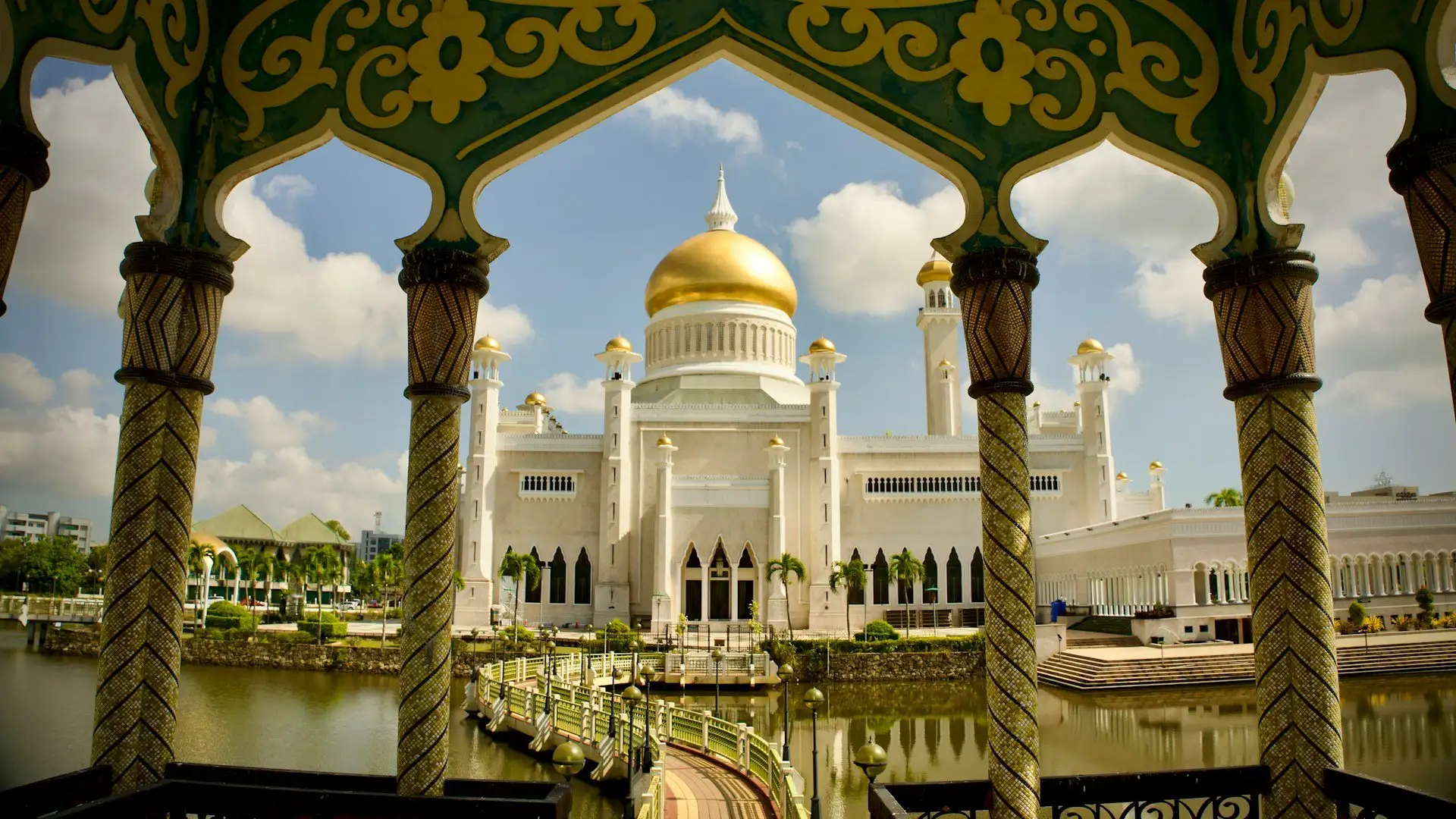
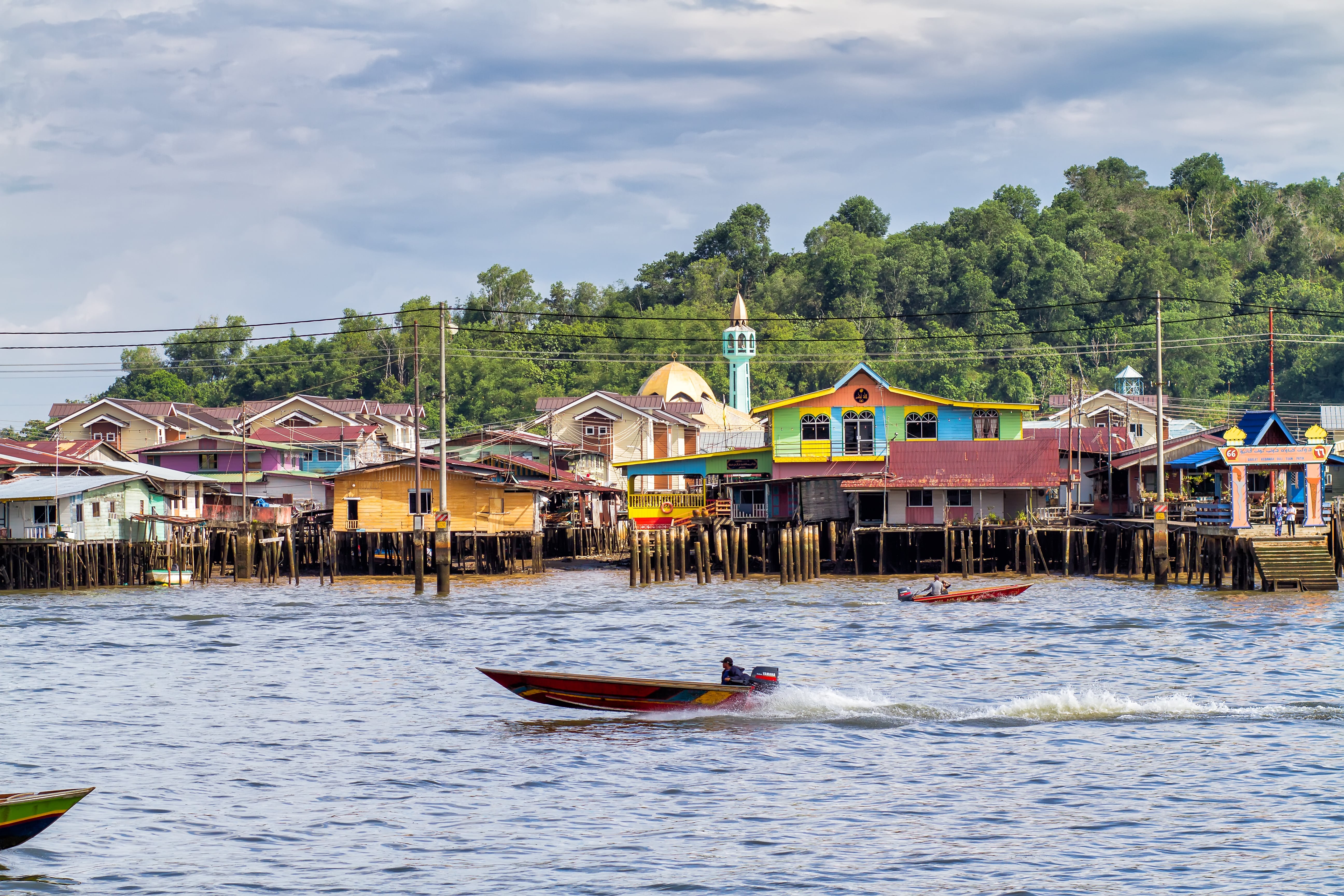
The people who stop here find something else. Kampong Ayer, the water village stretching along both banks of the Brunei River in the capital, is a community of around 30,000 people living in houses on stilts over the water, connected by wooden walkways and water taxis, continuously inhabited for at least 1,300 years. The Spanish explorer Pigafetta, sailing with Magellan's circumnavigation in 1521, described it as a Venice of the East, and the comparison holds. The Omar Ali Saifuddien Mosque, completed in 1958 on an artificial lagoon in the center of the capital, is one of the finest pieces of Islamic architecture built in the 20th century. Beyond the capital, Ulu Temburong National Park has Bornean rainforest at its most intact, preserved by oil wealth that removed the economic pressure to log it.
The honest complications
Brunei is genuinely dry, no bars, no hotel minibars stocked with beer, and a personal import allowance that must be consumed in private. There's no real budget hostel tier compared to the rest of Southeast Asia, and the country's Syariah Penal Code, introduced in stages from 2014 to 2019, applies to Muslims and in some provisions to non-Muslims, including provisions relevant to alcohol, Ramadan conduct, and same-sex relationships. None of this makes the country hostile to visitors, but arriving informed about the legal framework, covered in the safety chapter below, matters more here than in most destinations in this guide.
A History Worth Knowing
Brunei's current geography, two small slivers of territory surrounded by Malaysia, is the residue of what was once the dominant maritime power in the western Pacific. At its peak in the 15th and 16th centuries, the Bruneian Empire controlled most of Borneo, the southern Philippines, and significant portions of modern Indonesia. Antonio Pigafetta, sailing with Magellan's circumnavigation in 1521, wrote of the capital with genuine amazement: the number of cannon on the Sultan's war junks, the refinement of the court, the gold that European visitors found difficult to believe.
- 7th c. CE
Earliest records. Chinese sources mention Po-li, believed to be Brunei, as a trading polity; the Brunei River settlement that becomes Kampong Ayer has its origins here.
- 15th c.
The golden age. The Bruneian Empire reaches its peak, controlling most of Borneo, the southern Philippines and parts of the modern Indonesian archipelago.
- 1521
Magellan's fleet arrives. Antonio Pigafetta's account is the most detailed early European description of the sultanate and its wealth.
- 1841
James Brooke & the White Rajahs. James Brooke receives the governorship of Sarawak and his dynasty systematically annexes Brunei's territory over the following decades.
- 1929
Oil discovered. Offshore oil is found; commercial extraction begins in 1932, transforming a declining sultanate into one of the world's wealthiest countries per capita.
- 1984
Independence. Brunei achieves full independence under Sultan Hassanal Bolkiah, who became head of state in 1967 and remains the ruling Sultan today.
Read the full history: the decline, the oil wealth, and the Syariah Penal Code
The decline came gradually through the 17th and 18th centuries, driven by colonial disruption to trade networks, succession disputes weakening central authority, and rising piracy in waters Brunei had previously policed. By the 19th century the empire had contracted to approximately today's territory, and the sultans signed treaties with the British exchanging sovereignty for protection. The Limbang corridor separating Brunei's two districts was ceded to Sarawak by James Brooke's nephew in 1890, under circumstances Brunei still disputes.
The Japanese occupation from 1941 to 1945 destroyed much of the capital before the British resumed protection and Brunei negotiated independence in 1984. Oil, discovered offshore in 1929 and commercially extracted from 1932, created a per-capita income by the 1970s placing Brunei among the wealthiest countries in the world. The current Sultan, holding the titles of Prime Minister, Minister of Finance and Minister of Defence simultaneously, has used oil revenues to fund free healthcare, free education and subsidized housing, with no income tax. The same ruler introduced the Syariah Penal Code in stages from 2014 to 2019, a legal framework applying to Muslims and in some provisions to non-Muslims, attracting significant international attention for its provisions including amputation for theft and death by stoning for adultery and homosexual acts. The actual implementation has been minimal: the standard of proof required is extremely high, and Brunei's courts haven't applied the most severe penalties in practice, though the legal framework is real and understanding it is appropriate context for any visitor.
Top Destinations
Brunei is small enough that the capital and its main attractions can be covered thoroughly in two days. Adding Temburong for the rainforest extends the visit to three to four days. Everything here is either in Bandar Seri Begawan or accessible as a day trip from it, there's no overland touring circuit, Brunei is a place to understand in depth rather than cover in breadth.
Omar Ali Saifuddien Mosque
Built between 1954 and 1958, the spiritual and visual center of Bandar Seri Begawan. The main dome is covered in pure gold mosaic and rises 52 meters above an artificial lagoon; the exterior is Italian marble, the carpet came from Belgium, the stained glass from England. Non-Muslim visitors are welcome outside the five daily prayer times, and the golden-hour reflection in the lagoon is the single most photographed image in Brunei.
Royal Regalia Museum & Brunei Museum
The Royal Regalia Museum holds the Sultan's coronation regalia, the golden coronation chariot and jeweled ceremonial weapons, free entry, no photography inside. The Brunei Museum on the riverbank houses the region's best Islamic art collection alongside the Muara shipwreck gallery, ceramics recovered from a 10th-century Chinese trading vessel.
Kampong Ayer, the water village
The world's largest water village is a functioning community of approximately 30,000 residents in stilt houses over the Brunei River, connected by 36 kilometers of wooden boardwalks and served by water taxis operating like informal bus routes. It has its own mosques built on platforms, schools, clinics, fire station and police post, all waterborne, inhabited continuously for at least 1,300 years. Hire a water taxi from the BSB waterfront, ask the driver to take you into the village, then walk the boardwalks independently for an hour or two. Some households display a welcome sign and offer tea, accept.
Ulu Temburong National Park
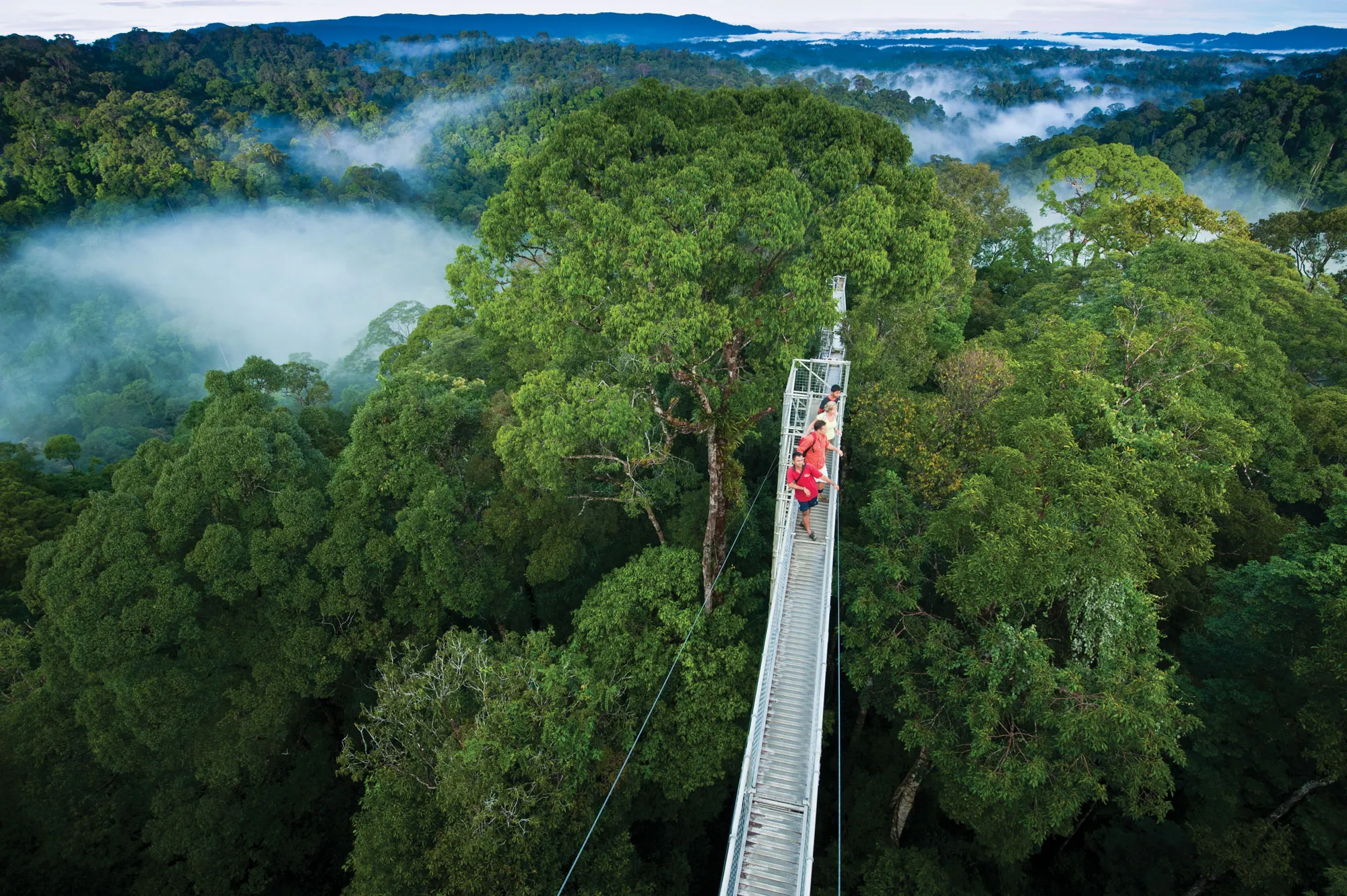
500 square kilometers of primary Bornean rainforest in the Temburong enclave, reached by speedboat from Bandar Seri Begawan through Limbang (Malaysian Sarawak), then longboat through river channels. The canopy walkway, suspended 60 meters above the forest floor, gives views across unbroken rainforest to the horizon. Proboscis monkeys, hornbills, pit vipers and monitor lizards are commonly sighted, and swimming in the river at the research center is one of the unexpected pleasures. Access is only through licensed operators; independent access isn't permitted.
Gadong Night Market
Operating from late afternoon until around 10pm, the most concentrated expression of Bruneian food culture: dozens of stalls selling ambuyat, nasi katok, grilled seafood, kuih and Bornean fruit juices, busy and primarily Bruneian in clientele, very cheap by the standards of a country where most things aren't. Saturday evenings are the most animated.
Proboscis monkey river cruise
Evening cruises from the BSB waterfront along the Brunei River provide reliable sightings as monkeys settle for the night in riverside trees, plus views of Kampong Ayer from the water and fireflies in the mangrove channels after dark. Hour-long cruises run at dusk; book in the afternoon for the same evening.
Culture & Etiquette
Brunei is a Malay Islamic Monarchy, a genuine cultural framework that shapes daily life. The five daily prayers are observed, Friday is the weekly holy day when most businesses close from 11:30am to 2pm, and the Syariah framework governing personal conduct for Muslims extends in some provisions to non-Muslims. None of this makes Brunei unfriendly: Bruneians are broadly warm and curious about foreigners, and English, a co-official language and the language of instruction from Year 1, makes genuine conversation possible.
Do
- Dress modestly throughout. Shoulders and knees covered outside hotel grounds; at mosques, full covering including hair is required, garments are always provided at the entrance.
- Remove shoes at mosques and homes. Universal at religious sites; at homes and the water village, remove shoes when entering someone's house without being asked.
- Use the right hand for eating and passing items. The left hand is considered unclean in Malay Muslim culture, especially important when eating and interacting with older Bruneians.
- Declare alcohol at customs if bringing your personal allowance. Two litres of spirits and 12 cans of beer for genuine personal consumption, declared on arrival.
- Greet with "Assalamualaikum" where appropriate. The Islamic greeting is the standard social opening with Bruneian Muslims, received with genuine warmth even used imperfectly.
Don't
- Drink or carry alcohol in public. Not sold anywhere in Brunei; drinking in public is illegal, and consuming your personal import allowance is permitted only in private space.
- Eat or drink in public during Ramadan daylight hours. Illegal for both Muslims and non-Muslims and enforced; adjust your schedule and respect the observance.
- Point with your finger. Considered rude in Malay culture; use your thumb with a closed fist to indicate direction instead.
- Display physical affection in public. Inappropriate for both same-sex and opposite-sex couples throughout the country.
- Photograph the Sultan or royal family critically. The royal family is treated with significant deference; posts or photos perceived as disrespectful have resulted in visitor deportations.
Deeper culture: kedai kopi eating culture, Hari Raya, and traditional crafts
Eating culture: warung & kedai kopi. Brunei's daily eating culture happens at small food stalls and coffee shops, the social spaces where Bruneians eat together, conversation running from local politics to football over teh tarik and roti canai. Sitting down at a kedai kopi table is the single most accurate introduction to daily Bruneian life available to a visitor.
Hari Raya & National Day. During Hari Raya Aidilfitri, Bruneian homes are open to visitors for several days, with homeowners setting out an elaborate spread of kuih for any caller; being invited into a home during this period is a genuine expression of the country's hospitality tradition. National Day on February 23rd includes a parade at the national stadium.
Traditional crafts. Kain tenunan, hand-woven silk fabric with gold-thread patterns historically reserved for the royal court, is still produced by a small number of traditional weavers in the Kampong Ayer area. Silverwork and the distinctive miniature Brunei brass cannon are the other traditional crafts, observable and purchasable at the Arts and Handicrafts Training Centre.
Food & Drink
Bruneian food is Malay food at its most Bornean: coconut, lemongrass, galangal, belacan, and Bornean chili varieties hotter than the standard Southeast Asian baseline. Pork is absent, as in any Muslim-majority country, shaping protein options toward beef, chicken, seafood and fresh river fish. Alcohol isn't available anywhere; the drinks culture runs on teh tarik, thick sweetened kopi, coconut water and fresh Bornean fruit juices.
Nasi Katok B$1
The definitive Bruneian street food: steamed rice, fried chicken and sambal chili paste wrapped in brown paper. Simplicity is deliberate; the best versions use properly marinated chicken and sambal made fresh that morning, available at virtually every roadside stall.
Ambuyat
The national dish: a sticky, glutinous paste from sago starch, flavorless by itself, eaten by wrapping it around a bamboo fork and dipping into accompanying sauces, binjai fruit curry, salted fish, sambal, where the flavor comes from. Textural and unforgettable, positively or negatively depending on your relationship to unfamiliar textures.
River Fish & Seafood
The tenggiri (Spanish mackerel) and ikan bakar (grilled fish) tradition of coastal communities is the best seafood eating in the country. Belacan-marinated grilled fish at riverside stalls near Kampong Ayer, eaten with rice and iced lime juice, is what visitors most reliably describe as the meal they remember.
Mee Goreng & Local Noodles
The Bruneian version of stir-fried noodles uses more belacan and a specific dark soy sauce for a distinctly richer flavor than Malaysian or Indonesian versions. Kedai kopi breakfast noodles at 7am with a glass of teh tarik is a grounding way to start a day.
Kuih & Sweets
An astonishing range of small sweet and savory cakes using rice flour, coconut milk, pandan and palm sugar, displayed at night markets in layered towers of color. Most are eaten as snacks and cost a few cents each.
Teh Tarik & Kopi
Teh tarik, pulled milk tea poured between containers to create froth, is the social beverage of kedai kopi culture. Kopi, thick Hainanese-style coffee, is the alternative. Fresh coconut water is the correct hot-weather drink.
When to Go & Itineraries
Brunei sits less than five degrees north of the equator and is hot and humid year-round; the practical distinction between seasons is rainfall rather than temperature. The northwest monsoon from November to February is generally drier and slightly more comfortable than the southwest monsoon from May to October, though Brunei receives rain in every month of the year.
All seasons compared, with temperatures
| Season | Verdict | Temps | Notes |
|---|---|---|---|
| Dec-Apr | Best | 24-32°C | Most reliably dry; National Day Feb 23; best mosque lagoon reflections |
| Oct-Nov | Good | 25-33°C | Manageable transition; quieter than Dec-Jan weekends; good monkey sightings |
| May-Sep | Fine, wetter | 25-33°C + humidity | More sustained rain; indoor attractions and water village fully accessible |
| Ramadan | Plan around | Varies | No public eating/drinking daytime; evenings after iftar more vibrant |
Minimal temperature variation year-round in BSB; rain is the real variable, and humidity makes every temperature feel warmer than it reads.
Itineraries
Two full days covers Bandar Seri Begawan thoroughly. Brunei works well as a two-to-three-day add-on to a broader Borneo trip including Kota Kinabalu (Sabah) or Kuching (Sarawak), with Royal Brunei Airlines and AirAsia connecting both.
- Day 1
Mosques, museum & water village. Early nasi katok, Omar Ali Saifuddien Mosque at 9am, Royal Regalia Museum mid-morning, water taxi to Kampong Ayer at 2pm, dusk proboscis monkey cruise, riverside fish dinner.
- Day 2
Museums, Gadong & the second mosque. Brunei Museum and Malay Technology Museum, lunch at Gadong Night Market, Jame'Asr Hassanil Bolkiah Mosque in the afternoon, golden-hour return to the lagoon reflection.
- Days 1-2
Bandar Seri Begawan in full. The two-day itinerary above, slower: a longer Kampong Ayer morning, the Arts and Handicrafts Centre, an evening at the Yayasan food court.
- Days 3-4
Ulu Temburong National Park. Speedboat to Bangar, longboat into the park, canopy walkway, river swimming, overnight in the park recommended for the dawn wildlife experience.
- Days 1-4
Kota Kinabalu, Sabah. Mount Kinabalu, Kinabalu National Park, the Kinabatangan River for orangutans and pygmy elephants, Semporna for Sipadan diving if booked in advance.
- Days 5-7
Brunei. Fly from KK to BSB, two days in the capital, one day in Ulu Temburong, a genuine contrast with Sabah's developed tourism infrastructure.
- Days 8-12
Kuching, Sarawak. The Sarawak Museum, Semenggoh orangutan rehabilitation centre, longhouse visits along the Skrang or Lemanak rivers, and Bako National Park's proboscis monkeys.
Getting there & around
Brunei is car-centric with minimal public transport; there's no rail system. Grab operates throughout BSB and is the most reliable option, fixed prices, no negotiation. For Ulu Temburong, the journey via speedboat then longboat is always arranged through a licensed tour operator.
All transport options with prices: Grab, taxis, water taxis, speedboat to Temburong
| Option | Price | Notes |
|---|---|---|
| Grab | B$5-15/trip | Fixed prices, air-conditioned, covers Gadong, Kiulap and the waterfront. Download the app before landing. |
| Water taxi | B$1/boarding | Continuous during daylight hours between the waterfront and Kampong Ayer; flag one down, they pass constantly. |
| Speedboat to Temburong | B$10-15 return | 45 minutes from Muara ferry terminal to Bangar, several times daily; usually part of a Temburong package. |
| Car rental | B$60-100/day | Driving on the left; useful for the Muara speedboat terminal and less-visited interior roads, not necessary for BSB sights. |
On the Temburong journey: the speedboat from Muara crosses Brunei Bay past offshore oil platforms before entering the Temburong River delta and slowing to longboat territory, a narrow wooden boat with a canopy negotiating increasingly tight river channels under an increasingly enclosed forest canopy. GetTransfer offers fixed-price airport pickups avoiding taxi negotiation on arrival.
Where to stay
Luxury hotel
The Empire Hotel and Country Club in Muara, a vast marble palace commissioned by the Sultan for a jubilee celebration and converted to a hotel with an atrium lobby you can drive a bus through. The Radisson is the most conveniently located five-star option in central BSB.
Mid-range hotel
The Riverview Hotel on the waterfront and the Sheraton Serasa in Muara are consistently recommended. Central BSB has well-run Chinese-owned hotels in the B$80-120 range, clean and well-positioned for the main sights.
Temburong lodges
Riverside chalets through licensed ecolodge operators, basic but comfortable, the experience being the forest itself. Staying overnight gives access to dawn and dusk wildlife windows that day visitors miss.
Budget guesthouse
More limited than in neighboring Malaysia; Jubilee Hotel and a small number of central BSB guesthouses serve this market, functional rather than charming. Miri in Malaysian Sarawak is a cheaper base if Temburong isn't part of the itinerary.
Budget Planning
Brunei is moderately expensive by Southeast Asian standards and cheap by Gulf standards. Food is genuinely cheap at local restaurants, night markets and kedai kopi; hotels are where the cost accumulates, since there's no budget hostel tier comparable to Bangkok or Bali. The Brunei Dollar is pegged to the Singapore Dollar at 1:1 and both are accepted everywhere at face value.
- Budget guesthouse or economy hotel
- Kedai kopi and night market meals
- Grab and water taxis for transport
- Free attractions: mosques, museums, Kampong Ayer
- Mid-range hotel in central BSB
- Mix of local and restaurant dining
- Ulu Temburong day trip (amortized)
- Evening proboscis monkey cruise
- Radisson BSB or Empire Hotel
- Restaurant dining for every meal
- Private driver for day trips
- Overnight Temburong ecolodge
Quick reference prices: nasi katok, transport, entry fees
| Nasi katok (1 portion) | B$1 |
| Kedai kopi meal | B$3-6 |
| Restaurant meal, mid-range | B$10-20 |
| Water taxi, Kampong Ayer | B$1 |
| Grab across BSB | B$5-12 |
| Omar Ali Saifuddien Mosque | Free |
| Ulu Temburong day trip | B$80-120/person |
| Proboscis monkey cruise | B$25-35/person |
Prices reflect July 2026 research and drift over time. Treat them as a planning baseline, not a quote.
Visa & Entry
Brunei operates a relatively generous visa-free entry system for most Western nationalities. UK and Germany get 30 days, US citizens get 90 days, Australia and Canada get 14 days, and most ASEAN nationals get 14 days. Most Western visitors need no advance visa application: simply arrive with a valid passport, a return or onward ticket, and sufficient funds. Some nationalities require an advance visa; check the current list at the Brunei Immigration Department website before booking.
✓ Valid passport
At least 6 months validity beyond your intended departure and at least one blank page for the entry stamp.
✓ Return or onward ticket
Immigration requires proof you're leaving within the visa-free period.
⚠ Alcohol declaration
Non-Muslims may import 2 litres of spirits and 12 cans of beer for personal use, which must be declared at customs on arrival; failure to declare is a serious offence.
⚠ Syariah Penal Code awareness
Applies to Muslims and in some provisions to non-Muslims. Understand the legal context before arrival, particularly around alcohol, Ramadan conduct and laws applicable to same-sex conduct.
| Brunei | Malaysia (Borneo) | |
|---|---|---|
| Daily budget | B$60-90, no budget hostel tier | Cheaper overall, wider budget accommodation range |
| Rainforest | 70% intact, Ulu Temburong's primary forest | Also excellent but under greater logging pressure |
| Alcohol | Dry country, none sold anywhere | Widely available |
| Crowds | Almost entirely skipped by tourists | Developed tourism infrastructure, more visited |
| Signature sight | Kampong Ayer water village, 1,300 years inhabited | Orangutans, Mount Kinabalu, Sipadan diving |
Safety, Solo Women & Family
Brunei is one of the safest countries in Southeast Asia by any standard. Violent crime is extremely rare and petty theft is uncommon. The main safety considerations are legal rather than criminal: the laws that govern behavior in Brunei are real and enforced, and understanding the framework removes essentially all risk for a visitor behaving with basic consideration and awareness.
Legal risks
The Syariah Penal Code applies to Muslims in full and to non-Muslims in several provisions. Alcohol consumption in public is prohibited for all, as is eating or drinking in public during Ramadan. Same-sex conduct is illegal under the code, discretion around public affection applies to all couples.
Road safety
High car ownership and generally orderly but fast driving on main highways. Pedestrian infrastructure is minimal outside central BSB. Use Grab or taxis rather than navigating unfamiliar roads on foot.
Natural hazards
Dengue fever is present with periodic local clusters; Ulu Temburong has leeches (manageable with leech socks), occasional venomous snakes, and river currents at swimming holes requiring awareness. Follow your guide's instructions in the forest.
Solo women and healthcare
Solo women: Brunei is consistently rated among the safest destinations in Southeast Asia for solo female travelers. Street harassment is essentially absent, and the conservative social environment is orderly rather than hostile. Travel alone at any hour in BSB without meaningful risk.
Healthcare: RIPAS Hospital in BSB is the primary facility, good quality by regional standards. Foreign visitors pay full private rates, so travel insurance covering medical expenses is recommended; serious cases sometimes require transfer to Singapore for specialist care.
Emergency numbers
Embassies in Bandar Seri Begawan
Most major Western countries have diplomatic representation in BSB, concentrated in the Jalan Kebangsaan and Jalan Tutong diplomatic areas.
- USA
- +673-2-238-900
- UK
- +673-2-222-231
- Australia
- +673-2-229-435
- Canada (via Singapore)
- +65-6854-5900
- Germany
- +673-2-225-547
- France
- +673-2-220-960
- Netherlands (via KL)
- +60-3-2168-6200
- New Zealand (via Singapore)
- +65-6235-9966
RIPAS Hospital: at Jalan Tutong, Bandar Seri Begawan (+673-2-242-424), the primary emergency medical facility, well-equipped by regional standards. For emergencies in Ulu Temburong, contact your tour operator immediately, their evacuation procedures are faster than navigating the system independently in a remote forest setting.
Family travel & pets
Brunei is a comfortable family destination by Southeast Asian standards, very safe, English is everywhere, and distances are manageable. The heat is the primary practical challenge for young children. Ulu Temburong works well for children aged seven or older who can manage the longboat journey and forest walking, and the water village exploration suits children of any age comfortable on the water.
The canopy walkway with kids, proboscis monkeys, and bringing pets
The canopy walkway at Ulu Temburong, swaying gently 60 meters above the forest floor, is suitable for children from about age eight who aren't afraid of heights, and the evening proboscis monkey river cruise (5:30-7pm) is a universally compelling experience that fits well with family schedules. Water taxis to Kampong Ayer have no railings, so keep young children close at boarding points.
Pets: Brunei requires a health certificate issued within 10 days of travel, current vaccinations, ISO microchipping, and an import permit from the Department of Agriculture and Agrifood obtained before departure, a process taking several weeks. Pet-friendly accommodation is extremely limited, and given the typical two-to-three-day Brunei visit, arranging pet care at home is the practical recommendation.
Brunei FAQ
Is Brunei safe to visit?
Yes, one of the safest countries in Southeast Asia. Violent crime is extremely rare and petty theft is uncommon. The main considerations are legal rather than criminal, Brunei's laws around alcohol and public conduct are real and enforced, and understanding them removes essentially all risk for a visitor behaving with basic consideration.
Do I need a visa for Brunei?
Most Western nationalities enter visa-free: UK and Germany get 30 days, US citizens get 90 days, and Australia and Canada get 14 days. Rules vary by nationality and change periodically, so check the Brunei Immigration Department's current list before booking.
Is alcohol allowed in Brunei?
Alcohol isn't sold anywhere in Brunei and drinking in public is illegal. Non-Muslim visitors may bring in 2 litres of spirits and 12 cans of beer for personal consumption, declared at customs, and consumed only in private.
How many days do you need in Brunei?
Two full days covers Bandar Seri Begawan's mosques, museums and water village thoroughly. Adding a day or two for Ulu Temburong National Park extends the visit to three or four days, which is genuinely sufficient for the country.
What is Kampong Ayer?
The world's largest water village, a functioning community of around 30,000 people living in stilt houses over the Brunei River, connected by 36 kilometers of wooden boardwalks, continuously inhabited for at least 1,300 years.
What are Brunei's laws on homosexuality?
Brunei's Syariah Penal Code, introduced in stages from 2014 to 2019, criminalizes homosexual acts and provides for severe penalties including death by stoning, though the standard of proof required is extremely high and these penalties haven't been applied in practice. Same-sex travelers should be aware of this legal context and exercise discretion, particularly around public displays of affection.
What is Ulu Temburong National Park?
500 square kilometers of primary Bornean rainforest in Brunei's Temburong enclave, reached by speedboat and longboat, with a canopy walkway suspended 60 meters above the forest floor and reliable sightings of proboscis monkeys and hornbills.
Is Brunei expensive to visit?
Moderately, by Southeast Asian standards, cheaper than Singapore but pricier than Thailand or Vietnam. Food at local kedai kopi and night markets is genuinely cheap; hotels are where costs accumulate, since there's no real budget hostel tier.
What language is spoken in Brunei?
Malay is the official language and the language of government and Islamic observance. English is co-official and the primary language of education from Year 1, so navigation as an English speaker is completely straightforward.
Can I combine Brunei with a Borneo trip to Malaysia?
Yes, and it's the ideal way to visit. Brunei works well as a two-to-three-day add-on between Kota Kinabalu (Sabah) for orangutans and Mount Kinabalu, and Kuching (Sarawak) for the Sarawak Museum and longhouse visits, with Royal Brunei Airlines and AirAsia connecting all three.
The Empire That Shrank and Kept Going
There's a specific quality to places that were once larger than they are now, that carry in their present smallness the memory of a different scale. Brunei has this quality more than any other country in Southeast Asia. The Sultan who currently lives in the Istana Nurul Iman Palace, the largest residential palace in the world by floor area, is the 29th in a line that once controlled most of Borneo and the southern Philippines and was described by a man sailing with the first circumnavigation of the globe as ruling one of the wealthiest and most sophisticated courts in Asia. What remains is the size of a medium English county, sitting on enough oil to fund a welfare state that most countries ten times its size cannot afford.
The Kampong Ayer water village is the thread that connects the small and the large, the present and the historical: thirty thousand people living on the water as their ancestors did for thirteen hundred years, having absorbed Portuguese contact, British protectorate, Japanese occupation and oil wealth, and kept going. Sitting in a water taxi at dusk, the mosque dome catching the last light on the lagoon and the call to prayer carrying across the water, is the moment Brunei's compressed history feels not like a series of events but like a place that has always known who it is. Two days. Go.