
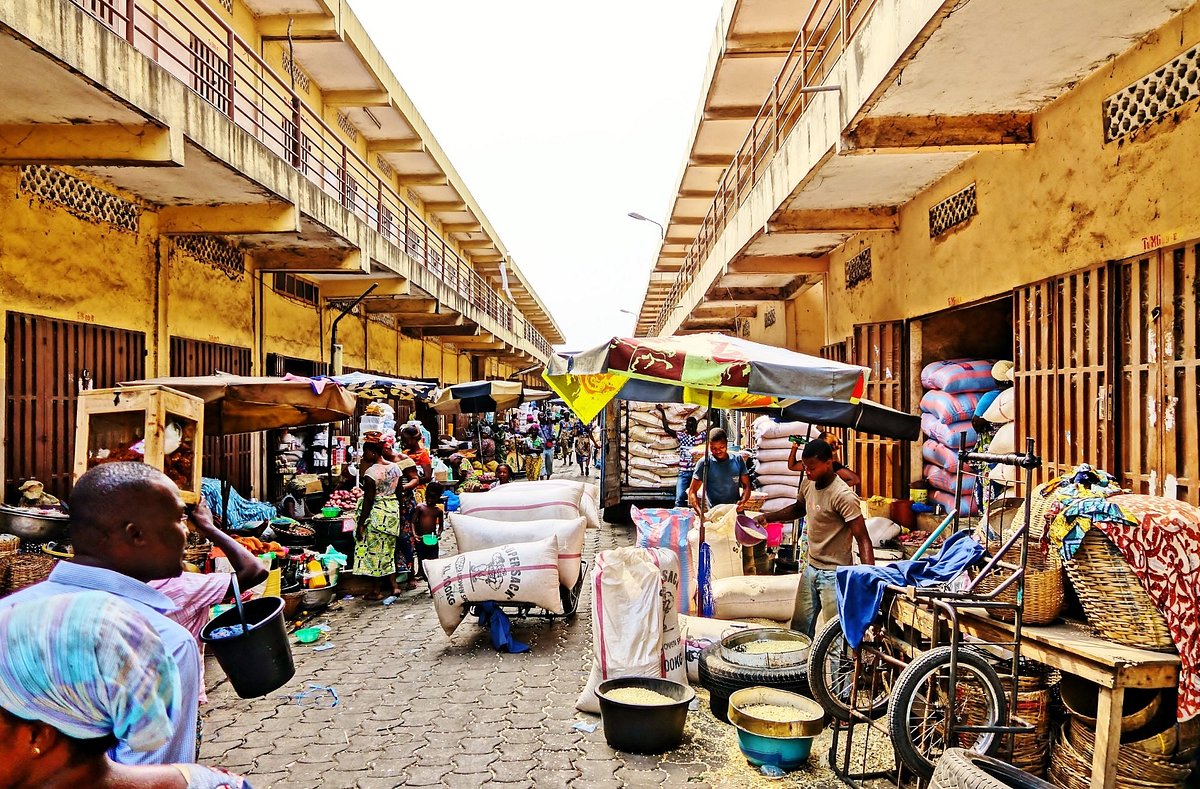
Not the capital on paper, the capital in practice
Cotonou grew up around a lagoon that connects Lake Nokoué to the Atlantic, and that geography still shapes the city: a working port, a market that spilled out until it became one of the largest in West Africa, and a chain of beach neighbourhoods facing the Gulf of Guinea. Porto-Novo holds the official title of capital, but every embassy, most government ministries in practice, the airport and the bulk of the country's commerce sit here instead, in a city of roughly a million and a half people that most visitors never realize isn't technically Benin's capital at all.
What Cotonou offers a visitor is less a checklist of monuments than a genuine working city: Dantokpa Market's sheer scale, Fondation Zinsou's free contemporary African art exhibitions in a country with almost no other formal gallery scene, and a lagoon that, followed a little further than most day-trippers bother, opens onto Ganvié, one of Africa's most striking settlements. It's also, straightforwardly, the base from which nearly every other Benin destination, Ouidah, Abomey, Porto-Novo and Grand-Popo, is reached.
The honest complications
Cotonou is not a polished city. Traffic is heavy and largely unregulated, zémidjan motorcycle taxis weave through it in a way that takes some acclimatizing, and the heat and humidity outside the December to February dry season are considerable. English is limited outside international hotels and tour operators, so a few French phrases go a long way. None of this makes the city difficult to visit well, but it rewards arriving with a plan rather than expecting to improvise the way you might in a more tourism-saturated capital.
A city that spreads along the lagoon and the coast
Cotonou's geography runs between the lagoon to the north and the Atlantic beach to the south, with the city center and market sitting close to where the two nearly meet. Where to base yourself comes down mostly to how central versus how beachfront you want to be.
Haie Vive
The district of embassies and long-established foreign residents, Haie Vive has quiet streets, a concentration of international restaurants and Cotonou's best security profile. Comfortable, central, and correspondingly more expensive than most of the city.
Cadjehoun
Cadjehoun sits close to Cardinal Bernardin Gantin International Airport and has shops, hotels and restaurants at nearly every corner, making it a genuinely convenient first-time base with easy access to the rest of the city.
Akpakpa
Home to Dantokpa Market on the lagoon's edge, Akpakpa is more residential and popular than Haie Vive, less expensive, and gives a far more authentic sense of everyday Cotonou than the international hotel districts.
Fidjrossè
A beach neighbourhood a short drive from Haie Vive and Cadjehoun, Fidjrossè has Cotonou's most pleasant stretch of Atlantic coastline and the late-afternoon grilled-fish stalls where fishermen sell straight off the boats.
A compact hotel scene, from beachfront chains to backpacker guesthouses
Cotonou's hotel stock is smaller than a comparably sized city elsewhere in West Africa, concentrated in a handful of international chains near the airport and the beach, with a growing budget guesthouse scene further out. These picks cover the realistic range.
For a central, beachfront base, the Golden Tulip Le Diplomate Cotonou is a 4-star hotel just five minutes from Cardinal Bernardin Gantin International Airport with a free 24-hour shuttle, less than a 10-minute walk to Fidjrossè Beach, a pool, and the on-site L'Instant restaurant; rates typically run from around $124 to $225 a night depending on season and booking window. Novotel Cotonou Orisha is another well-regarded international option with an outdoor pool and spa, aimed at both business and leisure travelers in the same central price bracket.
At the budget end, La Guesthouse Étoile, in central Cotonou, is set up specifically as a backpacker-friendly base with a communal, welcoming atmosphere, while Residence Maryka II sits in the heart of the city about five minutes from Saint Michel Church and ten minutes from the airport, a practical, no-frills option for travelers keeping costs down.
Maquis grills, market stalls and a lagoon full of fresh fish
Cotonou eats like a coastal Beninese city should: pâte and sauce as the daily staple, grilled fish and meat from open-air maquis, and street snacks like alloco sold from every other corner. The best of it isn't in hotel dining rooms, it's at the plastic-chair grills where the same family has been cooking the same dishes for years.
Pâte, amiwo & grilled fish
The everyday meal across Cotonou: cornmeal or cassava pâte with a spiced sauce, or amiwo's tomato-and-palm-oil cornmeal pudding, both served alongside grilled fish or chicken. Maquis, informal open-air grills with plastic chairs, serve this better and cheaper than any hotel restaurant.
International dining near Fondation Zinsou
For a change of pace, Bangkok Terrasse and Le Sorrento, both near Fondation Zinsou, offer Thai and Italian menus respectively in a more formal setting, while Chez Maman Benin in the same area serves a more home-style Beninese menu for travelers wanting local flavors without the maquis atmosphere.
Fidjrossè beach grills
Along the beach road near Fidjrossè, small grilled-fish stalls set up in the late afternoon selling the day's catch fresh off the fishing boats to a mostly local crowd. Agree the price before it's grilled, and expect a genuinely good, genuinely cheap meal with sand underfoot.
A market that's a destination in itself, and a lagoon worth following
Cotonou isn't built around a dense circuit of paid attractions; its best experiences are a handful of substantial stops, each worth a real block of time, and a lagoon that rewards going further than the standard sightseeing radius.
Dantokpa Market
Reputedly the largest open-air market in West Africa, Dantokpa sprawls across both banks of a lagoon channel in Akpakpa, selling everything from fresh produce and fabric to handmade crafts and Vodun ritual objects. It's disorienting on a first visit and genuinely rewarding on a second; going with a local guide or a hotel-arranged escort for the first pass makes it much easier to navigate.
Fondation Zinsou
A cultural landmark bridging Benin's heritage and contemporary artistic expression, Fondation Zinsou stages rotating exhibitions of traditional and modern African art from established and emerging artists, with free entry to its shows. Open Monday to Friday 8:30am to 7pm and Saturday 10am to 7pm, it's one of the only formal gallery spaces of its kind in the country.
Fidjrossè Beach
Cotonou's most pleasant Atlantic beach, a short drive from the city center, works for a daytime swim and is at its best in the late afternoon and evening when the grilled-fish stalls set up along the road behind it.
Lagoon pirogue tours
Guided dugout canoe tours depart from the lagoon near Dantokpa Market, threading through mangrove channels and past smaller fishing communities, with the option to continue all the way to Ganvié. Early morning departures are best for birdwatching and calmer water.
One, two or three days, planned realistically
Two to three full days covers Cotonou properly, including a Ganvié add-on. Arrange a zémidjan fare or a private driver in advance for anything beyond walking distance rather than improvising on the spot.
- Morning
Dantokpa Market. Start early, ideally with a local guide or hotel-arranged escort for the first pass through the market.
- Midday
Fondation Zinsou, then lunch. The gallery's current exhibition, followed by a meal at Chez Maman Benin or Le Sorrento nearby.
- Afternoon
Fidjrossè Beach. A slower afternoon by the water as the day cools off.
- Evening
Grilled fish on the beach road. Dinner straight from the boats at the Fidjrossè fish stalls.
- Day 1
The one-day route: Dantokpa, Fondation Zinsou, Fidjrossè Beach, grilled fish at sunset.
- Day 2
Ganvié. A half or full day trip to the stilt village, ideally departing by 7 or 8am for the floating market.
- Days 1-2
The two-day route above, at a gentler pace.
- Day 3
Ouidah. A full day trip west along the coast for the Route des Esclaves, the Temple of Pythons and the Sacred Forest of Kpassè.
Zémidjans everywhere, a driver for everything else
Cardinal Bernardin Gantin International Airport (COO) sits within the city itself, only a few kilometres from Haie Vive and Cadjehoun, so airport transfers are short. A hotel shuttle or a pre-arranged taxi is the simplest way in; if you flag a taxi independently, agree the fare before getting in. Within the city, the zémidjan, a yellow-vested motorcycle taxi and Cotonou's default transport, is everywhere: the name comes from the Fon phrase for "get me there fast," and fares run roughly 300 to 2,000 CFA (about 0.50 to 3 euros) depending on distance, always negotiated before boarding.
For Dantokpa Market's Akpakpa side, Fidjrossè and Cadjehoun, zémidjans and shared taxis handle it fine. For anything beyond the city, Ganvié, Ouidah, Abomey or Porto-Novo, a private driver arranged through your hotel or a tour operator is the practical choice; public transport covers these routes but slowly and without much English support.
Best time to visit and practical prep
Cotonou follows Benin's broader dry-season pattern: December to February is coolest and driest, March to May builds heat and humidity ahead of the rains, and June to September brings the heaviest downpours, when some unpaved routes to the lagoon and Ganvié's access points get harder going.
Practical prep: buy a local SIM (MTN or Moov Africa, available at the airport) on arrival, carry CFA francs since cards work only at upscale hotels and restaurants, and keep your printed e-visa approval and yellow fever certificate with you, both checked on arrival.
Inexpensive outside a handful of international hotels
Cotonou is affordable by international standards: maquis meals, zémidjan rides and budget guesthouses cost little, while the international-chain hotels near the airport and beach, along with private drivers for day trips, are where a mid-range or higher budget goes.
- La Guesthouse Étoile or similar
- Maquis meals (pâte, amiwo) $2-5
- Zémidjan rides around town
- Free sights: Fondation Zinsou, Fidjrossè Beach
- Golden Tulip Le Diplomate (roughly $124-225)
- Restaurant meals at Le Sorrento or Bangkok Terrasse
- Private driver for a Ganvié or Ouidah day trip
- Guided Dantokpa Market walk
- Top-tier international hotels
- Private driver for the full trip
- Multi-day guided excursions beyond Cotonou
- Fine dining across the international restaurant scene
A different security picture than Benin's north
Cotonou sits well outside the northern border regions the US State Department specifically advises against visiting, and the city itself is generally safe for well-prepared visitors under Benin's overall Level 2, Exercise Increased Caution rating. The practical concerns here are the ordinary ones of a large West African city: petty theft in crowded markets and around transport hubs, and the same general caution around night travel that applies across the country.
The three things that actually catch visitors: petty theft at Dantokpa Market and bus stations, where pickpocketing follows the crowds, so keep valuables secured and be extra attentive in the densest market alleys; night travel, since the US Embassy itself avoids traveling outside metropolitan areas after dusk and visitors should apply the same caution to any inter-city trip; and money-changing and ATM scams, so count change on the spot in markets and use ATMs only inside bank branches rather than standalone street machines. Emergency numbers are 117 for police, 118 for fire and 112 for ambulance, with response strongest in Cotonou itself compared with the rest of the country.
Ganvié alone is worth the trip out of the city
Cotonou's position on the lagoon and coast makes it a genuinely strong base for day trips that feel like an entirely different Benin from the city itself.
Ganvié
A settlement of an estimated 20,000 people living in houses built entirely on stilts, reachable in under an hour by car followed by a dugout canoe tour, or by a guided pirogue trip departing directly from the lagoon near Dantokpa Market. Early departures, 6 to 8am, catch the floating market at its liveliest and the light at its best.
Ouidah
Benin's historic slave port and the spiritual center of Vodun, with the Route des Esclaves leading to the Door of No Return, the Temple of Pythons, and the Sacred Forest of Kpassè, all manageable as a full day trip from Cotonou with a private driver.
Porto-Novo
A quieter, more compact alternative to Cotonou, with the Musée Honmè royal palace, the Da Silva Museum of Afro-Brazilian heritage, and a striking 19th-century Afro-Brazilian church converted into a mosque.
Grand-Popo
A relaxed beach town near the Togo border, with black-sand Atlantic beaches, the Bouche du Roy river mouth, and mangrove boat trips through the Mono River delta. Hotel Awalé Plage, a beachfront bungalow property with its own restaurant, is a well-regarded stop for lunch or an overnight.
Cotonou FAQ
Is Cotonou safe for tourists?
Yes, with normal precautions. Cotonou itself sits well outside the northern border zones the US State Department specifically flags for terrorism and kidnapping risk. The main concerns are petty theft around Dantokpa Market and bus stations, and night driving, which the US Embassy itself avoids outside metropolitan areas after dusk.
How many days do I need in Cotonou?
Two full days covers the city itself: one for Dantokpa Market and Fondation Zinsou, one for Fidjrossè Beach and the cathedral area. Add a third day for the Ganvié stilt village, an easy half or full day trip from the city.
How much does Cotonou cost per day?
Budget travellers manage on $30-50 a day with a guesthouse and maquis meals; mid-range runs $75-150 with a proper hotel and a private driver for day trips. Cotonou is inexpensive outside its handful of international-standard hotels.
When is the best time to visit Cotonou?
December to February, the coolest and driest stretch of the dry season. The rainy season, roughly June to September, brings the heaviest downpours and can make some unpaved routes to the lagoon and Ganvié's access points harder going.
Do I need a visa to visit Cotonou?
Yes. Most nationalities including the US, UK, EU, Canada and Australia need a 30-day e-visa arranged online at evisa.bj before arrival, along with a mandatory yellow fever vaccination certificate. See our Benin country guide for full visa details.
How do I get from Cotonou airport to the city centre?
Cardinal Bernardin Gantin International Airport sits within the city itself, only a few kilometres from central neighbourhoods like Haie Vive and Cadjehoun. A hotel shuttle or pre-arranged taxi is the simplest option; agree the fare in advance if you flag a taxi independently.
What is the best area to stay in Cotonou?
Haie Vive or Cadjehoun for first-timers: both are central, close to the airport, and have Cotonou's best hotel and restaurant options. Fidjrossè for a beachfront base with easy access to grilled-fish stalls and a slower pace in the evenings.
Do I need to speak French in Cotonou?
It helps enormously. French is the working language of hotels, restaurants, guides and zémidjan drivers; English is limited outside international hotel staff and some tour operators. A few French phrases go a long way.
Is it easy to visit Ganvié from Cotonou?
Yes. Ganvié sits about 18 kilometres from Cotonou on Lake Nokoué, reachable by car in under an hour followed by a dugout canoe tour, or by a guided pirogue trip departing directly from the lagoon near Dantokpa Market. Early morning departures, around 6 to 8am, catch the floating market at its best.
What Stays With You
Cotonou doesn't perform for visitors the way a capital built for tourism might, and that's the point. Dantokpa Market exists because a few hundred thousand people need somewhere to buy and sell, not because it photographs well, though it does. Fondation Zinsou gives away, for free, exhibitions that would carry an entrance fee anywhere else. And the lagoon that runs through the city keeps going, past the last of the tourist infrastructure, to a village that has been standing on stilts for three centuries for a reason that still matters to the people who live there.
Go with the e-visa sorted, French phrases practiced, and a driver arranged for Ganvié. What's left is the real, unglamorous, genuinely rewarding working city that most of Benin's other destinations are reached through.