
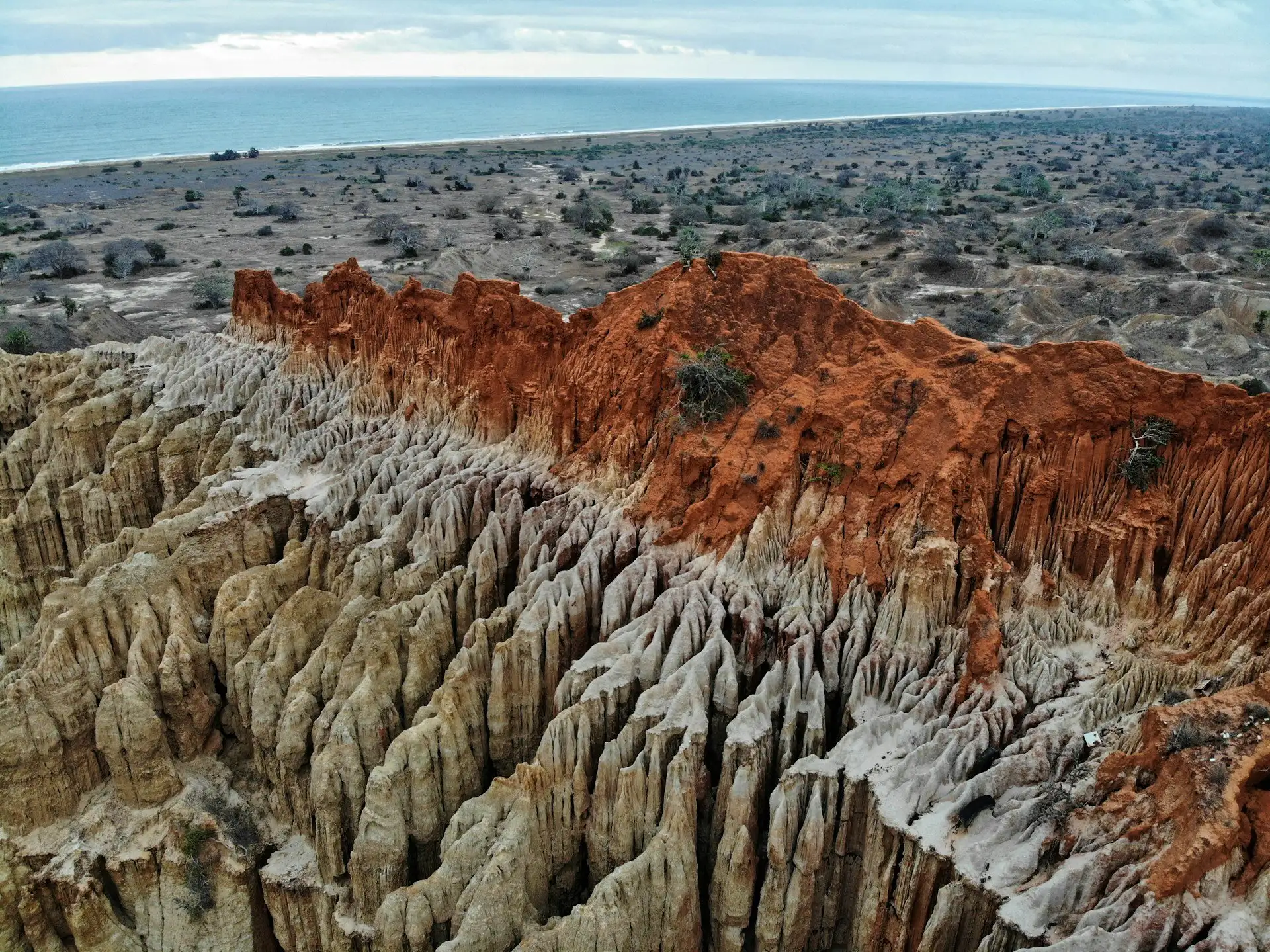
Angola
Waterfalls that dwarf Victoria Falls. A desert that meets the cold Atlantic. A capital city that spent fifteen years as the world's most expensive and is finally becoming something people actually want to visit. Angola is opening, slowly and on its own terms.
What You're Actually Getting Into
Angola is not an easy trip. The visa, until recently, was a bureaucratic obstacle course. The country spent decades at war and then another decade being so flooded with oil money that a beer in Luanda cost more than one in Zurich. The roads outside cities can be genuinely difficult. Landmines, a legacy of the 27-year civil war that ended in 2002, still require that you stick to established routes in rural areas. The tourist infrastructure is thin by any measure.
So why go? Because the geography is extraordinary and almost entirely without crowds. Kalandula Falls, on the Lucala River in Malanje province, drops 105 meters across a 400-meter-wide curtain of water. It is one of Africa's largest waterfalls by volume. Most people who've visited Africa have never heard of it. The Tundavala escarpment near Lubango drops 1,000 meters off the edge of the Huila plateau and looks over a landscape that extends to the horizon with nothing on it. The coast south of Namibe is where the Namib Desert, one of the oldest on earth, meets the cold Atlantic, creating an otherworldly collision of environments that produces fog forests, desert dunes, and empty beaches in the same twenty kilometers.
Luanda itself is a city in active transformation. The waterfront Marginal has been rebuilt. New restaurants, a growing arts scene, and a middle class that wants to show off their city are all present. It is still expensive and still chaotic and still has power cuts. But it is no longer simply an obstacle to get through on the way somewhere else.
What Angola rewards is the traveler who plans carefully, stays flexible, and doesn't need everything to run on time. What it offers in return is some of the most dramatic and least-photographed landscapes in Africa, and the particular warmth of a country that is not yet used to being visited.
Angola at a Glance
A History Worth Knowing
Angola's story is long, violent, and still very much present in the landscape and the people. Before the Portuguese arrived, the region was home to a collection of Bantu kingdoms of which the Kingdom of Kongo, centered near what is now the Congo River delta, was the most powerful. It controlled trade routes across a vast area, had a sophisticated administrative system, and when Portuguese sailors arrived in 1483 the initial contact was of rough diplomatic equals, not conqueror and conquered.
That didn't last. What the Portuguese found Angola useful for, above everything else, was people. The slave trade from Angola to Brazil and the Caribbean ran for nearly 400 years and exported an estimated four million human beings. The port of Luanda was one of the largest slave-trading ports in the world. This is not ancient history in Angola: it is the root of present-day Brazil's culture, language, and ethnicity, and it explains the particular bitterness with which colonialism is remembered here. Walk past the old slave market site on Luanda's waterfront. The silence around it is information.
Formal colonial control tightened through the 19th and early 20th centuries. Portugal, unlike the British, French, or Belgian empires, ran Angola with a particularly extractive and exploitative model, using forced labor (contratados) for plantation work long after formal slavery ended. When independence movements began forming in the 1950s, they did so against a backdrop of near-total exclusion from economic and political life.
Independence came on November 11, 1975, and civil war began almost immediately. Three movements that had fought the Portuguese together, the MPLA, FNLA, and UNITA, turned on each other with Cold War patrons supplying the weapons: the Soviet Union and Cuba backing the MPLA, the US and apartheid South Africa supporting UNITA. The war ran, with interruptions, from 1975 to 2002. Twenty-seven years. It ended only when UNITA's leader Jonas Savimbi was killed in combat in February 2002. The human cost was catastrophic: an estimated 500,000 to 800,000 dead, four million displaced, and an economy destroyed. The landmines are a physical residue of that war that clearance crews are still working through today.
What followed was an oil-funded reconstruction that was real but deeply unequal. Angola sits on massive offshore oil reserves and the revenue rebuilt Luanda's skyline while rural provinces remained largely as the war left them. The presidency of José Eduardo dos Santos ran for 38 years before he stepped down in 2017. His successor, João Lourenço, has pursued anti-corruption measures with enough seriousness to surprise observers who expected continuity. Angola in 2026 is more politically open than it has been in fifty years, still deeply poor outside the oil economy, and sitting on a landscape that has barely been explored by anyone who doesn't work for a mining company.
Diogo Cão reaches the Congo River delta. Initial contact with the Kingdom of Kongo.
Paulo Dias de Novais founds São Paulo de Luanda. The slave trade from this port will run for 300 more years.
Berlin Conference. Portugal's borders in Angola are formally recognized by European powers.
Armed uprisings against Portuguese rule. Brutal suppression follows. The liberation movement fractures into three factions.
Portugal withdraws. Independence declared November 11. Civil war begins the same day.
UNITA leader Jonas Savimbi killed. Ceasefire signed April 4, 2002. Twenty-seven years of war ends.
Dos Santos steps down after 38 years. João Lourenço elected. Anti-corruption drive begins in earnest.
e-Visa launched. Tourism infrastructure building. The country cautiously welcoming the outside world.
Top Destinations
Angola is a large country, roughly twice the size of France, and its regions are genuinely distinct. The north is tropical, green, and culturally complex. The central highlands around Huambo and Huila have a temperate climate and a landscape that looks more like the Scottish Highlands than anything most people associate with Africa. The south transitions into the Namib and Kalahari desert systems. Plan your trip around a region rather than trying to cover the whole country: the distances are real and the road quality varies enough that journey times are hard to predict.
Luanda
Luanda is a city of startling contrasts that has been actively reshaping itself since 2012. The Marginal waterfront promenade, rebuilt with Chinese investment, runs along the bay and is where the city comes in the evenings: families, food stalls, joggers, and the full spectrum of Luandan society. The Fortaleza de São Miguel, a 16th-century Portuguese fort on the hill above the city, gives context to everything below. The Museu Nacional de Antropologia holds one of the finest collections of traditional Angolan art and material culture on the continent. The Ilha de Luanda, a narrow sand spit extending into the bay, has the beach restaurants and nightlife. Luanda is expensive, genuinely chaotic at rush hour, and rewards patience with a city in the act of becoming something.
Kalandula Falls
On the Lucala River in Malanje province, 400 kilometers southeast of Luanda. The falls drop 105 meters across a horseshoe-shaped curtain nearly 400 meters wide. During the wet season, the roar is audible from two kilometers out and the spray soaks you before you're anywhere near the lip. By volume, this is one of Africa's largest waterfalls and among the continent's most dramatic landscapes. Getting there requires commitment: it's a five-hour drive from Luanda on roads that range from excellent new tarmac to challenging laterite dirt depending on the section and the season. The drive itself passes through Malanje, a provincial capital with a relaxed pace and good local food. Stay the night near the falls if you can arrange it. The dawn light on the mist is worth the effort.
Kissama National Park
Two hours south of Luanda, Kissama (also spelled Quiçama) is Angola's most accessible national park and the flagship of the country's wildlife recovery program. Operation Noah's Ark in 2001 airlifted elephants, buffalo, and zebra from Botswana and South Africa to repopulate a park devastated by civil war poaching and bush meat hunting. The recovery is real but still early: wildlife densities are lower than East or Southern Africa's great parks, but that's part of what makes it interesting. You're watching a savanna ecosystem come back to life. The park also has forest zones along the Kwanza River where palancas negras (giant sable antelope, Angola's national symbol) are occasionally seen.
Tundavala Gap, Lubango
Twenty kilometers from Lubango in the southern highlands, the Tundavala escarpment drops roughly 1,000 meters off the edge of the Huila plateau into an arid plain that extends toward the Namib. Stand at the edge and the drop is vertiginous, the horizon endless, and the silence so complete you can hear individual birds in the updraft far below. Lubango itself is one of Angola's most pleasant cities: a cool highland climate, good restaurants by Angolan standards, and the Cristo Rei statue on a hill above town — a twin to the one in Lisbon, placed here by the Portuguese in 1957. The city has a relaxed European-African atmosphere that's unlike anything in Luanda.
Namibe
The town of Namibe (formerly Moçâmedes) sits at the northern edge of the Namib Desert where it meets the cold Benguela Current of the Atlantic. The surrounding landscape is ancient, strange, and barely visited: welwitschia plants that live for 2,000 years, desert-adapted elephants, pink flamingos feeding in coastal lagoons, and sand dunes that terminate abruptly at a cold grey ocean. The drive south from Namibe toward Tombwa runs through scenery that looks like no place on the standard African travel circuit. There are almost no facilities. That is correct.
Huila & Huambo Highlands
The central highlands, running from Huambo south to Lubango, sit at 1,700 to 2,000 meters and have a temperate climate almost entirely unlike the rest of Angola. The landscape is open grassland and eucalyptus forest with a gentle light that surprises people expecting tropical heat. The Himba and Mumuila peoples of the southern highlands maintain traditional dress and ceremonies with more continuity than most of southern Africa. The coffee grown in these mountains was once among the world's most prized, and small-scale production is returning after decades of disruption.
Cabinda
Angola's northern exclave, separated from the rest of the country by a strip of the Democratic Republic of Congo, is where much of Angola's offshore oil wealth originates. Cabinda town has a relaxed, jungle-humid atmosphere and the surrounding Maiombe Forest is one of Central Africa's great remaining lowland rainforests. It is also an area where a low-level separatist conflict has occasionally flared. Check current conditions before visiting and consult your government's travel advisory for the specific situation at the time of your trip.
Luanda's Artspace
The Luanda art scene has grown faster than most observers expected. The Espaço Amostra gallery in Maianga hosts some of the continent's most interesting contemporary Angolan art. The Fundação Dr. António Agostinho Neto, built around the mausoleum of Angola's first president, contains a museum and cultural space that's more thoughtful than its monumental origins suggest. Friday evenings in the Bairro Azul neighborhood, when gallery openings happen simultaneously, give you a real window into Luanda's creative class.
Culture & Etiquette
Angola is a country of cultural pluralism that Portuguese colonialism tried to flatten and mostly failed to. The Kimbundu-speaking Mbundu people around Luanda and Malanje, the Kikongo-speaking Bakongo in the north, the Umbundu-speaking Ovimbundu of the central highlands, the Himba and Herero of the south, and dozens of other groups each bring distinct traditions, music, and social codes. What you see in Luanda is an urban synthesis of these cultures plus the particular mix that 500 years of Atlantic connection has produced. What you see in the Huila highlands is something older and less diluted.
The binding social value across most Angolan cultures is a version of communal solidarity: the idea that you do not eat while someone nearby is hungry, that extended family obligations take precedence over individual advancement, that generosity is a form of dignity. Visitors who understand this get much further than those who don't.
In Angola, skipping the greeting to get straight to what you want is rude in a way that closes doors. "Bom dia" (good morning), "Boa tarde" (good afternoon) and a handshake come first. Every time. With everyone present. This takes longer than you're used to and is worth every second.
Declining an offer of food or drink in someone's home is a rejection of their hospitality. Eat something even if you're not hungry. A symbolic amount is enough.
Angola is the world's fastest-growing Portuguese-speaking country. English is genuinely uncommon outside major hotels. Even ten phrases of Portuguese transforms the quality of your interactions completely.
Angolans in Luanda generally dress well. Appearing in public in torn or overly casual clothes signals disrespect. Smart casual is the baseline for city contexts.
"Posso tirar uma foto?" Always ask. Most people will say yes with a smile. Some won't. Respect both answers without negotiating.
This applies strictly and enforcement can be sudden. Do not photograph checkpoints, the presidential palace, military vehicles, or anything that could be construed as security-sensitive. The consequences range from confiscated equipment to detention.
Landmines. This is not a metaphor or a precaution from a distant past. Clearance is ongoing. Stick to established tracks and paths in rural areas, particularly in former conflict zones in the south and east.
Luanda has a significant wealth gap that is visible and sometimes tense. Wearing expensive jewelry, handling large amounts of cash in public, or leaving valuables visible in vehicles invites attention you don't want.
Angola has been a single-party state for most of its existence and political sensitivities are real. People will discuss politics among themselves with candor. As a foreign visitor, listen more than you speak on these subjects.
The concept of "African time" has genuine traction here. Meetings, transport, and arrangements run on flexible schedules. Build buffer into everything. Frustration is optional and counterproductive.
Music: Kizomba & Semba
Angola gave the world kizomba, one of the most widely danced social dances on earth, and its predecessor semba, a slower and more intimate urban form that emerged in Luanda's musseques (informal neighborhoods) in the 1950s. Both are danced close, require good communication between partners, and are performed at every celebration. Finding live semba on a Saturday night in Luanda is not difficult. It is one of the better things you will do in Africa.
Football
Angola qualified for the 2006 FIFA World Cup and the national team, the Palancas Negras (named for the giant sable antelope), commands serious loyalty. Petro de Luanda and Primeiro de Agosto are the main club rivals and their Luanda derbies generate the kind of atmosphere that makes you glad you happened to be in the city that weekend. Ask at your hotel when the next match is.
Capulana Fabric
Brightly patterned capulana cloth, worn wrapped as skirts or used as baby carriers, head wraps, and table coverings, is the visual fabric of everyday Angolan life. The patterns carry meaning in some traditions. The markets in Luanda's Roque Santeiro area (one of Africa's largest informal markets) sell hundreds of varieties. Buying fabric directly from a market vendor and having it made up by a local seamstress is cheaper and far more interesting than anything in a tourist shop.
Memory of War
The civil war is not distant history for most Angolans. People who were children during the conflict are now in their thirties and forties. Luanda's musseques are full of internally displaced people who came during the war and never went home. Be aware that questions about the war, about UNITA or MPLA allegiances, or about specific events can touch on personal losses that are still raw. Let people lead on this subject.
Food & Drink
Angolan cuisine builds on a foundation of cassava, beans, palm oil, and seafood, with Portuguese influences layered over centuries of Atlantic connection and Bantu culinary traditions underneath. It is warming, filling, often spicy, and genuinely distinctive from anything you'll find in the neighboring countries. The food is best in someone's home, reliably good at mid-range local restaurants, and expensive at Luanda's international hotel dining rooms without being meaningfully better.
The ingredient to understand is palm oil, which gives Angolan cooking a rich orange color and a specific depth of flavor that's unlike olive oil or vegetable oil. If you dislike it, a significant portion of the menu will be challenging. Most people come around to it within two days.
Muamba de Galinha
The national dish, as close as Angola has one. Chicken pieces cooked slowly in palm oil with okra, garlic, chili, and the muamba spice mix. Served with funge (cassava porridge) or rice. The okra thickens the sauce into something that coats everything. You'll find it in every local restaurant across the country. Order it the first night and use it as the benchmark for everything else.
Calulu
A slow-cooked stew of dried fish or smoked meat with vegetables (spinach, okra, tomatoes, sweet potato leaves) in palm oil, frequently with small dried shrimp adding a background umami depth. One of Angola's oldest dishes, with roots in Kongo culinary tradition. The dried fish version has a fermented intensity that's an acquired taste worth acquiring.
Funge
Cassava porridge, the starch base that appears alongside most Angolan dishes the way rice appears in East Asia or bread in Europe. The texture is smooth and dense, somewhere between firm polenta and mashed potato. Eaten by hand from the bowl, used to scoop up stew. It has almost no flavor on its own and is entirely about carrying the sauce. Give it a chance before judging it.
Grilled Seafood
The Benguela Current brings cold, nutrient-rich water up the Angolan coast and the result is exceptional seafood: tiger prawns, lobster, giant crab, and fish including corvina (meagre) and cachucho (pandora) that are grilled over charcoal with piri-piri and lemon. The informal beach restaurants on Mussulo and the Ilha do Luanda grill seafood to a standard that puts most European fish restaurants to shame at a fraction of the cost.
Cuca Beer
The national beer. A clean, cold lager brewed in Luanda since 1952. At 33cl served ice-cold, it is the correct companion to grilled prawns on a beach in the evening. The brand is beloved in a way that transcends mere product loyalty: Cuca is cultural shorthand for relaxation, celebration, and the particular pleasure of being Angolan. Drink it cold and in quantity.
Ginguba and Street Snacks
Roasted peanuts (ginguba) sold in paper cones by street vendors are the universal Angolan snack and cost almost nothing. Acaçá (fermented corn dough wrapped in banana leaves), mandazi (fried doughnuts), and grilled corn on the cob appear at any market. The street food culture around Luanda's Roque Santeiro and Benfica markets is active, cheap, and the best way to eat the city at ground level.
When to Go
Angola has two main seasons: a dry season (cacimbo) roughly May to October, and a wet season November to April. The dry season is the practical window for most travel, particularly anything involving rural roads, national parks, or overland driving. The wet season, while dramatically green and making Kalandula Falls at maximum spectacular volume, turns many roads outside cities into serious challenges.
Dry Season
Jun – SepThe classic travel window. Cooler temperatures especially on the highlands, reliable roads, good wildlife viewing in Kissama as animals congregate around water sources. The coast is often foggy in the mornings from the Benguela Current, which burns off by mid-morning to a clear Atlantic blue.
Shoulder
May & OctTransition months with manageable conditions in most areas. May has the last of the rains in the north but the south is already dry. October begins the build-up to the wet season but travel is still generally reliable. Good for combining north and south itineraries.
Wet Season
Nov – AprKalandula Falls at maximum volume is one of Africa's great spectacles. The landscape is intensely green. The downside: rural roads become difficult to impassable in some areas, wildlife disperses widely, and logistics get complicated. For experienced Africa travelers who want something different, the wet season has a moody beauty worth the effort.
Peak Wet
Jan – FebThe heart of the wet season. Luanda functions fine. Rural travel becomes genuinely difficult in many provinces. The north (Malanje, Uíge) can see roads cut off for days. Not recommended for a first visit unless you have specific wet-season objectives and a local fixer with current road information.
Trip Planning
Angola rewards planning more than almost any other African destination. The e-visa process, while much improved, still needs three weeks minimum. Getting beyond Luanda requires either domestic flights (reliable for major cities) or a sturdy 4x4 with a driver who knows the roads, which means pre-arranging a local operator. The country does not have a functioning tourist board that will help you once you're in trouble. Have your accommodation confirmed, your transport arranged, and a contact in every city you're visiting before you land.
Ten days is the minimum that justifies the logistics. Two weeks gives you Luanda plus either the Malanje waterfalls circuit or the southern highlands and Namibe coast. Three weeks can cover both with breathing room.
Luanda
Arrive and recover. Day two: Fortaleza de São Miguel in the morning, Museu Nacional de Antropologia in the afternoon, dinner on the Ilha waterfront. Day three: Kissama National Park day trip with a pre-arranged guide from Luanda. Evening at a semba bar.
Malanje + Kalandula
Fly or drive to Malanje. Spend the afternoon exploring the provincial capital. Day five: full day at Kalandula Falls. Stay the night near the falls. Day six: return to Malanje and fly back to Luanda.
Lubango + Tundavala
Fly to Lubango. Day eight: Tundavala Gap at dawn, spend the afternoon in the city. Day nine: drive to Namibe, overnight on the desert coast. Day ten: fly Lubango or Namibe back to Luanda for your flight home.
Luanda in Depth
Four days allows you to actually understand the city. Markets on day two (Roque Santeiro if open, Benfica market for food). Mussulo beach grill day on day three. Gallery openings Friday evening if your dates work. Hire a city guide for at least one half-day.
Malanje + Kalandula
Fly to Malanje. Two full days in the province including Kalandula Falls and the Pedras Negras de Pungo Andongo, a dramatic field of black granite monoliths with historical significance as the location where the 17th-century Queen Nzinga held court.
Lubango + Huila Highlands
Fly Malanje to Lubango (possibly via Luanda). Tundavala, the highlands plateau, Cristo Rei, and a drive through the Huila countryside. Overnight in a highland guesthouse. The cool evenings at 1,700 meters will feel remarkable after the coast.
Namibe Desert Coast
Drive or fly to Namibe. Two days on the desert coast: welwitschia plains, flamingo lagoons, the drive south toward Tombwa through the Namib edge. Fly home from Namibe or Lubango.
Luanda + Kissama
Five days in the capital. Overnight in Kissama National Park on days three and four for a proper safari experience rather than a day trip. Return to Luanda. Spend the last evening at a live music venue in the Bairro Azul.
North: Malanje + Uíge
Fly to Malanje. Kalandula and Pedras Negras de Pungo Andongo. Continue north to Uíge province if roads permit: the Zombo plateau and the cultural heartland of the Bakongo people. This requires a good local fixer and genuine flexibility.
Central Highlands: Huambo + Lubango
Fly to Huambo, Angola's second-largest city, which was the center of UNITA territory during the war and is now rebuilding rapidly. Drive south through the highlands to Lubango over two days. The landscape between the two cities is quietly spectacular.
South: Namibe + Desert Coast
From Lubango, drive down the spectacular Serra da Leba pass to Namibe. Three days on the desert coast including a drive to the Iona National Park boundary in the far south. The largest national park in Angola, Iona is the Namib's Angolan territory and almost entirely unvisited. Fly home from Namibe.
Vaccinations
Yellow Fever vaccination is mandatory for entry and proof is required at the border. Typhoid, Hepatitis A and B, Rabies, and Meningitis are strongly recommended. Malaria prophylaxis is essential throughout Angola. Consult a travel health clinic at least six weeks before departure.
Full vaccine info →Malaria
Angola has one of the highest malaria transmission rates in the world. This is not a precaution for anxious travelers: it is a real and significant health risk. Take your prophylaxis seriously, use DEET consistently, and sleep under a net. Start prophylaxis before you arrive and continue it for the full recommended period after leaving.
Connectivity
Unitel and Movicel are the main local operators. SIMs available at Luanda airport. Coverage is reasonable in cities and along main roads. Outside these areas, expect limited or no signal. Download offline maps and all key information before leaving city areas. An Airalo eSIM can serve as backup data for major cities.
Get Angola eSIM →Cash Strategy
US dollars and euros are accepted alongside kwanza in Luanda's hotels and major restaurants. Outside Luanda, kwanza cash is essential. ATMs in Luanda work with international cards but have daily limits. Carry more cash than you think you'll need when leaving the capital. There may not be a working ATM for two days.
Travel Insurance
Essential and should include medical evacuation cover. Angola's medical facilities outside Luanda are very limited. Clínica Sagrada Esperança in Luanda is the best private hospital and is expensive. Ensure your policy is valid for Angola specifically, as some exclude high-risk African destinations.
Local Operator
For anything beyond Luanda and Kissama, arranging a local tour operator or fixer before you arrive is strongly recommended. Angola is not set up for independent backpacker-style travel. A good local operator handles transport, accommodation, introductions, and road condition intelligence in a way no guidebook can replicate.
Transport in Angola
Getting around Angola requires accepting that the journey is part of the experience, not a formality between experiences. Domestic flights are the most reliable way to cover serious distances. Roads in the north and central highlands are being rebuilt and some sections are now excellent; others are not, and the switch between them can be abrupt. Never rely on Google Maps journey time estimates for rural Angola. Double them, and then add a contingency.
Domestic Flights
$80–200/routeTAAG Angola Airlines connects Luanda with Lubango, Namibe, Malanje, Huambo, Cabinda, and other provincial capitals. Frequency varies by route; some have daily flights, others twice weekly. Book as far in advance as possible. Luggage allowances are enforced.
4x4 with Driver
$100–200/dayThe correct way to do rural Angola. A local driver who knows the roads, knows when to take a detour, knows who to ask about road conditions ahead, and can communicate in Portuguese and local languages is worth more than any amount of online research. Pre-arrange through a local operator in Luanda.
Taxis in Luanda
Negotiate or appTaxify (Bolt) operates in Luanda and is the recommended option for city travel. Metered or negotiated taxis also run everywhere. Always agree a price before getting in if not using an app. Rush-hour traffic in Luanda is genuinely severe: allow double journey times 7 to 9am and 4 to 7pm.
Candongueiros
AOA 50–200/tripMinibus taxis that form Luanda's informal public transport network. Crowded, cheap, and functional if you know the routes. Route numbers are called out by the assistant hanging out the door. Useful for short urban trips once you understand the system; not recommended for airport runs with luggage.
Railways (Limited)
VariesThree rail lines were rebuilt after the civil war: Luanda to Malanje, Benguela to Huambo, and Moçâmedes to Menongue. Services are infrequent and schedules uncertain but the Benguela railway through the highlands is one of Africa's great journeys when it runs. Check current status locally before planning around it.
Water Taxis
AOA 500–2,000Essential for getting to Mussulo beach from the Ilha de Luanda. Small motorized boats make the crossing in 15 minutes and run through the day. Agree the fare before boarding. The experience of arriving at Mussulo by boat, with the Luanda skyline behind you and open beach ahead, is one of the city's better moments.
Accommodation in Angola
Angola's accommodation landscape has improved significantly since the end of the oil boom years when Luanda consistently ranked as one of the world's most expensive cities. International hotel prices have come down to merely expensive rather than absurd. Outside Luanda, options range from comfortable provincial hotels in cities like Lubango and Malanje to genuinely basic guesthouses in smaller towns. In the national parks and rural areas, accommodation ranges from simple lodges to camping. Build your itinerary around confirmed bookings: walking in without a reservation in provincial cities is a gamble you may lose.
International Hotels
$120–300/nightThe Intercontinental, Hilton, and several Portuguese-brand hotels operate in Luanda to full international standards. Reliable power, good wifi, English-speaking staff, and security. At these prices by international standards they represent reasonable value given what Luanda was charging five years ago.
Mid-Range Local Hotels
$50–100/nightProvincial cities like Lubango, Malanje, and Huambo have mid-range hotels that are clean and functional. Air conditioning, hot water, and restaurant on site are standard at this level. Research specific properties before booking as quality varies more than in countries with established tourism infrastructure.
Safari Lodges
$80–200/nightKissama National Park has a handful of lodges ranging from comfortable to very basic. Advance booking is essential in the dry season. The park lodges are the only practical option for an overnight safari experience without driving four hours back to Luanda after dark.
Camping
$10–30/nightCamping at designated sites in Kissama and Iona national parks is possible and the best way to experience the sound of Angola's savanna at night. Your local operator will know which sites are currently maintained and safe. Wild camping in rural Angola is not recommended without an experienced local guide.
Budget Planning
Angola is expensive compared to most of its African neighbors and the expense is largely structural: the oil economy drove up costs in Luanda to a level that hasn't fully corrected since oil prices fell. International hotel rooms, imported goods, and restaurant meals in Luanda are priced at levels comparable to Western European capitals. Local food, transport, and accommodation outside the capital are significantly cheaper. Budget accordingly: Luanda will drain your reserves faster than anywhere else on the itinerary.
- Basic guesthouse or cheaper provincial hotel
- Local restaurants and street food
- Candongueiro minibuses in Luanda
- Self-arranged transport where possible
- Difficult but doable outside Luanda center
- Mid-range hotel with air conditioning
- Mix of local and mid-range restaurants
- Bolt/taxi for city transport
- Domestic flights for intercity travel
- Guided day trips and park fees
- International hotel in Luanda
- Good restaurants including seafood dinners
- Private 4x4 with driver for rural travel
- Kissama lodge overnight
- Local tour operator package management
Quick Reference Prices
Visa & Entry
Angola introduced an e-visa system that transformed what was once one of Africa's most difficult visa processes into something manageable. Most nationalities can now apply online through the Serviço de Migração e Estrangeiros (SME) portal. The tourist e-visa is typically issued within 5 to 10 business days and allows a 30-day stay. Apply at least three weeks before travel and keep a printed copy with your passport.
The Yellow Fever vaccination certificate is mandatory for entry regardless of where you're arriving from. This is enforced at the airport. Without it, you will be refused entry or vaccinated on the spot at the airport clinic at your expense. Do not cut corners on this one.
Apply online through Angola's official SME e-visa portal. Allow 3 weeks minimum. Tourist visa: 30 days single entry. Keep your printed e-visa confirmation with your passport throughout your stay.
Family Travel & Pets
Angola with children is a complex calculation. The country's warmth toward families and children is genuine and total: Angolan culture is deeply family-oriented and children are genuinely welcomed wherever you go. The physical realities of travel in Angola, however, are demanding enough that bringing young children requires careful thought. Malaria prophylaxis for children has specific dosing requirements. Heat is real. Medical facilities outside Luanda are limited. The roads and journey times can be exhausting even for adults. The national parks and natural highlights are, on balance, better suited to children old enough to manage a full day in a 4x4 and to appreciate what they're looking at.
Families with teenagers who are experienced travelers can have an exceptional Angola trip. The novelty factor is extremely high, the landscape is dramatic, and the experience of being somewhere genuinely few of their peers have been is significant to that age group.
Kissama for Kids
Angola's most accessible national park has recovered sufficiently that elephant, buffalo, zebra, and waterbuck sightings are reliable in the dry season. For children who haven't done an African safari, Kissama is a genuine introduction to wild Africa without the infrastructure price tag of East Africa's famous parks.
Kalandula
Children old enough to appreciate scale find Kalandula extraordinary. The roar, the spray, the physical size of the falls at full volume is an experience that doesn't require cultural context or historical knowledge. Bring waterproof bags and embrace getting drenched.
Mussulo Beach
The peninsula south of Luanda, reached by water taxi, has calm Atlantic water, beach restaurants serving cold drinks and fresh fish, and enough space to spend an entire day without feeling crowded. Children enjoy the boat crossing. Adults enjoy the complete absence of anything urgent.
Malaria Planning
This needs to be front and center for any family trip to Angola. Pediatric malaria prophylaxis, DEET, long sleeves at dusk, and nets are not optional extras. Consult a specialist travel health clinic at least six weeks before travel. The risk is high throughout the country and is not diminished by staying in good hotels.
Food for Kids
Grilled chicken (frango grelhado) is available everywhere and universally appealing. Rice is a standard side. Fresh fruit is plentiful. The main caution is water: use only sealed bottled water for drinking and cleaning teeth, and be careful with raw vegetables and fruit that can't be peeled in basic restaurants.
Medical Readiness
Travel with a comprehensive medical kit including rehydration salts, pediatric fever medication, antihistamine, wound care, and any prescription medications for the full trip plus extras. The best private hospital in Angola is Clínica Sagrada Esperança in Luanda. Outside the capital, medical facilities range from limited to nonexistent.
Traveling with Pets
Bringing pets to Angola is bureaucratically possible and practically inadvisable for most visitors. The import requirements include a microchip, up-to-date vaccinations (including rabies), a health certificate issued within 10 days of travel by an accredited vet, and documentation in Portuguese or with a certified translation. The Angola Veterinary Authority must be notified in advance and import permits obtained.
Beyond the paperwork: Angola has endemic diseases including canine distemper, parvovirus, and tick-borne illnesses at levels that present real risk to animals not raised in the region. The heat, the variable access to veterinary care outside Luanda, and the general logistics of travel in Angola make bringing a pet a burden that will detract from the trip for everyone including the animal. Leave pets with trusted care at home.
Safety in Angola
Angola has been at peace since 2002 and the security situation in the main cities and tourist areas is significantly better than the country's international reputation suggests. Luanda has a visible security presence and crime against tourists, while not unknown, is primarily opportunistic rather than targeted. The genuine safety issues in Angola are specific and manageable with preparation: malaria, landmines in rural areas, and road conditions in the wet season are the three that require the most active planning.
Luanda City Center
Generally safe in daylight with standard precautions. The Marginal, Ilha, and hotel areas are well-patrolled. Use Bolt rather than flagging taxis at night. Avoid displaying expensive electronics and jewelry in public.
Musseques (Informal Settlements)
Luanda's informal neighborhoods are home to most of the city's population and are generally safe by day for visitors with a local guide. After dark and without local company, they require more caution. Don't wander into unfamiliar musseques alone at night.
Road Conditions
Long drives in rural Angola carry accident risk, partly from road quality and partly from local driving standards. Night driving outside cities is not recommended. Always use experienced local drivers who know the specific route.
Landmines in Rural Areas
A genuine and ongoing hazard in some rural areas, particularly in southern and eastern provinces. Never leave established roads and tracks. Never walk into bush off a path without a local guide who specifically knows that area. The Angola Land Mine Action organization maintains current clearance maps; your local operator should know the status of any area you're visiting.
Cabinda (Check Current Status)
The Cabinda exclave has experienced periodic low-level separatist activity. Check your government's current travel advisory before including Cabinda in your itinerary. Conditions change and the situation at the time of your visit matters more than any static description.
Health: Malaria
The most significant health risk for visitors to Angola. Not a background consideration: Angola has one of the highest malaria transmission rates in the world. Prophylaxis, DEET, nets, and prompt treatment of any fever are non-negotiable regardless of how long you are staying.
Emergency Information
Your Embassy in Luanda
Most embassies are in the Miramar and Alvalade districts of Luanda.
Book Your Angola Trip
Everything in one place. These are services worth actually using.
The Country That Hasn't Learned to Be Performed Yet
Most countries that have been visited for a long time have developed a version of themselves for the visitor: a curated experience, a smoothed-out presentation, the rough edges filed down. Angola hasn't had time to do this yet. What you encounter is the actual place, not a tourist-industry interpretation of it. The warmth is real warmth. The chaos is actual chaos. The landscapes are just there, unframed and unbothered by your camera.
There is a concept in Kimbundu, the language of the Mbundu people who built Luanda, called kubunguka: to open up, to unfold, to become. It's used to describe a child growing into their character, a landscape revealing itself after rain, a conversation finding its depth. Angola as a travel destination is in the middle of its own kubunguka. You have the rare opportunity to encounter it while that is still happening.