
Chile
The longest country in the world — 4,300km from the driest desert on earth to sub-Antarctic channels — compressed into a strip rarely more than 180km wide. The Atacama has never recorded rainfall in some locations. Torres del Paine's granite towers rise 2,800 metres from the Patagonian plain. Easter Island is 3,700km from anything. All of it connected by one extraordinary country that takes the world's most extreme landscapes as its everyday geography.
What You're Actually Getting Into
Chile is the world's longest country — 4,300km from the Atacama Desert in the north to Cape Horn in the south, compressed into a strip averaging 177km in width. This geography means that Chile is not one destination but five or six distinct ones stacked along the same strip of Pacific coast and Andean mountain chain: the absolute desert of the Atacama (the driest non-polar place on earth); the central valley and wine country around Santiago; the Lake District of volcanoes, ski resorts, and German-immigrant culture in the south; the Carretera Austral's roadless fjord-and-glacier wilderness; and Patagonia — specifically Torres del Paine, the granite spire landscape that has become the organizing myth of adventure travel in South America.
Torres del Paine requires specific advance planning that most visitors don't provide adequately. The W Trek — the 4–5 day circuit through the park's main landscapes — must be booked through CONAF's reservation system (reservas.parquesnacionales.cl), ideally 6–12 months ahead for December–February peak season. Not 6 weeks. Not 6 months as a generous buffer. Six to twelve months is the reality of the booking window for peak-season refugio spots and camping at the main sites. The park receives approximately 250,000 visitors per year with a limited number of beds and campsites along the W route — the arithmetic requires planning.
The Atacama is the second major destination that requires specific preparation. San Pedro de Atacama sits at 2,440m above sea level — mild altitude by Andean standards but enough to slow the first day. El Tatio Geysers, the most dramatic geyser field in the Southern Hemisphere, is at 4,320m — approached at 4am for the best geyser activity in cold (below 0°C before dawn). The altitude at El Tatio affects visitors who haven't acclimatized, producing the standard soroche symptoms. Take it slowly, hydrate, and don't rush the first 24 hours in San Pedro.
Santiago is significantly better than its reputation among travelers who treat it as a transit hub and spend one night before flying to the extreme destinations. The city of 7 million has genuinely excellent food (a restaurant scene that has been developing rapidly since the 2010s), extraordinary street art (primarily in Barrio Brasil and Yungay), wine country an hour away in the Maipo Valley, and the vibrant Barrio Bellavista arts and nightlife neighborhood that operates until 4am on weekends. The Central Market's seafood, the view from Cerro San Cristóbal, and the Museo de la Memoria y los Derechos Humanos (Memory and Human Rights Museum, dedicated to the Pinochet dictatorship's victims) are three destinations in the city that deserve serious engagement.
Chile at a Glance
A History Worth Knowing
The territory of modern Chile has been inhabited for at least 12,000 years — some sites in Monte Verde in the south have produced evidence of human habitation dating to approximately 14,500 years ago, among the oldest confirmed in the Americas and significantly older than most sites in North America. The pre-Columbian population was diverse: the Mapuche in the south (a confederation of peoples who developed one of the most effective resistance movements against colonial power in the Americas), the Aymara and Atacameño in the north (Andean peoples connected culturally and linguistically to the Inca sphere), and the Rapa Nui on Easter Island, whose civilization produced the moai statues and whose history is one of the most discussed archaeological puzzles in the world.
The Inca Empire extended its territory into northern and central Chile in the late 15th century but was stopped by the Mapuche in the south — the Mapuche's defensive military capacity, combined with the challenging terrain of southern Chile, halted Inca expansion at the Maule River, roughly the latitude of modern Talca. When the Spanish arrived, they encountered the same resistance. Pedro de Valdivia founded Santiago in 1541 and established Spanish colonial rule over the north and center of the country, but the Mapuche defended their territory in what became known as the Arauco War — a conflict that continued, in various forms, for over 300 years. The Mapuche were not fully incorporated into the Chilean state until the late 19th century, in a military campaign (the Pacificación de la Araucanía, 1861–1883) whose methods were those of a colonial conquest and whose land dispossession produced an Indigenous land rights conflict that remains politically active today.
Chilean independence was achieved in 1818 under Bernardo O'Higgins, with military support from the Argentine liberator José de San Martín. The 19th century saw Chile become the dominant military power on the Pacific coast of South America — the War of the Pacific (1879–1884) against Peru and Bolivia resulted in Chile annexing the Atacama Desert's mineral-rich territories (ending Bolivia's access to the sea, a grievance that remains diplomatically active) and acquiring the nitrate fields that funded Chile's 19th-century prosperity.
The 20th century's defining event is the 1973 coup. Salvador Allende — the first democratically elected Marxist president in the world — was overthrown on September 11, 1973, by a military junta led by General Augusto Pinochet, in a coup supported by the United States (the Nixon administration's involvement through the CIA is now extensively documented). Allende died in the Presidential Palace (La Moneda) during the coup — his death was ruled suicide in the official record, though the circumstances remain disputed. The Pinochet dictatorship (1973–1990) disappeared, tortured, and killed an estimated 3,200 people and forced more than 200,000 into exile. The regime also implemented a neoliberal economic transformation designed by University of Chicago-trained economists (the "Chicago Boys") that restructured Chile's economy from mixed to market-oriented — a transformation that produced strong economic growth alongside dramatically increased inequality. Both legacies — the human rights crimes and the economic model — continue to structure Chilean political debate.
The return to democracy in 1990 under Patricio Aylwin was followed by a long period of center-left governance (the Concertación coalition), significant economic growth, and a gradual reckoning with the dictatorship's crimes. The October 2019 social uprising (Estallido Social) — triggered by a metro fare increase but representing accumulated anger at inequality, the legacy of the neoliberal economic model, and the inadequacy of the pension system — was the largest protest movement in Chile since the return of democracy, with millions in the streets. It led to a referendum on replacing the 1980 Pinochet-era constitution (approved in 2020), followed by the election of Gabriel Boric — at 35 the youngest president in Chilean history — in 2021, and a complex constitutional drafting process that has produced a continuing national debate about Chile's political and social foundations.
Among the oldest confirmed human habitation sites in the Americas — older than most North American sites. The Americas were inhabited earlier and more diversely than long assumed.
The Rapa Nui carve approximately 900 moai, some weighing 82 tonnes. The civilization collapses before European contact — reasons still debated.
Pedro de Valdivia establishes Spanish rule in central Chile. The Mapuche stop the Spanish at the Maule River — as they stopped the Inca before them. The Arauco War begins.
O'Higgins and San Martín defeat the Spanish. Chile independent. Becomes the dominant Pacific coast military power within 60 years.
Chile defeats Peru and Bolivia. Annexes the Atacama mineral territories. Bolivia loses its sea access — a diplomatic grievance active to this day.
CIA-supported military coup. Allende dies in La Moneda. 3,200 killed, 200,000+ exiled, thousands tortured. The Chicago Boys transform the economy. Both legacies still live.
Aylwin inaugurated. Pinochet remains army commander until 1998. The Truth and Reconciliation Commission documents the crimes. The economic model continues.
Mass protests. Constitutional referendum approved 2020. Gabriel Boric elected 2021. The question of what Chile should be is being actively negotiated.
Top Destinations
Chile's tourist circuit runs along its remarkable length — from the Atacama in the far north to Torres del Paine in the far south, with Santiago and wine country in the center, the Lake District and volcanoes below that, and the Carretera Austral for the most adventurous. Easter Island is a completely separate trip requiring a dedicated flight from Santiago. Most visitors cover one or two of these regions per trip — the full length of Chile end-to-end requires at least three weeks and most of it by domestic flight.
Torres del Paine
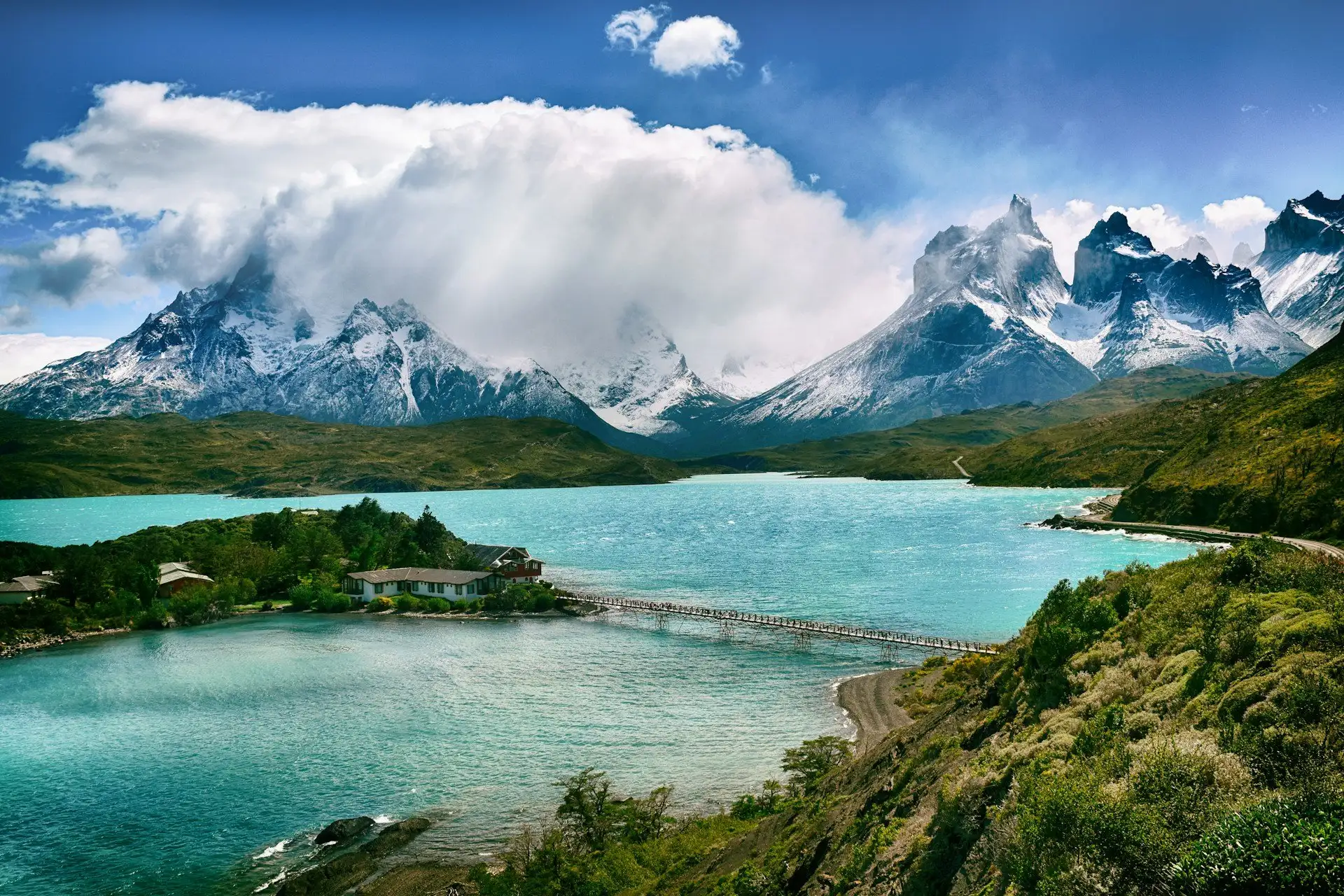
Torres del Paine National Park in Chilean Patagonia is organized around three granite towers — the Torres themselves, rising 2,800m from the Patagonian steppe in formations that suggest they were placed rather than grown. The W Trek (80km, 4–5 days) connects the main landscapes: Mirador Las Torres (the base of the towers, accessed by a steep 3-hour trail from the refugio), the Valle del Francés (where hanging glaciers calve directly into the valley below Paine Grande mountain), and the Grey Glacier (an enormous glacier extending from the Southern Patagonian Ice Field to Grey Lake). The full O Circuit (160km, 8–10 days) circles the massif including the less-visited back side. The park has guanacos (wild camelids) in enormous numbers, Andean condors overhead, pumas (rarely seen, tracks everywhere), and the specific Patagonian wind that can knock a person sideways. Book through reservas.parquesnacionales.cl 6–12 months ahead.
Atacama Desert & San Pedro
San Pedro de Atacama is the gateway to the most extreme desert landscape on earth. The valley sits at 2,440m in a landscape of moonlike salares (salt flats), volcanoes, and the specific stillness of a place where the concept of rain has no meaning. The experiences organized from San Pedro: Valle de la Luna (the "Valley of the Moon" — sculpted salt and rock at sunset, genuinely lunar), El Tatio Geysers at 4,320m (departure at 4am to see the geyser eruptions in the cold before-dawn air, most active when the temperature difference between the ground water and the air is greatest — dramatic but requires altitude preparation), the Salar de Atacama (flamingo lagoons at 2,300m where three flamingo species feed on the alkaline water), the Laguna Cejar (a buoyant salt lake where swimming is floating — similar chemistry to the Dead Sea), and night sky tours (the Atacama hosts the ALMA and ESO telescopes because its skies are the clearest on earth — the Milky Way overhead is extraordinary).
Easter Island (Rapa Nui)
Easter Island is 3,700km from the Chilean coast in the middle of the South Pacific — one of the world's most remote inhabited places. The Rapa Nui people who settled the island (arriving from eastern Polynesia approximately 800–1000 CE) carved approximately 900 moai from the volcanic tuff of Rano Raraku quarry, transported them across the island, and erected them on ahu (stone platforms) facing inland to watch over the communities. Some moai weigh 82 tonnes. The largest never erected stands 21 metres tall in the quarry. The engineering and logistics of the moai are genuinely puzzling with 15th-century technology. The UNESCO site covers the entire island. Hanga Roa is the only town. Fly from Santiago (5.5 hours) — three to four nights is the minimum for the main sites.
Valparaíso
Valparaíso — Chile's second city and its most artistically alive — is built on 42 hills (cerros) descending to a Pacific port, connected by funicular ascensores (many now defunct, some revived), covered in murals of extraordinary scale and quality, and operating with an urban energy that Santiago's wealth and order don't quite produce. Pablo Neruda's house La Sebastiana (one of three houses he owned — all now museums) is in Cerro Florida, full of the obsessive collectibles and sea views that characterized his domestic life. Cerro Alegre and Cerro Concepción are the main tourist hills — cafés, gallery-studios, murals, and the specific vantage of looking down at the Pacific and the bay. Viña del Mar, the beach resort city immediately north, is the weekend destination for Santiaguinos. Two days from Santiago.
Maipo, Colchagua & Casablanca
Chile's wine geography runs parallel to its length. The Maipo Valley (40km from Santiago) is where Chilean Cabernet Sauvignon established its international reputation — Concha y Toro, Santa Rita, and Cousiño Macul are the major houses, all offering tours and tastings. The Colchagua Valley (150km south, around Santa Cruz) produces Carmenère — the grape thought extinct in its Bordeaux homeland, rediscovered in Chilean vineyards in 1994 when DNA analysis revealed that what Chilean growers had labeled Merlot was actually the lost Carmenère. The Casablanca Valley (75km from Santiago toward Valparaíso) grows excellent Sauvignon Blanc and Chardonnay in the maritime cool-climate influence. Day trips from Santiago to Maipo and Casablanca; the Colchagua requires an overnight or long day.
Pucón, Villarrica & the South
The Chilean Lake District (roughly 600–900km south of Santiago) is a landscape of perfectly symmetrical volcanic cones rising above glacier-fed lakes — a landscape that 19th-century German immigrants described as "the Chilean Switzerland" and proceeded to settle with gingerbread houses and küchen (German cake). Villarrica volcano (2,847m) above the lake town of Pucón is the most accessible active volcano in South America — guided summit hikes (crampons, ice axe, full equipment provided) operate most of the year except during elevated activity periods. Whitewater rafting on the Trancura River, hot spring soaks in the river and at Termas Geométricas near Coñaripe, and the Huerquehue National Park (lakes and araucaria — monkey puzzle — trees) complete the Pucón circuit. Puerto Montt and Puerto Varas to the south connect to the Carretera Austral.
Carretera Austral
The Carretera Austral (Route 7) is a 1,240km road through Chilean Patagonia from Puerto Montt to Villa O'Higgins — one of the world's great drives, built through previously roadless wilderness. The road passes the Hornopirén fjords, the Chaitén town rebuilt after the 2008 volcanic eruption (you can still walk through the abandoned section consumed by lava and ash), Lago General Carrera (the second-largest lake in South America, shared with Argentina, with the marble caves of Puerto Río Tranquilo), the Cochrane area near the Northern Ice Field, and the Río Baker — Chile's largest river by volume, an extraordinary jade-blue torrent running through a canyon of polished granite. Much of the road is unpaved. Multiple ferry crossings are required. A 4x4 is strongly recommended. Allow 10–14 days end-to-end.
Santiago
Santiago is more than a transit hub and deserves two to three days of genuine engagement. The city of 7 million sits in a valley between the Andes (visible on clear days in extraordinary detail from the city — snow-capped peaks at 5,000–6,000m directly behind the skyline) and the coastal range. Barrio Italia, Barrio Brasil, and Yungay are the arts and independent culture neighborhoods. The Mercado Central is the correct place for a Chilean lunch of seafood — the large central market hall with a restaurant serving fresh catch is the Santiago institution. Bellavista is the nightlife neighborhood. The Museo Chileno de Arte Precolombino (Chilean Museum of Pre-Columbian Art) is among the continent's finest collections of Indigenous American art. The ski resorts of Valle Nevado and Portillo are 1–2 hours from the city — among South America's best.
Culture & Etiquette
Chilean culture is more formal than the Argentine or Brazilian equivalents and closer to a European social register in its emphasis on punctuality, polite distance with strangers, and a certain reserve in public interactions that warms considerably as relationships develop. Chileans are not cold — they are careful. A Chilean friend is a friend for life; a Chilean acquaintance is polite but not immediately warm in the Brazilian or Costa Rican way.
Chilean Spanish is one of the most challenging varieties of the language for learners — faster than standard Spanish, with significant vowel reduction (syllables at the end of words are often dropped entirely), extensive use of lunfardo-adjacent slang (po, weón/wena, cachai), and a specific Chilean rhythm that takes acclimatization. "Cachai?" (from "catch" — do you understand / get it?) is the most frequently deployed conversational particle. Most young Chileans in tourist areas have basic to functional English; outside major cities, Spanish is essential.
The CONAF reservation system (reservas.parquesnacionales.cl) opens W Trek refugio bookings far in advance. Peak season (December–February) fills completely. January is the absolute peak and the most wind-exposed month. November and March are shoulder season with better availability, lower prices, and fewer people on the trail. The park entry fee is approximately USD $35 in high season and must also be purchased through the CONAF system.
San Pedro de Atacama has one of the world's most extreme diurnal temperature ranges — days can reach 30°C and nights drop to 0°C in the same 24 hours because the desert altitude allows heat to radiate away rapidly after sunset. El Tatio Geysers before dawn requires heavy winter clothing (thermal base layer, down mid-layer, windproof outer). By 11am at El Tatio you'll be removing layers. Pack for both extremes simultaneously.
The 1973 coup, the Pinochet dictatorship, and the ongoing debate about the economic model and human rights are not historical footnotes in Chile — they are present-tense political subjects that Chileans hold strong views about. Engaging thoughtfully rather than superficially with these subjects — listening more than pronouncing — produces the most interesting conversations you'll have in the country. Visit the Museo de la Memoria before forming opinions.
Chilean seafood — specifically the cold-water Pacific species that only exist on the Chilean coast — is extraordinary and underrecognized internationally. Locos (abalone), erizos (sea urchin), machas (surf clams), congrio (conger eel, the basis of Chile's most famous fish soup), and the full spectrum of shellfish from the Chilean fjords are some of the finest seafood in the world. The Mercado Central in Santiago, the fish market in Puerto Montt, and any local restaurant in coastal Valparaíso are the correct places to access it.
Chilean wine tourism is sophisticated — the major Colchagua Valley wineries offer appointments-only library tastings, barrel samples, and vineyard walks led by winemakers. Arriving with some preparation (knowing the Carmenère story, understanding what the different appellations produce) produces a far more interesting tasting experience than arriving without context. The Chilean sommeliers at the best wineries are genuinely excellent and enjoy visitors who engage seriously.
Chile has among the world's strictest agricultural biosecurity controls — bringing fresh fruit, vegetables, meat, dairy, seeds, or plant material across any Chilean border (including from Argentina) is illegal and enforced with fines. This applies with particular strictness to Patagonia crossings (many hikers combine Argentine Patagonia with Torres del Paine) and to the Atacama crossings from Bolivia and Argentina. Eat your fresh food before the border or declare it at customs and have it confiscated without fine.
Santiago's tap water is generally safe to drink. In smaller towns, remote areas, and rural regions (including Atacama villages outside San Pedro), bottled or filtered water is advisable. The Pacific coast and fjord region have variable water quality. When in doubt, ask locally — Chileans will tell you honestly whether their local water is potable.
Chile's national parks — particularly Torres del Paine — have experienced devastating fires caused by visitor carelessness. A 2011–2012 fire burned 17,000 hectares of the park and took weeks to control. CONAF's fire restrictions are strict and enforced with significant fines. No open fires outside designated fire sites. No candles in tents. No smoking on trails. The Patagonian wind turns a spark into a firestorm in minutes.
Easter Island is 3,700km from continental Chile in the open Pacific. Flights are operated by LATAM from Santiago (5.5 hours) and occasionally Tahiti (5 hours). There is essentially no medical facility on the island capable of handling serious emergencies — a medical evacuation to Santiago is a 5.5-hour flight plus ambulance time. Travel insurance with medical evacuation coverage is not optional for Easter Island visits. The island's hospital is equipped for basic care only.
Much of the Carretera Austral (Route 7) is unpaved, deeply potholed, and crossed by river fords in the southern section. A 4x4 with high clearance is strongly recommended for the full route. A standard sedan can manage the northern paved section but will sustain damage on the central and southern gravel sections, and rental companies' policies typically exclude unpaved road damage. Multiple ferry crossings are also required — book ahead in peak season (December–February) as the ferries have limited vehicle capacity.
Pablo Neruda
Pablo Neruda — the 1971 Nobel Laureate for Literature, Chile's most celebrated poet, and one of the 20th century's most significant voices in Spanish — is woven into Chilean cultural identity in ways that require biographical engagement to fully appreciate. His three houses (La Chascona in Barrio Bellavista in Santiago, La Sebastiana in Valparaíso, and Isla Negra on the coast) are now all open as museums managed by the Fundación Neruda. The houses are collections of his obsessions — ships in bottles, ships' figureheads, antique maps, colored glass, and the view of the Pacific from every window. Reading a few poems before visiting the houses transforms the experience completely. He died 12 days after the coup, under circumstances disputed since — the official cause was prostate cancer, though later investigations have raised the possibility of something else.
Music — Nueva Canción & Cueca
Chile's musical contribution to 20th-century Latin American culture was Nueva Canción Chilena — the political folk music movement of the 1960s and 1970s, whose most famous figure was Víctor Jara. Jara, a folk musician, theater director, and committed socialist, was arrested at the Technical University of Santiago on September 11, 1973, and killed at the Estadio Chile (now renamed Estadio Víctor Jara) days after the coup. His story — and his music — is essential context for understanding Chile. The cueca, the national dance (a handkerchief-waving courtship dance with Indigenous and Spanish roots), is performed at every national holiday. During the dictatorship, women performed the cueca alone at protests — la cueca sola — as a symbol of the disappeared.
Football
Chilean football had its defining moment in the 2015 and 2016 Copa América victories — the first major international trophies in Chilean football history, achieved with a generation of players centered on Alexis Sánchez. The Chilean national team's playing style under Jorge Sampaoli (high-pressing, energetic, physically demanding) became internationally admired during this period. Club football: Universidad de Chile and Colo-Colo are the main Santiago clubs — the Superclásico between them is the fiercest rivalry in Chilean football. Attending a Colo-Colo home game at the Estadio Monumental (the largest in South America by capacity) provides the full South American football crowd experience.
Mapuche Culture
The Mapuche are the largest Indigenous nation in Chile (approximately 1.8 million people, roughly 10% of the population) and the most politically visible. The Mapuche land rights conflict — centered in the Araucanía region (La Araucanía, VIII and IX regions) — involves demands for the return of ancestral lands confiscated in the 19th-century Pacificación. The conflict has included arson attacks on agricultural and forestry property, state violence against Mapuche communities, and the application of anti-terrorist legislation to Mapuche activists. Visitors to the Lake District and Araucanía regions are in the territory of this ongoing conflict. The Mapuche cultural heritage — the mapudungún language, the machis (spiritual leaders), the textiles and silverwork — is visible and celebrated at cultural festivals and craft markets throughout the south.
Food & Drink
Chilean cuisine has historically been less celebrated internationally than Argentine or Peruvian cooking but has been developing rapidly — Santiago in particular has a restaurant scene that has grown significantly since the 2010s and now has a credible claim to being the second-best food city in South America after Lima. The foundations of Chilean food are the cold Pacific seafood (extraordinary and specific to Chile's waters), empanadas de pino (the Chilean baked empanada filled with beef, onion, boiled egg, olive, and raisin), and the Central Valley's wine alongside a food culture that is genuinely unpretentious and warm.
The most distinctively Chilean food tradition is the once (pronounced "ohn-seh") — a late afternoon tea-and-snacks meal eaten around 5–7pm that functions as a cross between British tea and a light dinner, and which means that Chileans often eat their actual dinner at 9–10pm. This is the most specifically Chilean meal and the least visible to tourists who follow standard restaurant hours.
Cold Pacific Seafood
Chilean waters produce some of the world's finest cold-water seafood — the Humboldt Current that runs along the Pacific coast creates an upwelling of nutrient-rich water that supports extraordinary marine biodiversity. Locos (Chilean abalone) — the most prized shellfish, served cold with mayonnaise or hot with a creamy sauce. Erizos (sea urchin) — eaten fresh from the shell with lemon. Machas a la parmesana (surf clams baked with parmesan and white wine). Caldillo de congrio — Pablo Neruda wrote an ode to this fish soup, which is made from conger eel with potatoes, onion, tomato, and cream. All of these are available at the Mercado Central in Santiago and at fish restaurants along the coast.
Empanada de Pino
The Chilean empanada — baked (not fried), large, and filled with a specific combination of minced beef (pino), diced onion, a slice of hardboiled egg, a black olive, and a raisin — is the country's most universal food. It is eaten at every occasion, from the national September 18 independence celebrations (where empanadas, chicha, and cueca dancing are the required combination) to street food throughout the year. The empanada de pino is specifically Chilean — the olive and raisin combination in a baked empanada is not found in this form elsewhere in South America. Also excellent: empanada de queso (cheese) and empanada de mariscos (seafood — particularly on the coast).
Cazuela & Hearty Stews
Cazuela is the Chilean comfort meal — a clear broth stew with a piece of bone-in beef or chicken, large chunks of potato, corn on the cob, pumpkin, rice, and green beans. It is home food, restaurant food, and celebration food. The quality depends on the stock (proper bone-in beef cazuela takes hours) and the freshness of the vegetables. Porotos granados (a summer bean stew with corn, pumpkin, and basil that is specific to the season when all three ingredients are fresh) is equally Chilean and equally invisible to tourist menus. Charquicán (a hash of jerky beef, potato, pumpkin, and vegetables) is from the north and has Atacameño roots.
Pisco & Wine
Chile and Peru both claim pisco as their national spirit — the dispute is genuinely heated and diplomatically significant. Chilean pisco (a grape distillate from the Elqui Valley) is the basis of the Pisco Sour (pisco, lemon juice, sugar, and egg white — the Chilean version uses lemon rather than lime and sometimes a dash of bitters). Chilean wine at any quality level is outstanding value — the Carmenère from Colchagua, the Cabernet Sauvignon from Maipo, and the coastal Sauvignon Blanc from Casablanca or San Antonio are all world-class. Craft beer has exploded since the 2010s — Santiago and Valparaíso both have excellent craft beer scenes with strong lager and IPA traditions.
Mote con Huesillos
The specific and specifically Chilean summer street drink: dried peach (huesillos) reconstituted in sweet syrup, served over cooked husked wheat (mote), cold, from a large glass jar at street vendors and market stalls throughout the summer. It is sweet, slightly fermented, and requires acquaintance before appreciation. It is also completely specific to Chile — you will not find it elsewhere. If someone hands you a glass, drink it. This is the experiential test of cultural immersion that traveler memoirs are made of.
Küchen & Lake District Baking
The 19th and early 20th-century German immigration to the Chilean Lake District produced a baking tradition that is maintained with genuine pride — the küchen (German cake, specifically with fruit toppings: plum, cherry, raspberry, or apple on a thick pastry base with crumble) is available at every café and bakery in Valdivia, Frutillar, Puerto Varas, and Pucón. The German influence in these towns is visible in the architecture, the bakeries, the beer halls (cervecerías), and the family names on every mailbox. Frutillar specifically hosts the annual Semanas Musicales (Musical Weeks) in February — a classical and folk music festival at the Teatro del Lago, one of the most beautifully situated concert halls in South America.
When to Go
Chile's enormous length creates completely different seasonal realities by region — and remember the Southern Hemisphere inversion: January and February are summer, July and August are winter. The Atacama is a year-round destination (the desert doesn't have a rainy season in any meaningful sense). Torres del Paine and Patagonia have a strict summer season. The Lake District is best in summer but has the unique advantage of ski resorts in winter. Santiago is year-round with a clear summer peak.
Southern Summer
Nov – Mar (Patagonia)The only viable window for Torres del Paine W Trek and Carretera Austral driving. December–February is peak: longest days (up to 18 hours of light in Patagonia's far south), warmest temperatures (10–20°C in the park), but maximum wind and maximum crowds. November and March are the best compromise — fewer visitors, similar temperatures, slightly shorter days. Easter Island is excellent year-round but most comfortable October–April.
Atacama Desert
Any monthThe Atacama has essentially no seasonality — the desert doesn't rain. The best stargazing is in winter (June–August) when the Milky Way is clearest. Summer (December–February) is the warmest during the day but still cold at night. El Tatio geysers are most active in the coldest months when the temperature differential is greatest. July–August is the altiplano winter — avoid if traveling to high-altitude salt flats near Bolivia.
Shoulder Season
Oct–Nov, Mar–AprOctober–November and March–April are ideal for most of Chile. Torres del Paine in these months has fewer people, similar weather to peak season (slightly cooler, slightly less wind), and better W Trek booking availability. The central valley and wine country are at their most beautiful — September–October for spring wildflowers (including the desierto florido in Atacama, when the desert briefly flowers after rare rains), March–April for autumn harvest. Santiago is comfortable year-round.
Chilean Winter
Jun – SepSantiago's ski resorts (Valle Nevado, La Parva, El Colorado — all within 1–2 hours of the city) operate June–September with snow reliability that is among the best in South America. The Andes skiing combines with Santiago city culture for a distinctive combination. Villarrica volcano near Pucón operates year-round for summit hikes when conditions permit. Patagonia is essentially inaccessible for hiking in winter — Torres del Paine closes some trails.
Trip Planning
Chile's most common planning mistake is treating the country as a single trip that can be seen end-to-end in two weeks. Flying from Santiago to Punta Arenas (for Torres del Paine) takes 3.5 hours. Flying from Santiago to Calama (for the Atacama) takes 2 hours. Flying from Santiago to Easter Island takes 5.5 hours. These are efficient in themselves but combining all three in two weeks leaves approximately 3 days per region — not enough for any of them. Choose two regions and go deep: the Atacama and Santiago/wine country (10–14 days), or Santiago and Torres del Paine (10–14 days), or Easter Island as a dedicated 5-day extension from either circuit.
Santiago
Day one: arrive Arturo Merino Benítez Airport (SCL). Barrio Bellavista, the Mercado Central for lunch, Cerro San Cristóbal for the city and Andes view. Day two: Museo de la Memoria in the morning (essential context). Barrio Italia afternoon — independent shops, cafés, the covered Feria Bio Bio. One evening meal at a Barrio Italia restaurant. Fly to Punta Arenas in the evening (3.5 hours).
Punta Arenas & Puerto Natales
Day three: arrive Punta Arenas, the southernmost city of significance in the world. Penguin colony at Isla Magdalena (1 hour by boat) — a Magellanic penguin colony of 120,000 pairs, November–March. Drive or bus to Puerto Natales (3 hours — the gateway to Torres del Paine). Prepare and repack for the W Trek.
W Trek — Torres del Paine
Five days for the W Trek (pre-booked through reservas.parquesnacionales.cl — 6–12 months ahead). Day four: enter the park, walk the Las Torres base (5 hours to the mirador — arrive at sunrise for the pink granite towers reflected in the teal lake). Night at Camp Torres refugio. Day five: Valle del Francés — the hanging glaciers of Paine Grande and the hanging valley of the French Valley (6–7 hours). Day six: continue to Paine Grande. Day seven: Grey Glacier — the 5km glacier tongue extending from the Southern Patagonian Ice Field into Grey Lake (boat option available). Day eight: exit the park to Puerto Natales.
Puerto Natales & Recovery
Two days in Puerto Natales after the trek. The town is small, charming, and completely organized around equipping and recovering trekkers. Good seafood, the Cueva del Milodón (Mylodon cave — a giant ground sloth bone was found here in 1896, fossilizing the legend into the Patagonian cultural geography), and the pleasure of a hot shower and a restaurant meal after five days of refugio food.
Valparaíso
Fly from Punta Arenas back to Santiago (3.5 hours). Day trip or overnight to Valparaíso — the mural walks of Cerro Alegre and Concepción, La Sebastiana, the fish market in the port area. Return to Santiago for departure flight.
Santiago
Two Santiago days: Museo de la Memoria (morning), Mercado Central lunch, Barrio Bellavista afternoon, wine tasting in Barrio Italia. Day two: day trip to the Maipo Valley — Concha y Toro or Santa Rita for a full winery tour and lunch, back for the evening. Fly to Calama (for the Atacama) the next morning.
Atacama Desert
Six days. Day three: arrive Calama, transfer to San Pedro de Atacama (1.5 hours). Rest and acclimatize — 2,440m, take it easy. Day four: Valle de la Luna at 3pm for the sunset and the full lunar landscape experience. Day five: El Tatio Geysers departure at 4am (book the previous day) — the most dramatic dawn in Chile. Flamingos at Laguna Cejar afternoon. Day six: Salar de Atacama full circuit — Laguna Chaxa for flamingos (morning light), Laguna Tebenquiche, the salt formations. Day seven: full-day 4x4 excursion to the Bolivian border via Salar de Aguas Calientes — volcanoes above 6,000m, vicuñas, and the most extreme landscape in the country. Day eight: stargazing tour (the definitive Atacama experience — the Milky Way at 2,440m with a professional astronomer is otherworldly). Fly back to Santiago.
Valparaíso & Wine
Two days on the coast circuit: Casablanca Valley winery in the morning (the drive from Santiago to Valparaíso passes through Casablanca — build a morning winery stop in). Valparaíso afternoon: cerros, murals, Neruda. Day ten: Neruda's Isla Negra house (45 minutes south of Valparaíso on the coast — the most atmospheric of his three houses, with the sea view through the living room window that he ordered). Return to Santiago.
Easter Island
Fly from Santiago to Easter Island (5.5 hours — book with LATAM, the only scheduled operator). Four days: day eleven: Ahu Tongariki at sunrise (the 15-moai platform, the most iconic view) then Rano Raraku quarry (spend 2 hours — every stage of moai carving is visible here, from fully carved moai ready for transport to unfinished ones still embedded in the hillside). Day twelve: Anakena beach and the Ahu Nau Nau moai (restored with topknots, the most complete). Rano Kau volcanic crater. Day thirteen: snorkelling, Tahai at sunset (the moai nearest the airport town). Day fourteen: fly back to Santiago for international departure.
Santiago in Depth
Three days: Museo de la Memoria, Museo Precolombino, Mercado Central lunch, Barrio Italia, the Lastarria district, the palaces of Cerro Santa Lucía. Day two: Maipo Valley full winery day — Santa Rita's Andean landscape setting and Cousiño Macul (the oldest winery still operating in Chile, 1856). Day three: Barrio Yungay and Barrio Brasil street art walk, the Matucana 100 cultural center, La Moneda Palace (the presidential palace bombed in the 1973 coup and rebuilt).
Valparaíso & Casablanca
Three days: Casablanca winery day, Valparaíso two full days (Neruda houses, cerros, the port, the Museo de Bellas Artes). Spend one night in Valparaíso to experience the city after the day-trippers leave — the evening restaurants and bars of Cerro Alegre are a different city from the daytime tourist version.
Lake District — Pucón
Fly from Santiago to Temuco (1 hour), drive to Pucón (1.5 hours) or fly directly to Pucón. Three days: Villarrica volcano summit hike (day eight, if weather permits — crampons provided, full equipment rental included in guided price). Huerquehue National Park for the araucaria forest and high-altitude lakes (day nine). Termas Geométricas for a full day of hot pools in native forest.
Atacama Desert
Fly from Temuco to Calama via Santiago. Six full days in the Atacama — all the major sites plus a full-day 4x4 excursion to the Bolivian border and a night at the Salar de Atacama under the stars. On the sixth day, the Elqui Valley (3 hours south of San Pedro by road, or fly separately from Santiago) for pisco distillery tours at Gobernadora or Mistral — Chile's best pisco producers.
Torres del Paine
Fly from Calama to Punta Arenas (via Santiago). Penguin colony at Isla Magdalena. Five full W Trek days (pre-booked months ahead). Day of recovery in Puerto Natales. Fly back to Santiago from Punta Arenas for international departure.
W Trek Booking — Act Now
Go to reservas.parquesnacionales.cl now. The W Trek requires booking each night's accommodation (refugio or camping) individually — there is no single "W Trek booking." Each refugio (Las Torres, Chileno, Los Cuernos, Paine Grande, Grey) has limited capacity and books out months ahead for December–February. November and March are more available but still need 3–6 months of advance planning. The park entry fee (approximately USD $35 in high season) is also purchased through the CONAF system. Without bookings, you cannot do the W Trek in peak season — there is nowhere to sleep.
Altitude in the Atacama
San Pedro de Atacama is at 2,440m — manageable for most visitors with mild initial symptoms. El Tatio Geysers are at 4,320m — a significant altitude gain that affects visitors not acclimatized to the Andean plateau. Spend a full day in San Pedro before visiting El Tatio. Symptoms of altitude sickness at El Tatio (headache, nausea, dizziness) should be treated by descending to San Pedro immediately. The geyser tour operators will have basic oxygen available. Don't rush acclimatization for the sake of the excursion schedule.
Connectivity
Entel and Movistar have the best national coverage in Chile. Entel specifically has the best coverage in Patagonia and remote areas — worth specifying if buying a local SIM. Buy at the airport or carrier stores in Santiago. An eSIM through Airalo works well for most city destinations. Torres del Paine has no mobile coverage except in the main refugios (satellite WiFi only). The Atacama has good coverage in San Pedro town but essentially none in the desert itself. Download offline maps before entering either area.
Get Chile eSIM →Power — Type C/L
Chile uses 220V (same as Europe) with Type C (two round pins) and Type L (three inline round pins — the Italian standard, not common elsewhere) plugs. European two-pin plugs fit Type C sockets, which are the most common in Chile. North American flat-pin plugs require a Type A/C adapter. Most modern electronics are dual-voltage (100–240V) — check device specifications before bringing voltage converters. Remote lodges in Patagonia and Atacama may have limited power hours (generator-dependent) — charge devices during the generator window.
W Trek Gear List
What the refugios provide: bed, bedding, dinner, breakfast. What you carry: a daypack with water (2L minimum per day), snacks, sunscreen, rain gear, windproof shell (rated for extreme wind — this matters), trekking poles, gloves and hat for the Grey Glacier section, and change of clothing for each day. Luggage transfer between refugios is available (for a fee) at some sections — ask when booking. The hiking boots must be broken in before the W Trek. Starting with new boots on day one of a 4–5 day trek in cold wet conditions is a well-documented way to ruin the experience.
Travel Insurance
Essential for Chile — particularly for Torres del Paine (helicopter evacuation from the park is expensive without coverage), Easter Island (remoteness means medical evacuation to Santiago for any serious condition), and the Atacama (altitude sickness requiring medical attention and descent). Confirm the policy covers: trekking at altitude, adventure activities (in Pucón specifically for volcano hikes and whitewater), and medical evacuation from Easter Island's remote location. Clínica Las Condes and Clínica Alemana in Santiago are the best private hospitals in Chile.
Transport in Chile
Chile's transport is organized around its extraordinary length. Between major regional destinations (Santiago to the Atacama, Santiago to Patagonia), domestic flights are essential — the distances are too great for any alternative. Within regions, a rental car gives the most flexibility. Santiago itself has one of South America's best metro systems. The Carretera Austral requires a 4x4 and multi-day planning with ferry crossings.
Domestic Flights
CLP $50,000–180,000LATAM Chile and Sky Airline connect Santiago to all major domestic destinations. Essential routes: SCL–CJC (Calama for Atacama, 2 hours), SCL–PUQ (Punta Arenas for Patagonia, 3.5 hours), SCL–PMC (Puerto Montt for Lake District, 1.5 hours), SCL–IPC (Easter Island, 5.5 hours). Book ahead — Easter Island in particular has limited capacity and fills up fast in peak season. LATAM and Sky offer good base fares 3–4 weeks ahead; last-minute prices on Easter Island flights are extremely high.
Santiago Metro
CLP $800–900/rideSantiago's metro is one of South America's best — clean, fast, extensive (6 lines, 136 stations), and covers most tourist destinations within the city. Buy a Bip! card (reusable, sold at any metro station) for discounted fares. Peak hours (7–9am and 5:30–8pm) are very crowded — keep valuables secured. The metro connects the airport (Aeropuerto station, Line 1) directly to the city center — the cheapest airport connection at CLP $800 versus CLP $12,000+ by taxi.
Uber & Taxis
App rate or meteredUber operates throughout Santiago. Cabify is an alternative with slightly different coverage. Both are GPS-tracked and significantly more transparent than street taxis. Official taxis in Santiago are metered — confirm the meter is running. In Valparaíso, taxis operate on fixed rates between cerros and the port area — agree the rate before entering. In Patagonia and the Atacama, taxis and transfers from accommodation are the standard option — negotiate rates for longer journeys.
Long-Distance Bus
CLP $15,000–80,000Chile's long-distance bus network (Turbus and Pullman are the main operators) is excellent for journeys under 8 hours — Santiago to Valparaíso (1.5 hours, every 15 minutes), Santiago to La Serena (6 hours), Santiago to Valdivia (10 hours overnight). The cama (flat bed) class on overnight coaches is genuinely comfortable. For Patagonia and the far north, flying beats the bus by a factor of 10 in time. Buy tickets at terminals or online at turbus.cl and pullman.cl.
Car Rental
CLP $25,000–60,000/dayEssential for wine country day trips, the Carretera Austral (requires 4x4), and the Atacama's outer excursion circuits. Standard vehicles work on the Pan-American Highway and between major cities. The Carretera Austral and rural Patagonia tracks require a 4x4. International license accepted alongside home country license. Book at airports — the major operators (Europcar, Hertz, Budget, Alamo) all have airport desks at SCL.
Navimag Ferry
From USD $500The Navimag ferry from Puerto Montt to Puerto Natales (for Torres del Paine) takes 3–5 days through the Chilean fjord system — one of the world's great slow journeys. Passes through the fiords, channels, and glaciers of the Chiloé Archipelago, passing Parque Nacional Pumalín and the Northern Ice Field. Accommodation ranges from bunk beds to double cabins. Food is included. Operates year-round with reduced frequency in winter. Book at navimag.com — fills up months ahead in peak season.
Park Buses (Torres del Paine)
CLP $20,000–45,000Bus services connect Puerto Natales to the Torres del Paine park entrance and to the main refugio points (administration center, Las Torres, Paine Grande). JB, Fernández, and Bus Sur operate the routes — buy at Puerto Natales bus terminal or from hostels. The catamaran across Grey Lake (connecting Grey Glacier to Paine Grande on the W Trek) is operated by CONAF and must be booked through the reservation system when booking your W Trek accommodations.
Atacama Tour Vehicles
USD $30–90/tourAll Atacama excursions (El Tatio, Valle de la Luna, Salar circuit, Bolivian border) are operated by licensed tour companies from San Pedro de Atacama in Toyota Land Cruisers and similar vehicles. Tour operators are concentrated on the main street of San Pedro — compare prices and confirm what's included (entrance fees, guide, food). Book El Tatio the day before (the 4am departure fills up); Valle de la Luna can be booked same-day. The quality of the guide varies significantly — ask other travelers for recommendations.
Accommodation in Chile
Chile's accommodation reflects its geography and the types of experiences on offer. Santiago has a full range of international and boutique hotels. The W Trek is structured around CONAF-operated refugios (mountain huts) that must be booked through the official reservation system — no private booking outside this system is valid for the W Trek route. The Atacama has excellent boutique lodges in San Pedro. Easter Island has limited but good accommodation in Hanga Roa. The Carretera Austral has a network of small guesthouses and eco-lodges along its length.
Santiago Hotel
CLP $60,000–300,000+/nightStay in Barrio Italia, Lastarria, or Barrio Bellavista rather than the business districts. The W Santiago (luxury, Barrio El Golf), Casa Higueras in Valparaíso (boutique, hillside), Hotel Magnolia (boutique, Barrio Lastarria — rooftop and swimming pool). Mid-range: The Aubrey (Cerro Concepción, Valparaíso — the best boutique hotel in Valparaíso), Hotel Noi Vitacura. Budget: the hostel sector in Barrio Brasil and Barrio Italia is well-developed with several good options in the CLP $12,000–25,000 dorm range.
W Trek Refugios
USD $80–150/person/nightThe CONAF W Trek refugio system includes Las Torres, Chileno, Los Cuernos, Paine Grande, and Grey — all with bunk beds, heating, and full board (dinner and breakfast included). The price includes all meals. Camping (at designated sites adjacent to refugios) is cheaper (approximately USD $15–25/person/night) but requires carrying all gear. Book at reservas.parquesnacionales.cl. The Explora Patagonia (at Salto Chico — luxury all-inclusive outside the W Trek booking system) is the premium option for those preferring day hikes to multi-day camping.
Atacama Lodge
USD $80–600/nightSan Pedro de Atacama has excellent boutique lodge options. Explora Atacama (luxury all-inclusive, with guided excursions included) is the premium choice. Alto Atacama Desert Lodge and Spa (mid-luxury, salt pool, mountain views). Ckunna (mid-range boutique, smaller and more personal). Budget: the hostel cluster in San Pedro's village center is well-developed — Kimal and Casa Atacameña offer budget-to-mid options. The lodge quality in San Pedro is generally higher than the equivalent price point in Chilean cities — the competition for the destination's limited accommodation has driven standards up.
Easter Island Guesthouse
USD $80–300/nightEaster Island accommodation is almost entirely in Hanga Roa town. Options range from small family guesthouses (residenciales) where the host cooks breakfast and can arrange guides to the Hangaroa Eco Village (the island's premium boutique hotel). Most mid-range accommodation includes breakfast and is willing to arrange tours. Book well ahead — the island has a limited number of beds and peak season is fully booked. A 3–4 night stay is minimum for the main sites; 5 nights allows time to see everything at an enjoyable pace.
Budget Planning
Chile is one of the more expensive countries in South America — more expensive than Peru, Bolivia, or Argentina at current exchange rates, roughly comparable to a mid-range European destination for accommodation and activities. The strong Chilean peso relative to most South American currencies has been maintained through strong macroeconomic management, and the absence of the currency arbitrage that makes Argentina cheap means Chile prices are more straightforward. What you see is what you pay. The W Trek specifically has a high minimum cost (park entry, refugio accommodation with meals, bus transfers) that accumulates to approximately USD $500–700 for 4 nights independent of getting to Patagonia.
- Hostel dorm (CLP $12,000–22,000)
- Mercado and soda-equivalent lunches
- Long-distance buses
- W Trek camping rather than refugios
- Self-guided national parks
- Boutique hotel (CLP $60,000–120,000)
- Restaurant meals with wine
- Domestic flights between regions
- W Trek refugio accommodation
- Guided Atacama excursions
- Explora Atacama or Patagonia lodge
- Easter Island premium guesthouse
- Private wine cellar experiences
- Private guides for all activities
- Navimag ferry private cabin
Quick Reference Prices
Visa & Entry
Chile offers visa-free entry for citizens of most Western countries. US, UK, EU, Canadian, Australian, Japanese, South Korean, and most other Western passport holders can enter for up to 90 days for tourism without any advance visa. On arrival, fill in the Tarjeta de Turismo (tourist card) and keep the stamped copy — it must be surrendered on departure. The biosecurity requirements at entry are Chile's most distinctive border feature — the strict no-fresh-food rule is actively enforced.
Fill in the tourist card on arrival. Keep the stamped copy. Surrender it on departure. Strict biosecurity — no fresh food, seeds, soil, or plant material across any Chilean border.
Family Travel & Pets
Chile is an excellent family destination with honest age assessments for specific activities. The W Trek is suitable for fit teenagers and adults — the daily distances (10–20km) and the cold, windy conditions are challenging for younger children. The Atacama is accessible for families with any age children, with the El Tatio excursion more appropriate for children 8+ given the early departure time and altitude. Easter Island is excellent for all ages — small, safe, and with the moai encounter that produces universal fascination. Santiago and the Lake District are broadly accessible for families.
Easter Island for Families
Easter Island is among the world's best family cultural destinations — safe (the island is small and the population is 8,000), fascinating at any age (the moai produce genuine awe in children), and accessible (no significant hiking required for the main sites). Renting bicycles or quad bikes to move between sites is popular and appropriate for older children. The Rano Raraku quarry — where half-finished moai are embedded in the hillside in every stage of completion — is specifically fascinating for children who ask "but how did they do it?"
Lake District Volcanoes
The Lake District is the best Chile destination for families with children — Villarrica volcano visible across the lake, swimming in the lake in summer, hot springs, and the German-influenced towns with excellent küchen bakeries. The Villarrica volcano summit hike is for adults and fit older teenagers (physical demands are significant). For families with younger children: the hot springs at Termas Geométricas, the Huerquehue National Park's lake trails (accessible for children who can walk 5km), and kayaking on Lake Villarrica or Lake Llanquihue near Puerto Varas are excellent.
Penguin Colonies (Magallanes)
The Magellanic penguin colony at Isla Magdalena near Punta Arenas (120,000 pairs, November–March, accessed by 1-hour boat tour from Punta Arenas) is universally loved by children — penguins that walk past you at knee height, completely indifferent to human presence, going about their business with complete self-possession. Seno Otway, closer to Punta Arenas, is a smaller colony accessible by road. The Monumento Natural Los Pingüinos at Isla Magdalena is the more spectacular of the two. Pre-book the boat tour through operators in Punta Arenas.
Atacama for Families
The Atacama is excellent for families with children aged 8+ — the valley of the moon at sunset, the flamingo lagoons, the El Tatio geysers (with the sunrise and the steaming landscape that children find genuinely otherworldly). The main consideration is altitude — San Pedro at 2,440m causes mild symptoms in some children, and El Tatio at 4,320m should be attempted only after a full day of acclimatization in San Pedro. Younger children should skip El Tatio; the valley landscape is accessible at lower altitude.
Santiago Ski Resorts
Valle Nevado, La Parva, and El Colorado ski resorts within 1–2 hours of Santiago are among South America's best (June–September). All three offer ski schools for children with age-appropriate programs. Valle Nevado is the most developed resort with the most runs and the best facilities. The combination of Santiago city sightseeing and a ski resort day trip in the Andes makes for an unusual family holiday that combines cultural and sporting experiences within easy reach of each other.
Lake District Water Activities
The Chilean Lake District's combination of volcanic lakes, rivers, and Pacific fjords creates extraordinary water activity options for families: kayaking on Lake Villarrica or Lake Llanquihue (calm water, safe for children), white-water rafting on the Trancura River (family-appropriate sections from age 8+), and the Petrohué waterfalls and river near Puerto Varas for swimming and swimming in crystal-clear glacial water with Osorno volcano rising behind it. The Parque Nacional Vicente Pérez Rosales around Petrohué has accessible hiking trails for families.
Traveling with Pets
Chile permits the import of dogs and cats with documentation: a health certificate from an accredited veterinarian issued within 10 days of travel, a microchip, a valid rabies vaccination, a declaration of good health, and proof of treatment against internal and external parasites. The Servicio Agrícola y Ganadero (SAG) — Chile's agricultural authority — inspects animals at the port of entry. Chile's strict biosecurity controls apply to animals as well as food: pets arriving from countries deemed high-risk for specific diseases may face additional testing or quarantine periods.
Practically: Chile's strict biosecurity regime, the national park system's prohibition on pets, and the nature of the country's most rewarding destinations (Torres del Paine, the Atacama, Easter Island) make bringing a pet to Chile inadvisable for a tourist trip. National parks strictly prohibit pets — you cannot bring a dog into Torres del Paine, Atacama, or any CONAF-managed park. Easter Island's flight-only access creates significant logistical and cost complications for animals. Santiago and the Lake District are dog-friendly in city parks and some accommodation. For a nature and adventure trip, leave pets at home.
Safety in Chile
Chile is one of the safer countries in South America — it has strong institutions, a functioning police force (Carabineros), relatively low violent crime rates by regional standards, and a tourism infrastructure that is well-managed and professionally operated. The main safety considerations for visitors are environmental (Torres del Paine wind and weather, Atacama altitude) and the standard urban precautions against petty theft in Santiago and other cities.
Main Tourist Destinations
Torres del Paine, the Atacama, Easter Island, the Lake District, Valparaíso (tourist areas), and Santiago's tourist neighborhoods (Bellavista, Lastarria, Barrio Italia) are all safe from serious crime. Standard precautions — secure valuables, use official transport, don't display expensive electronics — are sufficient. Violent crime specifically targeting tourists is rare by South American standards.
Santiago Petty Theft
The Santiago metro and crowded areas (Mercado Central, Plaza de Armas, Alameda during rush hour) have documented pickpocketing. The standard urban precautions apply: bag in front, phone in front pocket or bag, don't display expensive cameras in crowded transit. The Bío-Bío flea market area and La Vega Central market require more awareness than the tourist-facing neighborhoods.
Torres del Paine Weather
The W Trek involves exposure to Patagonian weather that can turn dangerous without adequate preparation. Hypothermia risk on the exposed sections between refugios in wet and wind is real — wet clothing combined with extreme wind chill produces cold exposure rapidly. The Grey Glacier section is the most exposed. Never start a trek section without adequate windproof and waterproof layers in your pack regardless of the morning weather. CONAF rangers provide daily weather briefings at refugios — heed them.
Atacama Altitude
El Tatio geysers at 4,320m and the Bolivian border circuits at 4,500m+ are the primary altitude concerns. Symptoms of AMS (headache, nausea, fatigue, breathlessness) at these altitudes require immediate descent. Tour operators for El Tatio carry basic oxygen — use it if symptoms develop. Don't push through altitude sickness for the sake of completing the excursion. Descend to San Pedro, rest, and reassess.
Valparaíso After Dark
Valparaíso's lower city (the port area, parts of Plan — the flat downtown) becomes less safe after dark. The tourist cerros (Alegre and Concepción) are generally fine but walking between them via unfamiliar routes at night is not recommended. Take a taxi between cerros after 10pm. Ask your accommodation for the safe walking routes before exploring independently.
Medical Facilities
Santiago: Clínica Las Condes (+56-2-2610-3000) and Clínica Alemana (+56-2-2210-1111) are the best private hospitals — internationally accredited and staffed to European standards. In Patagonia: a helicopter evacuation from Torres del Paine to Punta Arenas is the emergency response for serious injuries — expensive without insurance. In the Atacama: the SOME clinic in San Pedro handles altitude sickness and minor emergencies. Easter Island: the Hanga Roa hospital handles basic care; anything serious requires evacuation to Santiago.
Emergency Information
Your Embassy in Santiago
Most foreign embassies are in Las Condes, Vitacura, and Providencia neighborhoods of eastern Santiago.
Book Your Chile Trip
Everything in one place. These are services worth actually using.
The Absurd Geography
The thing about Chile is that its geography shouldn't work. The country is 4,300km long and 177km wide on average — a strip of land compressed between the Andes and the Pacific, containing the driest desert on earth in the north and sub-Antarctic channels in the south, with volcanoes in the middle and an island that is 3,700km off the coast. A Chilean who lives in Santiago and holidays in the Atacama is experiencing the same country as one who treks to Torres del Paine — and neither of these is the same country as the one on Easter Island, which is the most improbably situated inhabited place in the Pacific Ocean.
Standing on the valley floor at the base of the Torres at sunrise — the three granite spires catching the pink light before the sun clears the ridge, the lake below them the exact shade of turquoise that exists nowhere else, the wind already beginning its daily building toward the howl of the afternoon — you understand why people come back. The landscape is operating at a scale that the body measures against itself and finds itself small, which is the correct feeling. The Torres are 2,800 metres of granite that have been here for 12 million years. The wind has been blowing off the Southern Ocean for rather longer. You are here for four days and completely privileged to be allowed that. Go.