
What Travellers Must Know About Chile
Chile's four primary tourist risk categories — each well-documented and each with clear countermeasures.
Common Scams & Risks in Chile
Express kidnapping (secuestro express) is Chile's most serious tourist crime and operates almost exclusively through unlicensed taxi services. The scenario: a driver approaches an arriving passenger at the airport or bus terminal, offers a reasonable fare, then locks the doors and drives to multiple ATMs, forcing the victim to make withdrawals — sometimes holding them for several hours until ATM daily limits reset. Victims are generally released unharmed after the money is taken, but incidents involving violence are documented. The crime is heavily concentrated at Santiago's international airport, where unlicensed drivers operate aggressively in the arrivals area.
- Use Uber, Cabify, or InDriver exclusively for transport from Santiago's airport and throughout the city — all three are legal, regulated, and safe in Chile. Open the app before you exit the terminal and walk to the designated app pickup zone.
- Never accept an approach from any driver inside the terminal building or in the arrivals area who offers a taxi — regardless of how professional they look or how reasonable the price sounds.
- Official licensed taxis from the airport operate from clearly marked stands outside the terminal with fixed-rate pricing to Santiago zones — if you use a taxi, use only these official stands, never an approach.
- Set daily ATM limits on your bank card before travelling — limiting withdrawals to USD 200–300 per day significantly reduces the financial impact if express kidnapping does occur.
Card skimming (overlay devices on ATM card slots with hidden cameras capturing PINs) and the "good Samaritan" scam are the two main ATM fraud variants in Santiago. The good Samaritan scam: your card is apparently swallowed by a malfunctioning ATM; a helpful bystander — part of the operation — suggests you enter your PIN again to recover it while an accomplice observes. The card is then retrieved by the criminal after you leave, with your PIN already known. A variant involves someone "helping" you notice a mistake in your transaction while shoulder-surfing your PIN.
- Use ATMs inside bank branches during business hours — Banco de Chile, BancoEstado, Santander Chile, and Scotiabank branches throughout Santiago have the safest ATMs. Avoid standalone machines in convenience stores, tourist areas, and shopping centre common areas.
- Cover the keypad completely with your free hand when entering your PIN — this defeats shoulder-surfing and hidden cameras simultaneously.
- If your card is apparently swallowed, do not re-enter your PIN regardless of what anyone tells you. Call your bank's international number to cancel the card immediately.
- Decline all assistance from strangers at ATMs — if someone approaches while you are using an ATM, cancel your transaction and leave before completing the interaction.
The mustard scam is one of Santiago's most documented tourist tricks and operates consistently in tourist areas. A substance (mustard, bird dropping, ketchup, or similar) is dropped or sprayed on the tourist from behind or above. A helpful local immediately appears to assist with cleaning — while an accomplice picks pockets or grabs a bag during the distraction. The "helper" may also offer to take the victim to a nearby shop or bathroom, creating further opportunity. The scam is simple, effective, and repeated in Santiago's main tourist zones continuously.
- If you are suddenly splattered with any substance on a Santiago street, immediately grab your bags and valuables tightly before looking at the stain — the distraction is the point, not the mess.
- Decline assistance from any stranger who immediately appears after you are splattered — move to a secure location before addressing the mess.
- Use a crossbody bag worn in front in tourist areas, carry your phone in a secure front pocket rather than a back pocket, and keep your bag zipped at all times in crowded areas.
San Pedro de Atacama's tour operator market has persistent issues. Operators sell tours they cannot reliably deliver — particularly for the Bolivia salt flats crossing (a multi-day trip requiring Bolivian licensing that not all operators hold validly) and the El Tatio geyser dawn trip. Substitution — replacing the booked experience with a lower-quality alternative — is documented. Aggressive street touts in San Pedro pressure travellers into immediate bookings before they can research alternatives. The most serious risk is altitude: El Tatio geysers sit at 4,320m, and the Bolivian salt flats crossings pass through areas above 5,000m — altitude sickness (AMS) causes real medical emergencies and some tour operators do not adequately advise visitors about the symptoms or carry oxygen.
- Book Atacama tours through established operators with verifiable reviews — Atacama Unique Expeditions, Rancho Cactus, and Cosmo Andino Expediciones are among the established names. Check TripAdvisor and Google reviews specifically for the tours you want, not just the operator generally.
- Never book on the street from touts — spend your first day in San Pedro visiting operator offices on Caracoles street during the day, comparing prices and asking specific questions before committing.
- Acclimatise before high-altitude excursions — spend at least 2 nights in San Pedro (2,400m) before attempting El Tatio (4,320m). For Bolivian salt flats crossings above 4,500m, additional acclimatisation days are strongly recommended.
- Ask your tour operator specifically whether they carry supplemental oxygen for altitude emergencies on high-altitude excursions — reputable operators do. Ask whether they have a licensed Bolivian guide for salt flats crossings requiring Bolivian territory entry.
- Symptoms of altitude sickness: headache, nausea, fatigue, dizziness, shortness of breath. Descend immediately if symptoms appear — do not attempt to push through them at high altitude.
Patagonia's weather is genuinely dangerous and kills visitors every year. Torres del Paine National Park experiences wind gusts exceeding 120 km/h that can knock hikers off their feet on exposed ridgelines — the same ridgelines that provide the park's most spectacular views. Weather changes from warm and calm to cold, wet, and windy in under an hour with no warning. River crossings that are safe in the morning can be impassable by afternoon after upstream rain. Hypothermia occurs in summer conditions because the combination of wind and wet brings effective temperatures far below the air temperature. Multiple fatalities occur annually in Torres del Paine and the surrounding area from falls, exposure, and river accidents.
- Carry full waterproof shell (jacket and trousers), insulating mid-layer, hat, and gloves on every day hike in Torres del Paine regardless of the morning forecast — conditions change within the hour.
- Register your intended route with the park administration (CONAF) at the park entrance before any multi-day trek — this initiates search and rescue if you don't return on schedule. Registration is mandatory for the W and O circuits.
- Book refugio accommodation on the W circuit in advance through Fantástico Sur or Vertice Patagonia — open camping capacity is limited and attempting the circuit without accommodation booked has left visitors stranded in extreme weather.
- Do not attempt to cross rivers that appear flooded or fast-moving — afternoon water levels are significantly higher than morning levels after rain or glacier melt upriver. Wait, turn back, or use the designated bridge crossings.
- The Mirador Las Torres base hike (the most popular in the park) requires a very early start — the morning window before afternoon winds close in is typically 6am–12pm. Afternoon conditions on the moraine above Lago Torres can be dangerously exposed.
Chile sits on the Pacific Ring of Fire and is the most seismically active country on earth by cumulative earthquake energy — the largest earthquake ever recorded occurred in Valdivia, Chile in 1960 (magnitude 9.5). Major earthquakes are not rare events — Chile experiences a magnitude 8+ earthquake roughly every decade. The Chilean coast also faces tsunami risk following offshore earthquakes; volcanic eruptions occur periodically across the country's 87 active volcanoes. Chilean buildings are engineered for seismic resistance to a high standard and emergency response is well-practised — but tourists need to know what to do.
- If an earthquake occurs: Drop, Cover, and Hold On. Get under a sturdy table or against an interior wall away from windows. Do not run outside during shaking — falling debris outside is more dangerous than staying put.
- After a major coastal earthquake — particularly one where you feel shaking for more than 60 seconds — move immediately to high ground without waiting for an official tsunami warning. The time between earthquake and tsunami is typically 15–30 minutes on the Chilean coast.
- Know the tsunami evacuation routes at any coastal destination — they are posted in all Chilean coastal towns and at beaches. The markers are green signs with a wave and an upward arrow.
- Check SERNAGEOMIN (Chile's geological and mining survey) for current volcanic activity alerts if visiting areas near active volcanoes — Villarrica, Calbuco, and Osorno in the Lake District are the most visited and periodically active.
Pickpocketing in Santiago is concentrated in specific areas: the Santiago Metro (particularly Lines 1 and 2 during rush hour), Plaza de Armas and the surrounding historic centre, the Bellavista neighbourhood at night, and the funicular areas of Valparaíso. Bag snatching from café tables and from the backs of chairs in restaurants is documented — a bag hung on a chair back or left on a table is a consistent target in tourist-area restaurants throughout Chile.
- In the Santiago Metro during peak hours, hold your bag in front of you and keep phones in a zipped pocket — the Line 1 central stations (Universidad de Chile, Baquedano, Santa Lucía) are the highest-risk stops for pickpocketing.
- In restaurants, place your bag on your lap or loop the strap around your leg — never on the seat beside you, the back of your chair, or on the floor out of direct contact.
- In Valparaíso's cerros (hills), use the established funicular routes and be alert on quiet steps between neighbourhoods — follow other tourists and locals rather than navigating deserted routes alone.
Easter Island is one of the most remote inhabited places on earth — 3,700km west of mainland Chile, with flights only from Santiago (5.5 hours) and Tahiti. Everything on the island is expensive because everything is shipped or flown in. There is a single ATM in Hanga Roa (the only town) that frequently runs out of cash, particularly on weekends and holidays. The entry fee to the Rapa Nui National Park (which covers most of the island's archaeological sites) is USD 80 per person — payable only by credit card or bank transfer, not cash. This is legitimate and goes to the Rapa Nui community administration.
- Bring substantial cash in Chilean pesos from Santiago — the Hanga Roa ATM runs out regularly, particularly on weekends. A week's cash budget for two people should be carried from the mainland.
- The Rapa Nui National Park entry fee (USD 80) is paid by credit card at the park administration office in Hanga Roa — ensure your card will work for this transaction before travel.
- Accommodation, restaurants, and activities are significantly more expensive than mainland Chile — budget approximately 2–3× mainland prices for equivalent accommodation.
- The single LATAM flight from Santiago operates most days but is the only scheduled service — flight disruption strands visitors on the island. Ensure travel insurance covers extended stays due to flight cancellations.
Chile's Key Destinations
Chile's 4,300km length creates entirely distinct travel zones — the Atacama in the north requires entirely different preparation from Patagonia in the south.
Santiago is a modern, cosmopolitan capital of 7 million in the shadow of the Andes — on clear days (fewer than you might hope due to winter smog), the snowcapped Andes form a dramatic wall to the east. The Bellavista neighbourhood (Patronato's ethnic food market, La Chascona — Pablo Neruda's Santiago house), Barrio Italia, the Mercado Central fish market, and the view from Cerro San Cristóbal are the main visitor focuses. The wine valleys of Casablanca (white wines), Maipo (Cabernet), and Colchagua are within day-trip distance.
- Airport transport: use Uber, Cabify, or InDriver only — never accept unsolicited taxi approaches at arrivals
- Mustard scam concentrated in Plaza de Armas, Santa Lucía hill, and around La Moneda palace
- ATM fraud: use bank-branch ATMs during business hours; cover PIN completely; decline all stranger assistance
- Metro pickpocketing: peak hours on Lines 1 and 2, particularly Baquedano and Universidad de Chile stations
- Santiago's Santiago Card transit card for Metro is convenient and safe — buy at station ticket offices, not from street vendors
The Atacama is the driest non-polar desert on earth — some areas of the hyperarid core have never recorded rainfall in recorded history. San Pedro de Atacama (2,400m) is the tourist base for a landscape of volcanic lagoons with flamingos (Laguna Chaxa), salt flats (Salar de Atacama), geysers (El Tatio, 4,320m), the Valle de la Luna, and the Bolivian altiplano salt flats (Salar de Uyuni) accessed by multi-day crossings. The Atacama's elevation means genuinely cold nights year-round, and the ALMA radio telescope complex makes it the world's premier astronomical observatory.
- Tour operator quality varies enormously — research specific operators for specific tours before booking, not just overall ratings
- ATMs in San Pedro are limited and frequently out of cash — bring adequate pesos from Calama or Santiago
- Acclimatise at San Pedro for 2 nights minimum before any excursion above 4,000m
- Bolivia salt flats crossings require Bolivian-licensed guides and entry permits — verify operator compliance
- UV radiation at altitude is extreme — SPF 50+ sunscreen, hat, and sunglasses are essential at all times in daylight
Valparaíso — 120km from Santiago — is one of South America's most distinctive cities: a UNESCO World Heritage port city built on 42 hills (cerros), connected by funiculars (ascensores) and steep stairways covered in street art. The cerros Concepción and Alegre are the main tourist areas — colourful Victorian-era houses, independent restaurants, wine bars, and street murals by artists including the late Roberto Matta. The city is simultaneously bohemian and gritty — petty crime exists in the lower port areas and on less-trafficked cerro paths after dark. The nearby beach resort of Viña del Mar offers Pacific beaches.
- Stick to the main cerros (Concepción, Alegre) — quieter routes between hills after dark carry bag-snatch risk
- Pablo Neruda's house La Sebastiana is in Valparaíso — book timed entry in advance; street touts outside are not official ticket sellers
- Ascensores (funiculars): most are legitimate and well-maintained; small fare of CLP 100–200 each way
- Tsunami preparedness: Valparaíso is a major port on a seismically active coast — know the evacuation routes posted throughout the city
The Chilean Lake District — from Temuco south to Puerto Montt — is a landscape of volcanic lakes, Araucaria (monkey puzzle) forests, and the active volcanoes that define the region's skyline. Pucón, on Lago Villarrica beneath the near-perfectly cone-shaped Volcán Villarrica (2,847m, continuously active), is the activity base — volcano hiking, whitewater rafting, thermal pools, and winter skiing. Puerto Montt is the gateway to the Chilean fjords and to the Carretera Austral, the legendary unpaved highway running south through Patagonia. The Lake District is Mapuche heartland — Chile's largest indigenous group, whose relationship with the Chilean state involves ongoing land disputes particularly in La Araucanía region.
- Very low tourist scam risk throughout the Lake District
- Volcán Villarrica ascent: requires licensed guide and current volcanic activity check — summit closes when activity increases; SERNAGEOMIN publishes current alert levels at sernageomin.cl
- La Araucanía region (around Temuco and Angol): periodic roadblocks and vehicle arsons related to the Mapuche land conflict — monitor current situation; these incidents target rural roads, not tourists directly, but can disrupt travel
- Carretera Austral: most sections are unpaved and require high-clearance vehicle; services are very widely spaced — carry spare tyre, fuel, and supplies
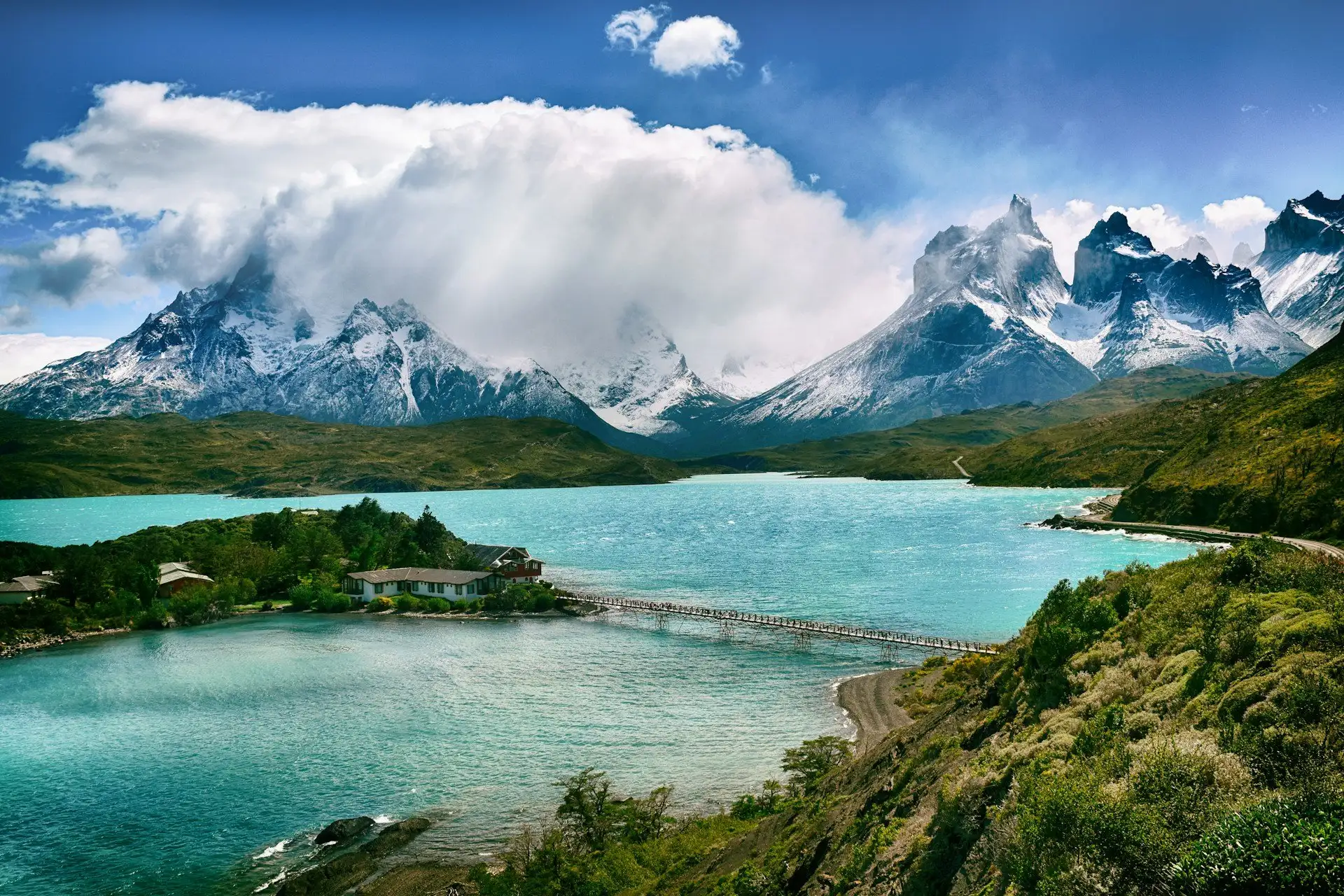
Torres del Paine National Park is South America's most spectacular national park and one of the world's great trekking destinations. The granite towers of the Paine Massif rise 2,800m from the surrounding pampa; the Grey Glacier, the French Valley, and Lago Nordenskjöld are among the other extraordinary landscapes within the park. Access from Puerto Natales (3 hours by bus) is well-organised. The W Trek (4–5 days) covers the main highlights; the O Circuit (8–9 days) adds the less-visited back of the massif. Refugio and camping accommodation must be booked months in advance for the peak season (December–February).
- Weather: always carry full waterproofs, insulation, and hat regardless of forecast — conditions change in under an hour
- Book W circuit refugios through Fantástico Sur (fantasticosur.com) and Vertice Patagonia (verticepatagonia.com) — open 6 months in advance and fill quickly for peak season
- Register trekking itineraries at CONAF park administration on entry — mandatory for multi-day circuits
- LATAM flies Santiago–Puerto Natales directly in peak season; out of season, bus from Punta Arenas (3 hours) is the alternative
- No tourist scam infrastructure in Torres del Paine — the risk is entirely natural and weather-related
Easter Island — Rapa Nui in the indigenous language — is one of the most remote inhabited places on earth, 3,700km west of mainland Chile in the South Pacific. The island's 900+ moai (monolithic human figures carved from volcanic tuff by the Rapa Nui people between roughly 1250 and 1500 CE) are distributed across the island, with the most dramatic concentration at Ahu Tongariki (15 moai in a row) and the unfinished figures at the quarry of Rano Raraku. The island has a small airport receiving LATAM flights from Santiago and Tahiti, a single town (Hanga Roa), and approximately 7,700 permanent residents who are ethnically Polynesian with a distinct culture from mainland Chile.
- Very low crime risk — the island's small, tight-knit community makes tourist crime unusual
- Single ATM in Hanga Roa: bring substantial cash from Santiago; ATM runs out regularly
- Rapa Nui National Park entry: USD 80, card payment at park office — covers all archaeological sites
- Hire a car, scooter, or bicycle to explore the island independently — guided tours are available but not necessary for most sites
- Flight disruption: the single LATAM service can be cancelled due to weather or technical issues — travel insurance essential
Safety Tips for Chile
- ✓ Use Uber, Cabify, or InDriver for all transport from Santiago's international airport and throughout the city. Never accept any unsolicited taxi approach in the arrivals hall or outside the terminal. Set your daily ATM limit to USD 200–300 before travel.
- ✓ Use ATMs inside bank branches during business hours. Cover your PIN completely with your free hand every time. If your card is apparently swallowed, call your bank to cancel immediately — do not re-enter your PIN regardless of what a helpful bystander suggests.
- ✓ If splattered with mustard, ketchup, or any substance in a tourist area: grip your bags immediately, decline assistance from anyone who appears to help, and move to a secure location before addressing the mess.
- ✓ In the Atacama: acclimatise at San Pedro de Atacama (2,400m) for at least 2 nights before any excursion above 4,000m. Carry sunscreen SPF 50+, hat, and sunglasses — UV radiation at altitude is severe. Bring sufficient cash from Calama or Santiago.
- ✓ In Patagonia: carry full waterproofs and insulation on every day hike regardless of the morning forecast. Register trekking itineraries with CONAF park administration. Book Torres del Paine W circuit refugios 6 months in advance. Never attempt to cross flooded rivers.
- ✓ Earthquake preparedness throughout Chile: Drop, Cover, Hold On during shaking. After any strong earthquake near the coast, move immediately to high ground without waiting for a tsunami warning — follow posted evacuation route signs (green wave-and-arrow signs in coastal towns).
- ✓ For Easter Island: bring a week's cash in Chilean pesos from Santiago. The single ATM runs out regularly. Book the LATAM flight well in advance — capacity is limited and the island is difficult to reach on short notice.
- ✓ Check SERNAGEOMIN (sernageomin.cl) for current volcanic activity alerts before hiking Volcán Villarrica or other active volcanoes in the Lake District. Summit hikes close when alert levels rise — verify the current level the day before.
Book Smart for a 4,300km Country
Torres del Paine refugios, Atacama tours, and Easter Island flights all require advance booking — Chile's most rewarding experiences are not walk-up.
Emergency Numbers & Contacts
Chile has well-functioning emergency services in urban and tourist areas. In remote areas like the Atacama high plateau or the Carretera Austral, satellite communicators are the primary safety infrastructure.