
Brazil
The largest country in South America and the fifth largest in the world — big enough to contain the Amazon rainforest, the world's largest wetland, the world's most spectacular waterfall, and still have room for Rio de Janeiro's beaches, Salvador's African heritage, and São Paulo's 22-million-person experiment in becoming the Americas' greatest city. Brazil is not a destination. It is a continent with one flag.
What You're Actually Getting Into
Brazil is the country that defies any single framing. It is simultaneously the home of the world's most celebrated party (Carnival), the world's most threatened ecosystem (the Amazon, losing approximately 10,000 square kilometres of forest annually), the world's most spectacular waterfall (Iguaçu, significantly larger than Niagara by volume and width), and the world's most racially complex democracy — a country where 55% of the population identifies as Black or mixed-race (the largest African-descended population outside Africa), and where the legacy of slavery, which was abolished only in 1888 — the last country in the Americas to do so — continues to shape social structure in ways that are visible, measurable, and ongoing.
The scale demands acknowledgment before planning. Brazil covers 8.5 million square kilometres. Flying from Manaus in the Amazon to Porto Alegre in the south takes 5 hours. The Amazon river basin alone is larger than Europe. Visitors who try to see "Brazil" in two weeks end up seeing a series of airports between glimpses of genuinely extraordinary places. The correct approach is regional: Rio de Janeiro plus the coast (10 days), or the Amazon from Manaus (5 days), or the Pantanal wildlife (4 days), or the northeast circuit (Salvador and the beaches, 10 days). These are distinct trips that happen to share a language and a passport stamp.
A practical note that appears in every Brazil guide and is repeated here because it is genuinely important: Portuguese, not Spanish. Brazil is the only Portuguese-speaking country in the Americas and the language is not mutually intelligible with Spanish in the way that many visitors assume. Brazilians will understand some Spanish but will respond in Portuguese, which sounds nothing like it. Learning basic Portuguese phrases — particularly greetings, numbers, and food vocabulary — transforms every interaction. Google Translate's camera mode handles most menus. The effort, however minimal, is received with warmth that is specifically Brazilian: Brazilians are among the world's most genuinely welcoming people to visitors who engage with them rather than expecting them to adapt.
The safety situation requires the same regional honesty as Mexico. Parts of Rio de Janeiro and São Paulo have high violent crime rates that require specific planning. The northeast's cities (Salvador, Recife, Fortaleza) need awareness. The Amazon and the Pantanal are remote but generally safe from human threats. The northeast beaches, Fernando de Noronha, and the southern states are the country's lowest-concern tourist destinations. The country rewards visitors who read the specific rather than accepting the general.
Brazil at a Glance
A History Worth Knowing
The land that became Brazil was inhabited for at least 12,000 years before European contact — by an estimated 2–6 million Indigenous people organized into hundreds of distinct peoples across the Amazon basin, the Atlantic coast, and the interior. The Tupinambá along the coast, the Yanomami in the Amazon, and hundreds of other nations each had distinct languages, cultural practices, and relationships to the land. Portuguese navigator Pedro Álvares Cabral arrived on the Brazilian coast on April 22, 1500, an arrival that began a process of dispossession, forced labor, and epidemic disease that would kill the vast majority of the Indigenous population within two centuries. Brazil's Indigenous population today numbers approximately 900,000 — roughly 0.4% of the country's total.
The Portuguese colonial economy was built first on brazilwood (the red dye tree that gave the country its name, harvested by Indigenous labor), then on sugar (the northeast's coast became the world's largest sugar producer in the 17th century), and then on gold and diamonds (discovered in Minas Gerais in the 1690s). All three of these economic phases were built on enslaved African labor on a scale that has few parallels in world history. Brazil received an estimated 4.9 million enslaved Africans — approximately 40% of all enslaved people transported across the Atlantic in the entire history of the slave trade. This is the largest enslaved population ever held in a single country. The cultures, religions, foods, music, and physical features of the enslaved Africans and their descendants shaped Brazil in ways that are visible in every dimension of the country today: Candomblé (the Afro-Brazilian religious tradition with Yoruba origins) is practiced openly alongside Catholicism; capoeira (the martial art / dance form developed by enslaved people) is performed in public squares; the rhythm of Brazilian music — samba, baião, forró — has African drumming patterns at its structural foundation.
Brazil achieved independence not through revolutionary war but through an aristocratic arrangement: when Napoleon invaded Portugal in 1807, the Portuguese royal family (the House of Bragança) fled to Rio de Janeiro with their entire court — making Brazil the only colony in history to briefly become the seat of its colonizing empire. When the king returned to Portugal in 1821, his son Pedro stayed behind and declared independence in 1822, becoming Emperor Pedro I of Brazil. This continuity with the monarchy — and the protection of the slave-holding class's interests throughout — distinguished Brazil's independence from the revolutionary independence of its Spanish-speaking neighbors.
Slavery was abolished in stages: the slave trade was officially banned in 1850 (though continued in practice), then children born to enslaved mothers were declared free in 1871 (though without support), then enslaved people over 60 were freed in 1885, and finally full abolition came with the Lei Áurea (Golden Law) of May 13, 1888. Brazil was the last country in the Americas to abolish slavery. Emperor Pedro II was overthrown the following year in a military coup that declared Brazil a republic — some historians argue the monarchy was deposed partly because the landowner class blamed abolition for their economic difficulties. The formerly enslaved population was freed without land, without compensation, and without civil rights infrastructure — a dispossession that directly shaped the racial and economic inequalities still visible in contemporary Brazil.
The 20th century brought cycles of democracy and authoritarian rule. Getúlio Vargas ruled as a populist dictator from 1930 to 1945 and was elected democratically in 1950. The 1964 military coup (supported by the United States, which feared a left-leaning government) installed a dictatorship that lasted until 1985 and was responsible for the torture and disappearance of thousands of political opponents. The return to democracy produced the 1988 constitution (considered one of the world's most progressive) and the presidencies of Fernando Henrique Cardoso, Luiz Inácio Lula da Silva (Lula), and Dilma Rousseff — all of whom navigated the tension between Brazil's extraordinary natural resources, its chronic inequality, and its aspirations to become a global power commensurate with its size. Lula's successful social programs reduced extreme poverty significantly during his first two terms (2003–2011). His imprisonment on corruption charges in 2018, his release in 2019, and his return to the presidency in 2023 after defeating Jair Bolsonaro — who refused to concede the election and whose supporters stormed government buildings on January 8, 2023 — constitute one of the most dramatic recent political histories in Latin America.
2–6 million people in hundreds of distinct nations. The Amazon, the coast, the interior. Not empty land.
Pedro Álvares Cabral. The brazilwood trade begins. Then sugar. Then gold. All built on enslaved labor — Indigenous first, then African.
4.9 million enslaved Africans — 40% of all Atlantic slave trade. The largest enslaved population ever held in one country. The last country in the Americas to abolish slavery (1888).
Napoleon invades Portugal. The entire Portuguese court relocates to Rio de Janeiro. Brazil briefly becomes the capital of its own colonizer's empire.
Pedro I declares independence. No revolution — an aristocratic arrangement that protects the slave-holding class's interests entirely.
US-supported coup. 21 years of military rule. Thousands tortured and disappeared. Democracy restored 1985.
Bolsa Família and social programs lift 30 million out of extreme poverty. Brazil joins the BRICS. The promise of a fairer country briefly materializes.
Lula defeats Bolsonaro. Bolsonaro refuses to concede; supporters storm government buildings January 8, 2023. Brazil's democracy survives. Deforestation reversal begins.
Top Destinations
Brazil divides naturally into regional circuits that are each a distinct trip. The southeast circuit (Rio + São Paulo) is the most visitor-ready. The Amazon from Manaus requires a commitment of at least 4–5 days. The Pantanal requires a similar commitment and is best done from Cuiabá or Campo Grande. The northeast circuit (Salvador, the beaches, Lençóis Maranhenses) is the country's longest coastal stretch. Iguaçu Falls can be combined with the Amazon or the south. Choose one or two regions per trip and return for the rest.
Rio de Janeiro
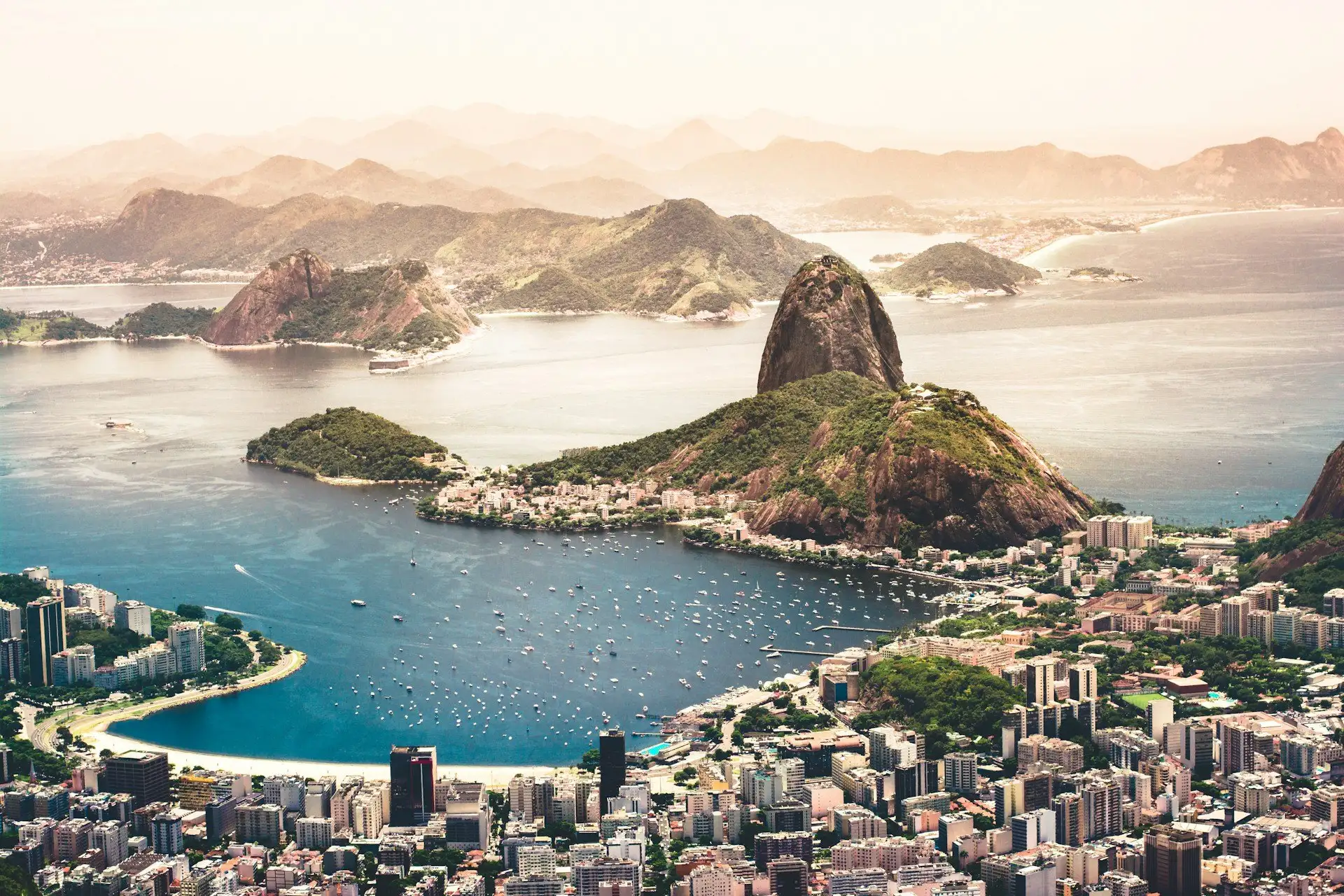
Rio is the city that global culture has used as a shorthand for tropical excess and it does not disappoint on that particular promise. The Christ the Redeemer statue on Corcovado — visible from almost anywhere in the city — and Sugarloaf Mountain at the mouth of Guanabara Bay are the two images that precede every visit. But Rio is also a city of profound inequality (the favelas that house approximately 25% of the population climb directly above the Ipanema beaches), extraordinary music (the samba schools rehearse year-round in their quadras, open to visitors), and a natural setting that has no equivalent among the world's major cities: the ocean on three sides, the Tijuca rainforest (the world's largest urban forest) directly behind, and mountains erupting from the city floor. Safety awareness is essential in Rio — see the safety section for specifics. But engagement is worth it.
Iguaçu Falls
Iguaçu (Iguazu in Spanish — the falls are shared with Argentina) is 2.7km wide and consists of 275 individual cascades dropping up to 82 metres. Eleanor Roosevelt, who saw Niagara Falls before visiting Iguaçu, reportedly said: "Poor Niagara." The comparison is apt: Niagara has more volume on a single fall, but the sheer panoramic scale of Iguaçu — the arc of water that fills the horizon, the wall of mist and sound, the walkway that leads to the Devil's Throat where you stand at the top of the main cascade with water erupting around you — has no equivalent. Both the Brazilian and Argentine sides are worth visiting and are half a day each. The Brazilian side gives the panoramic view; the Argentine side puts you inside the falls.
The Amazon — Manaus
The Brazilian Amazon is accessed primarily from Manaus — a city of 2 million people that exists in the middle of the jungle, 1,500km from the nearest major Brazilian city, connected to the outside world almost entirely by air and river. The Meeting of the Waters — where the dark tannic Rio Negro meets the sandy-colored Amazon proper and the two rivers flow side by side without mixing for 6km, due to their different temperatures, speeds, and mineral content — is 15km from Manaus and is one of the most visually extraordinary natural phenomena on earth. Jungle lodges 1–3 hours from Manaus provide the core Amazon experience: boat trips at dawn and dusk, night walks for caimans and tarantulas, piranha fishing, visits to riverside communities, and the sound of a rainforest at 3am through a mosquito net.
The Pantanal
The Pantanal is the world's largest tropical wetland — approximately 150,000 square kilometres of seasonally flooded grassland, forest, and river systems in Mato Grosso and Mato Grosso do Sul states. It is the best place on earth to see jaguars in the wild — not by tracking and luck but by boat along the Cuiabá River in the dry season (July–October) where jaguars are reliably present on the riverbanks. Giant otters, capybaras, caimans in extraordinary numbers, hyacinth macaws (the world's largest flying parrot), giant anteaters, and tapirs are all routinely observed. The Pantanal has higher wildlife density than the Amazon and the relatively open landscape makes animals easier to spot. Base from Cuiabá or Corumbá.
Salvador, Bahia
Salvador is the city with the deepest African cultural heritage in the Americas — the former capital of colonial Brazil, the main port of entry for enslaved Africans, and now a city of 2.9 million people where Candomblé is practiced openly, where acarajé is sold from tabuleiros by Baianas in traditional dress, where capoeira is performed in the Pelourinho (the UNESCO-listed colonial center) every day, and where the largest street Carnival in the world (by attendance) takes place every February or March. The Pelourinho — whose name derives from the pillory post where enslaved people were publicly punished — is now a living neighborhood of colonial baroque architecture that holds both the beauty and the horror of the colonial past in the same physical space.
São Paulo
São Paulo is Brazil's largest city (22 million in the metro area), its economic engine, and its most underrated tourist destination. Visitors who expect a chaotic megalopolis find instead a city of extraordinary restaurants (the best dining scene in South America), world-class art museums (the MASP — Museu de Arte de São Paulo, on Paulista Avenue — is the most significant art collection in the Southern Hemisphere), and a Japanese community (the largest outside Japan, in the Liberdade neighborhood) whose presence has given the city Japanese food at a level that rivals Tokyo. The Ibirapuera park is a 150-hectare green lung in the middle of the city designed by Oscar Niemeyer. São Paulo rewards three to four days from a visitor who isn't looking for beaches.
Lençóis Maranhenses
Lençóis Maranhenses National Park in Maranhão state is one of the most visually extraordinary landscapes on earth — vast white sand dunes covering 1,500 square kilometres, punctuated between May and September by thousands of crystal-clear freshwater lagoons that fill with rainwater trapped between the dunes. Swimming in a turquoise lagoon surrounded by white sand dunes under a Brazilian sky is an experience that photography consistently fails to represent adequately. The park is reached from São Luís (1 hour flight from Fortaleza or São Paulo) or by 4x4 from Barreirinhas. The lagoons are at their fullest in June and July. One to two days is sufficient for the main circuit.
Fernando de Noronha
Fernando de Noronha is an archipelago 350km off the northeast coast of Brazil — volcanic, almost entirely national park, with 21 islands and some of the clearest water in the Atlantic Ocean. The marine life is extraordinary: spinner dolphins in bays you can kayak to before breakfast, sea turtles nesting on the beach, nurse sharks resting in the shallows. The island limits visitor numbers with a daily environmental tax (TAXA) that increases daily to discourage long stays, keeping it uncrowded relative to its reputation. Fly from Recife or Natal (1.5 hours). 3–4 nights is ideal. One of the world's genuinely special islands.
Culture & Etiquette
Brazilian culture operates on a warmth and physical expressiveness that differs from Northern European or East Asian norms in almost every dimension. Physical greeting — a kiss on the cheek for women meeting anyone, a handshake or a hug for men — is standard in social contexts. Personal space is closer. Eye contact is more direct. The social pace is slower in ways that are not inefficiency but priority: relationship before transaction, conversation before business, food as social event rather than fuel.
Jeitinho brasileiro — the Brazilian way — describes a cultural flexibility around rules, a creative navigation of formal constraints through personal relationships and improvisation. It is simultaneously a source of charm and a source of frustration. Things that should take ten minutes take two hours; things that seem impossible become possible through the right contact. The country is run on this principle at every level.
Brazil is the only Portuguese-speaking country in the Americas and unlike Mexico or Colombia, encounters with English speakers outside the tourism industry and major hotel lobbies are rare. "Obrigado/Obrigada" (thank you, male/female speaker), "Por favor" (please), "Quanto custa?" (how much?), "Tudo bem?" (everything okay? — the standard greeting), "Com licença" (excuse me). Any attempt at Portuguese is received with disproportionate warmth.
Brazilians do not experience punctuality as a virtue in the way that Northern Europeans do. A 7pm dinner invitation means 8 or 8:30pm. A meeting scheduled for 10am may begin at 10:45am. Adapting to this rhythm rather than fighting it is the difference between an enjoyable Brazilian experience and an infuriating one. Confirm anything time-sensitive twice, in writing.
Brazilian beach culture has its own dress code that differs from both formal European modesty and casual resort dress. On Ipanema and Copacabana, the standard is minimal — sunga (small swim briefs) for men and bikini for women. Walking in beachwear any distance from the beach is not done. In the evenings in restaurant and social contexts, Brazilians dress carefully and with attention to appearance that is more European than casual American.
Candomblé is a living religion practiced by millions of Brazilians with direct Yoruba and Fon African roots — not a tourist performance. Visiting a terreiro (Candomblé temple) is possible with a guide and requires respectful behavior: conservative dress (white clothing is preferred), no photography without explicit permission, silence during rituals. The Afro-Brazilian Museum in São Paulo and the Sacred Art Museum in Salvador both provide excellent context before a direct encounter.
A boteco is a small neighborhood bar — the social institution of Brazilian street life, where people drink cold beer (chopp — draft) or caipirinhas and eat petiscos (bar snacks: bolinhos de bacalhau, coxinha, pão de queijo) for hours in the evening. Sitting at a sidewalk table at a boteco and ordering a round is how you become briefly Brazilian. It costs almost nothing and is the correct social experience.
Attempting to communicate in Spanish to Brazilians — who speak Portuguese and consider their language and culture distinct from their Spanish-speaking neighbors — is mildly offensive in the way that speaking French to a Flemish Belgian is offensive. Spanish is not Portuguese. Brazilians will understand some Spanish but respond in Portuguese, and the gesture of attempting their language, however badly, produces more warmth than fluent Spanish.
Brazil has a significant phone-theft problem in urban areas — expensive smartphones are snatched from hands, bags, and tables in cities across the country. The rule is consistent: don't use your phone at street level in Brazilian cities unless you are inside a café, restaurant, or secure space. Navigate before leaving, not while walking. Sitting at a sidewalk table checking your phone in certain neighborhoods is a known risk.
Some favelas in Rio have established community tourism operations with trained guides and established relationships with local communities. These are legitimate and worth doing. Entering any favela without such an arrangement — on the assumption that it's "just a neighborhood" — is dangerous and disrespectful. The community tourism operators in Rocinha, Vidigal, and Santa Marta (Rio) run excellent experiences; book through established operators.
Brazil is 8.5 million square kilometres. Flying from Manaus to São Paulo takes 4 hours. São Paulo to Recife takes 3 hours. The country is five times larger than Mexico. Any itinerary that includes more than two regional circuits is mostly an itinerary of airports. Choose your region, go deep, return next time.
Tap water is technically treated in major Brazilian cities but the quality varies by neighborhood and infrastructure, and stomach issues are common among first-time visitors. Bottled water is cheap and available everywhere. In the Amazon and rural areas, bottled or filtered water is essential. Most hotels provide drinking water; use it.
Carnival
Carnival in Brazil is not a single event but three distinct cultural expressions: Rio's Sambódromo parades (samba schools competing in a stadium-like parade ground, weeks of preparation producing 90-minute theatrical spectacles of rhinestone and feather); Salvador's street Carnival (the world's largest outdoor party, where blocos — bands on enormous trucks — move through the city for five days while millions dance in the streets); and Olinda's historical Carnival in Pernambuco (smaller, more traditional, frevo music and enormous paper-maché puppets through cobblestone streets). All three require booking 6–12 months in advance.
Football
Brazilian football produced Pelé, Ronaldo, Ronaldinho, and a style of play (jogo bonito — the beautiful game) that influenced every football culture in the world. Attending a match at the Maracanã in Rio de Janeiro — the stadium that held the 1950 World Cup final and is the most historically significant football ground in South America — is a genuinely extraordinary crowd experience. The atmosphere is loud, passionate, and colorful in a way that European football rarely is. Choose a local rivalry (Flamengo vs Vasco or Fluminense vs Botafogo) for maximum drama.
Music
Brazilian music is among the world's richest traditions: samba (Rio, from African drumming roots), forró (northeast, accordion and triangle, the music of the interior), baião (Bahia and northeast, Luiz Gonzaga's invention), bossa nova (Rio, 1950s, Tom Jobim and João Gilberto's jazz-samba synthesis that produced "The Girl from Ipanema"), MPB (Música Popular Brasileira — the broad popular tradition), and funk carioca (Rio's favela-rooted electronic music that has become one of the world's most influential contemporary sounds). Each region has its own tradition and all of them are heard live throughout the country nightly.
Brasília — The Planned Capital
Brasília was built from nothing in 3 years (1957–1960) in the middle of the cerrado (savanna) by President Juscelino Kubitschek, who promised "fifty years of progress in five." Designed by urban planner Lúcio Costa and architect Oscar Niemeyer, the city is a UNESCO World Heritage site — a complete example of 20th-century Modernist urban planning, with buildings that are among the most aesthetically significant works of architecture in the Americas. The National Congress, the Supreme Court, the Presidential Palace, and the Cathedral are all Niemeyer designs. As a living city it is sprawling and car-dependent; as an architectural experience it is genuinely extraordinary.
Food & Drink
Brazilian cuisine is as geographically diverse as the country itself. The national dish is feijoada — but feijoada in Rio differs from feijoada in São Paulo, and neither resembles what you get in Bahia or the Amazon. The regional food traditions are each extraordinary: Bahian cuisine (with its African palm oil and coconut milk foundations) is one of the great cuisines of the Americas; the Amazon basin has unique ingredients (açaí, tucupi, pirarucu) that appear nowhere else; the southern states (São Paulo, Santa Catarina, Rio Grande do Sul) have European immigrant food traditions alongside the Brazilian norm. Food is a serious social institution in Brazil — lunch is the main meal, it takes two hours, and sitting at the table is not something to be rushed.
Feijoada
The national dish: a slow-cooked black bean stew with pork in all its forms (ears, feet, tail, ribs, sausage, smoked meat) served on Saturdays at restaurants across the entire country. Eaten with white rice, farofa (toasted cassava flour), couve (collard greens sautéed with garlic), and orange slices to cut the richness. The feijoada has its origins in the food that enslaved people made from the parts of the pig that the enslavers didn't want — a history now acknowledged as part of its cultural significance. A proper feijoada takes 4–6 hours to prepare and is eaten as a multi-hour social event.
Churrasco
Brazilian barbecue in the rodízio format — continuous service of meat carved at the table from long skewers, by gaucho-dressed servers who circulate through the restaurant. A small disc on the table (green side up = keep bringing meat; red side up = pause) is the only control you have over the meat tide. The picanha (top sirloin cap, the cut Brazil is most famous for), the fraldinha (flank), the linguiça (sausage), and the chicken hearts are the standouts. All-you-can-eat for a fixed price. The best churrascarias are in Porto Alegre and São Paulo.
Acarajé
Salvador's street food — black-eyed pea fritters deep-fried in dendê (red palm oil), split open and stuffed with vatapá (a spiced shrimp and coconut paste), caruru (okra stew), and salada (fresh tomato and coriander). Sold exclusively by Baianas de acarajé — women in traditional white lace dress and head wrap who set up at specific spots in Salvador. The making and selling of acarajé is a tradition with direct Yoruba religious roots — in Candomblé, acarajé is offered to Iansã, the deity of wind and storms. The street version costs approximately R$10–20 and is one of the great street foods in the world.
Moqueca
Bahian moqueca is a seafood stew of extraordinary richness: fish or shrimp simmered in coconut milk, dendê palm oil, onion, tomato, coriander, and chili in a clay pot that comes to the table still bubbling. The Espírito Santo version uses less palm oil and no coconut milk, producing a lighter result. Served over white rice with farofa and pirão (fish-stock porridge). A fish moqueca for two at a good Bahian restaurant takes 30 minutes to arrive and 20 minutes to eat properly. Order two caipirinhas for the wait.
Açaí (the real thing)
The açaí powder sold internationally bears little relationship to the fresh açaí from the Amazon. Fresh açaí from a street vendor in Belém or Manaus is thick, dark purple, and served in a gourd bowl like ice cream — mixed with banana and granola if desired, or plain for the full flavor (earthy, slightly bitter, nothing like what's sold at European smoothie bars). In Belém, the Ver-o-Peso market serves açaí from dawn from large buckets — cold, local, and extraordinary. The real thing.
Caipirinha
Brazil's national cocktail and one of the world's finest: cachaça (unaged sugarcane spirit — not rum, which is distilled differently), muddled lime, and sugar over ice. Simple, balanced, and entirely correct. The quality depends on the cachaça — a good artisanal cachaça from Minas Gerais makes a caipirinha that a standard bar version cannot. Caipirosca (with vodka instead of cachaça) and caipifruta (with fresh tropical fruit) are variants. Drink the original with good cachaça first.
When to Go
Brazil's climate varies significantly across its enormous territory. The Amazon has a wet season and a dry season that produce different but equally extraordinary experiences. Rio and the southeast have a pleasant dry season and a rainy, humid summer. The northeast has an inverse wet season to the south. The Pantanal is most productive for wildlife in the dry season. The general rule: November to March is summer in the south (hot, humid, rainy in Rio and São Paulo); June to September is the dry season in most of the country and the best overall travel window.
Dry Season South
Apr – OctThe best window for Rio and São Paulo — comfortable temperatures (20–28°C), lower humidity, less rain. Also the best for the Pantanal (July–October wildlife peak) and good for the Amazon (June–November, lower water revealing riverbanks and beaches). The northeast coast is rainy from April–June — stagger carefully if combining south and northeast.
Northeast Dry Season
Jun – JanSalvador, Fortaleza, Natal, and the northeast beaches are at their driest and sunniest between June and January. Lençóis Maranhenses lagoons are fullest June–July. Fernando de Noronha is good year-round but visibility is best June–December. The northeast is essentially reversed from the south — its rains come February–May.
Carnival
Feb–Mar (varies)If Carnival is your goal, plan 6–12 months ahead — accommodation in Rio and Salvador fills and triples in price. The days leading up to and including Carnival (Friday to Tuesday before Ash Wednesday) are the main event. Beautiful, chaotic, exhausting, and unforgettable. Rio for the Sambódromo parade tickets (book through official site Liga RJ). Salvador for the street blocos (abadás — colored shirts — give access to the bloco's space).
Southern Summer
Dec – Feb (excl. Carnival)Rio's rainy season — afternoon downpours that can be heavy and sustained, high humidity, and the highest prices of the year (except Carnival). São Paulo is similarly hot and wet. The Pantanal floods (making roads impassable but the flooded-forest boat experience extraordinary). The Amazon has the highest water levels — different but not worse for the right kind of visitor. December especially: school holidays, maximum Brazilian domestic tourism, elevated prices everywhere.
Trip Planning
Two weeks is the minimum for any meaningful Brazil experience — the flight from Europe alone takes 10–12 hours and the internal distances justify the journey. Three weeks allows a proper regional circuit. The most common mistake is treating Brazil's internal flight network as equivalent to Europe's rail network — Brazilian domestic flights are necessary between major destinations, they take 2–5 hours, and they cost R$200–600 per journey when booked 3–4 weeks ahead (much more last-minute).
The Amazon is non-negotiable for any serious Brazil trip — the experience of being in the world's largest rainforest for even 3–4 days changes how you understand the country and the planet. This requires advance booking of a reputable jungle lodge from Manaus. Independent Amazon navigation is genuinely dangerous.
Rio de Janeiro
Five days. Day one: Ipanema and Leblon beaches in the morning, neighbourhood orientation. Day two: Sugarloaf Mountain at sunset (take the cable car for the view, not midday when it's crowded and hazy). Day three: Christ the Redeemer at dawn by train from Santa Teresa before the tour groups arrive. Tijuca forest afternoon hike. Day four: samba school rehearsal evening (Mangueira or Salgueiro, September–February before Carnival) or the Lapa neighbourhood for live music on a weekend. Day five: Santa Teresa neighbourhood — the arts district, Chácara do Céu museum, street food.
Iguaçu Falls
Fly from Rio to Foz do Iguaçu (2 hours). Day six: Brazilian side of the falls — the full panoramic walkway, ending at the Devil's Throat viewing platform (the best long-shot view). Day seven: Argentine side (Garganta del Diablo upper walkway — different experience, equally essential, requires crossing the border by bus). Day eight: Bird Park Iguaçu in the morning for up-close toucan, macaw, and harpy eagle encounters. Return to Rio or fly to next destination in the afternoon.
São Paulo
Four days. MASP (arrive at opening, free on Tuesdays). Liberdade Japanese neighborhood — the Sunday market on Praça da Liberdade is one of São Paulo's best food markets. Ibirapuera Park Sunday morning with half of São Paulo (the right time to understand the city's scale). One night in the Vila Madalena neighborhood for street art (Beco do Batman alley) and bars. One dinner at a proper São Paulo restaurant — D.O.M. if the budget allows, Mocotó (Northeastern food in Vila Medeiros) for the most authentic.
Rio de Janeiro
Five days as above. Add the Maracanã stadium tour or a live football match if timing allows (Brasileirão season runs April–December). One afternoon in the Favela Santa Marta with an authorized community guide — the fastest way to understand Rio's social geography and the most visually dramatic favela in the city (it climbs a hillside directly above Botafogo).
Iguaçu Falls
Three days as above. On day eight, consider the boat tour under the falls (the Macuco Safari — you get completely drenched, the experience is extraordinary, wear a swimsuit and leave cameras in the waterproof bag they provide).
Salvador, Bahia
Fly from Foz do Iguaçu to Salvador. Four days. Pelourinho (UNESCO-listed colonial center) on day nine — the capoeira roda in the Largo do Pelourinho, the São Francisco Church gold interior, acarajé from the best-known Baiana on the steps. Day ten: the Afro-Brazilian Museum and the Museu da Cidade. Day eleven: day trip to Praia do Forte (70km north — sea turtle project and beach). Day twelve: Bonfim Church (pilgrimage site and ribbons-on-fence tradition), the lower city fish market.
Lençóis Maranhenses
Fly from Salvador to São Luís. Day thirteen: São Luís colonial centre (UNESCO-listed azulejo-tiled houses, the second-largest colonial centre in Brazil). Day fourteen: transfer to Barreirinhas by road (3 hours) or speedboat. Days fifteen–sixteen: 4x4 tour to Lagoa Azul and Lagoa Bonita — the main lagoon circuit through the dunes. Swim in multiple lagoons. Return to São Luís for departure.
Rio de Janeiro
Five days. All the main sites plus one extended community tour (Rocinha or Santa Marta with a licensed guide). One evening at Pedra do Sal in the Saúde neighborhood (Afro-Brazilian history site, roots of Rio samba, informal street party Monday and Friday evenings).
Amazon — Manaus
Fly from Rio to Manaus (4 hours). Day six: arrive, visit the Teatro Amazonas (the extraordinary opera house built at the height of the rubber boom, 1896). Meeting of the Waters afternoon boat trip — see the two rivers flowing side by side without mixing. Days seven to nine: jungle lodge stay 1–3 hours from Manaus. Dawn river trips, night caiman walk, piranha fishing, boto (pink river dolphin) encounter, visit to a riverside community. Return to Manaus morning of day nine, fly to Cuiabá afternoon.
Pantanal
Four days in the southern Pantanal from Cuiabá or the Transpantaneira Highway. Days ten to twelve: jaguar boat safari on the Cuiabá River (the Porto Jofre end of the Transpantaneira is the most reliable jaguar-viewing area in the world — expect to see multiple individuals each day in dry season). Day thirteen: giant otter family morning, hyacinth macaw sunset. Return to Cuiabá, fly to Salvador.
Salvador, Bahia
Four days as above. Add a Candomblé terreiro visit with a specialist guide on one evening — the most direct encounter with Afro-Brazilian religious culture available to visitors. Confirm dress code (white) and photography rules before attending.
Fernando de Noronha
Fly from Salvador to Fernando de Noronha (1.5 hours via Recife). Four nights on the island: dolphin bay at dawn, snorkelling at Dois Irmãos, sea turtle beach visit (with TAMAR turtle protection project guide — only licensed visits permitted), and one day of free diving or scuba on the island's reefs (considered some of the finest dive sites in the South Atlantic). Return to Recife for departure.
Vaccinations & Yellow Fever
Yellow fever vaccine is required if visiting the Amazon or the Pantanal, and strongly recommended for most of Brazil. Some countries require proof of yellow fever vaccination if arriving from Brazil. Carry your International Certificate of Vaccination (yellow card). Hepatitis A and Typhoid vaccines recommended. Malaria prophylaxis is recommended for the Amazon (not for Rio, São Paulo, or coastal cities). Dengue fever is present throughout Brazil — mosquito repellent with DEET is essential.
Full vaccine info →Amazon Lodge Booking
Reputable Amazon jungle lodges from Manaus should be booked 4–6 weeks ahead (2–3 months for peak season June–October). Look for EMBRATUR-registered operators. A 3-night minimum gives you the core experience: Meeting of the Waters, night caiman walk, morning river trip, piranha fishing. All-inclusive packages (accommodation, meals, guides, boat transfers) typically cost $150–400 per person per night. Budget options exist but guide quality varies.
Connectivity
Claro and Vivo are the best networks for coverage across Brazil including the Amazon. Buy a SIM at the airport or at a phone store in any major city. Data is cheap. WhatsApp is the primary communication platform for everything in Brazil — tour operators, restaurants, hotels, and local contacts all communicate via WhatsApp. Have it installed and configured before arriving. An eSIM through Airalo is the alternative if you prefer not to swap cards.
Get Brazil eSIM →Power — Critical
Brazil's voltage situation is uniquely confusing: the country uses 127V in some states and 220V in others (São Paulo is predominantly 127V; Rio is mixed; Brasília is 220V). Most hotels have both or have stabilized sockets. The official plug type is Type N (two round pins plus a ground pin, unique to Brazil) — European plugs fit Type N sockets but not vice versa. Bring a universal adapter and check device dual-voltage ratings. This is genuinely important — plugging a 127V device into a 220V socket can destroy it instantly.
Travel Insurance
Essential for Brazil. Medical costs at private hospitals (which you should use in any emergency) are expensive without coverage. The Amazon specifically: ensure your policy covers emergency evacuation from remote areas. Medical evacuation from a jungle lodge to Manaus and then to a better-equipped city can cost $20,000–50,000 USD without insurance. The Fernando de Noronha environmental tax is not insurance-refundable — don't confuse the two. Confirm dengue and yellow fever are covered.
Mosquitoes & Dengue
Dengue fever is endemic throughout Brazil year-round. DEET-based repellent applied at dawn and dusk (the primary biting window for Aedes aegypti, the dengue mosquito) is essential everywhere in Brazil, including in cities. Malaria prophylaxis is specifically for the Amazon. Dengue has no prophylaxis drug — prevention through repellent and clothing coverage is the only protection. The Amazon adds malaria risk; prophylaxis (Malarone or Doxycycline) should be discussed with a travel health clinic.
Transport in Brazil
Brazil's transport reality is: fly between major cities, use Uber within cities, take long-distance buses for shorter intercity trips, and never drive yourself unless you are in southern Brazil's well-maintained road network and specifically prepared for Brazilian driving culture (fast, assertive, and occasionally alarming). The domestic flight network is extensive — LATAM, GOL, Azul, and Voepass connect all major destinations. Long-distance buses (semi-leito — reclining seats — and leito — full flat beds — for overnight journeys) are comfortable and cheap for distances under 12 hours.
Domestic Flights
R$200–700/routeThe essential transport for Brazil's distances. LATAM, GOL, and Azul connect all major cities. Book 3–4 weeks ahead for best prices. São Paulo (GRU or CGH) is the main hub — most domestic connections transit through it. Baggage rules vary by airline and fare class — budget carefully as low-base-fare tickets may charge R$80–150 for checked luggage separately.
Uber & 99
App rateUber operates in all major Brazilian cities. 99 (the Brazilian ride-hailing app) is often cheaper and equally reliable. Both are GPS-tracked and significantly safer than street taxis in any Brazilian city. Use one of these for all city movement and especially for airport arrivals. In Rio, the Uber from Galeão airport to Ipanema is a fixed ~R$70–90; the equivalent street taxi can cost double if you're not careful.
Long-Distance Bus
R$80–300/routeBrazil's bus network (Comfortável, Expresso, and premium leito sleeper classes) is excellent for overnight journeys of 6–12 hours — São Paulo to Rio (6 hours), Rio to Salvador (28 hours — fly for this), São Paulo to Foz do Iguaçu (18 hours — on this route the sleeper bus is actually comfortable and cheap). Buy at the rodoviária (bus terminal) or online at Buser or busbud.com.
Rio & São Paulo Metro
R$5–6/rideBoth Rio and São Paulo have metro systems. Rio's is limited (4 lines, covering mainly the south zone — Ipanema, Copacabana, Centro) but useful for tourists. São Paulo's is more extensive (5 lines, plus suburban rail) and essential for avoiding the city's legendary traffic. Both are safe during the day; exercise the standard precautions with valuables at peak hours. Buy single tickets or a rechargeable Bilhete Único card.
Amazon River Boats
R$150–400Slow boats (lanchas or barcos de linha) connect Manaus to Santarém, Belém, and other Amazon river towns — journeys of 2–5 days on the river. You hang a hammock on the deck (bring your own), eat on board, and watch the jungle pass. This is the authentic Amazon transport experience — slow, social, and genuinely different from any other travel. For the jungle lodge experience, transfers are organized by the lodge directly.
Car Rental
R$150–350/dayUseful in southern Brazil (the wine region of Rio Grande do Sul, the Serra Gaúcha, coastal Santa Catarina), the Pantanal Transpantaneira Highway, and for Lençóis Maranhenses access. Not recommended in Rio, São Paulo, Salvador, or any large Brazilian city — traffic, parking, and security risks make it counterproductive. A 4x4 is essential for the Transpantaneira and Lençóis. International license accepted alongside home country license.
Rio Bus & BRT
R$3–5/rideRio's bus system connects the entire city but is not recommended for tourists as a primary transport — air-conditioned routes are safe; the non-AC routes that serve favela communities are not appropriate for tourists unfamiliar with the city. The BRT (Bus Rapid Transit) connecting the airport to Barra and Ipanema is safe, cheap, and useful for airport connections. The metro + walk combination handles most tourist movement.
Corcovado Rack Railway
R$119 returnThe Trem do Corcovado — the rack railway to Christ the Redeemer — departs from Cosme Velho in the Santa Teresa neighborhood. Book online at trenmdocorcovado.com.br at least 3 days ahead; weekends and holidays sell out. Departs from 8:30am (this is the right time — before the tour buses). The train takes 20 minutes through Tijuca forest and deposits you at the statue's feet.
Accommodation in Brazil
Brazil's accommodation ranges from excellent boutique pousadas (the Brazilian equivalent of a B&B or guesthouse — owner-run, characterful, and usually better value than international chain hotels) to luxury hotels in São Paulo and Rio that compete with the world's best. The real and its exchange rate against the dollar and euro mean that mid-range and upscale accommodation in Brazil is very good value for European or North American visitors. In Rio, the neighborhood matters enormously: Ipanema and Leblon are the safest and most convenient tourist bases; Copacabana is central but noisier and with a higher petty crime rate; Santa Teresa is charming but requires care after dark.
Rio de Janeiro Hotel
R$350–2,500+/nightStay in Ipanema or Leblon rather than Copacabana if safety is a priority. The Fasano Rio (Ipanema) and Santa Teresa Hotel (Santa Teresa neighborhood, pool and city views) are the benchmark luxury options. Mid-range: Hotel Arpoador (right on the sea), Ipanema Inn. Budget travelers use the cluster of good hostels on Rua Farme de Amoedo in Ipanema. Avoid anywhere more than 5 minutes from the beachfront without specific local knowledge.
Amazon Jungle Lodge
R$700–2,000+/person/nightAll-inclusive lodges 1–3 hours from Manaus provide the Amazon experience: boat transfer, accommodation in cabins or tree platforms, all meals, and guided activities. Anavilhanas Jungle Lodge and Juma Lodge are the premium options. Amazon Eco Tours and Jungle Palace for mid-range. All include the core activities: Meeting of the Waters transit, night caiman walk, dawn river trip, piranha fishing, community visit. Book directly with the lodge or through a licensed Manaus tour operator.
Pantanal Pousada
R$500–1,800/person/nightEco-pousadas along the Transpantaneira Highway or on river tributaries near Porto Jofre are the base for jaguar spotting. Pousada do Pantanal, Araras Eco Lodge, and Pousada Piuval offer different price points and specialties. The jaguar-specific lodges near Porto Jofre (Caiman Lodge, Jaguar Flotel — literally a floating hotel on the river) are the most productive for big cat sightings. Dry season (July–October) bookings sell out — book 2–3 months ahead.
Pousada (Boutique Guesthouse)
R$200–800/nightThe pousada is the correct accommodation format for Salvador's Pelourinho, Paraty (a colonial town 4 hours from Rio), Búzios (beach town 2 hours from Rio), the historic cities of Minas Gerais (Ouro Preto, Tiradentes), and Fernando de Noronha. Owner-run, characterful, with breakfast included and staff who know their town better than any guidebook. Fernando de Noronha pousadas are the most expensive in Brazil due to the island's limited accommodation and visitor cap — budget R$800–2,500/night and book 4–6 months ahead.
Budget Planning
Brazil offers remarkable value for European and North American visitors when the real is weak against the dollar and euro — which it has been for most of the last decade. The experience of eating a full restaurant dinner with wine for $20 USD per person in São Paulo or buying fresh açaí from a street vendor in Belém for $1 is a consistent feature of Brazilian travel that rewards visitors who eat locally rather than at international-facing restaurants. The exceptions to good value are Amazon lodges (priced in USD by most operators), Fernando de Noronha (limited supply drives high prices), and Carnival period (prices across Rio and Salvador triple or quadruple).
- Hostel dorm (R$60–120)
- Prato feito and kilo restaurants
- Long-distance buses
- Metro and local transport
- Beaches and free city parks
- Pousada or mid-range hotel
- Restaurant meals with drinks
- Domestic flights when needed
- Guided tours (favela, Candomblé)
- Amazon lodge 3 nights
- Boutique hotel or luxury pousada
- Destination restaurants in São Paulo
- Pantanal jaguar lodge
- Fernando de Noronha pousada
- Private tours and experiences
Quick Reference Prices
Visa & Entry
Brazil's visa requirements have changed significantly in recent years. EU citizens, UK citizens, and citizens of many other countries have long-standing visa-free access for tourism stays of up to 90 days. The US, Canada, and Australia (which previously required full consular visas) were included in a new e-Visa program introduced in 2024 that allows online application for a 10-year multiple-entry visa. Check the current requirements for your specific passport — Brazilian visa policy has been actively changing and the situation may differ from what older sources report.
EU and UK citizens: visa-free on arrival for up to 90 days. US, Canadian, Australian citizens: e-Visa at gov.br/mre/en, $80 USD, valid 10 years multiple entry, each stay up to 90 days. Apply at least 72 hours before travel. Check current requirements as Brazil's visa policy has been actively evolving.
Family Travel & Pets
Brazil is excellent for families with honest assessment of where it works best. The beach destinations (Rio, the northeast coast, Florianópolis in Santa Catarina) are straightforwardly good for families with any age children. The Amazon requires minimum ages at most lodges (typically 6–8 years for night walks; some lodges have no minimum). Iguaçu Falls is universally accessible. The Pantanal jaguar safari works for children old enough to sit still and quiet on a boat (usually 8+). The cultural experiences of Salvador and the festivals are accessible at any age.
Brazilians are genuinely warm toward children — families with children receive extra attention and care in restaurants and accommodation that solo travelers don't. The only specific family caution is the urban safety situation in Rio and São Paulo, where the standard precautions (no ostentatious valuables, secure transport, neighborhood awareness) apply to children as much as adults.
Iguaçu Falls
Universally accessible and universally spectacular. The walkways on both the Brazilian and Argentine sides are manageable for children of any age who can walk 2–3km. The Macuco Safari boat tour under the falls (completely soaking) is specifically loved by older children. The Bird Park adjacent to the Brazilian side, where toucans and macaws can be encountered at arm's length in walk-through aviaries, is particularly good for younger children.
Amazon Family Lodges
Several Amazon lodges accept children with specific programs: guided river trips, piranha fishing, visits to rubber-tapper communities, and night walks for children over 8. The pink river dolphin (boto) encounter is universally loved by children — the botos approach boats and can sometimes be touched. The sounds of the Amazon at night through a mosquito net, the howler monkeys at dawn, and the scale of the river all produce the kind of impression on children that travel leaves permanently.
Pantanal Wildlife
The Pantanal's open landscape and boat-based wildlife viewing is more accessible for families with children than the dense Amazon forest. Caimans visible from the boat in extraordinary numbers, capybaras grazing on the bank, giant otters with pups, and the possibility of jaguars for older children (boats need to be quiet and patient) make the Pantanal one of the world's best family wildlife destinations. Most pousadas accept children 8+; some from younger ages depending on the activity.
Brazilian Beaches
The northeast coast (Natal, Maceió, Porto de Galinhas) and Florianópolis in the south have calm, warm water beaches suitable for young children. Porto de Galinhas specifically — a small town in Pernambuco with natural pools created by coral reefs at low tide, where fish swim around your feet — is consistently rated among Brazil's most family-friendly beach destinations. The northeast beaches are generally calmer than Rio's Atlantic-facing beaches, which have significant waves and strong currents requiring adult supervision.
Bird Park Iguaçu
The Parque das Aves adjacent to the Brazilian side of Iguaçu Falls has walk-through aviaries with hyacinth macaws, toucans, parrots, harpy eagles, and hundreds of other species that you can observe at extremely close range. One to two hours depending on the child's attention span. Combine it with the falls in a single day from Foz do Iguaçu city. Arguably the best accessible bird encounter in South America for non-birder families.
Salvador Cultural Experience
The capoeira performances in Salvador's Pelourinho — the martial art/dance form performed to berimbau music in public squares — are engaging for children of any age. The acarajé women in traditional dress, the street musicians, and the colorful colonial architecture of the Pelourinho create a sensory experience that children absorb differently from adults but absorb fully. The Museu do Carnaval in Salvador has Carnival costumes and props that children can try on.
Traveling with Pets
Brazil permits the import of dogs and cats from most countries with proper documentation: a Zoosanitary Certificate issued by your country's agriculture authority (in the UK, APHA; in the US, USDA-APHIS), a microchip, up-to-date rabies vaccination, and negative results for internal parasites. The certificate must be notarized and apostilled and must be issued within 10 days of travel. A specific import permit is not typically required for dogs and cats from low-risk countries, but the documentation requirements are strict and must be met exactly — partial documentation results in animals being held in quarantine.
Practically: Brazilian cities are reasonably pet-friendly, with parks and promenades where dogs are welcome. However, the Amazon, the Pantanal, and national parks do not permit pets. The heat and humidity of Brazil's tropical regions are challenging for animals from temperate climates. For a tourist trip rather than a relocation, leaving pets at home is the practical advice — the experiences that make Brazil extraordinary are overwhelmingly incompatible with traveling with a dog or cat.
Safety in Brazil
Brazil has a genuine and significant urban crime problem that requires honest engagement rather than dismissal or exaggeration. Homicide rates in some Brazilian cities are among the highest in the world — but these rates are concentrated in specific communities and driven by factors (drug-trade violence, police brutality, structural poverty) that primarily affect Brazilian residents rather than international tourists. Violent crime specifically targeting tourists is much rarer than the overall crime statistics suggest. What tourists commonly experience is opportunistic theft: phone snatching, bag theft, and occasional robberies at ATMs or on quiet streets.
The safety picture varies enormously by city and neighborhood. Rio de Janeiro requires the most awareness — but Rio's tourist circuit (Ipanema, Leblon, Santa Teresa, the city center) is manageable with the right precautions. The Amazon and the Pantanal are remote but generally safe from human threats. The northeast coast and Fernando de Noronha are among Brazil's safest tourist destinations. Salvador requires neighborhood awareness. São Paulo's tourist circuit (Paulista, Vila Madalena, Liberdade) is broadly safe.
Amazon, Pantanal, National Parks
Very safe from human threats. The risks are environmental: the river, the wildlife (caimans and anacondas on the riverbank require awareness, not fear), and the heat. Your guide will manage all of these. Don't stray from the group in the jungle or on the river. The Amazon's genuine danger is to those who enter it without knowledge and guidance — with a reputable lodge and guide, it is safe.
Fernando de Noronha, Northeast Beaches
Brazil's safest tourist destinations. Fernando de Noronha has almost no crime — the limited visitor numbers and small permanent population make it one of Brazil's most relaxed places. The northeast beach towns (Porto de Galinhas, Maceió, Natal) have the standard beach-town caution profile: don't leave valuables on the beach, use secure accommodation. Straightforward.
Rio de Janeiro
The rules in Rio: use Uber/99, not street taxis. Don't display phones or cameras on the street — use them inside cafés and restaurants. Stay in Ipanema or Leblon (safer) rather than Copacabana (higher crime). Don't walk from the beach back to your hotel at night with wet swimming gear and visible electronics. Enter favelas only with authorized community tour operators. Avoid the area around the central bus station (Rodoviária Novo Rio) at night.
Salvador
The Pelourinho tourist circuit is policed and relatively safe during the day. Evening precautions apply — use official transport to and from the Pelourinho, particularly after 10pm. The lower city (Comércio) and peripheral neighborhoods require awareness. Some areas of Salvador are not appropriate for tourist wandering regardless of time of day — ask your accommodation for a specific orientation.
ATM Safety
Brazil has a specific "ATM crime" problem: thieves target people immediately after they withdraw cash. Use ATMs inside bank branches during business hours rather than standalone ATMs on the street. Withdraw money before it's urgent rather than at night. Keep the amount small. Use Revolut or a travel card to make direct payments rather than carrying cash wherever possible.
Medical Facilities
Brazil has both public (SUS) and private healthcare. Private hospitals (Rede D'Or hospitals in Rio and São Paulo, Hospital Sírio-Libanês in São Paulo) are excellent and comparable to European standards. Use private hospitals in any non-emergency situation and in emergencies if you can — the SUS public system is overloaded. Travel insurance with direct billing to Brazilian private hospitals is the correct preparation.
Emergency Information
Your Embassy in Brasília
Most embassies are in Brasília. Major countries also have consulates in São Paulo and Rio de Janeiro — a consulate may be more useful than the embassy for practical emergencies depending on your location in Brazil.
Book Your Brazil Trip
Everything in one place. These are services worth actually using.
The Country That Defies Any Frame
Brazil does not resolve neatly into a travel narrative. The country that produces jogo bonito and Carnival and one of the world's great cuisines is the same country that held the last enslaved people in the Americas until 1888 and is still working through what that means for the 55% of the population who are descended from those people. The country of extraordinary natural beauty — the Amazon that produces 20% of the world's freshwater, the Pantanal where jaguars walk out of the reeds and look at your boat with complete indifference to your presence — is the same country whose deforestation rate has been the central ecological drama of the 21st century.
The right relationship with Brazil is not resolution but engagement. The acarajé woman who sells you a fritter from her tabuleiro in Salvador carries a religious tradition with direct Yoruba roots that survived 400 years of slavery and evangelical pressure and is still here, still practicing. The pink river dolphin that circles your canoe in a flooded Amazon forest at dawn carries genetic memory of a river system that has been here for 55 million years. Both of these things are in the same country. Going there, eating the food, listening to the music, watching the birds, and talking to the people is how you understand both. There is no other way.