
A capital built by immigrants who never quite stopped missing home
Buenos Aires earned its old nickname, "the Paris of South America," honestly: the wide boulevards, the Beaux-Arts facades, the Parisian-trained architects the early-20th-century elite imported wholesale, all of it real. What the nickname misses is everything that makes the city distinctly itself: a Rioplatense Spanish shaped by a century of Italian immigration, a dinner hour that starts when most cities are closing their kitchens, and a relationship with tango, football and grief (Evita's tomb still draws daily visitors) that no European capital shares.
The city rewards unhurried time more than a checklist. A long lunch at a parrilla, an afternoon wandering Palermo's leafy side streets, an evening at a milonga watching couples who've been dancing together for decades: none of it photographs as efficiently as a landmark, and all of it explains more about Buenos Aires than the landmarks do.
The honest complications
Buenos Aires spent the early 2020s in a genuinely disorienting economic spiral, and while the 2025 currency reforms have brought real stability, prices in dollar terms have shifted upward from the extraordinary "blue dollar" bargains some travelers still expect based on outdated blog posts. The city is also large and can feel worn at the edges outside its wealthier northern neighbourhoods: pavements are uneven in places, graffiti is widespread (some of it commissioned street art, some of it not), and the contrast between Recoleta's marble and the informal settlements visible from some train lines is a real part of what the city is, not something to look away from. None of this makes Buenos Aires unsafe or unpleasant to visit; it makes it a real, working capital rather than a curated stage set.
A large capital, five areas that matter
Buenos Aires is genuinely big, laid out in a grid that runs for miles along the Río de la Plata, and most first-time visitors underestimate how much a taxi or Subte ride separates its key neighbourhoods. Basing yourself in the north (Palermo or Recoleta) keeps the best restaurants and nightlife within easy reach.
Palermo
Buenos Aires' biggest and trendiest barrio splits informally into Palermo Soho (boutiques, restaurants, weekend design markets around Plaza Serrano) and Palermo Hollywood (media offices by day, bars and late-night restaurants by night), with the Bosques de Palermo parks and the Japanese Garden providing the green space both sub-neighbourhoods lack. Most first-time visitors end up basing themselves here.
Recoleta
Recoleta trades Palermo's buzz for Belle Époque apartment buildings, the city's grandest museums, and the famous Recoleta Cemetery itself. It's the traditional base for visitors who want elegance over nightlife, walkable to Palermo in twenty to thirty minutes.
San Telmo
Buenos Aires' oldest neighbourhood, all cobblestones and colonial-era buildings, hosts the sprawling Sunday antiques market along Defensa street and doubles as a tango heartland, with milongas and street performers working the market crowds. Atmospheric to visit any day, best experienced on a Sunday.
La Boca
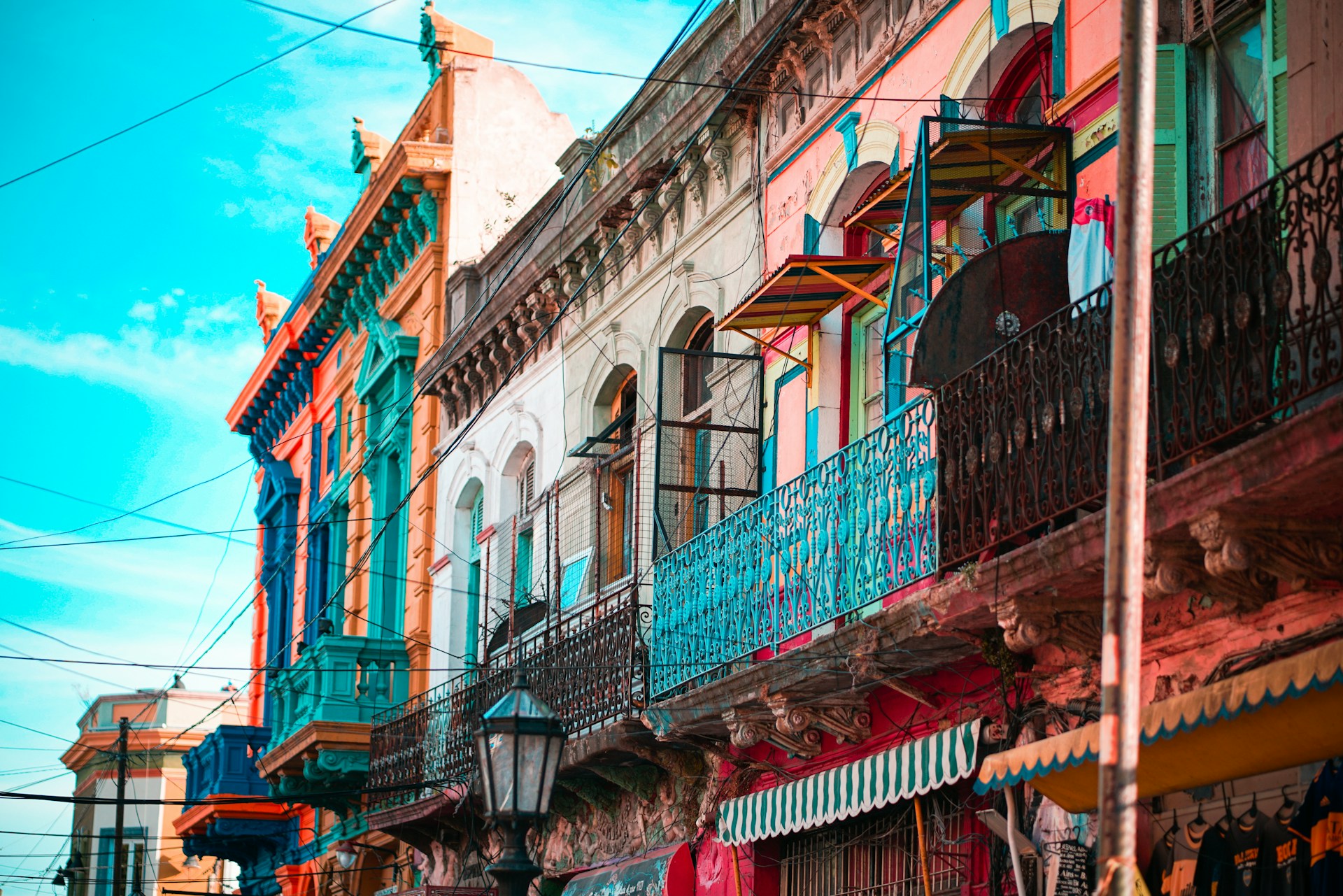
The working-class port neighbourhood where tango is said to have been born, and home to the brightly painted houses of Caminito street and Boca Juniors' iconic La Bombonera stadium. Worth a focused few hours in daylight; not a neighbourhood to base yourself in or wander after dark, since safety drops off sharply just blocks from the tourist core.
Puerto Madero
The newest neighbourhood, a redeveloped dockland of glass towers, the Faena Hotel, and the Puente de la Mujer bridge, walkable along the waterfront from San Telmo. Polished and pleasant but the least distinctly "Buenos Aires" of the areas here, better for an evening walk or dinner than a full day.
From a century-old grand hotel to a $12 hostel bed near Plaza de Mayo
Buenos Aires' hotel scene spans genuine grand-hotel history in Recoleta to fast-growing boutique properties in Palermo, with prices that remain reasonable by major-capital standards even after the currency reforms.
At the top, Alvear Palace Hotel in Recoleta has been the city's grand dame since the 1930s, a Leading Hotels of the World member surrounded by the neighbourhood's antique shops and boutiques. In Puerto Madero, the Faena Hotel, a converted early-1900s grain warehouse reimagined by designer Philippe Starck, pairs striking red-and-gold interiors with the Rojo Tango dinner show, one of the city's best-known tango performances.
In the boutique bracket, Fierro Hotel Buenos Aires in Palermo pairs contemporary rooms with an acclaimed in-house restaurant, while Mine Hotel Boutique in Palermo Soho offers a smaller, design-forward alternative a short walk from the neighbourhood's restaurant streets. CasaSur Recoleta Hotel adds a rooftop pool and bar in a quieter pocket of Recoleta.
At the budget end, Milhouse Hostel, with its Avenue and Hipo locations near Plaza de Mayo, a few minutes' walk from San Telmo, is the long-running benchmark for backpacker energy in the city: dorm beds, a rooftop terrace and an in-house bar built around a genuine social scene.
Steak treated as a civic institution, dinner that starts at nine
Buenos Aires eats seriously and late. The city's parrillas (steakhouses) are a legitimate reason to visit on their own, and the wider food scene, heavily shaped by Italian immigration, runs from market-stall empanadas to tasting menus that compete internationally.
World-class parrilla
Don Julio, at Guatemala 4699 in Palermo Viejo, holds a Michelin star and was recently inducted into the World's 50 Best Restaurants' Hall of Fame after years near the top of the ranking; expect a wait without a reservation booked well ahead. La Cabrera, with its Norte and Sur locations on Jose A. Cabrera street in Palermo Soho, is the more theatrical, generous-portion classic: every steak order arrives with a cascade of small complimentary side dishes.
Empanadas & market food
Baked or fried hand-pies sold by weight or the dozen at bakeries and market stalls across the city, with fillings (beef, ham and cheese, corn, spinach) that make a legitimate light lunch. San Telmo's Sunday market and Mercado de San Telmo, the covered market itself, are reliable spots to try several kinds at once.
Café culture & Café Tortoni
Café Tortoni, open since 1858 and the oldest café in the city, is a genuine institution rather than just a tourist stop: marble tables, stained glass, and a back room that has hosted tango and poetry performances for well over a century. Order a coffee and a plate of facturas (breakfast pastries) and take a slow hour.
Ice cream & dulce de leche
Argentina's Italian-immigrant heladerías produce ice cream that rivals Italy's own; dulce de leche granizado (with chocolate shavings) is the flavor to order first. Heladerías are dense across Palermo and Recoleta and open late into the night, matching the city's dinner schedule.
Marble mausoleums, a bookstore in an old theatre, and a tango show that isn't tourist theater
Buenos Aires' sights spread across several neighbourhoods, so pairing nearby stops on the same day matters more here than in a more compact city center.
Recoleta Cemetery
Recoleta Cemetery holds over 6,400 elaborate mausoleums across its walled grounds, an outdoor museum of Art Nouveau, Neo-Gothic and Baroque funerary architecture dating from 1822. Eva Perón's tomb, modest by the cemetery's own extravagant standards, draws a steady stream of visitors leaving flowers; a free map at the entrance or a guided walking tour makes the maze of narrow "streets" between mausoleums easier to navigate. Entry is free.
El Ateneo Grand Splendid
A working bookstore inside a fully preserved 1919 theatre, with the original stage now a café, the boxes converted to reading nooks, and frescoed ceilings intact overhead. Regularly ranked among the world's most beautiful bookstores and worth the visit even without buying anything, though the Spanish-language travel and photography sections make reasonable souvenirs.
San Telmo's Sunday market & La Boca's Caminito
San Telmo's Sunday antiques fair runs the length of Defensa street from Plaza de Mayo down to Parque Lezama, several hundred stalls deep with antiques, crafts, street tango and live music. Pair it, in daylight and with your bag zipped, with a few hours in La Boca for the brightly painted houses of Caminito street and, if the timing works, a Boca Juniors match at La Bombonera booked through a reputable tour operator rather than a street tout.
MALBA & Teatro Colón
MALBA (Museo de Arte Latinoamericano de Buenos Aires) holds the city's best modern and contemporary Latin American art collection in a striking purpose-built building in Palermo. Teatro Colón, widely considered one of the world's finest opera houses acoustically, runs guided tours through its gilded auditorium and backstage areas by day and a full performance calendar by night; booking a tour or a ticket ahead is worth it over a walk-up attempt.
One, two or three days, neighbourhood by neighbourhood
Three full days cover Buenos Aires properly; even one focused day hits the essentials if you pick a single neighbourhood pairing. A fourth day is really the Tigre Delta trip, worth adding if your schedule allows it.
- Morning
Recoleta Cemetery and El Ateneo. The mausoleums, then a browse and coffee at the bookstore-theatre a short walk away.
- Midday
Palermo. Lunch and a wander through Palermo Soho's boutique streets.
- Afternoon
Bosques de Palermo. The parks and Japanese Garden for a slower pace before dinner.
- Evening
Don Julio or La Cabrera, booked ahead, for the parrilla experience.
- Day 1
The one-day route: Recoleta, El Ateneo, Palermo, dinner at a parrilla.
- Day 2 morning
San Telmo. The Sunday antiques market if timing allows, or the covered Mercado de San Telmo any other day.
- Day 2 afternoon
La Boca. Caminito and, if there's a match, La Bombonera, back before dark.
- Day 2 evening
A milonga in San Telmo or Almagro for a genuine tango evening.
- Days 1-2
The two-day route above, at a gentler pace.
- Day 3
MALBA and Teatro Colón. The museum in the morning, an opera house tour or evening performance to close out the trip.
Two airports, a useful Subte, and rideshare that actually works
Ministro Pistarini International Airport, universally called Ezeiza (EZE), sits about 35km south of the centre and handles nearly all international flights. The official airport taxi desk inside arrivals charges a fixed rate of roughly $40 to the city centre, paid before you travel; Uber and Cabify cost similarly and are widely used despite Uber's still-unsettled formal legal status. Aeroparque Jorge Newbery (AEP), just 4km from Palermo on the river, handles most domestic flights and some regional international routes, making transfers considerably shorter and cheaper.
The Subte (subway) covers the city center on six lines and is the fastest way between neighbourhoods at rush hour; a single ride costs roughly $1-2 with a registered SUBE card, sold at kiosks and stations and worth registering to your passport on day one, since unregistered cards cost around 50% more per ride. Buses (colectivos) cover routes the Subte misses but are harder for visitors to navigate without a transit app. Walking works well within Palermo, Recoleta and San Telmo individually, but the distances between them are real: budget for taxis or rideshare between neighbourhoods rather than assuming everything is walkable.
Best time to visit
Buenos Aires works as a city break year-round since it doesn't depend on beach weather, but March to May and September to November are the most comfortable: mild and dry, without January-February's humid heat (regularly above 30°C) or July's grey, damp winter chill (around 8-14°C). Argentine school holidays in January push up domestic tourist numbers and prices even though the city itself can feel quieter as residents leave for the coast.
Mid-priced now, not the bargain it briefly was
Buenos Aires is noticeably cheaper than Western European or North American capitals but no longer the extraordinary "blue dollar" bargain it was during Argentina's 2020-2024 currency crisis. Since the currency controls lifted in April 2025, prices have become more predictable and, in dollar terms, higher than many older travel blogs still suggest.
- Hostel dorm bed $8-15
- Empanadas and market meals $3-6
- Subte and colectivo fares
- Free sights: Recoleta Cemetery, parks, El Ateneo
- Boutique hotel $80-140
- Parrilla dinners $25-50/person
- Rideshare between neighbourhoods
- Teatro Colón tour and a milonga night
- Alvear Palace or Faena Hotel $250-400+
- Tasting menu at Don Julio
- Private guides and tango dinner shows
- Airport transfers over public transit
Safe by South American capital standards, with the usual caveats
Buenos Aires is safe for tourists who take normal city precautions. Violent crime against visitors is uncommon, and Palermo, Recoleta and the main tourist parts of San Telmo are fine to walk in the evening with the same awareness you'd bring to any major capital. The practical risks are pickpocketing, counterfeit bills and taxi-related scams, not violent crime.
The three things that actually catch visitors: street taxi overcharging and counterfeit-bill swaps, avoidable by using Uber, Cabify or a clearly marked radio taxi rather than hailing on the street; distraction theft around Retiro bus terminal, crowded Subte cars and busy tourist plazas, so keep bags zipped and in front of you; and the specific "fake police" scam, where someone posing as a plainclothes officer asks to inspect your wallet for counterfeit bills and then pockets the cash, which real police never need to do on the street. La Boca outside the immediate Caminito tourist core is the one neighbourhood worth actively avoiding after dark or off the main strip.
Emergency numbers: 911 general emergency (police, fire, medical), 107 ambulance, 100 fire, and 0800-999-5000 the dedicated tourist police line, with staff able to assist beyond Spanish.
Tigre's river delta, and a border crossing to Uruguay
Buenos Aires' position on the Río de la Plata makes it a workable base for two very different day trips: a river delta an hour north, and a genuinely easy international crossing across the water.
Tigre
Tigre, where the Paraná river system fans into hundreds of channels lined with stilted houses, is reachable by a direct commuter train from Retiro station. Riverboat cruises run from short one-hour loops to half-day trips deeper into the delta, and the Puerto de Frutos craft and produce market by the train station is worth an hour for handmade goods rather than the usual tourist trinkets.
Colonia del Sacramento, Uruguay
A high-speed ferry across the Río de la Plata reaches Colonia del Sacramento, a UNESCO-listed Portuguese-and-Spanish colonial old town, in about an hour, making a genuine international day trip possible from Buenos Aires. Bring your passport for the border crossing, and check current ferry schedules and pricing before you go, since routes and operators shift.
Buenos Aires FAQ
Is Buenos Aires safe for tourists?
Yes, by South American capital standards. Violent crime against visitors is uncommon, and central and northern neighbourhoods like Palermo and Recoleta are fine to walk in the evening with normal awareness. Pickpocketing, counterfeit bills and street-taxi overcharging are the main practical risks, not violent crime.
How many days do I need in Buenos Aires?
Three full days covers the city well: one for Palermo and Recoleta, one for San Telmo and La Boca, one for Teatro Colón and a tango evening. A fourth day fits the Tigre Delta day trip comfortably.
How much does Buenos Aires cost per day?
Budget travellers manage on $50-80 a day with hostel beds and empanada-and-market meals; mid-range runs $90-150. It's mid-priced by international standards now, not the extreme bargain it was during Argentina's 2020-2024 currency crisis.
When is the best time to visit Buenos Aires?
March to May and September to November: mild and dry, without the humid heat of January-February or the grey chill of July's winter. Buenos Aires works as a city break year-round since it doesn't depend on beach weather.
What is Palermo?
Buenos Aires' largest and trendiest neighbourhood, split into Palermo Soho (boutiques, restaurants, nightlife) and Palermo Hollywood (media offices, bars), plus the green Bosques de Palermo parks. The most common base for first-time visitors.
Is Recoleta Cemetery worth visiting?
Yes. Over 6,400 elaborate mausoleums, including Eva Perón's tomb, make it one of the most visited sites in the city and a genuinely striking piece of architecture and history, not just a curiosity stop.
How do I get from Buenos Aires airport to the city centre?
From Ezeiza (EZE), the official airport taxi desk charges a fixed rate of roughly $40 for the 45-75 minute drive; Uber and Cabify cost similarly. From Aeroparque (AEP), just 4km from Palermo, transfers are quicker and cheaper.
What is the best area to stay in Buenos Aires?
Palermo or Recoleta for first-timers: central-feeling, walkable to the best restaurants, and a short Subte or rideshare ride from everything else. Palermo is livelier at night; Recoleta is quieter and more formal.
Can I do a day trip to Tigre from Buenos Aires?
Yes, easily. Tigre, the delta town where the Paraná river system fans into hundreds of channels, is about an hour north of Buenos Aires by commuter train, with boat cruises and the Puerto de Frutos craft market. A comfortable half or full day trip.
Is Uber legal in Buenos Aires?
It operates in a legal grey area that has trended in Uber's favour, including a September 2025 court ruling supporting its legality, but formal regulation is still pending. In practice it runs openly across the city alongside Cabify and traditional taxis.
What Stays With You
Buenos Aires does not have Rio's beaches or Lima's ceviche, and it is not trying to compete on either. What it has is a capital built almost entirely by people who arrived from somewhere else, Italy and Spain above all, and spent a century turning homesickness into a specific, durable culture: the late dinners, the cheek kisses, the mate thermoses carried through the parks, the tango that started in La Boca's port bars and ended up conquering Paris.
Sit at Café Tortoni on your last evening with a coffee and a facturas plate, watch a city that never quite stopped being an immigrant port town go about its night, and understand why so many visitors extend a planned two nights into a week.