
What You're Actually Dealing With
The Risks That Actually Catch People
Iraq's risk profile is predominantly security-based and institutional rather than conventional tourist scam activity. What follows covers both the serious security considerations and the practical tourist-facing issues.
Iraq experiences sporadic attacks from ISIS remnants in northern and western regions, rocket and drone attacks by Iranian-backed militia groups (particularly targeting locations associated with US presence), and periodic civil unrest particularly around elections and political flashpoints. These incidents are impossible to predict with precision. The risk is not evenly distributed -- Kurdistan is significantly safer -- but no part of Iraq is entirely without security risk.
- Check your government's Iraq advisory broken down by region the week before travel and again on the day you fly. The situation changes faster than any guide.
- Register your presence with your embassy immediately upon arrival. Erbil has British, American, and European consular presence -- use it.
- Avoid travel between cities at night. The intercity risk profile is significantly higher after dark.
- Have a clear and tested exit plan before you enter the country. Know which land border crossings are currently operational to Turkey (Ibrahim Khalil at Zakho), Jordan (Trebil), and Kuwait (Safwan) as fallback options to the airport.
Military and police checkpoints are a constant feature of Iraqi travel. In Kurdistan they are the Peshmerga and generally professional. In central Iraq they are federal police and army, variable in professionalism. Near Najaf and Karbala during pilgrimage periods they multiply significantly. At some checkpoints, particularly outside Kurdistan, informal payments are requested from drivers. As a foreigner in a vehicle, you will almost certainly be asked to show your passport at multiple points on any overland journey.
- Carry your passport at all times. Having it quickly accessible rather than buried in your bag reduces checkpoint delays.
- Stay calm, be polite, and respond to questions directly. Checkpoints in Kurdistan are generally relaxed; in central Iraq they can be tense -- follow the lead of your driver.
- Your driver knows the checkpoint dynamics on any route you're travelling far better than you do. Follow their instructions about when to speak and when to let them handle the interaction.
Taxi overcharging at airports and tourist sites is the most conventional tourist scam in Iraq. At Erbil airport, the journey to the city centre should cost around $10-15; drivers quote $25-35 to arriving foreigners. Careem (the Middle Eastern ride-hailing app) operates in Erbil and Sulaymaniyah and gives you app-confirmed pricing. In Baghdad, security concerns around transport are more serious than the overcharging issue.
- Install Careem before landing in Erbil or Sulaymaniyah. It works from the airport and solves the pricing problem entirely.
- If using a street taxi, agree the price in USD before getting in. Ask your hotel what the correct fare is for your specific route in advance.
- For Baghdad, arrange airport transfer through your hotel rather than using street taxis -- security considerations override pricing concerns here.
Iraq has broad photography restrictions around military, governmental, and infrastructure targets. In the current security environment, photographing a checkpoint, military vehicle, oil pipeline, or security force member can lead to detention for questioning that ranges from brief to extended. This risk is real and not limited to obviously sensitive locations -- a photo that happens to include a guard tower in the background has caused problems for visitors.
- Don't photograph checkpoints, military personnel, oil infrastructure, or government buildings. Keep your camera completely away at these moments.
- At archaeological sites and in city markets and bazaars, photography is generally fine -- ask permission from individuals before pointing a camera at them.
- If questioned about photography, be cooperative and straightforward. Explaining that you're a tourist interested in the history is almost always sufficient in Kurdistan; in central Iraq, follow your guide's lead on how to respond.
The Shia holy cities of Najaf and Karbala receive tens of millions of pilgrims during Arbaeen (the 40th day after Ashura) and other pilgrimage periods, creating extreme crowd density and logistical complexity. Non-Muslim visitors can attend these cities but need to be aware that certain shrine interiors are restricted to Muslims. The sheer scale of pilgrimage crowds during peak periods creates security risks from crushing and stampede, not just from external attack -- the security forces manage large crowds with methods that can be disorienting.
- Visit Najaf and Karbala outside peak pilgrimage periods if you're primarily interested in the architecture and history -- the sites are extraordinary in quieter periods.
- If you attend Arbaeen, go with an experienced guide who knows crowd movement and safe positions. The scale is genuinely overwhelming at peak times.
- Dress conservatively at all times in the south -- women should cover fully, men should avoid shorts.
Iraq's archaeological looting problem from the 2003 invasion period and the ISIS era means that fake "ancient" artefacts circulate in bazaars and tourist contexts, alongside occasionally genuine pieces that cannot legally leave the country. Buying what is presented as an authentic Mesopotamian artefact -- a cylinder seal, a cuneiform tablet, a bronze figurine -- is almost certainly buying a reproduction at genuine-item prices, and in the small chance it is real, transporting it out of Iraq constitutes trafficking in cultural property under international law.
- Don't buy items presented as ancient artefacts. The reproduction market is substantial and the legal risk of transporting a genuine piece is significant regardless of how you acquired it.
- Contemporary Iraqi art, crafts, and textiles are entirely fine to buy and bring home -- the bazaars have genuinely beautiful copperwork, textiles, and ceramics.
- If a deal seems too convenient -- a stall near a major archaeological site offering "ancient" objects at negotiable prices -- it is a reproduction or a legal trap.
The Destinations — An Honest Assessment
Iraq's three distinct regions offer genuinely different experiences and require genuinely different approaches. The history underneath all of them is extraordinary. The logistics on top of it vary enormously.
Erbil is the capital of the Kurdistan Region and one of the oldest continuously inhabited cities in the world -- the citadel at its centre, Qal'at Erbil, has been occupied for at least 6,000 years and is a UNESCO World Heritage Site. The citadel itself is currently being restored and only partially open, but the view from its walls over the sprawling modern city below -- shopping malls, hotel towers, street markets -- collapses your sense of time in a specific way. The Grand Bazaar below the citadel sells copperwork, textiles, and spices in a warren of covered lanes that has been doing business in roughly the same location since the Assyrian period. The restaurants on Ankawa Road in the Christian quarter of the city serve Iraqi-Kurdish food that is a completely distinct culinary tradition from Arabic Iraqi cooking -- lamb stews, dolma, grilled meats, rice dishes coloured with turmeric and dotted with raisins -- in a relaxed atmosphere that feels nothing like a city in a conflict-adjacent country.
- Careem operates in Erbil and gives app-confirmed fares -- install it before landing and use it for everything
- The Qal'at Erbil citadel is free to walk around the perimeter at any time; interior access is limited and changes based on restoration works -- check at the gate
- Ankawa Road's restaurants are where expats, NGO workers, and Erbil's professional class eat -- more relaxed than the city centre, good alcohol availability (Kurdistan is significantly more liberal on alcohol than the rest of Iraq)
- The Erbil Bazaar's best copperwork is in the alley just inside the main gate off Qal'at Square -- the craft has been practiced in this specific spot for centuries
Sulaymaniyah is Kurdistan's cultural capital -- more intellectual, more politically engaged, and more arts-focused than commercial Erbil. The Kurdistan Museum on Salim Street has a collection covering 10,000 years of Kurdish and Mesopotamian history including Sumerian cylinder seals, Neo-Assyrian reliefs, and objects from the Kurdish genocide (Anfal) of the 1980s that form one of the most important human rights documentation collections in the region. The Azmar Mountain east of the city has hiking trails above 1,500 metres with views back over the city and south toward the disputed territories. The old bazaar district around Mawlawi Street has a teahouse culture that is genuinely the city's social heartbeat -- men playing backgammon and trading gossip since before anyone can remember.
- The Kurdistan Museum is the single most important museum in Iraqi Kurdistan and requires at least two hours -- the Anfal documentation rooms are sobering and necessary
- Sulaymaniyah's coffee shops and teahouses are more mixed-gender and relaxed than Erbil's -- the city has a liberal cultural atmosphere by Iraqi standards
- The road from Sulaymaniyah to Halabja (50km southeast) passes through landscape that becomes increasingly significant as you understand what happened here in 1988 -- the Halabja Memorial is the most important memorial to chemical weapons victims in the world
- Avoid travel toward the Iranian border area east of the city without current intelligence -- the border zone has seen security incidents
Beyond the cities, Iraqi Kurdistan has mountain landscapes that most visitors never expect. The Barzan Valley north of Erbil, ancestral home of the Barzani family that has dominated Kurdish politics for generations, has peaks rising to 3,600 metres with hiking trails, waterfalls, and traditional stone villages. Duhok in the northwest -- three hours from Erbil -- is a pleasant mountain city with a lake resort at Duhok Dam and the Amadiya ancient town on a plateau above a sheer-sided mountain that Alexander the Great supposedly detoured around. Rawanduz Gorge, carved by the Great Zab River into limestone cliffs above the town of Rawanduz, has some of the most dramatic canyon scenery in the Middle East and has recently developed basic ecotourism infrastructure with zip lines, canyon walks, and guesthouses.
- Very low scam presence throughout Kurdistan's rural areas -- the region is working hard to develop ethical tourism and the communities benefit directly
- Rawanduz Gorge is 2-3 hours from Erbil on a road that winds dramatically through the mountains -- do it as a full day rather than rushing
- The Hamilton Road from Rawanduz toward Iran (built by New Zealand engineer Archibald Hamilton in the 1920s and 30s) is one of the great mountain drives in the region -- go as far toward the border as current security conditions allow and no further
- Peshmerga checkpoints on mountain roads are frequent and professional -- have your passport accessible and the interaction will be friendly and brief
Baghdad is a city of 9 million people that has survived more than it has any right to and continues to function with a resilience that is its defining characteristic. The Iraq Museum on Museum Square -- the most important collection of Mesopotamian antiquities in the world, looted badly in 2003 and substantially recovered since -- has reopened and is worth the risk calculus for serious visitors interested in what 6,000 years of continuous civilisation actually looks like in object form. The Al-Mutanabbi Street book market, bombed in 2007 and rebuilt, fills every Friday morning with secondhand books, manuscripts, and intellectual Baghdad doing what it has done since the Abbasid Caliphate. The Al-Rashid Street area in the old city has Abbasid-era architecture in various states of preservation. All of this requires current security intelligence, hotel-arranged transport, and realistic acceptance that the visit is genuinely risky.
- The Iraq Museum (Mathaf al-Iraq) is open most days except Monday; check current hours with your hotel as they vary -- budget three to four hours minimum
- Arrange all transport through your hotel. Security conditions in Baghdad change by neighbourhood and by day -- your hotel knows the current safe corridors
- The Green Zone (International Zone) restrictions have eased considerably since 2019 but remain relevant -- don't wander near it without knowing current access rules
- The Al-Mutanabbi Friday book market is one of the most specifically Baghdad experiences available -- the tradition of intellectual life on this street goes back to the 10th century Abbasid period when it was called Darb Zubaydah
The ziggurat of Ur, near Nasiriyah in southern Iraq, is a 4,000-year-old stepped temple platform that still rises 30 metres from the Mesopotamian plain. It was built by King Ur-Nammu around 2100 BC, partially reconstructed by Saddam Hussein in the 1980s (a historically controversial decision that is visually apparent), and administered by the Iraqi Air Force whose base surrounds the site -- advance permission is technically required. Babylon, 90km south of Baghdad, is the most famous Mesopotamian site of all: most of the visible remains date to Nebuchadnezzar II's reign (605-562 BC) and include the Ishtar Gate approach (the original is in Berlin's Pergamon Museum; a reconstruction is here), the processional way, and the remains of the palace complex. Visiting these sites requires genuine logistical work with a trusted local operator -- they are worth it.
- Both sites require a local operator with current permissions and contacts -- solo visits to Ur especially are not practical given the military base situation
- The State Board of Antiquities and Heritage (SBAH) manages access to major sites; a registered local guide or tour company handles the permissions more efficiently than individual visitors can
- The journey from Baghdad to Babylon (90km south) or Nasiriyah (370km south) for Ur requires current road security intelligence -- do not attempt either drive without up-to-date information from your operator on the day of travel
- Ur in late afternoon, when the light turns the honey-coloured brickwork amber and the desert stretches empty in all directions, is one of the most resonant landscape experiences available to anyone willing to reach it
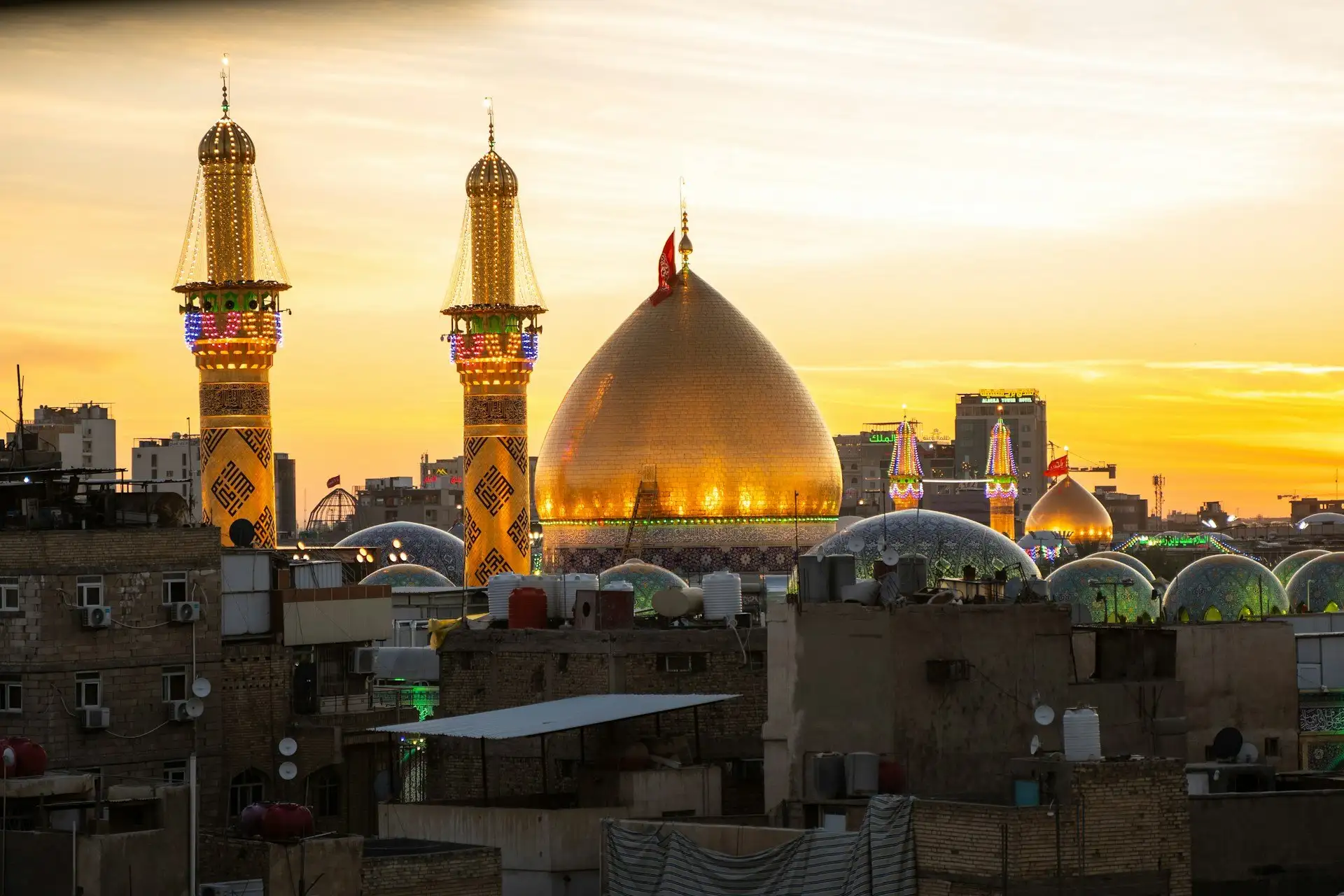
Najaf and Karbala are the two holiest cities in Shia Islam. Najaf holds the tomb of Ali ibn Abi Talib, the Prophet Muhammad's cousin and son-in-law, in the Imam Ali Shrine -- one of the most visited religious sites on earth, with Wadi-us-Salaam cemetery surrounding it (the largest cemetery in the world by number of burials, over 6 million). Karbala is the site of the Battle of Karbala in 680 AD, where Ali's son Hussein was killed, an event that defines Shia identity as foundationally as anything in religious history. During Arbaeen, up to 20 million pilgrims walk to Karbala from Najaf over two days in the largest annual human gathering on earth. Non-Muslims can visit both cities and the experience of witnessing the scale and sincerity of Shia devotion at these shrines -- the weeping, the prayer, the flags, the community meals (saha) offered freely to pilgrims by local families -- is genuinely unlike anything else on earth.
- Non-Muslims are welcome at both cities but cannot enter the innermost shrine areas -- exterior courtyards and the approach roads are accessible and provide full visual context
- Dress fully conservatively -- women should cover completely; men should wear long trousers and a long-sleeved shirt
- The saha system during pilgrimage periods means that volunteers will press food and tea on you continuously -- accepting is an act of participation in the hospitality tradition, not an obligation to contribute
- The Wadi-us-Salaam cemetery in Najaf is worth time on its own -- the density of domed mausoleums, the families visiting, the sense of accumulated grief and devotion over centuries is unlike any other cemetery in the world
Before You Go — The Checklist
- ✓ Read your government's Iraq advisory broken down by specific region -- Kurdistan, central Iraq, and the south have genuinely different risk profiles that a single advisory headline does not convey.
- ✓ Register with your embassy before arriving. Erbil has British, American, and EU consular presence -- use the STEP/LOCATE systems before you land.
- ✓ Install Careem before landing in Erbil or Sulaymaniyah. It gives app-confirmed pricing and removes the taxi overcharging problem.
- ✓ Bring sufficient USD cash. ATMs exist in Kurdistan but are unreliable elsewhere and USD is accepted at tourist businesses throughout the country.
- ✓ Don't photograph checkpoints, military personnel, oil infrastructure, or government buildings -- anywhere in Iraq.
- ✓ Avoid overland travel between cities after dark. The security risk profile increases significantly at night on intercity routes.
- ✓ For Baghdad and the south, arrange all transport through your hotel or a reputable local operator. This is not negotiable from a security perspective.