
What You're Actually Dealing With
The Scams That Actually Catch People
East Timor's scam profile is thin and unsophisticated. Most of it comes down to foreigner pricing and the absence of fixed tariffs. Nothing here is organised or threatening.
No meters exist in Dili taxis. Every fare is negotiated and the foreigner rate is reliably two to three times the local rate. The airport to central Dili should cost $3-5 USD; drivers quote $10-15. Short hops around Dili cost $1-2 locally and $3-5 to a foreigner who hasn't asked first.
- Ask your accommodation what the correct fare is for specific journeys before you need them — arrive knowing the number.
- Agree the price before getting in, in USD, for the whole journey not per person.
- For airport arrivals, some hotels offer pickup; it's worth the first-night convenience.
Someone attaches themselves to your visit at a natural site or viewpoint, provides unsolicited guidance or commentary, then names a price at the end that was never discussed. At Ramelau — the highest peak in the country — individuals near the trailhead offer to guide the summit hike without establishing a fee upfront.
- If you want a guide, agree the price before starting — ask your guesthouse to connect you with someone they know and trust.
- If someone begins guiding without being asked, stop and ask the fee immediately or decline politely and continue independently.
- The Ramelau summit hike is manageable without a guide in good conditions; local knowledge adds value but isn't mandatory.
Outside Dili, accommodation options are limited and online listings are often outdated or inaccurate about facilities. A guesthouse described as having hot water or reliable electricity may have neither. In a country with infrastructure limitations, this isn't always deliberate misrepresentation — but arriving at a remote location to find the room is not what was advertised is a real situation with limited alternatives.
- Contact accommodation directly before booking and ask specific questions about power, water, and room condition.
- For guesthouses in Maubisse, Same, or other interior towns, local knowledge from your Dili accommodation is the most reliable source of current information.
- Have a flexible fallback plan; rural East Timor has limited alternatives if the first option doesn't work out.
Shared minibuses (anggunas) run between Dili and towns like Baucau, Same, and Maliana at fixed local rates. Foreigners are routinely quoted two to three times the standard fare. The Dili to Baucau run costs locals around $2-3; foreigners are quoted $6-10. Driver-guide day hire for interior trips is also subject to significant variance — prices named on the spot to foreigners are often double what a locally arranged rate would be.
- Ask your guesthouse for current intercity fares before going to the bus terminal — arrive knowing the number.
- For driver-guide hire, arrange through your accommodation rather than approaching drivers directly; local networks price more honestly.
- Paying a modest premium above local rates is normal and fair in a very poor country — the issue is extreme overcharging, not the existence of a foreigner rate.
East Timor has exceptional diving — Atauro Island's reef system was recorded as one of the highest fish diversity sites on earth. The dive operator market is small and quality varies significantly. Some operators run with equipment that is inadequately maintained and guides whose safety protocols are inconsistent. The lower the price, the more often corners are being cut.
- Use operators with verifiable PADI or SSI affiliation and visible equipment maintenance — Compass Charters and Atauro Dive Resort are the most consistently recommended.
- Inspect tanks, BCDs, and regulators before getting in the water.
- The marine life quality here is genuinely extraordinary; spending slightly more for a reputable operator is justified by the diving itself, not just by safety.
Foreigner pricing at markets and roadside stalls is universal and modest by Southeast Asian standards. Tais (traditional woven cloth) is priced significantly higher for foreigners at the dedicated Tais Market than the same items would cost from a village weaver or through a local contact. The gap is real but the amounts involved are small.
- Negotiate politely at the Tais Market — it's expected and nobody is offended by it.
- For the best tais prices and the most direct economic benefit to makers, ask your guesthouse about buying directly from weavers in villages near your route.
- Context: even the inflated foreigner price for tais is modest by any international standard; the craft is genuinely worth buying at any reasonable price.
The Destinations — Honest Takes
East Timor is small and slow to travel. A week is enough to see the main sites. Two weeks lets you reach the interior properly.
Dili is a coastal capital of about 250,000 people that operates with the unhurried pace of a city that has been through extraordinary things and is still working out what comes next. The waterfront along Avenida de Portugal has the best restaurants and the evening promenade culture. The Resistance Museum covers the Indonesian occupation with a directness that leaves an impression. Cristo Rei, the 27-metre statue above a bay east of the centre, is reached by a staircase of 520 steps and the view from the top is the best in the city.
- Agree taxi fares before getting in — airport to central Dili is $3-5 USD, not $10-15
- The waterfront restaurants are good and honestly priced by Dili standards; the markup exists but isn't extreme
- Dili has had some petty theft in the Colmera area at night; keep phones out of sight after dark in busy street areas
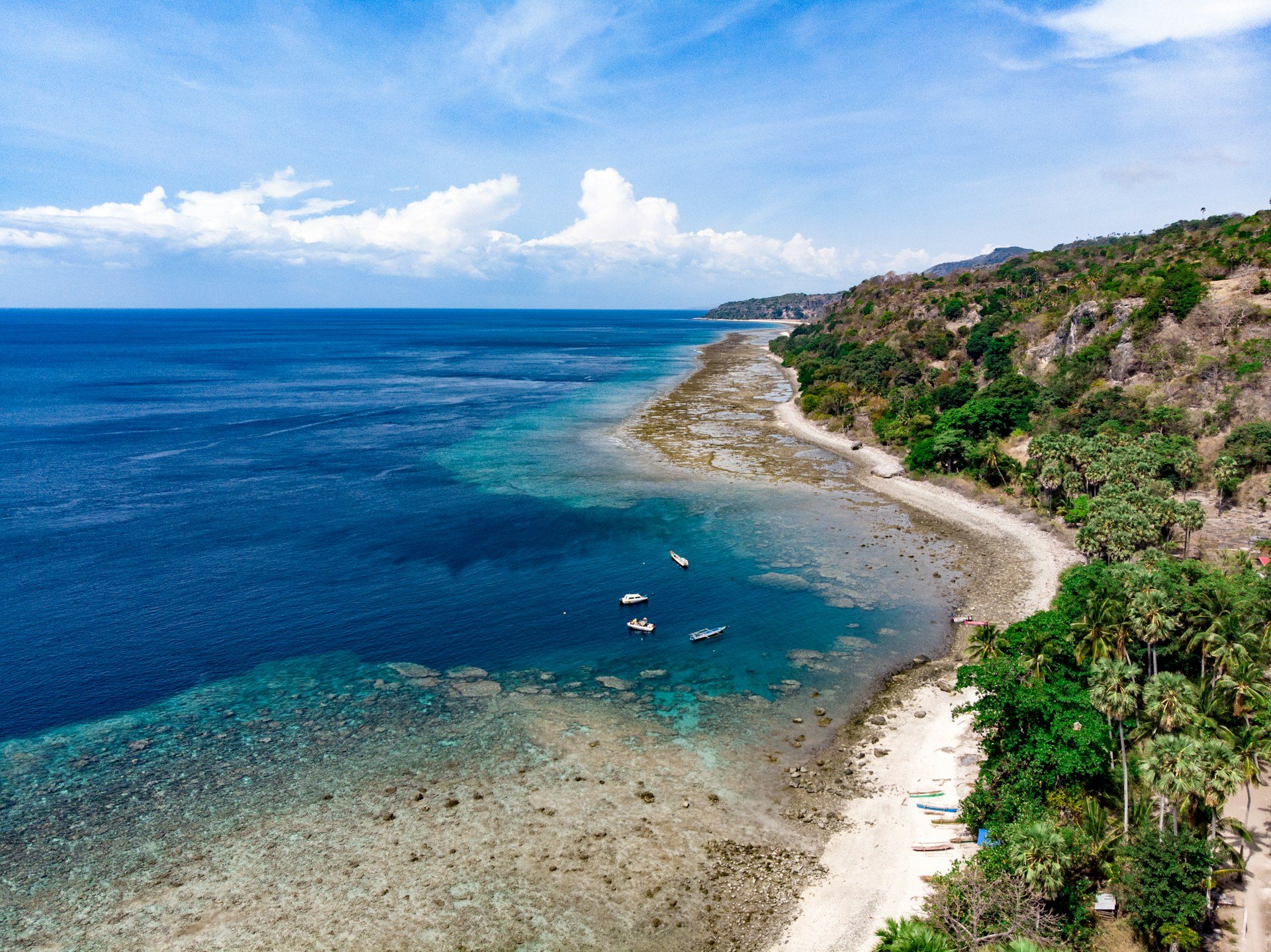
Atauro is a small volcanic island 25km north of Dili, reached by a 90-minute ferry or a fast boat, and it has been recorded as having the highest reef fish diversity on earth. The diving and snorkelling here is legitimately world-class, not travel-brochure world-class. The island has a handful of simple guesthouses and eco-lodges, no cars to speak of, and the kind of slow pace that makes Dili feel hectic by comparison. Barry's Place and Atauro Dive Resort are the most established accommodation options.
- No meaningful scam presence; the island operates at too small a scale
- Book accommodation in advance during dry season (June-August) — the island's limited rooms fill with divers
- Use vetted dive operators only; Atauro's reef quality means the diving delivers everything promised, the operator variable is the only meaningful risk
Baucau is East Timor's second city, 120km east of Dili along the north coast road — a 2.5 to 3 hour drive on a good day. It sits at altitude above a coastal plain and has a Portuguese-era upper town with a pousada (colonial-era guesthouse) and a market square that feels like a different century. The natural pool at Suco Triloka nearby, fed by a freshwater spring into a rock basin above the sea, is one of those specific beautiful things that almost nobody outside the country knows about.
- Very low scam presence; Baucau sees few tourists and the foreigner premium is modest
- The Pousada de Baucau is the most reliable accommodation option; book directly by phone or through your Dili guesthouse
- The coast road east of Dili to Baucau is the best road in the country; beyond Baucau conditions deteriorate significantly
Maubisse is a mountain town 70km south of Dili, reached by a road that climbs steeply into coffee country and drops the temperature by 15 degrees. The Portuguese-era pousada there is simple and cold and worth staying at for the view of the valley below in the morning. From Maubisse, the road continues south toward Same and Ainaro and the approach to Mount Ramelau, the country's highest peak at 2,986 metres. The summit hike from Hato-Builico village takes 3-4 hours and the view at dawn, above the cloud layer, justifies every step of the approach drive.
- Roads to the interior are rough and require a 4WD; do not attempt them in a regular car or in the wet season without local advice
- Unofficial guides at the Ramelau trailhead — agree fees upfront or hire through your accommodation
- Accommodation outside Maubisse town is very basic; carry food and more water than you think you need for any overnight in the interior
Jaco Island is a small uninhabited island at the eastern tip of Timor, sacred to the Timorese and formally protected — no overnight stays are permitted and no permanent structures exist. Getting there requires reaching the village of Tutuala, which is a serious drive from Dili (5-6 hours minimum on deteriorating roads), then hiring a local boat for the short crossing. The beach on Jaco is the kind that makes people stop talking. The snorkelling around it is excellent. Almost nobody gets there. That is the point.
- No scam infrastructure exists this far east
- The drive to Tutuala requires a solid 4WD, a full tank of fuel (no stations beyond Lospalos), and an early start from wherever you slept the night before
- The boat crossing is short and controlled by local fishermen; agree the price before departing and confirm the return pickup time explicitly
The south coast of East Timor — from Suai west to the border — is the country's least visited region and its most dramatic coastline. The road from Dili requires crossing the central mountains and takes the better part of a day. Suai has a cathedral and a history connected to the 1999 massacres that marks it as a place of gravity as well as geography. Diving on the south coast, where the Banda Sea drops into deep open water close to shore, is for experienced divers; the conditions are more variable than the sheltered north but the pelagic encounters are significant.
- No tourist scam presence; the south coast sees very few international visitors
- Self-sufficiency is required; fuel, food, and accommodation options are scarce and unpredictable outside Suai
- A local fixer or driver with south coast experience is strongly recommended for anyone planning more than a passing drive-through
Before You Go — The Checklist
- ✓ Buy medical evacuation insurance before you land — Dili's hospital handles routine cases; serious injuries go to Darwin or Bali.
- ✓ Carry all the USD cash you'll need for travel outside Dili; ATMs only exist in the capital and small bills ($1, $5, $10) are more useful than large ones in rural areas.
- ✓ Ask your Dili guesthouse for current taxi and intercity transport fares before you need them — arrive at negotiations knowing the number.
- ✓ Arrange guides and drivers through your accommodation rather than approaching people directly at sites or terminals; local networks price more honestly.
- ✓ For the interior, use a 4WD only and check road conditions with locals before departing — wet season closures happen without notice.
- ✓ Book dive operators with PADI or SSI affiliation and inspect equipment before getting in the water — the marine life quality here is genuine, the operator variable is the only risk.
- ✓ Contact accommodation outside Dili directly before booking and ask specific questions about water, power, and room condition — listings are frequently outdated.