
What You're Actually Dealing With
The Scams That Actually Catch People
Dominica is a low-risk destination. The issues that arise are mostly about price negotiation, variable operator quality, and the specific hazards of adventure tourism on an island where the terrain is genuinely demanding. None of it is threatening. All of it is manageable.
Dominica has no metered taxis. Fares are supposed to be set by official government rate cards, but drivers frequently quote above the official rate to visitors who don't know what the correct fare looks like. The Melville Hall Airport to Roseau run, which is the main airport arrival for most visitors, takes about 75 minutes and should cost EC$165-185 (roughly $60-70 USD) per vehicle. Drivers sometimes quote in USD at unfavourable conversions, add per-person charges to what should be a vehicle rate, or add baggage fees that aren't in the official schedule. The Canefield Airport is closer to Roseau (20 minutes, around EC$55-65) and sees fewer issues, but the same dynamics apply. Cruise ship passengers arriving at the Roseau cruise terminal face the most aggressive version of this, with drivers competing for fares as passengers disembark.
- The Dominica government publishes official taxi rates. Ask your accommodation before arrival what the correct fare from the airport should be, in EC dollars. Arrive knowing the number and negotiate from it rather than from the driver's opening bid.
- Agree the full price before getting in, confirm it's for the vehicle not per person, and confirm it includes luggage. Drivers who won't commit to a price before you're seated have the advantage once you're inside.
- Licensed taxis in Dominica have H plates (for hire). If a vehicle doesn't have H plates, you're in an unlicensed car with no official rate structure and no recourse if the driver invents a price at the destination.
- For regular transport around Roseau, minibuses run fixed routes for EC$1.50-3 per trip and are how most Dominicans move around the capital. Ask your guesthouse which route covers your destination.
Someone is waiting at the car park or entrance point of Dominica's most visited natural attractions. He offers to guide you in, claims the trail is confusing without local knowledge, and says he knows spots the official trail doesn't show you. For Emerald Pool and Trafalgar Falls, which are genuinely easy to navigate independently, this is a soft-sell with minimal basis. For the Boiling Lake hike, which is a serious 8-hour round trip through shifting volcanic terrain that does require navigation knowledge, the offer of a guide has more legitimate grounding. The issue is that these unofficial guides have no vetted qualifications, sometimes give incorrect safety information, and name their price at the end of the interaction rather than the beginning. The end price is reliably higher than what you'd have agreed to upfront if the conversation had started honestly.
- For the Boiling Lake hike, a licensed guide is a genuinely good idea rather than an unnecessary expense. Book through your accommodation or through the Dominica Watersports and Tour Operators Association before you arrive. A licensed guide costs around $60-80 USD for the day and earns it.
- For Emerald Pool and Trafalgar Falls, the trails are well-marked, short, and manageable without assistance. A polite decline is the full interaction required: "No thank you" delivered without opening a negotiation is sufficient.
- If you do want a guide who's approached you at a trailhead, agree the price before starting, get it in writing if possible, and clarify whether it's per person or per group. "We'll sort it out at the end" always resolves in the guide's favour.
- Official entry fees at sites like Emerald Pool are collected at a staffed booth. Cash handed to an individual claiming to collect entry fees outside the official booth is not an entry fee.
Dominica's adventure tourism is excellent when it's done properly and hazardous when it isn't. The island's rivers, canyons, and open water are genuinely wild in a way that resort-island snorkelling is not. Canyoning in the interior involves rappelling down waterfalls, swimming through gorges, and navigating terrain where a twisted ankle is a serious evacuation problem. Whale watching in Dominica's deep-water channel is in a different category from the motorboat tours on calmer Caribbean islands. The gap between a properly equipped, safety-conscious operator and someone who bought a boat and a couple of life jackets is significant. The cheaper the price you found, the more often the safety shortcuts explain the saving.
- Book adventure activities through operators who are members of the Dominica Watersports and Tour Operators Association (DWTOA) or who are specifically recommended by Discover Dominica, the national tourism authority. These operators are vetted and carry appropriate insurance.
- Before boarding any boat or starting any canyoning activity, check that life jackets are available for every participant, that the guide has a communication device, and that there's a clear plan for what happens if conditions change. Legitimate operators will not be offended by these questions.
- Whale watching in Dominica is outstanding year-round for resident sperm whales. The operators who work with research organisations and follow approach guidelines produce better encounters anyway, because the whales stay longer when they're not being chased.
- For diving, Dominica has excellent sites (Champagne Reef, Scott's Head, the Soufrière Scott's Head Marine Reserve) and several reputable dive operators in Roseau. Check that your operator is affiliated with a recognised certification body (PADI, SSI) and that their tanks and equipment are visibly maintained.
Hurricane Maria in 2017 left a legacy of inaccurate accommodation listings. Properties that were rebuilt after the storm sometimes have photos from before it, meaning the room you book based on the listing looks different from what you arrive to find. In some cases this is an honest lag in updating photos; in others it's deliberate misrepresentation. Dominica also has a significant number of rural eco-lodges and guesthouses that operate at varying standards and whose listings don't always accurately convey the level of basic infrastructure (intermittent electricity, cold-water showers, shared facilities) that "eco" sometimes implies. This is not a scam in the conventional sense, but arriving at a room that doesn't match expectations in a remote location with no alternatives is a bad situation.
- Email accommodation providers directly before booking and ask when their current photos were taken. If photos predate 2018, ask for current ones. Any legitimate operator rebuilt after Maria will have them and will be happy to share.
- Read reviews specifically from after 2018 and look for comments on infrastructure: hot water, electricity reliability, wi-fi, room condition. These details matter more on a remote island where alternatives are limited.
- For eco-lodges in the interior, "rustic" means something real on this island. If you need consistent air conditioning, reliable hot water, and strong wi-fi, clarify these points before booking rather than discovering on arrival that the generator runs from 6pm to 10pm only.
- The standard hotels in Roseau (Roseau Valley Hotel, Garraway Hotel) and the established eco-resort options (Secret Bay, Jungle Bay where rebuilt) have more consistent infrastructure and more reliable listings than the smaller rural options.
Dominica's craft market in Roseau's Old Market Plaza operates on days when cruise ships are in port with noticeably different energy than on days when they aren't. On cruise days, the stalls are fully staffed, the vendors are engaged and occasionally persistent, and the prices are higher. On non-cruise days, the same vendors are more relaxed, more willing to talk, and more open to genuine price discussion. This isn't a scam, it's pricing according to demand, but visitors who arrive on cruise ship days and don't negotiate will pay cruise-ship tourist prices. The genuinely made Kalinago crafts from the Kalinago Territory (woven larouma baskets, cassava graters, calabash bowls) are worth buying at fair prices; the mass-produced shell jewellery and generic Caribbean souvenirs found everywhere are not worth much at any price.
- Visit the Old Market on a non-cruise-ship day if your schedule allows. The atmosphere is calmer, the prices are more honest, and the conversation more genuine. Your guesthouse can tell you which days ships are in port.
- Negotiate politely. Dominicans selling crafts expect it and don't find it rude. Opening at 60-70% of the asking price and meeting somewhere in the middle is the normal dynamic.
- For Kalinago crafts specifically, buying directly from the Kalinago Barana Aute cultural village in the Kalinago Territory puts the money more directly into the community than buying from Roseau market intermediaries. The baskets woven from larouma reeds are genuinely beautiful and worth the journey.
This one sits at the junction of scam and safety issue. When a popular trail like Boiling Lake is closed due to conditions or volcanic activity, individuals sometimes position themselves at the trailhead and offer to guide visitors "through the closure" to the lake anyway, implying that the closure is either overstated or navigable with local knowledge. The Boiling Lake hike involves crossing a valley called the Valley of Desolation, which is an active geothermal zone where ground conditions change and where the lake level, temperature, and surrounding terrain shift with volcanic activity. Closures happen for real reasons. Following someone who claims otherwise into an active volcanic area is not a calculated risk, it's a straightforwardly bad decision.
- Check trail status directly with the Dominica Forestry and National Parks division or with Discover Dominica before making the journey to the trailhead. Their information is current and accurate. A random person at the car park is neither.
- If you arrive and the trail is officially closed, it is closed. The Valley of Desolation has caused serious injuries and fatalities when visitors have pushed through closures. There is no version of "but we'll be careful" that changes the geothermal reality.
- A licensed guide who is operating legitimately will not take you into a closed zone. If a guide offers to, that tells you something important about how they operate the rest of their work.
The Destinations — Honest Takes
Dominica is small enough to base yourself in one place and reach almost everything from it. Most visitors use Roseau as their anchor. Portsmouth in the north is a quieter alternative with good access to the Indian River and the Cabrits National Park.
Roseau is a capital city of about 16,000 people built at the mouth of the Roseau River where it meets the Caribbean Sea, and it operates with an unhurried confidence entirely at odds with what most people imagine a capital should feel like. The French Quarter, the oldest surviving part of the city, has 18th and 19th century colonial stone buildings with ornate wooden balconies that survived Maria better than the newer construction around them. The Roseau Market on Saturdays is the best version of itself: produce from the interior farms piled in a riot of christophene, dasheen, plantain, and soursop; local women in madras plaid; the particular smell of fresh thyme and green seasoning that characterises Dominican cooking. The Dominica Museum on the waterfront covers the island's indigenous, colonial, and ecological history in three small rooms more efficiently than most museums manage in thirty. Bay Street along the waterfront is where most of the restaurants and some of the guesthouses sit, and the food there is as good as anywhere on the island if you find the right spots.
- Taxi rates from the cruise terminal are the most likely overcharge situation in Roseau; know official rates before arrival or book transport through your hotel
- The Old Market craft sellers are more reasonable and more interesting on non-cruise-ship days; check the port schedule and time your visit accordingly if you can
- The waterfront restaurants range from excellent local cooking to mediocre tourist food at similar prices; ask your guesthouse for specific recommendations rather than walking into the first place on the strip
- Roseau is walkable for its core area; beyond the centre, the roads rise steeply into the hills and distances are longer than they look on a map
The Boiling Lake hike is eight hours round trip from the Titou Gorge trailhead, 13 kilometres through rainforest, up a ridge, down into the Valley of Desolation, and up again to the lake. The Valley of Desolation earns its name: a barren, sulphur-streaked landscape of fumaroles, boiling mud pools, and hot springs where nothing grows and the ground occasionally gives way underfoot into hidden thermal vents. The lake itself, the second largest boiling lake in the world, is a roiling grey-blue crater of superheated water whose temperature has been measured at 92°C at the edges. It disappears into its own steam. On clear mornings, which are rare, you can see straight down into it. On most mornings you stand at the rim in the cloud and feel the heat coming up and hear the water churning below you and that is enough. This hike requires fitness, proper footwear, a packed lunch, and ideally a licensed guide for the navigation through the valley section. It rewards all of it.
- Check official trail status before departing Roseau; the trail closes for volcanic activity and heavy rain and the closures are real safety measures not bureaucratic caution
- Book a licensed guide through your accommodation or the Dominica Watersports and Tour Operators Association; the valley section genuinely benefits from local knowledge and the guide cost is reasonable
- Start before 7am; the hike takes 7-9 hours and you want to be off the ridge before afternoon cloud and rain sets in
- Decline any offer from unofficial guides at the trailhead who claim to know a route around a closure; there is no safe route around a geothermal closure
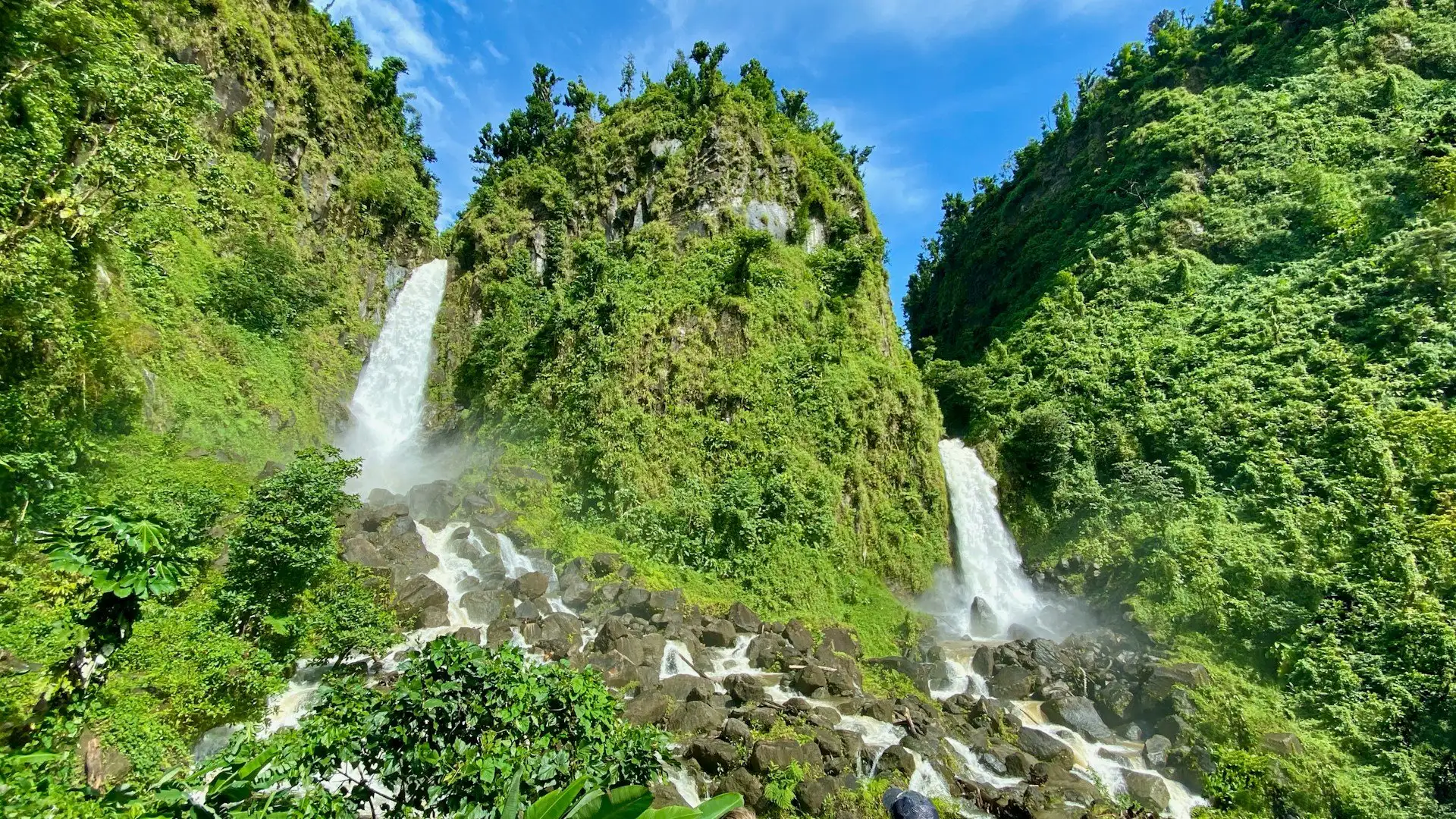
Trafalgar Falls is two waterfalls, Father and Mother, tumbling into a river pool from separate cliff faces above a volcanic boulder field, and the walk from the visitor centre takes about fifteen minutes on a concrete path through the forest. The water in the pool where they meet is warm on one side, cold on the other, because one falls over a thermal spring and one doesn't. You can wade to the warm side. Most people do. Titou Gorge is a narrow slot canyon five minutes from the Trafalgar road where a river cuts through black volcanic rock to a waterfall at its far end; you swim through it, the walls close to within arm-span, the light coming in green and shifting above you. It is one of the more specifically beautiful short swims available anywhere in the Caribbean. Both are easy to visit independently. Both are worth half a day of your time on the island.
- Official entry fees are collected at staffed booths at both sites; anyone collecting cash outside the booth is not an official attendant
- Unofficial guides at both sites are unnecessary; the paths are well-marked and the distances are short
- Titou Gorge has strong current after heavy rain; check conditions before entering and don't push through if the flow looks powerful — people have been injured here in high water
- The road to Trafalgar is narrow and requires confidence to drive; going with a local driver avoids the stress of navigating it yourself
Portsmouth is Dominica's second town and the island's most immediately charming, a slightly faded waterfront settlement at the head of Prince Rupert Bay where the yachting community anchors and the Indian River begins. The Indian River is a narrow tidal estuary of extraordinary stillness, lined with bwa mang trees whose roots arch into the water like cathedral ribs and whose canopy closes over the river completely, turning the whole thing into a green tunnel that filters the light into something close to underwater. The boats that take you up the river are powered by oar only, no engines, because the Protected Forest Status of the area prohibits motorised craft. The boatmen who work the river are among the better informal guides you'll encounter in the Caribbean, with genuine knowledge of the ecology, the bird life, and the history, and a capacity for conversation that makes the hour genuinely pleasurable. The bush bar at the upper end of the navigable river, operated by one of the river guide families, serves rum punch and coconut water in a clearing that has appeared in more than one film. It earns the visit.
- Indian River boat trips are operated by a licensed cooperative of river guides; book at the official embarkation point at the river mouth on the main road, not through anyone who approaches you in Portsmouth town
- The official rate for the river trip is posted at the embarkation point; you don't need to negotiate, just pay the posted rate
- Cabrits National Park, at the northern tip of the peninsula above Portsmouth, has a well-preserved 18th century British fort (Fort Shirley) and good snorkelling just offshore; the entry fee is modest and collected officially at the park gate
- Portsmouth itself has had some issues with street harassment toward tourists, milder than most Caribbean islands but worth a brief awareness; the waterfront and the route to the Indian River are fine, wandering deep into the residential areas at night requires the same common sense you'd apply anywhere
The Kalinago Territory is a 3,700-acre reserve on Dominica's northeast coast, home to about 3,000 members of the Kalinago people, the indigenous Caribbean population who inhabited these islands for centuries before European contact and who survived on Dominica specifically because the island's mountainous terrain and the Kalinago's fierce resistance made it one of the last places Europeans could consolidate control. The Kalinago Barana Aute, a living cultural village on the clifftop at Salybia, demonstrates traditional craft-making, canoe-building, and food preparation with genuine engagement rather than performance. The baskets woven from larouma reeds are the craft to look for: intricate geometric patterns, extremely well-made, and available directly from the makers. The coastal walk along the territory's dramatic northeastern cliffs, above Atlantic surf crashing into volcanic rock below, is one of the genuinely spectacular short walks on the island and almost nobody does it. The territory is about 45 minutes from Roseau by road and benefits from a local guide who knows the community.
- Very low scam presence; the community operates tourism with a straightforward and honest structure
- Buy crafts directly from the Kalinago Barana Aute or from individual makers you meet in the territory; this puts money more directly into the community than Roseau market intermediaries
- Ask permission before photographing individuals; the community is welcoming to visitors but photography without asking is considered rude and occasionally causes friction
- The coastal trail is not formally marked in all sections; going with a local community member who knows it is recommended
Champagne Reef, just south of Roseau near the village of Pointe Michel, is named for the constant stream of volcanic bubbles that rise from the seabed through the coral. Snorkelling here is unusual in a way that's difficult to describe accurately: warm water laced with tiny bubbles rising around you, the feeling of swimming through champagne, with healthy coral and reef fish immediately below. You don't need to dive to experience it. The entry point is a set of concrete steps at the shore, the reef starts in about three metres of water, and the whole site is accessible from the road. Scott's Head, at the southern tip of the island where the Caribbean Sea meets the Atlantic, is Dominica's most celebrated dive site: a submerged volcanic pinnacle dropping 900 metres, with walls covered in black coral, sea horses, seahorses, and occasional whale sharks. Both are within 20 minutes of Roseau and between them represent some of the best accessible snorkelling and diving in the Eastern Caribbean.
- Champagne Reef is freely accessible from the shore; no guide is necessary and no official entry fee applies at the water entry point
- For Scott's Head diving, use an established dive operator with visible equipment maintenance and PADI or SSI affiliation; the depth and the conditions make this a site where operator quality matters
- The village of Soufrière near Scott's Head has some of the best local food on the island; the fish fry on Friday evenings is worth timing your visit around
Before You Go — The Checklist
- ✓ Research official taxi rates before landing, in Eastern Caribbean dollars. Ask your accommodation what the correct fare from your arrival point (Melville Hall or Canefield) should be. Agree the full vehicle price before entering any taxi. Licensed taxis have H plates; unlicensed vehicles have no official rate structure.
- ✓ Get a local driving permit if you're renting a car. It's required by law, costs EC$30, and is issued at the port of entry or the police station. Roads in the interior are narrow, steep, and often single-track; drive with appropriate caution and confidence with manual transmission before attempting the mountain routes.
- ✓ Check trail status for the Boiling Lake hike directly with the Dominica Forestry and National Parks division before departing for the trailhead. The trail closes for volcanic activity and heavy rain. Do not accept offers from individuals at the trailhead who claim to guide you through a closure.
- ✓ Book adventure activities (canyoning, whale watching, diving) through DWTOA-affiliated operators or those recommended by Discover Dominica. Inspect equipment before starting. The terrain and conditions on this island mean operator quality is a safety issue, not just a comfort issue.
- ✓ Verify accommodation photos are post-2018. Email properties directly and ask for current photos if their listing images seem outdated. Clarify infrastructure expectations (hot water, electricity hours, wi-fi reliability) before booking rural eco-lodges.
- ✓ Pack proper rain gear and hiking boots regardless of season. Dominica receives rain year-round and the interior trails are genuinely muddy. "Waterproof" means sealed seams and proper construction, not water-resistant. Your feet will thank you on the Boiling Lake descent.
- ✓ Buy travel insurance that covers activity-specific adventure sports and medical evacuation. Dominica's hospital in Roseau handles routine cases; serious injuries or complex medical situations require evacuation to Barbados or Martinique. This insurance is not expensive relative to what it covers.