Atlas Guide

Explore the World

Mount Teide volcano rising above the clouds over Tenerife at sunset
Atlantic · Spain

Tenerife,
La Isla del Teide

Spain's largest island is a study in contrasts — a UNESCO volcano that pierces the clouds at 3,715 metres, ancient laurel forests unchanged since before the Ice Age, black lava beaches lapped by the Atlantic, and a colonial city that is one of Spain's most handsome. Year-round sun, year-round wonder.

🌋 Mount Teide — Spain's Highest Peak
🐋 Year-Round Whale Watching
🌿 UNESCO Laurel Forest
☀️ 350 Days of Sunshine
About Tenerife

Seven Landscapes on One Island

Tenerife is the largest and most visited of the Canary Islands — and it rewards that status with an extraordinary variety that no other island in the Atlantic can match. The statistics alone are remarkable: Spain's highest peak (Mount Teide, 3,715m), the world's third-largest volcanic crater (Las Cañadas del Teide), one of the oldest laurel forests on earth (the Anaga peninsula), Europe's highest-altitude botanical garden, and more species of flora found nowhere else on earth than almost anywhere outside the Galápagos.

The island divides physically and psychologically into two distinct zones. The south — Costa Adeje, Los Cristianos, Playa de las Américas — faces the African trade wind shadow, basks in the most reliable sunshine of any European resort destination, and has built one of the continent's most extensive beach tourism infrastructures over the past five decades. The north — Puerto de la Cruz, La Orotava, La Laguna, the Anaga and Teno peninsulas — faces the Atlantic winds head-on, is greener, more dramatic, more culturally rich, and incomparably more beautiful for anyone willing to accept the occasional morning cloud.

Between these two worlds, Teide dominates everything. Visible from almost every point on the island and from the neighbouring islands of La Gomera, La Palma, and Gran Canaria on clear days, it is the defining presence of Tenerife — a perfectly formed stratovolcano whose summit was once believed by the Guanche people to be the gates of hell, and whose national park is the most visited in Spain and the fourth most visited in the world.

🏨 Find Hotels in Tenerife

Mount Teide and its caldera landscape at dawn with volcanic rock formations Anaga laurel forest with ancient mossy trees and misty ravines
3,715m
Mount Teide Altitude
Must-See

Top Attractions in Tenerife

A volcano that rises above the clouds, a forest that predates human civilisation, an abandoned village clinging to a cliff edge, and some of the most dramatic coastal scenery in the Atlantic — Tenerife is relentlessly spectacular.

Teide National Park volcanic landscape with red lava fields and Teide summit
🌋 UNESCO World Heritage

Teide National Park

Spain's most visited national park and one of the world's great volcanic landscapes — the Cañadas del Teide caldera (a 16km-wide ancient crater) surrounds the cone of Teide itself with an unearthly terrain of lava flows, volcanic bombs, and rock formations that inspired the crew of Planet of the Apes to film here. The Teleférico cable car rises to 3,555 metres in 8 minutes; the summit itself (3,715m) requires an advance free permit from the National Park authority. At altitude the air is clean, the views extend to every neighbouring island, and the stargazing at night is among the finest in the northern hemisphere.

Anaga Rural Park ancient laurel forest trail with ferns and twisted trees
🌿 Ancient Forest

Anaga Rural Park

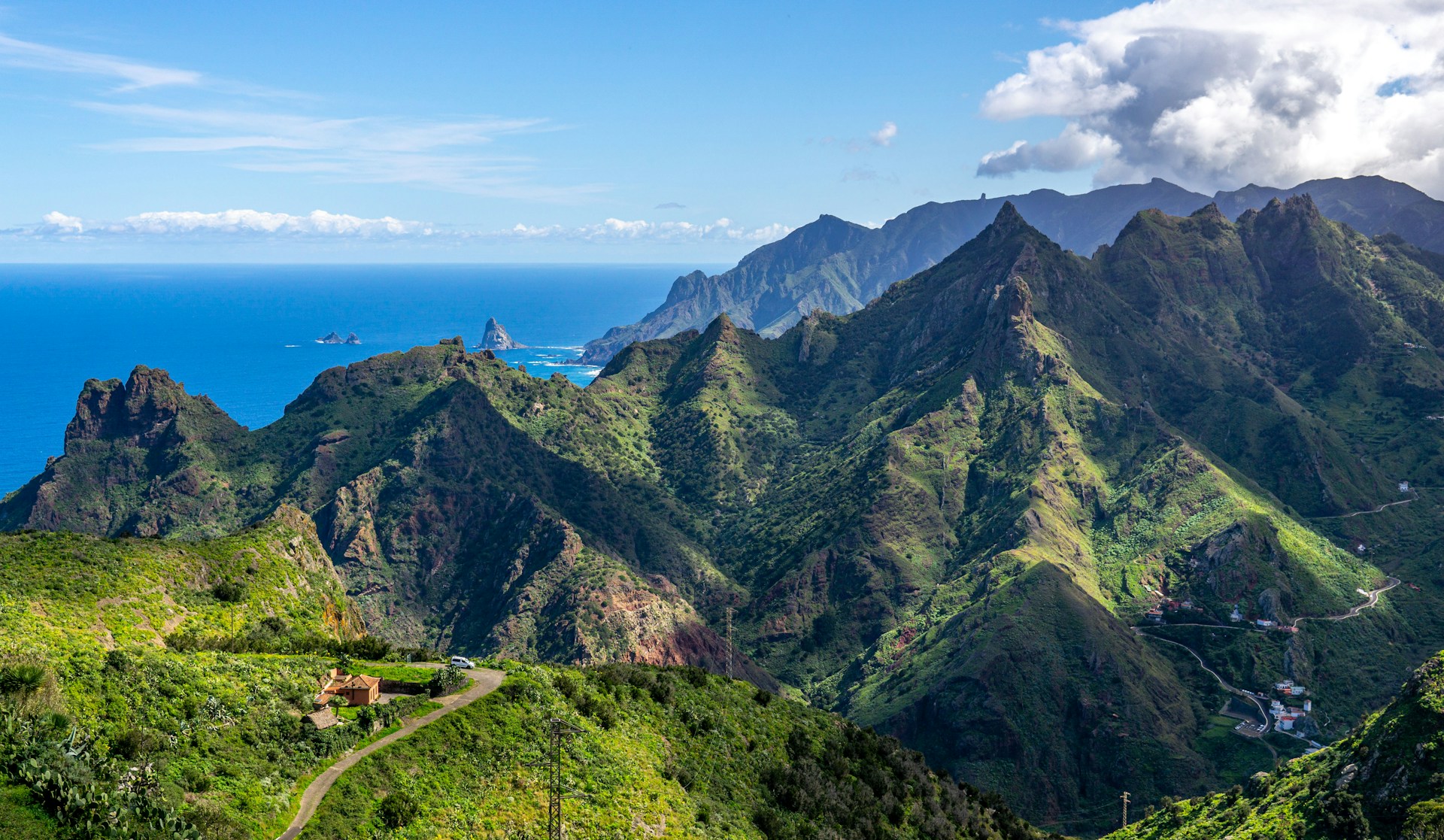
The most extraordinary natural landscape in Tenerife and one of the most biodiverse places in Europe — a UNESCO Biosphere Reserve of ancient laurisilva (laurel forest) covering the dramatically serrated northeastern peninsula of the island. These forests are the last surviving remnant of the subtropical forests that once covered southern Europe and North Africa before the Ice Ages, preserved here by the Anaga mountains' ability to trap Atlantic clouds and moisture. Walking the ridge trails through moss-draped trees above ravines that drop to black-sand coves is one of the most profoundly atmospheric experiences in the Canary Islands. No hire car needed — park on the ridge road and walk.

San Cristóbal de La Laguna colonial street with colourful facades
🏛️ UNESCO Colonial City

San Cristóbal de La Laguna

The finest colonial city in the Canary Islands and a UNESCO World Heritage Site — a university town of remarkable architectural integrity, with an unbroken grid of 15th and 16th-century streets lined with noble mansions, colourful wooden-balconied facades, churches, and convents. La Laguna was the first non-fortified colonial city in Spanish history and served as the model for the urban planning of cities throughout Latin America. Today it is a lively, genuinely local city of 160,000 people — excellent restaurants on Calle Herradores, art galleries in converted mansions, and a student population that keeps it vibrant year-round. 20 minutes from the airport by tram.

Masca village clinging to dramatic cliff gorge in Tenerife northwest
🏘️ Hidden Village

Masca Village & Gorge

The most dramatically sited village in the Canary Islands — a tiny settlement of white houses perched on a narrow ridge deep within the Teno massif, accessible by a single road of extraordinary hairpin bends that winds down from 900 metres through some of the most dramatic scenery on the island. Below the village, the Masca Gorge descends 3km through vertical basalt walls to a pebble beach accessible only on foot (3–4 hour descent, boat pickup required for return — book in advance). The gorge walk is one of the finest hiking experiences in the Canaries; the road to the village is one of the finest drives. Combined, they make a full and unforgettable day.

Los Gigantes vertical black basalt cliffs rising 600 metres above the Atlantic
🧱 Dramatic Coastline

Los Gigantes Cliffs

The Acantilados de los Gigantes — the Cliffs of the Giants — are among the most dramatic coastal formations in the Atlantic: vertical walls of black basalt rising 300–600 metres sheer from the sea along a 9-kilometre stretch of the island's northwest coast. From the water they are genuinely awe-inspiring. Boat trips from the marina at Los Gigantes approach the cliff base for the full scale effect; the same boats offer whale and dolphin watching in the deep channel to the west. The small black-sand beach at the foot of the cliffs and the marina promenade make Los Gigantes an excellent half-day excursion from the southern resorts.

La Orotava colonial town with wooden balconies and Teide in the background
🌸 Colonial Town

La Orotava

The most beautiful town in Tenerife — a perfectly preserved colonial settlement on the north coast with a spectacular setting above the Orotava Valley, one of the most fertile and photogenic landscapes in the Canaries. The historic centre is a succession of noble mansions with elaborate carved wooden balconies, baroque churches, and cobblestone streets framing views down to Puerto de la Cruz and across to the sea. The Corpus Christi sand carpet (made from volcanic ash and flower petals) in June is one of the most remarkable festivals in Spain. The Casa de los Balcones artisan shop is the best place to buy traditional Canarian crafts and lacework.

Where to Stay

Tenerife's Key Areas

Tenerife's north-south divide is the most important decision you make for your trip. Each zone offers a fundamentally different island experience.

☀️
Costa Adeje & Playa de las Américas — Resort South

The island's tourist heartland — kilometre after kilometre of hotels, beach clubs, water parks, and all-inclusive resorts in the driest, sunniest part of Tenerife. Costa Adeje is the more upscale end with luxury resorts and Playa del Duque (one of the finest golden-sand beaches on the island). Playa de las Américas is livelier and cheaper. Ideal for sun-seekers who want guaranteed beach weather and resort amenities. Well-connected to the rest of the island by motorway.

Los Cristianos — Family-Friendly South

The most authentically town-like of the southern resorts — a working fishing harbour that grew into a resort, with a sheltered bay, calm beach, good restaurants, and the ferry terminal for day trips to La Gomera. Less overtly commercial than Playa de las Américas, with more of a genuine community feel. Popular with families and returnee visitors. The whale and dolphin watching boats also depart from here.

🌊
Puerto de la Cruz — The North's Cultural Hub

The historic resort capital of the north — a genuine Canarian town with a long history of European visitors, black-sand beaches (Playa Jardín designed by César Manrique), the Lago Martiánez lido complex, and access to La Orotava and the Anaga. Cooler and cloudier than the south but dramatically more characterful. The excellent Loro Parque animal park is nearby. A good base for those who want culture, nature, and beaches without the mass-resort atmosphere of the south.

🏙️
Santa Cruz de Tenerife — The Capital

The island's capital is a real working city of 200,000 people — excellent shopping, the Auditorio de Tenerife (one of the most striking concert halls in Europe, designed by Santiago Calatrava), the Museo de la Naturaleza y el Hombre with its extraordinary Guanche mummies, and the home of the world's second largest Carnival after Rio. Connected to La Laguna by tram. Rarely chosen as a base by tourists but worth at least a half-day visit, particularly for the carnival in February.

🌋
Vilaflor & the Teide Foothills

Spain's highest village at 1,400 metres — a pine-scented, dramatically situated settlement in the foothills of Teide with crisp air, extraordinary stargazing, and proximity to the national park that neither the north nor south resorts can match. Rural hotels and casas rurales make excellent bases for serious Teide hikers and those who want to experience the island at altitude. The drive up from the south through pine forests at sunset is magnificent.

🌿
Anaga Peninsula — Wild Northeast

The most isolated and least-visited corner of the island — ancient fishing villages accessible only via dramatic mountain roads, black-sand beaches with no infrastructure whatsoever, and the laurel forest covering the ridge above. Taganana, Benijo, and Roque de las Bodegas are three of the most authentic villages in the Canary Islands. No resort hotels; only a handful of small rural guesthouses. Ideal for hikers and those seeking total escape from the tourist infrastructure. 45 minutes from Santa Cruz by car.

Eat & Drink

What to Eat in Tenerife

Canarian cuisine in Tenerife is rooted in the volcanic terroir of the island and the Atlantic fishing tradition — simple, honest food with a distinct identity that owes as much to the island's ancient Guanche culture as to the Spanish colonial influence.

Papas arrugadas wrinkled Canarian potatoes with red and green mojo sauces
🥔 Essential Experience

Papas Arrugadas con Mojo

The Canary Islands' most iconic dish and Tenerife's most fundamental eating experience — small, knobbly Canarian potatoes (papas negras grown in volcanic soil) boiled in water with an extraordinary quantity of salt until the skin wrinkles and a white salt crust forms. Served with two mojo sauces: mojo picón (red, fiery, made with dried peppers, garlic, cumin, and vinegar) and mojo verde (green, aromatic, made with fresh coriander or parsley). Every family, every restaurant, every guachinche has its own mojo recipe. A meal in themselves when accompanied by local cheese — order them everywhere, always. The mojo is worth taking home in a jar.

Grilled whole vieja fish with papas arrugadas and mojo on Tenerife restaurant table
🐟 Atlantic Catch

Vieja & Atlantic Fish

Vieja (parrotfish) is Tenerife's signature fish — a large, colourful Atlantic species found in the waters around the Canary Islands, prized for its sweet, firm white flesh. Grilled whole with papas arrugadas and mojo, it is the definitive Canarian fish meal. The fishing villages of the Anaga peninsula — Taganana, Roque de las Bodegas — serve the freshest vieja on the island in small family restaurants that have not changed for decades. Cherne (wreckfish) and sama (red snapper) are two other local species of excellent quality. Always ask what came in that morning.

Gofio escaldado Canarian toasted grain soup with fish broth
🌾 Guanche Heritage

Gofio Escaldado

Gofio — toasted ground grain, the ancient staple of the Guanche people — appears throughout Tenerife's food culture in forms both traditional and contemporary. Gofio escaldado is the most classic preparation: gofio mixed into hot fish stock and stirred until it forms a thick, porridge-like mass, garnished with onion and mojo. It sounds simple; it is deeply satisfying. Tenerife's newer generation of chefs has found creative ways to incorporate gofio into modern Canarian cuisine — gofio ice cream, gofio-crumbed fish, gofio bread. Try the traditional escaldado at a guachinche in the north.

Tenerife white wine in vineyard with volcanic black soil and Teide backdrop
🍷 Volcanic Wine

Tenerife Wine

Tenerife has five DOP wine appellations and produces some of the most distinctive wines in Spain — grapes grown in volcanic black soil (known as picón) at altitudes from sea level to 1,600 metres on ungrafted vines that survived the phylloxera blight of the 19th century, producing a genetic diversity found nowhere else in the world. The Tacoronte-Acentejo DO in the north produces excellent medium-bodied reds from the Listán Negro grape; the Valle de la Orotava produces distinctive whites. The bodega-restaurants (guachinches) of the Orotava Valley, open seasonally when the family has wine to sell, are the most authentic setting for tasting. Ask at your hotel for the nearest guachinche.

Plan Your Trip

When to Visit Tenerife

Tenerife earns its "Island of Eternal Spring" reputation — there genuinely is no bad month to visit. But understanding the seasonal differences helps you plan the right kind of trip.

Jan
Feb
Mar
Apr
May
Jun
Jul
Aug
Sep
Oct
Nov
Dec
Best Overall Great — Busier or Slightly Cooler Hot & Busy — Calima Risk Avoid
🌸
Spring (Mar – May) — The Finest

March to May is Tenerife at its absolute best — warm enough to swim in the south (sea 20–22°C), wildflowers in the Teide caldera, the island uncrowded, accommodation affordable, and the full variety of landscapes accessible. The almond blossom in the Teno valley peaks in February. Easter week brings spectacular religious processions throughout the island. The finest time for hiking Teide and exploring the Anaga without summer heat.

🎭
Carnival Season (Feb) — World-Class

The Santa Cruz de Tenerife Carnival (February–March) is the largest carnival in Spain and one of the biggest in the world — only Rio de Janeiro surpasses it in scale. Two weeks of elaborate costumes, parades, the legendary drag Gala Queen competition, and concerts that fill the city's streets. An extraordinary experience that transforms the otherwise workaday capital into one of the most exuberant spectacles in Europe. Book accommodation months in advance.

☀️
Summer (Jul – Aug) — Hot & Busy

The south of Tenerife is at its most crowded and most expensive in July and August, driven by Spanish domestic tourism joining the Northern European influx. Temperatures in the south reach 30–33°C; the north is cloudier and slightly cooler. Occasional calima dust events from the Sahara raise temperatures further. Hiking Teide in summer requires early starts before the heat builds. Book everything well in advance; the island handles the volume but with some strain.

❄️
Winter (Dec – Feb) — Peak Sun Season

December to February is peak season for Northern Europeans escaping cold winters — the south coast resorts fill with British, German, and Scandinavian visitors drawn by reliable 20–22°C temperatures and reliable sunshine. The north is cooler and occasionally rainy. Christmas in the Canaries has a distinct character with elaborate Belén (nativity) displays. February Carnival is unmissable. Snow on the summit of Teide in winter creates one of the most extraordinary sights in Spain — a volcano with a snow cap visible from tropical beaches 45 minutes below.

Insider Knowledge

Tenerife Travel Tips

What experienced Tenerife visitors know — the practical wisdom that turns a good trip into an extraordinary one.

🎟️
Book the Teide Summit Permit Months Ahead

Access to the summit of Teide above the cable car station requires a free permit — and those permits book out months in advance, particularly in summer. Visit the Teide National Park website (reservasparquesnacionales.es) and book as soon as your travel dates are confirmed. Without a permit you can still take the cable car to 3,555m and walk to the Mirador La Fortaleza viewpoint, which is genuinely spectacular and requires no permit. The summit itself adds perhaps 15% more view for considerably more effort — but if you've come this far, get the permit.

🚗
The Two Airports Serve Different Parts of the Island

Tenerife has two airports that serve completely different zones. Tenerife South (TFS, Reina Sofía) is near the southern resorts — 20 minutes to Costa Adeje, 25 minutes to Los Cristianos. Tenerife North (TFN, Los Rodeos) is near Santa Cruz, La Laguna, and Puerto de la Cruz — 20 minutes to the capital, 30 minutes to the north coast. Most package holidays and low-cost carriers use TFS; some Iberia and Vueling flights use TFN. If you're based in the north, make sure you're flying into TFN — the drive from TFS to the north takes over an hour.

🐋
Choose the Right Whale Watching Operator

Whale and dolphin watching in Tenerife is genuinely excellent year-round — the deep channel between Tenerife and La Gomera supports resident pilot whale and bottlenose dolphin populations. But the quality varies enormously between operators. Choose small rigid-inflatable boat (RIB) tours of 12–15 passengers over large catamarans for the most intimate, manoeuvrable experience. Look for operators with qualified marine biologists on board. The best tours depart from Los Gigantes marina. Book directly with operators rather than through hotel desks to avoid commission-inflated prices.

🌤️
Drive Above the Clouds for Teide Views

On many days in the north, the Anaga and Orotava valley are draped in cloud — but Teide's summit pierces 3,715m into clear blue sky above. Drive up the TF-24 or TF-21 through the cloud layer and emerge into brilliant sunshine and a sea of white cloud stretching to the horizon. This cloud-inversion view — the island's lower slopes invisible beneath a flat white layer, Teide emerging above it — is one of the most extraordinary sights in the Canary Islands and possible on any "cloudy" day in the north. Takes 40–50 minutes from Puerto de la Cruz.

🍽️
Find a Guachinche for Lunch

Guachinches — unlicensed rural family restaurants in the north that open when the family has homemade wine to sell — are Tenerife's greatest food secret. A fixed-price lunch of two or three traditional dishes (always papas arrugadas, always fresh fish or pork, always gofio) with unlimited house wine for €10–15 per person. They have no signage; they appear on local Facebook groups and in word of mouth from other travellers. Ask your accommodation in the north for the nearest one currently open. They close unpredictably, change location seasonally, and are entirely unreachable by any tourist app. That is precisely what makes them special.

🌌
Stargaze from Teide — It's Extraordinary

The Teide National Park is one of the world's top stargazing locations — at 2,000+ metres, above the cloud layer and far from light pollution, the night sky is extraordinary. Several operators run guided evening stargazing tours with telescopes from inside the national park. The Teleférico also operates special night cable car ascents in summer for summit stargazing. Even without a tour, driving up to the Parador de las Cañadas del Teide on a clear night and lying on the volcanic rock looking upward is an unforgettable experience. The Milky Way is visible to the naked eye most clear nights.

Need to Know

Practical Information

Everything you need to arrive, navigate, and get the most from Tenerife.

✈️
Getting There
  • Tenerife South (TFS) — main airport, serves southern resorts; 20 min to Costa Adeje
  • Tenerife North (TFN) — serves capital area and north; 20 min to Santa Cruz / La Laguna
  • Direct flights from most major European cities; Ryanair, easyJet, TUI, Jet2, Vueling
  • Flight time: approximately 4h from the UK, 3h30 from Germany, 2h20 from mainland Spain
  • Taxi from TFS to Costa Adeje ~€20; to north ~€70–80 — consider a hire car from the airport
🚗
Getting Around
  • Hire car — essential for the Anaga, Masca, Teide foothills, and west coast
  • TITSA buses — comprehensive network; affordable but slow for long-distance routes
  • Tram — connects Santa Cruz and La Laguna (Line 1); fast, cheap, modern
  • TF-1 motorway — fast spine road connecting south to north (1h south to north)
  • Taxis — metered and reliable; pre-book for Masca gorge early morning trips
💰
Money & Budget
  • Currency: Euro (€); IGIC tax 7% (vs 21% on mainland Spain) — goods are cheaper
  • Budget: €50–70/day (self-catering, local bars, bus transport)
  • Mid-range: €110–180/day (3-star hotel, restaurant meals, hire car)
  • All-inclusive resort packages widely available from €80–130/person/night
  • Fuel significantly cheaper than mainland Europe — fill up on the island
📶
Connectivity
  • EU roaming applies — no extra charges for EU/EEA mobile users
  • Good 4G/5G coverage in towns and main roads; dead spots in Anaga and Teno
  • Free Wi-Fi in hotels, restaurants, and major public spaces
  • Spanish SIM cards from Movistar, Vodafone, Orange at both airports
  • Airalo eSIM recommended for non-EU visitors — buy before travel
🏥
Health & Safety
  • Tenerife is very safe — standard tourist precautions apply
  • Emergency services: 112 (EU standard)
  • EU EHIC / GHIC cards cover EU/UK citizens for emergency treatment
  • Altitude sickness possible above 3,000m on Teide — ascend slowly, hydrate well
  • Ocean swimming: north coast has strong currents — only swim at flagged beaches
📋
Entry Requirements
  • Tenerife is part of Spain and the Schengen Area — no passport control for EU/EEA
  • UK citizens — passport required; 90-day Schengen visa-free period applies
  • US, Canada, Australia — visa-free for up to 90 days in Schengen zone
  • ETIAS authorisation required from 2026 for visa-exempt non-EU visitors (€7)
  • Note: Canary Islands NOT in EU customs union — different duty-free allowances apply
Trusted Partners

Book Your Tenerife Trip

Everything you need to plan and book your Tenerife visit in one place.

Common Questions

Tenerife FAQ

The questions every Tenerife-bound traveller asks — answered honestly.

They suit different visitors. The south (Costa Adeje, Los Cristianos) offers the most reliable sunshine, the best beach resort infrastructure, and all-inclusive convenience — ideal for those who want guaranteed sun and a relaxing beach holiday. The north (Puerto de la Cruz, La Orotava, La Laguna, the Anaga) is dramatically more beautiful, culturally richer, and more authentically Canarian — but receives more cloud and occasional rain in winter. Many experienced visitors now base themselves in the north and use the motorway for day trips to southern beaches. With a hire car, you can have both.
The cable car (Teleférico) takes you to 3,555 metres and is bookable online — always book in advance as it sells out, especially in summer. From the cable car top station you can walk freely to the Mirador La Fortaleza lookout, which gives spectacular views. To continue to the actual summit (3,715m), you need a separate free permit from the National Park website (reservasparquesnacionales.es). Permits are released 90 days in advance and book out within hours in peak season. The summit walk takes about 1 hour from the cable car station each way and is physically demanding at altitude. The cable car alone is worth the trip even without the summit permit.
The Santa Cruz de Tenerife Carnival is the largest and most famous in Spain — often compared to Rio de Janeiro for its scale, energy, and extraordinary costumes. It takes place in February (dates shift annually with Shrove Tuesday) and runs for approximately two weeks. The opening election of the Carnival Queen, the Drag Gala competition, the massive Saturday parade (Coso), and the closing Burial of the Sardine are the key events. The streets of Santa Cruz become one of Europe's greatest outdoor parties. Book accommodation in Santa Cruz or La Laguna months ahead — everything fills well in advance.
Tenerife is one of Europe's finest family holiday destinations. The southern resorts have calm, sheltered beaches ideal for children, extensive waterpark infrastructure (Siam Park — regularly voted the world's best waterpark), Loro Parque wildlife park in the north, and excellent family resort accommodation at all price points. The year-round warm weather, direct flights from across Europe, and well-developed family tourism infrastructure make it particularly accessible. For older children and teenagers, the Teide cable car, whale watching, and the Masca gorge hike are exciting additions to the beach holiday.
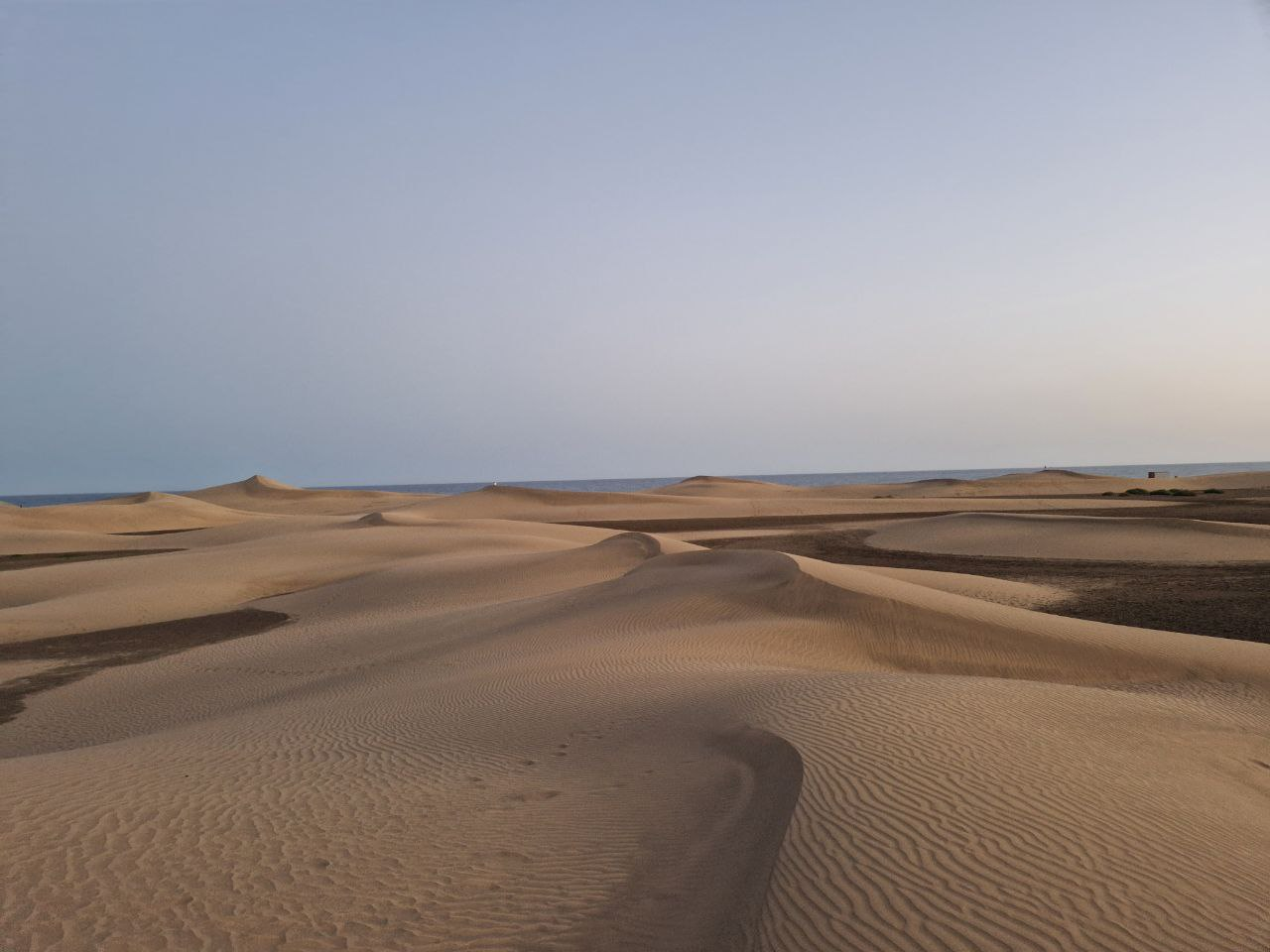
Both are excellent and very different. Tenerife is larger with Mount Teide (an extraordinary volcano), more varied landscapes, a more dramatic northern coastline, and the Anaga laurel forest — its natural attractions are more spectacular overall. Gran Canaria has better beaches in the south (the Maspalomas dunes are unique), a more interesting and genuine capital city in Las Palmas, and slightly lower prices. Gran Canaria suits those who want to combine beach with urban culture; Tenerife suits those who want volcanic landscapes, whale watching, and the widest possible variety in one island. If you can only visit one, Tenerife edges it for sheer dramatic variety.
Siam Park in Costa Adeje has been voted the world's best waterpark multiple times by TripAdvisor — a genuinely extraordinary Thai-themed complex with a wave pool, the Tower of Power (a near-vertical free-fall slide through a shark tank), a lazy river, and excellent food. It is genuinely worth visiting for families and adults alike. Book tickets online in advance (cheaper and avoids queues). Go on a weekday to avoid peak weekend crowds. Combined with a morning at one of the nearby beaches, it makes an excellent full day.
Keep Exploring

More Popular Destinations

Loved Tenerife? These destinations are equally unmissable.