
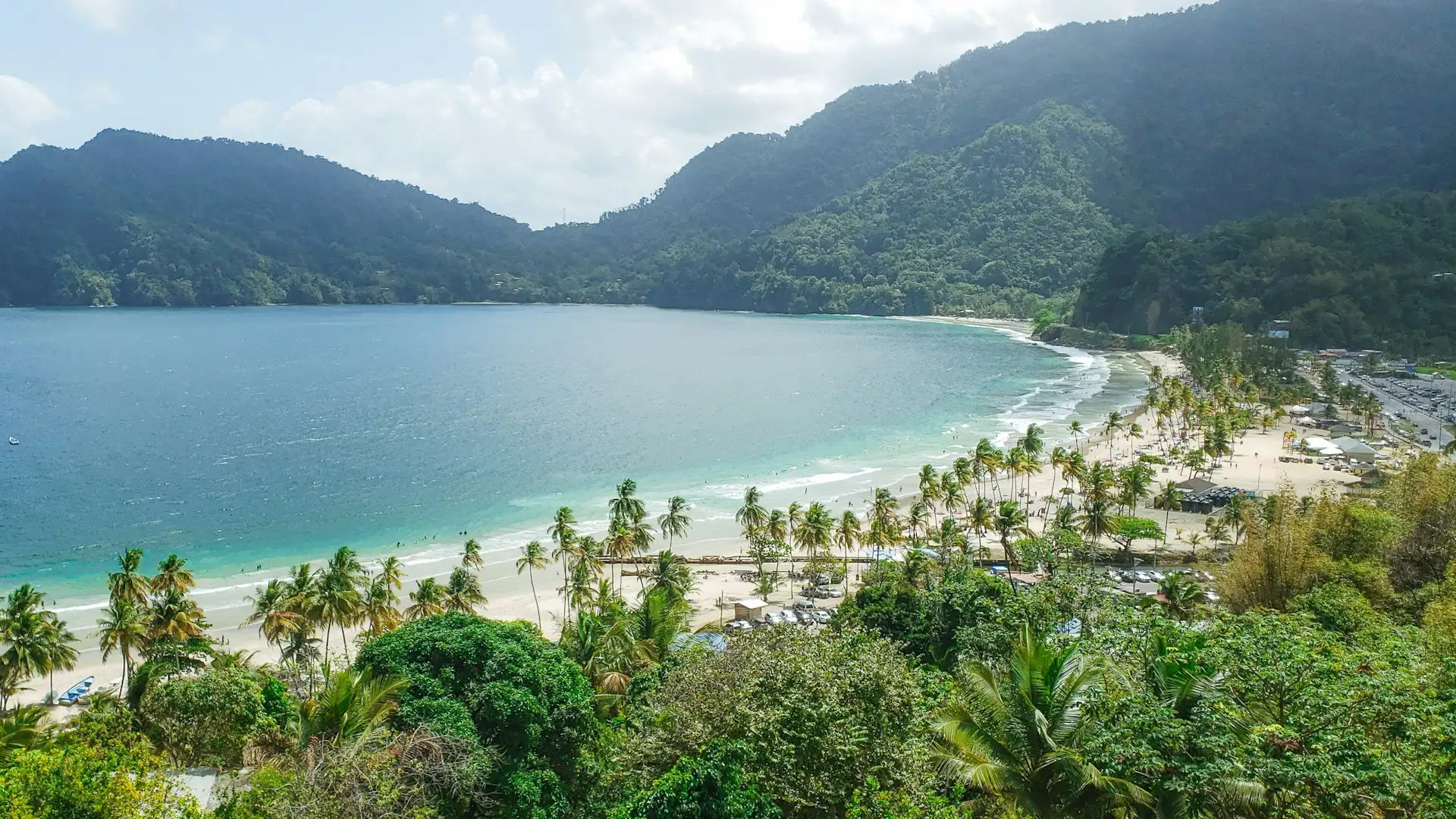
Trinidad & Tobago
Trinidad gave the world Carnival in its modern form, calypso, the steelpan — the only acoustic instrument invented in the 20th century — soca, and a street food culture so layered it takes a week to begin to understand. Tobago gave the world a quieter life and a reef. Both are worth your time.
What You're Actually Getting Into
Trinidad and Tobago is not one destination. It is two islands joined by history and constitutional arrangement that are genuinely different experiences requiring different approaches, different expectations, and different safety assessments. Understanding this before you book matters.
Trinidad is the larger island — 4,748 square kilometres, 1.3 million people, the southern anchor of the Caribbean chain sitting 11 kilometres from Venezuela. It is the most culturally significant island in the Caribbean by most measures: the origin of Carnival in its modern costumed parade form, the birthplace of calypso and its descendants soca and chutney soca, the place where the steelpan was invented from biscuit tins and oil drums in the 1940s, and the home of a street food culture that synthesises African, Indian, Chinese, Spanish, French, and Syrian influences in combinations that have no equivalent anywhere else in the hemisphere. Trinidad has significant violent crime concentrated in specific Port of Spain communities and the east-west corridor — this is real and requires honest assessment, which this guide provides in the safety section. It also has Maracas Bay, the Asa Wright Nature Centre, the Northern Range rainforest, and a culinary tradition that is itself worth the flight.
Tobago is the smaller island — 298 square kilometres, approximately 65,000 people, separated from Trinidad by 34 kilometres of water and by the full character difference between a working industrial Caribbean capital and a relaxed beach island. Tobago is the reef, the beach, the Sunday School street party at Buccoo that has been running every Sunday for decades, the leatherback turtle nesting that brings visitors from around the world between March and July. Tobago has a significantly lower crime rate than Trinidad and a more developed tourist infrastructure relative to its size. Most visitors to Tobago who have also been to Trinidad say the same thing: they are completely different destinations. That is true. Visit both.
The practical reality: Trinidad is not a beach holiday destination in the way that most Caribbean islands are. Its best beaches (Maracas Bay, Las Cuevas, Manzanilla) are genuinely excellent but they are not the primary reason to go. The primary reason to go to Trinidad is what it created — the music, the food, the cultural complexity of a society that is South Asian, African, Chinese, Syrian, European, and Indigenous all at once and has been negotiating that complexity in creative and sometimes difficult ways for centuries. If that is what you want from a Caribbean trip, Trinidad delivers it at a level no other island approaches. If what you want is beach, book Tobago.
T&T at a Glance
A History Worth Knowing
Trinidad was inhabited by the Arawak and Carib peoples when Columbus arrived on his third voyage in 1498, naming the island for the three peaks he saw from the sea (the Trinity). Spain colonised the island from 1592 but treated it as a backwater for most of the colonial period — the plantation economy developed late compared to other islands and the indigenous population was largely destroyed through disease and forced labour by the early 18th century.
The decisive change came with the Cedula of Population of 1783, issued by the Spanish Crown to encourage Catholic settlers from other islands. This brought a wave of French Creole planters from Martinique, Guadeloupe, and Saint Lucia, along with their enslaved African workers, who established sugar and cocoa plantations and created the French Creole cultural overlay that still exists in Trinidad's place names, family names, and the patois spoken in some rural communities. The British took Trinidad from Spain in 1797 — the same year they deported the Garifuna from Saint Vincent — without significant resistance, and formalised control at the Treaty of Amiens in 1802.
The emancipation of enslaved people in 1834–1838 created an immediate labour crisis as formerly enslaved people left the plantations. The British response was the introduction of indentured labour from India — a system that brought approximately 144,000 people from India to Trinidad between 1845 and 1917 to work on sugar and cocoa estates under five-year contracts that were nominally free labour but in practice closely resembled what had preceded them. The Indian indenture system shaped Trinidad fundamentally: today approximately 40% of the population is of South Asian descent. The mixing of African, South Asian, Chinese (who came separately), Syrian, and European populations in a relatively small space over 180 years produced the unique cultural chemistry that is modern Trinidad.
Tobago's history diverged significantly from Trinidad's. Tobago was fought over by almost every European power — Britain, France, the Netherlands, and Courland (a small Baltic duchy) all held it at various points — and its plantation economy developed earlier and was more devastated by emancipation. Tobago was federated with Trinidad in 1888 after decades of economic decline, a subordination that Tobagonians have never fully accepted. The Tobago House of Assembly now exercises substantial autonomy within the republic, and the debate about Tobago's political status relative to Trinidad is ongoing.
Carnival in Trinidad began as the pre-Lenten celebrations of the French Creole planter class — elaborate masked balls that enslaved people parodied in their own street celebrations, cannes brûlées (burning cane field) events that mocked the planters' culture. After emancipation, the formerly enslaved population claimed Carnival as their own, developing it into the costumed masquerade tradition that is now recognisable globally. The colonial authorities repeatedly tried to ban it — the Canboulay Riots of 1881 were the most significant confrontation between Carnival masqueraders and colonial police — and failed. Carnival survived and became the most significant cultural export the Caribbean has ever produced.
Trinidad and Tobago gained independence on August 31, 1962 under Eric Williams, the historian and politician whose party the People's National Movement governed the country through the oil boom of the 1970s. The discovery of significant oil and gas reserves off Trinidad's coast transformed the economy — T&T is one of the wealthiest countries in the Caribbean per capita, sustained by hydrocarbon revenues rather than tourism. This creates a country that is both richer and less tourism-dependent than its Caribbean neighbours, which has consequences for the visitor experience: Trinidad is not organised around your comfort in the way that tourism-dependent islands are.
Third voyage. Names the island Trinidad for three peaks. The Arawak and Carib populations are decimated by disease and forced labour over the following century.
Spanish Crown invites French Creole Catholic planters to settle Trinidad. They bring enslaved African workers and their French cultural traditions, fundamentally reshaping the island.
Without significant resistance, Britain takes the island from Spain. The same year they deport the Garifuna from Saint Vincent. The empire is busy in 1797.
Formerly enslaved people leave the plantations. The British respond with Indian indenture from 1845, bringing 144,000 South Asian workers to Trinidad over 72 years.
Colonial police attempt to suppress Carnival. Masqueraders fight back in what becomes the defining confrontation in Carnival's survival as a popular cultural form.
After decades of economic decline, Tobago is attached to Trinidad. Tobagonians consider it a subordination. The political tension persists in the present day.
From biscuit tins, biscuit drums, and oil drums, Trinidadian panmen develop the steelpan — the only acoustic instrument invented in the 20th century. The colonial government banned their earlier percussion instruments, which accelerated the innovation.
August 31. Eric Williams becomes Prime Minister. The oil and gas economy develops through the 1970s boom. T&T becomes the wealthiest Caribbean nation per capita by GDP.
Top Destinations
T&T requires a separate itinerary for each island. Trinidad's primary draws are cultural (Carnival, food, music) and natural (Asa Wright, Grand Riviere turtles, the Northern Range). Tobago's draws are beach and reef. Most visitors fly into Piarco International Airport in Trinidad and either stay on Trinidad or take the short internal flight or overnight ferry to Tobago. Doing both properly requires at least ten days.
Port of Spain & Carnival
The capital of T&T sits at the foot of the Northern Range on the Gulf of Paria. Most of the year it is a working Caribbean city of 250,000 people with limited conventional tourist appeal and significant urban character. During the three weeks before Ash Wednesday it becomes the most concentrated cultural event in the Western Hemisphere. The Queen's Park Savannah — an enormous oval park in the city centre — hosts Panorama (steelpan competition), Dimanche Gras (Calypso Monarch and Soca Monarch finals), and the masquerade band presentations. The Monday morning J'ouvert begins at 3am with paint, mud, and oil, and is one of the most physically intense street experiences available anywhere. The Tuesday parade of the large costume masquerade bands brings tens of thousands into the streets. If you attend no other event, attend Panorama — there is nothing else in music like it.
Grande Riviere, Trinidad
A small village on Trinidad's northeastern coast accessible by a winding mountain road. Between March and July, Grande Riviere beach hosts the densest leatherback sea turtle nesting in the world — up to 200 turtles per night on approximately 500 metres of beach. The guided night watches, conducted under strict red-light conditions by local conservationists, put you within arm's reach (though not touching) of female leatherbacks that weigh 400–600 kilograms laying their eggs. No other beach in the Caribbean has this concentration. Females have been returning to the same beach for decades. The hatchling releases from July onward are separately available. Stay at least one night in Grande Riviere — the village accommodation is basic and the experience is not.
Asa Wright Nature Centre
An estate in Trinidad's Northern Range converted to an internationally renowned nature lodge and birding centre in 1967. The covered veranda overlooking feeding stations in the valley below produces an extraordinary density of hummingbirds, tanagers, motmots, and Bearded Bellbirds on any given morning. The adjacent rainforest has the largest known colony of oilbirds (guácharos) accessible to visitors anywhere in the world, in a cave on the estate that can be visited on guided tours. Trinidad's proximity to Venezuela means its bird list is significantly richer than any true island — over 460 species recorded on the estate itself. Birders rate it among the top ten lodges in the Western Hemisphere.
Maracas Bay, Trinidad
The most famous beach in Trinidad, about 40 minutes from Port of Spain over the Northern Range by a spectacular winding road. A wide bay with surf, backed by steep forested hills, with a line of beach stalls selling bake and shark — the quintessential Trinidad beach food. The bake and shark at Richard's, on the left side of the beach car park, has been the most discussed street food item in Trinidad for a generation. The shark (usually Caribbean sharpnose or black tip) is marinated, fried, and placed in fried bake with an extraordinary array of condiments: shadow beni (culantro) sauce, tamarind, pepper sauce, garlic sauce, cucumber, pineapple, coleslaw. Order everything.
Pigeon Point & Crown Point, Tobago
Pigeon Point Heritage Park, on Tobago's southwestern tip, has the image that appears in every T&T tourism photograph: a thatched-roof jetty extending over turquoise shallow water, white sand, palm trees. The image is real. The beach is managed, fenced, and charges an entry fee — it is the closest Tobago comes to a managed resort beach, and the clearest Caribbean water on the island is here. Crown Point, a five-minute drive away, is the main tourism hub of Tobago with most of the guesthouses, restaurants, and the airport. Store Bay beach at Crown Point is slightly less photogenic but free, very local, and has food stalls serving the best crab and dumpling in Tobago.
Buccoo Reef & Nylon Pool, Tobago
The Buccoo Reef marine protected area off Tobago's southwestern coast is the most visited reef in T&T. Glass-bottom boat and snorkelling tours run from Pigeon Point and Store Bay. The reef has suffered from intensive tourism pressure and bleaching events but retains good sections. The Nylon Pool — a sandbar in 1–1.5 metres of clear water a short boat ride from shore — is the social experience of the reef trip: everyone wades in the impossibly clear shallow water while the captain explains that swimming here will make you younger (it won't, but the water is genuinely extraordinary). The Friday night Sunday School street party at Buccoo village is entirely separate and entirely excellent: steelpan, food stalls, and dancing on a closed street from around 9pm.
Speyside & Little Tobago
The northeastern corner of Tobago, reached by the road over the Main Ridge Forest Reserve (the oldest legally protected forest in the western hemisphere, gazetted in 1776). Speyside village has the best dive sites in Tobago — the Kelliston Drain and the Japanese Gardens reef sections have extraordinary coral and the largest Atlantic manta ray population in the Caribbean. Little Tobago island, a short boat ride from Speyside, is a seabird sanctuary with red-billed tropicbirds, magnificent frigatebirds, and one of the most intact coral reef walls in the southern Caribbean on its eastern face. The Main Ridge drive itself, through primary forest at 360 metres, is birding of exceptional quality.
Pitch Lake, La Brea, Trinidad
The Pitch Lake at La Brea in southwestern Trinidad is the largest natural deposit of asphalt in the world — 40 hectares of black, viscous, slowly churning bitumen that is approximately 75 metres deep at its centre. It is genuinely strange to walk on: the surface gives slightly under your feet, warm in places, with pools of sulphur water between the harder sections. Sir Walter Raleigh described it in 1595 and used the pitch to caulk his ships. The lake has been mined commercially for asphalt since the 1860s and the roads of several countries were paved with Trinidadian pitch. Guided walks across the lake surface take 45 minutes and are available at the visitor centre.
Culture & Etiquette
Trinidad is the most culturally complex society in the Caribbean and it knows it. The Afro-Trinidadian and Indo-Trinidadian communities each comprise approximately 35–40% of the population and have maintained distinct cultural identities — different music traditions, different food traditions, different religious practices, different political alignments — while participating in a common national culture built partly from their synthesis. The Chinese, Syrian-Lebanese, and European communities are smaller but culturally significant. "All of we is one" is the national aspiration; the political reality is more complicated and Trinidadians will tell you so with directness that reflects both frustration and affection for the complexity.
Trinidadians communicate directly, argue enthusiastically, and have a developed conversational aesthetic that treats a good argument as a form of entertainment. The calypso tradition — social satire in song, historically pointed at politicians, social hypocrites, and the colonial order — is the musical form of this. You are unlikely to offend a Trinidadian by having a strong opinion. You may offend them by not having one.
The steelpan competition at the Queen's Park Savannah during Carnival is not a tourist event — it is the most serious musical competition in the Caribbean, practised for six months, contested with genuine intensity, and the results are discussed with the same analytical depth that other cultures apply to international sport. Get a seat in the grandstand, arrive when the first band starts, and stay until the last note. Nothing else in the Caribbean prepares you for it.
Trinidad's food culture rewards dedicated attention. A breakfast of doubles, a mid-morning pholourie with tamarind sauce, lunch as pelau from a home cook, afternoon bake and shark at Maracas, evening crab and callaloo — this is an entire day organised around eating well, and it is a reasonable way to spend a day in Trinidad.
Calypso is not background music. It is social commentary with a century of specific reference. The Mighty Sparrow, Lord Kitchener, David Rudder, Machel Montano — understanding who these people are and what they represent in Trinidadian culture is the difference between hearing music and understanding what you're hearing.
Trinidad's taxi system is PH (private hire) cars with H registration plates, which function as shared route taxis at fixed fares. Maxi taxis (yellow-striped minibuses) cover longer routes. For night travel and unfamiliar routes in Port of Spain, use app-based services (inDriver operates in T&T) or hotel-arranged transport rather than hailing unknown vehicles.
The Sunday School street party at Buccoo has been running every Sunday night for years. It is not a school — it is a closed street, steelpan music, food stalls, and dancing that starts around 9pm. Go at 10pm, when it reaches its best state. It is the most relaxed version of the social energy that Carnival concentrates, available every Sunday rather than once a year.
Port of Spain has specific areas of elevated crime risk, particularly at night. Laventille, Morvant, and parts of east Port of Spain are not appropriate for visitor foot traffic after dark. The Ariapita Avenue restaurant strip, the Queen's Park Savannah area, and the western residential suburbs (Maraval, Diego Martin) are significantly safer. Ask specifically at your accommodation.
The Indo-Trinidadian cultural contribution — to the food (roti, doubles, curry, dahl puri), to the music (chutney soca), to the religious landscape (the Divali Nagar festival, Hindu temples, Muslim masjids) — is not colour or flavour added to an otherwise African-Creole culture. It is half the cultural identity of the country and deserves engagement as such.
The pre-dawn J'ouvert (from "jour ouvert," daybreak) on Carnival Monday morning begins around 3am with paint, mud, and oil. It is the most raw and uninhibited part of Carnival. It is also the most dangerous part — crime incidents during J'ouvert have occurred. Attend with a group, stick together, leave valuables at the hotel, wear clothes you don't mind ruining, and go with people who know how it works.
Tobagonians have a distinct identity, a semi-autonomous government, and a documented history of feeling subordinated by Trinidad. Treating Tobago as simply the beach annex of the larger island misses who Tobagonians are and why the political tension between the islands continues. Ask Tobagonians about Tobago, not about Trinidad.
Carnival takes place in February or early March, which is Trinidad's dry season. The sun is intense, J'ouvert generates enormous body heat, and the costume parade on Tuesday runs through the middle of the day. Drink water constantly, use sunscreen under any costume, and know the signs of heat exhaustion. Several visitors require medical attention each year for dehydration.
Steelpan
The steelpan is not a steel drum. A drum is percussive. A steelpan is a melodic instrument capable of producing a full chromatic scale from a single oil drum, achieved by hammering the base into carefully tuned pitch zones and then playing with rubberized mallets. The development, from biscuit tin to concert-quality instrument, happened across approximately twenty years of collective innovation in the Trinidadian panyard communities of Laventille, Belmont, and San Fernando. The colonial government repeatedly banned the ancestral drum traditions from which it grew, and each ban produced a more sophisticated workaround. The Panorama competition during Carnival — steelbands of up to 100 players performing 8–12 minutes of original arrangement — is the artistic apex of the tradition.
Calypso, Soca & the Music Tradition
Calypso is social satire in song — a tradition that developed in Trinidad from the early 20th century through the Mighty Sparrow, Lord Kitchener, and Calypso Rose (the first woman to win the Calypso Monarch title) into a serious literary and musical form. Soca, the synthesis of calypso and soul music developed in the 1970s by Lord Shorty (Garfield Blackman), became the dominant party music of the Caribbean and its diaspora globally. The Calypso Monarch and Soca Monarch competitions during Carnival are genuine creative events, not nostalgia — the songs are written for each year's competition and the best of them become the soundtrack of the Caribbean for the following twelve months.
Divali & Hosay
Trinidad's Hindu Divali (Festival of Lights) in October–November is the most visible Hindu festival in the Caribbean — the Divali Nagar fairground in Chaguanas fills with hundreds of thousands of visitors over a week. Hosay, the Indo-Trinidadian commemoration of the Battle of Karbala, involves the construction and procession of ornate tadjahs (replicas of the tombs of Imam Hussein and his brother Hassan) through the streets of San Fernando and St James — one of the most distinctive religious processions in the Caribbean. Both festivals are open to respectful visitors and represent the Indo-Trinidadian cultural presence that the tourism marketing of T&T consistently undersells.
Cricket Culture
C.L.R. James wrote that to know cricket is to know the Caribbean. Trinidad's contribution to West Indies cricket includes Brian Lara, who holds the world record for the highest individual score in Test cricket (400 not out, against England in 2004) and the record for the highest individual score in first-class cricket (501 not out). The Queen's Park Oval in Port of Spain is one of the great cricket grounds of the world. When West Indies play at the Oval, the stands become an expression of the calypso culture that the music tradition only partially conveys.
Food & Drink
Trinidad has the most complex street food culture in the Caribbean and one of the most complex in the Americas. The synthesis of West African, South Asian, Chinese, Spanish, French, and Syrian culinary traditions that occurred in the same small space over 200 years produced a food culture that is entirely original — not the sum of its parts but something that none of its contributing traditions could have produced alone. The essential Trinidadian foods are not in restaurants. They are from vendors, stands, roadside stalls, and home kitchens. A formal restaurant meal in Port of Spain is not how Trinidadians eat and it is not where Trinidadian food is best.
Doubles
Two pieces of bara (fried flatbread) filled with curried channa (chickpeas), topped with your chosen combination of tamarind sauce, shadow beni (culantro) sauce, pepper sauce, kuchela (mango pickle), and chadon beni. Costs TTD $7–10. The condiment selection is the personal identity expression — how much pepper you take defines you as a person in Trinidad. "With everything, slight pepper" is the diplomatically correct starting position for a first timer. Eaten standing, folded in wax paper, in approximately 90 seconds. The morning queue at a good doubles vendor is one of the most sociologically dense observations available in the Caribbean.
Roti
Not Indian roti — Trinidadian roti. The dhal puri (a roti skin made from split pea flour, layered and flaky) or the buss up shut (paratha, torn and crumpled to resemble a "busted-up shirt," eaten with tongs) wrapped around curried chicken, curried duck, curried goat, curried aloo (potato), or curried channa. Eaten from a dhalpuri roti shop on any street in Port of Spain for TTD $20–35. The skins are made fresh, the curry is long-cooked, and the combination of the soft, layered bread with the dry curry inside is one of the singular eating experiences of the Caribbean.
Bake and Shark
The iconic Maracas Bay beach food. Fried shark fillet (usually Caribbean sharpnose or blacknose shark) in a fried bake (bread roll), dressed with your combination of shadow beni sauce, garlic sauce, pepper sauce, tamarind, chadon beni, cucumber, coleslaw, pineapple, and lettuce. Richard's on the left side of the Maracas Beach car park is the most famous vendor and the wait is generally worth it. The combination of the crispy fried shark against the soft bake, with the chadon beni and tamarind cutting through, is genuinely excellent. This is not fish and chips.
Crab and Dumpling (Tobago)
The signature dish of Tobago. Blue crab cooked in a coconut milk, garlic, herb, and seasoning broth, served with dense flour dumplings to mop the sauce. Available at the food stalls at Store Bay beach in Crown Point from lunchtime until sold out. The crab is cracked and you eat it with your hands — use the dumpling to hold the shell pieces and work the meat out. The sauce left in the pot is the best part. Order extra dumplings to address it. Costs TTD $60–100 per portion.
Pelau
Brown rice cooked with pigeon peas, chicken or beef, coconut milk, pumpkin, carrots, and a caramelised sugar base that gives the dish its characteristic dark colour and slightly sweet depth. Pelau is the one-pot home cooking of Trinidad — made on Sundays, brought to fetes and parties, eaten from a styrofoam container on the side of the road at a street party. The caramelised sugar base (browning) is the technique that makes it Trinidadian rather than Caribbean generic. Available at lunch counters and home-cook vendors throughout Trinidad for TTD $30–50.
Rum & Carib Beer
Angostura Bitters — the globally distributed cocktail ingredient — is produced in Trinidad. The Angostura 1824, 1919, and rum reserve expressions are excellent and significantly underpriced in T&T relative to export markets. A bottle of Angostura 1919 at a Port of Spain liquor store costs TTD $200–250. Carib beer is the national lager — light, cold, and exactly right at Maracas Bay. Shandy Carib (grapefruit flavour) is the hangover recovery drink of Carnival Monday and Tuesday and available at every vendor during the festival.
When to Go
The timing decision in T&T is dominated by one question: are you going for Carnival? If yes, your dates are fixed — the Monday and Tuesday before Ash Wednesday, usually February or early March. Everything else builds around that. If Carnival is not the goal, the dry season from January to May gives the best conditions for beach and nature activities. The leatherback turtle season at Grande Riviere runs March through July, which overlaps with both Carnival season (March end) and the start of the wet season.
Carnival Season
Feb – early MarThe peak of T&T cultural life. Panorama, J'ouvert, the masquerade parade, the Calypso and Soca Monarch competitions. Accommodation in Port of Spain books up 6–12 months ahead for Carnival week. Prices are peak and non-negotiable. Attending Carnival without advance planning — costume registration, accommodation, event tickets — is very difficult. It is worth the advance planning.
Turtle Season
Mar – JulLeatherback turtle nesting at Grande Riviere peaks in April and May. The beach is at its most dramatic with the highest turtle densities. This overlaps with the end of dry season (March–May good conditions) and the start of wet season (June–July wetter). Stay at least one night in Grande Riviere to be there for the evening watch.
Dry Season
Jan – MayThe best conditions for Tobago beaches, Asa Wright birding, and the Northern Range. January has fewer visitors than Carnival period. April and May are excellent for combining turtle watching with Tobago beach time.
Hurricane Season
Aug – OctT&T sits south of the main hurricane track and is rarely directly affected — this is one of the few Caribbean destinations where hurricane risk is genuinely low. However, heavy rainfall, flooding, and rough sea conditions can disrupt Tobago beach activities and some tours. The wet season generally is August–November.
Trip Planning
Ten days is the minimum to do both islands properly — five days on Trinidad and five on Tobago. For Carnival, you need the full week before and including Carnival Tuesday, plus at least two days on either side. For the leatherback turtles, a minimum two-night stay at Grande Riviere plus transfer time from Port of Spain is required. For Tobago alone, a week is sufficient to cover the main beaches, the reef, and a day trip to Speyside.
Getting between the islands: the TTIT (Trinidad and Tobago Inter-Island Transport) operates an overnight ferry from Port of Spain to Scarborough, Tobago (approximately 5.5 hours). The preferred option is the Caribbean Airlines or LIAT inter-island flight (25 minutes, multiple daily). The ferry is cheap and the flight is fast. Both are reliable.
Trinidad Essentials
Fly into Piarco International. Day one: doubles for breakfast on Ariapita Avenue, the Queen's Park Savannah afternoon walk, a panyard visit in the evening (the Phase II pan orchestra in Woodbrook has practice sessions open to visitors during Carnival season — and the pan room is open for visitors year-round). Day two: Maracas Bay — over the Northern Range road, beach and Richard's bake and shark, back via the Magnificent Seven Victorian houses along the Savannah.
Tobago
Fly from Piarco to ANR Robinson Airport (25 min). Five days: Crown Point and Pigeon Point for beach on day three. Buccoo Reef glass-bottom boat and Nylon Pool on day four — Sunday School in the evening if it's Sunday. Day five: the Main Ridge road to Speyside, a dive or snorkelling at Kelliston Drain. Day six: Little Tobago bird island boat trip. Day seven: Store Bay crab and dumpling for lunch, flight back to Piarco, international connection.
Trinidad In Depth
Four days: day one for Port of Spain food circuit (doubles, pholourie, roti, evening pelau). Day two: Asa Wright Nature Centre — stay overnight for the morning veranda birding and the oilbird cave tour. Day three: Grande Riviere — the winding road through the northeast, turtle watch in the evening (book ahead through the village accommodation). Day four: back to Port of Spain via the East Coast, stopping at the Manzanilla coconut palm beach.
Tobago
Six days: Crown Point and beach for days five and six. Speyside and dive days on seven and eight. Sunday School if timing works. The Argyle Waterfall on day nine — the highest waterfall in Tobago, reached by a guided walk. Final morning at Store Bay for crab and dumpling, then the flight. Six days on Tobago at the right pace is the correct amount of Tobago.
Port of Spain Food & Music
Two days entirely dedicated to eating and music in Port of Spain. The full street food circuit (doubles, pholourie, bake and shark at Maracas, roti from a roti shop on Cipriani Boulevard, pelau from a lunch counter on Frederick Street). Evening at a Carnival show (outside Carnival season) or a panyard practice session.
Asa Wright & Northern Range
Two nights at Asa Wright Nature Centre. Morning birding on the veranda, oilbird cave tour, guided forest hikes. The night sounds of the Northern Range from the lodge veranda — frogs and insects and the occasional agouti — are the correct end to any Asa Wright day.
Grande Riviere Turtles
Two nights in Grande Riviere (March–July only for turtles). The evening turtle watch on day five. The hatchling emergence if timing and luck coincide. The village morning with fresh cocoa tea from a local household if you ask. The road back via the Heights of Aripo through the forest reserve on day six.
Tobago Fully
Eight days. Three days in Crown Point — beaches, Buccoo Reef, Sunday School. Drive to Speyside (via Main Ridge) for three nights. Dive Kelliston Drain, Little Tobago boat trip, the Speyside viewpoint at dawn. Two nights at a guesthouse on the mid-island coast (Plymouth or Black Rock) for the Grafton Beach area. Final day: Store Bay, the helicopter ridge road view, departure.
Carnival Planning
For Carnival: register with a masquerade band 6–12 months ahead. The major bands (Tribe, Island People, YUMA) sell costume sections by character and price tier. Section tickets include costume, some drinks, and access to the band's security perimeter during the parade. Panorama and the Monarch competitions require separate tickets. Book accommodation 6+ months ahead — Port of Spain guesthouses and hotels sell out within weeks of dates being confirmed.
Turtle Watch Booking
Book turtle watching at Grande Riviere through the Grande Riviere Nature Tour Guide Association or through your accommodation in the village. The village has a small number of guesthouses — Le Grande Almandier is the main one. Night watches are timed and managed by the local guides. Do not attempt to visit the beach independently at night during turtle season — the ecosystem management depends on the guided system.
Currency
Trinidad and Tobago Dollar (TTD), pegged informally around TTD 6.80–7.00 to 1 USD. US dollars are accepted in some tourist businesses but local prices are in TTD. ATMs in Port of Spain, San Fernando, Crown Point Tobago, and Scarborough. Carry TTD for street food, PH taxis, and market transactions. Credit cards accepted at hotels and larger restaurants.
Connectivity
Digicel and TSTT (bmobile) are the main providers with good coverage across both islands. The Northern Range and Grande Riviere have limited coverage in some valleys. Download offline maps before heading into the northeast. An eSIM with T&T coverage is the easiest option for short visits.
Get a T&T eSIM →Vaccinations
No mandatory vaccinations. Recommended: Hepatitis A, Hepatitis B, Typhoid. No malaria risk in T&T. Dengue is present — mosquito protection is advisable particularly in the wet season and in forested areas. Yellow fever certificate required if arriving from an endemic country.
Full vaccine info →Travel Insurance
Recommended with medical evacuation cover. The Eric Williams Medical Sciences Complex in Port of Spain and the Scarborough General Hospital in Tobago are the main facilities. For serious injuries, evacuation to Barbados or Miami is possible. Include activity cover for diving, hiking, and any Carnival-related injury (J'ouvert in particular).
Transport in T&T
Trinidad's transport is a mix of PH (private hire) shared taxis on fixed routes, maxi taxis (striped minibuses), and private car rental. Port of Spain driving is dense and fast-moving — car rental in the city is challenging for unfamiliar visitors. For reaching Maracas, Asa Wright, or the northeast, renting a car is the most practical option. For getting around Port of Spain itself, PH taxis (look for the H registration plate) and maxi taxis are sufficient. Tobago is small enough that a rental car is highly recommended — most of the best beaches and the Speyside coast are not accessible by any public transport.
Piarco International Airport
POS — main gatewayPiarco International Airport is 26km east of Port of Spain with direct flights from New York (JFK), Miami, Toronto, London (Heathrow), and multiple Caribbean hubs. Caribbean Airlines is the national carrier with the most extensive Caribbean and North American network. The drive from Piarco to Port of Spain (the Churchill-Roosevelt Highway) takes 30–60 minutes depending on traffic.
Inter-Island Flight
$80–120 USD returnCaribbean Airlines and LIAT fly between Piarco (POS) and ANR Robinson Airport (TAB) in Tobago multiple times daily. The flight takes 25 minutes. This is the recommended option over the ferry for most visitors — it is faster, more reliable in terms of schedule, and the short hop between two airports with full customs clearance is straightforward.
Inter-Island Ferry
TTD $100 one wayThe TTIT (T&T Inter-Island Transport) runs overnight ferries from Port of Spain (King's Wharf) to Scarborough, Tobago. The fast ferry takes approximately 2.5 hours; the conventional ferry overnight takes 5.5 hours. Cheap and an experience in itself — the view of the Gulf of Paria at dusk from the ferry deck is excellent. Rough sea conditions can make the crossing uncomfortable on the fast ferry.
PH Taxis (Trinidad)
TTD $4–12 per routePrivate hire cars with H registration plates that run fixed routes at fixed prices, picking up and dropping off passengers along the way. The system is informal but well-established — locals know the routes. For visitors, the main useful routes are from Port of Spain city centre to Maraval, St Clair, and along the main suburban corridors. InDriver and other app-based services also operate.
Car Rental
$50–80 USD/dayDrive on the left. Available at both airports and in Port of Spain. A local temporary licence is not required — your home driving licence is valid. Port of Spain city driving requires confidence with aggressive local driving culture. For Asa Wright, Grande Riviere, Maracas, and the northeast, a rental car is the most practical option. In Tobago, a car is almost essential for anything beyond Crown Point.
Maxi Taxi
TTD $5–15 per routeYellow-striped minibuses (maxi taxis) cover the main inter-city routes: Port of Spain to San Fernando, Chaguanas, Arima. Colour-coded stripes indicate which zone they serve. Cheap and packed. Good for the main arterial routes in Trinidad. Not useful for Asa Wright or northeast destinations which are off the main corridors.
Accommodation
T&T's accommodation differs significantly between the two islands. Trinidad's Port of Spain has a full range from international business hotels (the Hyatt Regency is the highest quality) to guesthouses in residential suburbs. The Asa Wright Nature Centre lodge is the specific accommodation for birdwatchers and naturalists. Tobago has well-developed beach resort infrastructure in Crown Point and a growing number of boutique guesthouses in Speyside, Plymouth, and along the north coast.
Port of Spain Hotel
$120–300/nightThe Hyatt Regency Port of Spain (the most reliable upscale option) and the Hilton Trinidad in the Lady Young Road area above the Savannah are the main international hotel properties. Guesthouses in Maraval, Diego Martin, and St Clair offer more personal accommodation with local context. During Carnival, most Carnival-specific accommodation (house rentals in residential areas near the parade route) is arranged through community networks rather than standard booking platforms.
Asa Wright Nature Centre
$220–350/night (all meals)The lodge accommodation at Asa Wright includes all meals, guides, and veranda access. The price is high by Caribbean guesthouse standards and justified entirely by what you get: world-class birding from the veranda at breakfast, the oilbird cave, guided forest walks, and the extraordinary soundscape of the Northern Range forest at night. Book 2–3 months ahead for peak season.
Tobago Beach Resort
$120–350/nightMagdalena Grand and the Coco Reef Resort are the main all-inclusive options in Tobago. Grafton Beach Resort and the Blue Haven Hotel (a converted 1940s colonial property in Bacolet, Scarborough) are the most historically interesting options. Speyside has small guesthouses for divers. The Charlotteville area in the far northeast is the most remote and the most rewarding for independent travelers.
Grande Riviere Village
$80–150/nightLe Grande Almandier is the main guesthouse in Grande Riviere — a comfortable small property run by the family that pioneered turtle conservation tourism in the village. The village has other, simpler guesthouses. Staying in the village rather than day-tripping from Port of Spain is essential for turtle watching — the night watch begins at dusk and requires you to be on the beach at the right moment.
Budget Planning
T&T has a wide price range. The street food economy on Trinidad is extraordinarily affordable — a full day of eating from vendors costs TTD $200–300 (approximately $30–45 USD). Hotels and formal restaurants are mid-range Caribbean pricing. Carnival adds significant cost through costume registration (TTD $2,000–6,000 for a premium band section), event tickets, and accommodation surge pricing during Carnival week. Tobago is slightly more expensive than Trinidad for accommodation, slightly cheaper for food at local stalls.
- Guesthouse in Port of Spain suburbs
- Full street food diet (doubles, roti, pelau)
- PH taxis and maxi taxis
- Self-guided beach days at Maracas
- Carib beer at TTD $15 at a local bar
- Mid-range hotel in Port of Spain or Crown Point
- Mix of street food and restaurant meals
- Car rental on both islands
- Asa Wright day visit or overnight
- Tobago dive days and reef tours
- Hyatt Regency or equivalent
- Premium Carnival band costume section
- Panorama grandstand tickets
- Asa Wright all-inclusive lodge
- Private guide for turtle watching
Quick Reference Prices
Visa & Entry
Citizens of the United States, Canada, the United Kingdom, all EU member states, Australia, New Zealand, and most other Western nations enter Trinidad and Tobago visa-free for stays of up to 90 days. You need a valid passport and a return or onward ticket. An embarkation/disembarkation card is completed at entry. The immigration process at Piarco is generally efficient for Western passport holders.
Most Western passport holders enter without a visa. Return ticket required. Standard immigration process at Piarco International.
Family Travel & Pets
T&T is a very good family destination with appropriate planning. Tobago is easier for families with young children — calm beaches, the reef, the Sunday School, and a pace that accommodates early nights. Trinidad's best family experiences are the turtle watching at Grande Riviere (extraordinary for children who have never seen an animal this large at this proximity), the Asa Wright nature lodge (birding is engaging for curious children of any age), and the food culture (doubles at 7am is a universal experience). Carnival with children requires age-based decisions — J'ouvert is definitely adults only, but the Tuesday costume parade can be participated in or watched from the Savannah grandstand with children.
Grande Riviere Turtles
The leatherback turtle watch at Grande Riviere is one of the most genuinely extraordinary wildlife experiences available to families in the Western Hemisphere. Children who are old enough to walk quietly and follow guide instructions (generally 8+) can stand within a few metres of a 500-kilogram female sea turtle completing her nesting cycle. The scale alone produces a response in children that no zoo or documentary replicates.
Asa Wright Birding
The covered veranda at Asa Wright with hummingbirds feeding within arm's reach, tanagers landing on nearby branches, and the sound of Bearded Bellbirds ringing through the valley is immediately engaging for children with any interest in wildlife. The lodge staff are experienced with family groups. The oilbird cave tour (on guided schedule) adds a specific creature — the world's only nocturnal fruit-eating bird — that holds children's attention because it is genuinely strange.
The Food Education
Eating doubles, roti, and bake and shark with children in Trinidad provides an immediate, concrete lesson in food culture that no formal education duplicates. The condiment selection at a doubles stand, the process of a roti being made and filled, the bake and shark assembly at Maracas — these are participatory experiences of cultural learning. Most children who try doubles become enthusiasts within the first two.
Tobago Beaches
Tobago's main beaches in the Crown Point area — Pigeon Point, Store Bay, and the beaches along the Milford Road — have calm, graduated-depth Caribbean water suitable for children who can swim. The glass-bottom boat trip to the Buccoo Reef and Nylon Pool is specifically designed for families who don't snorkel — children see the reef from above the surface in a stable boat.
Panyard Visit
The steelpan orchestras of Trinidad practice in panyards (open yards or covered facilities) several evenings a week during Carnival season, and some are open to visitors at other times of year. Standing in a panyard while 100 instruments produce the specific harmonics of the steelpan is a physical experience as much as an auditory one — the resonance is felt in the chest. Children who have never experienced live steelpan remember it.
Pitch Lake
The La Brea Pitch Lake guided walk produces guaranteed child engagement: you walk on what feels like solid ground, then on what feels like thick rubber, then you see the hot liquid bitumen at the centre, then the guide explains that Sir Walter Raleigh used this pitch to caulk his ships in 1595 and your phone is in your pocket. The scale and strangeness of the largest natural asphalt lake in the world requires no adult mediation to be compelling to a 10-year-old.
Traveling with Pets
Bringing pets to Trinidad and Tobago requires a veterinary health certificate, proof of current rabies vaccination (administered at least 30 days before arrival), and an import permit from the T&T Ministry of Agriculture, Land and Fisheries. Dogs additionally require vaccination against distemper, parvovirus, and other diseases. The process takes several weeks and documentation must be authenticated.
In practical terms, T&T is not set up for pet tourism. Hotels and guesthouses on both islands largely do not accept animals. The heat is stressful for most domestic animals. Leave pets at home.
Safety
T&T requires the honest zone-based safety assessment that this guide applies throughout. Trinidad has a serious violent crime problem concentrated in specific communities. Tobago has a significantly lower crime rate and is broadly safe for tourists. The two islands are different safety environments and should be assessed separately. Most government travel advisories classify Trinidad at "exercise a high degree of caution" and Tobago at a lower level within the same advisory.
Tobago Generally
Tobago has a substantially lower crime rate than Trinidad. Crown Point, Pigeon Point, Buccoo, Speyside, and the main tourist areas are broadly safe. Standard precautions — don't leave valuables on the beach, use hotel-arranged or app-based transport after dark — apply. Violent crime involving tourists is rare.
Trinidad Tourist Areas
The Ariapita Avenue restaurant strip, Maraval, St Clair, Diego Martin, Maracas Bay, and Asa Wright are broadly safe for visitors exercising urban precautions. Ask specifically at your accommodation about current conditions for any neighborhood you plan to visit independently.
Port of Spain Urban
Laventille, Morvant, and parts of east Port of Spain have concentrated gang violence. Downtown Port of Spain (away from the waterfront hotel district) requires awareness after dark. Use PH taxis or inDriver rather than walking unfamiliar areas at night. The danger is real and not applicable to tourists who stay on established routes.
Carnival Safety
J'ouvert is the highest-risk moment in the Carnival calendar — crime incidents have occurred in the pre-dawn crowds. Attend with a group, keep phones and valuables at the hotel, stay within well-populated areas, and leave before the crowd density starts to decrease (around 7am). The official J'ouvert in the main Savannah circuit is significantly safer than unofficial gatherings.
Transport Safety
Use PH taxis (H registration plates) for route travel in Port of Spain. InDriver operates in T&T and is a reliable alternative. Do not get into unmarked cars in either city. At night, hotel-arranged or app-based transport is safer than hailing on the street, particularly in Port of Spain after midnight.
Natural Hazards
T&T sits south of the main hurricane track and is rarely directly affected — a genuine safety advantage over most Caribbean destinations. The main natural hazards are the Northern Range terrain (always hike with a guide), the open water between the two islands in rough conditions, and the sun at equatorial latitude. Use reef-safe sunscreen particularly in Tobago's protected areas.
Emergency Information
Your Embassy in Port of Spain
Most major nations have embassies in Port of Spain in the Maraval and St Clair neighborhoods.
Book Your T&T Trip
Everything in one place. Start Carnival planning early. Eat doubles on day one.
What Trinidad Made
There is a word in Trinidad English — "liming" — that has no precise equivalent in any other variety of the language. To lime is to be somewhere with people, doing nothing in particular, with no urgency and no defined purpose. It is not laziness. It is a positive social act — the cultivation of presence without agenda. You can lime at a doubles stand, at a beach, at a panyard, in a bar, at a corner. The lime is the point of the lime. There is no outcome being pursued except the lime itself.
Trinidad is the country that invented Carnival — the most organised, most costumed, most musically sophisticated mass street event in the world — from the creative synthesis of African, Indian, French, Spanish, Chinese, and Syrian populations thrown together by colonial economics and forced to make something from their proximity. The steelpan came from oil drums because the colonial government banned the drums that preceded it. Calypso came from the oral poetry tradition of enslaved Africans shaped by French Creole culture and sharpened by the need to say things in public that could not be said directly. Doubles came from the Indian flatbread tradition meeting the African curried chickpea in a country where neither was originally from and both were fully at home. The synthesis is the country.
Go to Trinidad knowing what you came for. Go to the panyard and stand still while the steel fills the air from every direction. Go to the doubles stall at dawn and join the queue. Let yourself be in the country rather than passing through it. That is liming. It is what Trinidad is for.