

What You're Actually Getting Into
Nicaragua is the largest country in Central America by land area but among its least visited relative to Costa Rica next door, which works in the traveler's favor: colonial cities without the crowds, volcanoes you can hike alone, and prices well below its neighbor's. The country's defining features are lakes and volcanoes, a chain of active cones running along the Pacific side, and Lake Nicaragua, Central America's largest lake, home to the freshwater Ometepe volcanoes and one of the few lakes in the world with resident freshwater bull sharks.
The honest complication that sits above everything else is political. Nicaragua has been governed by Daniel Ortega and Vice President Rosario Murillo through an increasingly authoritarian system since 2007, one that dismantled most independent civil society and media following the 2018 protests, which were met with lethal force and left over 300 dead. Through 2026, restrictions have tightened further: a January constitutional change bans dual nationality, and the government has revoked Nicaraguan citizenship from some dual nationals, expelled critics, and restricted photography of government buildings and police. None of this is primarily aimed at tourists, and the well-established circuit through Granada, León, Ometepe and San Juan del Sur continues to operate normally for most visitors. But it's the honest context for this trip, not a footnote.
The honest complications, beyond politics
Road infrastructure outside the main tourist circuit is poor, and night driving in rural areas is genuinely inadvisable. Healthcare access varies sharply between private clinics in Granada and Managua, which are good, and public facilities elsewhere, which are under real strain; comprehensive travel insurance with evacuation coverage matters here more than in some neighboring countries. None of this should be exaggerated: the standard tourist route is well-trodden and, crime-wise, comparable to or safer than much of the region. But go in informed rather than assuming Nicaragua is simply "Costa Rica but cheaper."
A History Worth Knowing
Nicaragua's pre-Columbian history includes the Nicarao and Chorotega peoples in the Pacific region and Miskito, Rama and Sumu peoples along the Caribbean coast, a distinction that still shapes the country's cultural geography today, evident in the footprints preserved in volcanic mud at the Museum of Acahualinca, thousands of years old. Spanish colonization from the 1520s established Granada and León as rival colonial power centers, a rivalry, Conservative Granada against Liberal León, that shaped Nicaraguan politics for centuries and contributed to Managua's eventual selection as a compromise capital.
- 1524
Spanish colonization. Granada and León founded as rival colonial centers, a political division that persists in different form today.
- 1821
Independence from Spain. Nicaragua becomes part of the Federal Republic of Central America, later fully independent in 1838.
- 1856-57
William Walker's filibuster war. American adventurer William Walker seizes power and briefly declares himself president before being driven out.
- 1936-1979
Somoza dynasty. The Somoza family rules for over four decades, backed by the US, until overthrown by the Sandinista revolution.
- 1979-1990
Sandinista era & Contra War. The FSLN government fights a US-backed Contra insurgency; Ortega loses the 1990 election to Violeta Chamorro.
- 2007
Ortega returns to power. Daniel Ortega is re-elected president and has remained in power since, alongside Vice President Rosario Murillo.
- 2018
April protests. Mass protests against pension reforms are met with lethal state force; over 300 people die, and the government moves toward its current authoritarian posture.
- 2026
Constitutional restrictions tighten. A January constitutional change bans dual nationality; the government continues revoking citizenship and restricting civil liberties.
Read the full history: the Somoza dynasty, the Contra War, and Ortega's second era
The Somoza family's four-decade rule, beginning with Anastasio Somoza García in 1936, was characterized by close alignment with US interests and increasingly concentrated family wealth and power. The Sandinista National Liberation Front (FSLN), named after 1930s rebel leader Augusto César Sandino, overthrew the Somozas in 1979, initiating a socialist-leaning government under Daniel Ortega that immediately drew US opposition. The Contra War of the 1980s, in which the US covertly funded and armed anti-Sandinista rebels, devastated the country and became one of the defining Cold War proxy conflicts in the Americas, later central to the Iran-Contra scandal in Washington.
Ortega lost power in the 1990 election but returned in 2007 through legitimate electoral politics, gradually consolidating control over the following decade and a half: constitutional changes removing term limits, weakening of judicial independence, and closer alignment between the party and state institutions. The April 2018 protests, initially sparked by social security reforms, escalated into the broadest anti-government movement Nicaragua had seen since the Somoza era, met with a violent crackdown that international human rights bodies documented extensively. The years since have seen a systematic closure of civic space: thousands of NGOs shut down, independent media outlets expelled or closed, and by 2026, a constitutional amendment eliminating dual nationality that has affected dual Nicaraguan citizens of several countries.
Top Destinations
The classic Nicaragua circuit runs Granada, the volcano country around León, Ometepe Island, and either the Pacific surf coast around San Juan del Sur or the Caribbean's Corn Islands. Ten to fourteen days covers the mainland circuit well; adding the Corn Islands is worth the extra flight and time for the contrast alone.
Granada
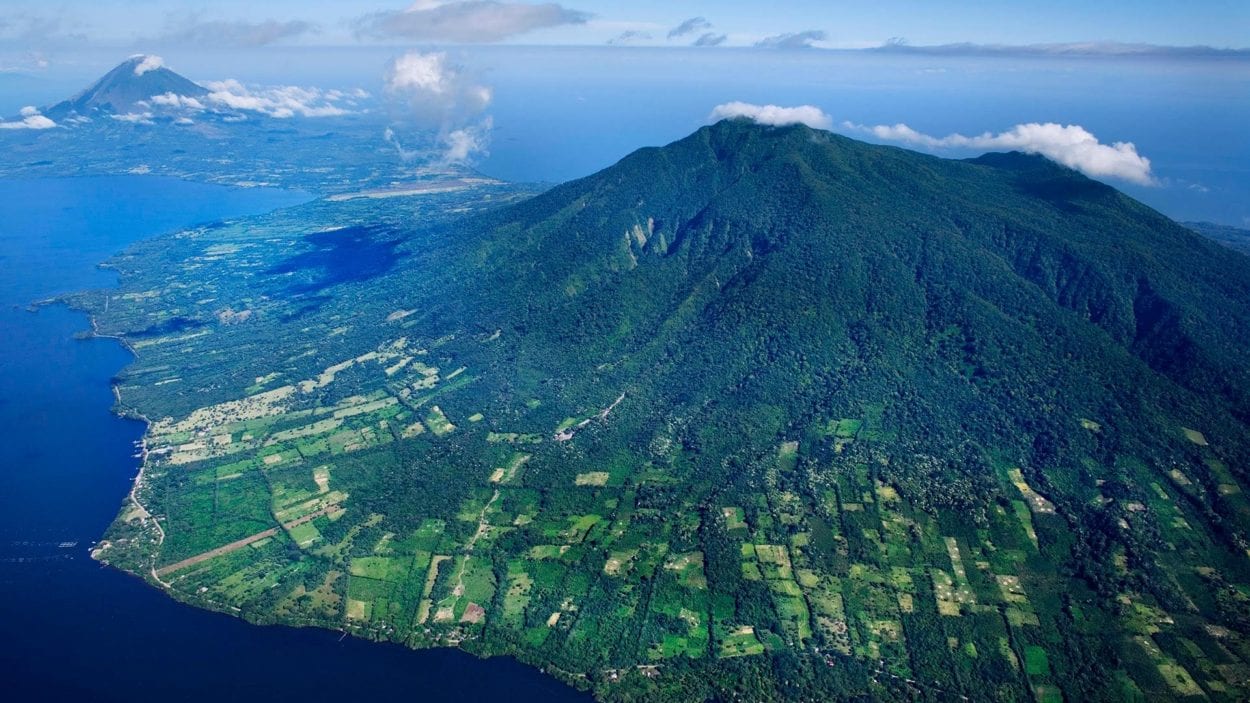
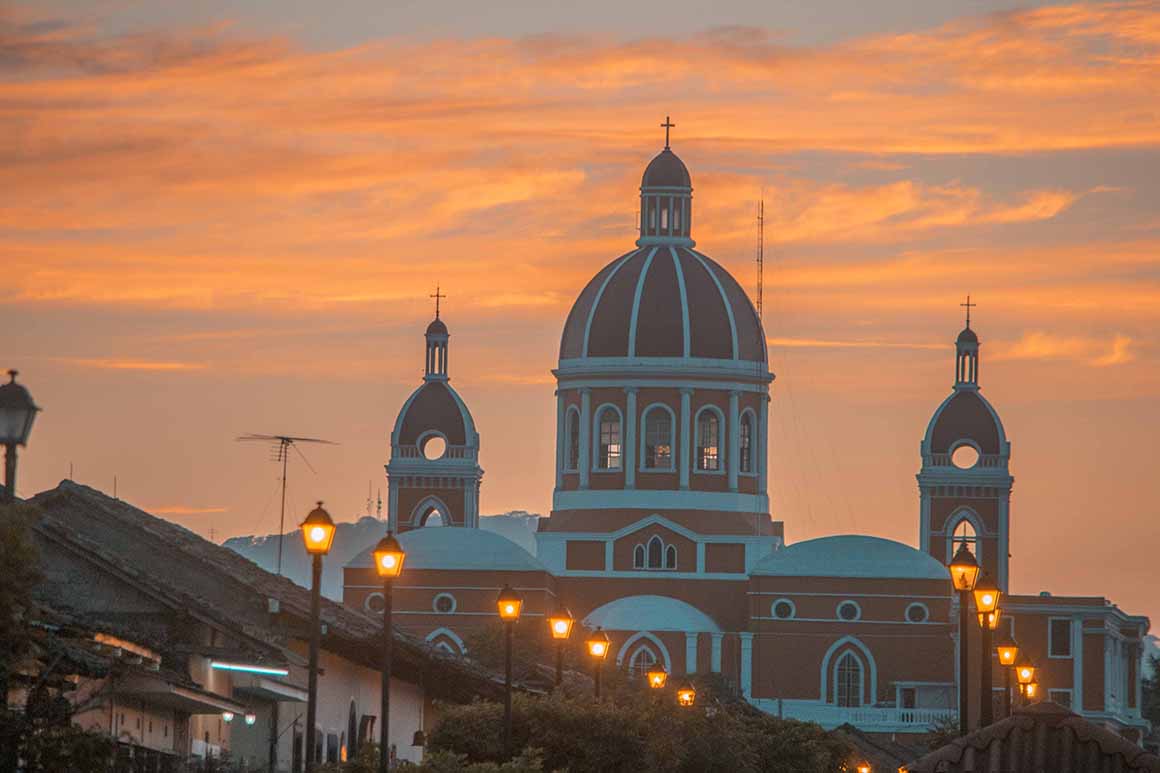
Founded in 1524, one of the oldest colonial cities in the Americas, with brightly painted facades along Calle La Calzada, the Cathedral of Granada's yellow towers, and boat trips through Las Isletas, 365 small islands scattered across Lake Nicaragua at the base of Volcán Mombacho. The most tourist-ready city in the country, with the best restaurant scene and a genuine sense of colonial-era grandeur intact.
León
Grittier and more politically significant historically than Granada, home to Nicaragua's largest cathedral, a UNESCO World Heritage Site, and murals commemorating the Sandinista revolution throughout the old town. León is the base for the volcano circuit, including Cerro Negro sandboarding and hikes up Volcán Telica and Volcán Momotombo.
Ometepe Island
Formed by two volcanoes joined by a narrow isthmus in the middle of Lake Nicaragua: Concepción, active and still smoking, and Maderas, dormant, with cloud forest and a crater lake reachable by a demanding day hike. Petroglyphs scattered across the island date back over a thousand years. Reached by ferry from San Jorge near Rivas, the island runs at a genuinely slower rural pace than the mainland, and a night or two at a lakeside eco-lodge is one of the more restorative stops in Central America.
San Juan del Sur & the Surf Coast
The Pacific coast south of Managua, San Juan del Sur and the beach towns around it (Tola, Popoyo, Playa Gigante), has become Nicaragua's most developed tourist and surf destination, with consistent breaks, a lively backpacker and expat scene, and increasingly upscale resort development along what's marketed as the Emerald Coast. Turtle nesting at nearby La Flor Wildlife Refuge, arribadas of thousands of olive ridley turtles, runs roughly August to December.
Big Corn & Little Corn Islands
Two small Caribbean islands off the east coast, reached by a short flight from Managua to Big Corn, then a panga boat to the smaller, quieter Little Corn. Afro-Caribbean Creole culture, English and Miskito alongside Spanish, white-sand beaches, and diving and snorkeling considerably less developed than similar Caribbean destinations. The pace and character shift completely from the Pacific side; most visitors describe it as feeling like a different country.
Culture & Etiquette
Nicaraguans, known locally as Nicas, are widely described by visitors as unusually warm and hospitable, a trait that persists despite the political tensions of recent years. Family and community are central to social life, and religious festivals, particularly La Purísima in December, honoring the Immaculate Conception, are deeply significant, community-wide occasions.
Do
- Greet warmly before any transaction. A brief "buenos días" and small talk before getting to business is expected and appreciated.
- Dress modestly outside beach towns. Especially in smaller towns and religious contexts, away from the more relaxed norms of San Juan del Sur or the Corn Islands.
- Tip around 10%. Appreciated in restaurants, particularly outside major tourist hubs where it isn't automatically added.
- Carry small denomination córdobas and USD. Both circulate widely; USD is especially useful in tourist areas, but small bills matter since change can be scarce.
Don't
- Discuss Nicaraguan politics openly. The government monitors dissent closely; casual political conversation, even seemingly innocuous, can create risk for the Nicaraguans you're speaking with, not just yourself.
- Photograph government buildings, police, or official events. Restricted and enforced; put the camera away around anything resembling official infrastructure or activity.
- Attend or photograph protests or political gatherings. Even as an observer, proximity to any demonstration carries real risk given current enforcement patterns.
- Drive at night in rural areas. Poor road conditions, unlit roads and unpredictable local driving norms make this a genuine hazard independent of any political concern.
Deeper culture: La Purísima, Nicaraguan poetry, and the Caribbean coast's distinct identity
La Purísima. Nicaragua's most significant religious festival, celebrated throughout early December, honoring the Immaculate Conception with home altars, community singing (gritería), and the giving of small gifts and treats to visitors who come to sing at each altar. It's one of the more distinctive and community-embedded Catholic traditions in Latin America.
Literary tradition. Nicaragua has an outsized poetic tradition for its size: Rubén Darío, the father of Spanish-language modernismo, remains a genuine national hero, and later poets like Ernesto Cardenal and Gioconda Belli wove revolutionary politics directly into their verse. Poetry is taken seriously here in a way that surprises many visitors.
The Caribbean coast. The Miskito, Creole and Rama communities of the Caribbean side have a distinct history, largely separate from Spanish colonial rule until relatively recently, shaped instead by British influence and Afro-Caribbean migration. English and Miskito are widely spoken alongside Spanish, and the cultural rhythm, food and music differ meaningfully from the Pacific side.
Food & Drink
Nicaraguan food is simple, corn- and rice-based, and reflects the country's agricultural roots and Spanish-indigenous fusion. The best of it is found in comedores, small family-run eateries, rather than tourist-strip restaurants, and prices stay low even in Granada's more polished dining scene.
Gallo Pinto
The national breakfast: rice and beans fried together with onion and pepper, usually with eggs, plantain or cheese. Found in every comedor across the country for C$50-80 ($1.50-2.50), the everyday staple of Nicaraguan life.
Nacatamal
Steamed corn dough filled with pork, rice and spices, wrapped in banana leaves, traditionally a weekend treat especially popular in León. C$100-150 ($3-5), often eaten Sunday mornings with coffee.
Vigorón
Boiled yuca topped with chicharrón (fried pork) and a tangy cabbage salad (curtido), served on a banana leaf. A quick, affordable Masaya market specialty, C$60-100 ($2-3.50), and one of the country's most distinctive street foods.
Quesillo
A soft tortilla wrapped around cheese, pickled onion and cream, a specific specialty of the town of La Paz Centro, sold from roadside stalls along the Managua-León highway.
Rondón (Caribbean Coast)
A coconut milk seafood stew from the Corn Islands and Caribbean coast, a specific Afro-Caribbean dish distinct from Pacific-side cuisine, reflecting the region's separate cultural history.
Flor de Caña Rum
Nicaragua's internationally recognized rum, distilled near León since 1890, aged in oak barrels and considered among Central America's finest; widely available and reasonably priced everywhere.
When to Go & Itineraries
Nicaragua has a tropical climate with a clear dry season, November through April, and a wet season, May through October. The dry season is the most comfortable for the volcano circuit and beach time; the wet season brings lush green landscapes, lower prices and fewer crowds, with rain typically arriving in predictable afternoon bursts rather than all-day downpours.
All seasons compared, with temperatures
| Season | Verdict | Temps | Notes |
|---|---|---|---|
| Nov-Apr | Best | 25-32°C | Dry season; best volcano hiking and beach conditions; peak prices Dec-Feb |
| May-Oct | Good, lush | 25-30°C | Wet season; afternoon rain typical, mornings often clear; greenest landscapes, lower prices |
| Aug-Dec | Turtle season | 25-30°C | Olive ridley turtle arribadas at La Flor Wildlife Refuge near San Juan del Sur |
Pacific lowlands averages. Highland areas like Matagalpa and Jinotega run noticeably cooler year-round.
Itineraries
Ten to fourteen days covers the mainland circuit comfortably. A week works if you focus on one region rather than the whole country.
- Days 1-3
Granada. Colonial center, Las Isletas boat trip, a day trip to the Mombacho cloud forest or Masaya volcano and craft market.
- Days 4-5
León & Cerro Negro. Cathedral and Sandinista murals, sandboarding down Cerro Negro, one of the great only-in-Nicaragua activities.
- Days 6-8
Ometepe Island. Ferry from San Jorge, a Maderas or Concepción day hike, petroglyphs, and a slow lakeside couple of nights.
- Days 9-10
San Juan del Sur. Beach time, surf lesson if desired, La Flor turtle refuge if the season aligns, before flying home.
- Days 1-3
Granada. As above, with an added day for Catarina's mirador viewpoint over Laguna de Apoyo, a volcanic crater lake good for swimming.
- Days 4-6
León & volcano circuit. Cerro Negro sandboarding, plus a guided hike up Telica or Momotombo for those wanting more.
- Days 7-9
Ometepe Island. A full volcano hike day, petroglyph sites, and genuine downtime at a lakeside eco-lodge.
- Days 10-11
San Juan del Sur. Beach and surf time on the Pacific coast.
- Days 12-14
Corn Islands. Fly from Managua to Big Corn, panga to Little Corn for a completely different, Caribbean close to the trip.
Getting there & around
Augusto C. Sandino International Airport in Managua is the main international gateway. Domestic transport ranges from comfortable inter-city coaches to the iconic repurposed yellow school "chicken buses," with boats essential for Ometepe and the Corn Islands.
All transport options with prices: buses, ferries, domestic flights
| Option | Price | Notes |
|---|---|---|
| Inter-city coach (Tica Bus etc.) | $5-15/route | Comfortable, air-conditioned, connects major towns and international routes to neighboring countries. |
| Chicken bus | $2-5/day | Repurposed North American school buses, the local budget option; slow but an authentic experience. |
| Ometepe ferry | ~$3-5 | From San Jorge (near Rivas) to Moyogalpa or Altagracia; can be rough in windy conditions. |
| Domestic flight to Corn Islands | $100-180 return | Managua to Big Corn Island; the practical way to reach the Caribbean side given road/boat time otherwise. |
| Panga (small boat) | $5-10 | Big Corn to Little Corn Island, and along the Caribbean coast between Bluefields, Pearl Lagoon and El Rama. |
Night driving: avoid rural roads after dark given poor lighting, unpredictable local driving and road condition variability. GetTransfer offers fixed-price pickups from Managua's airport.
Where to stay
Hostels & budget guesthouses
Abundant in Granada, León and San Juan del Sur; generally clean and social, a good way to meet other travelers on the well-worn circuit.
Colonial boutique hotels, Granada
Restored colonial buildings converted into characterful mid-range hotels, some with courtyard pools; the best value tier in the country's most polished city.
Ometepe eco-lodges
Lakeside properties ranging from simple to comfortable, several genuinely eco-focused given the island's conservation profile; two nights is the sweet spot for the volcano hikes.
Pacific coast resorts
Increasingly upscale development around Tola and the Emerald Coast, catering to surf and wellness travelers at prices approaching Costa Rica's.
Budget Planning
Nicaragua is one of the more affordable countries in Central America, noticeably cheaper than Costa Rica for comparable experiences. Budget travelers do well on hostels, comedor meals and chicken buses; the Pacific surf coast and Corn Islands run higher given their more developed tourist infrastructure.
- Hostel dorm or budget guesthouse
- Comedor meals, gallo pinto
- Chicken bus transport
- Free beaches and hiking trails
- Colonial boutique hotel, Granada
- Mix of comedor and restaurant dining
- Tica Bus and occasional domestic flight
- Guided volcano hikes and boat trips
- Pacific coast resort or upscale Granada hotel
- Full restaurant dining throughout
- Private drivers and domestic flights
- Corn Islands diving package
Quick reference prices: food, transport, activities
| Gallo pinto breakfast | $1.50-2.50 |
| Vigorón, market | $2-3.50 |
| Nacatamal | $3-5 |
| Chicken bus, per day | $2-5 |
| Tica Bus, inter-city | $5-15 |
| Cerro Negro sandboarding tour | $25-35 |
| Ometepe eco-lodge | $30-70/night |
| Managua-Corn Islands flight | $100-180 return |
Prices reflect July 2026 research and drift over time. Treat them as a planning baseline, not a quote.
Visa & Entry
Most Western nationalities, including the US, Canada, EU countries and Australia, can enter Nicaragua visa-free for up to 90 days with a valid passport, paying a $10 tourist card fee on arrival. Nicaragua participates in the CA-4 border agreement with Guatemala, Honduras and El Salvador, meaning time spent across all four countries counts toward a single shared 90-day limit, worth tracking carefully on a regional itinerary.
✓ Valid passport
At least 6 months validity beyond your stay, standard practice across the region.
✓ Tourist card fee, $10
Paid on arrival for most nationalities; some nationalities require an advance visa, check before booking.
⚠ CA-4 shared 90 days
Time in Guatemala, Honduras, El Salvador and Nicaragua counts against one combined 90-day allowance.
⚠ Dual nationals, check current status
The January 2026 constitutional change banning dual nationality has affected some Nicaraguan dual citizens; verify your specific situation with a Nicaraguan consulate before travel if this applies to you.
| Nicaragua | Costa Rica | |
|---|---|---|
| Daily budget | $25-40, noticeably cheaper | $50-80, more developed tourist pricing |
| Crowds | Uncrowded outside San Juan del Sur and Granada | Well-established mass tourism infrastructure |
| Political context | Level 3, Reconsider Travel; genuinely restrictive climate | Stable democracy, no comparable advisory |
| Signature draw | Colonial cities, Ometepe's volcanoes, Corn Islands | National parks, wildlife density, established eco-tourism |
Safety in Nicaragua
Nicaragua carries a Level 3, Reconsider Travel advisory from the US State Department, most recently reissued in 2026. Unlike many Level 3 countries, the primary driver here isn't street crime or terrorism, it's arbitrary enforcement of local laws and the documented risk of wrongful detention, particularly for anyone perceived as critical of the government, including some dual nationals whose citizenship has been affected by the January 2026 constitutional change.
Political risk
Government and law enforcement continue to target perceived opponents. Avoid political discussion, protests, photography of officials or government buildings; drones are illegal, and phones may be searched for anti-government content at checkpoints or crossings.
Petty crime
Pickpocketing occurs in crowded markets like Managua's Huembes; violent crime against tourists is uncommon but possible in specific Managua neighborhoods and isolated beach areas after dark.
Healthcare access
Private clinics in Granada and Managua offer good care; public healthcare elsewhere operates under real strain. Comprehensive insurance with evacuation coverage is strongly recommended.
Road safety, solo travelers, and the practical read on the political climate
Road safety: poor infrastructure and erratic driving make road travel genuinely risky outside the main paved routes; avoid rural night driving entirely, seat belts and motorbike helmets are legally mandatory.
Solo and female travelers: generally safe within the established tourist circuit; locals are hospitable and the well-worn Granada-León-Ometepe-San Juan del Sur route sees regular solo travel without incident. Avoid isolated areas after dark regardless of gender.
The practical read: the vast majority of visitors to Nicaragua's tourist circuit in 2026 travel without any direct encounter with the political risks described above. The advisory reflects real, documented cases, mostly involving activists, journalists, dual nationals with perceived ties to opposition activity, or people caught up in checkpoints during periods of unrest, rather than random risk to ordinary tourists keeping a low profile. Register with your embassy's travel program, avoid any political engagement, and monitor your government's current advisory in the weeks before departure.
Emergency numbers
Embassy contacts and medical evacuation
Most Western embassies are located in Managua.
- USA
- +505-2252-7100
- Spain
- +505-2266-3195
- Germany
- +505-2266-3917
- France
- +505-2222-6210
- Canada (via San José, Costa Rica)
- +506-2242-4400
Medical evacuation: private hospitals in Managua and Granada handle most needs; serious cases may require evacuation to Costa Rica or the US. Confirm your travel insurance explicitly covers medical evacuation before departure.
Nicaragua FAQ
Is Nicaragua safe to visit in 2026?
The US State Department maintains a Level 3, Reconsider Travel advisory, driven primarily by arbitrary law enforcement and the risk of wrongful detention rather than street crime against tourists. Most visitors to Granada, León, Ometepe and San Juan del Sur travel without incident, but the political climate is genuinely restrictive: avoid photographing government buildings or police, avoid political discussion, and stay especially cautious around any protest or large gathering.
Do I need a visa for Nicaragua?
Most Western nationalities, including the US, Canada, EU and Australia, can enter visa-free for up to 90 days with a valid passport, paying a $10 tourist card fee on arrival. Nicaragua is part of the CA-4 border agreement with Guatemala, Honduras and El Salvador, so time spent across all four counts toward a shared 90-day limit.
What is Ometepe Island?
An island in Lake Nicaragua formed by two volcanoes, Concepción (active) and Maderas (dormant, with cloud forest and a crater lake), joined by a narrow isthmus. It's one of the country's signature destinations for volcano hiking, petroglyphs, and a slow, rural island pace.
Can you sandboard down a volcano in Nicaragua?
Yes, at Cerro Negro near León, one of the youngest and most active volcanoes in Central America. Visitors hike up the black volcanic slope and sandboard or ski down on a board, a genuinely unique activity available in very few places on earth.
What are the Corn Islands?
Two small Caribbean islands off Nicaragua's east coast, Big Corn and Little Corn, with white-sand beaches, clear water and a slower, distinctly Caribbean Creole culture different from the Pacific side of the country. They require a flight or a longer boat journey and reward the extra effort.
How many days do you need in Nicaragua?
Ten to fourteen days covers the standard circuit well: Granada, León, Ometepe, and either the Pacific surf coast or the Corn Islands. A week is workable if you pick one region rather than trying to cover the whole country.
Is Nicaragua cheap to visit?
Yes, one of the more affordable countries in Central America. Budget travelers manage on $25-40 a day outside resort areas, with hostels, local comedores and chicken-bus transport keeping costs low; the Pacific surf coast and Corn Islands run noticeably higher.
What is gallo pinto?
Nicaragua's national dish, rice and beans fried together with onion and pepper, usually served at breakfast alongside eggs, plantain or cheese. It's the everyday staple found in every comedor across the country.
Is Granada or León better to visit?
Granada is the more polished, tourist-ready colonial city with better restaurants and lake access; León is grittier, more politically significant historically, with striking cathedral architecture and closer access to the volcano circuit including Cerro Negro. Most itineraries include both.
What language is spoken in Nicaragua?
Spanish is the official and dominant language nationwide. English and Miskito are more commonly spoken on the Caribbean coast, including the Corn Islands, reflecting the region's distinct Afro-Caribbean and indigenous history.
The Poet's Country
Rubén Darío, born in a small Nicaraguan town in 1867, became the father of modernismo, the literary movement that reshaped Spanish-language poetry across two continents. His statue stands in Managua's central park; his image is on the córdoba banknotes; his verses are taught to every schoolchild. A country of six million people that produced one of the most influential poets in the language's history, and then, decades later, produced Ernesto Cardenal, a poet-priest who ran a religious commune on the Solentiname islands before becoming a Sandinista minister of culture, and Gioconda Belli, whose poetry moved between revolutionary politics and unabashed sensuality with equal confidence.
This is the tension worth holding as you travel here: a small country with an outsized creative and intellectual tradition, currently governed by a system that has grown less tolerant of the very kind of free expression its poets are celebrated for. You'll meet Nicaraguans who talk about Darío with real pride within the same conversation where they change the subject carefully when politics comes up. Both things are true. Neither cancels the other out.