
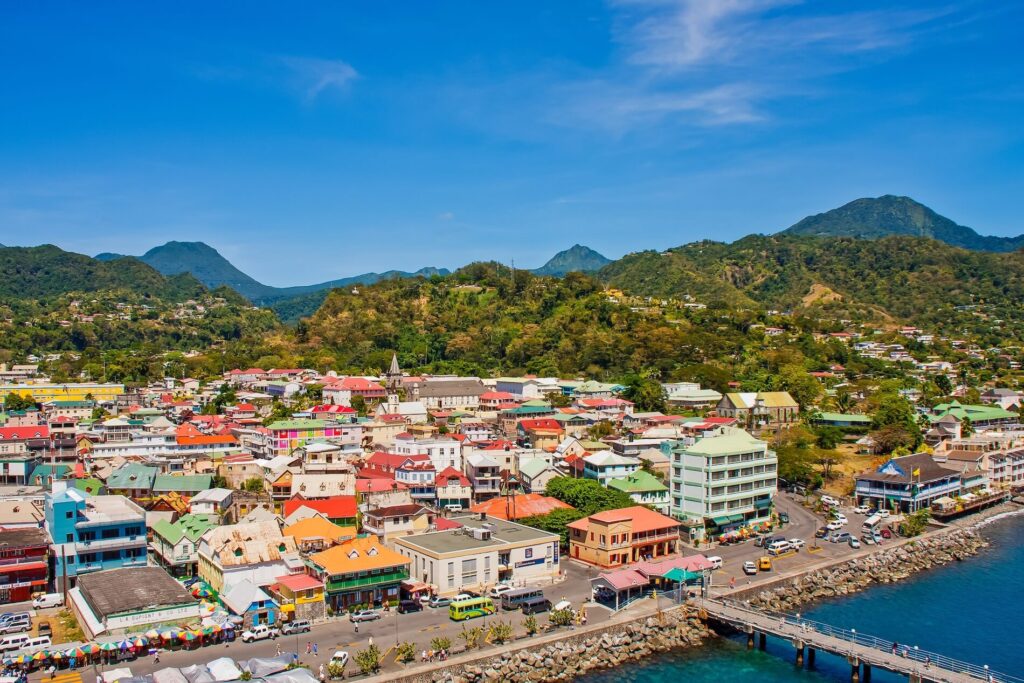
A small capital built to launch bigger days
Roseau is compact even by small-capital standards: a British grid plan from 1768 wrapped around an older, crooked French Quarter, the whole thing walkable in twenty minutes if you're not stopping. It has one real cathedral, one real fort turned hotel, a market that only fully wakes up on Saturday mornings, and a cruise ship berth that lands several thousand day-trippers right in the middle of it a few mornings a week. None of that is the reason to come.
The reason to come is what Roseau sits next to: the Soufrière-Scotts Head Marine Reserve and its resident sperm whales twenty minutes south, the Boiling Lake trailhead twenty minutes into the hills, Trafalgar Falls a short drive up the valley. Roseau works best understood as a launch pad, a comfortable, inexpensive base with decent food and a genuine old town worth an afternoon, not a multi-day destination in its own right.
The honest complications
Roseau's streets are narrow, mostly one-way, and easy to get turned around in, especially in the French Quarter where the British grid gives up. Cruise ship mornings (check the port schedule before you plan a quiet wander through the market) bring real crowds and a spike in vendors approaching visitors directly. There's no beach to speak of in town, no ride-hailing app to fall back on, and after dark the city center empties out fast outside of a few restaurant strips; plan taxis in advance rather than expecting to hail one on the street at 10pm.
A grid, a tangle, and a valley behind both
Roseau reads as two overlapping street patterns: the regular British grid drawn up in 1768, and the older, crooked French Quarter that predates it and never got redrawn. Almost everything a first-time visitor wants sits within that combined footprint or a short drive up the Roseau Valley behind it.
The French Quarter
Roseau's original neighbourhood, centered on Dawbiney Square (still called the Old Market by everyone), predates the British grid and keeps its own crooked, narrow street pattern. King George V Street, its main artery, holds many of the city's best-preserved wooden houses with decorated balconies, and is also where several of the best Creole lunch counters operate.
The Bay Front & Victoria Street
The waterfront strip holds Fort Young, the cruise ship berth, and the main run of restaurants and hotels facing the Caribbean Sea. Victoria Street, one of the city's key thoroughfares, connects the Bay Front through Bath Road and High Street toward Turkey Lane and out to the Citronier and Eggleston villages above town.
Newtown & Bath Estate
South and east of the historic core, these residential districts hold a mix of guesthouses and local life away from the cruise-day bustle, an easy walk from the Botanical Gardens and a short taxi from downtown.
The Roseau Valley
Following the Roseau River inland leads to Trafalgar and Wotten Waven, villages surrounded by rainforest and hot springs, and the trailhead area for both Trafalgar Falls and, further on, the Titou Gorge approach to Boiling Lake. Several of the area's best guesthouses and its most atmospheric restaurant sit out here rather than in town.
From a rebuilt 1770 fort to a budget guesthouse with a dive shop
Roseau's hotel scene is small and mostly independent rather than chain-driven, which keeps prices reasonable even at the top end by Caribbean standards.
At the top, Fort Young Hotel occupies the site of an actual 1770 fort, destroyed by Hurricane David in 1979 and rebuilt as the city's best-known waterfront address, with a pool and restaurant looking straight out over the Caribbean Sea.
In the boutique bracket, Ocean Oasis Hotel Dominica and Villa Copthall both post some of the highest guest ratings in the city, while La Maison 29 is a smaller, well-reviewed guesthouse option in the same central bracket.
At the budget end, Symes Zee Villa pairs inexpensive rooms with its own windsurfing, snorkeling and diving activities, a practical pick if the water is as much a priority as the price.
Accras at dawn, callaloo by lunch, cocoa tea either way
Roseau eats plainly and well. The best introduction to Dominican Creole food is not a hotel restaurant but the Saturday morning rush at the Old Market, followed by a proper sit-down Creole lunch on King George V Street.
Saturday morning at the Old Market
Farmers bring produce down from the hills before dawn, and the food stalls around them sell accras (fried saltfish fritters) and bakes hot off the pan, often alongside cocoa tea, a spiced, chocolate-forward hot drink that's the classic pairing. It thins out fast after mid-morning.
Traditional Creole
Pearl's Cuisine and Cornerhouse Cafe, both on King George V Street, are the reliable choices for a proper Creole lunch: callaloo soup, provision and saltfish, stewed meats. In the French Quarter, The Great Old House runs a Saturday breakfast of accras, bakes and cocoa tea that locals show up early for.
An authentic local breakfast
Sundowner Restaurant is the pick specifically for a Creole breakfast done properly, a good alternative if the market stalls are too crowded on a cruise-ship morning.
Out in the Roseau Valley
Papillote Rainforest Restaurant, set in an organic garden in the Roseau Valley near Trafalgar Falls, serves some of the most distinctive food on the island, including fish steamed in a banana leaf, worth the short drive out and easy to combine with the falls themselves.
A market, a garden, a fort and a cathedral
Roseau's own sights are modest and can be covered properly in a single unhurried day, leaving the rest of your time for the island beyond it.
The Old Market (Dawbiney Square)
The cobblestone square at the heart of the French Quarter is Roseau's most photogenic corner and, on Saturday mornings specifically, its liveliest: produce stalls, bay oil and bush medicine sellers, craft vendors, and the best cheap Creole breakfast food on the island. On other days it's quieter but still worth a walk-through for the surrounding wooden architecture.
Dominica Botanic Gardens
A 40-acre garden established in 1890, sometimes called "the lungs of Roseau," a short walk east of the centre. Two aviaries hold Sisserou and Red-Necked Amazon parrots, both native to Dominica and endangered in the wild; the Sisserou appears on the national flag and is found nowhere else on Earth.
Fort Young
Built in 1770 and destroyed by Hurricane David in 1979, the fort's surviving structure is now the Fort Young Hotel; even if you're not staying there, the waterfront terrace and remaining fortifications are worth a look on a walk along the bay.
Our Lady of Fair Haven Cathedral
Completed in 1916 in a Romanesque style with a grand stone facade, the cathedral is one of the city's most prominent landmarks and free to step inside outside of services.
One day in town, then out to the island
Roseau itself needs one focused day. Everything past that is really a day trip into the rest of Dominica, launched from the same base.
- Morning
Old Market and the French Quarter, ideally on a Saturday, plus a walk through King George V Street.
- Midday
Dominica Botanic Gardens, then lunch at Pearl's Cuisine or Cornerhouse Cafe.
- Afternoon
Fort Young and the Bay Front, Our Lady of Fair Haven Cathedral.
- Evening
Dinner on the waterfront, or the short drive out to Papillote in the Roseau Valley.
- Day 1
The one-day route above.
- Day 2
Trafalgar Falls and the hot springs, a 20-minute drive into the Roseau Valley, easy walking and a soak afterward.
- Days 1-2
The two-day route above.
- Day 3
Whale watching out of Soufrière, a half-day boat trip to see Dominica's resident sperm whales, best November through March.
Walkable in town, a car or driver for everything else
Douglas-Charles Airport (DOM), Dominica's main airport, sits about 47km northeast of Roseau, roughly an hour's drive; a fixed-fare taxi runs around XCD 91 (about $35) per passenger. Canefield Airport (DCF), used mainly for small inter-island flights to Guadeloupe and Martinique, is only about 15 minutes from the city. Cruise ships dock directly in the city centre at the Roseau Cruise Ship Berth.
Central Roseau, the Bay Front and the French Quarter are all walkable within about twenty minutes of each other, though the one-way streets and crooked French Quarter lanes take some getting used to. Neither Uber nor Bolt operates in Dominica; arrange taxis through your hotel or agree a fare with a licensed driver before getting in, and rent a car (left-hand drive, temporary visitor's permit required) if Trafalgar Falls, Boiling Lake or Portsmouth are on your list, since public transport doesn't reliably reach the trailheads.
Best time to visit
February through April is driest and busiest, both in town and for day-trip hiking conditions. May through December is the rainy season and June through November is hurricane season, peaking in late August and early September; whale sightings, unrelated to the rain, are best November through March.
Cheap to eat and sleep in, pricier to do things from
Roseau itself is inexpensive: market meals, guesthouse rooms and local buses all come in well below Caribbean beach-resort prices. The real cost of a Roseau-based trip is the guided day trips, Boiling Lake, whale watching, diving, that are the actual reason to be here.
- Guesthouse room $30-55
- Market meals & local kitchens $5-10
- Walking plus the occasional bus fare
- Free sights: Old Market, Fort Young exterior, cathedral
- Boutique hotel $80-180
- Restaurant dinners $15-30/person
- Rental car ~$50-70/day
- One guided day trip (Boiling Lake or whales)
- Fort Young Hotel or similar waterfront pick
- Private guides for hiking and diving
- Private whale-watching charter
- Dinners at Papillote or similar
Safe by Caribbean capital standards, with the usual caveats
Roseau is safe for tourists; Dominica overall carries a Level 1 US State Department advisory, its lowest tier, as of May 2026. Violent crime against visitors is rare, and the town is fine to walk in the day and early evening with normal urban awareness. The practical risks are petty theft on busy cruise-ship days and the occasional overcharging by unlicensed taxis or vendors, not violent crime.
The things that actually catch visitors: opportunistic theft around the Old Market and cruise berth on the busiest ship days, so keep bags closed and in front of you; unlicensed taxi overcharging, avoidable by arranging transport through your hotel or agreeing a fare upfront; and hiking without a guide on trails outside town, which is illegal on Boiling Lake specifically and unwise anywhere in the national parks given fast-changing weather. Roseau is a reasonable base for solo female travellers with the same precautions that apply island-wide: avoid walking alone late at night, use licensed transport, and don't hike alone.
Emergency numbers match the rest of Dominica: 999 general emergency, police in Roseau on (767) 266-5100, fire and ambulance on (767) 266-4400, and the main hospital in Roseau on (767) 266-2000.
Boiling Lake, waterfalls and whales, all within an hour
Roseau's real value is how much of Dominica sits within an hour's drive, and these are the trips almost every visitor builds their stay around.
Boiling Lake & the Valley of Desolation
The trailhead sits near Titou Gorge in the Roseau Valley, a short drive from town, but the hike itself is the island's most demanding: a full day through a barren, steaming geothermal landscape to the shore of the world's second-largest hot spring lake. Book a licensed guide in advance; departures are typically very early, around 6am.
Trafalgar Falls & hot springs
Twin waterfalls, known locally as Father and Mother, drop into pools a short forest walk from the parking area, with a natural hot spring nearby. The easiest and most reliably rewarding day trip from Roseau, and easy to combine with lunch at Papillote in the same valley.
Whale watching & diving at Soufrière-Scotts Head
Dominica is the only country with resident sperm whales visible year-round, and boats out of Soufrière or Roseau itself reach the marine reserve where they live in well under an hour. Sightings cluster closest to shore November through March; swim-with-whales trips require a government permit, so book through a licensed operator rather than an informal one.
Champagne Reef
Volcanic gas bubbles up through the sea floor at this shore-accessible snorkel site south of Roseau, creating a fizzing, "champagne" effect around the coral and resident hawksbill turtles. Easy to combine with a Soufrière boat trip or visit independently.
Roseau FAQ
Is Roseau safe for tourists?
Yes. Violent crime against visitors is rare and central Roseau is fine to walk in the day and early evening with normal urban awareness. Petty theft on busy cruise-ship days and overcharging by unlicensed taxis are the main practical risks, not violent crime.
How many days do I need in Roseau?
One focused day covers the Old Market, Botanical Gardens and Fort Young. Most visitors use Roseau as a base for two to four additional days of day trips to Boiling Lake, Trafalgar Falls and the whale-watching boats out of Soufrière.
How much does Roseau cost per day?
Budget travelers manage on $50-90 a day with guesthouses and market meals; mid-range runs $100-200. Roseau itself is inexpensive to eat and sleep in; the cost adds up in guided day trips like Boiling Lake and whale watching.
When is the best time to visit Roseau?
February through April: driest weather and easiest hiking conditions for day trips. Whale sightings are best from November through March regardless of rainfall.
What is the French Quarter?
Roseau's oldest neighbourhood, laid out with crooked streets before the British grid plan of 1768 was extended around it. King George V Street, its main artery, holds many of the city's best-preserved wooden houses with decorated balconies.
Can I walk to Boiling Lake or Trafalgar Falls from Roseau?
No. Both require a drive first: Trafalgar Falls is about 20 minutes from central Roseau, and the Boiling Lake trailhead at Titou Gorge in the Roseau Valley is a similar distance, followed by a 6 to 8 hour guided hike.
How do I get from the airport to Roseau?
From Douglas-Charles Airport it's about an hour's drive (47km), with a fixed taxi fare of roughly XCD 91 (about $35) per passenger. Canefield Airport, used mainly for inter-island hops, is only about 15 minutes from the city.
What is the best area to stay in Roseau?
The Bay Front and French Quarter for first-timers: central, walkable to the market and cathedral, and close to Fort Young. Guesthouses further up the Roseau Valley trade a short drive for a quieter, more rainforest-immersed stay.
Can I do a day trip to see whales from Roseau?
Yes. Licensed operators run half-day boat trips from Roseau or nearby Soufrière to see Dominica's resident sperm whales, visible year-round with the closest sightings from November to March. Swim-with-whales trips require a government permit.
Is Uber or Bolt available in Roseau?
No, ride-hailing apps do not operate in Dominica as of 2026. Arrange taxis through your hotel or guesthouse, or agree a fare with a licensed driver before you get in.
What Stays With You
Roseau will not be the postcard from your trip. The postcard is the steam rising off the Valley of Desolation, or a whale's tail disappearing twenty meters from the boat, or the green flash of a Sisserou parrot found nowhere else on Earth. What Roseau gives you is the ordinary version of Dominica in between those moments: a market stall selling accras before the sun is properly up, a cathedral that's stood since 1916, a fort that survived one hurricane by becoming a hotel and is still standing for the next one.
Spend your one day here properly, then let the town do what it does best: send you somewhere more extraordinary the next morning.