
Maldives
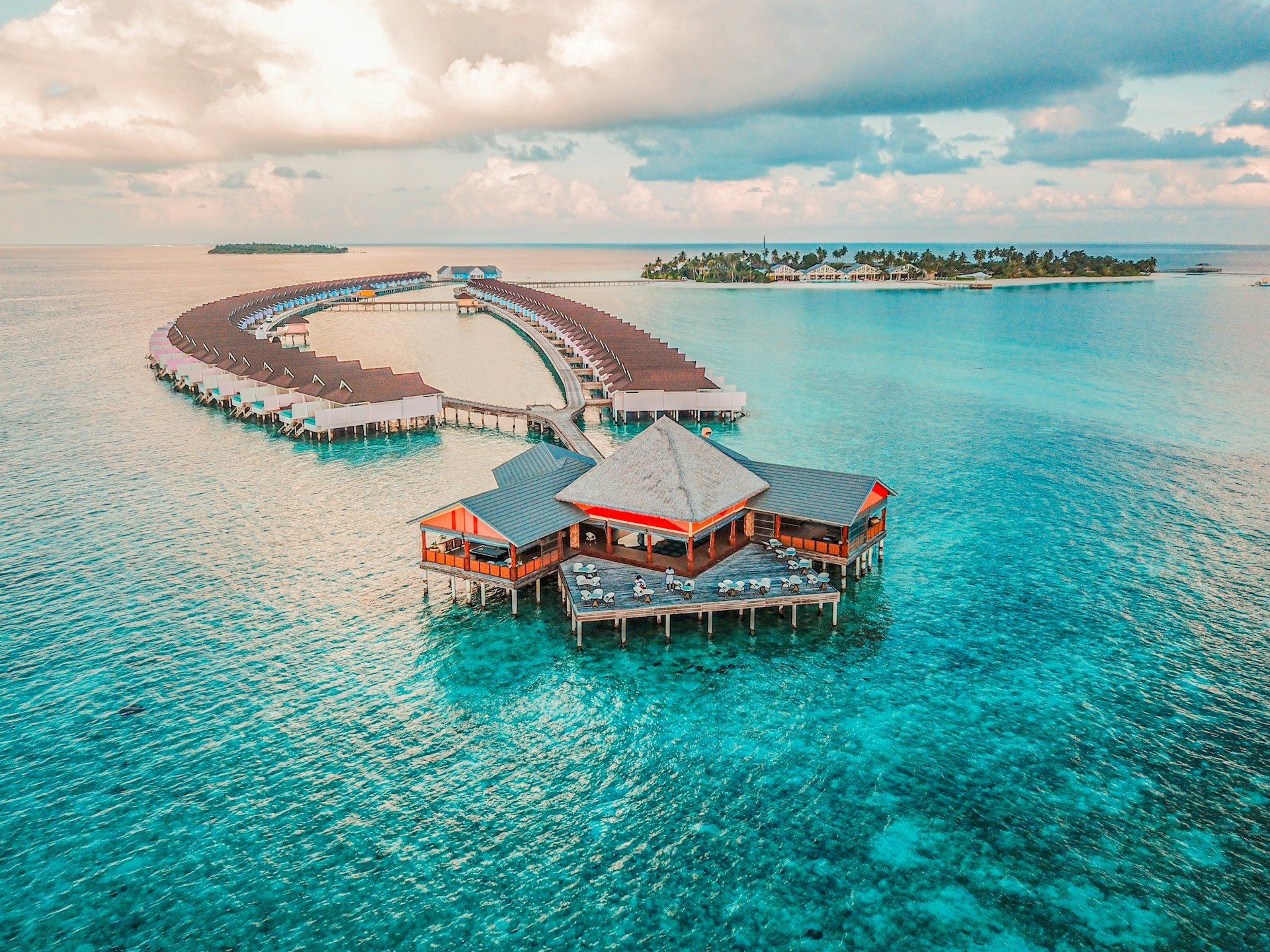
1,200 islands spread across the Indian Ocean, none of them more than two meters above sea level. The water is an impossible shade of turquoise that makes you think the photos were edited until you arrive and see that they weren't. The reef starts three meters from shore. Whale sharks appear at dawn without announcement. And climate change is not a distant threat here — it's the present reality of the world's most beautiful disappearing act.
What You're Actually Getting Into
The Maldives is one of those places where the photographs are accurate and that's almost the problem. You arrive already knowing what it looks like — the overwater bungalows, the turquoise lagoons, the perfectly white sand — and then you stand in front of it and discover that knowing what something looks like is entirely different from being inside it. The water color is produced by the specific combination of white sand, shallow depth, and Indian Ocean light and it changes throughout the day from pale jade in the morning to deep sapphire at noon. The reef starts meters from the beach. The whale sharks are real.
The honest context that most brochures omit: the Maldives is not one kind of destination. It is two simultaneously coexisting destinations that share a geography but almost nothing else. The first is the resort Maldives — private island retreats where seaplanes drop guests at jetties leading directly to overwater villas, where meals cost more per day than most countries cost per week, and where the entire infrastructure is designed to make you feel like you are on a private ocean. This version is extraordinary and extraordinarily expensive and is what most people picture when they hear the word Maldives.
The second is the local island Maldives, which opened to non-resort tourism in 2010 and transformed who could afford to visit. Inhabited Maldivian islands with guesthouses, local restaurants, local life happening alongside the same reefs and the same turquoise water, at a fraction of the resort price. Maafushi, Ukulhas, Mathiveri, Rasdhoo — islands where you rent a bicycle in the morning, snorkel the house reef before breakfast, eat fish curry at a local restaurant for $5, and watch the sunset from a fishing dhoni with the island's fishermen in the evening. Not the same experience as a resort. In some ways a better one.
The final context: the Maldives has an average elevation of 1.5 meters above sea level and is the world's most at-risk nation from rising seas. The government has been the most vocal climate advocacy voice in international forums for decades — not as an ideological position but as an existential one. Visiting the Maldives in 2026 means visiting something that may be profoundly different within the lifetimes of people alive today. The bioluminescent plankton that lights the shoreline blue at night, the whale sharks that arrive at feeding aggregations at dawn, the reef that supports an entire country's food security — these are things that exist now and need to be seen now. Go with that weight, and spend your money with local operators who have skin in the game.
Maldives at a Glance
A History Worth Knowing
The Maldives has been inhabited for at least 2,500 years, its first settlers arriving by boat from the Indian subcontinent and Sri Lanka and building a civilization adapted to the specific constraints and gifts of living on coral atolls in the middle of the Indian Ocean. The Maldivians were, by necessity, the world's greatest small-boat navigators — fishing the deep channels between atolls, reading the Indian Ocean's monsoon winds with precision that predated any formal nautical science, and trading with Arab, Indian, and East African merchants who stopped at the islands on their routes across the ocean.
The cowrie shell — Cypraea moneta — collected from Maldivian reefs, was the dominant currency across much of South and Southeast Asia and West Africa for centuries. The Maldives was, in effect, the world's mint for an entire monetary system. The islands that appear so remote and paradisiacal today were a strategic commercial resource of the first order in the medieval global economy. Ibn Battuta, the 14th-century Moroccan traveler who covered more of the medieval world than anyone else on record, spent eighteen months as a judge in Malé in the 1340s and recorded the Maldivian society he found with detail and affection in his travel memoir.
Islam arrived in the Maldives in 1153 CE, brought by a Moroccan scholar named Abu Barakata al-Barbari who is credited — through a narrative that blends history and legend — with converting the king and ending the earlier Buddhist tradition. The mosques built in the centuries following are among the most distinctive in the Islamic world: constructed from coral stone with hand-carved reliefs, oriented precisely toward Mecca across the ocean, and surviving in various states of preservation across many of the inhabited islands. The Old Friday Mosque (Hukuru Miskiy) in Malé, built in 1656, is the finest example still standing and one of the oldest buildings in the Maldives.
The British signed a protectorate agreement in 1887 that gave them control of foreign affairs while leaving the Maldivian sultanate intact — a lighter-touch colonialism than most of the empire practiced. Independence came in 1965 without conflict. The sultanate was abolished by referendum in 1968 and replaced by a republic. The post-independence decades under President Maumoon Abdul Gayoom — who held power from 1978 to 2008 — are complicated: he brought stability, tourism infrastructure, and genuine development, while also running an authoritarian state that imprisoned opponents and controlled media. Democracy arrived formally in 2008 with Mohamed Nasheed's election, and the subsequent political history has been turbulent enough to require checking a current source rather than this guide.
The 2004 Indian Ocean tsunami killed over 100 Maldivians and devastated the infrastructure of dozens of islands. The country rebuilt faster than most. What it could not fully rebuild — and cannot — is the reef system that sustained Maldivian civilization for millennia. The coral bleaching events of 1998, 2016, and subsequent years killed significant portions of the reef ecosystem that the entire country's economy, food security, and cultural identity depends upon. The Maldives in 2026 is a country living simultaneously in a tourist paradise and an environmental emergency, and both are true at the same time.
Settlers arrive from India and Sri Lanka. An Aryan-speaking Buddhist civilization establishes itself on the atolls.
Maldivian cowrie shells become the dominant currency across Asia and West Africa. The islands are a global commercial hub disguised as a remote paradise.
The Maldives converts from Buddhism to Islam. The Islamic sultanate established. Coral stone mosques built across the atolls.
The great Moroccan traveler spends 18 months as a judge in Malé, leaving one of the most detailed accounts of medieval Maldivian society.
Britain takes control of Maldivian foreign affairs while leaving the sultanate intact. The lightest-touch colonial relationship in the empire.
The Maldives becomes fully independent from Britain. One of the last countries to join the United Nations.
The first tourist resort opens on Kurumba Island. The modern Maldives tourism industry begins its extraordinary growth.
Over 100 Maldivians killed, dozens of islands devastated. The country rebuilds but the environmental vulnerability is starkly revealed.
Guesthouses permitted on inhabited islands for the first time. The Maldives becomes accessible to non-luxury travelers. The country's tourism identity changes permanently.
Top Destinations
The Maldives is organized into 26 administrative atolls spread over 800 kilometers of Indian Ocean, and the destination question is primarily about which atoll and which type of island — resort or local. Most visitors either transfer directly to a resort from the airport by seaplane or speedboat, or take a speedboat to a local island guesthouse. The geography means your "destination" is often a single island for the duration of your stay, with day trips to neighboring atolls, sandbanks, and dive sites.
South Ari Atoll
South Ari Atoll has the most reliable year-round whale shark aggregation in the world. The whale sharks here — juvenile specimens of 4 to 8 meters — feed on fish spawn in the waters around a specific area called the South Ari Marine Protected Area, and they appear consistently enough that guesthouses on nearby local islands (Dhangethi, Mandhoo) run morning excursions with genuinely high sighting rates. Manta rays are also reliably present along the atoll's eastern rim channels. This is the Maldives for people who came for the ocean rather than for the infinity pool.
Vaadhoo Island, Raa Atoll
The beach of Vaadhoo Island became globally famous when photographs of its bioluminescent shoreline — waves breaking in electric blue as dinoflagellate plankton light up with the disturbance — went viral and were widely suspected of being photoshopped. They were not. The bioluminescence is real, most visible on moonless nights from June through November, and the experience of standing on a dark beach while the tide writes in light is one of those things that exists outside normal categories of experience. The island has a small guesthouse scene and is not the only place in the Maldives where the phenomenon occurs — other islands in Raa Atoll and elsewhere have it too — but it is the most famous and most reliably documented.
Malé
The most densely populated island city on earth — roughly 200,000 people on a 5.8 square kilometer island — Malé is not a destination most visitors plan for but rewards the half-day it deserves before the speedboat to whichever island comes next. The Old Friday Mosque and its coral stone graveyard, the Sultan Park, the fish market at the harbor where the morning's catch arrives at dawn and is sold before 7am, the chaotic waterfront with its ferry terminals and dhoni workshops — these are a concentrated version of Maldivian life that no resort island provides. Two to three hours on foot covers the entire capital.
North Malé Atoll
The atolls closest to Malé — North and South Malé — have the highest density of dive sites and the most established infrastructure, including the famous Banana Reef (one of the world's most photographed dive sites), the HP Reef with its overhangs and pelagic fish, and numerous thilas (submerged reef columns) where the current brings fish in quantities that experienced divers specifically travel for. The proximity to Malé and Velana International Airport makes North Malé Atoll the most accessible part of the Maldives for short trips.
North Malé Atoll Surf Breaks
The Maldives has the best right-hand surf breaks in the Indian Ocean, and several of them are within speedboat distance of the resorts and guesthouses of North Malé Atoll. Cokes, Pasta Point, and Sultans are the famous breaks — powerful, hollow, and surfed by a small enough number of people that lineups are manageable outside peak surf season. The combination of warm water (no wetsuit needed), consistent swell from May to October, and uncrowded breaks makes the Maldives one of the world's finest surf destinations for intermediate to experienced surfers.
Maafushi, Kaafu Atoll
The most developed local island guesthouse destination in the Maldives: 45 minutes by speedboat from Malé, with dozens of guesthouses ranging from basic to genuinely comfortable, a bikini beach (the designated swim area where non-Maldivian dress is permitted — the rest of the island is conservative), local restaurants, dive shops, surf trips, and whale shark excursions all bookable within walking distance. Not a wilderness experience but a genuinely good base for the active traveler who wants ocean activities at accessible prices. The guesthouse competition has driven quality up and prices down considerably.
Baa Atoll (UNESCO Biosphere Reserve)
Baa Atoll was designated a UNESCO Biosphere Reserve in 2011 for the density and health of its reef ecosystem. Hanifaru Bay within the atoll is the world's largest known manta ray feeding aggregation — during the southwest monsoon season (May to November), hundreds of manta rays gather to feed on the plankton-rich upwellings in a spectacle that has no equivalent anywhere else on earth. Entry to Hanifaru is controlled and limited to snorkelers only (no SCUBA). The resort islands in Baa Atoll are some of the Maldives' most exclusive; there is a growing local island scene on islands like Dharavandhoo that provides access at guesthouse prices.
Liveaboard Diving
A liveaboard — a dive boat that is also your accommodation for 7 to 14 nights — allows you to reach the outer atolls and remote dive sites that no land-based operation can access. The southern atolls (Addu, Fuvahmulah) have pelagic species including thresher sharks and tiger sharks rarely seen in the more trafficked northern waters. A liveaboard trip is the most expensive way to see the Maldives and the most complete way — you wake up on the reef, dive it at dawn, dive it again at noon, dive it at dusk, and then do the whole thing on a different reef the next day. For serious divers, it is the only logical way to visit.
Culture & Etiquette
The Maldives operates on a dual system that can confuse first-time visitors: resort islands and local islands live under different rules. On resort islands, which are by definition private and managed under tourism law, alcohol is available, bikinis are fine on the beach, and the social norms are essentially international. On local inhabited islands, the Maldives is a conservative Muslim society where different rules apply — not as performance, but as actual daily life for the people who live there.
This distinction matters practically. If you're staying on a local island guesthouse, you are a guest in a community where people pray five times a day, where alcohol is not available anywhere on the island, where women cover modestly, and where the beach is divided into sections — a "bikini beach" designated for tourism activity, and the rest of the island where local norms apply. These rules are not burdensome once you understand them. They are simply the context.
Away from the designated bikini beach, cover shoulders and knees on local islands. This applies on the streets, at restaurants, and at any non-beach area. Swimwear is only appropriate at the designated bikini beach. This is a legal requirement, not a cultural suggestion.
Shoes off at any mosque entrance and at most traditional homes. The direction is usually clear from the footwear outside the door.
During the five daily prayer times, some shops briefly close and Friday midday is observed as the main prayer of the week. Plan around these naturally rather than pressing for service during prayer.
Maldivian hospitality involves offering tea — a sweet, milky brew — to visitors. Accepting it is the correct social response. It is also very good.
On local islands, the fishermen returning at dawn, the evening volleyball game on the island square, the Friday market — these are not attractions, they are the daily rhythm of an island community. Engaging respectfully and with genuine curiosity is appreciated.
Alcohol is completely prohibited on all inhabited local islands. Attempting to bring it from duty-free or from a resort is illegal and the penalties are real. This is not a grey area.
On local islands, swimwear is only appropriate at the designated bikini beach area. Walking through the village, to a restaurant, or anywhere else requires appropriate cover. Respect this consistently — you are in someone's community, not a resort zone.
Never. Coral grows at approximately 1 centimeter per year and a single footstep destroys decades of growth. Always maintain neutral buoyancy when snorkeling or diving, never grab coral for stability, and never stand on a reef regardless of depth. This is the most important environmental rule in the Maldives.
Feeding fish, sharks, or rays disrupts natural behavior, creates dependency, and can cause aggressive behavior toward subsequent divers and snorkelers. Ethical dive and snorkel operators do not feed marine life. If an operator offers fish feeding as an activity, choose a different operator.
On local islands especially, photographing Maldivian women in particular without asking is invasive and inappropriate. Always ask, even with a gestural question and a smile, before pointing a camera at anyone.
Ocean Culture
The Maldivian relationship with the ocean is not decorative — it is functional, historical, and deeply embedded in identity. Fishing is still the second-largest industry and the primary food source. The bodu beru drum-and-dance tradition has its roots in seafaring culture brought from East Africa centuries ago. The dhoni — the traditional wooden boat whose distinctive shape appears on the national coat of arms — is still built on the islands using traditional techniques passed through families. Understanding the Maldives means understanding that the ocean is not a backdrop here. It is the whole story.
Bodu Beru
The traditional bodu beru performance — rhythmic drumming on large barrel drums accompanied by chanting and increasingly frenetic dancing — arrived in the Maldives from East Africa centuries ago through the trade routes that connected these Indian Ocean cultures. It is performed at celebrations, festivals, and cultural events and the energy of a full bodu beru performance, with the drumming accelerating until it becomes physically palpable, is one of the most distinctive cultural experiences in the country. Resort cultural nights sometimes feature it; the genuine version happens in village celebrations.
Ramadan in the Maldives
Ramadan on local islands means daytime fasting observed genuinely — restaurants may be closed during daylight hours on some local islands, or serve only from curtained-off areas. The evenings after iftar are social and celebratory. Resort islands operate normally year-round. If your visit to a local island coincides with Ramadan, the evening atmosphere after the fast breaks is genuinely memorable — the island comes alive at dusk in a way it doesn't at other times of year.
Dhivehi Language
Dhivehi — the Maldivian language — is an Indo-Aryan language most closely related to Sinhala (Sri Lankan) that has absorbed significant Arabic, Hindi, and Persian vocabulary through centuries of Islamic practice and Indian Ocean trade. It is written in Thaana script, which reads right to left. "Shukuriyyaa" means thank you. "Marhabaa" is hello. "Rangalhu" means good or fine. Using any of these on a local island will get an immediate warm reaction — the gap between "tourist who makes no effort" and "visitor who tries" is wider in Maldivian culture than almost anywhere else in the region.
Food & Drink
Maldivian cuisine is honest, specific, and built entirely around what the ocean provides. Tuna — skipjack tuna in particular, caught in the traditional pole-and-line method that the Maldives has practiced for centuries and that remains one of the most sustainable fishing methods on earth — is the foundation of almost every traditional dish. The cuisine draws on South Asian, Sri Lankan, and Arab influences absorbed through centuries of ocean trade, producing a cooking style that is spiced with dried chilli, grated coconut, and curry leaves, and that uses the fresh tuna in preparations ranging from raw to smoked to fermented.
The resort version of Maldivian dining is international cuisine at high prices on private islands. The local island version is what Maldivians actually eat: fish curry with rice, mas riha (tuna curry), garudhiya (tuna broth), and hedhikaa (short eats) at local cafes called hotels that have nothing to do with accommodation and everything to do with the Maldivian tradition of gathering to eat small plates of fried and spiced things at any hour of the day.
Mas Huni
The quintessential Maldivian breakfast: smoked tuna shredded and mixed with freshly grated coconut, onion, lime juice, and chilli, served with flatbread called roshi. The combination is cool, spiced, slightly smoky, and entirely specific to these islands. Every local island cafe serves it in the morning. It costs almost nothing. It tastes like the country.
Garudhiya
A clear, light tuna broth — barely seasoned, slightly smoky, served hot with rice, lime, chilli, and dried tuna flakes on the side. It is the base of Maldivian cooking in the same way that dashi is the base of Japanese cooking: simple, essential, and deceptively difficult to make well. Every household has its version. The garudhiya at a local island's evening meal, made with fish caught that morning, is food that tastes of its geography in the most literal possible way.
Hedhikaa (Short Eats)
The Maldivian snack culture: small fried and baked items sold from local cafes throughout the day. Kulhi boakibaa (spiced fish cake), gulha (fried fish-filled dumplings), bishi keyo (banana fritters), and bajiyaa (fish-filled pastry) are the staples. They are eaten standing at the counter, with sweet milk tea, at 10am or 4pm or at midnight. The hedhikaa spread at any local island cafe is a complete picture of Maldivian food culture in miniature.
Mas Riha (Tuna Curry)
Fresh tuna in a coconut milk curry spiced with curry leaves, dried chilli, turmeric, and onion — served over rice and eaten communally with your hands at a family table or from a plate at a local restaurant. It is the comfort food of the Maldives and the dish that makes clear how completely the Maldivian kitchen centers on tuna. The version at local island restaurants costs $3 to $5 and is the most authentic meal available in the country at any price.
Coconut Everything
Coconut is the second ingredient in nearly every Maldivian dish after tuna: grated fresh in mas huni, pressed into milk for curry, dried and used as a spice, and drunk fresh from the green young coconut that any island cafe will open for you at any time of day. The coconut trees that line every island beach are not decorative — they are a working part of the food system. Drinking a fresh coconut in the shade of the tree it came from on a Maldivian beach is not a cliché. It is genuinely the right thing to be doing.
Sweet Milk Tea & Raa
Milk tea — strong black tea with condensed milk and sugar, drunk in small glasses throughout the day — is the Maldivian social lubricant, present at every hedhikaa session and every conversation. Raa is the traditional toddy tapped from the cut flower of the coconut palm — mildly alcoholic when fresh, increasingly strong as it ferments, and technically now restricted in its consumption though still produced on some islands. On local islands where alcohol is prohibited, sweet milk tea is the drink around which social life organizes itself.
When to Go
The Maldives has two seasons defined by the Indian Ocean monsoon, and the right choice depends entirely on what you're there for. The dry northeast monsoon season from November through April delivers clear skies, calm seas, and the best visibility for snorkeling and diving. This is peak season and prices reflect it. The southwest monsoon from May through October brings rain and occasionally rough seas, but also warmer water temperatures, the manta ray aggregations at Hanifaru Bay in Baa Atoll, productive pelagic diving conditions, and dramatically lower prices. The wet season is not a bad time to visit — it is a different time, better for some things and worse for others.
Dry Season
Nov – AprClear skies, calm seas, and visibility up to 30 meters on the reef. Ideal for snorkeling, diving, photography, and the overwater bungalow experience that requires actual sun. December through February is peak season — book resort accommodations six months ahead. January and February are the best months overall.
Manta Season
May – NovThe southwest monsoon drives nutrient-rich upwellings that concentrate plankton and attract manta ray aggregations at Hanifaru Bay in Baa Atoll. May through November sees hundreds of mantas feeding simultaneously — the largest such aggregation on earth. Also the bioluminescence season for Vaadhoo and other islands. Prices are 30–50% lower than peak season.
Shoulder Season
Oct – Nov / Apr – MayThe transitional months between monsoons offer a balance of conditions: not the guaranteed calm of deep dry season, not the reliable rain of deep wet season. Prices are mid-range and booking lead time is shorter. October to November in particular can deliver excellent conditions with dramatically lower prices than December.
Peak Wet Season
Jun – AugThe southwest monsoon is most active in June through August. Periods of rough seas, heavy rain, and reduced visibility on the reef are possible — though rarely continuous. If you're primarily here for underwater life (mantas, whale sharks, pelagic diving) rather than sun and beach photography, these months can actually be excellent. Budget travelers find the best prices here.
Trip Planning
The most important planning decision for the Maldives is resort vs. local island vs. liveaboard — because these are genuinely different trips with different costs, different experiences, and different logistical requirements. Make this decision first. Then choose your atoll based on what you want to do (whale sharks: South Ari; manta rays: Baa Atoll; surf: North Malé; remote diving: southern atolls on a liveaboard). Then book accommodation, because the good options at every price point fill up significantly in advance of peak season.
Arrival + Malé
Land at Velana International Airport. Spend two to three hours in Malé before the speedboat connection: Old Friday Mosque, fish market on the harbor, the waterfront. Take the afternoon speedboat to your local island or resort. Arrive in time for sunset from the beach. Eat at a local cafe if on a guesthouse island.
Base Island Activities
Morning snorkel on the house reef before breakfast — this is when the fish are most active and the light is best. Book one day trip: whale sharks if South Ari, manta snorkel if Baa Atoll, dive if certified, sandbank excursion if primarily here for the scenery. Two free days for the beach, snorkeling, and unhurried local island life if on a guesthouse island.
Day Trips & Exploration
A fishing excursion at dawn — traditional Maldivian pole-and-line fishing, returning with whatever the ocean provides, some of which will be cooked for lunch. A dolphin cruise at sunset (Indo-Pacific spinner dolphins are reliably present in most Maldivian channels at dusk). An uninhabited sandbank half-day for the minimalist Indian Ocean experience.
Final Morning + Departure
One last house reef snorkel at dawn. A proper mas huni breakfast. Speedboat back to Malé for the flight. Buy dried tuna and Maldivian chilli sauce at the Malé market to take home — they are genuinely excellent and available at no airport markup from the harbor market.
Arrival + Malé
Spend a full half-day in Malé before continuing — the capital deserves more than a transit. Overnight in Malé or Hulhumalé (the artificial island next to the airport) if your connection requires it. The Grand Friday Mosque in Malé, the largest in the country, is worth seeing alongside the older Hukuru Miskiy.
First Island Base
Four nights on a local island in North Malé or Kaafu Atoll (Maafushi is the most developed; Thulusdhoo is better for surf; Ukulhas for a quieter atmosphere). Morning house reef snorkeling, afternoon activities, evenings at local cafes. A whale shark day trip to South Ari Atoll if the timing works (can be done as a multi-hour day trip from North Malé guesthouses).
South Ari Atoll
Speedboat transfer to a guesthouse island in South Ari (Dhangethi or Mandhoo). Three days based here specifically for the whale shark swims — morning excursions run when conditions allow, which in South Ari is most days. A night snorkel for bioluminescence if the season is right. A day trip to Ukulhas (one of the Maldives' cleanest guesthouse islands, with an excellent house reef).
Departure or Resort Extension
Return to North Malé area for final nights. If budget allows, one or two nights at a resort on a different island for the overwater bungalow comparison — not the whole trip at resort prices, but enough nights to experience both worlds. Final morning activities, airport transfer.
Malé + Hulhumalé
Full exploration of Malé and the connected artificial island of Hulhumalé, which has its own beach scene and some of the best seafood restaurants in the Maldives at local prices. The CROSSROADS marina complex on Emboodhoo Lagoon — a multi-island tourist development — is architecturally interesting and has good restaurants if you want the resort aesthetic without the full resort price.
Baa Atoll (May–November) or North Malé (other months)
If visiting during manta season: fly to Dharavandhoo in Baa Atoll and base yourself for the Hanifaru Bay manta aggregation — the world's largest. Five days gives you multiple visits to Hanifaru and time to explore the atoll's exceptional house reefs. If outside manta season: North Malé guesthouse islands with surf trips, dive days, and dolphin cruises.
South Ari Atoll Whale Sharks
Four days based on a South Ari local island for the whale shark experience. Morning swims with whale sharks before breakfast, afternoons on the house reef, evenings watching the fishing boats return. The combination of regular whale shark encounters and a genuinely local island atmosphere is the best the Maldives offers at any price point.
Resort Experience
Three nights at a mid-tier resort to experience the overwater bungalow reality alongside the local island experience. Not mandatory but provides the full picture. The resort version of the Maldives is extraordinary even if it's not the whole story. Pick a resort with a good house reef rather than one that's primarily a beach and bar destination.
Liveaboard (Southern Atolls)
Seven nights on a liveaboard circuit through the southern atolls — Addu, Fuvahmulah, the outer reefs — for the pelagic species and genuinely remote dive sites that no land-based operation reaches. Thresher sharks at Fuvahmulah, hammerheads at Addu, and the experience of waking up on a different reef every morning. This is the Maldives for committed divers and the finest underwater experience in the Indian Ocean.
Vaccinations
No mandatory vaccinations for most visitors. Recommended: Hepatitis A, Hepatitis B, and routine vaccines up to date. Dengue fever is present in the Maldives — use repellent particularly in Malé and inhabited islands. No malaria risk in the Maldives.
Full vaccine info →Connectivity
Good 4G in Malé and the main inhabited islands. Remote atolls and resort islands have WiFi but mobile coverage varies. Dhiraagu and Ooredoo sell SIM cards at the airport. Resort WiFi is generally included but sometimes throttled. On liveaboards and remote islands, expect limited connectivity — which is either the problem or the point depending on your perspective.
Get Maldives eSIM →Power & Plugs
The Maldives uses Type G sockets — the British three-pin plug, 240V — the same as the UK, Malaysia, and Singapore. Visitors from the US, Europe, and Australia need a Type G adapter. Resorts often have universal adapters in rooms; guesthouses may not. Bring your own.
Snorkel & Dive Gear
Bring your own mask and fins if you own them — the fit of your own equipment is better than hire equipment and the savings over a 7-night trip are significant. For diving, equipment hire is available at all dive centres but bringing your own regulator is recommended for longer trips. If doing a Kinabalu-level commitment to Maldivian diving, your own BCD and regulator are worthwhile.
Travel Insurance
Comprehensive travel insurance including diving cover (if applicable) and medical evacuation is essential. Medical facilities in the Maldives outside Malé are extremely limited. Serious medical emergencies require evacuation to Malé or onward to India or Sri Lanka. Dive insurance through DAN (Divers Alert Network) is specifically recommended for divers — standard travel insurance often has inadequate decompression illness cover.
Sun Protection
The Maldives sits at the equator and the combination of direct sun, reflected light off the water, and extended hours of outdoor activity makes sunburn a genuine medical risk rather than a minor inconvenience. High-SPF reef-safe sunscreen (no oxybenzone or octinoxate — they harm coral), a rash guard for snorkeling, a hat, and sunglasses are essential equipment. The reef will thank you for the reef-safe sunscreen choice.
Transport in the Maldives
Transport in the Maldives is essentially the question of how you get from Velana International Airport to your island, and then between islands if you're moving. The options are seaplane (fast, spectacular, expensive, daylight hours only), speedboat (reliable, accessible, slower), and domestic ferry (cheapest, slow, limited routes). Within the resort or local island itself, you walk — none of them are large enough to require anything else.
Seaplane Transfer
$350–600 returnThe seaplane — operated by TMA (Trans Maldivian Airways), the world's largest seaplane airline — flies from the seaplane terminal at Velana to resort islands across the atolls. 20 to 40 minutes of extraordinary aerial views of atoll geography. Limited to daylight hours — late arrivals or early departures miss it entirely. Mostly used for resort transfers. Worth it once for the views alone.
Speedboat
$20–80/tripThe workhorse of Maldivian transport. Speedboats run scheduled routes between Malé and the main local islands in Kaafu Atoll, and private speedboat transfers connect to more distant islands. 30 to 90 minutes depending on destination. Can be rough in the wet season. Operates day and night. The main way guesthouse travelers move around.
Public Ferry
$1–10/tripThe cheapest option by far: government-operated public ferries connect Malé to islands across the atolls on scheduled routes. Comfortable and reliable but slow (2 to 4 hours for routes a speedboat does in 45 minutes) and running on limited schedules. Worth using for the authentic island-hopping experience and the extraordinarily cheap fares.
Dhoni (Traditional Boat)
Negotiated per tripThe traditional Maldivian wooden boat, now motorized, is used for short inter-island hops, fishing trips, snorkeling excursions, and sandbank visits. Hiring a dhoni with a local skipper for a day trip is one of the more genuinely Maldivian transport experiences available. Your guesthouse arranges them.
Liveaboard
$150–400/nightA liveaboard dive boat functions as both transport and accommodation, moving between dive sites and atolls on a 7 to 14-night itinerary. Not a budget option but the most complete way to experience the Maldives underwater. Book through specialist dive travel operators — most have long-standing relationships with specific liveaboard vessels.
Helicopter
$300–600 one-waySome ultra-luxury resorts are accessible only by helicopter transfer from Malé. A niche option but worth knowing about if you're comparing resort options and the helicopter transfer cost isn't in the brochure headline price. It usually isn't.
Domestic Flights
$80–200 one-wayMaldivian Air and Island Aviation operate domestic flights to islands with runways (not seaplane lagoons) across the atolls — including Addu Atoll in the far south, which is 500km from Malé and inaccessible by speedboat in any sensible timeframe. Essential for reaching the southern atolls without a liveaboard commitment.
Bicycle (On Island)
RM100/day hireOn local islands, the bicycle is the main mode of intra-island transport. Most guesthouses have them to hire or include in the room rate. The entire circumference of most guesthouse islands takes under 30 minutes by bicycle — a morning ride before breakfast is both practical and pleasant.
Accommodation in the Maldives
The accommodation decision in the Maldives is the most consequential travel decision in the country — it determines your experience, your budget, your access to activities, and what version of the Maldives you actually visit. The two primary options (resort vs. local island guesthouse) are genuinely different experiences at genuinely different price points. A third option — liveaboard — is its own category for divers. There is no single right answer and knowing which version you want is the starting point.
Private Island Resorts
$500–5,000+/nightThe classic Maldives: a private island where you are the guest population, with overwater villas, infinity pools, and meals at prices that make the room rate look moderate by comparison. The experience is extraordinary and the price is real. The best resorts have excellent house reefs and genuine wildlife activity alongside the hospitality. Research the reef health of any resort before booking — it varies significantly.
Local Island Guesthouses
$60–250/nightThe same Indian Ocean, the same reef, the same whale sharks, for a fraction of the resort price. Local guesthouses on islands like Maafushi, Ukulhas, Dhangethi, and Mathiveri provide comfortable accommodation with access to snorkeling, diving, and ocean excursions at dramatically lower costs. You live within an actual community rather than a managed retreat. The food — at local restaurants — is better.
Liveaboard Dive Boats
$150–400/night incl. diving7 to 14 nights on a dedicated dive boat moving between atolls and dive sites, with accommodation, meals, and typically 3 to 4 dives per day included in the rate. The most complete way to experience Maldivian underwater life. Ranges from budget shared cabin vessels to luxury liveaboards with en-suite cabins and fine dining. Book well ahead — the best vessels fill 6 to 12 months out for peak season.
Malé & Hulhumalé Hotels
$80–200/nightPractical for overnight transit stops between international flights and island transfers. Hulhumalé, the artificial island adjacent to the airport, has grown into a genuine destination with beach access, good seafood restaurants, and hotels that provide a better-value base than the resort alternatives. Not why you come to the Maldives but a legitimate option for the first or last night.
Budget Planning
The Maldives has the widest budget range of any destination in this series — from $60/night guesthouses where you eat fish curry for $5 to $5,000/night overwater villas where a glass of water costs $15. The key variable is accommodation type, not the country itself. The ocean activities, the wildlife, the food, and the landscape are essentially the same at both ends of the price spectrum. You are paying for the hospitality infrastructure around the experience, not for the experience itself.
- Local island guesthouse (basic room)
- Local restaurants for all meals
- Public ferry transport between islands
- House reef snorkeling (free)
- One guided excursion (whale shark, sandbank)
- Better local island guesthouse with A/C
- Mix of local restaurants and guesthouse meals
- Speedboat transfers
- Multiple day trips (whale sharks, diving, mantas)
- 1–2 nights at a mid-tier resort for comparison
- Private island resort overwater villa
- All-inclusive or resort dining
- Seaplane transfers
- Guided dive and snorkel programs
- Spa and premium amenities
Quick Reference Prices
Visa & Entry
The Maldives offers visa on arrival to all nationalities at no charge for a 30-day stay — one of the most welcoming visa policies in the world. No advance application is required. You need a valid passport (at least 6 months validity), a confirmed outbound ticket, confirmed accommodation for your stay, and sufficient funds. The immigration officer may ask for accommodation confirmation — have your guesthouse or resort booking on your phone.
Extensions are available for a fee at the Department of Immigration in Malé if you want to stay longer than 30 days, up to a maximum of 90 days total.
No advance application. No fee. Valid for all passports. One of the easiest entry processes in the world.
Family Travel & Pets
The Maldives is one of the world's great family destinations when approached correctly, and a frustrating destination when approached incorrectly. The correctly part: resort islands with shallow lagoons, calm water, excellent snorkeling accessible to children, and infrastructure designed for comfort and convenience are genuinely excellent for families with children of any age. The frustrating part: the overwater villa experience that most adult travelers specifically want is actively unsuitable for young children — the open water around the villa, the lack of a beach, and the adult-focused amenities create more stress than joy.
The family sweet spot is a resort with a beach island rather than a pure overwater setup, a good lagoon with calm shallow water, and a snorkel program for children. Alternatively, a good local island guesthouse with a calm bikini beach gives families the genuine Maldivian experience without the resort price tag, and children who can snorkel have immediate access to extraordinary reef life.
Snorkeling for Children
Children who can swim comfortably and follow instructions (roughly 6 and up for most house reefs) have access to one of the world's finest snorkeling environments. The fish density and coral color on a healthy Maldivian house reef is immediately engaging at any age old enough to put a mask in the water. The calm, warm, clear lagoon water makes the Maldives one of the easiest places in the world to introduce children to snorkeling.
Sea Turtles
Green turtles and hawksbill turtles are common on many Maldivian reefs and regularly encountered on snorkel trips without any special arrangement. Swimming alongside a sea turtle — which will continue grazing on the coral at a leisurely pace while regarding you with complete calm — is a wildlife encounter that lands differently on every child and most adults.
Baby Sharks & Ray Petting (Avoid)
Some operators in the Maldives offer "shark feeding" or "ray touching" experiences that are genuinely harmful to the animals and should be avoided regardless of how they are marketed. Responsible operators do not hand-feed sharks or allow touching of rays. The Maldives has both species in abundance on any reef — the natural encounter is better than the manipulated one, and doesn't require anyone to hold a bait bucket.
Bioluminescence for Children
The bioluminescent beach experience — waves breaking in electric blue — is one of those genuinely magical natural phenomena that requires no framing to land on a child. Stand on the dark beach at Vaadhoo or another bioluminescent island on a moonless night and wave your hand through the water at the shoreline: the light trails your fingers make in the water are one of those experiences that don't fit into normal categories of "interesting" or "pretty." They are simply extraordinary.
Beach & Lagoon
The calm, shallow, warm lagoon water that most resort and local islands have on their sheltered side is perfect for young children: warm enough that they never want to come out, calm enough that parents can relax, and shallow enough that confidence builds quickly. The specific quality of the Maldivian lagoon color — that turquoise that can't be explained by description — registers as genuinely special even for children who can't fully articulate why.
Fishing Excursion
Traditional Maldivian fishing trips — pole-and-line tuna fishing on a dhoni, the same method practiced here for centuries — work well with older children who can sustain the activity for a couple of hours. The line goes in, the fish comes up, it goes in the bucket, the process repeats. For children interested in how food actually gets caught, it's genuinely educational and genuinely fun.
Traveling with Pets
Pet travel to the Maldives is not practical and in most cases not permitted. The Maldives does not have standard provisions for tourist pet import — the country's biosecurity regulations are strict and designed to protect both the island ecosystems and the local animal populations. There is no established import pathway for tourist pets, and the combination of island isolation, limited veterinary facilities outside Malé, and the absence of any accommodation infrastructure that accommodates pets makes the Maldives genuinely unsuitable as a pet travel destination.
Leave pets at home for the Maldives. This is one destination where the correct answer is unambiguous.
Safety in the Maldives
The Maldives is one of the safest tourist destinations in the world in terms of crime. Violent crime against visitors is extremely rare. The resort island model — where you are effectively on a private island with no possibility of random street encounters — creates an environment that is among the most controlled and secure in travel. Local island guesthouses are also safe; crime against tourists is uncommon and the conservative Islamic society creates strong community-level social order.
The real safety considerations in the Maldives are environmental and marine: the ocean, currents, sun exposure, and dive-related risks are the actual hazards worth preparing for.
Crime
Extremely low. Theft and violent crime against tourists are rare by any global standard. Resort islands are essentially crime-free environments. Local islands are safe but standard awareness about valuables applies in any community setting.
Political Stability
The Maldives has a functioning democratic system since 2008 with some political turbulence but no threat to tourist safety. The country is politically stable in the context relevant to visitors.
Ocean Currents
Maldivian channels between atolls can produce very strong currents that create excellent drift diving conditions for experienced divers and genuinely dangerous conditions for swimmers and beginner snorkelers. Always ask about current conditions before entering any channel water. The lagoon side of any island is typically calm; the channel side can be unpredictable.
Sun Exposure
The equatorial sun at sea level with reflection off white sand and water is significantly more intense than any sun you've previously experienced at temperate latitudes. Reef-safe SPF 50+ applied every 90 minutes, a rash guard for snorkeling, and a hat and cover-up between 11am and 3pm are not optional precautions — they are what stands between a good holiday and a serious burn.
Diving Safety
Only dive with certified, equipment-inspected dive operators. Decompression illness is the primary diving risk and the nearest hyperbaric chamber is in Malé — rescue and treatment require evacuation from most islands. DAN (Divers Alert Network) dive insurance is essential for any diving trip. Do not push depth limits, especially in the outer atolls where the wall diving is temptingly deep.
Healthcare
The main hospital in Malé (IGMH) handles serious cases but capability for complex trauma or cardiac events requires evacuation to India or Sri Lanka. Resort islands have medical officers and basic facilities. Travel insurance with medical evacuation cover is essential — the flight to India from the Maldives is not free.
Emergency Information
Your Embassy in Colombo (Sri Lanka)
Most countries do not have embassies in Malé — they are covered by embassies in Colombo, Sri Lanka, which is the nearest diplomatic hub. Some countries have honorary consuls in Malé for emergencies.
Book Your Maldives Trip
Everything in one place. These are services worth actually using.
Go While It's Still Here
The Maldivian government has been buying land in Australia and India for decades. Not as investment. As places for the population to go when the sea levels rise past the point where the atolls can be defended. This is not a distant scenario. It is the contingency planning of a country that has been living with this reality longer than the rest of the world has been paying attention to it.
The coral reef that sustains the Maldives — economically, nutritionally, culturally — has already lost significant portions to bleaching events driven by ocean warming. The islands that gave the world the cowrie currency, that hosted Ibn Battuta, that converted to Islam in 1153 and built coral stone mosques that still stand today: they are genuinely at risk in ways that the overwater villa photographs do not communicate. Go while the bioluminescence still lights the shore at night. Swim with the whale sharks while they still come. Watch the manta rays feed at Hanifaru Bay. And understand, when you're standing in that water, that this is what it looks like when something extraordinary is fighting to survive.