
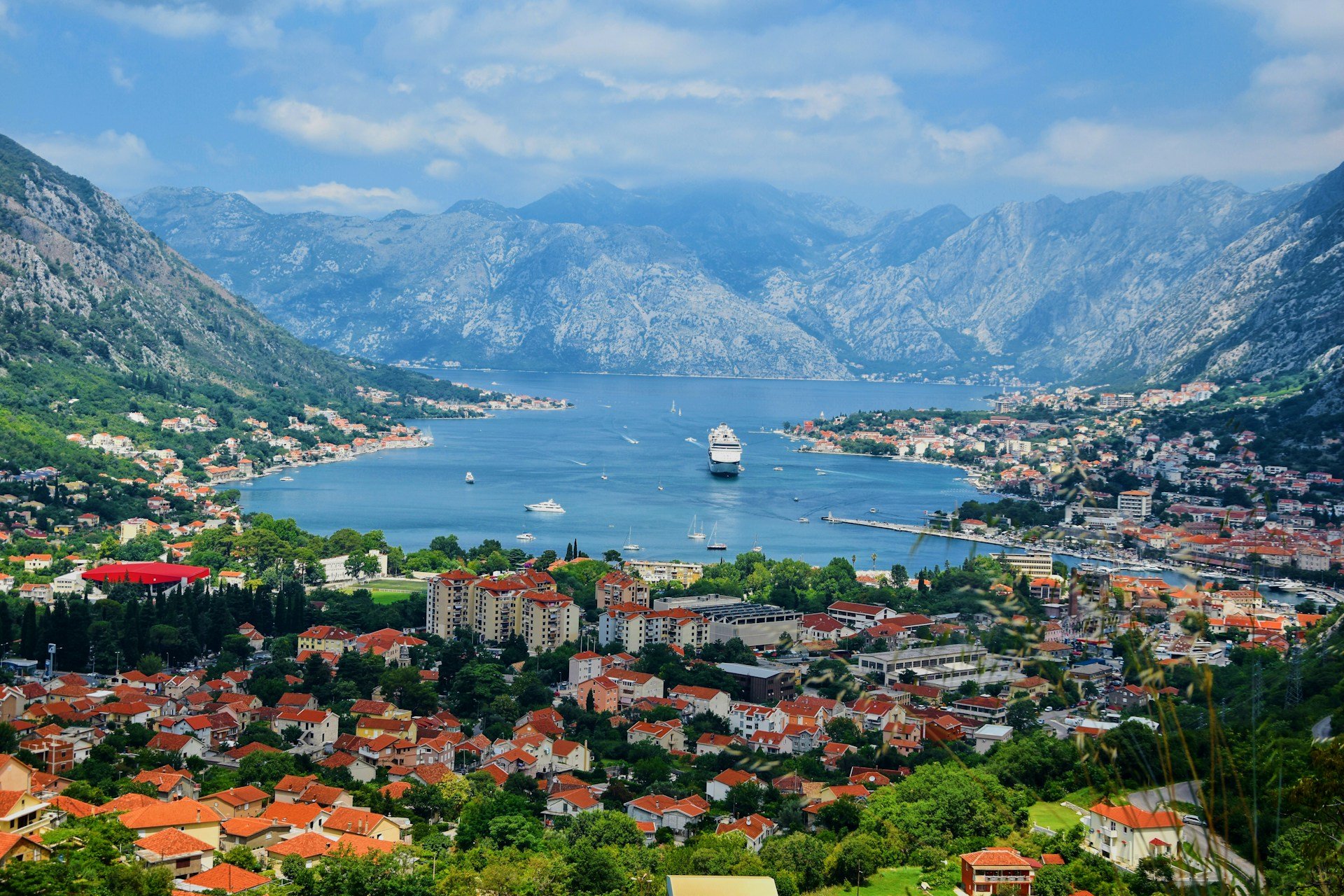
Montenegro
A medieval walled city inside Europe's southernmost fjord. Mountains so black and abrupt they gave the country its name. The deepest canyon in Europe. A lake full of monastery islands on the Albanian border. All of it in a country you can drive across in two hours, using the Euro without being in the EU, with some of the best value on the Adriatic and a wilderness the coastal tourism has barely touched.
What You're Actually Getting Into
Montenegro is 13,812 square kilometers with a population of 620,000 and a geography so varied it seems implausible. The Adriatic coast runs 293 kilometers. Immediately behind it, the Dinaric Alps rise to over 2,500 meters within 25 kilometers of the sea, which is why the drive from Kotor's medieval walls to the skiing at Zabljak takes under two hours and the view from the top involves snow above and the Adriatic behind. The name means Black Mountain — Crna Gora in Montenegrin, Montenegro in the Venetian Italian that gave the country its international name — a reference to the appearance of Mount Lovcen, the dark limestone peak that rises directly behind the coast.
The Bay of Kotor — Boka Kotorska — is the flagship attraction and deserves its reputation entirely. Technically not a glacial fjord (formed by river erosion and subsequent sea flooding) but looking exactly like one: a winding inlet cutting 28 kilometers inland between limestone mountains, with the medieval walled city of Kotor at its innermost point. UNESCO-listed since 1979, the Bay has 52 villages and a concentration of medieval churches, Venetian noble houses, and Orthodox monasteries that constitutes the most architecturally dense landscape on the Adriatic outside Dubrovnik. The difference from Dubrovnik: the Bay is larger, less crowded in the inner reaches, and the mountains rising immediately above every village make the scale genuinely dramatic.
The interior is the country's real secret. Durmitor National Park in the north — UNESCO biosphere reserve, home to the Tara Canyon (the deepest gorge in Europe at 1,300 meters, deeper than the Grand Canyon) and 18 glacial lakes — is one of the genuinely wild landscapes in the Balkans. The Bar to Belgrade railway crosses 254 bridges and passes through 254 tunnels. The village of Zabljak at 1,450 meters altitude is the highest town in the Balkans. Riding the train from Bar up through the mountains is an experience available to anyone with a €4 ticket.
Montenegro uses the Euro despite not being an EU member — adopted unilaterally in 2002. It is NOT in Schengen. Time here does not count against Schengen allowances. The country joined NATO in 2017 and is an EU accession candidate. It is not cheap by Balkans standards but considerably cheaper than Croatia's Dalmatian coast. A good guesthouse dinner costs €15–20. A room in a Bay B&B runs €50–80.
Montenegro at a Glance
A History Worth Knowing
Medieval Montenegro begins with the Doclean principality centered around the Zeta valley in the 9th century. The Nemanjic dynasty incorporated Zeta into its realm in the 12th century. Stefan Nemanja's son Rastko became Saint Sava — founder of the Serbian Orthodox Church — and the connection between Orthodoxy, national identity, and political survival defines Montenegro's subsequent history more than any other single thread.
The Ottoman expansion into the Balkans after the Battle of Kosovo Polje in 1389 reshaped the entire region. What makes Montenegro's history distinct is the sustained, successful resistance to Ottoman domination from the highland interior. While the coastal towns fell — Kotor to Venice in 1420, other towns to the Ottomans — the mountain tribes held. The Montenegrin highland culture, organized around clan structures, with blood feud as the primary social enforcement mechanism, developed partly in response to maintaining independence against a larger empire through guerrilla warfare from mountain terrain. This culture is the context for Njegos's epic poem "The Mountain Wreath" (Gorski vijenac, 1847) — considered the greatest work of South Slavic literature — which deals with the clash between Christian and Muslim identities in the Montenegrin highlands at the turn of the 18th century.
The Petrovic dynasty ruled Montenegro from approximately 1696 as prince-bishops simultaneously the spiritual and temporal rulers of the territory. The most significant was Petar II Petrovic-Njegos (1813-1851) — the author of The Mountain Wreath, a trained poet who corresponded with the major literary figures of his era. He is buried on the summit of Mount Lovcen in a mausoleum designed by sculptor Ivan Mestrovic, completed in 1974. The approach is through a tunnel entrance and then 461 steps cut into the mountain, emerging onto a platform where two stone caryatids hold the sarcophagus above the clouds. The Bay of Kotor is visible far below on clear days.
Montenegro achieved formal recognition as an independent state at the Congress of Berlin in 1878, making it one of the earliest Balkan states to gain international recognition alongside Serbia and Romania. Prince Nikola I declared himself King in 1910 and ruled until Montenegro was incorporated into the new Kingdom of Serbs, Croats, and Slovenes in 1918. WWII brought Italian and then German occupation of the coastal areas while the interior produced a complex civil conflict between Partisans and Chetniks, overlaying resistance to occupation with fratricidal war. The Tito-led Partisan victory incorporated Montenegro into Socialist Federal Yugoslavia.
Montenegro declared independence from the State Union of Serbia and Montenegro on June 3, 2006, following a referendum in which 55.5% voted for independence — just above the 55% threshold required by the EU. The country joined NATO in 2017 and is an EU accession candidate with formal negotiations ongoing. The Democratic Party of Socialists, which Milo Djukanovic led for 30 years, lost its parliamentary majority in 2020 for the first time since independence. Corruption and the rule of law remain the primary obstacles to EU accession.
Medieval Montenegro takes shape as Duklja/Zeta. The territory that will become Montenegro begins its distinct political existence.
The Bay of Kotor comes under Venetian control. 373 years of Venetian rule shape the coastal architecture permanently. The mountain interior continues to resist.
Prince-Bishop Petar II Petrovic-Njegos modernizes the state and writes The Mountain Wreath. The greatest work of South Slavic literature from a Montenegrin mountain village.
Congress of Berlin. Montenegro becomes one of the first Balkan nations to achieve international recognition as an independent state.
Montenegro incorporated into Yugoslavia. Complex WWII civil conflict and resistance. Tito's socialist development transforms the country's infrastructure.
June 3: 55.5% vote for independence — just above the required threshold. Montenegro becomes the world's newest internationally recognized state at the time.
Montenegro joins NATO. EU accession negotiations open. The country is formally oriented westward after centuries of contested sovereignty.
Top Destinations
Montenegro divides naturally into three zones: the Bay of Kotor and the coast (warm, Venetian, medieval, accessible), the interior highlands (wild, Orthodox, mountainous, requires a car), and the south coast (beaches, Budva's nightlife, more developed tourism). A complete Montenegro trip covers all three. A first visit in a week covers the Bay and adds a day at Durmitor or Lake Skadar.
Kotor
The best-preserved medieval city on the Adriatic outside Dubrovnik, and in some respects more interesting: less polished, less expensive outside peak season, and with the additional drama of fortification walls climbing the mountain behind the city to Castle San Giovanni 260 meters above sea level. The wall walk — 1,350 steps, approximately 90 minutes return — is steep and hot in summer but gives a view of the Bay available nowhere else. The Old Town inside the walls is compact (500m by 250m), packed with Romanesque and Baroque churches, and easily walkable in two hours at ground level. The Cathedral of Saint Tryphon (1166 CE) is the most important Romanesque monument on the eastern Adriatic. Kotor is UNESCO-listed. Allow two nights minimum to see it properly including the wall walk and a cruise-ship-free morning.
Durmitor National Park and Tara Canyon
Durmitor — a UNESCO World Heritage Site and biosphere reserve — is the Montenegro that exists in complete contrast to the coastal resort. The Tara Canyon cuts 1,300 meters into the limestone at its deepest point, making it the deepest gorge in Europe. The Tara River running through it has some of the cleanest water in Europe. Rafting the Tara, available from operators in Zabljak, is the best way to experience the canyon — one to three day trips available. Zabljak, the highest town in the Balkans at 1,450 meters, is the base for hiking in summer and skiing in winter. Crno Jezero (Black Lake) — twin glacial lakes in beech forest, a 30-minute walk from Zabljak — is the most accessible of the 18 Durmitor lakes and one of the most beautiful short walks in the country.
Lake Skadar National Park
Shared between Montenegro and Albania, Lake Skadar is the largest lake in the Balkans and one of Europe's most important bird sanctuaries — pelicans, pygmy cormorants, herons, and over 280 recorded species. Several island monasteries are accessible by boat from the Montenegrin shore: Kom (14th century), Beska (15th century), and Starcevo among them. The lake is at its best in spring (pelicans nesting, water levels high) and autumn. Rijeka Crnojevica and Virpazar on the lake's northern shore have boat tour operators. The Plantaze winery — one of the largest single-estate wineries in Europe at 2,300 hectares — is near the lake and produces Montenegro's best Vranac red wine.
Cetinje
The old royal capital, now a town of 13,000 on the plateau behind Mount Lovcen, is one of the most unexpectedly rich cultural destinations in the country. The National Museum occupies the former Royal Palace and additional buildings including the Billiards Palace — King Nikola's extraordinary collection of gifts from European monarchies. The Cetinje Monastery holds what is claimed to be the authentic Hand of Saint John the Baptist, brought to Montenegro via Malta by the Knights of Saint John. Cetinje is 40 minutes from Kotor over the Lovcen pass and is consistently overlooked by Bay visitors who don't realize what is on the other side of the mountain.
Perast and Our Lady of the Rocks
Perast is a single-street Baroque town of 350 people on the Bay's narrowest channel, with 16 church towers for its tiny population — a measure of the wealth that Venetian naval service generated for captains who retired here. Immediately offshore: Saint George island with a 12th-century Benedictine monastery, and Our Lady of the Rocks — a man-made island created since 1452 by the tradition of throwing stones into the water after the discovery of an icon. Each returning sailor added a stone and the island grew over centuries. Our Lady of the Rocks has a church, a museum of votive offerings, and embroidered ex-votos that constitute one of the more unusual pilgrimage traditions on the Adriatic. Reach Perast by bus from Kotor (30 minutes) or by kayak along the Bay shore.
Ostrog Monastery
Built into a vertical cliff face in the mountains above the Zeta valley — literally carved into the rock — Ostrog is the most visited pilgrimage site in the Western Balkans, drawing Orthodox Christians from across the former Yugoslavia. The monastery houses the relics of Saint Vasilije of Ostrog. On the feast days of Saint Vasilije (May 12 and June 29), tens of thousands of pilgrims arrive, some walking the final kilometers barefoot. Outside pilgrimage season, the physical situation — white walls against grey cliff, the mountain falling 900 meters to the valley floor below — is unlike anything else in the country. Dress modestly, visit respectfully: this is a genuinely active religious site, not an attraction.
Budva and the Beaches
Montenegro's most developed tourist town — a medieval walled old city surrounded by beach resort infrastructure developed primarily for the Russian and Ukrainian tourist market. The beaches (Mogren, Becici, and the famous Sveti Stefan island-resort) are genuinely good. Summer nightlife is intense. Budva is not the Montenegro that independent travelers typically prioritize, but the beaches in shoulder season (May, June, September) are excellent and the old city retains Venetian-era walls and churches despite the tourist pressure. Sveti Stefan island is connected by causeway but converted into a luxury resort inaccessible without a booking costing several hundred euros per night.
Bar–Belgrade Railway
Completed in 1976 after 25 years of construction through the most difficult terrain in Yugoslavia, the Bar-Belgrade railway passes through 254 tunnels and crosses 254 bridges, including the Mala Rijeka viaduct — 498 meters long, 198 meters above the valley floor, the highest railway viaduct in Europe at the time of its construction. The Montenegrin section from Bar through Podgorica and up through the mountains to the Serbian border gives the most dramatic railway views in the Western Balkans. Riding from Bar to Kolasin (2 hours, approximately €5) gives the essential experience. Riding the full Bar to Belgrade overnight train (10 hours) is a legitimate adventure journey.
Culture & Etiquette
Montenegro's culture divides meaningfully between the coastal strip — historically Venetian, Catholic, and urban — and the interior highlands, which are Orthodox, clan-based, and shaped by centuries of independence from outside authority. The contrast is real. The Baroque palaces of Kotor or Perast have more in common with Dubrovnik's culture than with the Orthodox mountain culture two hours inland.
The highland tradition of gostoprimstvo — hospitality to guests — is one of the most pronounced in the Balkans. An invitation to a Montenegrin home in the interior means coffee (always), rakija (always), and a meal that appears regardless of whether you said you were hungry. Refusing persistently is acceptable but requires several refusals. The first refusal is form; the second is genuine hesitation; the third is final. Montenegrins are typically direct, with a dry humor close to black at times.
The Orthodox monasteries — Ostrog, Cetinje Monastery, the island churches of Lake Skadar — are active religious sites requiring covered shoulders and knees for both men and women. Many provide wraps at the entrance but bringing your own is more reliable. This applies everywhere including the smaller, less-visited village churches throughout the country.
"Hvala" (HVAH-lah) is thank you. "Dobar dan" (DOH-bar dahn) is good day. Montenegro uses the same language as Serbian/Croatian/Bosnian under the Montenegrin name. The effort of basic greetings produces genuinely warm responses, particularly in the interior where international visitors are still rare enough to be notable.
The Tara River rafting operators in Zabljak book out in July and August weeks in advance. Book before you arrive. The best operators: Tara Tour and Outdoor Montenegro, both with established safety records and English-speaking guides. The full 2-day canyon option with overnight camp is significantly better than the 1-day version.
The Bay of Kotor road running around the inner bay is the standard tourist route by day. At night, with the village lights reflecting in the water and the mountains silhouetted above, it is one of the most beautiful drives in the Balkans and virtually empty of traffic after 10pm.
Tivat Airport has an established problem with unlicensed taxi drivers significantly overcharging tourists. The standard taxi from Tivat to Kotor is €15–18. Unofficial drivers have been known to charge €50–80. Use the official taxi rank or book a transfer in advance via GetTransfer. The airport is also served by public bus to Kotor for €2.
Budva's summer season — crowded, expensive, oriented toward mass tourism — is not what most of Montenegro looks like. The Bay, the mountains, and the lakes are the actual country. Leaving Budva's beach zone for even an afternoon reveals this immediately. The best Montenegrin food, landscape, and hospitality are away from the resort strip.
Montenegro's mountain roads are genuinely slow — hairpin bends, altitude changes, occasional road works. 60km in the interior can take 90 minutes. Kotor to Zabljak (150km) takes 2.5–3 hours in normal conditions. Don't plan the canyon and the coast in the same afternoon and expect to make both comfortably.
Montenegro's capital is frequently dismissed. It is not scenic. But the old Ottoman quarter (Stara Varos) has a clock tower and bazaar; the Millennium Bridge is architecturally interesting; and the bar and restaurant scene is where young Montenegrins actually socialize at prices well below the coast. Give it an evening if passing through.
Bay of Kotor by Kayak
Kayaking the Bay of Kotor is one of the best physical activities in the country. Operators in Kotor run guided full-day tours covering the inner bay, Perast, and Our Lady of the Rocks. The perspective from water level — mountain walls above, medieval church towers across the water, the bay surface calm in the morning — is different from any land view. The bay is calm enough for beginner paddlers in the inner sections. Afternoon winds can pick up in the outer bay.
Njegos and The Mountain Wreath
Petar II Petrovic-Njegos's "The Mountain Wreath" (Gorski vijenac, 1847) is the central text of Montenegrin and South Slavic literature. A verse drama dealing with the 18th-century confrontation between highland Christian and Islamicized Slavic communities, it is simultaneously a celebration of Montenegrin identity and a deeply troubling text about communal violence. English translations exist. Reading it before visiting Cetinje and Lovcen illuminates the highland culture in ways no guidebook can match.
Winter Montenegro
Montenegro's mountain resort of Zabljak operates from December through March with slopes suited to intermediate skiing at prices well below Alpine resorts. The combination of Adriatic coast (mild, 15°C in January) and mountain skiing within 2.5 hours drive is unusual in Europe. Kotor in January — empty walls, no cruise ships, misty bay mornings — is a specifically excellent experience that almost nobody takes advantage of.
Rakija Culture
Rakija — grape or plum brandy — runs through Balkan hospitality. In Montenegro it is typically grape-based (lozovaca) and home-produced. Accepting the first rakija offered is a social requirement; refusing is possible but awkward. The best home-produced rakija, aged in oak and properly distilled, is genuinely excellent. The ritual of the initial glass with a host is both a genuine courtesy and the most direct window into the hospitality culture.
Food & Drink
Montenegrin food divides between the coast (Adriatic fish, olive oil, vegetables, the Mediterranean-Italian tradition from the Venetian period) and the interior (lamb, veal, cheese, smoked meats, the Balkan grill tradition). The dairy from the highland areas is extraordinary: Njeguski prsut (smoked ham) and Njeguski sir (hard sheep's milk cheese) from the village above the Bay are the two most distinctive local products and appear on every restaurant menu in the country.
Njeguski Prsut and Sir
The village of Njegusi above the Bay of Kotor — birthplace of Njegos — produces a smoked ham and a hard cheese that are Montenegro's most distinctive food products. The prsut is air-dried and cold-smoked in the specific microclimate of the Lovcen mountains where cold mountain air meets warm Adriatic humidity, giving a flavor distinct from Dalmatian or Italian prosciutto. Both appear as appetizers in virtually every restaurant in the country. Buying them at the roadside stalls in Njegusi on the Lovcen pass road is the correct way to taste them at source.
Adriatic Fish
The coast tradition: grilled whole fish (brancino, orada — sea bass, gilthead bream) served with blitva (Swiss chard with olive oil and garlic), fresh local olive oil, and bread. The fish restaurants in Kotor's Bay villages — Ljuta, Dobrota, Prcanj — serve better and cheaper fish than the tourist restaurants inside the walls. Order one whole fish per person, blitva, bread, a carafe of local white wine. Total: €15–20 per person at a Bay village konoba versus €35–45 inside the walls.
Kacamak and Cicvara
The mountain food staples. Kacamak is a thick cornmeal porridge enriched with cheese and potato — the highland equivalent of polenta, heavier and more sustaining, served at mountain huts and kafanas in Durmitor. Cicvara is a richer version made with cream and sheep's milk cheese that has almost architectural density. Both are served at Zabljak restaurants and mountain huts and are the correct breakfast before a day hiking in Durmitor.
Lamb Under Sac
Jagnjetina ispod saca: lamb portions slow-cooked under a metal bell (sac) covered with embers for several hours, producing exceptionally tender, smoky, herb-scented meat. This is the most specifically Montenegrin meat preparation and appears in both coastal and highland restaurants. The preparation requires advance notice — many restaurants prepare it only when ordered ahead. The version at rural konobas in the Bay villages around Morinj or Risan is better than anything available in the touristy parts of Kotor.
Vranac Wine
Vranac is the indigenous dark red grape of Montenegro and the best argument for Montenegrin viticulture. Wine from the Crmnica district around Lake Skadar — particularly from Plantaze winery, which operates one of the largest single vineyards in Europe at 2,300 hectares — is bold, tannic, and deeply colored. A bottle of Plantaze Vranac costs €5–8 in a shop and €12–18 in a restaurant. Montenegro has almost no international wine distribution so drinking Vranac here is a specific geographical pleasure.
Burek and Pita
The Balkan pastry tradition: burek is filo pastry filled with meat and baked in round pans, cut in wedges; pita is the same pastry with spinach and cheese (zeljanica) or potato. Both bought by weight from bakeries for €1–2 per 100g and constitute the most affordable and typically available breakfast in the country. The best version is always fresh from the oven, eaten standing at the bakery counter. Every Montenegrin town of any size has at least one buregdzija open from 6am.
When to Go
May through September is the coastal season. June and September are the best months — warm sea, manageable crowds, long days, accommodation below peak prices. July and August are hot (35°C on the coast), intensely crowded at Budva and Kotor's old town, and more expensive. The interior highlands are excellent from May through October with peak hiking in July and August despite the coastal heat. Winter (December–March) is genuinely excellent for Kotor and for skiing at Zabljak.
Late Spring / Early Autumn
May–Jun, Sep–OctThe Bay of Kotor without the crush. Swimming from June. September sea temperature peaks at 25°C. Durmitor trails open. Bay village restaurants uncrowded. Lovcen and the mountain roads clear of snow. September is arguably the single best month — sea, mountains, and the vine harvest all at once.
Winter Coast
Dec–FebKotor in January: empty walls, no cruise ships, misty bay mornings, the cat population in possession of the old town. The most atmospheric version of the Bay of Kotor. Zabljak skiing running. Accommodation at lowest annual prices. Ostrog Monastery in winter snow against the grey cliff is extraordinary.
Summer Interior
Jul–AugPeak hiking season in Durmitor. Tara Canyon rafting at its most popular — book ahead. The interior is 10°C cooler than the coast. Avoid the coast in August for a focused highlands trip: Zabljak, Crno Jezero, the canyon, Lake Skadar in the cool morning mist.
Peak Summer Coast
Jul–AugKotor's old town in August: cruise ship passengers filling every alley, 35°C heat on stone pavement, accommodation 50–80% more expensive than May. Still justifies itself if you arrive before 9am and leave before 11am when ship passengers begin their excursions. Evening after 7pm is manageable. Midday is punishing.
Trip Planning
A car is the key planning decision for Montenegro. Without one, you can do Kotor and the Bay by bus and boat, and Budva by bus — but Durmitor, Lake Skadar, Cetinje, Ostrog, and the canyon require either a rental car or an organized tour. Renting from Tivat Airport and returning there gives maximum flexibility. Mountain roads are slow — plan no more than 150km per day in the interior.
Montenegro makes a natural centerpiece of a Western Balkans circuit: entry from Albania (Shkodra–Ulcinj, 1.5 hours), Bosnia (Sarajevo–Niksic, 3 hours), or Croatia (Dubrovnik–Kotor, 45 minutes). All three borders are functional and straightforward for EU and most Western passport holders.
Bay of Kotor
Fly to Tivat (bus to Kotor €2, 20 min). Day one: check cruise ship schedule, walk the Bay shore by kayak or on foot. Day two: Kotor wall walk before 8am — bring water, 1,350 steps, 90 minutes return, €8 entry. Old town after. Afternoon: bus to Perast and boat to Our Lady of the Rocks. Day three: drive the Lovcen switchback road (take the old 25-hairpin road up, the tunnel back down) to Cetinje — the National Museum, Billiards Palace, Cetinje Monastery. Return over Lovcen in the evening.
Durmitor and Tara Canyon
Drive from Kotor to Zabljak (2.5 hours via Niksic). Day four: Crno Jezero walk (1.5 hours round trip), Zabljak orientation, kacamak dinner at a mountain kafana. Day five: Tara Canyon — either rafting (book ahead, €50–70 for the day option) or drive to the Djurdjevica Tara Bridge for the canyon view (172m above the river, a 1940s concrete bridge now with a zipline). Return to Kotor via the Bar–Belgrade highway past Kolasin.
Lake Skadar and Departure
Day six: drive to Rijeka Crnojevica on Lake Skadar (1 hour from Kotor). Boat tour to the island monasteries — 2.5 hours, pre-book with local operators. Fresh lake fish (carp, bleak) lunch at the lakeside restaurant. Drive to Tivat or Podgorica for the airport. Day seven: departure or final evening walk in Kotor if flying next morning.
Bay of Kotor Slowly
Four days in and around the Bay: Kotor two nights (wall walk, old town, Bay village kayaking), Perast and Our Lady of the Rocks, Cetinje and Lovcen. Day four: the inner Bay road — Prcanj, Stoliv, Lepetane, and the car ferry across the narrowest point to the Lustica Peninsula. The peninsula's villages (Traste, Bigova) have almost no tourists and genuinely good waterfront seafood restaurants facing the outer bay.
Ostrog and Podgorica
Day five: drive to Ostrog Monastery (45 minutes from Podgorica) — the cliff monastery visit in the morning, then Podgorica for the night. Day six: Podgorica's Stara Varos (Ottoman quarter), the Millennium Bridge, the riverside walk. Alternatively drive directly to Virpazar on Lake Skadar for an evening on the lake shore with local Vranac wine.
Durmitor Three Days
Three days in the north from Zabljak base. Day seven: Crno Jezero and the Durmitor ring walk (12km, full day, multiple glacial lakes). Day eight: full-day Tara Canyon rafting — book the two-day option with camp overnight in the canyon for the best experience. Day nine: morning return to Zabljak, afternoon drive back south via the canyon road and Mojkovac.
Lake Skadar and South Coast
Day ten: Lake Skadar boat tour from Virpazar, Plantaze winery Vranac tasting near Podgorica. Days eleven to thirteen: Budva old town and beaches (Mogren, Sveti Stefan view from the public beach), Ulcinj in the south (significant Albanian-Muslim population, the long sandy Ada Bojana beach at the river delta). Stari Bar — the ruined medieval Ottoman city above modern Bar, largely unrestored, atmospheric, almost no tourists. Day fourteen: return to Tivat airport.
All of Montenegro
The full 14-day itinerary above. Add: Kolasin as a hiking and mountain base 70km north of Podgorica on the Bar–Belgrade railway. The Prokletije (Accursed Mountains) on the Albanian border accessed from Plav — the most remote hiking in Montenegro, with trails crossing into Kosovo and Albania. The Durmitor ring hike done as a two-day trail with mountain hut overnight for the full alpine experience.
Western Balkans Extension
From Montenegro into Bosnia via Niksic–Foca (3 hours). Foca for the Tara Canyon continuation on the Bosnian side. Sarajevo (4 hours from Foca) for 3 nights — the most historically layered city in the Balkans, where Ottoman, Austro-Hungarian, Yugoslav, and post-siege layers are all simultaneously visible. Return via Trebinje in Hercegovina (Adriatic-zone Bosnia, closer to Dubrovnik in character) back to Kotor. Alternatively head south into Albania from Ulcinj: Shkodra, the Albanian Riviera, and Gjirokastra in 5–7 days.
Car Rental
Rental at Tivat Airport (Europcar, Budget, Hertz and local operators) — budget €30–50/day. Check insurance covers mountain roads. No toll roads in Montenegro. The mountain passes require confidence on hairpin bends but not special equipment in summer. Check if the contract permits Albania or Kosovo crossings if planning a regional circuit.
Monastery Dress
Cover shoulders and knees at all Orthodox monasteries: Ostrog, Cetinje Monastery, the Lake Skadar island monasteries. Many provide wraps at the entrance but supply is not guaranteed. A lightweight scarf in your daypack solves this permanently for the whole trip across Montenegro and the entire Balkans circuit.
Vaccinations
No mandatory vaccinations for Montenegro. Routine vaccines recommended. Tick-borne encephalitis risk in forested mountain areas April–October — use repellent for Durmitor hiking. Hepatitis A advisable. Water in Kotor and Budva is safe to drink. Spring and mountain water in rural areas should be treated or boiled.
Full vaccine info →Connectivity
EU roaming does NOT apply — Montenegro is not in the EU. Buy a local SIM at Tivat or Podgorica airport (Telekom Montenegro, T-Mobile, or m:tel) for €5–10 with data. Alternatively use Airalo for an eSIM before departure. Coverage good on the coast and in towns; variable in Durmitor; poor in the canyon itself.
Get Montenegro eSIM →Tara Canyon Rafting
Book in advance for July and August — best operators (Tara Tour, Outdoor Montenegro) fill weeks ahead. The 1-day option (€50–70) covers the most dramatic section. The 2-day option with canyon camp overnight (€120–150) is the better experience. Safety equipment and English-speaking guides included. No prior rafting experience required.
Cruise Ship Schedule
Check cruisetimetables.com before planning Kotor days. Ships arrive around 8am, depart around 5pm. Kotor on a ship day is manageable before 9am and after 5pm; genuinely challenging 10am–4pm. Ship-free days give a completely different experience of the city. There are typically 3–5 ship-free days per week in peak season.
Transport in Montenegro
Montenegro's public transport covers the main towns but not the destinations that make the country worth visiting. The Bay of Kotor is served by frequent buses along the coast road. Podgorica connects by bus to Kotor, Budva, and Bar, and by train to Serbia. Everything else — Durmitor, Ostrog, Lake Skadar villages, Cetinje, and the canyon — requires a car or organized tour.
Intercity Bus
€3–15The main public transport network. Kotor to Budva: €4, 45 minutes, hourly. Kotor to Podgorica: €7, 2 hours, several daily. Podgorica to Zabljak: €8, 3 hours, 2–3 daily. Buy tickets at the bus station (autobusna stanica) or from the driver. The Bay of Kotor local buses run the coastal road and stop at all villages — useful for day trips from Kotor to Perast, Dobrota, and Risan.
Train (Bar–Belgrade)
€4–25Bar to Podgorica: €4, 1 hour. Bar to Kolasin: €5, 2 hours — the most dramatic mountain section. Bar to Belgrade overnight: €25, 10 hours. The railway is slow but the views through the mountains are extraordinary, including the Mala Rijeka viaduct at 198m height. Buy tickets at the station or at zpcg.me.
Car Rental
€30–55/dayAvailable at Tivat and Podgorica airports (Europcar, Budget, Hertz, and local operators). Essential for Durmitor, Ostrog, Lake Skadar villages, and the canyon. Mountain roads require confidence but not 4WD in summer. Some operators charge extra for Albania and Kosovo border crossings — check before signing. Return fuel full.
Bay of Kotor Boat
€2–10The car ferry at Lepetane–Kamenari crosses the narrowest point of the Bay in 5 minutes (€5 per car, passengers free). Water taxis operate between Bay villages from Kotor harbour throughout the day in summer. Boat tours of the inner Bay run from Kotor and Perast. Kayak rental in Kotor from €10/hour for self-guided Bay exploration.
Taxi and Bolt
€0.80/kmBolt app works in Podgorica and increasingly in Kotor and Budva. Hailed taxis from Tivat Airport should use meters — the official rate to Kotor is €15–18. Unlicensed drivers have charged €50–80 in documented cases. Use Bolt or the official taxi rank at the airport. Never pay more than €20 for the Tivat–Kotor journey.
Airports
Tivat and PodgoricaTivat Airport (TIV) is 6km from Kotor — the correct arrival point for Bay of Kotor visits. Public bus to Kotor: €2, 20 minutes. Podgorica Airport (TGD) serves the capital and has more year-round connections. Budget airlines (Ryanair, Wizz Air, easyJet) serve both airports. Summer charters significantly expand the options.
Border Buses
€5–20Regular buses: Kotor to Dubrovnik (€15, 2 hours via Herceg Novi), Podgorica to Sarajevo (€20, 5 hours), Podgorica to Tirana (€15, 4 hours), Podgorica to Shkodra (€8, 1.5 hours). These buses cross the borders with full formalities — show passport, wait, continue. Generally smooth for EU and Western passport holders.
Cycling and E-Bikes
€15–35/dayE-bike rental in Kotor is increasingly available and makes the Bay villages accessible under power. The Bay of Kotor has a developing cycle path but the main coastal road can be busy. The interior highland roads are for experienced mountain bikers only — gradients and road surfaces require serious fitness and appropriate equipment.
Flying to Tivat: public bus from the airport to Kotor costs €2 and takes 20 minutes. From Dubrovnik: bus via Herceg Novi (€15, 2 hours, several daily). From Podgorica: bus to Kotor (€7, 2 hours). Once in Kotor, the Bay villages are accessible by local bus (€1–3) every 30–60 minutes along the coastal road. Perast is 30 minutes by bus north. For Cetinje: bus from Kotor (€4, 40 minutes via the mountain road). For Durmitor, Ostrog, and Lake Skadar: organized day trips from Kotor are the realistic option, available from tour operators at the Old Town entrance for €35–70.
Accommodation in Montenegro
Kotor's old city has guesthouses and apartments in converted Baroque buildings — atmospheric and expensive in peak season. The Bay villages (Dobrota, Ljuta, Prcanj) have B&Bs and family guesthouses at significantly lower prices with better access to local restaurants. For Durmitor, hotels in Zabljak are modest but functional. Lake Skadar's accommodation is mostly small guesthouses in Virpazar or Rijeka Crnojevica.
Kotor Old Town
€60–180/nightApartments and guesthouses in medieval Baroque buildings inside the walls — the most atmospheric sleep on the Montenegrin coast. The cats of Kotor (legendary, semi-feral, thousands of them) patrol the streets at night. Old Town apartments are tight on space, sometimes noisy from summer bar noise, and definitively characterful. Old Town House and Palazzo Drusko are reliable options. Book well ahead for July and August.
Bay Village B&B
€40–80/nightThe Bay villages north of Kotor (Dobrota, Prcanj, Ljuta) have family guesthouses directly on or near the Bay shore — half the price of the Old Town, 10 minutes drive from Kotor's walls. These are the rooms where the Bay view at breakfast over the water is included, the owner's family produces the olive oil and wine, and the konoba down the road costs half the tourist restaurant price.
Zabljak Mountain Hotels
€30–60/nightZabljak's accommodation ranges from basic mountain pensions to the slightly more polished Hotel Durmitor. Prices are significantly lower than the coast. For the canyon experience, guesthouses in Scepan Polje at the canyon entrance offer overnight access to the river. In winter the ski accommodation fills — book December through March ahead of time.
Hostel
€15–25/nightKotor's hostel scene has grown since 2015 — Old Town Hostel Kotor and Hostel Marija in the old city are the main options. Budva has several party-oriented hostels. The Balkans hostel circuit reaches Montenegro adequately for backpackers doing the regional route from Dubrovnik through Kotor to Albania.
Budget Planning
Montenegro is mid-range by Balkans standards — more expensive than Albania, comparable to mid-range Croatia. The Bay of Kotor tourist trap prices are a separate tier from the local economy. Eating in Bay villages, staying outside the old town walls, and buying wine at the winery shop saves 40–60% against the tourist track.
- Hostel dorm or Bay village B&B
- Burek breakfast from a bakery
- Konoba lunch outside the walls (€10–15)
- Bay village fish dinner (€15–20)
- Bus transport or shared rental car
- Bay village guesthouse or Kotor B&B
- Restaurant meals in Bay villages
- Tara Canyon day rafting (€50–70)
- Car rental split between two people
- Vranac wine with dinner
- Kotor Old Town apartment or boutique hotel
- Tara Canyon 2-day rafting with canyon camp
- Bay kayaking guided full day tour
- Lamb under sac at a heritage konoba
- Lovcen Mausoleum and Lake Skadar boat tour
Quick Reference Prices
Visa & Entry
Montenegro is NOT Schengen and NOT an EU member. It operates its own independent visa system. The critical consequence for travelers: time spent in Montenegro does NOT count against your Schengen 90-day allowance. You can use your full Schengen allowance in Croatia, Slovenia, and other Schengen countries and then enter Montenegro without any Schengen clock running.
Citizens of the EU, US, UK, Canada, Australia, New Zealand, and most Western nations can enter Montenegro visa-free for 90 days. ETIAS does NOT apply — it is a Schengen system and Montenegro is not in Schengen. Check the current visa-free list at mfa.gov.me for your specific nationality.
Montenegro has its own generous visa-free system. EU, US, UK, Canadian, Australian, and New Zealand citizens enter visa-free for 90 days. NO ETIAS required. Time in Montenegro does NOT count against Schengen allowances.
Family Travel & Pets
Montenegro is an excellent family destination for families with older children who can handle some physical engagement — the wall walk in Kotor (1,350 steps), the canyon views, the boat tours. The Bay is gentle enough for young children on beach days. Families with teenagers will find the Tara Canyon rafting, the Durmitor hiking, and the Lovcen drive consistently engaging. Food is child-accessible and prices for family meals at village konobas are reasonable.
Kotor Wall Walk
1,350 steps to the top of the medieval fortification — accessible for children over 8 with reasonable fitness, genuinely impressive for teenagers. Go before 8am in summer. The view at the top earns every step. Children who complete it remember it. Water essential; the descent is harder than the ascent on the knees. The cats of Kotor in the old town below provide good entertainment for young children while adults rest.
Bay Kayaking
Half-day guided kayak tours of the inner Bay are appropriate for children from about 10 upward. The distance (8–12km typically) is manageable and the pace is set by the guide. The waterside perspective on the medieval villages and the mountains rising above the water is the best view of the Bay available. Rental without guide for families with kayaking experience from €10/hour in Kotor.
Tara Canyon for Older Children
The Tara Canyon rafting is appropriate from age 14 upward (16 for some operators on more challenging sections). The day option (class 3 rapids) is suitable for teenagers with basic fitness. The combination of canyon depth, river clarity, and the scale of the gorge walls (1,300 meters) produces a genuinely memorable experience. The 2-day option with canyon camp overnight is the best version.
Lake Skadar Boat Tour
The Lake Skadar monastery island boat tour works for families of any age — pelicans visible at close range in spring, island monastery landings, and flat-water boat journey. The lake's wildlife (280+ bird species) provides natural engagement that children find more accessible than historical sites alone. The lake carp and bleak fish at a lakeside restaurant make an unusual family lunch.
Beaches
The Bay of Kotor's beaches are small pebble beaches with calm water suitable for younger children. The south coast beaches at Budva (Mogren, Becici) are sandy and well-equipped. Ada Bojana near Ulcinj — a river island beach — is one of the finest family beach environments in Montenegro: wide, sandy, calm, and considerably less crowded than Budva in peak season.
The Cats of Kotor
Kotor has a semi-feral cat population of thousands, historically protected as companions to the medieval maritime community. The cats are everywhere in the old town — sleeping in doorways, on cafe chairs, in the churches. The Cats of Kotor museum on Trg od Mljeka square documents their history and funds the sterilization program. Children find Kotor's cats universally engaging, making the old town easier to explore with young children in tow.
Traveling with Pets
Montenegro is not in the EU but follows EU-standard pet travel documentation in practice. Dogs and cats from EU countries need a microchip, valid rabies vaccination, and an EU pet passport. Pets from non-EU countries (including post-Brexit UK) need a third-country health certificate issued by an official veterinarian within 10 days of travel. Check current requirements at Montenegro's Veterinary Directorate before traveling.
Pet-friendliness is moderate. Dogs are welcome at outdoor restaurant terraces in most cases. Bay of Kotor villages are more dog-welcoming than the busy tourist areas of Kotor's old city. Most guesthouses and B&Bs accept dogs with advance notice. Beach access for dogs varies — most organized beaches in Budva do not allow dogs in summer. Bear and wolf territory in Durmitor means dogs should be kept on leads on remote trails — a loose dog encountering a bear in the Tara Canyon forest is a genuine concern for both parties.
Safety in Montenegro
Montenegro is generally safe for tourists. The main practical concerns are pickpocketing in Kotor's Old Town and Budva in peak summer, taxi overcharging at Tivat Airport, road safety on mountain roads, and occasional organized crime activity in Budva's nightlife. The mountains and rural areas are safe and the hospitality is genuine.
General Safety
Montenegro is generally safe for tourists visiting the Bay, the mountains, and the lakes. Violent crime against visitors is rare. The rural areas and mountain communities are hospitable and safe. Normal urban awareness applies in Kotor's crowded old town and Budva's peak-season bars.
Solo Women
Montenegro is reasonably safe for solo female travelers. The Bay of Kotor and coastal towns are the most comfortable environments. The interior highlands have a traditional and conservative social character but genuine hospitality. Late-night Budva requires the same awareness as any Mediterranean resort nightlife area. Kotor's old town after midnight on peak summer weekends can be boisterous.
Tivat Airport Taxis
Unlicensed taxi drivers at Tivat Airport charging €50–80 for the Kotor journey (official rate €15–18) is a documented and persistent problem. Use Bolt, the official taxi rank, or a pre-booked transfer via GetTransfer. Never agree a price above €20 for Tivat to Kotor.
Mountain Road Safety
Montenegro has a higher road accident rate than the EU average, particularly on mountain roads. Drive slowly on hairpin bends, keep left (you are driving on the right but mountain roads have oncoming traffic on blind corners), avoid overtaking on switchbacks, and don't drive mountain roads after dark if you're unfamiliar with them. The Lovcen and Durmitor roads require full attention.
Budva Nightlife
Budva's peak-season nightlife — concentrated around the beach clubs and bars of the modern resort strip — has been associated with occasional organized crime incidents (shootings at specific venues) that very rarely directly affect tourists. Normal awareness and avoiding the flashpoint venues (local knowledge from hostel staff is reliable) is the practical approach. The old town area is genuinely safer than the resort strip.
Healthcare
Montenegro's public healthcare system is basic. The Clinical Center of Montenegro in Podgorica is the main hospital. Kotor has a local health center for minor issues. Travel insurance with medical evacuation is strongly recommended — serious conditions may require evacuation to Croatia or Serbia. Private clinics in Podgorica, Kotor, and Budva have some English-speaking staff.
Emergency Information
Your Embassy in Montenegro
Most embassies are in Podgorica. Some countries handle Montenegro through their Belgrade or Sarajevo missions.
Book Your Montenegro Trip
Everything in one place. These are services worth actually using.
The Black Mountain Remains
Every country in this series persists through something. Lithuania through memory. Luxembourg through competence. Malta through density of history. Monaco through the specific alchemy of one story told consistently for 727 years. Montenegro persists through a characteristic that the name itself encodes: the mountains are genuinely dark, genuinely steep, and genuinely there. Crna Gora. The black mountain. The Venetians named it that because they could see it from the sea and it looked exactly like the thing it was.
The country held its interior against Ottoman expansion for centuries using the specific advantages of that terrain — small groups of fighters who knew every cave and switchback, moving faster than any organized army in terrain that made organized armies useless. Njegos wrote the defining epic of this culture and is buried on the summit of the mountain that gave the country its name. The mausoleum sits above the clouds with the Adriatic visible below and the walls of Kotor visible if the day is clear. 461 steps, a tunnel through the rock, and then open sky and the stone caryatids holding the sarcophagus above everything.
Down in Kotor, the cats own the streets in the quiet hour before the cruise ships arrive. The cathedral from 1166 is lit gold by the morning sun. The Bay turns silver in early light. The mountains above are still black. In Montenegrin, Crna Gora — the specific combination of land and light and naming that was accurate when the Venetians first wrote it down and is accurate still.