
Lithuania
Once the largest country in Europe. A Baroque capital with a self-declared republic inside it. Sand dunes that migrate across a UNESCO peninsula. A hill covered in over 100,000 crosses planted in defiance of an occupation that is gone but not forgotten. Lithuania knows exactly who it is.
What You're Actually Getting Into
Lithuania is the largest and southernmost of the three Baltic states, a country of 2.8 million people that was, at its 15th-century peak under the Grand Duchy of Lithuania, the largest state in Europe — stretching from the Baltic Sea to the Black Sea, encompassing what is now Lithuania, Latvia, Belarus, Ukraine, and large parts of Poland and Russia. Lithuanians know this and it matters to them in the specific way that historical greatness matters to countries that have spent subsequent centuries being occupied by others. The Grand Duchy is not nostalgia. It is evidence of a political sophistication and territorial ambition that defines national character long after the territory itself is gone.
Vilnius is the destination that most people arrive for, and it earns the attention. The old city is the largest surviving Baroque urban complex in Northern Europe — UNESCO-listed, built across the confluence of the Neris and Vilnia rivers, packed with churches (Vilnius has more churches per capita than almost any other European city), and containing, in its Užupis quarter, a neighborhood that declared itself an independent republic in 1997 and has maintained the fiction with such committed seriousness that it has become something more interesting than fiction. The constitution of the Republic of Užupis — on plaques in multiple languages along Paupio gatvė — includes the right to be happy, the right to be a dog, and the right to make mistakes. It was written by an artist and adopted by a community. The border is staffed by "soldiers" in fancy dress. The ambassador has diplomatic credentials that some countries have actually accepted.
Beyond Vilnius the country diversifies rapidly. Kaunas, the interwar capital, has an art deco city center and a Ninth Fort that holds Lithuania's most direct and devastating engagement with Holocaust history. The Curonian Spit — a 98km sand peninsula between the Curonian Lagoon and the Baltic Sea, shared with Russia's Kaliningrad — has dune landscapes unlike anything else in the Baltic region, pine forests, fishing villages with deep-blue painted boats, and the migrating sand mountains that Thomas Mann wrote about when he built a summer cottage there in 1930. The Hill of Crosses near Šiauliai is the most singular place in Lithuania: a hillside covered in over 100,000 crosses of every size and material, planted continuously since the 19th century, bulldozed repeatedly by Soviet authorities and replanted each time with more crosses than before, now a UNESCO Intangible Cultural Heritage and one of the most moving places in Northern Europe.
Lithuania joined NATO and the EU in 2004 with the full conviction of a country that had spent half a century under forced occupation and had no intention of repeating the experience. Russia's 2022 invasion of Ukraine is felt here with the same personal clarity as in Latvia and Estonia — perhaps more acutely in some respects, since Lithuania shares a border with Russia's Kaliningrad exclave and with Belarus, whose government supports the Russian invasion. The Suwalki Gap — the narrow corridor of NATO territory between Kaliningrad and Belarus — is one of the most discussed strategic vulnerabilities in European security planning. Lithuanians are aware of this and are not casual about it.
Lithuania at a Glance
A History Worth Knowing
Lithuanian tribes are among the oldest continuously documented peoples in Europe. The Baltic languages — Lithuanian and Latvian — are the most archaic surviving branch of the Indo-European family, retaining grammatical features and vocabulary that Latin and Sanskrit preserve but that most modern European languages have shed. Lithuanian linguists sometimes demonstrate this by showing that the Lithuanian word for "smoke" — dūmas — corresponds directly to ancient Sanskrit dhūma and Greek thumos, a line of descent that reveals something about how long Baltic cultures have been in place and how slowly they evolved in a relative geographic isolation.
The Grand Duchy of Lithuania emerged in the early 13th century, coalescing from tribal territories under Mindaugas, who was crowned Lithuania's only king in 1253. His assassination in 1263 ended the kingship experiment, but the duchy continued its expansion under subsequent rulers. By the late 14th century under Grand Duke Vytautas the Great, the Grand Duchy stretched from the Baltic to the Black Sea — an entity of roughly 900,000 square kilometers that was the largest state in Europe and governed a population that was majority Slavic (Belarusian and Ukrainian-speaking) despite its Lithuanian ruling class. Vilnius was established as the capital in 1323 by Grand Duke Gediminas, who reportedly chose the site after dreaming of an iron wolf howling at the confluence of two rivers — the founding legend is still told and the iron wolf statue still stands in the city.
The 1386 Union of Krewo allied Lithuania with Poland through the marriage of Grand Duke Jogaila to the Polish Queen Jadwiga and the consequent Christianization of Lithuania — the last European country to convert, at a state level, to Christianity. The subsequent Polish-Lithuanian Commonwealth, formalized by the Union of Lublin in 1569, was one of Europe's most sophisticated multi-ethnic political experiments: a parliamentary state with elected kings, a large noble class with extensive rights, and a religiously tolerant tradition that attracted Jewish communities from across Europe. By the 17th century, Lithuania's Jewish community — concentrated in Vilnius, which became known as the "Jerusalem of Lithuania" for its density of Jewish scholarship and population — was among the most intellectually productive in the world. The Vilna Gaon, Rabbi Elijah ben Solomon Zalman, born in Šėta in 1720 and based in Vilnius for most of his life, is considered one of the greatest rabbinical authorities in Jewish history.
The partitions of Poland at the end of the 18th century (1772, 1793, 1795) ended the Commonwealth and delivered Lithuania to Russian imperial control. For the next 123 years, the Lithuanian language was periodically banned in print — from 1864 to 1904, Lithuanian books printed in Latin script were prohibited, a suppression that produced the "book smugglers" (knygnešiai) who carried printed Lithuanian-language texts across the Prussian border at personal risk. The national awakening of the 19th century — the recovery and publication of folk songs (dainos), the emergence of Lithuanian-language literature, the organization of the first national cultural events — happened partly underground and partly in exile, producing a national consciousness that was defined by linguistic survival as much as anything else.
Independent Lithuania was declared on February 16, 1918 — a date that remains the most important in the national calendar. The interwar republic (1918–1940) was a parliamentary democracy that transitioned to an authoritarian nationalist government under Antanas Smetona in 1926, but one that invested significantly in Lithuanian cultural institutions: the state theater, the university, the national museum, the Lithuanian language dictionaries and grammars that formalized the language for a modern state. Kaunas was the temporary capital during this period, since Vilnius was occupied by Poland after a 1920 military takeover.
The Soviet occupation of 1940 and the Nazi German occupation of 1941–1944 brought a sequence of catastrophes. The Lithuanian Jewish community — approximately 250,000 people, a third of the pre-war population of some cities — was almost entirely murdered in 1941, primarily in the forests of Paneriai (Ponary) outside Vilnius and at the Ninth Fort near Kaunas. The speed and completeness of the Lithuanian Holocaust was among the worst in Europe: by the end of 1941, over 95% of Lithuanian Jews were dead. Lithuanian collaboration in these killings — both by the German Einsatzgruppen's Lithuanian auxiliaries and by individual Lithuanians acting independently — is a historical reality that the country has addressed with varying degrees of directness at different periods. The Paneriai Memorial and the Ninth Fort are the primary sites where this history can be confronted.
The Soviet reoccupation from 1944 brought mass deportations to Siberia — particularly the deportation of June 1949, which removed around 29,000 people in a single operation targeting farmers who resisted collectivization — and the sustained suppression of Lithuanian language and culture. The armed resistance known as the Forest Brothers continued guerrilla operations against Soviet forces until the early 1950s. The last Forest Brother, Stasys Guiga, died in 2008.
Lithuania was the first Soviet republic to declare independence from the USSR, on March 11, 1990. The Soviet response — economic blockade and the January 1991 crackdown in which Soviet troops killed 14 unarmed civilians at the Vilnius TV Tower — failed to reverse the declaration. On August 19, 1991, during the Moscow coup attempt against Gorbachev, Lithuania's independence was internationally recognized. The Lithuanian flag is flown from the TV Tower in memory of those killed defending it, and the tower is now both a working transmission facility and a museum.
Lithuania joined NATO and the EU in 2004. The country hosts NATO's Enhanced Forward Presence battlegroup and has been one of the strongest advocates for Ukrainian sovereignty since Russia's 2014 annexation of Crimea and accelerated that position dramatically after the 2022 full-scale invasion. Lithuania was the first country in the world to cut off Russian gas imports after February 2022. The Suwalki Gap — the 104km NATO land corridor between Russian-controlled Kaliningrad and Belarus — is a strategic reality that shapes Lithuanian security policy every day.
Mindaugas crowned Lithuania's first and only king. The Grand Duchy begins its expansion.
Grand Duke Gediminas establishes Vilnius as capital after his iron wolf dream. The city's founding legend is still told.
Under Vytautas the Great, Lithuania stretches from the Baltic to the Black Sea — the largest state in Europe.
Union of Lublin creates one of Europe's most sophisticated parliamentary states. Religious tolerance attracts Jewish communities.
Third Partition of Poland ends the Commonwealth. Lithuania under Russian rule for 123 years. Language suppression from 1864.
February 16: the Act of Independence of Lithuania. The most important date in the national calendar.
250,000 Lithuanian Jews murdered — over 95% of the community — by the end of 1941. Paneriai forest and Ninth Fort. One of the fastest and most complete in Europe.
Mass deportations. Forest Brothers resistance. 46 years of Soviet rule.
March 11: Lithuania leads the Baltic independence movement. January 1991 Soviet crackdown kills 14 at the TV Tower. International recognition in August 1991.
Lithuania joins both organizations. The security anchor sought since 1990 is achieved.
Top Destinations
Lithuania organizes naturally around Vilnius in the southeast, Kaunas in the center, and the coast in the west — Klaipėda as the port city and gateway to the Curonian Spit, Palanga as the main beach resort. The Hill of Crosses near Šiauliai sits in the north. A car makes the country most accessible; trains and buses connect the main cities adequately.
Vilnius
Vilnius is one of the great underestimated cities of Europe. The Old Town — 3.6 square kilometers of largely intact Baroque architecture, the largest such complex in Northern Europe — was listed by UNESCO in 1994 and has been gradually restored since independence without losing its lived-in, slightly shabby quality that makes it more interesting than a museum piece. Gediminas Tower on the castle hill gives the best view over the city and the river confluence. The Gates of Dawn at the southern entrance to the Old Town has a venerated icon of the Virgin Mary in a chapel above the gate. The Church of St. Anne in the Gothic style (Napoleon reportedly said he would carry it back to Paris on the palm of his hand) sits beside the red-brick Church of St. Francis, creating a church composition that defines the Vilnius skyline. Allow three full days — preferably four.
Curonian Spit (Kuršių Nerija)
The Curonian Spit is one of the genuinely extraordinary landscapes in Europe: a 98km sand peninsula, nowhere more than 4km wide, separating the Curonian Lagoon from the Baltic Sea. The Lithuanian portion (52km) is a national park containing the Parnidis Dune — a massive moving sand mountain above the village of Nida with a sundial at its peak — pine forests planted in the 19th century to slow the dunes' movement, fishing villages with distinctive dark-blue painted wooden boats, and the weatherboard-cottage summer colony where Thomas Mann stayed in 1930. The Mann cottage in Nida is now a museum. Take the ferry from Klaipėda (20 minutes) to Smiltynė and cycle south — the cycling path runs the full Lithuanian length of the spit. Allow two nights in Nida minimum.
Kaunas
Kaunas served as Lithuania's temporary capital from 1920 to 1940 (when Vilnius was occupied by Poland) and the interwar period produced an architectural coherence in its city center — art deco, modernist, and national romantic styles — that is distinct from anywhere else in the Baltic states. The Old Town has a medieval castle and a pedestrianized main street (Laisvės alėja, Freedom Avenue — 1.6km and lined with cafés) that is the social spine of the city. The Ninth Fort on the city's outskirts is the most important Holocaust memorial in Lithuania, where approximately 50,000 people were killed. Kaunas is currently one of the most creative cities in the Baltic states, with a gallery and arts scene that competes with Vilnius at a fraction of the tourist pressure.
Hill of Crosses (Kryžių Kalnas)
Twelve kilometers north of Šiauliai, this low hill is covered in over 100,000 crosses — wooden, metal, carved, painted, minuscule and enormous — planted continuously since the 19th century. The Soviet authorities bulldozed the site in 1961, 1973, and 1975. Each time, Lithuanians returned at night and planted more crosses than had been removed. Pope John Paul II visited in 1993 and left a cross. The site now has UNESCO Intangible Cultural Heritage status. It is simultaneously a religious pilgrimage, a national monument, and a statement about the ineffectiveness of suppression. Standing in it is an experience that doesn't reduce to description. The bus from Šiauliai runs several times daily.
Trakai
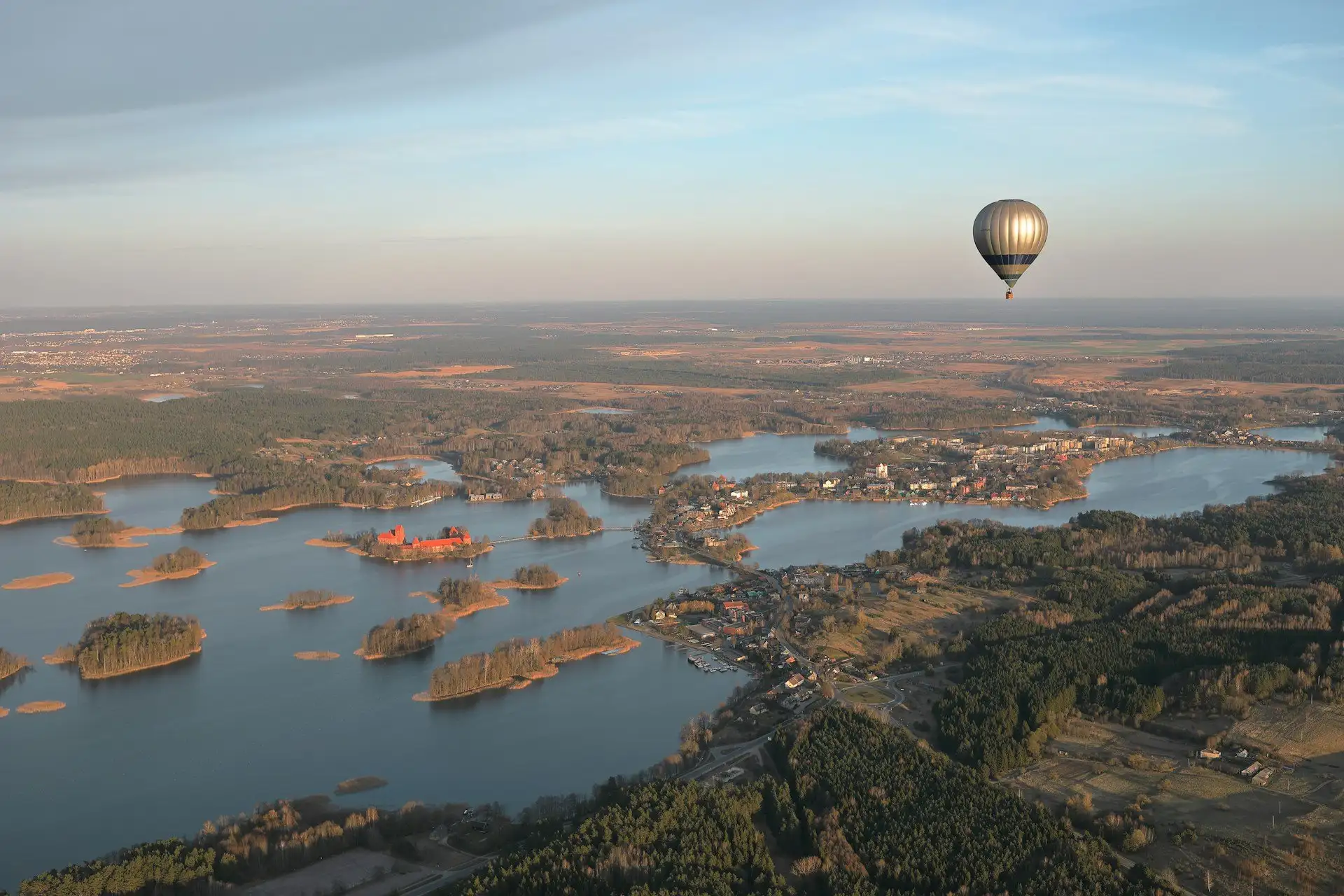
Twenty-eight kilometers from Vilnius, the medieval capital of the Grand Duchy of Lithuania sits on an island in a lake, connected by wooden bridges, in one of the most photographed castle-in-water configurations in the Baltic states. The Trakai Island Castle was built in the 14th century by Grand Duke Vytautas and has been repeatedly rebuilt after various destructions — the current version is a mid-20th century reconstruction that is historically accurate in form if not in materials. The town of Trakai has a Karaite community (a small Turkic-speaking Jewish sect brought from Crimea by Vytautas in the late 14th century) that still maintains its language, food traditions, and prayer house. Their filled pastry — kibinai — is the correct Trakai lunch.
Klaipėda & the Coast
Lithuania's only port and third largest city, Klaipėda is the gateway to the Curonian Spit ferry. The old town (formerly Memel, a German city until 1923 when it was annexed by Lithuania) has half-timbered buildings and a different architectural character from inland Lithuanian towns. Palanga, 30km north, is the main beach resort — long, pine-backed sand beaches that fill with the entire Lithuanian summer population in July. The Palanga Amber Museum in a 19th-century manor house has the most comprehensive amber collection in the world, including a piece with a 49-million-year-old lizard preserved inside it.
Užupis
Worth its own entry beyond the Vilnius section. Užupis (literally "beyond the river" — it sits across the Vilnia from the main Old Town) declared itself an independent republic on April 1, 1997. It has a constitution in 41 languages on plaques along Paupio gatvė, a president (artist Romas Lileikis), a flag, an anthem, and an army of 12 volunteers who perform border ceremonies on Republic Day. The neighborhood is genuinely artistic — galleries, studios, the Angel of Užupis statue on a column in the central square — and genuinely lived-in by artists, writers, and people who find the concept appealing. The river and the church create a specific enclosed atmosphere unlike the rest of Vilnius.
Soviet Bunker (Žemaitija)
In the forest near Plokščiai in Žemaitija National Park, a former Soviet nuclear missile base (decommissioned in 1978) has been converted into what may be the most extraordinary Cold War museum in Europe. The bunker is entirely underground — five meters of reinforced concrete — and contained four SS-4 missiles each carrying a warhead 80 times more powerful than Hiroshima. Tours are conducted by former Soviet soldiers and run 1.5–2 hours through the actual missile silos, command rooms, and living quarters. The experience of understanding that these silos, in this forest in what is now a national park, once held weapons aimed at European capitals is genuinely affecting. Book well ahead.
Culture & Etiquette
Lithuanians are Baltic in manner — somewhat reserved with strangers, warm with people they know, direct in communication once that directness has been earned. The national character carries the marks of a long occupation in the form of a privacy culture and a skepticism about authority that coexists with a deep cultural confidence. Unlike Latvia and Estonia, Lithuania is overwhelmingly Catholic rather than Lutheran, which produces a different relationship with religious observance, ceremony, and the role of the Church in public life.
The historical scale of Lithuania — the Grand Duchy legacy — gives the culture a self-possession that is different from the smaller Baltic states. Lithuanians are aware of having been great, of having built a multiethnic empire, and of having maintained their language through 123 years of Russian rule and 46 years of Soviet occupation. That awareness is not arrogant — it is grounded. It is what enables the Republic of Užupis to be funny rather than merely eccentric: a people confident enough in their history to play with it.
"Ačiū" (AH-choo — yes, it sounds like a sneeze) is "thank you" in Lithuanian. It is one of the oldest words in any European language and using it correctly is the fastest way to produce a genuine response from a Lithuanian you've just met. "Labas" (LAH-bahs) is "hello." Two words, enormous goodwill generated.
Lithuanian Independence Day (the 1918 declaration) is the most deeply felt national holiday. Events in Vilnius include concerts at the National Philharmonic, flag ceremonies, and a general atmosphere of civic pride that shows you the country's self-understanding more directly than any museum. Book accommodation well ahead — Vilnius fills up.
The Holocaust in Lithuania, the Soviet deportations, and the January 1991 killings at the TV Tower are all present in the country's cultural life and publicly discussed. Engaging with this history — visiting Paneriai, the Ninth Fort, the Occupation Museum in Vilnius, the TV Tower — is not morbid tourism. It is what Lithuanians themselves do and consider important.
The Karaite community in Trakai is among the last survivng Karaite communities in the world — a Turkic-speaking people with their own religious tradition, brought to Lithuania by Vytautas the Great in the 14th century. The Kenesa (prayer house) in Trakai is an active place of worship. Visit respectfully and eat the kibinai with actual curiosity about who made them.
The Hill of Crosses is a living pilgrimage site where people continue to bring crosses in memory of lost relatives and national suffering. Treat it as the sacred space it is rather than a photo backdrop. A small cross purchased from vendors outside and planted on the hill is an appropriate and welcome gesture.
Lithuania is Catholic, Latvia and Estonia are Lutheran. Lithuania was the last European country to convert to Christianity (1387). Lithuanian is one of the oldest living languages in Europe; Estonian is Finno-Ugric and entirely unrelated to either Baltic language. These are different countries, different languages, different histories, different cultures. The confusion is understandable and tiresome to all three.
Lithuania shares a border with Russia's Kaliningrad exclave and with Belarus. The Suwalki Gap is one of NATO's most discussed strategic vulnerabilities. Lithuania was the first EU country to cut off Russian gas in 2022. This is not paranoia — it is geography and recent history. Treating Lithuanian security concerns as overreaction misreads the situation badly.
Vilnius had a significant stag party problem in the late 2000s and early 2010s. The city has made deliberate efforts to address this through pricing, regulation, and the development of higher-quality tourism. Arriving as a group looking for the cheapest bar crawl will find an environment that has moved past that and a local population that is visibly done with it.
Russia's Kaliningrad exclave borders Lithuania to the southwest. The border is a legitimate international crossing but is subject to the standard Russia-EU border complications, including the requirement for a Russian visa for most Western nationals. Do not approach the Kaliningrad border without full documentation. It is not a scenic road trip boundary.
January in Vilnius averages -5°C with possible extremes of -20°C. Ice on pavements is common from December through February. Pack genuinely warm clothing if visiting in winter — thermal layers, a proper cold-weather coat, insulated waterproof boots. The cold is dry and manageable with the right gear but severe without it.
Sutartinės & Folk Music
Lithuanian sutartinės — traditional two-part polyphonic songs sung in close harmony — are UNESCO-listed Intangible Cultural Heritage. They are one of the oldest documented musical traditions in Europe, using a specific interlocking structure of voices that predates most Western harmonic theory. The composer Mikalojus Konstantinas Čiurlionis (1875–1911), whose work is displayed extensively in the Kaunas National Art Museum, combined Lithuanian folk music with late Romantic composition to produce a body of work that was ahead of its time and is now recognized as one of the great contributions of the Baltic cultural revival. His paintings, which attempt to represent music visually, are genuinely extraordinary.
Amber
The Baltic amber coast produced 90% of the world's known amber deposits, and Lithuania's share — particularly the beaches around Palanga and the Curonian Spit after storms — is significant. The Palanga Amber Museum holds the largest amber collection in the world, including pieces with prehistoric insects, plants, and organisms preserved inside. Baltic amber ranges from pale yellow through honey-orange to dark brown-red and the quality varies enormously. The amber market in Palanga's town center sells everything from fine jewelry to tourist trinkets — the test for genuine Baltic amber is warmth to the touch and floatation in saturated salt water.
Catholicism
Lithuania is the most Catholic of the Baltic states — about 80% of the population identifies as Catholic, and the Church's role in national resistance to Soviet occupation gives it a different cultural weight than the more nominal affiliation in much of Western Europe. The churches in Vilnius (over 40 in the Old Town alone, by various counts) are not merely architectural monuments — they are actively used. The Gates of Dawn icon is a genuine object of Marian veneration. Knowing that Lithuania's conversion to Christianity in 1387 was the last in Europe gives the Catholic tradition here a specific quality: it is a newer adoption that was consciously chosen by a state leadership, not a gradual organic process.
The Book Smugglers
Between 1864 and 1904, the Russian imperial government banned the printing of Lithuanian language texts in the Latin alphabet, requiring Lithuanian to be printed in Cyrillic if at all. The response was the knygnešiai — book smugglers — who carried Lithuanian-language books printed in Prussia across the border at personal risk, distributing them through networks of families and teachers. An estimated 30,000 people participated. The tradition is now a specific point of national pride: a people who maintained their language through prohibited book distribution. The Knygnešių sietynas museum in Vilnius covers the history, and the knygnešiai have their own national holiday (March 16th).
Food & Drink
Lithuanian food is Northern European peasant cooking elevated by genuine craft: root vegetables, pork, rye bread, dairy, foraged mushrooms and berries, and smoked and salted fish from the Baltic and the lagoon. The cuisine has undergone a genuine revival since independence — a generation of Lithuanian chefs who grew up eating cepelinai at their grandmothers' tables have opened restaurants that take the same ingredients seriously without making them precious. The result is a food scene in Vilnius that is significantly better than most visitors expect and modestly priced by Western European standards.
Cepelinai
The national dish: large dumplings made from raw and cooked potato dough, filled with minced meat or cottage cheese, boiled until they resemble grey-green zeppelins (the name comes from the German word), and served with sour cream and bacon bits. A single cepelinai is a meal. They are heavy, filling, comforting, and a genuine representation of what Lithuanian cooking has been for centuries. Every restaurant in Lithuania serves them. The best versions are at local canteens (kavinės) in ordinary neighborhoods, not tourist restaurants.
Cold Beet Soup (Šaltibarščiai)
A cold soup of pickled beets, kefir, cucumber, dill, and hard-boiled eggs that is bright pink and served chilled — Lithuania's summer staple, appearing on every menu from June through August. It is strange at first encounter and immediately addictive. It is served alongside boiled potatoes with a knob of butter. The combination — cold pink soup and hot potato — is a specifically Lithuanian experience that has no close parallel elsewhere in European cooking. Try it on the first day and eat it every day after.
Kibinai (Karaite Pastry)
The Karaite community of Trakai brought their traditional filled pastry to Lithuania in the 14th century and it has never left. A kibinas is a semicircular pastry filled with mutton and onion (the traditional version) or cheese and potato (modern variation), baked until golden, and eaten hot. Available exclusively in Trakai from dedicated Karaite restaurants. Senoji Kibininė on Karaimų gatvė is the institution. Eating kibinai in Trakai is eating a food tradition that connects directly to the medieval Grand Duchy — it was the Karaites' job to guard the castle and this was what they ate.
Smoked Eel & Baltic Fish
The Curonian Lagoon produces smoked eel (ungurys) that is one of the great Lithuanian foods and almost unknown outside the country. The fishing villages of Nida and Juodkrantė on the Curonian Spit have smoke houses where the morning's catch is prepared and sold from the door — buy a piece wrapped in paper and eat it walking. The smoked bream (karosai), perch (ešeriai), and dried and salted fish available at the Klaipėda market are equally excellent. This is the seafood tradition of a people who fished the lagoon for a thousand years.
Rye Bread & Dairy
Lithuanian dark rye bread (juoda duona) is a staple — dense, slightly sour, with a crust that makes a specific sound when broken. The Vilnius bread market at the Hales market on Pylimo gatvė has a dozen vendors selling different regional loaves on Saturday mornings. The dairy: Lithuanian sour cream (grietinė) is thick and appears on cepelinai, soups, and as a condiment to practically everything. The fresh cheese (varškė) with honey is the correct breakfast in a rural guesthouse.
Beer & Midus
Lithuanian craft beer has grown rapidly since 2010. Vilniaus Alus, Dundulis (their "Smoked Porter" is exceptional), and the Gubernija brewery in Šiauliai are the main producers. The Bambalyne bar on Stiklių gatvė in Vilnius Old Town has the most comprehensive Lithuanian beer selection in the country — over 100 bottles from smaller breweries. Midus — Lithuanian mead, made from honey and spiced with herbs — is a heritage drink that predates Christianity in Lithuania and is worth trying at a traditional restaurant. It is sweeter and more complex than beer and was historically the drink of the nobility.
When to Go
May through September is the practical travel window. June and July are peak: warm, long days, the Curonian Spit at its most accessible, Vilnius Old Town outdoor cafés in full operation. The coastal season at Palanga and the Spit runs June through August — July is crowded with Lithuanian vacationers, August somewhat less so. February 16th (Independence Day) is the most emotionally significant time to be in Vilnius. December has good Christmas markets in Vilnius Cathedral Square.
Late Spring / Summer
May – AugWarm days, long evenings, the Curonian Spit beach season, Vilnius outdoor cafés and festivals. The Šaltibarščiai cold beet soup season. Folk music festivals across the country. The Hill of Crosses most visited but also most alive. June brings the longest days — sunset after 10pm near midsummer.
Autumn
Sep – OctMushroom season. Vilnius Old Town in golden light with summer crowds gone. The Curonian Spit quieter, the dune light in September specifically beautiful. Kaunas at its best atmospheric. Cheaper accommodation. October cools quickly and the deciduous forests around Trakai and Vilnius turn spectacular.
Winter
Dec – FebVilnius Christmas market in Cathedral Square is excellent. Snow transforms the Baroque city into something from a different century. February 16th Independence Day is the most significant national occasion. Cold (-10°C to -20°C possible), short days, but the city functions normally and is genuinely atmospheric.
Early Spring
Mar – AprMarch and April are the muddiest and most unpredictable months. Snow may still be on the ground in early March. April improves but the coast and Curonian Spit are not yet open. Vilnius museums and culture are fully running. Republic Day in Užupis is April 1st — a specific reason to come in early spring if that appeals.
Trip Planning
Lithuania works well as a standalone destination or as part of the Baltic triangle with Latvia and Estonia. Vilnius to Riga takes 4 hours by bus (Lux Express, Ecolines). Vilnius to Tallinn takes 8–9 hours and usually includes a change in Riga — better to fly or add Latvia as a stop. A week in Lithuania with a car covers Vilnius, Trakai, Kaunas, the Hill of Crosses, and the Curonian Spit without rushing. Two weeks adds the Soviet bunker, Palanga, and enough time to slow down in Nida.
The Curonian Spit requires some planning: the ferry from Klaipėda to Smiltynė is frequent and cheap, but accommodation in Nida books out in July and August — book two to three months ahead for peak summer. A car on the Spit is possible (there's a daily entry fee for vehicles) but cycling the dedicated path between the villages is a better experience.
Vilnius
Day one: arrive, walk from the Gates of Dawn north through the Old Town to Gediminas Tower for the panorama. Evening in Užupis. Day two: Cathedral, Palace of the Grand Dukes of Lithuania (reconstruction of the medieval palace, with genuine archaeological finds incorporated), the Jewish heritage quarter around Žydų gatvė, and the Choral Synagogue ruin. Afternoon Paneriai memorial by suburban train (30 minutes). Day three: Vilnius University courtyards, the Church of St. Anne, breakfast at Halės Market. Day trip to Trakai — kibinai at Senoji Kibininė, castle island walk, kayak on the lake if the season allows.
Kaunas & Hill of Crosses
Train or bus from Vilnius to Kaunas (70 minutes). Day four: Kaunas Old Town, Laisvės alėja cafés, the funicular up to the Aleksotas hill for the city panorama, the Čiurlionis Art Museum. Afternoon: Ninth Fort — allow two hours, arrive prepared. Day five: morning bus from Kaunas toward Šiauliai, stopping at the Hill of Crosses (bus from Šiauliai station, 20 minutes). Allow two hours at the site. Continue to Klaipėda by afternoon bus or return to Vilnius.
Curonian Spit
Ferry from Klaipėda to Smiltynė (20 minutes, every 30 minutes). Rent bicycles at the ferry landing and cycle south toward Nida (50km — or take the bus and cycle just the best sections). Day six: Juodkrantė village, the Witches' Hill sculptural park in the forest. Day seven: Nida — Parnidis Dune at sunset, Thomas Mann cottage, smoked eel from the fish smokers near the harbor. Return ferry to Klaipėda and bus or train to Vilnius for the flight home.
Vilnius Fully
Four days including the Museum of Occupations and Freedom Fights (formerly KGB Museum, in the actual former KGB headquarters and prison on Gedimino prospektas — the cells are preserved and can be walked through), the Rasos Cemetery where the heart of composer Mikalojus Konstantinas Čiurlionis and the mother of the US Senator is buried, and a full day at the TV Tower (Vilniaus televizijos bokštas) — the revolving restaurant at 195 meters and the January 13th memorial room where the 1991 killings are documented.
Kaunas, Hill of Crosses, Šiauliai
Rent a car from Vilnius for flexibility. Kaunas two nights: Ninth Fort on day one, the full M.K. Čiurlionis Museum on day two (his paintings and his music deserve separate attention and the museum has both). Drive north: Hill of Crosses with time to walk it properly rather than rushing. Šiauliai's Photography Museum — one of the best small photography museums in the Baltic states — on the same day. Night in Šiauliai or continue to Klaipėda.
Curonian Spit Slowly
Four days on the Spit changes the experience completely. Stay in Nida. Two cycling days covering the full Lithuanian length and the dune lookouts. One day walking the dunes and swimming on the lagoon side (warmer than the Baltic). One day for the Thomas Mann cottage and the local Nida museums. Eat smoked eel every day. The Spit in the early morning before tourist buses arrive is the best version of it — the light on the dunes at 7am is specifically extraordinary.
Palanga & Return
Klaipėda ferry, drive north to Palanga for two nights. Amber Museum in the Tiškevičiai Palace — the 49-million-year-old lizard in amber is in room 14. Beach evenings. Day trip to the Soviet bunker at Plokščiai in Žemaitija National Park (book in advance at bunkeris.lt). Return to Vilnius via Kaunas for the international flight.
Vilnius Deeply
Five days including Vilnius properly, the Paneriai memorial, a day trip to Kernave (a UNESCO-listed archaeological site 35km from Vilnius where the first capital of the medieval Lithuanian state once stood, now a field of earthwork mounds above a river bend), and the Aukštaitija National Park for an overnight canoe trip on the interconnected lakes northeast of Vilnius — the cleanest lake district in Lithuania with ancient wooden churches on the shores.
Central Lithuania & Coast
Kaunas (two nights), Hill of Crosses, the Žemaitija National Park Soviet bunker, Klaipėda and four nights on the Curonian Spit. Slow down in Nida. Walk every dune path. Eat at the Nida fish smokers two days running. Take the rowing boat across the lagoon to the Lithuanian side of the dunes at sunset.
Palanga & Samogitia Region
Palanga beach, Amber Museum, and a drive through the Samogitia (Žemaitija) hill country — the most distinct regional culture in Lithuania, with its own dialect, folk art tradition, and slower rhythm of life. Plateliai Lake and the village of Žarėnai have traditional wooden farm architecture that is increasingly rare. Night in a rural farmhouse sodyba (the Lithuanian equivalent of an agriturismo).
Baltic Triangle: Riga & Tallinn
Bus north from Šiauliai to Riga (3 hours), four nights including Riga's Art Nouveau quarter, Gauja National Park, and Jūrmala beach. Then bus to Tallinn (4 hours from Riga), three nights for the medieval old city — the most intact in the Baltic states. Return bus to Vilnius via Riga for the international flight. The full Baltic circuit in 21 days: achievable, rich, and more distinct than most visitors expect given the countries' geographic proximity.
Jewish Heritage
Vilnius was the "Jerusalem of Lithuania" and the center of Ashkenazi Jewish intellectual life. The Jewish heritage walk covers the Great Synagogue site (demolished by the Soviets), the old ghetto streets, and the Vilna Gaon State Jewish Museum. Book a guided tour — the history requires context that a self-guided walk alone doesn't provide. The Paneriai memorial is 30 minutes from central Vilnius by suburban train.
Soviet Bunker Booking
The Soviet nuclear missile bunker at Plokščiai in Žemaitija National Park books out weeks ahead in summer. Reserve at bunkeris.lt before your trip. Tours are conducted by former Soviet military personnel and the experience is unlike any other Cold War museum in Europe. Tours run daily in season.
Vaccinations
No mandatory vaccinations for Lithuania. Tick-borne encephalitis strongly recommended for forest hiking — Lithuania has significant TBE risk from April through October. The Curonian Spit forests and any Lithuanian forest hiking requires tick repellent, long trousers, and tick checks after walking.
Full vaccine info →Connectivity
EU roaming applies for European carriers. Non-EU visitors should get a Lithuanian or EU eSIM via Airalo. Coverage is excellent in cities and major roads; acceptable on the Curonian Spit; patchy in the most rural areas of Samogitia and Aukštaitija. Lithuania has excellent internet infrastructure — 4G coverage is wide.
Get Lithuania eSIM →Curonian Spit Vehicle Fee
Vehicles entering the Curonian Spit National Park pay a daily entry fee (€3–5 depending on season). Cyclists and pedestrians are free. The cycling path runs the full Lithuanian length of the spit and is genuinely the better way to experience it — renting bikes at Smiltynė immediately after the ferry is the recommended approach.
Travel Insurance
EU EHIC covers emergency treatment at Lithuanian public hospitals for EU citizens. Non-EU visitors need travel insurance. Lithuanian healthcare is generally good in Vilnius and Kaunas; more limited in rural areas. Standard comprehensive travel insurance is recommended for all visitors.
Transport in Lithuania
Vilnius has a reasonable bus and trolleybus network and a growing network of electric buses. The Lux Express and Toks bus companies connect Vilnius to Kaunas (70 minutes), Klaipėda (3.5–4 hours), Šiauliai (2.5 hours), and to Riga, Tallinn, and Warsaw. Train service covers Vilnius to Kaunas and a few other routes but is slower and less frequent than the bus. A rental car unlocks the Hill of Crosses, the Soviet bunker, and the rural regions entirely.
Intercity Bus
€5–15Lux Express is the premium operator — comfortable, WiFi, onboard café. Toks and Kautra cover more regional routes cheaply. Vilnius bus station (autobusų stotis) on Sodų gatvė is the main hub, adjacent to the train station. Book online at lux-express.com or toks.lt for best prices. Same-day booking is usually possible outside summer.
Train
€5–12Lietuvos Geležinkeliai (LG) operates rail services. Vilnius to Kaunas (70 minutes, several daily), Vilnius to Šiauliai (2 hours), and the Paneriai suburban stop (15 minutes from Vilnius). The Vilnius–Klaipėda direct train is slow (4+ hours) — the bus is faster. Book at traukiniobilietas.lt.
Bolt & Taxi
€0.60/km + flagUse the Bolt app throughout Lithuania — cheaper and more transparent than hailed taxis. Bolt from Vilnius Airport to the Old Town runs €8–12. The Vilnius Old Town taxi ranks have legitimate metered taxis; unlicensed drivers near the bus station have been known to overcharge. Use Bolt as default.
Car Rental
€25–55/dayEssential for the Hill of Crosses, Soviet bunker, Samogitia region, and any rural destinations. International companies (Hertz, Europcar, Budget, Sixt) at Vilnius Airport. Road quality is generally good on national roads; some rural roads unpaved. Lithuanian driving is assertive by Nordic standards but reasonable. Traffic police actively enforce speed limits.
Curonian Spit Ferry
€1.20 foot passengerDFDS ferry from Klaipėda harbor to Smiltynė runs every 30 minutes year-round (more frequent in summer). Foot passengers pay €1.20 each way. Cyclists free. Cars pay a vehicle fee plus the national park entry fee. The crossing takes 20 minutes. Buy tickets at the Klaipėda ferry terminal or at the kiosk at the dock.
Cycling (Curonian Spit)
€10–18/dayThe Curonian Spit is the best cycling in Lithuania: a flat dedicated path from Smiltynė to Nida (50km), separated from the main road, through pine forest with dune views. Bike rental at Smiltynė immediately after the ferry landing. Bring water and sun cream — shade is minimal on the dune sections. The full 50km takes 3–4 hours at a comfortable pace with stops.
Vilnius City Transit
€1/ride cardVilnius operates buses and trolleybuses on the MTicket app system (€1/ride with the app vs €1.20 cash). A 24-hour pass is €3.50. The Old Town is compact and walkable — transit is most useful for reaching the suburbs, the Soviet-era housing districts, and the airport (bus 1 or 2, 30 minutes, €1).
Domestic Flights
LimitedLithuania has no significant domestic air routes — the country is small enough that buses and cars cover the territory. Vilnius Airport (VNO) is 5km from the center and serves extensive European connections. Kaunas Airport is served by Ryanair as an alternative Vilnius entry point (50km from Vilnius center by bus).
Lux Express is the most comfortable way to travel between Baltic cities. Vilnius to Riga (4 hours, from €9), Riga to Tallinn (4 hours, from €9), and direct Vilnius to Tallinn (9 hours, from €15) routes run multiple times daily. The buses have WiFi, power outlets, onboard café service with decent coffee, and reclining seats that are significantly better than the budget alternative. Book at lux-express.com — early booking fares are genuinely cheap. The €9 Vilnius to Riga fare booked two weeks ahead beats flying once airport transfer time is included.
Accommodation in Lithuania
Vilnius has a well-developed accommodation market across all price ranges. The Old Town has converted historic buildings including the Stikliai Hotel (the most characterful luxury hotel in Vilnius, in a 17th-century merchant's house on Gaono gatvė) and numerous smaller boutique guesthouses. The Užupis neighborhood has B&Bs that put you in the artists' quarter rather than the tourist core. Kaunas has good mid-range accommodation and is significantly cheaper than Vilnius.
The Curonian Spit has accommodation ranging from basic camping to upscale guesthouses in Nida and Juodkrantė. July and August book out quickly — three months ahead is not too early for Nida in peak summer. The rural Lithuania experience — a sodyba (farmhouse guesthouse) in the Samogitia hills or the Aukštaitija lake district — is the most authentically Lithuanian sleeping option and typically includes breakfast and the option of dinner.
Old Town Boutique
€70–180/nightVilnius Old Town has excellent boutique hotels in converted historic buildings. Stikliai Hotel (Gaono gatvė) is the finest — a restored 17th-century mansion with a celebrated restaurant. Shakespeare Boutique Hotel, Artagonist Hotel, and several smaller guesthouses on Literatų gatvė offer character and location at more moderate prices.
Rural Sodyba
€40–80/nightThe Lithuanian farmhouse guesthouse tradition. Rooms in a traditional wooden farmhouse, breakfast with local dairy and bread, often dinner by arrangement, access to nature trails and lake swimming. The Aukštaitija lake district northeast of Vilnius has the best concentration. Book through sodybos.lt (Lithuania's rural tourism directory).
Curonian Spit Guesthouse
€50–120/nightNida has a range of guesthouses in the traditional fishing village wooden architecture. Book 2–3 months ahead for July and August. The best guesthouses in Nida are the ones with lagoon or dune views — slightly more expensive but the sunsets make the difference. Juodkrantė is quieter and a little cheaper than Nida for the same quality.
Hostel
€15–28/nightVilnius has a good hostel scene. Hostel B14 on Barboros Radvilaitės gatvė is reliably excellent. Jimmy Jumps House near the Old Town is social and well-equipped. Kaunas has smaller but functional hostel options near the city center. The Baltic hostel circuit (Vilnius, Riga, Tallinn) is established and consistent in quality.
Budget Planning
Lithuania is one of the more affordable EU member states, though Vilnius prices have risen significantly since 2010. The gap between Lithuania and Western Europe remains substantial — a good restaurant dinner that costs €60 in Paris costs €20–25 here. Outside Vilnius, prices drop further. The Curonian Spit accommodation premium in peak summer is real — budget for more there than elsewhere.
- Hostel dorm or basic guesthouse
- Halės Market breakfast (€3–5)
- Canteen lunch with cepelinai (€5–8)
- Local restaurant dinner (€10–15)
- City buses and intercity buses
- Boutique guesthouse or 3-star hotel
- Restaurant lunch and dinner with local beer
- Curonian Spit ferry and bike rental
- Museum entries and guided Jewish heritage tour
- Bolt taxis for evening returns
- Old Town boutique hotel or Nida lagoon view
- Full restaurant dining with Lithuanian wine or mead
- Rental car for rural regions
- Private guide for Vilnius Jewish heritage
- Soviet bunker tour and Trakai day trip
Quick Reference Prices
Visa & Entry
Lithuania is a full EU and Schengen member. EU citizens can enter and stay indefinitely. Citizens of the US, UK, Canada, Australia, New Zealand, Japan, South Korea, and most Western nations get 90 days visa-free within any 180-day Schengen period. The Schengen clock runs across all member states — time spent in Poland, Germany, Latvia, or any other Schengen country before Lithuania counts against the same 90-day allowance.
ETIAS (European Travel Information and Authorisation System) is now in operation and required for most non-EU nationals who previously entered Schengen visa-free. This includes UK, US, Canadian, Australian, and New Zealand passport holders. It is a short online pre-registration (not a visa), costs €7, is valid for three years, and takes minutes to complete. Check your specific nationality before booking.
Important note: Lithuania borders Russia's Kaliningrad exclave. Do not confuse the Lithuanian-Kaliningrad border with a tourist-accessible crossing — entering Kaliningrad requires a valid Russian visa for most Western nationals. The border exists and is administered but is not a casual transit point.
Lithuania is full Schengen and EU. Most Western passport holders enter visa-free. ETIAS required for UK, US, Canadian, Australian, New Zealand, and other non-EU visitors. The 90-day count runs across all Schengen countries combined.
Family Travel & Pets
Lithuania is a good family destination, strongest for families engaged with history, nature, and outdoor activities. The Curonian Spit is ideal for children — flat cycling, lake and sea swimming, sand dunes large enough to run down, and the novelty of a landscape that barely seems to exist. Trakai is universally appealing: an island castle, boats on the lake, and the kibinai Karaite pastry that children find immediately interesting once you explain where it came from.
The historical sites require age-appropriate preparation. Paneriai and the Ninth Fort deal with mass murder and should be approached with children old enough to handle that context — typically twelve and above in most families' assessment, though this varies significantly. The Soviet bunker at Plokščiai has explicit nuclear weapons content but frames it historically rather than graphically. Teenagers often find it the most engaging site in Lithuania.
Trakai Island Castle
The island castle reached by wooden bridges, with a medieval history museum inside and rowboats on the lake for after — Trakai is structured to work for families. The legend of Grand Duke Vytautas and the Karaite guards, the island setting, and the kibinai lunch make it a complete day that doesn't require pre-loading historical context to work. Children under 7 enter free.
Curonian Spit Cycling
The flat cycling path between Smiltynė and Nida is accessible for children from about 8 upward. The ferry crossing from Klaipėda, the pine forest path, the dune viewpoints, and the lagoon swimming make the Spit the most varied single-day family experience in Lithuania. The dunes at Parnidis — 52 meters of sand you can run down — are genuinely thrilling for children of any age.
Užupis for Teenagers
Teenagers who find regular tourist attractions boring often respond to Užupis — the idea of a self-declared republic with a constitution containing the right to be a dog, a president who is an artist, and an army of 12 people who take the whole thing completely seriously. Reading the constitution plaques in English along Paupio gatvė is a conversation about political philosophy dressed as absurdism. Republic Day on April 1st adds the border ceremony to that.
Aukštaitija Lake District
The interconnected lake system in Aukštaitija National Park northeast of Vilnius — canoe routes connecting multiple lakes, ancient wooden churches on islands, and farmhouse sodybos with boats to borrow — is the most peaceful family nature experience in Lithuania. Summer canoe trips suitable for older children; lake swimming for all ages in July and August.
Amber Hunting
After storms on the Baltic coast near Palanga and on the Curonian Spit, amber washes up on the beach and can be found by anyone walking the shoreline — a treasure hunt that costs nothing and produces tangible results. The Palanga Amber Museum gives the geological and historical context for what you've found. Pieces with visible inclusions (bubbles, plant fragments) are the most interesting to find and keep.
Soviet Bunker (Teenagers)
The underground nuclear missile bunker at Plokščiai, with its authentic missile silos and Cold War command rooms, is the most engaging site in Lithuania for teenagers with any interest in history, technology, or the Cold War. The guided tour (lanterns in the dark underground passages, former Soviet soldiers as guides, the actual dimensions of missiles that were aimed at European capitals) is unlike any museum experience available in Western Europe. Book at bunkeris.lt.
Traveling with Pets
Lithuania follows EU Pet Travel Scheme rules. Dogs and cats from EU countries need a microchip, valid rabies vaccination, and an EU pet passport. Pets from non-EU countries (including post-Brexit UK) need a health certificate from an accredited vet and may require additional documentation. Lithuania's State Food and Veterinary Service maintains current entry requirements online.
Lithuania is moderately pet-friendly in practical terms. Dogs are welcome in most outdoor spaces, on Lithuanian beaches outside the main bathing season, and in many rural guesthouses with advance notice. The Curonian Spit National Park allows dogs on leads throughout. Urban Vilnius and Kaunas have plenty of park space. Most sodybos rural guesthouses accept dogs — verify when booking.
Tick risk is significant in Lithuanian forests from April through October — the same genuine concern as for human travelers. Dogs should be treated with tick prevention products and checked after every forest walk. The Curonian Spit pine forests are particularly active tick habitat in early summer.
Safety in Lithuania
Lithuania is a safe country for tourists by any objective measure. Violent crime against visitors is rare. The main practical risks are pickpocketing in Vilnius Old Town tourist areas in summer, taxi overcharging (solved by Bolt), and the natural hazards of forest ticks and Baltic weather. The geopolitical context — borders with Kaliningrad and Belarus — is a security policy concern rather than a visitor safety concern in normal circumstances.
General Safety
Lithuania ranks as a safe country by European standards. Vilnius Old Town is safe at all hours including late evening. Kaunas is equally safe. The countryside is extremely quiet. Normal urban awareness applies in the Old Town tourist areas.
Solo Women
Lithuania is generally safe for solo female travelers. Street harassment is less common than in southern European cities. Normal late-night awareness applies particularly in Old Town on weekends when the bar district gets busy. The Užupis quarter and Naujamiestis are quieter and comfortable at night.
Ticks
Tick-borne encephalitis and Lyme disease are present in Lithuanian forests from April through October. The Curonian Spit, Trakai forests, and Aukštaitija lake district all have tick populations. Use repellent, long trousers in forests, and check daily. TBE vaccine strongly recommended for any forest hiking.
Pickpocketing
Concentrated in Vilnius Old Town during peak tourist season. Standard precautions apply: zipped bags, front pockets, awareness in crowds at Pilies gatvė and Cathedral Square. Not a serious problem but worth the minimum awareness.
Borders
Lithuania's borders with Kaliningrad (Russia) and Belarus are international borders requiring appropriate documentation. The Belarus border has been subject to orchestrated irregular migration since 2021. Do not approach either border without full correct documentation and current advisory awareness.
Healthcare
Lithuania's public healthcare (Sveikatos apsaugos ministerija) covers EU EHIC holders for emergency treatment. Vilnius University Hospital and Kaunas Hospital are well-equipped. Private clinics (Northway, Mediklinika) in Vilnius offer English-speaking GPs for non-emergency care. Non-EU visitors need travel insurance.
Emergency Information
Your Embassy in Vilnius
Most Western embassies are in central Vilnius.
Book Your Lithuania Trip
Everything in one place. These are services worth actually using.
The Country That Knows Its Own Name
Every country in this series teaches something specific. Latvia teaches what it means to keep a culture alive through song. Kosovo teaches what it costs to build a state from nothing. Lithuania teaches something else: what it means to persist in knowing exactly what you are, across occupations and suppression and attempted erasure, until the moment you can say it aloud again.
The Lithuanian language is one of the oldest surviving Indo-European languages. The folk songs collected in the 19th century were being sung in the 15th. The Grand Duchy of Lithuania existed when England was fighting the Wars of the Roses and the Ottoman Empire was young. None of this is history for its own sake — it is the context for the specific character of a people who spent 123 years being told they could not print their language in their own alphabet, who smuggled books across a border to keep it alive, who planted crosses on a hillside every time an occupying government removed them, and who became the first Soviet republic to declare independence from an empire that had tried to make them forget they had ever been anything else.
In Lithuanian, the word for this quality of persisting knowledge is atminimas — remembrance, but more than passive memory. An active holding of what was and what is. Stand at the Hill of Crosses and you understand it completely. Stand at the Paneriai memorial and you understand what it cost. Then walk back to Vilnius through its Baroque streets and eat cepelinai in a restaurant that is serving the same dish that has been served here for three hundred years, and understand that this, too, is atminimas.