
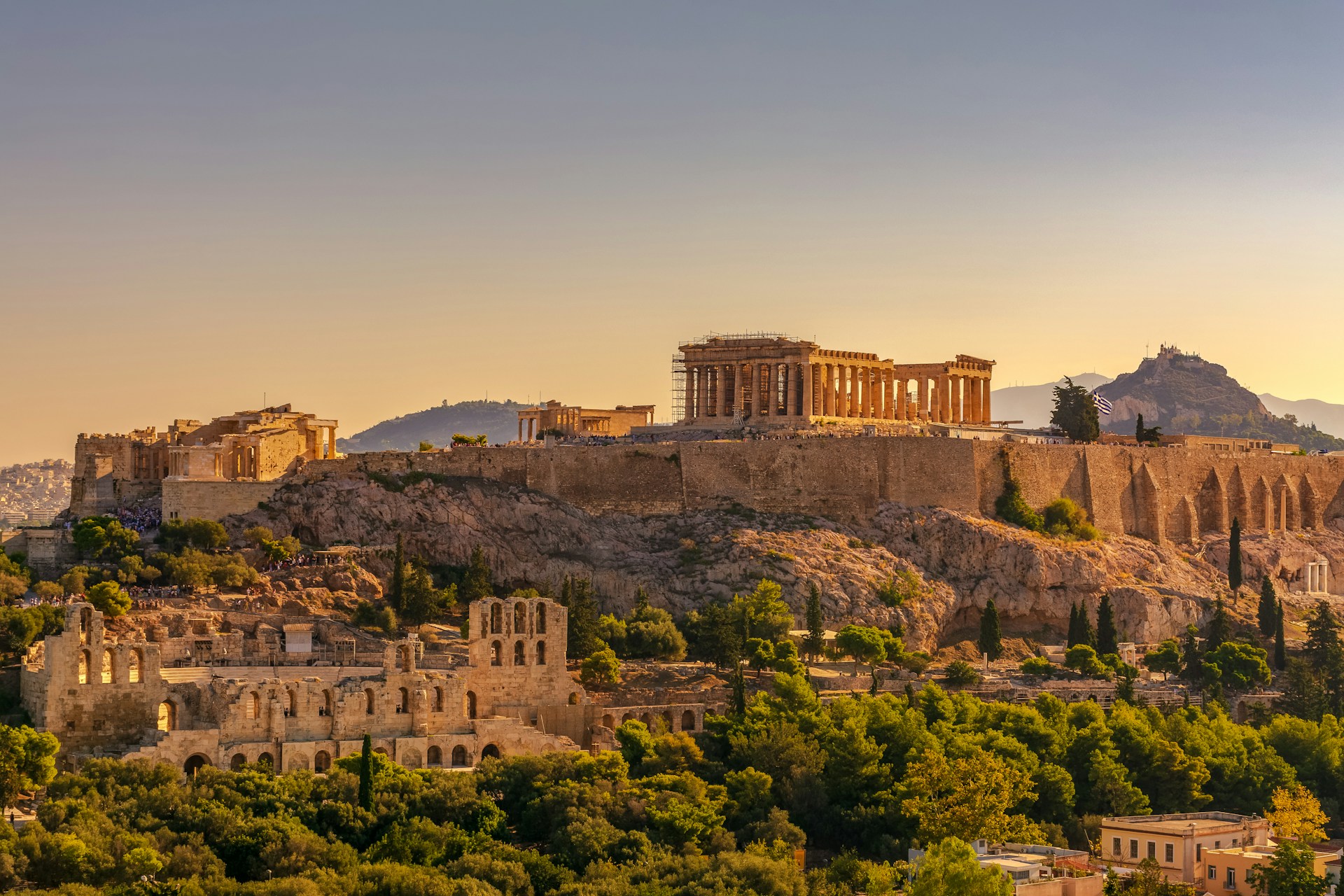
The ancient capital that never became a museum
Athens does not perform ancient Greece for tourists the way some historic cities perform their own past. It is a real, sprawling, occasionally chaotic capital of 3.1 million people, and the Acropolis simply happens to sit in the middle of it, visible from balconies and rooftop bars across half the city. The genuine trick of Athens is contrast: you can stand in the 5th-century-BCE Ancient Agora and then, ten minutes later, be eating a €4 souvlaki wrap on a street that's been selling the same thing since the 1960s.
What changed in the last decade is that the world stopped treating Athens as a one-night obligation before the islands. The Acropolis Museum, opened in 2009, gave the ruins context they'd lacked for two centuries. Neighbourhoods like Koukaki and Pangrati developed real food scenes independent of the tourist trail. Athens is still, by a wide margin, cheaper than Santorini or Mykonos for equivalent quality, which makes an extra day here one of the best value additions to any Greece itinerary.
The honest complications
Summer heat is real: Athens regularly exceeds 38°C in July and August, and the ancient sites offer almost no shade at midday. The marble and polished stone streets around the Acropolis get genuinely slippery, especially the smooth marble of the Acropolis rock itself; flat, grippy shoes are not optional. Monastiraki's flea market and the metro are the city's pickpocketing hotspots, on par with any major European tourist center. And large demonstrations, most often centered on Syntagma Square, occur with little notice and can shut down metro stations and streets for hours; they're aimed at the Greek government, not tourists, but plan around them if one is underway.
Six neighbourhoods, one rock in the middle of all of them
Athens's neighbourhoods radiate out from the Acropolis, and where you base yourself comes down to how much tourist energy you want outside your door versus how much you want to feel like the city belongs to someone else too.
Plaka
The old town at the foot of the Acropolis: neoclassical houses, narrow lanes, and the closest walk to the ruins of anywhere in the city. It is genuinely pretty and genuinely saturated with souvenir shops and tourist-menu tavernas on the main strips; step one block off Adrianou Street and it calms down considerably. For a first visit, nothing beats the location.
Koukaki
South of the Acropolis, Koukaki has become the neighbourhood second-time (and increasingly first-time) visitors choose: specialty coffee shops, modern Greek tavernas, and a residential calm that Plaka and Monastiraki don't have, while staying a flat 10-minute walk from the Acropolis Museum and the Acropolis entrance itself. Peak summer, Koukaki hotels sell out 4-6 weeks ahead.
Monastiraki
The commercial heart of old Athens, built around the Sunday flea market and the souvlaki strip on Mitropoleos Street. It's the most atmospheric neighbourhood after dark, with rooftop bars looking straight at the floodlit Acropolis, and the most crowded and pickpocket-prone by day.
Psirri
Just north of Monastiraki, Psirri has the city's densest concentration of bars, live rembetiko music venues and street art. Quiet and slightly run-down by day, genuinely lively after 10pm, and the neighbourhood with Athens's best late-night energy.
Pangrati
East of the centre, Pangrati is where Athenians actually eat: fewer tourists, better prices, and a genuine neighbourhood feel built around Varnava and Proskopon squares. If dinner matters more to you than the view from your hotel window, stay here or at least eat here.
Kolonaki
Athens's most polished neighbourhood, all high-end boutiques and sunglassed locals at pavement cafés, tucked below Mount Lycabettus. Worth an afternoon for the contrast with Psirri's grit, and for the cable car up Lycabettus for the best panoramic view of the city.
From Acropolis-view suites to Greece's original hostel
Athens's hotel scene has grown up fast: design-led boutique properties now sit alongside the grand old names, and the hostel scene at the budget end is some of the best value in the Mediterranean. These picks cover every budget, each earning its place on location or character.
At the top, AthensWas on Dionysiou Areopagitou, from around €320 a night, is a contemporary design hotel with uninterrupted Acropolis views from Athens's most beautiful pedestrian street, while the Divani Palace Acropolis in Koukaki, from around €160 in low season, pairs two pools with direct Acropolis views and a five-star scale few boutique properties can match.
In the design bracket, the New Hotel near Syntagma (from around €350), designed by the Campana Brothers with 79 rooms and a member of Design Hotels, is one of the city's most distinctive stays, and the Herodion Hotel in Koukaki (from around €150) has two of the best rooftop terraces in the city, both looking straight at the Acropolis and the ancient Herodes Atticus theatre below it.
At the budget end, the Students & Travellers Inn in Plaka, running since 1977 as the first hostel in Greece, has dorms from around €22 and private rooms in a genuinely central location, while Bedbox Hostel offers a similarly priced, more modern alternative with a bar, kitchen and terrace for travellers who want a social base.
A souvlaki rivalry that's been running since 1964
Athens's food scene runs from €4 street food to two-Michelin-star dining, and the city's dining reputation has shifted hard in the last few years as chefs rework traditional Greek cooking into something lighter and more design-conscious without losing the soul of it. The best cheap meals and the best serious meals are often just streets apart.
Souvlaki on Mitropoleos Street
Athens's most famous food rivalry plays out on a 100-metre stretch of Mitropoleos Street, where O Thanasis, grilling since 1964 and ranked among the world's best restaurants by TasteAtlas, faces off against Bairaktaris across the street, a former favourite of a Greek prime minister. Thanasis has the edge on the pork souvlaki itself; Bairaktaris is the better sit-down plate meal. Try both and pick a side.
Fine dining & neo-tavernas
Delta, the only restaurant in Greece with two Michelin stars, sits at the top of the scene, while Aleria in Metaxourgeio is widely considered the city's best all-round restaurant for a serious but unstuffy tasting menu. For a traditional dinner with atmosphere, Geros Tou Moria in Plaka has been doing it for decades, and To Mavro Provato in Pangrati is the neighbourhood's best casual Greek kitchen.
Neighbourhood tavernas
O Lolos in Koukaki spills its tables onto the street for a simple, heavy-hitting classics menu, and Ouzeri Lesvos keeps an old-school, no-frills ouzo-and-meze atmosphere that's increasingly rare in the centre. Tavern Klimataria, family-run since 1927, pairs a full Mediterranean menu with live music and dancing most evenings.
The Acropolis is only the start of it
Athens rewards planning around opening times more than any city its size: the Acropolis at 8am, before both the heat and the tour groups, is a completely different experience from the Acropolis at 1pm. A few sights benefit from advance booking, and this chapter walks through the city roughly the way a good two or three days would.
The Acropolis and Acropolis Museum
The Acropolis costs €20 in summer (April-October) and €10 in winter, or is covered by the €30 combined ticket for seven archaeological sites (also including the Ancient Agora, Roman Agora, Hadrian's Library, the Temple of Olympian Zeus, Kerameikos and the Lykeion), valid across several days. Book a timed-entry slot online and arrive right at 8am opening; by 11am in summer the Parthenon's viewing platform is genuinely crowded and the marble underfoot is uncomfortably hot. Down the hill, the Acropolis Museum (€15 summer / €10 winter) houses what remains in Greece of the Parthenon sculptures with a glass floor over active excavations, and gives the ruins outside a context most visitors are missing when they walk up cold; budget 90 minutes.
The Ancient Agora and Plaka
The Ancient Agora (€10, or included on the combo ticket) is the civic heart of classical Athens, where Socrates taught and democracy was practiced in the open air; the well-preserved Temple of Hephaestus and the reconstructed Stoa of Attalos, now a small museum, are the highlights. From there it's a short walk into Plaka's tangle of neoclassical lanes, worth an unhurried wander rather than a checklist, and up to the quiet, lantern-lit alleys of Anafiotika, a tiny Cycladic-style enclave tucked against the Acropolis rock, built by island workers in the 19th century and easy to miss if you don't look for the stepped lanes above Plaka's main strip.
Monastiraki, Psirri and the museums
Monastiraki's Sunday flea market spreads out from the square in every direction, genuine junk mixed with genuine antiques; come for the wander rather than a specific purchase. The National Archaeological Museum (€20), Greece's largest and most important, holds the Mycenaean gold masks including the so-called Mask of Agamemnon and a collection that rewards two unhurried hours far more than its slightly out-of-the-way location near Exarchia suggests. In the evening, the bars around Psirri and the rooftop terraces of Monastiraki's hotels both deliver a floodlit Acropolis view without a ticket.
Lycabethus and the free viewpoints
Mount Lycabethus, reachable by cable car from Kolonaki or a steep 30-minute walk, is the highest point in central Athens and the best panoramic view of the whole city, the Acropolis included, especially at sunset. It's free to walk up and costs a small fare for the funicular. The Pnyx, the hill where the Athenian citizen assembly once met, offers a quieter, free alternative view of the Acropolis from the west, usually with a fraction of the crowds of the paid sites.
One, two or three days, planned around opening times
Two to three full days covers Athens properly before an island connection; even one well-planned day delivers the essentials if you're tight on time.
- Morning
Acropolis at opening. Timed 8am entry, then straight down to the Acropolis Museum before the tour-group crush arrives.
- Midday
Plaka and lunch. Wander the old town lanes, climb to Anafiotika, then souvlaki at O Thanasis or Bairaktaris on Mitropoleos Street.
- Afternoon
Ancient Agora and Monastiraki. The Temple of Hephaestus, then the flea market for atmosphere rather than shopping.
- Sunset
Lycabethus or a Monastiraki rooftop. The whole city and the floodlit Acropolis from above. Dinner in Psirri or Koukaki.
- Day 1
The one-day route: Acropolis, Acropolis Museum, Plaka, souvlaki, Ancient Agora, Monastiraki, Lycabethus at sunset.
- Day 2 morning
National Archaeological Museum. Two unhurried hours with the Mycenaean gold, then coffee in Kolonaki.
- Day 2 afternoon
Pangrati and the Panathenaic Stadium. The all-marble stadium of the first modern Olympics, then a wander through Pangrati's food streets.
- Day 2 evening
Dinner in Pangrati or Koukaki. To Mavro Provato or O Lolos, the Athens evening locals actually have.
- Days 1-2
The two-day route above, at a gentler pace, adding the Pnyx for a quiet sunset alternative to Lycabethus.
- Day 3, option A
Cape Sounion. The clifftop Temple of Poseidon, 90 minutes from the centre, best timed for sunset over the Aegean.
- Day 3, option B
Mycenae, Epidaurus & Nafplio. A full-day trip into the Peloponnese: the Lion Gate, the acoustically perfect ancient theatre, and Nafplio's Venetian old town.
Compact centre, hot pavement, an efficient metro
Athens's historic centre is compact and largely walkable, but the marble and polished stone underfoot demand real shoes and the summer sun demands real water breaks. From the airport, Metro Line 3 runs to Syntagma in about 40 minutes for €9 single, against €5.50 for the 24-hour X95 express bus (45-70 minutes, runs around the clock) or a fixed-rate taxi at roughly €38-40 during the day and higher overnight. In the city, get a rechargeable transit card or tap a contactless card directly at metro and bus validators for the standard €1.20 fare; a 24-hour unlimited pass covering metro, tram and bus costs €4.10.
Uber and the local ride app Beat are widely used and inexpensive for central trips. The metro covers the historic centre, Piraeus port and the airport on three clean, modern lines; buses and trams fill in the rest. Walking covers Plaka, Monastiraki, Psirri and Koukaki easily; Kolonaki and Pangrati are a bit further out but still walkable from the centre in 20-30 minutes.
Best time to visit and demonstration awareness
Athens has a Mediterranean climate: May-June and September-October are the sweet spots, warm enough to swim on a day trip but without July and August's heatwaves, which regularly exceed 38°C and make midday sightseeing genuinely uncomfortable. Winter is mild, quiet and green, with the ancient sites largely to yourself.
Demonstrations gather most often at Syntagma Square with little notice and can disrupt metro service and traffic for hours. They're directed at the Greek government, not tourists, and are usually peaceful, but it's sensible to avoid the immediate area and check local news if something is underway during your visit.
Athens is the value play of a Greece trip
Athens runs noticeably cheaper than Santorini or Mykonos for equivalent quality, since it isn't competing on scarce caldera-view real estate. The hostel scene is excellent at the budget end, and the main cost trap is eating on the main Plaka tourist strip instead of two streets back.
- Hostel dorm €18-30
- Souvlaki & taverna meals €12-20
- Metro day pass €4.10
- Acropolis plus one more site
- Boutique hotel in Koukaki or Plaka
- Restaurant meals €35-50
- Metro plus the occasional Uber/Beat
- 7-site combo ticket, a museum, a day tour
- AthensWas or equivalent, €300+
- Tasting menu at Delta or Aleria
- Private guided Acropolis tour
- Private day trip to the Peloponnese
A Level 1 city, with three things to actually know
Greece carries a Level 1 "Exercise Normal Precautions" rating from the US State Department, its lowest risk category. Violent crime against tourists in Athens is rare, and the city centre is fine to walk in the evening with normal urban awareness. Athens rates well for solo female travellers too: harassment is uncommon, and hostel and neighbourhood culture make meeting other travellers easy.
The three things that actually catch visitors: pickpocketing, concentrated around the Monastiraki flea market, crowded metro carriages and Piraeus's ferry terminals; heat, which sends more tourists to Athens hospitals each summer than crime does, so carry water and avoid midday sun at the ancient sites; and taxi overcharging, mostly at the airport, where unofficial or unmetered drivers quote inflated flat fares, so insist on the meter or the official €38-40 fixed rate, or use Uber/Beat. That's the whole list. The emergency number is the EU-standard 112 from any phone, and police can also be reached directly on 100.
Athens is one of Europe's best day-trip bases
Athens's position at the base of Attica and the Peloponnese, with Piraeus port in the city itself, makes it an outstanding base for a wider Greece trip. Four options are worth a day each.
Cape Sounion
The clifftop Temple of Poseidon at Attica's southern tip is Athens's easiest, most rewarding half-day escape: dramatic ruins directly above the Aegean, best timed for sunset when the columns catch the last light. No ferry required, easily done by rental car, bus or organised tour.
Mycenae, Epidaurus & Nafplio
A full-day loop into the northeastern Peloponnese: the Lion Gate and Cyclopean walls of Mycenae, the Bronze Age seat of Agamemnon's kingdom; the ancient theatre at Epidaurus, whose acoustics carry a dropped coin 60 metres to the top row; and the elegant Venetian old town of Nafplio, Greece's first capital after independence, for lunch and a wander. Organised tours run €85-130 all-inclusive; a rental car covers the same ground with more flexibility.
Delphi
The ancient world's most important religious sanctuary, on the slopes of Mount Parnassus, with the Temple of Apollo and an excellent site museum. The best all-around single day trip from Athens for a first-time visitor prioritising ancient history over islands.
Aegina & Hydra
The Saronic islands are the easiest genuine island escape without leaving Athens's orbit: Aegina by ferry from Piraeus in around 30 minutes (from ~€9.50), Hydra in about 2 hours, car-free with donkeys and water taxis instead. A relaxed alternative to a full Cyclades ferry commitment if time is short.
Athens FAQ
Is Athens safe for tourists?
Yes. Greece rates Level 1, Exercise Normal Precautions, from the US State Department. Violent crime against tourists is rare in Athens; the main concerns are pickpocketing around Monastiraki and the metro, and occasional large demonstrations around Syntagma Square.
How many days do I need in Athens?
Two to three full days covers the essentials well: one for the Acropolis, Acropolis Museum and Plaka, one for the Ancient Agora, Monastiraki and a neighbourhood like Pangrati or Kolonaki, and a third for a day trip to Cape Sounion or the Peloponnese.
How much does Athens cost per day?
Budget travellers manage on €50-70 a day with hostels and souvlaki-and-taverna meals; mid-range runs €100-150. Athens is noticeably cheaper than Santorini or Mykonos for equivalent quality.
When is the best time to visit Athens?
May-June and September-October: warm weather, manageable crowds, lower prices than peak summer. July and August bring heatwaves that regularly exceed 38°C, uncomfortable for a lot of walking on stone streets and archaeological sites.
Should I stay in Athens or go straight to the islands?
Stay at least two nights. The Acropolis, the Acropolis Museum and Plaka are genuinely worth the time, not just a layover before the ferry, and most first-time Greece itineraries combine a few Athens days with island time afterward.
How do I get from Athens airport to the centre?
Metro Line 3 runs from the airport to Syntagma in about 40 minutes for €9. The X95 express bus costs around €5.50 and runs 24 hours. A taxi is a fixed flat rate of roughly €38-40 during the day and higher at night.
What is the best area to stay in Athens?
Plaka for first-timers who want to be steps from the Acropolis and don't mind tourist crowds. Koukaki for a quieter, more local feel with the same easy walk to the Acropolis Museum. Monastiraki for nightlife and the flea market energy.
Do I need to buy Acropolis tickets in advance?
Strongly recommended in high season. Book a timed-entry ticket online in advance, arrive right at opening (8am), and consider the €30 combined ticket covering seven archaeological sites if you're visiting more than the Acropolis alone.
Is Athens walkable?
Yes, the historic centre is compact and flat to moderately hilly. Marble and polished stone streets, especially around the Acropolis, get slippery, so wear shoes with real grip rather than smooth-soled sandals.
What is the Athens metro day ticket and do I need one?
A 24-hour unlimited ticket covering metro, tram and bus costs €4.10, worth it if you're making more than three trips in a day. Single rides are €1.20 and valid for 90 minutes across all forms of transport except the airport line.
What Stays With You
Athens is easy to underrate because it competes for attention with its own country's islands, and it loses that comparison on beaches every time. What it wins on is depth: no Greek island gives you the Acropolis at dawn with almost nobody else there, or the specific feeling of eating a €4 souvlaki on the same street corner where the same shop has been grilling since before your parents were born. The ruins are not staged for you. The city simply happens to have grown up around them.
Go up to the Pnyx or Lycabethus on your last evening, watch the floodlights hit the Parthenon, and understand why Athenians never felt the need to apologize for their capital.