
What You're Actually Getting Into
Germany is Europe's largest economy and its most-visited country after France and Spain, and it earns the traffic on infrastructure alone: a rail network that mostly works, cities that are walkable and bike-friendly, and a tourism apparatus built for independent travelers rather than package tours. But the country's real draw is how visibly its history sits on the surface. Berlin was flattened in 1945, split by a wall for 28 years, and reunified in 1990; you can trace all three eras on a single afternoon walk. Munich pairs Baroque grandeur with a beer hall culture that predates the country itself. None of it is staged for visitors, which is part of what makes it work.
Germany is also more affordable than its reputation suggests. A currywurst or döner costs 5 to 7 euros, a large beer in a beer garden runs 4 to 6 euros, and regional trains are covered by the flat-rate €63 Deutschland-Ticket. The one place prices spike hardest is accommodation during Oktoberfest and the Christmas market season, when Munich and the classic market towns book out and double in price months ahead.
The honest complications
Germany runs on more bureaucracy and cash than most first-time visitors expect: many restaurants, small shops and even some hotels are cash-only or card-reluctant, and government offices operate on appointment systems that can feel opaque. The Ladenschlussgesetz (shop closing law) shuts most retail on Sundays, so grocery runs need to happen Saturday. Public transport is generally excellent but not immune to delays, particularly on long-distance ICE routes, and Deutsche Bahn's punctuality has been a genuine national talking point in recent years, not just a stereotype to laugh about. None of this derails a trip, but it rewards a little planning that "efficient Germany" marketing doesn't always prepare you for.
A History Worth Knowing
Germany as a unified nation-state is younger than the United States, formed in 1871 out of a patchwork of kingdoms and principalities. Within a single lifetime it then fought two world wars, perpetrated the Holocaust, split into two opposing states during the Cold War, and reunified. Understanding roughly this arc changes how the country's museums, memorials and even its street layout read.
- 1871
Unification. Otto von Bismarck unites the German states into the German Empire under Prussian leadership after the Franco-Prussian War.
- 1933–1945
The Third Reich. Hitler's Nazi regime, the Holocaust's murder of six million Jews and millions of others, and the devastation of the Second World War, which leveled most major German cities.
- 1949–1990
Divided Germany. The Federal Republic (West) and the German Democratic Republic (East) split by the Berlin Wall from 1961, a physical and ideological Cold War frontier.
- 1989–1990
Reunification. The Wall falls on 9 November 1989; formal reunification follows on 3 October 1990, now celebrated as German Unity Day.
- 1999–2002
The euro. Germany adopts the euro, cementing its role as the EU's largest economy.
- 2015–present
Modern Germany. A major role in the European migrant response, continued reckoning with reunification-era East-West inequality, and steady growth in tourism to Berlin, Bavaria and the Christmas market circuit.
Read the full history: the Holy Roman Empire, the wars, and life behind the Wall
Before 1871, "Germany" was a loose collection of hundreds of kingdoms, duchies and free cities nominally under the Holy Roman Empire, a fact that still shows in the country's cultural diversity: Bavaria, Saxony and the Rhineland each retain distinct dialects, cuisines and civic identities that predate the modern state by centuries.
The Nazi period and the Holocaust are treated with unusual directness in German public life, a policy known as Vergangenheitsbewältigung, "coming to terms with the past." Memorials are not tucked away: the Memorial to the Murdered Jews of Europe sits a five-minute walk from the Brandenburg Gate, and Holocaust education is compulsory in German schools. Visitors should expect this history to be present and openly discussed rather than glossed over, and should treat sites like former concentration camps, Sachsenhausen near Berlin among them, with the gravity they warrant.
Division after 1945 split Germany into four Allied occupation zones that hardened into two states by 1949: the capitalist Federal Republic in the west and the Soviet-aligned German Democratic Republic in the east. The Berlin Wall, built almost overnight in August 1961 to stop the flow of East Germans fleeing west, became the era's defining symbol; the East German Stasi secret police built one of history's most extensive surveillance states to enforce it. The Wall's fall in November 1989, triggered by a bureaucratic mix-up in a press conference announcement that East Germans took as immediate permission to cross, remains one of the most dramatic bloodless political events of the 20th century.
East-West differences today. Reunification did not erase 40 years of divergent development overnight. Former East German regions still show lower average wages and, in some areas, different political voting patterns than the west, a live topic in German politics rather than settled history. Visitors mostly encounter this as texture: Berlin's Prenzlauer Berg and Friedrichshain, once East Berlin, feel different architecturally from the rebuilt postwar west, and small towns in Saxony or Brandenburg have a visibly different pace and building stock than their western equivalents.
Top Destinations
Germany divides naturally into five travel zones: the capital, Bavaria in the south, the Rhine Valley and the west, Hamburg and the north, and the Black Forest and Romantic Road. It's a big country, roughly the size of Montana, and the excellent rail network means the constraint is usually time, not distance. A two-week trip covers three of these zones comfortably; a week covers Berlin plus one more.
Berlin, the capital that keeps rebuilding itself
Berlin is Germany's biggest draw for first-time visitors: the Brandenburg Gate, the Reichstag's glass dome (free but requires advance registration), the Berlin Wall Memorial and East Side Gallery, and Museum Island's five collections in one UNESCO-listed cluster. It's also a genuinely creative, unpolished city, techno clubs that run through the weekend, a former nuclear bunker turned museum, and neighbourhoods, Kreuzberg, Neukölln, Friedrichshain, that feel distinctly unfinished in a way that reads as energy rather than neglect. Budget at least three days; our full Berlin city guide covers it chapter by chapter.
Munich, beer halls and Baroque
Munich is Bavaria's capital and Germany's most traditionally "postcard" big city: the Marienplatz's Neo-Gothic town hall with its glockenspiel, the Hofbräuhaus beer hall, and the English Garden, a park larger than New York's Central Park with a standing river wave that surfers ride year-round. Oktoberfest, the world's largest folk festival, runs 19 September to 4 October 2026 at the Theresienwiese and books out accommodation across the city months in advance; visit outside those dates for a calmer, still excellent city.
Neuschwanstein & the Alps
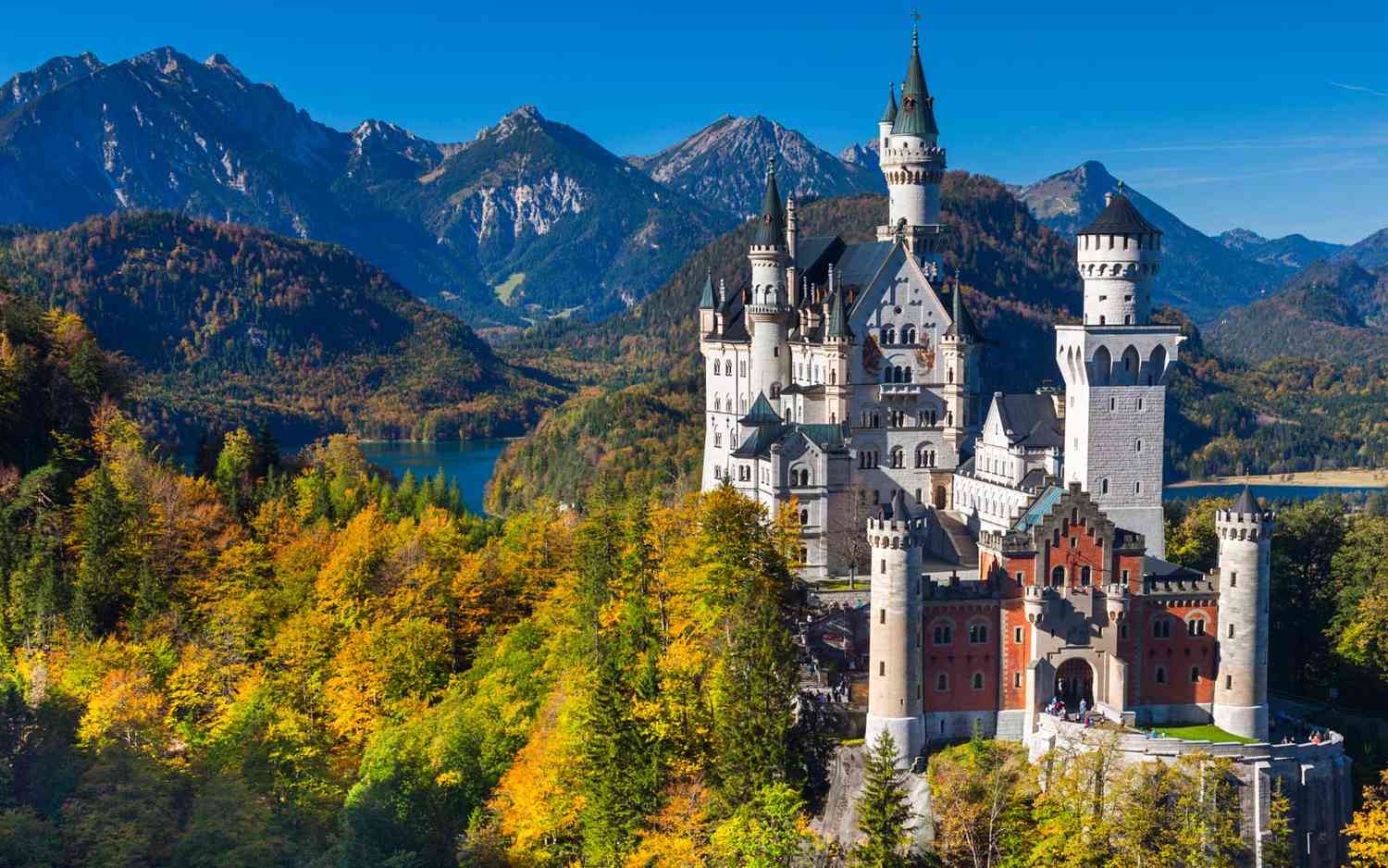
Neuschwanstein Castle, King Ludwig II's 19th-century fantasy commission and the direct inspiration for Disney's Sleeping Beauty Castle, sits above the village of Hohenschwangau near Füssen, about two hours from Munich by train and bus. Tickets (around €21, book online in advance in summer) must be collected at the Hohenschwangau ticket center at the base of the hill. Combine it with the neighbouring Hohenschwangau Castle, Ludwig's boyhood home, for a full day.
Cologne & the Rhine Valley
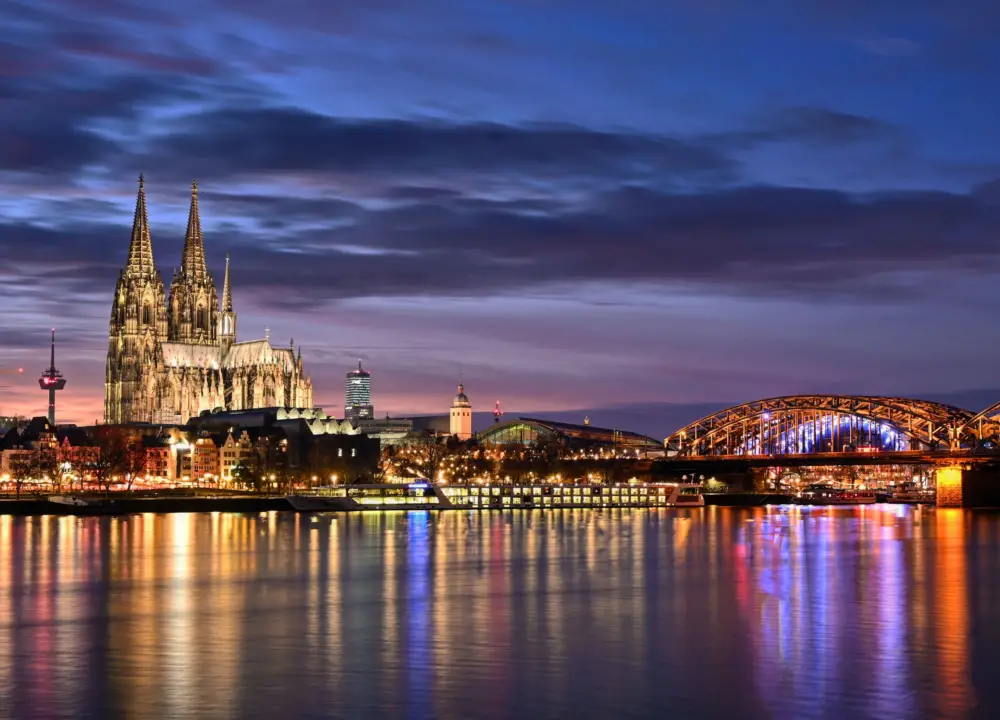
Cologne's twin-spired cathedral, a UNESCO World Heritage Site that took over 600 years to complete, dominates the skyline directly beside the train station, and the old town's Kölsch beer culture (served in small 200ml glasses, replaced automatically until you put a coaster on top) is worth an evening on its own. From Cologne, the Rhine Valley's UNESCO-listed stretch between Bingen and Koblenz runs through vineyard-covered cliffs studded with medieval castles and river towns like Rüdesheim and Bacharach; the classic day out combines a train leg with a Rhine river cruise through the most scenic section.
Hamburg, the maritime north
Hamburg is Germany's second city and busiest port, built around the Elbphilharmonie concert hall's wave-shaped glass crown atop a converted warehouse, and the Speicherstadt, the world's largest historic warehouse district and a UNESCO World Heritage Site. The Reeperbahn nightlife strip in St. Pauli is famous (and infamous) in equal measure; the Fischmarkt's Sunday-morning fish auction, running since the 17th century, is the more family-friendly counterpoint. Hamburg works well as a one-to-two-day add-on from Berlin, about 1 hour 45 minutes by ICE train.
The Black Forest
The Schwarzwald in Germany's southwest is the source of cuckoo clocks, Black Forest cake and some of the country's best hiking and spa towns; Baden-Baden's 19th-century thermal baths and Freiburg's solar-powered old town, laced with tiny gutters called Bächle, are the standard anchors. Best explored with a car, since the smaller villages and trailheads sit well off the rail network.
The Romantic Road
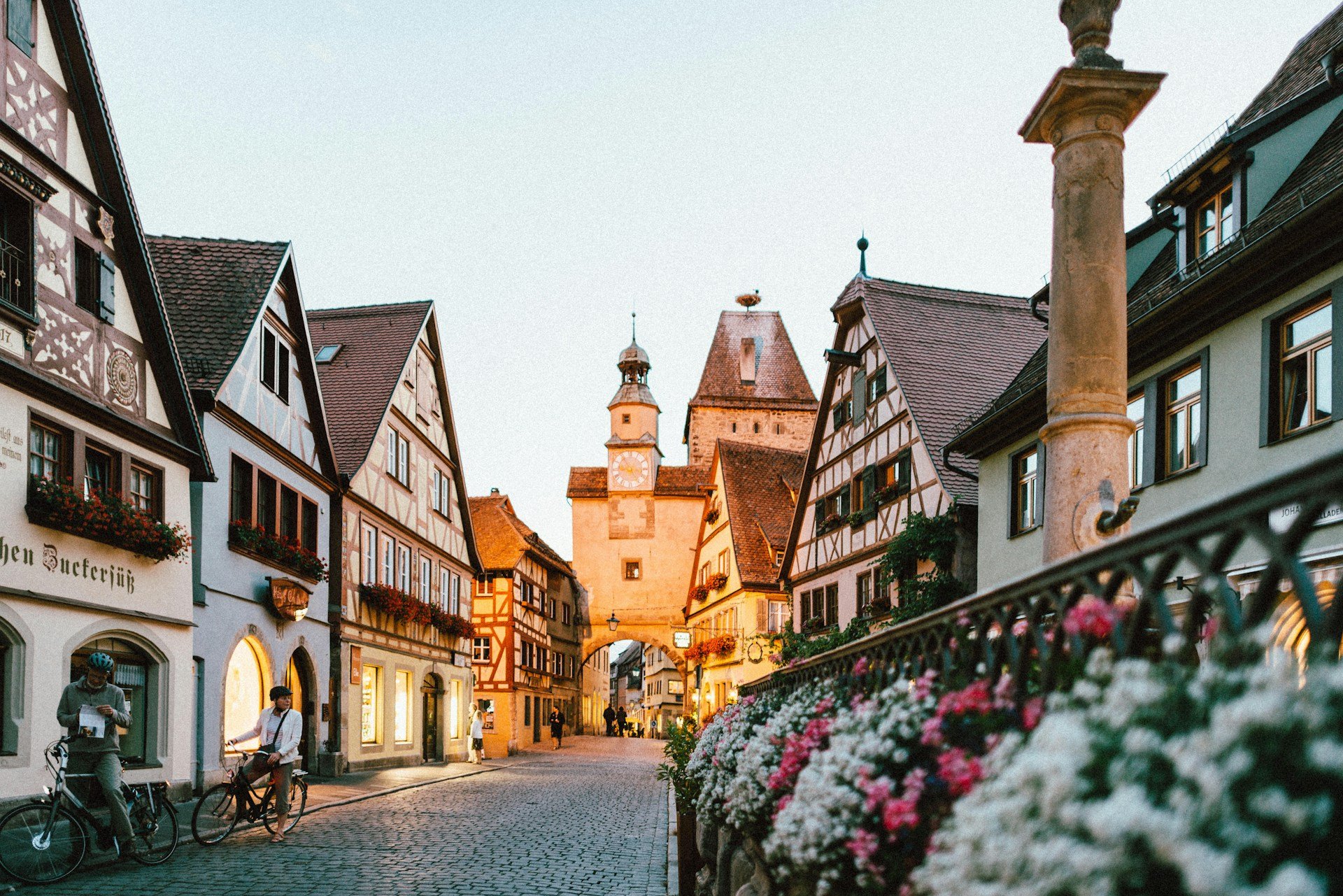
A 350-kilometer signposted route from Würzburg to Füssen linking medieval towns that largely escaped WWII bombing, most famously Rothenburg ob der Tauber, whose walled old town and half-timbered houses are the most complete surviving example of a medieval German town. Doable as a multi-day road trip or, for Rothenburg alone, as a train-accessible day or overnight trip from Munich or Frankfurt.
Hidden gems beyond the main circuit
The zones above cover a first or second trip well. With extra days, these are the spots that rarely make the standard guides but reward the detour.
Saxon Switzerland National Park
Dramatic sandstone table mountains and the Bastei bridge over the Elbe valley, an hour from Dresden and largely missed by visitors who stop at Dresden's rebuilt Baroque old town alone.
Berchtesgaden & the Königssee
An impossibly clear alpine lake ringed by sheer peaks, reached by an electric boat that stops mid-lake for a trumpeter to demonstrate the six-fold echo. Quieter than Neuschwanstein and, many visitors say, more beautiful.
Wartburg Castle, Eisenach
Where Martin Luther translated the New Testament into German while in hiding in 1521, a UNESCO World Heritage Site with sweeping forest views and none of the crowds of the Bavarian castles.
Trier, Germany's oldest city
Founded by the Romans around 16 BCE, with the best-preserved Roman gate north of the Alps (the Porta Nigra) and a cluster of UNESCO-listed Roman ruins most visitors skip entirely for the Rhine.
Rügen Island
Germany's largest island, with chalk cliffs made famous by the Romantic painter Caspar David Friedrich and some of the country's best beaches, far less crowded than the North Sea resorts.
Bamberg's old town
A UNESCO World Heritage old town built across seven hills, famous for its smoked Rauchbier beer and largely untouched by WWII bombing, a quieter alternative to Rothenburg with a genuine local beer culture.
Culture & Etiquette
German social culture prizes directness, punctuality and rule-following in a way that can read as brusque to visitors from more indirect cultures, but it's not hostility: Germans generally mean exactly what they say and expect the same back. Formality matters more than in much of Western Europe, particularly around titles and the formal "Sie" form of address with strangers and in business settings.
Do
- Be on time, or a few minutes early. Punctuality is taken seriously for everything from train departures to dinner reservations; being late without notice reads as genuinely disrespectful.
- Carry cash. Many restaurants, bakeries, markets and small shops are cash-only or prefer it; don't assume card payment will work everywhere, especially outside big cities.
- Separate your recycling. Germany's household waste system splits into paper, packaging, organic and residual waste streams; hotels and rentals expect guests to follow the same bins.
- Say "Prost" and make eye contact when toasting. Clinking glasses without eye contact is considered mildly rude, an old superstition that's stuck around as etiquette.
- Respect Sunday quiet hours (Ruhezeit). Loud activity, including vacuuming, drilling or loud music, is discouraged on Sundays and during weekday quiet hours in residential buildings.
Don't
- Jaywalk, especially with children nearby. Germans overwhelmingly wait for the pedestrian signal even on empty streets, and crossing against a red "Ampelmann" while kids are watching draws real disapproval.
- Bring up Nazi-era history casually or make jokes about it. Germans engage with this history seriously and educationally; flippant references land badly. Displaying Nazi symbols is also illegal.
- Expect Sunday shopping. Most retail closes; bakeries, restaurants, petrol stations and station shops are the main exceptions.
- Assume tipping works like the US. Round up or add 5-10%, handed directly to the server when you pay; large American-style tips are unnecessary and can come across as showy.
- Cut in line or ignore posted queue systems. Germans queue formally (a numbered ticket system, or Schlange) at bakeries, government offices and pharmacies, and take the order seriously.
Deeper culture: Vergangenheitsbewältigung, regional identity and beer culture
Vergangenheitsbewältigung. Literally "coming to terms with the past," Germany's national policy of confronting Nazi-era history openly through education, memorials and public discourse rather than minimizing it. It's why concentration camp memorials, the Holocaust Memorial and Stolpersteine (brass "stumbling stone" plaques marking Nazi victims' former homes, embedded in pavements across the country) are so visible.
Regional identity. "German" flattens enormous regional variation: Bavarians, Rhinelanders, Saxons and Hamburgers each have distinct dialects, cuisines and, often, a friendly rivalry with Berlin's dominance of national attention. Bavaria in particular retains a strong separate identity, including its own conservative political party.
The Reinheitsgebot. Germany's 1516 beer purity law, restricting beer to water, barley and hops (yeast was added to the definition later), is the world's oldest still-enforced food-quality regulation and a genuine source of national pride, especially in Bavaria where it originated.
Food & Drink
German food is heartier and more regionally varied than its "sausage and beer" reputation suggests: Bavarian roast pork, Rhineland stews, and Berlin's own Turkish-German street food tradition all sit under the same national umbrella. It's also one of Western Europe's better-value food scenes: a filling street meal rarely tops 7 or 8 euros.
Currywurst & Döner €5-7
Currywurst, sliced sausage in curry-spiced ketchup, was invented in postwar Berlin and remains the city's defining street food. The döner kebab, though Turkish in origin, was popularized as a Berlin sandwich format by Turkish-German vendors in the 1970s and is now one of Germany's most-eaten fast foods nationwide.
Sausages & Schnitzel €8-16
Bratwurst varies by region (Nuremberg's are finger-sized and sold in dozens); Schweinshaxe (roast pork knuckle) and Wiener Schnitzel are Bavarian beer hall staples, usually served with potato salad or Spätzle egg noodles.
Beer €4-6/large
Brewed under the 1516 Reinheitsgebot purity law: Bavarian Helles and Weissbier, Cologne's small-glass Kölsch, and Berlin's tart Berliner Weisse, often served with a shot of woodruff or raspberry syrup.
Pretzels & Bakery Culture €1.50-3
German bakeries (Bäckerei) are a genuine daily institution, not a tourist stop: fresh Brezel pretzels, dense rye Vollkornbrot, and regional pastries sold from cases that rotate through the day.
Christmas Markets & Glühwein ~€4-5/cup
Late November through December, town squares fill with wooden stalls selling mulled wine (Glühwein, served in a collectible mug with a small deposit), roasted chestnuts and gingerbread; Nuremberg and Dresden run two of the oldest and largest markets.
Wine €5-10/glass
Germany is a serious Riesling producer, not just a beer country: the Mosel and Rhine valleys grow some of the world's best cool-climate whites, best tasted at a vineyard Weingut rather than a city wine bar.
When to Go & Itineraries
May, June and September are the best months for warm weather without peak crowds or prices. July and August are busiest and hottest; late November and December bring the Christmas market season, genuinely worth planning a trip around despite the cold and short days. Winter outside the markets is quiet and cheap but grey.
All four seasons compared, with temperatures
| Season | Verdict | Temps | Prices & crowds |
|---|---|---|---|
| May-Jun & Sep | Best | 14-23°C | Mid prices, manageable crowds |
| Jul-Aug | Good (busy) | 18-28°C | Peak prices in Bavaria and coastal areas; Oktoberfest late Sep |
| Late Nov-Dec | Good (cold) | 0-7°C | Christmas markets, higher city-break prices |
| Jan-Mar | Quiet | -2-8°C | Lowest prices, grey skies, fewer tourists |
Year-round city averages: Berlin 10°C, Munich 9°C, Hamburg 10°C, Cologne 11°C. Bavarian Alps can hold snow into April and see it return by November.
Itineraries
Seven days covers Berlin plus one other region adequately. Two weeks adds a third region and lets the trip breathe rather than becoming a city-to-city sprint. The excellent rail network means the itinerary constraint is almost never distance.
- Days 1-3
Berlin. Brandenburg Gate, the Reichstag dome (book ahead), Museum Island, the Berlin Wall Memorial and an evening in Kreuzberg or Friedrichshain.
- Days 4-5
Munich. ICE train from Berlin (about 4 hours). Marienplatz, the Hofbräuhaus, the English Garden.
- Days 6-7
Neuschwanstein & return. Day trip to Füssen and Neuschwanstein Castle, back to Munich for a final night.
- Days 1-3
Berlin. The full three-day circuit, plus a half-day in Potsdam for Sanssouci.
- Days 4-5
Hamburg. 1h45 by ICE. The Elbphilharmonie, Speicherstadt, the Reeperbahn.
- Days 6-7
Cologne & the Rhine. The Cathedral, then a train-and-cruise day through the Rhine Gorge to Rüdesheim or Bacharach.
- Days 8-10
Munich. Marienplatz, English Garden, day trip to the Königssee at Berchtesgaden.
- Days 11-14
Bavaria's castles & Romantic Road. Neuschwanstein, then Rothenburg ob der Tauber for two slower final days.
- Days 1-4
Berlin extended. Add Sachsenhausen Memorial and a full day in Potsdam.
- Days 5-6
Dresden & Saxon Switzerland. The rebuilt Baroque old town, then a day at the Bastei bridge.
- Days 7-9
Hamburg & the north. The full city, plus an optional Rügen Island add-on for beach and chalk cliffs.
- Days 10-12
Cologne & the Rhine Valley. Cathedral, Rhine Gorge cruise, an overnight in Bacharach or Rüdesheim.
- Days 13-16
Munich & the Alps. City time plus Neuschwanstein and Berchtesgaden.
- Days 17-21
Black Forest & Romantic Road. Rental car through Freiburg, Baden-Baden, and Rothenburg ob der Tauber to close the loop.
Getting there & around
Frankfurt Airport (FRA) is the main international gateway, with Berlin Brandenburg (BER) and Munich (MUC) also well connected from North America, the UK and the rest of Europe. Deutsche Bahn's ICE high-speed trains link every major city (Berlin-Munich around 4 hours, Berlin-Hamburg 1h45); book ahead for the cheapest fares, which rise closer to departure. The €63/month Deutschland-Ticket covers all regional trains and city public transport nationwide, though not the faster ICE/IC long-distance services, and can be worth it even for a two-to-three week trip that stays off the high-speed network.
All transport options with prices: trains, rental cars, flights
| Option | Price | Notes |
|---|---|---|
| ICE high-speed trains | €30-120 | Berlin-Munich in about 4 hours. Book early for Sparpreis discount fares. |
| Deutschland-Ticket | €63/month | All regional trains, U-Bahn, S-Bahn, trams and buses nationwide. Not valid on ICE/IC. |
| Domestic flights | €40-150 | Rarely worth it over the train except Berlin-Munich in a hurry; adds airport transfer time. |
| Rental car | €35-60/day | Best for the Black Forest, Romantic Road and rural castle routes off the rail network. |
Autobahn driving: Germany's famous no-speed-limit sections exist but are less common than the reputation suggests; many stretches carry posted limits, especially near cities and construction zones. An international driving permit is recommended alongside your home license.
Practical prep: a German or EU SIM/eSIM covers the whole Schengen area under EU roaming rules if bought within the EU; otherwise an eSIM before landing avoids the airport kiosk markup. Standard EU travel insurance (EHIC-equivalent for EU citizens) covers most needs; non-EU visitors should carry separate travel medical insurance.
Where to stay
Hostels & budget stays
Every major city has well-run international-standard hostels; Berlin and Munich have the widest choice, with private rooms often available alongside dorms for a modest premium.
Mid-range city hotels
Reliable chain and independent options cluster near main train stations in every city; booking a few weeks ahead avoids the worst of Oktoberfest and Christmas-market season price spikes.
Rhine Valley & Romantic Road guesthouses
Family-run Gasthäuser and Weingut (winery) rooms in towns like Bacharach and Rothenburg ob der Tauber offer a more traditional stay than a city hotel, often with breakfast included.
Munich during Oktoberfest
Prices routinely double or triple across every hotel bracket during the festival's two-plus weeks; book six months or more ahead, or plan around the dates entirely.
Budget Planning
Germany sits mid-pack for Western Europe: pricier than Southern or Eastern Europe, generally cheaper than the UK, Switzerland or Scandinavia. Food and beer are where the value is strongest; accommodation during Oktoberfest and the Christmas markets is where it disappears fastest.
- Hostel dorm bed €20-30
- Street food (döner, currywurst) €5-8
- Deutschland-Ticket for regional transport
- Free sights: Berlin Wall, cathedrals, city walks
- 3-star hotel or boutique guesthouse
- Restaurant dinners €15-25/person
- ICE trains between cities
- Museum Island pass, castle tickets
- 4-5 star city hotels
- Fine dining and wine-region tastings
- Rental car for the Black Forest/Romantic Road
- Peak Oktoberfest or Christmas-market rates
Quick reference prices: beer, trains, entry fees
| Currywurst or döner | €5-7 |
| Large beer (beer garden) | €4-6 |
| Coffee | €3-4 |
| Restaurant meal (mid) | €15-25 |
| Berlin single transit ticket | €4 |
| Deutschland-Ticket | €63/month |
| Museum Island day pass | €24 |
| Neuschwanstein Castle entry | ~€21 |
| Berlin-Munich ICE (advance) | €30-70 |
| Hostel dorm bed | €20-30/night |
Prices reflect August 2026 research and drift over time, especially rail fares and Oktoberfest/Christmas-market accommodation. Treat them as a planning baseline, not a quote.
Visa & Entry
Germany is a full Schengen Area member, so entry rules are the shared Schengen rules: citizens of the US, UK, Canada, Australia, New Zealand and around 60 other countries can enter visa-free for up to 90 days within any rolling 180-day period, across the entire Schengen Area, not just Germany. The German Federal Foreign Office is the authoritative source for current entry rules, not third-party paid "visa" sites.
✓ Valid passport
At least 3 months validity beyond your planned departure date from the Schengen Area.
✓ 90/180-day tracking
Time in Germany counts against the same clock as time in France, Italy, or any other Schengen country; track your cumulative days across a longer European trip.
✓ Proof of funds/onward travel
Rarely checked for short tourist stays but can be requested at the border; keep a rough itinerary and accommodation confirmation handy.
✓ Registration (Anmeldung)
Only relevant for stays over 90 days or if renting long-term; standard hotel and short-let stays don't require this from tourists.
| Germany | Austria | |
|---|---|---|
| Daily budget | €50-70 gets a comfortable trip | Similar, Vienna and ski resorts trend a bit pricier |
| Cities | Berlin's scale and history, Munich's Bavarian tradition | Vienna's imperial grandeur, more compact overall |
| Mountains | Bavarian Alps around Berchtesgaden and Neuschwanstein | The full Austrian Alps, more ski-town infrastructure |
| Beer & wine | Reinheitsgebot beer culture, strong Rhine/Mosel Rieslings | Excellent beer too, plus Grüner Veltliner wine country |
| Schengen | Founding member, same 90-day allowance | Same allowance, shared with Germany's clock |
Safety, Solo Women & Family
Germany is safe for tourists. The US State Department rates it Level 2 (Exercise Increased Caution), the same tier as France and the UK, meaning standard urban precautions rather than any elevated concern. Violent crime against visitors is rare; the practical risks are pickpocketing and, occasionally, aggressive scam attempts around major train stations and Christmas markets, not violent crime.
Pickpocketing
Concentrated at major train stations, on crowded U-Bahn/S-Bahn trains, and at busy Christmas markets. Distraction techniques (fake petitions, staged bumps) are the common method; keep bags zipped and in front of you.
Traffic & cycling
German cities have extensive dedicated bike lanes that pedestrians sometimes wander into without noticing; look both ways for cyclists, not just cars, before stepping into a crosswalk.
Nightlife areas late at night
Areas like Berlin's Alexanderplatz and Hamburg's Reeperbahn at night carry the usual big-city late-night caution: stick to well-lit main streets and avoid unlicensed taxis.
Two more things worth knowing: fake police and Nazi symbols
Fake police scams. Occasionally reported in Berlin and other large cities: individuals posing as plainclothes officers ask to inspect a wallet for counterfeit notes or drugs, then remove cash unnoticed. Real German police carry visible ID and generally don't conduct wallet searches on the street; ask to see identification and, if uncertain, insist on moving to a public, well-lit location or calling 110.
Nazi symbols and Holocaust denial are illegal in Germany, not just taboo, and enforcement is real. This mostly matters for visitors in terms of avoiding jokes or costumes referencing the era, which can draw a serious and unexpected police response.
The 3 scams to actually know about
Germany is not a high-scam destination by European standards, and most visitors never encounter any of these. But knowing the patterns going in avoids nearly all of it. The full country list lives on our Germany travel alerts page.
Fake petition distraction
A person or small group approaches with a clipboard asking for a signature, often for a "deaf charity," while an accomplice goes through an open bag. Decline politely, keep bags closed, and walk on.
Unofficial "help" with ticket machines
Someone offers to help at a ticket machine, then pockets change or a card left in the reader. Use official DB staff or app-based tickets, and never let a stranger handle your card.
Overpriced "guided" walk-up tours
Unlicensed guides near the Brandenburg Gate or Cologne Cathedral offer impromptu tours at inflated cash prices. Book reputable walking tours in advance instead.
Solo women travelers
Germany rates well for solo women overall, especially in major cities where street harassment is uncommon and public transport runs late with reasonable safety. The usual big-city caveats apply: avoid poorly lit stretches of major train stations and nightlife districts alone late at night, and use licensed taxis or ride-hailing apps rather than unmarked cars. Germany's extensive, reliable public transport and well-lit city centers make it one of the more straightforward Western European countries to navigate solo. Full detail on our Solo Woman Explorer pages.
Emergency numbers
Embassies in Berlin and healthcare notes
112 and 110 are free, work from any phone including foreign mobiles and locked SIM-less devices, and are answered 24/7 with English-speaking operators generally available. 116 117 is the non-emergency medical line for when a GP is closed. Most embassies cluster in Berlin's Tiergarten and Mitte districts near the government quarter.
- USA
- +49-30-8305-0
- UK
- +49-30-204-570
- Canada
- +49-30-203-120
- Australia
- +49-30-880-0880
- France
- +49-30-590-039-000
- Netherlands
- +49-30-209-560
- Ireland
- +49-30-220-720
- New Zealand
- +49-30-206-210
Healthcare: Germany's hospitals and pharmacies (Apotheke, marked with a red "A") are high quality and widely available; non-EU visitors should carry travel medical insurance since German healthcare, while excellent, is not free for tourists without coverage.
Family travel & pets
Germany is an excellent family destination: castles and interactive museums genuinely engage kids, playgrounds are well-maintained and everywhere, and public transport is stroller-friendly with elevators at most major stations. Many museums and attractions offer family tickets or free entry for young children, and German trains have dedicated family compartments on longer routes.
Kids at the castles, EU pet rules, and family discounts
Castles with kids: Neuschwanstein involves a steep uphill walk or a horse-drawn carriage/shuttle bus option; younger children may find the walk long. Hohenschwangau Castle nearby has an easier approach and works well as an alternative or addition for families with smaller kids.
Pets: EU pet passport holders can enter with dogs, cats and ferrets given valid rabies vaccination and microchip, standard under EU rules since Germany is an EU member. Non-EU visitors need an EU health certificate issued by an accredited vet within 10 days of travel, current rabies vaccination, and (for some countries) proof of tapeworm treatment for dogs. Many German cafes and even some restaurants welcome well-behaved dogs.
Germany FAQ
Is Germany safe to visit?
Yes. Germany rates Level 2 (Exercise Increased Caution) from the US State Department, the same tier as France and the UK, and violent crime against tourists is rare. Pickpocketing on trains and at Christmas markets is the main practical risk.
Do I need a visa for Germany?
Citizens of the US, UK, Canada, Australia, New Zealand and around 60 other countries can enter visa-free for up to 90 days in any 180-day period across the whole Schengen Area, of which Germany is a member.
How much does Germany cost per day?
Budget travelers manage on €50-70 a day, mid-range on €100-150. Germany is pricier than Eastern or Southern Europe but noticeably cheaper than Scandinavia or Switzerland, especially for food and beer.
When is the best time to visit Germany?
May, June and September are best for warm weather without peak crowds. Late November to December is the Christmas market season, and mid/late September to early October is Oktoberfest in Munich.
How many days do you need in Germany?
Seven days covers Berlin and one other region well, such as Bavaria. Two weeks adds the Rhine Valley or Hamburg and lets you slow down rather than rush between cities.
Is Germany in the Schengen Area?
Yes. Germany is a founding Schengen member and uses the euro. Time spent in Germany counts against the same 90/180-day allowance shared with every other Schengen country.
Is it better to rent a car or take the train in Germany?
The train for city-to-city travel; Germany's ICE high-speed network is excellent and parking in city centers is expensive and limited. A car earns its keep on the Romantic Road, the Black Forest and rural castle routes off the rail network.
What language is spoken in Germany?
German. English is widely spoken in cities, at hotels and among younger Germans, less reliably in small towns and rural areas, especially in the former East.
Is Germany safe for solo female travelers?
Yes, generally well-rated. Cities are safe to walk with normal urban awareness, though train stations and busy nightlife areas late at night warrant the usual caution any major European city does.
Is Germany good for families with kids?
Yes. Castles, museums built for interaction, excellent playgrounds and reliable public transport make it an easy country to travel with children, and many museums and trains offer family or child discounts.
Why do so many shops close on Sundays in Germany?
Germany's Ladenschlussgesetz (shop closing law) keeps most retail shut on Sundays and public holidays, with exceptions for bakeries, restaurants, petrol stations and shops inside major train stations. Plan grocery runs for Saturday.
Is Germany cheaper than France or Italy?
Roughly comparable to France, and generally a bit cheaper than Italy's tourist-heavy cities for food and beer, though accommodation in Munich and Berlin during major events (Oktoberfest, Christmas markets) can spike above both.
What Stays With You
Germany doesn't ask you to choose between history and a good time, and that combination is what most visitors remember. A morning at a Holocaust memorial can sit beside an afternoon in a beer garden with your own picnic spread across the table, both handled with the same unfussy directness. The Wall that split a city for 28 years is now a stretch of painted concrete and a memorial park you can walk in twenty minutes, and the fact that it's ordinary now is itself the point.
What's worth taking home isn't a souvenir stein, it's the pace: German cities give you room to be efficient and unhurried in the same afternoon, museum in the morning, nothing planned by evening. Go before the Christmas markets get even more expensive than they already are.