
Georgia
8,000 years of wine, mountains that dwarf the Alps, a capital with sulfur in its streets, and a hospitality tradition that treats feeding a stranger as a matter of personal honor. You will eat too much. This is the correct outcome.
What You're Actually Getting Into
Georgia sits at the precise point where Europe ends and Asia begins — or where Asia ends and Europe begins, depending on who you ask, and Georgians have strong opinions on the subject. The country occupies the South Caucasus, pressed between the Greater Caucasus range to the north and the Lesser Caucasus to the south, with the Black Sea to the west and a 362km border with Russia that has been a source of ongoing tension since the 2008 war. In 69,700 km² it contains subtropical coast, Alpine terrain above 5,000m, semi-arid steppe, and some of the most diverse ecology in the region. There are 500 microclimates. The country's biodiversity is extraordinary.
Tbilisi is the obvious anchor and it's a city that operates on its own logic. The sulfurous hot springs that gave the city its name — Tbilisi means "warm place" in Georgian — still feed bathhouses in the Abanotubani district where you can soak in a private tiled room for €10 an hour. The old town (Kala) is a tangle of carved wooden balconies, Persian-era mosques, Armenian churches, Georgian Orthodox cathedrals, and synagogues all within a few hundred metres of each other, which is an accurate physical map of the history that passed through here. Rustaveli Avenue has the opera house, the parliament building, the national museum, and three centuries of national life on a single boulevard. At night, the bars are in medieval cellars and the wine is local and cheap and poured by people who understand it as an act of welcome, not a commercial transaction.
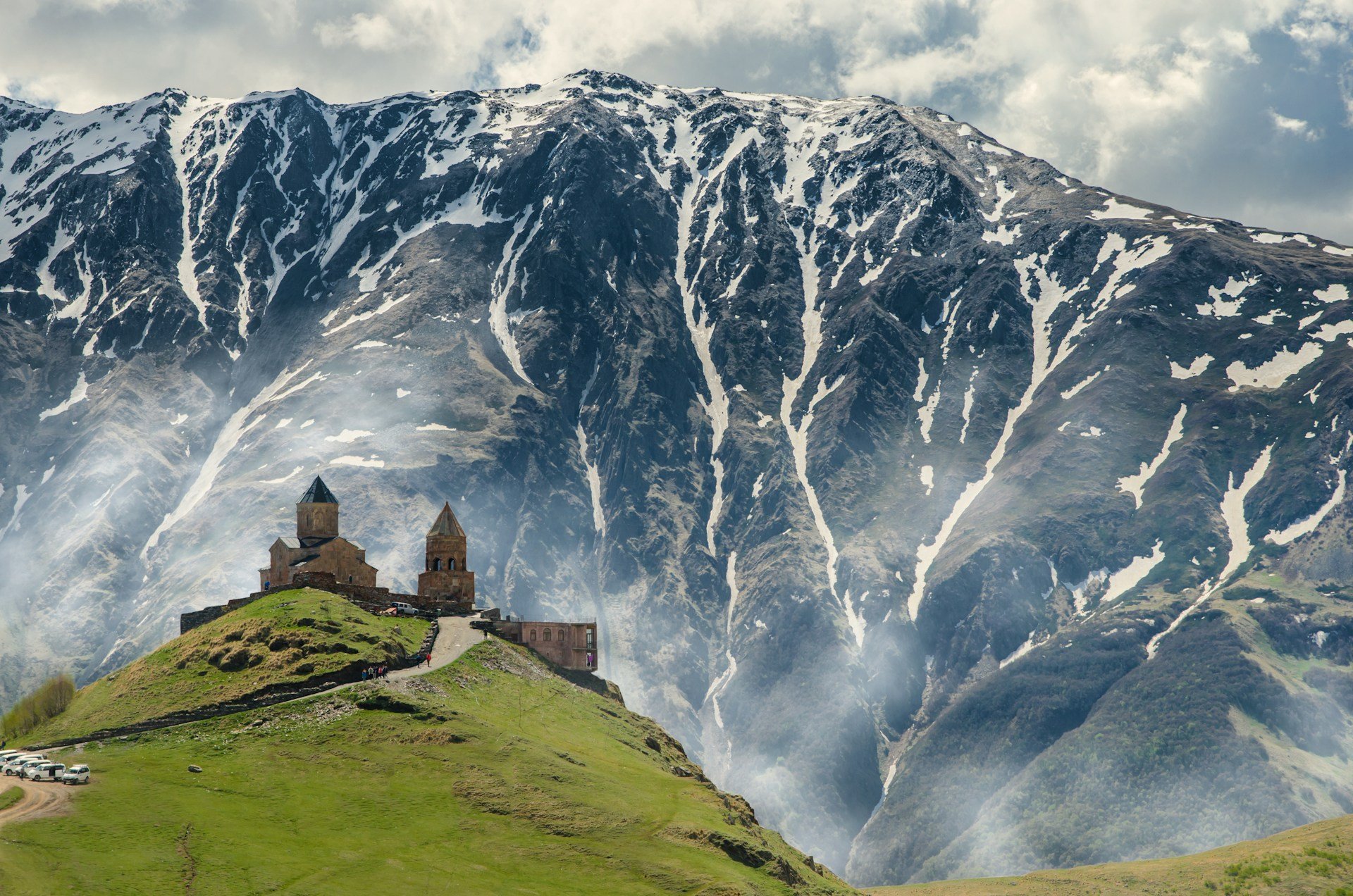
The mountains are the other half. The Georgian Military Highway north from Tbilisi passes through the Dariali Gorge and emerges at Stepantsminda (formerly Kazbegi) at 1,740m, with the Gergeti Trinity Church perched on a 2,170m crag above the village and Mount Kazbek at 5,047m behind it. The image is on every Georgian tourism advertisement for a reason: it is genuinely that arresting, and the hike up to the church takes two hours. Svaneti, in the remote northwest, is a different order of experience entirely — a highland region sealed off for centuries by the mountains surrounding it, where medieval defensive towers still stand in every village and the trails connect communities that maintained their own dialect, laws, and culture for a thousand years of relative isolation.
The wine is not incidental to any of this. Georgia is where wine was invented — archaeologically verified evidence puts the first qvevri fermentation around 6000 BCE in the Kvemo Kartli region near modern Tbilisi. The tradition of making wine in buried clay vessels, fermenting white grapes with their skins for months to produce the amber wines that the natural wine world has spent the last decade catching up with, is UNESCO-recognized intangible cultural heritage. Visiting the Kakheti wine region east of Tbilisi and tasting directly from a family's qvevri in a cellar that smells of earth and oak and fermentation is one of those experiences that can't be approximated in a wine shop anywhere else.
Georgia at a Glance
A History Worth Knowing
Georgia is one of the oldest continuously inhabited regions on earth and the archaeological evidence is startling. The Dmanisi site in southern Georgia produced hominid fossils dating to 1.8 million years ago — the oldest human ancestor fossils ever found outside Africa, suggesting that Homo erectus left Africa earlier and spread faster than previously understood. The site is still being excavated and consistently produces revisions to the standard timeline of human migration.
The wine evidence is nearly as ancient. Archaeologists working at sites in the Kvemo Kartli region southeast of Tbilisi have found traces of tartaric acid — the chemical signature of grape fermentation — in clay vessels dating to approximately 6000 BCE. This makes Georgia the oldest wine-producing region with archaeological verification, a claim supported by subsequent finds across the country and a tradition of qvevri winemaking that has continued without interruption for eight millennia. When Georgians say wine is in their blood, this is not hyperbole; it is a statement about 6,000 years of genetic and cultural inheritance.
The ancient kingdom of Colchis, on the Black Sea coast in what is now western Georgia, was the destination of Jason and the Argonauts in Greek mythology. The Golden Fleece — likely a reference to the practice of panning for gold using sheep's fleeces in Georgian mountain rivers, which was real — drew Greek colonizers who established settlements along the coast from the 8th century BCE. The eastern kingdom of Iberia (Kartli) traded with Rome and Parthia simultaneously and managed the considerable diplomatic skill required to survive between them. Christianity arrived in 337 CE, brought according to tradition by a Cappadocian slave named Nino, and became the state religion that has defined Georgian identity ever since.
The medieval period produced Georgia's golden age under Queen Tamar, who ruled from 1184 to 1213 and presided over the country's greatest territorial expansion and cultural flowering. The poet Shota Rustaveli wrote the epic poem The Knight in the Panther's Skin during her reign — a work still memorized by Georgian schoolchildren and considered the foundation of Georgian literary identity. The cave city of Vardzia, carved into a cliff face by the Mtkvari River, was built under Tamar as a monastery and refuge. It held thousands of monks in rooms connected by tunnels through the rock, and the frescoes of Tamar's image in the church at its center are still visible.
The Mongol invasions of the 13th century ended the golden age comprehensively. Georgia spent the next several centuries as a battleground between Ottoman Turkey and Safavid Persia, each sacking Tbilisi repeatedly — the city was burned and rebuilt so many times that its current character, a layering of different architectural periods and cultural influences over a single riverbed, is literally the result of successive destructions and reconstructions.
Russia entered in 1801, annexing the Kingdom of Kartli-Kakheti voluntarily — the Georgian king petitioned Russia for protection from Ottoman-Persian pressure — and then the rest of the country by conquest over the next thirty years. Russian rule brought railways, infrastructure, and the particular cultural influence that explains why older Georgians still speak Russian while younger ones are learning English. Georgian independence was briefly declared in 1918, suppressed by the Red Army in 1921, and not achieved again until April 9, 1991, when the Soviet Union's dissolution produced independence that cost more to maintain than the first time.
The post-Soviet period has been violent and unresolved in ways that directly affect modern travel. The wars over South Ossetia and Abkhazia in the early 1990s, followed by the five-day Russo-Georgian War in August 2008, left 20% of Georgian territory under Russian military occupation. Both South Ossetia and Abkhazia are controlled by Russian forces, recognized as independent by Russia and a handful of other states, and treated as Georgian territory by virtually all international law. The border through South Ossetia — the main road north to Russia — is closed and dangerous. The 2003 Rose Revolution brought Western-oriented reform. The 2024 protests over EU accession represent the latest chapter in a country still deciding which direction it faces.
Oldest human ancestor fossils found outside Africa. Georgia sits at the literal crossroads of human migration history.
Archaeological evidence of qvevri fermentation near modern Tbilisi. Eight millennia of unbroken wine tradition begins.
Saint Nino brings Christianity from Cappadocia. Georgia becomes one of the earliest Christian states on earth.
Georgia's greatest territorial expansion. Rustaveli writes The Knight in the Panther's Skin. Vardzia cave city completed.
Genghis Khan's forces end the golden age. Repeated Mongol, Ottoman, and Persian invasions follow for centuries.
Georgia absorbed into the Russian Empire. 190 years of Russian rule follows, shaping language, infrastructure, and identity.
Soviet dissolution. Independence declared April 9. Wars over South Ossetia and Abkhazia follow in the 1990s.
Five-day war in August. Russia recognizes South Ossetia and Abkhazia as independent. 20% of Georgian territory under occupation.
Georgian Dream suspends EU accession. Mass protests erupt in Tbilisi. Political situation remains unresolved as of 2026.
Top Destinations
Georgia is small — roughly the size of Ireland — but the geographic and cultural variety compressed into it requires deliberate planning. Tbilisi is the anchor. The Caucasus mountains to the north, the wine country east, the Black Sea coast and Svaneti to the west, and the cave cities to the south each deserve separate time. A two-week trip covers three or four of these properly. Don't try to rush all of them.
Tbilisi
Tbilisi is a city built on thermal springs, repeatedly destroyed and rebuilt, which has given it a layered character unlike any other capital in the region. The old town's carved wooden balconies — balakhana — overhang narrow streets where Orthodox churches, mosques, and synagogues coexist within walking distance of each other. The Narikala fortress above the old town was first built in the 4th century and offers the view that contextualizes everything below. Rustaveli Avenue is the formal axis — national museum, opera, parliament, the Rustaveli Theatre. Sololaki and Marjanishvili neighborhoods have the cafes and bars. The Dry Bridge market on weekends sells Soviet-era artifacts, antique jewelry, and carpets from a flea market that has been operating in this spot for three decades. Allow three to four days minimum.
Kazbegi (Stepantsminda)
The Georgian Military Highway north of Tbilisi passes through landscapes that escalate from agricultural valley to Alpine drama over three hours. Stepantsminda sits at the foot of Mount Kazbek (5,047m) and exists primarily as a base for the 2-hour hike up to Gergeti Trinity Church — a 14th-century church on a 2,170m promontory above the village that has become Georgia's most iconic image and remains worth it even when you've seen the photograph a hundred times. The hike is genuinely achievable for fit walkers. The views from inside the church back down the valley, with the Dariali Gorge visible in the distance, are the payoff. Stay overnight for the sunset and dawn light on Kazbek, which changes the entire scene.
Kakheti
Eastern Georgia, two hours from Tbilisi, is the country's wine heartland and the region where the qvevri tradition is most concentrated. Telavi is the regional capital and base for winery visits. Signaghi, a small fortified town on a ridge above the Alazani Valley, has the most dramatic setting — walls encircling the old town, views across to the Caucasus range, and enough natural wine bars that an afternoon can disappear very naturally. Family wineries accepting visitors include Pheasant's Tears in Sighnaghi (the reference for serious qvevri wine) and Twins Wine House in Napareuli. The Alaverdi Cathedral monastery complex near Telavi, with its 11th-century cathedral and in-house winery, is one of the most unusual religious sites in Georgia.
Svaneti
Svaneti is the region that sealed itself off from the rest of the world through the sheer verticality of its surroundings and maintained that isolation long enough to develop a culture entirely its own. The Svan towers — medieval defensive structures rising from the villages — number over 175 still standing in the Mestia and Ushguli areas. Mestia is the regional center and the base for the Svaneti trail network, including the 55km multi-day trek to Ushguli, one of Europe's highest permanently inhabited villages at 2,200m. The drive or flight to Mestia is part of the experience — the road through the Enguri Gorge is either alarming or exhilarating depending on your disposition. A small plane from Tbilisi in 55 minutes is the alternative.
Batumi
Georgia's Black Sea city is a deliberate contrast to the rest of the country — a 21st-century resort town grafted onto a 19th-century Ottoman port, with a casino industry, seaside promenade, Art Nouveau buildings in the old town, and a subtropical climate where palm trees grow alongside Soviet-era apartment blocks. The old town around Piazza Square has the best architecture. The Batumi Botanical Garden on the northern headland is one of the best in the Caucasus region. In summer it's popular and slightly chaotic; in spring or autumn it's genuinely pleasant. Batumi is best understood as a contrast to the rest of Georgia rather than a substitute for it.
Vardzia
A cave monastery carved into a cliff face above the Mtkvari River in southern Georgia, built in the 12th century under Queen Tamar and expanded to house thousands of monks across 13 floors of interconnected rooms, churches, and wine cellars cut directly into the volcanic rock. Tamar's own portrait survives in the fresco cycle of the main church. The scale of what was excavated from solid rock with medieval tools is one of those things that photographs never quite convey — you understand it only when you're standing at the bottom looking up at 3,000 rooms stacked into a cliff face. Three hours south of Tbilisi, worth a dedicated day trip.
Mtskheta
Georgia's ancient capital, 20km north of Tbilisi, where the Aragvi and Mtkvari rivers meet. The Svetitskhoveli Cathedral, built in the 11th century over the site where Christ's robe was supposedly buried, is the most important religious building in Georgia and the coronation church of Georgian kings for centuries. Jvari Monastery on the hilltop above the confluence was built in the 6th century and is the view that defines the approach to Mtskheta. Both are UNESCO World Heritage sites. Half a day from Tbilisi; easily combined with the journey toward Kazbegi.
Javakheti & Borjomi
The mineral water town of Borjomi in the Borjomi Gorge produces the most famous product in Georgia — Borjomi sparkling water, drunk across the former Soviet Union for 150 years and supposedly with medical properties that kept the Romanovs coming to the region annually. The gorge itself is excellent walking country. The Javakheti plateau south of Borjomi is an Armenian-majority highland of volcanic lakes and treeless steppe that feels nothing like the rest of Georgia. Lake Paravani and the fortress town of Akhaltsikhe with its Rabati Castle complex are the key stops.
Culture & Etiquette
Georgian hospitality — stumartmaspindzloba in Georgian — is not a cultural value in the way that, say, punctuality is a cultural value in Finland. It is closer to a religious obligation. The old proverb is "a guest is a gift from God," and in practice this means that if a Georgian invites you into their home or to their table, the question of whether the food will run out or the wine will be enough is simply not a consideration that arises. You will be fed until you cannot move. You will be offered a toast by the tamada (toastmaster) and expected to respond. The correct response to all of this is gratitude, participation, and eating considerably more than you thought you were going to.
The formal social context is the supra — a Georgian feast that follows a specific structure with a tamada leading toasts to God, peace, the homeland, guests, ancestors, and the future, in an order that is traditional and not random. A tourist sitting at a Georgian family supra and participating in the toasts, even incompetently, is one of the most warmly received things a visitor can do in this country. The wine poured for toasts is usually local and good. The obligation is to drink, not to drain the glass, but draining it will not disappoint anyone.
Refusing food or wine in a Georgian home is culturally equivalent to rejecting the person's hospitality — a significant rebuff. If you truly cannot eat or drink more, a polite "enough, thank you, it is wonderful" with your hand over the glass is better than refusal. If you don't drink alcohol, say so before the toasts begin; this is entirely understood and respected.
"Gamarjoba" (hello) and "madloba" (thank you) are the two words that will produce the most disproportionately warm response from Georgians of any words you can learn. The Georgian script (Mkhedruli) is beautiful and completely unique — attempting to read even one word from a sign will cause genuine delight.
Georgia's Orthodox churches are active religious spaces with dress codes: women cover their heads (scarves available at entrances), both genders cover shoulders and knees. This applies throughout the country and is expected, not optional. Monasteries in Svaneti and Kakheti enforce this consistently.
At any Georgian table, the tamada leads toasts and everyone drinks together. Standing for important toasts (to God, to peace, to the fallen) is the correct response. Proposing your own toast to your Georgian hosts — in any language — will be received with genuine pleasure.
Many markets, marshrutkas, and village guesthouses are cash-only. Georgian lari is the currency. USD and EUR are accepted at some tourist-facing businesses but at variable rates. ATMs in Tbilisi are abundant; in rural areas, bring cash from the city.
Both territories are under Russian military control. South Ossetia's "border" with Georgia proper is a live conflict line. Abkhazia can technically be reached from the Georgian side via one checkpoint but is not recognized as safe for independent travel and any visit may complicate future Georgian visa applications. No tourist purpose justifies the risk.
For most Georgians, Russia is the country that occupies 20% of their territory, has destroyed their cities multiple times, and forced hundreds of thousands of their citizens into displacement. Expressing any sympathy for Russian political positions in a Georgian context is at best deeply insensitive. Listen rather than opine.
Georgia has been in periodic military tension and its security forces are visible and sensitive about documentation. Photographing military installations, checkpoints, or police operations without clear permission is inadvisable and can result in confrontation.
The Caucasus produces weather changes that are faster and more severe than most European mountain ranges. Storms that weren't on the forecast appear within an hour. In Svaneti and around Kazbegi, summer storms with lightning and hail above the treeline are common. Carry waterproof layers regardless of morning conditions.
Tbilisi's tap water is generally safe. Rural Georgia's water quality varies and stomach issues from untreated water are a common traveler complaint. Bottled water costs ₾1–2 everywhere. Borjomi mineral water from the source in Borjomi Gorge is technically safe and spectacular.
Polyphonic Singing
Georgian polyphonic choral singing — three independent vocal lines that interweave without a conductor and resolve into harmonies unlike any other tradition in the world — is UNESCO intangible cultural heritage. It developed in different forms in different regions: the Svan style from the highlands, the Kakhetian style from the east, the Kartlian style from central Georgia. You can hear it performed in churches on Sunday mornings and at specialized concerts, but the most authentic version is when a group of men at a supra simply begin singing between toasts because the mood requires it.
Orthodox Christianity
The Georgian Orthodox Church is not merely a religious institution but one of the primary carriers of Georgian national identity. The Church under Patriarch Ilia II commands enormous popular respect and political influence. Christianity in Georgia predates the Roman Empire's adoption by a decade, and the specific Georgian form — with its own script created specifically to translate the Bible, its own saints, its own iconographic tradition — is distinct from both Eastern Orthodoxy and Western Christianity in ways worth understanding before you visit. Behave with genuine respect in churches; this is not optional etiquette.
The Georgian Script
Mkhedruli — the Georgian alphabet — is one of only 14 alphabets in current use worldwide that belong to no other script family. It was created specifically for the Georgian language in the 5th century CE and has been used continuously since. The rounded, flowing characters appear everywhere — on church inscriptions, street signs, wine labels, tattooed on arms — and function as a visual symbol of Georgian distinctness. Learning to recognize even a few letters changes how the country looks around you.
Wrestling & Sport
Georgia produces wrestlers at a rate that is statistically remarkable for a country of 3.7 million — multiple Olympic and World Championship medals across freestyle and Greco-Roman wrestling, as well as judo. Georgian martial arts (chidaoba, the traditional wrestling form) is practiced at festivals. Rugby, introduced by the French in the 1990s, has become the national sport with remarkable speed — Georgia regularly competes at Rugby World Cups and consistently upsets tier-one nations. A Georgian national team match is an excellent evening in Tbilisi.
Food & Drink
Georgian food is among the most distinctive cuisines in the world and the most underknown outside the former Soviet Union, which is an injustice that is slowly being corrected. It combines the walnut-and-herb complexity of Persian cooking, the stone-oven bread tradition of the Caucasus, the cheese culture of Alpine Europe, the grape-leaf stuffing of the Mediterranean, and the dumpling tradition of Central Asia into something that is entirely none of these things and entirely itself. The food writer Jeffrey Steingarten called it the best cuisine he'd never heard of. He was describing the 1990s, but the sentiment is still approximately true.
The khinkali — a large soup dumpling filled with spiced meat broth and pork or beef, eaten by holding the knotted top, biting a hole in the side, drinking the broth, then eating the rest, and leaving the knot on the plate — is the essential Georgian food experience and costs ₾4–8 for a portion of six at any local restaurant. Getting this ritual right matters to Georgians and learning it signals the right kind of seriousness about the food.
Khinkali
The Georgian soup dumpling, filled with spiced minced meat or potato or cheese or mushroom, with a thick knotted top you hold while eating and leave on the plate when done. The broth inside is the point — bite the side carefully and drink it before the rest. Eating more than ten is a point of pride that Georgians will respect. Anything above twelve requires documentation. The best khinkali in Georgia are from mountain villages in Svaneti and Mtiuleti, where the recipe hasn't changed and the portions haven't shrunk.
Khachapuri
Georgia has multiple varieties of cheese-filled bread, none of which resemble what the word "bread" suggests elsewhere. The Adjarian khachapuri — a boat-shaped dough filled with molten sulguni cheese, topped with a raw egg and a knob of butter at the table, then stirred into the cheese before eating — is the most famous and the one that has started appearing on menus in Brooklyn and London. It costs ₾10–18 in Tbilisi and substantially less in Adjara itself. Order it, eat it immediately, and don't attempt to eat anything else for several hours.
Mtsvadi & Churchkhela
Mtsvadi is Georgian shashlik — skewered meat (usually pork or lamb) grilled over vine cuttings, seasoned with nothing except the smoke and a squeeze of pomegranate. In the right hands, with the right firewood, it's extraordinary. Churchkhela is the Georgian energy bar: walnuts threaded onto a string, dipped repeatedly in thickened grape must until coated in a candle-shaped layer of solidified grape juice. It looks alarming, lasts for months, and tastes exactly like its component parts — walnut, grape, nothing else — in a combination that makes complete sense once you've eaten one.
Walnut Dishes
Walnuts are to Georgian cooking what olive oil is to Mediterranean cooking — a foundational fat and flavoring that appears across half the menu. Badrijani nigvzit: thin fried eggplant rolled around a paste of ground walnut, garlic, and fenugreek. Pkhali: compressed balls of minced vegetables (spinach, beetroot, green bean) bound with the same walnut paste. Satsivi: a cold walnut sauce with garlic and spice served over poultry. The walnut dishes are typically vegetarian and among the finest things Georgian cooking produces.
Qvevri Wine
The amber wines of Georgia — made by fermenting white grapes with their skins and seeds in buried clay qvevri vessels for months — are the oldest winemaking tradition on earth and the origin of what the natural wine world calls "orange wine." They taste nothing like conventional white wine: tannins, texture, earth, dried fruit, and a complexity that benefits from serving slightly cool but not cold. Rkatsiteli from Kakheti and Rkatsiteli-Mtsvane blends are the starting points. A bottle at a Tbilisi wine bar costs ₾15–30. A bottle from the producer's cellar in Kakheti costs ₾10–15 and the experience of drinking it there is worth the trip.
The Supra Table
A Georgian feast table (supra) is assembled rather than served course by course — everything arrives together and you eat from shared dishes throughout. Cold dishes (pkhali, badrijani, lobiani bean bread, salads), hot dishes (khinkali, mtsvadi, lobio bean stew in a clay pot), bread (shoti, the canoe-shaped bread from a tone oven), and wine all present simultaneously. The tamada toasts structure the meal temporally. The only correct approach to a supra is to abandon any thoughts about portion control for the duration and regret nothing.
When to Go
Georgia is a four-season destination with genuinely different experiences in each. The sweet spots are May through June and September through October — warm enough for mountain hiking and outdoor eating, cool enough to be comfortable in Tbilisi, and outside the peak summer crowds that have descended on the popular destinations since tourism began growing seriously in 2015. September is harvest season in Kakheti and arguably the best single month to visit: wine country in full harvest, autumn light, and the Rtveli wine festival in Telavi where the entire region is pressing grapes and drinking last year's vintage simultaneously.
Autumn
Sep – OctHarvest season in Kakheti. The Rtveli festival in September. Warm days, cool evenings, outstanding food and wine availability. Mountain trails still open. The light in October in Tbilisi's old town is the specific quality that painters keep returning to.
Late Spring
May – JunWildflowers in the mountain meadows. All hiking trails open by mid-May. Svaneti roads operational. The best time for mountain hiking before the July–August heat and tourist peak. Tbilisi has long warm evenings ideal for outdoor dining in the Fabrika or Marjanishvili bar districts.
Winter
Dec – FebTbilisi is mild and functional in winter. The ski resorts at Gudauri (1.5 hours from Tbilisi) and Bakuriani offer good skiing at prices well below Western European alternatives. The Svaneti road may close. Kazbegi is accessible but cold. Hot sulfur baths in the Abanotubani are at peak desirability.
Peak Summer
Jul – AugTbilisi in July and August is hot (35°C+), crowded with domestic tourists and a rapidly growing international tourist influx, and priced accordingly. Kazbegi and Svaneti are at their busiest. Batumi is peak season for Georgian and regional beach tourism. Not bad, but not the Georgia that most people fall in love with.
Trip Planning
One week covers Tbilisi plus Kazbegi and Kakheti adequately. Two weeks adds Svaneti properly, Vardzia, and time to slow down. Three weeks covers the full country at the pace it deserves. The key constraint is that many of Georgia's best destinations require significant road time — Svaneti is a full day's journey from Tbilisi each way, and the road itself requires either a hardy stomach or a flight. Plan with generous buffer time; Georgian roads are improving but still require patience.
Tbilisi
Day one: land, walk from wherever you're staying to the old town, eat khinkali at a local place, drink wine at a natural wine bar on Erekle II Street. Don't try to do too much. Day two: Narikala fortress in the morning, Abanotubani sulfur baths in the afternoon — book a private room at Royal Bath or Gulo's Thermal Spa for two hours. Day three: Georgian National Museum (the Treasury specifically), Dry Bridge flea market if it's the weekend, evening at Fabrika's outdoor bar complex in Chugureti.
Mtskheta Day Trip
30 minutes by marshrutka north of Tbilisi. Jvari Monastery for the river confluence view, Svetitskhoveli Cathedral, lunch at a local restaurant with mchadi (cornbread) and lobio (bean stew). Back to Tbilisi by afternoon. Easy, essential, cheap.
Kazbegi
Either hire a driver from Tbilisi (₾150–200 round trip, the standard approach) or take the marshrutka from Didube station (₾15, 3 hours). Hike to Gergeti Trinity Church on arrival afternoon. Overnight in Stepantsminda — the guesthouses are cheap and the hosts usually feed you dinner. Second day: walk up the Chkheri Valley for Kazbek views or the Arsha waterfall trail. Return to Tbilisi in the evening.
Kakheti
A day trip or overnight to Sighnaghi — two hours from Tbilisi — via a driver or taxi. Pheasant's Tears winery for lunch and a tasting of qvevri wines. Walk the old town walls. Buy wine directly from the cellar to take home (bring an empty bag). Return to Tbilisi for departure.
Tbilisi in Depth
Four days: all the Tbilisi essentials plus a proper evening at a Georgian family-style restaurant for the full supra experience. The Baro tapas bar on Shavteli Street for natural wine and small plates. The Rustaveli Avenue museums. The Fabrika complex and Marjanishvili neighborhood for Tbilisi's younger cultural scene.
Kazbegi & Military Highway
Hire a car and driver for two nights. Stop at Ananuri fortress on the Zhinvali reservoir on the way north — a 17th-century castle complex above an emerald lake. Overnight in Stepantsminda. Full day hiking: Gergeti Church and then further up toward the Gergeti glacier if conditions allow. Third day: the Dariali Gorge and Sno Valley.
Kakheti Wine Country
Self-drive or hired car east to Telavi. Base in Sighnaghi for two nights. Pheasant's Tears winery, Twins Wine House, Alaverdi Cathedral monastery. The Gombori mountain pass road connecting Sighnaghi to Tbilisi (unpaved sections in places, extraordinary views) for the return drive.
Vardzia & South Georgia
Rent a car south through Borjomi (drink from the source, buy a case to take home) and on to Vardzia. Two hours at the cave city. Drive back through Akhaltsikhe and Rabati Castle. Return to Tbilisi via Borjomi Gorge. Final evening: the best restaurant dinner of the trip — Barbarestan on Davit Aghmashenebeli Ave, cooking from a 19th-century Georgian cookbook, reservation required.
Tbilisi
Four full days. Include a day trip to Mtskheta and an evening at a Georgian traditional music concert — the Anchiskhati church choir performs Sunday services; the Tbilisi State Conservatory has student concerts most evenings that cost essentially nothing.
Svaneti
Fly Tbilisi to Mestia (55 minutes, Van Air, book ahead). Three nights in Mestia — the tower-houses and the Svaneti Museum of History and Ethnography. Day hike to Koruldi Lake above Mestia (1,300m ascent; worth it for the view of four 4,000m+ peaks simultaneously). The Chalaadi glacier walk. Consider the multi-day Mestia–Ushguli trek if you have the fitness and gear.
Kazbegi & Military Highway
Fly back to Tbilisi and continue to Kazbegi by car. Two nights in Stepantsminda. Gergeti Trinity Church, the Gergeti glacier approach, the Sno Valley. The Kazbegi National Park trailhead office at the park entrance has current trail conditions and permit requirements.
Kakheti Harvest Season
In September, time this section for the Rtveli harvest festival. Stay at a family guesthouse in a Kakhetian village — the kind where the host wakes you up to help pick grapes at 6am if you're interested, which you should be. Telavi market, Alaverdi Cathedral, Pheasant's Tears, the Bodbe Convent where Saint Nino is buried.
South Georgia & Batumi
Drive south: Vardzia cave city, Borjomi, Akhaltsikhe's Rabati Castle. Then west to Batumi for two nights — the botanical garden, the old town Art Nouveau quarter, a Black Sea sunset dinner of fresh sea bass with Adjarian wine. Drive or train back to Tbilisi for departure from TBS airport.
Vaccinations
No mandatory vaccinations required for Georgia. Recommended: Hepatitis A and B, Typhoid (if eating from street vendors or local markets), and routine vaccines up to date. Rabies vaccination recommended for extended rural travel given the presence of stray dogs in towns and villages.
Full vaccine info →Connectivity
A local SIM on arrival at Tbilisi airport or any Magti/Silknet/Beeline shop is the best option — a 10GB data plan costs ₾15–25. Coverage in Tbilisi and on main roads is good 4G. In Svaneti villages and remote mountain areas, data connectivity drops to patchy 2G or nothing. Download offline maps (Maps.me works well in Georgia) before leaving Tbilisi.
Get Georgia eSIM →Power & Plugs
Georgia uses Type C and Type F (Schuko) plugs at 220V/50Hz. Standard continental European adapter. North American and UK visitors need a plug adapter. Power outages in rural Georgia are occasional — guesthouses in Svaneti and remote villages may have intermittent electricity. Carry a power bank.
Language
Georgian (Kartuli), with its unique Mkhedruli script. Russian is widely understood, especially by anyone over 35. English is functional in Tbilisi's tourist areas and among young Georgians but limited in rural areas and small towns. Download Google Translate with Georgian and Russian offline. The camera translation function works on Georgian script with reasonable accuracy.
Stray Dogs
Georgia has a visible stray dog population in towns and cities. Most are tagged (indicating neutering and vaccination programs) and non-aggressive. However, in rural areas and around monasteries, territorial dogs can be aggressive toward hikers. Carry a walking stick on mountain trails — more as a visual deterrent than a weapon. If charged by a dog, stop walking, stand still, avoid eye contact, and move away slowly when it loses interest.
Travel Insurance
Travel insurance with medical evacuation cover is strongly recommended for Georgia, particularly for mountain activities in Kazbegi and Svaneti. Georgian hospitals vary significantly in quality; serious injuries require evacuation to Tbilisi. Mountain rescue exists but response times can be long. Hiking in the Greater Caucasus without insurance is a decision with real financial consequences if something goes wrong.
Transport in Georgia
Georgia's transport infrastructure is improving steadily but is still firmly in the developing stage. Tbilisi has a functional metro, buses, and excellent ride-hailing apps. Intercity travel is dominated by the marshrutka — a minibus taxi that runs fixed routes, departs when full rather than on schedule, and costs very little. Trains connect Tbilisi to Batumi and Kutaisi. For anywhere beyond the main routes, a hired driver is the most effective and often most affordable approach for groups of two or more.
Tbilisi Metro
₾1/tripTwo lines covering the main city corridors. Clean, reliable, cheap. Top up a metro card (₾2 deposit) at any station. The Rustaveli and Liberty Square stations are the tourist hubs. Runs until midnight.
Marshrutka (Minibus)
₾10–30The backbone of Georgian intercity travel. Tbilisi–Kazbegi: ₾15, 3 hours, departs Didube bus station when full (usually around 10am). Tbilisi–Batumi: ₾25, 5 hours. Tbilisi–Telavi: ₾10, 2 hours. No fixed departure times — arrive early and wait. Inexpensive and functional.
Yandex Go / Bolt
₾5–20 across TbilisiBoth apps operate in Tbilisi and are the recommended way to take taxis within the city. Yandex Go (formerly Yandex Taxi) has the widest coverage. Standard street taxis in Tbilisi require negotiating a price before getting in — always agree the fare first or use an app.
Tbilisi Airport (TBS)
₾50 by taxiLocated 18km east of the city center. Taxi from airport to center via Yandex Go: ₾40–60, 30–45 minutes. No direct metro connection. The airport taxi queue outside arrivals uses official airport taxis at higher fixed rates than app-based options — walk out of the terminal exit and order via Yandex Go for better prices.
Train
₾20–40Trains connect Tbilisi to Batumi (5 hours, ₾35 in first class), Kutaisi (3 hours), and Borjomi (2.5 hours). The overnight train to Batumi is a pleasant way to travel. Book at railway.ge or in person at Tbilisi Central Station. Trains are slower than marshrutkas but more comfortable for long routes.
Car Rental / Hired Driver
₾80–150/day (car); ₾150–300 (driver)Self-drive is feasible but Georgian driving culture is assertive and mountain roads require experience. For Kazbegi and Svaneti, a hired driver with a 4WD vehicle (₾150–250 for Kazbegi day return, ₾300–500 for Svaneti return) is the most practical option for most visitors. Drivers are available through guesthouses and via the Bolt driver network.
Domestic Flights
₾90–200 one wayVan Air operates Tbilisi–Mestia (Svaneti) flights in small propeller aircraft (55 minutes vs 8+ hours by road). Weather-dependent and subject to cancellation in poor visibility — build a buffer day before any onward connection. Book at vanair.ge well in advance for summer and autumn.
Bike & Scooter Rental
₾30–80/dayTbilisi has electric scooter rentals (Bolt and Lime) for navigating the old town and flat areas. For longer routes, bicycle rental shops on Erekle II Street in the old town offer mountain bikes for the Mtskheta day trip and short rides. Motorcycles are available for experienced riders wanting to do the Military Highway independently.
For most visitors, a hired driver beats self-drive for routes outside Tbilisi. Georgian mountain roads are narrow, occasionally unmarked, and shared with cows, trucks, and drivers with significantly different risk assessments than most Western visitors. A driver for the Kazbegi run costs ₾150–200 round trip, which split two ways is less than car rental plus the fuel, insurance, and stress. For multi-day rural itineraries, a trusted driver (ask your guesthouse for recommendations) is both cheaper for groups and considerably less fraught than navigating Svaneti's tracks in an unfamiliar vehicle.
Accommodation in Georgia
Georgia's accommodation landscape has transformed rapidly since 2015. Tbilisi now has boutique hotels in renovated Soviet-era buildings and old-town mansion guesthouses alongside the international chains. Outside the capital, the guesthouse (stumari saxli) model dominates — family-run accommodation where breakfast and dinner are often included and where you'll eat better than at any restaurant in the area. The mountain guesthouses in Kazbegi and Svaneti are the best argument for this format: basic rooms, extraordinary home cooking, views of the Caucasus from the window.
Boutique Hotels (Tbilisi)
₾200–600/night (~$75–220)Tbilisi's boutique scene is excellent and affordable by Western European standards. Fabrika Hostel in Chugureti (a former Soviet sewing factory converted into hotel, hostel, market, and bar complex) is the reference for the creative end. Hotel Stamba in Vera, converted from a Soviet printing house, is the design reference at the luxury end. Both operate on a philosophy of Georgian industrial heritage that produces genuinely interesting spaces.
Mountain Guesthouses
₾60–120/night (~$22–44) incl. mealsThe guesthouses in Stepantsminda (Kazbegi), Mestia (Svaneti), and Sighnaghi (Kakheti) include dinner and breakfast in their rates and the food is typically better than any restaurant nearby. Hosts speak basic English; meals are served family-style with local wine or chacha (grape spirit). Book through Booking.com in advance for July–August; the rest of the year you can often just arrive.
Hostels
₾30–60/night (~$11–22)Tbilisi has a genuinely good hostel scene. Fabrika Hostel, Envoy Hostel (old town, carved wooden balcony, social atmosphere), and Pushkin 10 are all well-regarded. Hostel culture has extended to the mountain towns — Stepantsminda and Mestia both have hostels with common kitchens and organized day hike groups. Georgia is one of the cheapest hostel destinations in the region.
Apartment Rentals
₾100–250/night (~$37–92)For longer stays in Tbilisi, apartment rentals via Airbnb or Booking.com offer significant value. The old town and Sololaki neighborhoods have apartments in historic buildings with carved balconies at prices well below comparable European cities. A one-bedroom apartment in a characteristic building in the old town for a week costs less than a mid-range Tbilisi hotel for three nights.
Budget Planning
Georgia is one of the most affordable destinations available to Western travelers, and this is not a relative statement — it is an absolute one. A full meal with local wine for two people at a proper Georgian restaurant costs ₾60–100 ($22–37). A bottle of good qvevri wine at a Tbilisi wine bar costs ₾20–40 ($7–15). A private sulfur bath in the Abanotubani for two hours costs ₾25–50 ($9–18). Budget travelers consistently discover Georgia and restructure their understanding of what travel should cost. The main budget pressure is flights, not the country itself.
- Hostel dorm (₾30–50/night)
- Khinkali and khachapuri at local spots
- Metro and marshrutka transport
- House wine at local restaurants (₾5–8)
- Free churches, fortresses, old town walking
- Guesthouse or mid-range hotel
- Full Georgian restaurant dinners
- Private sulfur bath experience
- Hired driver for day trips
- Qvevri wine tasting at Kakheti wineries
- Boutique hotel or luxury guesthouse
- Dinner at Barbarestan or top restaurants
- Private tours and wine estate access
- Flights to Mestia for Svaneti
- Mountain guide for Kazbek or Svaneti treks
Quick Reference Prices
Visa & Entry
Georgia has one of the most generous visa policies in the world. Over 100 nationalities can enter and remain for up to 365 days without any visa — not 90 days, not 30 days, but a full year. This makes Georgia exceptional even by global standards and explains why it has become a significant destination for remote workers and long-term travelers. Citizens of the US, UK, all EU countries, Canada, Australia, New Zealand, Japan, South Korea, and most other Western nations qualify for the 365-day visa-free policy.
The entry process is simple: arrive at Tbilisi International Airport, present your passport to the border officer, receive an entry stamp. There are no forms to fill out in advance, no pre-registration systems, and no fees for most qualifying nationalities. The one significant requirement is proof of onward travel if asked — border officers occasionally check this for visitors from countries where overstaying has been an issue.
Over 100 nationalities including US, UK, EU, Canada, Australia, and New Zealand can stay up to one year without a visa. Check the Georgian Ministry of Foreign Affairs website for the complete current list before booking.
Family Travel & Pets
Georgia is a deeply child-oriented society. Children are welcomed everywhere — at restaurants, at family supras, in churches, at late-night gatherings — and Georgian adults treat children with an affectionate directness that can feel overwhelming but is entirely sincere. A family visiting Georgia will eat very well, spend very little, and be treated with a warmth that has nothing to do with commercial hospitality. The practical challenges are the transport infrastructure (long, rough roads to mountain destinations) and the lack of specific children's attractions — Georgia offers natural and cultural experiences rather than purpose-built family facilities.
Kazbegi for Families
The Gergeti Trinity Church hike (2 hours up, 1.5 hours down, 2,170m destination) is achievable for children from around age 8 with reasonable fitness. The views justify the effort in a way that's self-evident to children. The village of Stepantsminda itself — horses grazing on the main street, Kazbek visible from the front door of any guesthouse — is the kind of place children absorb without being told to appreciate it.
Food & Children
Georgian food works extremely well for children: khinkali dumplings are universally accepted, khachapuri is essentially cheese bread, mtsvadi is grilled meat on a stick, and there's always bread and cheese at the table. The natural wine is obviously not for children, but the grape juice produced by the same families and the Borjomi mineral water are both excellent alternatives. No Georgian host will let a child leave the table hungry.
Vardzia Cave City
3,000 rooms carved into a cliff face, tunnels connecting them, frescoes from 800 years ago. Children who couldn't name a single cave monastery before visiting Vardzia will describe it in detail for months afterward. The site is climbable (basic safety precautions needed), the scale is dramatic, and the concept — a city inside a mountain — communicates immediately regardless of age.
Horse Riding
Georgia has a strong equestrian tradition, particularly in the mountain regions. Horse riding excursions in Kazbegi and Svaneti are available from around ₾50–100/hour per horse and provide access to trails that aren't easily walkable with younger children. Many Kazbegi guesthouses have horses. This is one of those activities where Georgia's remoteness becomes a feature rather than a limitation.
Church History for Children
The Mtskheta combination — Jvari Monastery on its hilltop and Svetitskhoveli Cathedral below — is accessible, visually striking, and the stories behind them (a cloth robe buried under a cathedral, a woman missionary from Cappadocia, 1,700 years of continuous use) are the kind of narrative detail that holds children's attention more reliably than pure architecture. 30 minutes from Tbilisi by marshrutka.
Sulfur Baths
The private rooms at Tbilisi's Abanotubani baths are excellent for families: a tiled private chamber with a naturally heated sulfur pool, a wooden changing room, and an hour or two of soaking. Children find the sulfur smell memorable (in their own words: "like farts") and the hot water genuinely relaxing. Book a private room (₾25–60 for the room, not per person) at Gulo's Thermal Spa or Royal Bath for the best experience.
Traveling with Pets
Georgia's pet entry requirements follow a relatively straightforward health certificate model. Dogs and cats require a microchip, valid rabies vaccination, and a veterinary health certificate issued within 10 days of travel and endorsed by the relevant government authority in your country. An import permit from the Georgian National Food Agency may be required — check current requirements at food.gov.ge before booking, as these have changed periodically.
Practically, Georgia is not an especially pet-friendly travel destination in the way that France or Germany are. Hotels and guesthouses generally do not accommodate pets, particularly in mountain regions where guesthouses are small family operations. The stray dog population in Georgian towns and cities is significant and can be threatening to smaller domestic animals. Hiking trails in national parks are open to dogs but the same stray dog risk applies on rural roads.
If you bring a pet to Georgia, the most practical approach is to book accommodation specifically confirmed as pet-friendly (verify directly with the property), carry a sturdy lead and consider a muzzle for crowded areas, and be aware that veterinary care outside Tbilisi is limited. For most visitors, leaving pets at home is the more practical choice for Georgia specifically.
Safety in Georgia
Georgia's safety situation requires a layered answer. For the vast majority of tourist experiences — Tbilisi's old town, Kazbegi, Kakheti, Svaneti, Batumi, the main cultural and historical sites — Georgia is safe and crime against tourists is uncommon. The risks that exist are specific and mostly avoidable with information. The political volatility since 2024 adds a dimension that requires monitoring but has not, as of early 2026, significantly affected tourist safety in core travel areas.
Tbilisi General Safety
Low violent crime rate in tourist areas. Petty theft in crowded markets (Dry Bridge, Dezerter Bazaar) and on public transport is the main concern. The old town and Sololaki are safe at night. Standard urban bag awareness applies.
Political Situation (2024–present)
Large-scale protests in Tbilisi since late 2024 over EU accession suspension have occasionally turned confrontational between protesters and police. Avoid large protest gatherings and check current conditions before travel. The core tourist areas have remained functional but the political atmosphere is tense. Check government travel advisories regularly.
Mountain Safety
The Caucasus mountains are serious terrain. Weather changes fast; Kazbegi and Svaneti trails can become dangerous in summer storms. Never hike above the treeline without full waterproof kit, a map, and a charged phone. The Gergeti Trinity Church trail is well-worn but exposed to lightning in afternoon storms — start early and be off the ridge by noon in summer.
South Ossetia & Abkhazia
These occupied territories are off-limits and dangerous. The South Ossetian "border" is a live military boundary with unpredictable Russian and South Ossetian security forces. Abkhazia's single crossing point is technically accessible but legally and practically problematic. Multiple governments advise against all travel to both areas. No tourist purpose justifies the risk.
Road Safety
Georgian roads and driving culture require respect. Mountain roads are narrow, poorly marked, and shared with trucks and livestock. Night driving in rural areas is significantly more dangerous than daylight. The Georgian Military Highway at night or in poor visibility should not be attempted by unfamiliar drivers. Hire a local driver for mountain routes.
Solo Women
Georgia is generally safe for solo female travelers. Street harassment in Tbilisi is less prevalent than in some regional neighbors. In conservative rural areas and among older generations, a solo foreign woman may attract curious attention that is rarely threatening but can be uncomfortable. Dressing modestly outside Tbilisi reduces unwanted attention. The nightlife areas of Tbilisi are comparable to any mid-sized European city.
Emergency Information
Your Embassy in Tbilisi
Most embassies are in the Vake district of Tbilisi.
Book Your Georgia Trip
Everything in one place. These are services worth actually using.
You Will Be Fed Until You Cannot Move. This Is the Welcome.
The thing that stays with visitors to Georgia is not the mountains, though the mountains are extraordinary. It is not the wine, though the wine is unlike anything made anywhere else. It is the experience of being treated by strangers as if your arrival were an occasion. Georgians have a concept — stumartmaspindzloba — that translates approximately as "the host-guest relationship" but means something more fundamental than the words suggest. The guest's wellbeing is the host's honor. The act of feeding and sheltering a traveler is not optional generosity but a moral obligation with deep religious and cultural roots.
This produces a country where you will be invited into homes you didn't expect to enter, fed food you didn't order, poured wine you didn't ask for, and toasted to by a man you met twenty minutes ago who has appointed himself the tamada of the moment and is now proposing a speech about Georgia's place in the story of humanity. The correct response to all of this is to stop resisting and start eating. Georgia is a country that insists on being experienced at close range. It works.