
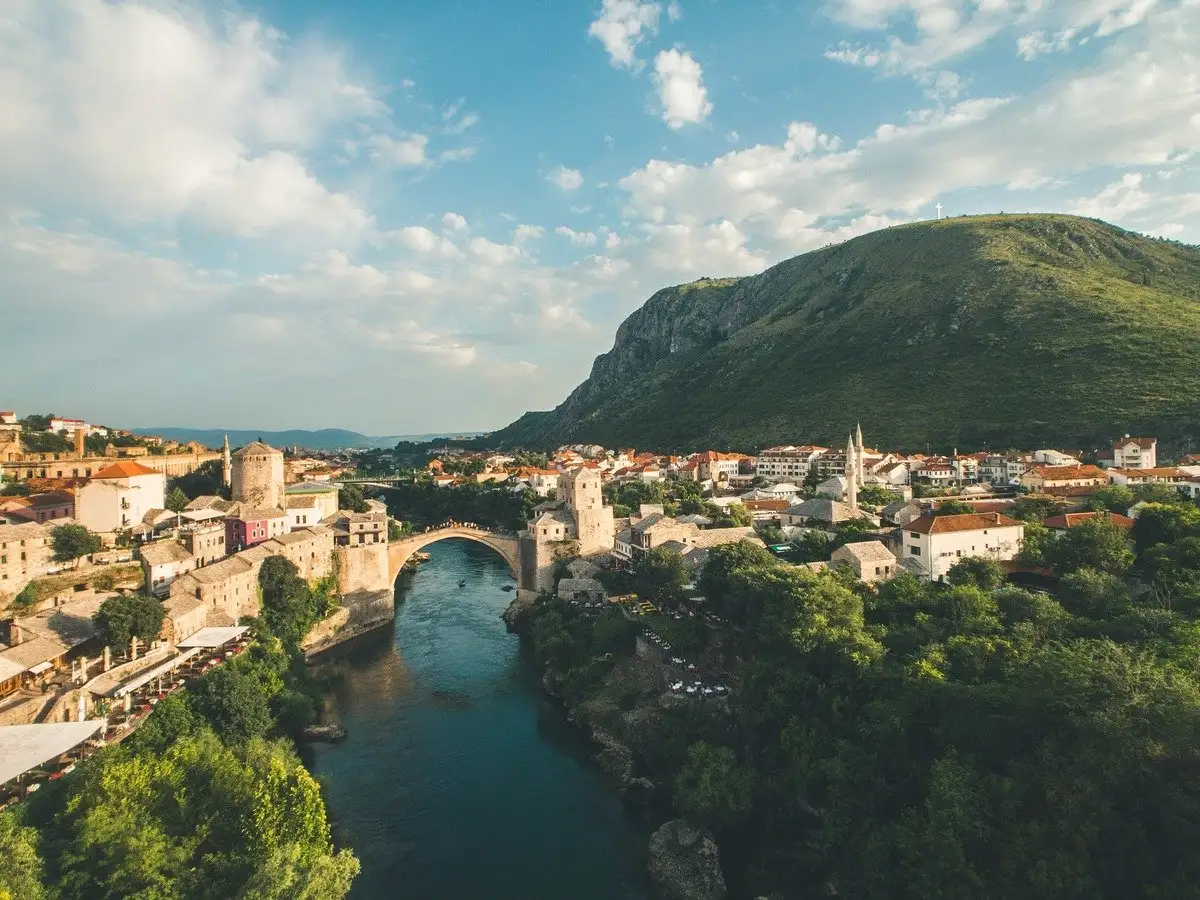
Bosnia & Herzegovina
A country where you can hear the call to prayer and church bells simultaneously from the same street corner. Where war cemeteries cover the hillsides above a city that rebuilt itself and kept going. Where coffee is not a drink but a ceremony, and where almost everyone who visits says it was the best surprise of their trip.
What You're Actually Getting Into
Bosnia and Herzegovina is the kind of country that recalibrates your sense of what European travel can be. It is cheap, genuinely welcoming, historically dense, physically beautiful, and still in the process of understanding what it is after the 1990s war that the international community has largely moved on from and Bosnians have not. Coming here requires engaging with that reality. Not dwelling in it, not treating it as dark tourism, but understanding that the hillside cemeteries with their white stones and the ruins that still stand in some towns are not decoration — they are thirty years ago.
Sarajevo alone is worth the trip. The city sits in a valley surrounded by hills, and the hills are where the Serb forces positioned their snipers and artillery for 1,425 days between 1992 and 1996 — the longest siege of a capital city in the history of modern warfare. The city that survived that and rebuilt, that still has its Ottoman bazaar and its Austro-Hungarian boulevards and its Socialist Yugoslav apartment towers and its new glass buildings all in the same valley, is one of the most layered and emotionally complex cities in Europe. You will not walk through it without feeling the weight of what happened here. That weight is the point.
Beyond Sarajevo: Mostar with its rebuilt 16th-century bridge that was deliberately destroyed in 1993 and rebuilt stone by stone by 2004, surrounded by a town that is still visibly divided. The turquoise waterfalls of Kravice in the Trebižat river, surrounded by swimming locals and rafts of wildflowers in summer. The dervish tekke at Blagaj, built into the cliff face above the Buna spring, which produces 43 cubic meters of water per second from what appears to be solid rock. Mountains that are genuinely wild. Cities that cost a fraction of what anything comparable in Western Europe would cost.
The country is not a polished tourist destination. The infrastructure is inconsistent, the roads between destinations require patience, and the political situation — a country still governed under the Dayton Agreement framework, with three ethnic constituencies effectively running separate quasi-states within a single state — is complex enough that "Bosnia" means very different things to the people who live inside it. Arrive knowing this. It makes the trip considerably richer.
Bosnia & Herzegovina at a Glance
A History Worth Knowing
Bosnia's history is a sequence of empires moving through, each leaving something that the next one built on rather than erased. The medieval Bosnian kingdom produced the stećci — enigmatic medieval tombstones carved with geometric and figurative motifs that stand across the Bosnian landscape like permanent punctuation, their makers not fully identifiable with any of the major religious traditions of the time. The Ottoman Empire absorbed Bosnia in 1463 and held it for 400 years, long enough to convert a significant portion of the population to Islam, build the mosques and bazaars and hans that define the old cities, and embed a cultural layer that is today the majority identity of Bosniak Muslims. The Ottomans left; the mosques and the tradition of Bosnian coffee remained.
The Austro-Hungarian Empire took over in 1878 following the Congress of Berlin, and the transformation was rapid and visible. The Habsburgs were enthusiastic builders: they imposed a European city plan on Sarajevo, built the City Hall (the Vijećnica) in a Moorish Revival style that managed to be simultaneously respectful of the Ottoman heritage and completely Viennese in its ambitions, and connected the country to the European rail network. They also ruled a population with three distinct religious identities — Muslim Bosniaks, Orthodox Serbs, Catholic Croats — that they managed through a policy of careful balance that was not quite tolerance and not quite suppression.
On June 28, 1914, the Austro-Hungarian heir Archduke Franz Ferdinand and his wife Sophie were assassinated on Appel Quay in Sarajevo by Gavrilo Princip, a Bosnian Serb nationalist. The spot is marked with a small plaque on the corner of what is now called Latin Bridge. World War One began within weeks. This is the most consequential street corner of the 20th century, and it is a five-minute walk from the Ottoman bazaar.
The interwar period brought Yugoslavia — the Kingdom, then after WWII the Socialist Federal Republic under Josip Broz Tito. The Yugoslav decades were not simple but were, for Bosnia in particular, a period of relative coexistence enforced by a political structure that made ethnic nationalism actively dangerous. Tito's death in 1980 removed the central force holding that structure together, and over the following decade the constituent republics began pulling apart.
The Bosnian War of 1992–1995 is the event that defines modern Bosnia for most outside observers and for Bosnians themselves. When Bosnia declared independence from Yugoslavia in 1992, Bosnian Serb forces backed by Serbia began a campaign of ethnic cleansing aimed at creating an ethnically pure Serb territory across Bosnia. The siege of Sarajevo, which lasted from April 1992 to February 1996, killed approximately 13,000 people in the city, including more than 5,000 civilians. Bosnian Serb forces controlled the surrounding hills and could shell any point in the city. The population survived through tunnels, international aid airlifts, and an extraordinary collective refusal to stop functioning as a city.
In July 1995, in the eastern town of Srebrenica, which had been declared a UN safe area, Bosnian Serb forces under General Ratko Mladić systematically executed approximately 8,000 Bosniak men and boys over several days while UN Dutch troops stood by ineffectually. The International Court of Justice has ruled this a genocide. It is the worst mass killing in Europe since WWII, and it happened 30 years ago, while European governments debated intervention. The Srebrenica-Potočari Memorial and Cemetery, where the identified remains of victims are interred in rows of identical white stone markers, receives visitors now. It should receive many more.
The Dayton Agreement ended the war in November 1995. It froze the situation as it existed — Bosnia divided between the Bosniak-Croat Federation and the Republika Srpska — in a political structure that has since made functioning governance extremely difficult and ethnic reconciliation structurally harder. Bosnia applied for EU membership in 2016 and was granted candidate status in 2022. It is not close to accession. The political divisions that Dayton created remain essentially intact. The country functions, and functions with remarkable creativity and resilience given the constraints, but the framework that governs it was designed to end a war, not to build a country.
Bosnia absorbed into the Ottoman Empire. Over 400 years of rule converts much of the population to Islam. Mosques, bazaars, and Ottoman urban culture established.
Congress of Berlin hands Bosnia to Austria-Hungary. European city planning imposed alongside Ottoman heritage. Sarajevo becomes a hybrid city.
Archduke Franz Ferdinand assassinated in Sarajevo on June 28. WWI begins within weeks. The street corner on Latin Bridge is still there.
Bosnia within Tito's Socialist Federal Republic of Yugoslavia. Multi-ethnic coexistence enforced by political structure. Sarajevo hosts the 1984 Winter Olympics.
Siege of Sarajevo — 1,425 days, 13,000 killed. Srebrenica genocide — approximately 8,000 Bosniak men and boys executed in July 1995. Worst atrocity in Europe since WWII.
War ends. Bosnia divided into two entities under a complex power-sharing structure. International community intervenes after the fact.
Bosnia granted EU candidate status. Accession distant. Political divisions continue. Country rebuilds, grows tourism, and moves forward on its own terms.
Top Destinations
Bosnia is not large — about the size of West Virginia — but the road infrastructure makes distances feel longer than they are. Sarajevo in the center-east is the hub for most visitors. Mostar is three hours southwest by bus. The natural attractions of the Kravice waterfalls and the Blagaj tekke cluster around Mostar. Jajce and the Pliva lakes sit in the country's center. The war memorial at Srebrenica is in the east, accessible from Sarajevo. Plan routes carefully and don't underestimate journey times.
Sarajevo
You can walk from the Ottoman Baščaršija bazaar into the Austro-Hungarian street grid in about 90 seconds. That transition — from carved wooden shops selling copper and hand-knotted rugs to Habsburg apartment blocks and Catholic cathedral — happens nowhere else like this in Europe. The Tunnel of Hope, through which Sarajevans received supplies during the siege, is 20 minutes from the center and is the most important museum you'll visit in the country. The War Childhood Museum, converted from a social media project into a physical space, is three rooms and will stop you entirely. The Yellow Bastian hill above the city gives the panorama that explains the siege geography immediately. Spend at least three nights.
Mostar
The Stari Most — Old Bridge — was built by the Ottomans in 1566, stood for 427 years, and was deliberately destroyed by Croat forces on November 9, 1993. It was rebuilt from the original stone using traditional techniques and reopened in 2004. UNESCO-listed. People dive from it into the Neretva for money and for glory, and in summer the wait for the dive can be long. The bridge itself is the thing, but the old town around it — Ottoman merchants' houses, mosques, the coppersmith street Kujundžiluk — is genuinely beautiful. Be aware that Mostar remains a divided city, with Croat and Bosniak communities still largely separated. The east bank is Bosniak; the west bank is Croat. This is visible and worth understanding.
Kravice
A cascade of turquoise waterfalls on the Trebižat river, 40 kilometers from Mostar. In summer, Bosnians swim in the pools at the base, barbecue on the banks, and spend entire days doing nothing ambitious. The water is clear enough to count the stones on the bottom. Entry costs a few euros, facilities are basic, and the atmosphere is entirely local. Combine with a visit to Blagaj on the same day. Rent a car from Mostar or join a day tour.
Blagaj Tekke
At the source of the Buna river — where 43 cubic meters of water per second emerges from a cliff face as if the mountain simply decided to exhale — sits a 16th-century dervish monastery built directly into the rock. The setting is the most striking in the country: white water pouring from solid limestone, the tekke overhanging the pool, willows trailing in the current. The interior is open to visitors of all faiths. Twenty minutes from Mostar, usually combined with Kravice.
Srebrenica
The Srebrenica-Potočari Memorial and Cemetery is where approximately 8,000 victims of the July 1995 genocide have been interred, identified through DNA matching as remains have been recovered from mass graves over three decades. The white stone markers extend in rows that seem to go on beyond what you prepared yourself for. The associated memorial center documents the genocide through survivor testimonies and forensic evidence. It is not a comfortable place to visit. It is among the most important places in Europe. About two hours from Sarajevo by car.
Jajce
A medieval fortress town where the Pliva river flows into the Vrbas river over a 17-meter waterfall in the center of town. Jajce is where Tito proclaimed the Socialist Federal Republic of Yugoslavia in 1943 in a building that still stands, and where the medieval Bosnian kings were crowned. The waterfall is photographically irresistible. The old town above it is genuinely historic. The Pliva lakes a kilometer north are where wooden watermills have been grinding grain since the Middle Ages. Three hours from Sarajevo, an easy overnight trip.
Bjelašnica & Jahorina
The two mountains that hosted the alpine skiing events at the 1984 Sarajevo Winter Olympics, both accessible within an hour of the city. Bjelašnica's old village is the highest permanently inhabited settlement in the Balkans. In summer both mountains are exceptional hiking territory. In winter the ski resorts operate on infrastructure that was rebuilt after war damage — affordable by Alpine standards, uncrowded by European standards, and genuinely good terrain. Day trips from Sarajevo in either season.
Počitelj
A small fortified Ottoman town perched on a hillside above the Neretva river, 30 kilometers south of Mostar. The stone buildings, mosque, clock tower, and citadel climb the hillside in tiers that have changed little since the 16th century. Počitelj was occupied and partially destroyed during the 1990s war; the rebuilding was completed with UNESCO support. An hour from Mostar, it pairs with Blagaj and Kravice as a southern Herzegovina day. The view from the citadel across the Neretva valley is exceptional.
Culture & Etiquette
Bosnia is a country where three constituent peoples — Bosniak Muslims, Bosnian Serbs (Orthodox Christian), and Bosnian Croats (Catholic) — share a territory and a language while maintaining distinct identities that the 1990s war sharpened rather than eroded. This is the political and cultural reality that shapes everything about daily life in Bosnia. As a visitor, you are not expected to navigate this complexity in detail, but you should be aware of it — which religious building you're near, which entity of the country you're in, which community's experience you're hearing when someone shares their wartime memories.
What is consistent across all three communities: hospitality that feels like a reflex rather than a performance. If you stop to ask directions in Bosnia, there is a meaningful chance the person you ask will walk you there. If you are invited into a Bosnian home — and invitations come more easily here than most European countries — refusing the coffee and food that follow would be genuinely impolite. Accepting them graciously, eating what is placed in front of you, and staying longer than you planned is the correct response.
Bosnian coffee (bosanska kafa) is served in a brass džezva, poured slowly into a small cup with grounds still settling, accompanied by a sugar cube and a glass of water. Drink it slowly. Do not rush. Accepting it when offered by a local is a social gesture — declining without a strong reason is mildly impolite.
Active mosques in Sarajevo and Mostar receive visitors but require modest dress. Headscarves for women entering prayer areas. Shoes off at the door. Quiet and respectful behavior inside. Most mosques provide scarves at the entrance.
"Dobar dan" (good day), "Hvala" (thank you), "Molim" (please/you're welcome). The effort is disproportionately well received for the minimal investment. In Bosnian/Croatian/Serbian the words are nearly identical — don't worry about the political distinctions when learning pleasantries.
Most Bosnians, particularly in Sarajevo, are willing and often interested in talking about what happened during the war. They are not fragile about it. Engaging respectfully — listening more than speaking, asking rather than asserting — is the correct approach. It makes the trip incomparably more meaningful.
The Bosnian Convertible Mark (KM) is pegged to the euro at 1.96 KM. Many smaller establishments, markets, and rural areas are cash-only. ATMs are available in all cities and most towns.
The war involved documented atrocities by Serb and Croat military and paramilitary forces against Bosniak civilians in particular. It also involved a complex political situation that cannot be reduced to simple villain narratives in conversation with people who lived through it. Listen before you offer analysis.
The hillside cemeteries visible throughout Sarajevo, and the Srebrenica memorial in particular, are active sites of mourning. Photograph thoughtfully, not performatively. At Srebrenica especially, behavior that treats the cemetery as a backdrop rather than a grave is noticed and offensive.
Approximately 50% of the population identifies as Bosniak Muslim. Approximately 30% are Bosnian Serb (Orthodox). Approximately 15% are Bosnian Croat (Catholic). The country has a Jewish community in Sarajevo that has existed continuously since the 16th century. Do not make assumptions about individuals based on geography or appearance.
Alcohol is widely available in Bosnia, including at most restaurants. In more conservative Muslim households or certain areas of the country, declining alcohol offered is fine; bringing your own into a space where nobody is drinking is tone-deaf. Read the context.
The Stari Most is extraordinary. It is also surrounded by a genuinely divided city that most visitors experience only as a picturesque backdrop. Cross to the west bank. Notice the difference. Understand that the division you are walking through is not scenery.
Bosnian Coffee Culture
Bosnian coffee is a ceremony, not a beverage. The finely ground coffee is boiled in a brass džezva and poured into a small cup (fildžan) where the grounds continue to settle. You drink it slowly — the grounds settle over 10–15 minutes and you stop before you reach them. With it comes a cube of sugar (which locals hold in their teeth and drink the coffee through), a glass of water to drink first and reset the palate, and time. The kafana (café) is the Bosnian social institution. Going there is the activity, not the interruption between activities.
Sevdalinka Music
Sevdalinka is the traditional Bosnian music form — a melancholic, improvisational song tradition with Ottoman and Sephardic influences that developed over 400 years in Bosnian cities. The word comes from the Turkish for longing or passion. Hearing it live in a kafana in Sarajevo's old town, performed by someone who means it rather than performs it for tourists, is one of the genuine musical experiences available in this country. Ask at the tourist office about live performance nights in Baščaršija.
Olympic Legacy
Sarajevo hosted the 1984 Winter Olympics and the infrastructure still stands — the ski jumps on Igman, the bobsled track on Trebević mountain. Both were used as military positions during the siege and show the damage. The bobsled track has been partially restored as a walking attraction. Walking up to it and understanding that what you are looking at was simultaneously an Olympic venue and a war installation is a specific Bosnia experience that is impossible to replicate anywhere else.
Literary Sarajevo
Sarajevo has produced a disproportionate share of significant contemporary literature, largely shaped by the experience of the siege. Aleksandar Hemon, who was in Sarajevo when the war began and escaped to Chicago, writes about the city with specificity and grief that amounts to a form of cartography. His collection The Question of Bruno and his novel The Lazarus Project are both worth reading before or during the trip. The city he describes is the city you are walking through.
Food & Drink
Bosnian cuisine is Balkan meat-and-grain cooking elevated by 400 years of Ottoman technique and inflected by the ingredients of a mountainous country. It is hearty, unpretentious, and consistently delicious in ways that visitors to more fashionable destinations rarely experience. The quality-to-price ratio is almost embarrassing. A sit-down dinner with appetizers, a main course of grilled meat or stew, bread, and a drink rarely exceeds €12–15 at a local restaurant. At the tourist-facing places around Stari Most in Mostar it runs a bit higher — still cheap, still good.
The meat culture is serious. Ćevapi — small grilled sausages of minced beef and lamb — are the national fast food and require no qualification: they are the best version of this thing you will eat anywhere. They arrive in a flatbread (somun) with chopped onion and a dollop of kajmak (clotted cream). Ordering them and eating them standing at a takeaway window in Sarajevo's Baščaršija is one of those moments that seems too simple to be significant and then turns out to be the thing you remember.
Ćevapi
Bosnia's non-negotiable dish. Small grilled sausages of minced beef and lamb mixed with garlic and spices, served ten per portion in a flatbread called somun with raw onion and kajmak cream. Aščinica Ćevabdžinica Petica on Bravadžiluk Street in Sarajevo has been making the same ćevapi since 1948 and is still the benchmark. Order the smallest size (5 pieces) first to calibrate. Then order more.
Burek & Pita
Burek is a flaky phyllo pastry filled with minced meat (burek specifically means the meat version; cheese-filled is sirnica, spinach-filled is zeljanica). Baked in round coils and cut by weight, it is a Bosnian morning institution — eaten for breakfast, for a snack, for a meal when nothing else is required. Forto Pekara bakery in Baščaršija opens at 5am and serves freshly baked burek until it runs out. It always runs out. Go before 8am.
Bosanski Lonac
Bosnian pot — a slow-cooked stew of mixed meats (beef, lamb, pork in non-Muslim contexts), root vegetables, and cabbage, layered in a clay pot and cooked for hours until the broth is rich enough to eat alone. It is the Bosnian peasant tradition elevated into something genuinely exceptional. Found on menus in Sarajevo and especially in rural restaurants. Order it in autumn when the vegetables are at their best.
Dolma & Ottoman Dishes
The Ottoman culinary legacy: stuffed peppers and tomatoes, lamb with prunes, chicken with walnuts, baklava and other honey-drenched pastries. The Aščinica (traditional Bosnian restaurant) style serves these dishes cafeteria-style — point at what you want from pots behind glass — which is both the most authentic and the most affordable way to eat them. The small aščinicas hidden in the courtyards off Baščaršija are the places to find this.
Rakija & Wine
Rakija — fruit brandy, typically plum (šljivovica) or grape (loza) — is the Balkan social lubricant and arrives at guesthouses and home visits as a welcome gesture. Refusing it requires the explanation that you don't drink alcohol, which is accepted without issue. Herzegovina, the southern region around Mostar, produces excellent wine — the Žilavka white grape and Blatina red are indigenous varieties found nowhere else. Local wineries around Mostar offer tastings and tours.
Sweets & Bakeries
Ottoman confectionery is alive and serious in Bosnia. Baklava (here lighter and less sweet than the Turkish version), tulumba (fried dough dipped in syrup), kadaif (shredded pastry with walnut and cream), and halva fill the window displays of the Baščaršija sweet shops. The slastičarnica (sweet shop) Ćilim on Sarači Street in Sarajevo has been making the same walnut baklava since the 1970s and sells it by weight. Bring a container.
When to Go
May to September is the main travel window, with June and September the best months. July and August bring heat to Mostar and the Herzegovina valleys that is genuinely oppressive — 38–40°C is not unusual — though the mountains above Sarajevo remain comfortable. The Kravice waterfalls and Neretva swimming holes are at their best in summer. Sarajevo at any time of year is worth visiting; the city has enough indoor culture to absorb bad weather.
Late Spring
May – JunWarm but not brutal, waterfalls full from snowmelt, the countryside intensely green. Mostar before the summer crowds. Sarajevo with café terraces open and the mountains still snow-capped. The best single period for combining city and nature.
Early Autumn
Sep – OctSummer crowds gone, temperatures dropping from the August peak, the Neretva river still warm for swimming into September. Mostar in September is considerably more pleasant than July. Mountain hiking extends through October. The food markets are at their richest.
Summer
Jul – AugPeak season for the natural sites — Kravice, Neretva swimming, mountain hiking. Mostar and Herzegovina are very hot. Sarajevo, in its valley at 500m elevation, is more bearable. The city is genuinely alive in summer and the mountains above are excellent refuges from midday heat.
Winter
Nov – MarSarajevo in winter is grey and cold. The mountains get heavy snow, which is good if you're skiing but closes some roads. The city is atmospheric and cheap, and the indoor café culture is at its most genuine. Mostar and Herzegovina are cold and quiet. Not bad for the right kind of traveler, but the natural attractions are largely inaccessible.
Trip Planning
Five days comfortably covers Sarajevo and a day trip to Mostar, Blagaj, and Kravice. Seven to ten days adds Srebrenica, Jajce, the Olympic mountains, or a border crossing into Dubrovnik (Croatia) via Počitelj. Bosnia pairs naturally with Croatia or Montenegro for a broader Balkan circuit. The road between Sarajevo and Dubrovnik via Mostar is one of the more scenic drives in the Western Balkans and takes about four hours.
Sarajevo
Day one: land, walk Baščaršija, coffee at a kafana behind the bazaar, the Latin Bridge where WWI began, Gazi Husrev-beg Mosque, Vijećnica city hall. Ćevapi for dinner. Day two: Tunnel of Hope Museum in the morning (book entry in advance), Yellow Bastion for the view at sunset, War Childhood Museum in the afternoon — three rooms, profound. Day three: the old Jewish quarter and the Sephardic synagogue, the 1984 Olympic bobsled track on Trebević mountain (taxi up, walk down), evening in the café district around Ferhadija Street.
Mostar + Blagaj + Kravice
Bus or rental car to Mostar (3 hours). Day four: Stari Most bridge, Kujundžiluk coppersmith street, both banks of the river. Day five: hire a car or join a tour for Blagaj tekke in the morning (arrive before 10am, before the buses), then south to Kravice waterfalls for swimming. Return to Mostar or continue to Dubrovnik.
Srebrenica or Mountains
Option A: Return from Mostar to Sarajevo, then hire a car east to Srebrenica memorial (2 hours). Allow 3–4 hours at the memorial. This is the most important thing you can do in Bosnia. Option B: Day trip to Bjelašnica mountain for hiking, the highest Balkan village at Umoljani, and a lunch at a mountain farmhouse. Return to Sarajevo, fly home.
Sarajevo
Four full days in the capital. Beyond the main sites: the National Museum (reopened after years of closure due to funding failures — the medieval stećci collection in the courtyard alone justifies the visit), the History Museum with its siege of Sarajevo exhibition, the street art and graffiti district in the Kovači area. An evening hike to Žuta tabija (Yellow Bastion) for the muezzin call at sunset when every mosque in the valley calls simultaneously.
Srebrenica
Hire a car or join a guided tour from Sarajevo. The drive east through the Drina valley is itself historically significant. Allow the full day — the memorial center requires time to absorb, the cemetery requires time to walk, and the context requires time to sit with. Return to Sarajevo in the evening.
Mostar + Herzegovina
Rent a car in Sarajevo. Drive south via the Neretva canyon. Mostar for two nights: bridge, old town, west bank, Koski Mehmed Pasha Mosque for the minaret view. Blagaj and Kravice day trip. Počitelj on the way south. Trebinje, a Bosnian Serb town of Baroque squares and excellent wine near the Croatian border, for a night.
Jajce + Return
North from Sarajevo to Jajce — the medieval capital, the waterfall in the town center, the Pliva watermills. Overnight in Jajce, then back to Sarajevo for the final night and flight. The drive between Jajce and Sarajevo through the Lasva valley passes through towns with names that anyone who followed the 1990s war will recognize. The landscape is beautiful and the history is everywhere.
Sarajevo Deep
Five days to understand the city rather than photograph it. A guided war history tour on day one to get the geography and chronology straight. The rest of the time: neighborhoods rather than sights. Kovači for the craftsmen still working. Logavina Street — the subject of Barbara Demick's book about the siege — for what an ordinary residential street means here. The evening kafana circuit.
East Bosnia: Srebrenica + Višegrad
Two days in eastern Bosnia following the Drina river. Srebrenica memorial. Then Višegrad — a historically significant town associated with both Ivo Andrić's Nobel Prize-winning novel The Bridge on the Drina and with documented wartime atrocities. The tension between literary beauty and historical horror is specific to this country and is most concentrated here.
Herzegovina: Mostar + South
Six days in Herzegovina with a rental car. Mostar properly, Blagaj, Kravice, Počitelj, the Hutovo Blato bird reserve, the stone village of Lukomir on Mount Bjelašnica (the highest permanently inhabited village in the Balkans, reached via unpaved road in summer). Trebinje for Bosnian Serb perspective on the same history. The Herzegovinian wine route.
Central Bosnia + Northwest
Jajce and the Pliva watermills. Travnik, the former Ottoman capital of Bosnia, with its double fortress and its colorful bazaar. The Una river national park near Bihać in the northwest — rafting, waterfalls, and the most spectacular river scenery in the country. Return to Sarajevo for the final night.
Vaccinations
No mandatory vaccines for Bosnia. Recommended: routine vaccines up to date, Hepatitis A. Tick-borne encephalitis (TBE) vaccination if hiking in forested areas from spring to autumn — tick populations in Bosnian forests are significant.
Full vaccine info →Cash & Currency
The Bosnian Convertible Mark (KM or BAM) is pegged to the euro at 1.956 KM. ATMs are widespread in cities and most towns. Smaller restaurants, markets, and rural areas are often cash-only. Bring euros as backup — they're accepted informally in many places though not officially required.
Connectivity
Local SIMs from BH Telecom or M:tel are available at the airport and in cities. eSIMs from Airalo cover Bosnia. Coverage is good in cities and main roads, limited in mountain areas. Download offline maps for any rural or mountain travel — Google Maps works well in Bosnia.
Get Bosnia eSIM →Language
Bosnian, Croatian, and Serbian are three official languages that are mutually intelligible and nearly identical. Younger people in Sarajevo and Mostar frequently speak English. Outside main cities, Russian (from the Yugoslav era) is more useful than English for older generations. The Cyrillic alphabet appears on some signs, particularly in Republika Srpska — learn the basics for navigation.
Travel Insurance
Bosnia has limited English-language medical facilities outside Sarajevo. Travel insurance with medical and evacuation cover is strongly recommended, particularly for mountain activities. Verify coverage for the Western Balkans — some EU-oriented policies exclude non-EU countries.
Car Rental
A car significantly expands what's possible in Bosnia. Kravice, Blagaj, Srebrenica, Jajce, and the mountain roads are all dramatically easier with your own transport. Roads are generally good on main routes and patchy on secondary ones. International driving permit is technically required but rarely checked. Book in advance in high season.
Transport in Bosnia
Transport in Bosnia is functional but requires patience. The main intercity bus routes — Sarajevo to Mostar, Sarajevo to Banja Luka — are reliable and affordable. The rail network is limited and slow; buses are almost always the better option between cities. Within Sarajevo, trams and buses cover the main routes, and the city center is compact enough to walk most sightseeing. For anything off the main routes — Kravice, Srebrenica, the mountains, Jajce — a rental car is the practical solution.
Intercity Buses
KM 15–30/routeThe primary way to travel between cities. Sarajevo to Mostar: 3 hours, multiple daily departures from the East Sarajevo bus station. Book at the terminal or through Autoprevoz. Comfortable, reliable, and cheap. Most international routes (Split, Dubrovnik, Belgrade, Zagreb) also operate by bus.
Sarajevo Trams
KM 1.80/tripSarajevo's tram network runs along the main valley floor, connecting the old town with the new city and the Ilidža spa suburb. The number 3 tram runs the full tourist corridor from Baščaršija to Ilidža. Buy tickets at kiosks or on board. The trams are the correct way to understand the geography of the siege — the tramline was one of the main sniper targets.
Taxis
KM 5–15 around SarajevoInexpensive and metered. The main app is Boing taxi (local) or Bolt in Sarajevo. Agree a price for longer journeys (day trips to mountain villages, for example) before departure. Street taxis to tourists occasionally try overcharging — use the meter or apps whenever possible.
Car Rental
€25–50/dayEssential for Kravice, Blagaj, Srebrenica, Jajce, and mountain access. Available from Sarajevo airport. Roads are good on main routes, patchy to poor on mountain roads and secondary roads. A standard sedan handles most tourist routes; 4WD is only needed for specific off-road areas like the road to Lukomir village.
Trains
KM 8–20/routeLimited network, slow speeds, but beautiful scenery. The Sarajevo to Mostar train runs twice daily through spectacular mountain terrain — longer than the bus (3.5 hours vs 2.5 hours) but genuinely scenic. The Sarajevo to Zagreb overnight train runs in summer. For most routes, buses are faster and more frequent.
Day Tours
€25–50/personOrganized day tours from Sarajevo to Mostar and from Mostar to Kravice and Blagaj are the practical option if you don't have a car. Most Sarajevo hostels and hotels can arrange or recommend tour operators. The quality varies — ask specifically about group size and guide knowledge of war history.
Sarajevo Airport
KM 10–15 by taxiSarajevo International Airport is 10km from the center. Taxis take 15–20 minutes. No direct bus to the center — taxi or rideshare only. Vienna, Istanbul, Frankfurt, Ljubljana, and London are the main hub connections. Flight options have improved significantly since 2020 but are still limited compared to regional capitals.
Cross-Border Routes
VariesBosnia borders Croatia, Serbia, Montenegro, and Kosovo (the latter two via Serbia). The Sarajevo to Dubrovnik route (via Mostar and Počitelj) is one of the most scenic road trips in the region — about 4 hours by car. Note that Bosnia has a 20km stretch of coast at Neum that interrupts the Croatian coastline, requiring a border crossing if driving along the Croatian coast.
Accommodation in Bosnia
Bosnia is one of Europe's best-value accommodation destinations. Sarajevo has a well-developed hostel scene alongside boutique hotels and guesthouses in the old town that offer genuine character at prices that would get you a bed in a dormitory in Vienna. Mostar's accommodation clusters near the Stari Most — staying on the Bosniak east bank gives better atmosphere; the west bank is quieter. For mountain and rural accommodation, small family-run pansions are the norm and are uniformly excellent value.
Boutique Hotels
€50–120/nightSarajevo has a growing number of well-designed boutique hotels in Ottoman-era buildings near Baščaršija. Hotel Kovači in the old coppersmiths' quarter and Luthansa Garni in the Habsburg district are reliable mid-range options with genuine character. Book well in advance for summer.
Guesthouses & Pansions
€25–60/nightFamily-run guesthouses are the backbone of Bosnian tourism accommodation, particularly in Mostar, the mountain villages, and smaller towns. Breakfast is typically included, the hosts speak enough English to manage, and local recommendations for where to eat and what to see are worth more than any guidebook.
Hostels
€12–22/dormSarajevo has an excellent hostel scene that has built up around the backpacker route through the Western Balkans. Hostel Franz Ferdinand (the name is appropriate) and Hostel Gali in the old town are consistently well-reviewed. The hostel community is well-informed about war history tours and travel logistics.
Mountain Farmstays
€20–40/nightVillages like Lukomir on Bjelašnica mountain offer home-stays with local families that include dinner and breakfast. The food is better than almost any restaurant, the views are extraordinary, and the experience of staying in a working Bosnian mountain village is completely unlike anything available in more developed tourist countries.
Budget Planning
Bosnia is one of the cheapest countries in Europe for travelers by any measure. The Bosnian Convertible Mark is pegged to the euro at 1.96 KM, making mental arithmetic straightforward. A budget traveler who eats at local restaurants and stays in a hostel dorm will struggle to spend €30 a day in Sarajevo. Mid-range travel with a private room and restaurant meals runs €60–90. The prices in tourist-facing Mostar are slightly higher than Sarajevo but still significantly cheaper than anywhere in Western Europe.
- Hostel dorm or budget guesthouse
- Ćevapi and burek for most meals
- Local buses and trams for transport
- Free walking and outdoor sites
- Bosnian coffee twice daily
- Private room in boutique guesthouse
- Full restaurant meals twice daily
- Day tours or car rental for excursions
- Museum entries and experiences
- Rakija and wine in the evenings
- Boutique hotel, double room
- Best restaurants and private guides
- Rental car throughout
- Private war history tours
- All transport and admissions included
Quick Reference Prices
Visa & Entry
Bosnia and Herzegovina is not a member of the EU or the Schengen Area. This means time spent in Bosnia does not count against your 90-day Schengen allowance — useful for travelers combining Bosnia with EU countries on a longer Balkan itinerary. Citizens of the EU, UK, US, Canada, Australia, New Zealand, Japan, and most other Western nations can enter Bosnia visa-free for up to 90 days. The visa-free list is relatively broad; check the BiH Ministry of Foreign Affairs (mfa.gov.ba) for your specific nationality before travel.
EU, UK, US, Canada, Australia, New Zealand, Japan, and most Western passport holders enter visa-free. Time in Bosnia does not count against Schengen allowance. Verify your specific nationality at mfa.gov.ba before booking.
Family Travel & Pets
Bosnia is a good family destination with appropriate expectations. The cities are safe, the food is universally liked by children (ćevapi, burek, and sweets are hard to argue with), the natural sites are genuinely spectacular for all ages, and Bosnian culture's warmth toward children is real and immediate — restaurants welcome them without reservation and locals will engage with children directly in a way that doesn't happen in more reserved European cultures.
The war history is the question that requires parental judgment. The siege of Sarajevo, Srebrenica, and related history is central to understanding the country. It is appropriate for older teenagers who can engage with historical complexity. The Tunnel of Hope Museum is manageable and important for teenagers. Srebrenica is appropriate for older teenagers and adults who are prepared for it — going with younger children requires more thought about what context you're providing.
Kravice Waterfalls
The turquoise pools at the base of the falls are perfect for children — calm, shallow at the edges, warm in summer, and free from the infrastructure of organized tourist attractions. Families with children will find this the most spontaneously enjoyable thing in the country: bring a picnic, find a spot on the bank, and spend the afternoon doing nothing ambitious. Age 3 upwards without limitation.
Mostar Bridge Divers
The young men who dive from the 21-meter Stari Most bridge into the cold Neretva below have been doing so for centuries. Watching the dive — which requires a crowd contribution before the diver commits — is immediately compelling for children. The bridge itself, explained as built by the Ottomans in 1566, destroyed by a tank shell in 1993, and rebuilt stone by stone by 2004, opens a conversation about why things that people made are worth protecting.
Medieval Fortresses
Sarajevo's Yellow Bastion, Jajce's medieval fortress, and Počitelj's hilltop citadel are all accessible and physically engaging for children — towers to climb, walls to walk, views to interpret. The fortresses in Bosnia are not polished museum sites; they're ruins that children can explore with genuine freedom, which is more engaging than guided-tour constraints.
Mountain Activities
Bjelašnica and Jahorina mountains offer hiking in summer and sledding or basic skiing in winter. The Olympic infrastructure remains and the mountains are uncrowded by Alpine standards. The drive up to Bjelašnica village in summer, then hiking the ridge to the viewpoint, takes a half-day and provides the kind of space and air that cities don't. Children from age 8 upward handle the main hiking trails easily.
Sweet Shops & Bakeries
The Baščaršija sweet shops, particularly the Turkish-style confectionery windows with their displays of baklava, tulumba, and lokum, are immediately captivating for children. The ability to point at anything, have it wrapped in paper, and eat it while walking is a fundamental pleasure. Most pieces cost under €0.50. Budget accordingly for repeat visits.
Tunnel of Hope
The museum at the entrance to the wartime tunnel that connected besieged Sarajevo to the outside world is appropriate for teenagers and mature older children. The tunnel itself is preserved for 25 meters and visitors can walk through. The photographs and footage are not gratuitously violent but are honest about what the siege involved. Age 12 and up with parental context preparation.
Traveling with Pets
Bosnia's pet entry requirements involve a microchip compliant with ISO standards, valid rabies vaccination (at least 21 days before entry), and a veterinary health certificate issued within 10 days of travel. EU Pet Passport holders traveling from EU countries are recognized. Non-EU travelers need an officially endorsed health certificate. Requirements can change — verify with the Bosnian Veterinary Office or your country's agricultural authority before booking.
Pet-friendly accommodation exists in Bosnia but is less standardized than in Western Europe. Confirm explicitly with any property before booking. Dogs are generally tolerated in outdoor café settings and in parks; indoor restaurant access varies by establishment. The mountain hiking trails in Bjelašnica and the Neretva valley are dog-friendly and excellent for active dogs. Stray dog populations in some Bosnian towns are a practical consideration — keep pets on a leash in urban areas.
Safety in Bosnia
Bosnia and Herzegovina is generally safe for tourists. The country has a low rate of violent crime against visitors, and both Sarajevo and Mostar are as safe in practice as most European cities. The specific risk that Bosnia presents that most European countries do not is unexploded ordnance — landmines and other munitions from the 1990s war that remain in rural and forested areas. This is a real risk with real consequences; it is also entirely avoidable by following simple precautions.
City Safety
Sarajevo and Mostar are safe for tourists including at night. Standard urban precautions in crowded areas. Crime against visitors is low. The war history creates a sober atmosphere in some areas of Sarajevo that is not threatening — it is simply the city knowing what happened here.
Solo Women
Bosnia is manageable for solo women travelers, particularly in Sarajevo. Street harassment exists at a level comparable to other Balkan countries — less than Turkey or North Africa, more than Scandinavia. Confident, purposeful navigation and modest dress in more conservative areas reduces unwanted attention.
Landmines — Critical
Approximately 120,000 landmines and pieces of unexploded ordnance remain in rural Bosnia, primarily in mountain and forested areas. Stay on marked paths and paved or gravel roads in all rural and mountain areas. Do not enter abandoned buildings or walk through overgrown areas off trails. Warning signs exist but are not comprehensive. This is the single most important safety information for Bosnia travel.
Mountain Weather
Conditions on Bjelašnica, Jahorina, and the central Bosnian mountains change quickly. Snow can occur at altitude from October through May. Check weather forecasts before any mountain excursion and carry appropriate clothing and water even for short hikes.
Road Conditions
Main roads between cities are generally good. Secondary and mountain roads vary from adequate to poor. Night driving on mountain roads requires caution. Potholes, unmarked hazards, and livestock on rural roads are normal conditions. Drive with appropriate attention on any route outside the main cities.
Healthcare
Medical facilities in Sarajevo are adequate for most emergencies. Outside the capital they are more limited. Travel insurance with medical evacuation cover is strongly recommended. Pharmacies are well-stocked and pharmacists in cities generally speak adequate English.
Emergency Information
Your Embassy in Sarajevo
Most embassies are in the Grbavica and Novo Sarajevo neighborhoods of the city.
Book Your Bosnia Trip
Everything in one place. These are services worth actually using.
Bosnia Will Ask Something of You
Most travel destinations give you things. Bosnia asks something in return. Not much — only that you arrive knowing what happened here, that you engage with the history honestly rather than treating the war cemeteries as atmospheric backdrops, and that you allow the country to be complicated rather than packaging it as a charming underrated gem where everything is cheap and the people are warm. All of that is true. It is also not the whole story.
The Bosnian word for this kind of being-present-to-a-place is merhamet — a word borrowed from Arabic through Turkish that means something like mercy or compassion extended toward the world you're walking through. It is what Bosnians found ways to practice during a siege, and what the country extends to everyone who arrives. Arrive with your own version of it. The trip will be better, and you will leave different from how you came.