
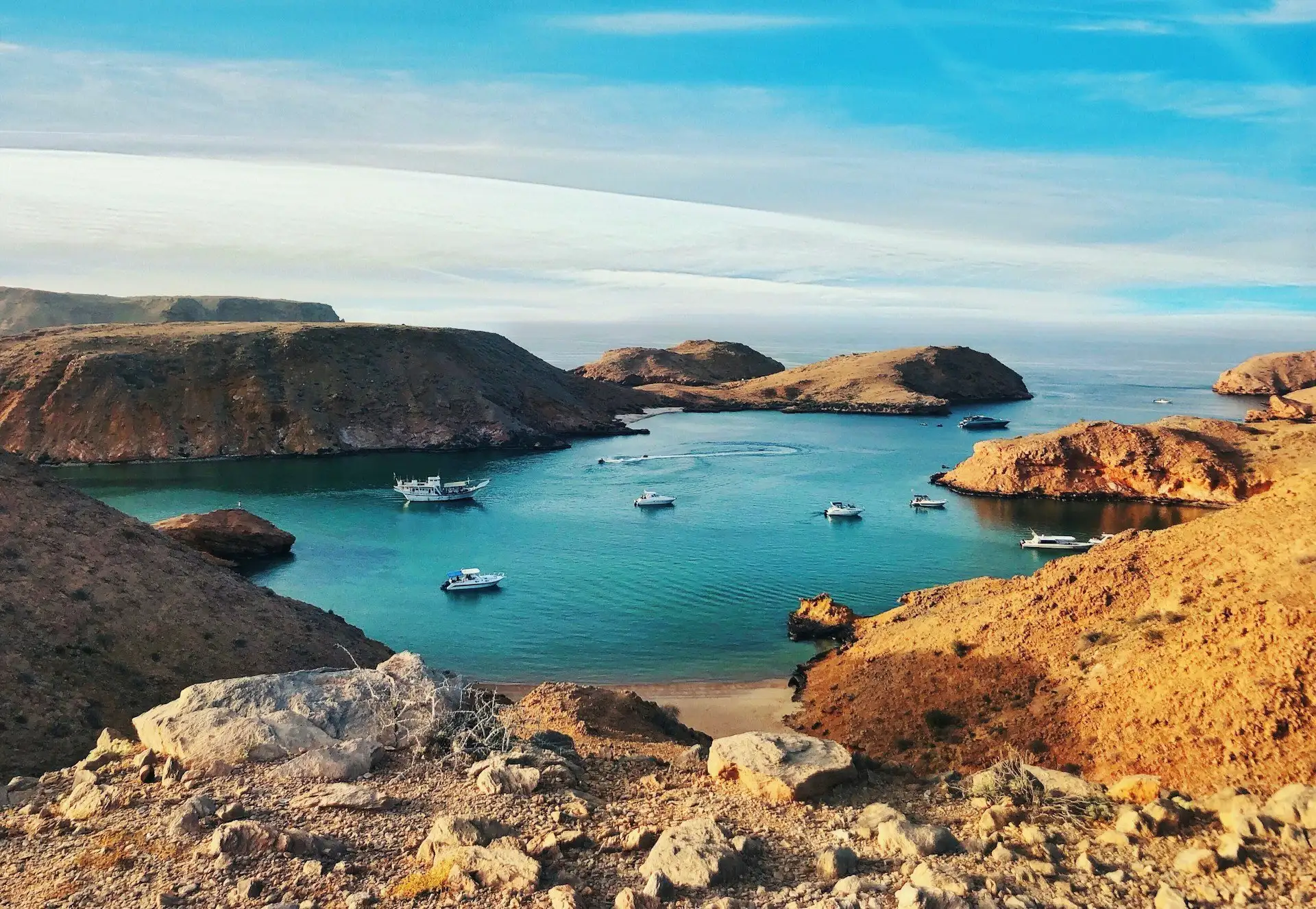
Oman
A country where turquoise wadis cut through ochre canyon walls, where ancient forts anchor every hillside, where frankincense has been traded for four thousand years and still scents the air in the souqs, and where a man you have never met will stop his car to make sure you know where you're going and then invite you home for coffee. The Middle East at its most generous and least complicated. Drive it.
Why Oman Is Different from Every Gulf Country
Oman occupies a geographic and cultural position in the Arabian Peninsula that is unlike any of its neighbors. It is not the gleaming mall-and-skyscraper Gulf of Dubai. It is not the religious conservatism of Saudi Arabia. It has oil but not so much that it abandoned its pre-oil culture entirely, not so much that the money arrived fast enough to overwrite the physical landscape before anyone thought to preserve it. What you find instead is a country whose traditional architecture — the mudbrick forts, the falaj irrigation channels, the frankincense trading towns — survived intact into the modern era, and whose people maintained a relationship with their landscape and their neighbors that feels, to most visitors, like the Arab world they had hoped to find.
The road trip is the correct format for Oman. The country is large — approximately the size of France — with a highway network good enough to cover serious distances comfortably and a landscape that changes dramatically from the Gulf coast north to the Hajar Mountains, east to the Batinah plain, south through the great gravel plains of the interior to the edge of the Empty Quarter (Rub' al Khali), and far south to Salalah in Dhofar, where a seasonal monsoon transforms the landscape into something that looks nothing like Arabia. Rent a car in Muscat and point it inland and you will find a version of the Middle East that most people don't know still exists.
The wadis are the specific thing. A wadi is a seasonal river valley — dry most of the year but filled with crystal-clear water pooled in canyon-carved basins that range from accessible roadside swimming holes to technical canyoning routes requiring ropes and a guide. Wadi Shab, two hours south of Muscat, has a canyon swimming hole so turquoise it looks edited. Wadi Bani Khalid, three hours south, has deep natural pools surrounded by date palms. Wadi Nakhr, in the Hajar Mountains, is a gorge so deep that Oman has taken to calling it the Grand Canyon of Arabia, which is marketing hyperbole that happens to contain genuine accuracy about the scale.
The honest limitations: Oman is not budget-friendly in the Gulf sense — accommodation costs more than most of Southeast Asia, restaurant meals outside the Indian-influenced local spots are expensive, and the car rental adds a daily fixed cost. Alcohol is available in licensed hotel bars and restaurants but not in local areas. The summers — particularly in the interior and the capital — are genuinely brutal from June through September, when daytime temperatures reach 45°C and outdoor activity between 9am and 5pm becomes genuinely dangerous. October through March is when to go.
Oman at a Glance
Frankincense, Maritime Empire & the Modernization That Preserved Things
The history of Oman is the history of frankincense and the sea. The Dhofar region in southern Oman — particularly the Wadi Dawkah, where the Boswellia sacra trees grow in no other place on earth in such concentration — was the world's primary source of frankincense for over three thousand years. Ancient Egypt imported it by the shipload for temple rituals. The Romans burned it at public ceremonies and in private homes. The incense road that carried frankincense north through Arabia to the Mediterranean markets was one of the ancient world's most valuable trade routes, and the Omani merchants who controlled its southern end accumulated a wealth that built the ancient cities of Qalhat, Sumhuram, and Khor Rori — ruins that still stand on the Dhofar coast and are now UNESCO World Heritage sites.
The maritime component is equally significant. Omani sailors navigated the Indian Ocean at a time when European sailors were still debating its extent, reaching India, East Africa, China, and Southeast Asia on trading voyages that established the commercial networks that shape the Indian Ocean rim to this day. The dhow — the traditional wooden sailboat with the distinctive lateen rig — was the vehicle of this maritime empire, and Oman's dominance of Indian Ocean trade reached its peak in the Yaruba and Said dynasties of the 17th through 19th centuries. At its height, the Omani empire controlled Zanzibar (which became a Sultanate of its own under Omani-descended rulers), the East African coast from Mombasa south, the southern coast of Iran, and much of the Persian Gulf. This is not obscure history: the Swahili words for trade, slave, and many maritime terms in East African languages trace back to Omani-Arabic, and the clove trade of Zanzibar was an Omani enterprise.
The 20th century brought oil, but not in the quantities that transformed the UAE or Saudi Arabia. The more consequential transformation was Sultan Qaboos bin Said, who deposed his father in a palace coup in 1970, took a country that had essentially no modern infrastructure — fewer than ten kilometers of paved road, three schools — and built a modern state with extraordinary speed while maintaining the cultural and architectural heritage that other Gulf states were in the process of demolishing. Qaboos's genius, historically speaking, was not the oil money — it was the judgment about what to spend it on. He built roads and hospitals without bulldozing the forts. He educated a generation without erasing the falaj. He is genuinely mourned by most Omanis, who remember what the country was before 1970 and understand what he built. He died in January 2020 after fifty years in power. His cousin, Sultan Haitham bin Tariq, succeeded him and has continued the same general approach.
Dhofar's Boswellia sacra trees become the source of the ancient world's most valued incense. The trade routes north generate extraordinary wealth.
Sumhuram, Khor Rori, and Qalhat flourish as the frankincense export terminals. UNESCO World Heritage status today.
The Ibadi school of Islam — neither Sunni nor Shia, predating the split — becomes dominant in Oman and shapes its distinctive, tolerant religious culture to this day.
Portugal seizes Muscat and controls the Omani coast. Forts built at Muscat's harbor entrance still stand. Oman ultimately expels the Portuguese under the Yaruba dynasty.
Oman controls Zanzibar, the East African coast, and Indian Ocean trade routes. The empire at its peak rivals European colonial powers in the western Indian Ocean.
Deposes his father in a palace coup. Begins modernizing Oman from a near-medieval state in remarkable speed, while preserving its cultural heritage.
Qaboos dies after fifty years in power. Sultan Haitham bin Tariq takes over, continuing the modernization and preservation approach.
The Road Trip Circuit
Oman is best understood as a road trip country. The capital Muscat is your logistics hub — arrive, collect your rental car, and head out. The main circuit covers the Hajar Mountains, the interior wadis, Nizwa's fort and souq, the Wahiba Sands desert, and the coastal return. A full circuit of central and northern Oman takes seven to ten days. Adding Salalah in the south requires either flying (1.5 hours) or two days of driving each way, and it is worth treating as a separate trip.
Wadi Shab
Two hours south of Muscat along the coastal highway, a short boat crossing across a pool, and then an hour's walk through a canyon of biblical proportion — sheer limestone walls rising hundreds of meters above a path that follows a stream through date palms and oleander — until the canyon opens into a series of deep turquoise swimming pools where the water is so clear and so cold and so exactly the color of shallow Caribbean sea that first-timers stop and look at it for a while before believing it's real. The final pool has a cave with a waterfall inside it, accessible only by swimming through a narrow submerged passage. Go on a weekday morning. Arrive by 7am. Leave before the tour buses arrive at 10am. The difference between 7am and 10am at Wadi Shab is the difference between paradise and a crowded water park.
Nizwa
Two hours inland from Muscat, the former capital of interior Oman and the cultural heart of the country. The Nizwa Fort — a massive circular tower completed in 1668 that took twelve years to build, with a cannon battery that makes the defensive logic immediately legible — is the finest example of Omani military architecture. The adjacent souq is the most authentic in the country: a date market, a silversmith quarter where khanjar daggers (the traditional curved Omani dagger worn on formal occasions and depicted on the national flag) are made and sold, a live animal market on Friday mornings where goats and cattle are traded in a chaotic and entirely genuine fashion. Stay the night. The town empties after the day-trippers leave and the evenings are quiet and cool and entirely different.
Jebel Akhdar
The "Green Mountain" plateau above Nizwa at 2,000 meters altitude — cool enough in summer to be a genuine escape from the coastal heat, covered in rose terraces (the Damask roses grown here produce the rose water that flavors Omani coffee), pomegranate orchards, and ancient villages clinging to the edge of cliffs above a gorge so deep it takes your eyes a moment to adjust to the scale. The road up requires a 4WD. The view from the Anantara Al Jabal Al Akhdar resort's infinity pool — over a canyon that drops 1,000 meters to the valley floor — is one of the most vertiginous views from a sun lounger anywhere on earth. You don't have to stay there to walk to the viewpoint.
Wahiba Sands (Sharqiyah Sands)
Three hours southeast of Muscat, the Wahiba Sands is a contained sand desert — approximately 180 kilometers long and 80 kilometers wide — where golden dunes rise to 100 meters and the Bedouin-descended communities who live in and around the desert still move with their camels between seasonal pastures. The standard experience: arrive in the afternoon, drive into the dunes with a guide, watch the sunset from a dune crest, spend the night at a desert camp under a star field with no competing light, watch the sunrise, and leave before the midday heat. The desert itself is the spectacle and the night sky is the specific reward that no photograph has adequately conveyed.
Wadi Nakhr (Grand Canyon of Oman)
Above the village of Al Hamra near the Jebel Shams plateau, a gorge opens in the earth that drops 1,000 meters to the valley floor — the Oman Tourism Board's "Grand Canyon" comparison is made for marketing reasons but is not entirely without merit in scale terms. The walk along the rim — the Balcony Walk, a four-to-six-hour return route on a maintained trail — passes abandoned mudbrick villages on the canyon lip whose former inhabitants moved down to the valley when road access made the lower ground more accessible. The views are relentless and the physical exposure of the trail — a ledge in places, with the gorge directly below — is real. Don't do it in sandals.
Salalah & Dhofar
Salalah in Dhofar province — 1,000 kilometers south of Muscat — has two entirely distinct personalities. From October through June: a pleasant coastal city with frankincense markets, the ruins of the ancient incense road cities (Sumhuram, Khor Rori), Al Baleed archaeological park, and the Wadi Dawkah frankincense tree reserve where the Boswellia sacra trees grow gnarled and low across the rocky hillsides. From July through September: the khareef transforms Dhofar into an Arabian anomaly — green hills, mist, cool temperatures, and waterfalls appearing from nowhere on cliffs that are bone-dry eight months of the year. Salalah is also the departure point for road access toward the Yemen border (check current advisories — the border area has fluctuating security).
Muscat
Muscat is the most livable Gulf capital — low-rise, spread across a series of bays between rocky headlands, with the Sultan Qaboos Grand Mosque (the largest in Oman, with a single-piece handwoven carpet of 4,343 square meters in the main prayer hall) and the Mutrah Souq as the anchor cultural visits. The Corniche from Muscat to Mutrah at dusk — the old Portuguese forts on the headlands, the dhows in the harbor, the souq lights reflecting on the water — is the version of the Gulf that most people didn't know was available. Give Muscat two days at the beginning or end of your road trip, not just a transit stop.
Ras Al Jinz Turtle Reserve
On the easternmost point of the Arabian Peninsula, green sea turtles have been nesting on the beach at Ras Al Jinz for longer than the written record. The turtle nesting season runs from May through October, with August and September producing the highest density of activity. Guided night tours (permit required, booked through the reserve) take visitors to the beach to watch turtles nesting and, in the right season, hatchlings making their way to the sea. The reserve manages visitor numbers carefully and the experience — 500-kilogram animals moving through the darkness while you watch in silence — is consistently described as one of Oman's finest wildlife encounters.
Culture & Etiquette
Oman's social norms are shaped by Ibadi Islam — moderate, non-confrontational, and considerably more relaxed than the Gulf's more conservative neighbors — and by a tribal hospitality tradition that treats guests with a generosity that can feel overwhelming until you understand it as the social architecture of a desert culture where strangers have always depended on each other's goodwill. The guest is, in Omani tradition, genuinely under the protection and responsibility of the host. This is not performance.
Oman is among the most comfortable Arab countries for solo female travelers. Omani women are present and active in professional and public life in ways that differ from some Gulf neighbors. Foreign women are not required to cover their hair; modest clothing (shoulders and knees covered in conservative areas) is appropriate outside beach or resort contexts. The harassment that female travelers sometimes experience in other parts of the region is genuinely uncommon here.
Omani coffee (kahwa) — spiced with cardamom and saffron, served from a curved brass dallah into small handleless cups, accompanied by dates or halwa — is the social gesture of welcome. It is offered at every formal meeting, in homes, in government offices, and increasingly in many souqs and shops. Accepting it is the correct response. It is refilled until you tilt the cup from side to side to indicate you've had enough.
In Muscat's tourist areas, cities, and along the coastal highway, relatively relaxed dress is accepted. In the interior — Nizwa, the mountain villages, rural areas — cover shoulders and knees. Bikinis and swimwear are appropriate at beaches, wadi swimming spots, and resort pools, but not while walking between a wadi car park and the swimming area.
The universal Arabic greeting. Learning it and using it — particularly with the handshake for men, the palm-to-chest gesture for women greeting men — gets an immediate and warm response. Omanis appreciate the attempt at the greeting regardless of your subsequent linguistic helplessness.
At any mosque you enter (non-Muslims may visit many Omani mosques outside prayer times) and at most traditional homes. The Grand Mosque in Muscat specifically requires modest clothing, removed shoes, and a head covering for women — all of which are available at the entrance.
If you stop at a roadside shop, a petrol station, or pull over to look at a fort and an Omani man comes over and invites you for tea — accept. This is not commerce. It is the hospitality culture operating as designed. The conversation that follows over cardamom tea in a plastic chair in front of a petrol station in the interior of Oman is typically one of the better conversations of the trip.
Photographing Omani women in particular without explicit permission is inappropriate across the Gulf region. In markets and souqs, ask before pointing a camera at vendors or shoppers. Many Omanis are willing to be photographed if you ask warmly; the assumption that you can photograph anyone in a market without consent is the problem, not the photograph itself.
Public displays of affection between couples — kissing, prolonged embracing — are inappropriate in public spaces including beaches. Holding hands between couples is generally fine. This applies to both heterosexual and same-sex couples; same-sex relationships are illegal in Oman and public expression of them creates legal risk.
During Ramadan, eating, drinking, and smoking in public between dawn and sunset is illegal for everyone in Oman, including non-Muslims. Restaurants may be closed or screened during the day. Respect this consistently — it is law rather than social preference.
Oman has strict drug laws with significant minimum sentences. This is not a context where cultural nuance applies. Do not bring any controlled substances into the country.
The Hajar Mountain roads — particularly the descent from Jebel Akhdar and the tracks around Jebel Shams — have sheer drops, hairpin bends, and loose gravel surfaces. The combination of spectacular scenery and actual driving hazard requires full attention. Driving for the view rather than the road is how accidents happen on these routes.
The Khanjar
The khanjar — the curved dagger with a distinctively J-shaped blade and a hilt of rhinoceros horn (now replaced with alternative materials) or sandalwood — is the national symbol of Oman, depicted on the national flag and coat of arms, and worn by Omani men at formal occasions. It is not merely decorative: a fine khanjar is a family heirloom and a significant gift. The khanjar workshops in the Nizwa souq are among the few remaining places where you can watch the blade-making and silverwork happen in real time. The full dress of an Omani man — the white dishdasha robe, the kumma cap or mussar turban, and the khanjar at the waist — is one of the most distinctive national dress traditions in the Gulf.
Frankincense Culture
Frankincense — the dried resin of the Boswellia sacra tree — is not an artifact or a historical curiosity in Oman. It is burned in Omani homes at social visits, at weddings, at the Friday prayer, and at funerals. It is traded in souqs alongside produce and livestock. The mabkhara (incense burner) is present in most Omani living rooms as a functioning object rather than a display piece. Being in a room where someone is burning frankincense — the specific warm, slightly sweet, resinous smell — is one of the most immediately Omani sensory experiences available. Buy a small piece in the Mutrah Souq or the Salalah frankincense market. Burn it. Understand why four thousand years of trade was built around it.
The Falaj System
The falaj (plural aflaj) is a traditional irrigation system that channels water from underground aquifers or mountain streams to agricultural villages through gravity-fed underground and surface channels, some of which have been in continuous operation for over a thousand years. The aflaj of Oman are a UNESCO World Heritage site, and the five listed examples represent a still-functioning engineering tradition that allowed agriculture to exist in one of the driest environments on earth. Walking through a wadi village and following the falaj channels — water running through stone channels beside date palms and vegetable gardens in a landscape that would otherwise be desert — is the material evidence of what made permanent settlement in Arabia possible.
Dhow Building
Sur, on Oman's eastern coast, is the last place in Arabia where traditional wooden dhows are still built by hand using the same joinery techniques that built the vessels of Oman's Indian Ocean empire. The Sur boatyard is a working shipyard rather than a heritage display — the sawdust and the smell of teak and the sound of adzes are real. Visiting is possible by arrangement and the craftsmen have a reasonable if limited English interaction with curious visitors. The last of the traditional builders are teaching the next generation, but the timeline of how much longer the craft survives in its fully traditional form is uncertain.
Food & Drink
Omani cuisine is a product of the country's maritime history — Indian spices absorbed through centuries of Indian Ocean trade, Persian rice-cooking traditions absorbed through proximity and commerce, East African coastal influences from the Zanzibar connection, and a Bedouin tradition of communal meat and date eating that predates all the above. The result is a cuisine more aromatic and complex than most visitors expect from the Gulf, built around slow-cooked meats, fragrant rice dishes, and the specific sweetness of Omani dates and halwa.
The Indian community — historically substantial in Oman since the trade era, and expanded further with the South Asian labor migration of the oil boom — has left an Indian restaurant tradition in Muscat and the major cities that is among the finest in the Gulf. The budget traveler who eats at the Indian and Pakistani restaurants around the Muscat and Ruwi working districts eats better and more cheaply than anyone paying tourist prices at resort buffets.
Shuwa
The national celebration dish: whole lamb or goat marinated for 24 hours in a spice paste of dried chilli, cumin, coriander, turmeric, and cloves, then wrapped in date palm leaves or banana leaves, sealed in a burlap sack, and slow-cooked in an underground pit (al tanoor) for 24 to 48 hours. The result is meat so tender it falls from the bone on contact, infused with smoke and spice in a way that no oven-roasted version approaches. Shuwa is made for Eid celebrations and significant gatherings — it is not a restaurant dish in the conventional sense. If invited to a Shuwa meal, nothing else you eat in Oman will taste quite as significant.
Majboos
The Omani version of the Gulf's great rice dish: spiced rice cooked with chicken, fish, or lamb over a long simmer with dried limes (loomi), cardamom, turmeric, cinnamon, and a spice blend that varies by family and region. Served on a communal platter, eaten by hand or with a spoon, with a side of raita or tomato sauce. It is the everyday meal of Omani households, available at working-class local restaurants for a few rials, and the version you eat at a Nizwa or Ibra restaurant made with fresh fish from the coast is the one that explains why the Indian Ocean spice trade was worth building an empire for.
Omani Halwa
A dense, jewel-dark confection of starch, sugar, ghee, saffron, rosewater, and nuts — served in small portions at the end of a meal or as a hospitality gesture alongside kahwa. It is intensely sweet, fudge-like in texture, and deeply perfumed. Every Omali family and every region has its own recipe, but the Muscat halwa tradition is considered the benchmark. The proper consumption method: take a small piece from the communal bowl using the provided spoon, follow it with a sip of kahwa, and understand why this combination has been the greeting gift of Omani hospitality for centuries.
Omani Fish
The Omani coast produces kingfish, hammour (grouper), red snapper, and tuna in the quantities that sustain both the local diet and a significant fishing industry. The fish souq at Mutrah in Muscat, where the catch arrives at dawn and is sold directly from boats to buyers, is a morning scene of organized chaos and extraordinary freshness. The best fish restaurants in Muscat — Bait Al Luban for traditional preparations, the seafood stalls along the Sur waterfront — serve that morning's catch grilled over charcoal with lemon and baharat spice blend.
Kahwa (Omani Coffee)
The social institution of the Arabian Peninsula: Omani coffee is made from lightly roasted green coffee beans, not the dark roast of Western espresso culture, steeped with cardamom and saffron and sometimes rosewater, poured from a brass dallah into small handleless cups (finjan), and served without milk or sugar alongside dates. It is bitter, aromatic, warm, and entirely specific to this geography. The ritual of the dallah being refilled from a pot kept warm on low heat, the cup tilted to signal enough, the conversation that happens over it — this is not a coffee transaction. It is a social form that has been running continuously for four hundred years.
Omani Dates
Oman produces dozens of varieties of dates from the palm groves that line the wadis and the Batinah coast, and the quality gap between a fresh Omani date and a supermarket date from anywhere else is as large as the gap between a fresh tomato and a tinned one. The Fard, Khunaizi, and Khalas varieties are the most prized. Buy them from the Nizwa date market or the roadside date stalls that appear at harvest time (August through October) in the agricultural areas — a bag of fresh Khalas dates costs almost nothing and is one of the better food purchases in the Gulf region.
When to Go — and When the Wadis Run
October through March is the consensus window and it's correct: temperatures between 20 and 32°C on the coast, cooler in the mountains, clear skies, and the wadis accessible and swimmable. December through February is the peak — slightly cooler, slightly more crowded, and occasionally rainy in the mountains which turns the wadi scenery dramatically greener. November and March are excellent and less crowded. Salalah specifically has its own entirely different calendar governed by the khareef monsoon.
Winter Peak
Nov – MarThe classic Oman window. Comfortable temperatures, swimmable wadis, navigable desert, and the mountain roads accessible without the extreme heat risk. December through February is peak season — book popular camps and mountain resorts ahead. March brings the Jebel Akhdar rose harvest.
Khareef Season
Jul – SepWhile the rest of Oman bakes, Dhofar receives its Indian Ocean monsoon and transforms. Waterfalls appear on otherwise dry cliffs, the mountains turn green, and the temperature drops to a pleasantly cool 25–28°C. Salalah fills with Omani tourists who come specifically for this anomaly. The rest of the country is brutally hot during this period — combine a khareef trip with a Salalah-only visit rather than a full national circuit.
Shoulder Season
Oct & AprOctober is the transition from summer to winter — temperatures dropping into the comfortable range, fewer crowds than December–February, and the wadis filling from any early rains. April is warm but the mountains are still accessible and the visitor numbers are lower than peak. Both are good months for a road trip.
Summer Interior
Jun – Aug (except Salalah)The interior of Oman — the Hajar Mountains, the Wahiba Sands, the road between Muscat and Nizwa — reaches 45°C+ in summer. Outdoor activities are genuinely dangerous in midday heat. Muscat is manageable with air conditioning and careful timing but the road trip that defines the Oman experience cannot be done safely in this period. Go to Salalah or go in winter.
Planning the Oman Road Trip
Ten days is the minimum to do northern and central Oman justice — Muscat, the Hajar Mountains, Nizwa, the wadis, and the Wahiba Sands. Two weeks allows a more relaxed pace and adds the turtle reserve at Ras Al Jinz. Three weeks includes a separate Salalah trip. The rental car is the organizing fact: pick it up at Muscat Airport, drive the circuit, return it to Muscat. Most of the main sites are within a four-to-six-hour drive of Muscat and the roads are excellent. A 4WD is needed specifically for Wahiba Sands, the Jebel Akhdar access road, and any rough wadi tracks — for the main highway circuit, a standard saloon is sufficient.
Muscat
Day one: Grand Mosque at opening (8am for non-Muslims, before the heat and crowds), Mutrah Souq in the late afternoon when the light softens and the traders are at full activity, Corniche walk at sunset between the two Portuguese forts. Day two: the National Museum (one of the Gulf's finest, covering 106,000 years of Omani history), Royal Opera House if a performance is scheduled, Al Alam Palace exterior. Pick up the rental car on day two's afternoon.
Wadi Shab & Sur Coast
Drive south on the coastal highway. Wadi Shab in the very early morning (leave Muscat by 5:30am to arrive before the crowds). Continue to Sur for the afternoon — the dhow-building yard, the Bilad Sur fort, and the Sur Lagoon. Overnight in Sur. Next morning: Wadi Bani Khalid (a different wadi character from Shab — wider, more open, with natural rock formations around the pools) before driving back through the interior toward Nizwa.
Wahiba Sands + Nizwa
Enter the Wahiba Sands from the north at Al Wasil. Afternoon in the dunes with a guide, sunset from the highest accessible dune, overnight at a desert camp. Dawn in the dunes before leaving. Drive to Nizwa: arrive by noon for the fort before peak heat, the souq in the late afternoon, Friday livestock market if timing allows. Overnight in Nizwa.
Jebel Akhdar
Drive up to the Jebel Akhdar plateau (4WD required at the checkpoint — rental agencies provide appropriate vehicles). Two days: the Rose Garden village of Al Ayn for the terraced farms, the Balcony Walk along Wadi Nakhr's rim, the village of Birkat Al Mouz at the foot of the mountain for the falaj and date palm oasis. Overnight on the plateau.
Return via Bahla & Jabrin
Bahla Fort — a UNESCO World Heritage site, a massive mudbrick fortification under continuous restoration — and the Jabrin Castle nearby, an extraordinary 17th-century interior with painted ceilings that is the Oman equivalent of a small Alhambra. Return to Muscat via the highway. Final evening at the Mutrah fish souq for a farewell fish dinner. Return car. Depart.
Muscat
Two full days including the fish market at dawn (4:30am for the serious version, 6am for the sensible version), the Bait Al Zubair private museum for the finest collection of Omani material culture in the country, and an evening at the Royal Opera House if the schedule permits. Day two: the Muscat Heritage City (the old quarter, separate from the commercial city) on foot.
Sur Coast & Turtle Reserve
Wadi Shab at dawn (leave Muscat at 5am). Sur for dhows and fort. Overnight at Sur or Ras Al Hadd. Evening turtle tour at Ras Al Jinz (book ahead — night tours are timed and limited). Return via Wadi Bani Khalid in the morning.
Wahiba Sands + Al Mudayrib
Three days in and around the Wahiba Sands including an overnight with a Bedouin-heritage family in the desert village of Al Mudayrib (book through local operators) — a deeper engagement with desert culture than a standard tourism camp provides. Camel milking, traditional bread baking, and a long evening of conversation via your guide-translator.
Nizwa, Bahla, Jebel Akhdar
The full fort and mountain circuit. Nizwa Fort and souq. Bahla UNESCO fort. Jabrin Castle's painted interiors. Two nights on Jebel Akhdar including the early morning Balcony Walk in cooler temperatures.
Rustaq & Batinah Coast Return
Drive north through the Batinah coast — the date-palm agricultural heartland of northern Oman — stopping at Rustaq Fort (one of Oman's largest and most impressive, with natural hot springs nearby) and the Nakhal Fort above its palm oasis. Return to Muscat via the Sohar coastal route for the Omani pottery tradition town of Al Burj.
Northern Oman Full Circuit
The full 14-day itinerary above, at a slightly slower pace with more time in the mountains and an additional day at the Ras Al Jinz turtle reserve waiting for optimal nesting conditions rather than a scheduled single night.
Salalah & Dhofar
Fly from Muscat to Salalah (1.5 hours, significantly preferable to two days of driving through the great empty south). Seven days: the Wadi Dawkah frankincense reserve (the specific trees that supplied the ancient world), the UNESCO ruins at Sumhuram and Khor Rori (the actual incense port), Al Baleed Archaeological Park in Salalah city, the Mughsail Beach blowholes, Wadi Darbat (a wadi that during khareef becomes a waterfall — check the season), and the drive toward the Yemeni border through Taqah and Mirbat to the Tomb of Job (Nabi Ayoub) on the hilltop above Salalah. Fly back to Muscat for departure.
The Right Rental Car
For the main Oman circuit, a standard saloon handles the paved highway routes. For Jebel Akhdar (mandatory 4WD checkpoint), Wahiba Sands, and any rough wadi tracks, a 4WD is required. Most rental agencies at Muscat Airport offer Toyota Land Cruisers and similar 4WDs — book ahead in peak season. Check that your insurance covers off-road driving (many basic policies don't). Inflate your tyres before the highway; deflate to around 18–20 psi for sand driving in Wahiba.
Water & Heat
Dehydration in Oman's dry heat is faster than in humid climates — you lose water through breathing without feeling significantly sweaty. Carry minimum two liters of water per person per wadi walk or outdoor activity. In summer (May through September), outdoor activity outside of early morning (before 9am) and evening (after 5pm) is dangerous. The wadi swimming is deceptively demanding — the canyon walk in 35°C heat followed by cold water immersion creates a thermal shock that requires respect.
Connectivity
Omantel and Ooredoo provide reliable 4G across all major cities and highways. Remote wadi and mountain areas have patchy to no coverage. Download offline maps (Google Maps offline covers Oman's main routes well; iOverlander has community notes on specific wadi tracks). The Royal Oman Police navigation app (Mawater) is useful for specific Omani road routing. A local SIM from the airport is cheap and recommended.
Get Oman eSIM →Power & Plugs
Oman uses Type G sockets — British three-pin, 240V. The same as the UK, Malaysia, and Singapore. US and European visitors need an adapter. Most hotels and desert camps provide basic charging facilities; some remote camps have limited generator power hours. A power bank is useful for long driving days.
Vaccinations & Health
No mandatory vaccinations for most visitors. Recommended: Hepatitis A, Hepatitis B, Typhoid, and routine vaccines. Oman is a Hepatitis A risk area particularly from food and water. Tap water in Muscat is treated; in rural areas drink bottled. Heat exhaustion and heat stroke are the primary health risks for summer visitors or those who underestimate wadi activity in midday heat.
Full vaccine info →Travel Insurance
Standard comprehensive travel insurance is appropriate for Oman. Check that off-road driving is covered if you plan to take a rental 4WD into the sand — many basic policies exclude damage from off-road use. Medical facilities in Muscat are good; in remote areas you are several hours from a hospital. The Royal Hospital in Muscat is the primary international-standard facility.
Transport in Oman
The honest transport summary for Oman is: rent a car. Public transport between cities is limited and infrequent, and the entire point of Oman — the wadis, the forts, the desert, the mountain roads — is only accessible by road. The highway network is excellent, the roads are generally well-maintained, petrol is cheap by any international standard, and the driving culture is reasonably orderly compared to neighboring countries. Muscat's urban sprawl requires a car or app-based taxi for efficient movement within the city; the long-distance routes between Muscat, Nizwa, Sur, and Salalah are straightforwardly driven without local knowledge requirements.
Rental Car
OMR 15–35/dayThe essential Oman travel tool. Standard saloons from the major agencies (Avis, Budget, Hertz, and local operators) cover all paved routes. 4WD is mandatory for Jebel Akhdar (checkpoint), Wahiba Sands, and off-road wadi access. Book ahead in peak season — the airport rental desks run out of 4WDs in December through February. International driving license required alongside your home license.
Careem & OTaxi (Muscat)
OMR 1.5–6/tripCareem (the MENA equivalent of Uber) and the local OTaxi app are reliable within Muscat and cover the main city areas. Fixed-price before confirmation, tracked ride, in-app payment. Street taxis exist but metering compliance is variable — app-based is consistently more reliable. For intercity transfers, pre-negotiated private taxis are the alternative to self-driving.
Mwasalat Bus
OMR 1–5/routeOman's national bus company operates routes between Muscat, Nizwa, Sohar, Sur, and Salalah. Services are infrequent (sometimes one or two departures daily), and the journey times are long. The Muscat–Salalah route takes approximately 12 hours by bus versus 1.5 hours by flight. Useful for budget travelers who are time-flexible; inadequate as the primary transport for anyone wanting to explore the country efficiently.
Oman Air Domestic
OMR 30–80 one-wayOman Air and SalamAir connect Muscat to Salalah (the essential connection — the 1,000km south is not a practical drive for a short trip), Khasab (Musandam Peninsula — the fjord-like northern tip of Oman separated from the rest by UAE territory), and occasionally other regional airports. The Muscat–Salalah route runs multiple times daily and is priced reasonably in advance.
Dhow Cruises (Musandam)
OMR 15–30/personThe Musandam Peninsula's fjord landscape — the Khors, or inlets, carved by the Hajar Mountains meeting the Strait of Hormuz — is primarily explored by dhow cruise. Day trips from Khasab take visitors through the dramatic inlet scenery with dolphins almost guaranteed, swimming stops in the turquoise water, and views of the mountains rising straight from the sea that look more Norwegian than Arabian.
Guided Wadi & Desert Tours
OMR 20–80/person/dayFor Wahiba Sands entry and serious wadi canyoning (beyond the standard walkable routes), local guides are available through operators in Muscat and Nizwa. A guide with a local 4WD for Wahiba Sands adds safety margin for sand driving and provides access to deeper desert away from the tourist camp clusters. For technical canyoning in wadis like Wadi Bani Awf, a certified canyoning guide is essential.
Petrol
Heavily subsidized (~OMR 0.17/liter)Petrol in Oman is government-subsidized and extremely cheap. Fill up when you can in the interior — petrol stations are frequent on main highways but absent on mountain and wadi tracks. The fuel saving on a 10-day road trip is genuinely significant compared to any European equivalent. Premium and regular unleaded are universally available; diesel for 4WD vehicles is available at most major stations.
Ferry (Shinas–Musandam)
OMR 5–15A seasonal ferry service operates between the mainland Omani coast at Shinas and the Musandam exclave at Khasab, allowing access to the peninsula without the UAE border crossing that overland routes require. Check current schedules as service frequency changes. For most visitors, flying to Khasab or entering via the UAE-Oman Musandam border is more practical than the ferry.
Accommodation in Oman
Oman's accommodation ranges from luxury beach resorts and international brands in Muscat to mountain lodges at Jebel Akhdar, desert camps at Wahiba Sands, and small family guesthouses in the interior towns. The mid-range is well-served in Muscat and decent in Nizwa; the gap between the luxury end and the basic end in rural Oman is significant, and there is less of the backpacker-hostel ecosystem that exists in Southeast Asia or Turkey. Budget travelers who are comfortable with basic guesthouses and camping can manage; those expecting a mid-range European guesthouse standard everywhere will find some nights in the interior are either expensive hotels or very basic local accommodation.
Muscat International Hotels
OMR 40–200+/nightThe full range: InterContinental, W Hotel, Park Hyatt, and the landmark Chedi Muscat (a low-rise resort of exceptional taste set in gardens near the sea) at the high end. The Business Hotel zone around the airport in Seeb has solid mid-range options. For location in the old Muscat area near Mutrah, the Haffa House is a comfortable mid-range option walking distance from the souq.
Jebel Akhdar Mountain Resorts
OMR 80–300+/nightThe Anantara Al Jabal Al Akhdar Resort and the Alila Jabal Akhdar both sit on the canyon rim at around 2,000 meters, with the vertigo-inducing views of Wadi Nakhr below. Both are genuinely spectacular and genuinely expensive. The non-guest viewpoint at the Anantara is accessible without paying — walk from the village of Diana to the hotel's public viewing terrace for the same view without the room rate.
Wahiba Sands Desert Camps
OMR 25–80/night incl. dinnerThe desert camp experience ranges from basic Bedouin-style tents to glamping setups with air conditioning (which slightly defeats the purpose of sleeping in the desert but is understandable in temperatures above 30°C). The 1000 Nights Camp and the Nomadic Desert Camp are well-reviewed mid-range options. For the real experience, spend at least one night without air conditioning — the temperature after midnight in winter is around 15°C and the star field at 2am is worth the blanket.
Interior Guesthouses & Rest Houses
OMR 12–35/nightNizwa, Ibra, Sur, and the Batinah coast towns have local guesthouses and government rest houses (funded by the tourism ministry and consistently clean and basic). These are the budget end of Oman accommodation — functional rather than atmospheric, reliable rather than memorable. The Nizwa Guest House and similar operations are useful for keeping the road trip cost manageable without camping.
Budget Planning
Oman is mid-to-expensive by regional standards and expensive compared to Southeast Asia or Central Asia. The Omani Rial is one of the world's highest-valued currencies (1 OMR ≈ $2.60 USD), which makes the arithmetic feel steep at first. Food at local restaurants and market stalls is genuinely cheap; accommodation ranges from reasonable to very expensive depending on your choices; the car rental is a daily fixed cost that inflates the daily average but enables the entire trip. Budget travelers who eat local, use guesthouses, and share car rental costs can manage well; travelers who default to hotel restaurants and international brand accommodation will spend more than they anticipated.
- Local guesthouse or rest house
- Local restaurants and market food
- Shared car rental cost
- Self-guided wadis and forts
- Desert camp basic tier
- 3–4 star hotels in Muscat and cities
- Mix of local and hotel dining
- Private car rental (4WD for full circuit)
- Guided wadi and desert experiences
- Mid-range Wahiba desert camp
- Chedi Muscat, Anantara Jebel Akhdar
- Full resort dining
- Private guided tours
- Glamping desert camps
- Dhow cruises, private experiences
Quick Reference Prices
Visa & Entry
Most visitors from Western countries (US, UK, EU, Australia, Canada, Japan, South Korea, and many others) can obtain a visa on arrival at Muscat International Airport or apply for an e-visa online through the Royal Oman Police portal at evisa.rop.gov.om. The standard tourist visa is valid for 30 days and is extendable at the Royal Oman Police immigration offices for a further 30 days. GCC citizens (Saudi Arabia, UAE, Kuwait, Bahrain, Qatar) do not require a visa.
The e-visa process is straightforward: fill in the online form, upload passport scans, pay the fee (around OMR 6 or approximately $15), and receive approval within a few working days. Having the e-visa approval avoids the arrival queue and is recommended for peak-season travel.
Most Western nationalities. 30-day tourist visa. e-Visa at evisa.rop.gov.om — recommended over arrival queue. OMR 6 fee (~$15).
Family Travel & Pets
Oman is one of the genuinely excellent family destinations in the Middle East and in this series. The country is safe, the people are warm toward children in the specific way that Arab hospitality extends its welcome to the youngest guest first, and the combination of wadi swimming, fort exploration, camel encounters, and desert camping provides a family travel experience that is both physically engaging and culturally genuine. The wadi swimming is the activity that most children remember longest — the turquoise water, the canyon walls, the cave at the end of Wadi Shab — and it is accessible for families with children old enough to swim confidently (roughly 8 and up for Wadi Shab's full route).
Wadi Swimming
The wadis are natural water parks without the infrastructure — no queues, no entrance fees, no announcer. The turquoise pools are genuinely magical for children who swim well, and the canyon walk to reach them is the adventure that precedes the reward. Wadi Bani Khalid is the most accessible family option: wider paths, shallower sections, and pools suitable for non-swimmers alongside the deeper areas. Wadi Shab requires more confidence in water. Lifejackets are available to hire at both.
Fort Exploration
Omani forts are genuinely child-engaging in a way that many historic sites are not: the stairs, the cannon ports, the rooftop battlements with actual views, the trap doors and hidden corridors that Nizwa Fort specifically contains in its design. The Jabrin Castle's painted ceilings and multi-level rooms make it the most architecturally interesting for older children. The Bahla Fort, under restoration, gives a sense of the ongoing commitment to preservation that is itself interesting to explain to children of the right age.
Camel & Desert Camp
The Wahiba Sands overnight experience — arriving in a 4WD, watching the sunset from a dune, sleeping under the desert stars — is suited to children from around 6 years old who can manage the physical part of the visit. The camel rides at the camp are short and calm. The star field at night with no competing light is the specific thing that most children remember: lying on a blanket in the sand and watching a sky so full of stars that the Milky Way is visible as a solid band.
Turtle Watching (Ras Al Jinz)
The guided night turtle tour is appropriate for children from around 7 years old who can follow instructions about silence and movement. Watching a 500-kilogram green turtle make her way up the beach in the dark, dig her nest, and lay eggs while the naturalist guide explains in whispers is a wildlife encounter that most children (and adults) describe as genuinely overwhelming. Book well in advance — night tours are limited in number and fill up in the August–September peak.
Musandam Dhow Cruise
The Khuryat Bay dolphin cruise from Muscat (accessible without the flight to Khasab) has reliable Indo-Pacific bottlenose dolphin encounters in the morning — boats follow the pods as they travel the bay and children typically lean over the bow railing in a state of sustained amazement. The Musandam fjord cruise from Khasab adds the dramatic landscape backdrop. For families flying specifically to Khasab for the full fjord experience, the trip is worth the extra logistics.
Grand Mosque (Age-Appropriate)
The Sultan Qaboos Grand Mosque in Muscat is one of the few large mosques in the Gulf where non-Muslim visitors are actively welcomed outside prayer times. For families with children old enough to understand the scale of the architecture and to maintain the required respectful behavior, it is a genuinely impressive cultural visit. The main prayer hall carpet — handwoven as a single piece, 70 meters x 60 meters, 4,343 square meters — is the detail that catches children's imaginations. Modest dress required for all; headscarves for women at the entrance.
Traveling with Pets
Pet import to Oman requires a veterinary health certificate issued within 10 days of travel, a valid rabies vaccination, an ISO-standard microchip, and a health certificate from an official government veterinary authority. Dogs and cats are the primary animals for which import provisions exist. Apply for the import permit through the Ministry of Agriculture, Fisheries and Water Resources before travel — the process takes several weeks.
Practically: Oman in summer is dangerously hot for pets in ways that require serious planning — vehicles reach fatal temperatures in minutes at parking. The wadi and desert environments that define the Oman experience are not suitable for most domestic animals. Accommodation in traditional guesthouses and desert camps does not accommodate pets. The pet-travel infrastructure in Oman is limited outside Muscat, where the expat community has created some pet-friendly services.
For most visitors, leaving pets at home for an Oman road trip is the practical and welfare-appropriate decision.
Safety in Oman
Oman is one of the safest countries in the world by almost every measurable metric. The Global Peace Index consistently ranks Oman among the top 20 most peaceful nations. Violent crime against tourists is essentially absent. The political stability under Sultan Qaboos's fifty-year reign and his successor Sultan Haitham has produced a country where the fundamental social contract — you treat visitors with hospitality and they behave with respect — functions reliably. The risks worth preparing for are environmental rather than human.
Crime
Extremely low. Oman ranks among the world's safest countries for travelers. Petty theft, which is the background risk in most tourist destinations, is genuinely uncommon. The social ethic around hospitality to guests creates a strong community-level discouragement of behavior that would embarrass the host community.
Solo Women
Oman is among the most comfortable Middle Eastern countries for solo female travelers. The harassment that some women experience in other parts of the region is genuinely uncommon here. Standard urban awareness applies in Muscat's crowded areas; in the interior and at sites you are effectively safer than in most European tourist destinations.
Wadi Flash Flooding
The genuine risk. Wadis can flood within minutes from rain in distant catchment areas without any visible warning at the wadi floor. Never park or camp in a wadi canyon. Never enter a swimming wadi during or after heavy rain in the area. Check weather and wadi conditions with locals before entering any canyon. This is the one safety rule that kills tourists in Oman with some regularity.
Heat & Sun
Summer heat (45°C+) and even winter sun at high reflective surfaces (wadi canyon walls) present real heat exhaustion and sunstroke risks. Carry water consistently. Avoid outdoor physical activity between 10am and 4pm in any season hotter than comfortable. The interior heat in April through October is not inconvenient — it is medically significant.
Mountain Road Driving
The Hajar Mountain roads are narrow, have significant drops, and attract distracted driving from tourists focusing on the scenery rather than the road. Drive these sections with full attention, use pull-offs for photography, and avoid driving in fog or after rain when the surfaces become slippery. Night driving on mountain roads is inadvisable.
Healthcare
The Royal Hospital in Muscat and the Sultan Qaboos University Hospital are the primary international-standard facilities. Private hospitals including Muscat Private Hospital and the Al Hayat International Hospital provide good care. Outside Muscat, regional hospitals exist in Nizwa, Sohar, Sur, and Salalah but with more limited specialist capability. Medical evacuation to Muscat from remote areas is available by helicopter through OMAN Insurance's emergency line for policyholders.
Emergency Information
Your Embassy in Muscat
Most embassies are in the Al Khuwair diplomatic area of Muscat.
Book Your Oman Trip
Everything in one place. For Oman, book the rental car before the hotel — availability in peak season is the constraint that structures everything else.
The Hospitality Is Not Marketing
There is a moment that happens reliably on Oman road trips, somewhere in the interior, usually at a petrol station or a roadside stall. You stop to look at the map or to buy water and a man — often older, sometimes with children nearby, always in the white dishdasha and kumma cap — comes over to ask where you're going. Not to sell you anything. Just to make sure you know where you're going. And when the conversation continues, as it invariably does, there is a cup of kahwa involved, and a plate of dates, and the conversation moves to family and work and the specific qualities of the wadi you just came from and his opinion of the best time to visit Jebel Akhdar.
The Arabic concept of diyafa — hospitality, the obligation to the guest — is not a tourism marketing strategy in Oman. It is an active social value that predates tourism by about four thousand years and that has survived into the present in ways that have not survived in most places. Receiving it correctly — with genuine reciprocal warmth, with curiosity about the person offering it, without the tourist's unconscious habit of treating hospitality as a service — is both the respectful response and the key to the version of Oman that is worth traveling this far to find. Drive it slowly. Stop when something looks interesting. Accept the kahwa.