
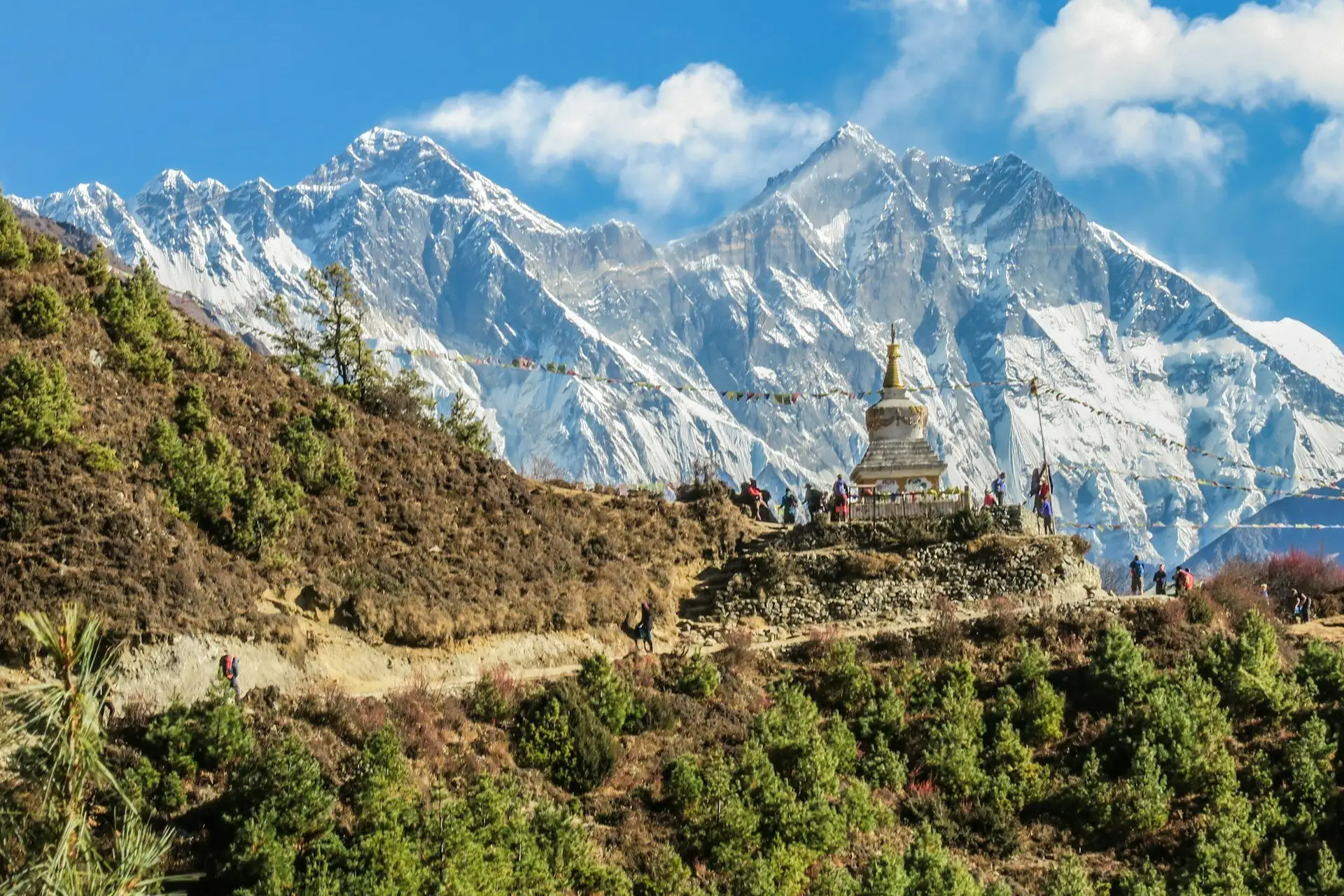
Nepal
A country that contains eight of the world's ten highest peaks, medieval Hindu temple squares untouched by any other civilization's interruption, a mountain culture built by the people the world calls when it needs someone to go very high, and tea houses at 4,000 meters where you can order hot lemon and dal bhat and watch Everest appearing above the clouds. The trekking alone justifies everything. The rest is extraordinary surplus.
What Nepal Actually Involves
Nepal's geography is the organizing fact of everything. The country runs roughly 800 kilometers east to west and just 200 kilometers north to south, but in those 200 kilometers it ascends from the subtropical Terai plains at 70 meters above sea level to Everest at 8,849 meters — the greatest vertical range of any country on earth. This compression of altitude zones produces a corresponding compression of climate zones, ecosystems, and cultures: within a few days' walk you can move from rhododendron forests at 3,000 meters through alpine meadows at 4,000 to the high-altitude desert of the rain shadow above 4,500 where the landscape looks more like Tibet than the tropical Nepal below. The trekking trails that traverse this compression are the reason Nepal is on most serious hikers' lists.
The two circuits that define Himalayan trekking are both here. The Annapurna Circuit — roughly 200 kilometers around the Annapurna massif, crossing the Thorong La pass at 5,416 meters — was for decades considered the finest trekking route in the world, and still is by most people who have done both it and everything else. The Everest Base Camp trek doesn't circle a mountain; it approaches one, following the Dudh Kosi river through the Sherpa heartland of the Khumbu, ascending through rhododendron and pine and then above the tree line to the moraine and glacier terrain below the South Col. The view from Kala Patthar at 5,545 meters, with Everest directly ahead and the Khumbu glacier below, is the reason approximately 30,000 people a year complete this walk despite knowing exactly what it involves.
Kathmandu is the other Nepal. The medieval city that was the capital of a valley kingdom for centuries and is now a chaotic, polluted, fascinating, historically dense city of over a million people. Durbar Square — the royal palace square at the center of the old city — contains temples, courtyards, and monuments that a UNESCO World Heritage designation cannot fully capture. The 2015 earthquake damaged many of the valley's historic structures significantly; the restoration work is ongoing and Kathmandu in 2026 is a city rebuilding its physical heritage alongside its economy and its confidence after the worst natural disaster in its modern history.
Two things worth knowing before you go: First, since April 2023 all trekkers on Nepal's main trekking routes are required to be accompanied by a licensed guide. Solo trekking without a guide is no longer permitted. This is a significant change from the previous system and it has practical, logistical, and financial implications that require planning. Second: altitude sickness is not an inconvenience to manage — it is a medical condition that kills people every year on Nepal's trails, including experienced, fit people who went too high too fast. The acclimatization schedule is not optional. Follow it without exception regardless of how well you feel.
Nepal at a Glance
A Valley Kingdom That Stayed Itself
Nepal has the distinction, rare in Asia, of never having been formally colonized. The British signed a treaty with the Gorkha kingdom after the Anglo-Nepalese War of 1814 to 1816 — a war the British won at significant cost against the Gurkha soldiers whose fighting ability was so impressive that the British immediately began recruiting them, a relationship that continues today — but Nepal remained an independent kingdom rather than becoming a British possession. This is not an accident of geography; the Himalayas provided a buffer that made conquest impractical, and the Shah dynasty that had unified Nepal in the 18th century was sufficiently pragmatic to negotiate rather than resist to the end.
The Kathmandu Valley where Nepal's medieval civilization concentrated is a different story from the mountain periphery. The Newari people — the indigenous inhabitants of the valley who created the temple squares, the palace architecture, the woodcarving tradition, and the mercantile culture that made Kathmandu a center of trans-Himalayan trade — have been in the valley since at least the 7th century CE. The three city-states of the valley — Kathmandu, Bhaktapur, and Patan — spent several centuries in artistic competition with each other, each attempting to outdo the others in the elaborateness of their Durbar Squares, their pagodas, their festivals. The result is one of the densest concentrations of medieval religious architecture in Asia, built by a people who were simultaneously Hindu and Buddhist in a syncretic tradition that distinguished between the two religions far less sharply than either dogma suggested.
Prithvi Narayan Shah unified Nepal in 1768 by conquering the valley kingdoms and established the kingdom that, in its various political forms, has lasted to the present. The Shah dynasty ruled until 2008, when Nepal became a republic after a decade-long Maoist insurgency (1996 to 2006) that killed approximately 17,000 people and ended in a peace deal that brought the Maoists into parliamentary politics. The royal massacre of June 2001 — in which Crown Prince Dipendra shot and killed the king, queen, and most of the royal family before turning the gun on himself — was a trauma that accelerated the monarchy's collapse: by 2008 the Shah dynasty had ruled Nepal for 240 years and it ended with a parliamentary vote.
The 2015 earthquake — magnitude 7.8, epicenter near Gorkha — killed approximately 9,000 people, injured 22,000 more, and caused catastrophic damage to the cultural heritage of the Kathmandu Valley. Dharahara Tower collapsed. Entire blocks of the Bhaktapur and Patan Durbar Squares were destroyed or damaged. The reconstruction effort, funded by international aid and Nepali government contribution, has been ongoing but uneven — some sites are restored, others remain scaffolded or partially cleared, and the experience of walking through the valley's heritage zones in 2026 is still marked by the earthquake's imprint.
The Newari people establish the valley city-states. Temple-building, metalwork, and trans-Himalayan trade flourish over the following centuries.
Prithvi Narayan Shah conquers the Kathmandu Valley and unifies Nepal under the Gorkha kingdom. The Shah dynasty rules for 240 years.
Britain fights Nepal, wins at significant cost, and immediately begins recruiting Gurkha soldiers. Nepal remains independent — one of the only South Asian states never formally colonized.
Edmund Hillary and Tenzing Norgay Sherpa reach the summit of Everest on May 29. Nepal's mountains become the focus of world attention.
A decade-long civil war between the government and Maoist rebels kills approximately 17,000 people. Ends with a peace deal that brings the Maoists into parliamentary politics.
Crown Prince Dipendra kills the king, queen, and most of the royal family at a palace gathering before shooting himself. The dynasty never recovers its legitimacy.
Nepal becomes a republic. The 240-year Shah monarchy ends with a parliamentary vote. The country begins a turbulent democratic transition.
Magnitude 7.8 earthquake kills 9,000, injures 22,000, and devastates Kathmandu Valley's cultural heritage. Reconstruction is ongoing in 2026.
The Treks, the Cities, and the Wildlife
Nepal's destinations divide into three worlds: the Kathmandu Valley with its medieval cities, the Himalayan trekking regions spread across the country's northern arc, and the Terai lowlands in the south. Most first-time visitors combine Kathmandu with one major trek. A fuller trip adds Pokhara as a base, Chitwan for wildlife, and possibly a second trek or a restricted-area permit destination like Upper Mustang.
Everest Base Camp (EBC)
The route follows the Dudh Kosi river from Lukla airport (a nine-minute flight from Kathmandu, the world's most dramatic airstrip) through rhododendron and juniper forest, past the Sherpa trading town of Namche Bazaar at 3,440 meters, through the high-altitude villages of Tengboche, Dingboche, and Lobuche, to base camp at 5,364 meters and Kala Patthar at 5,545 — the viewpoint from which Everest's full south face is visible in a way that the base camp itself, surrounded by the moraine, doesn't allow. The standard itinerary is 12 to 14 days return, including the essential acclimatization rest days at Namche and Dingboche. It is strenuous. It is not technical mountaineering. It is one of the genuinely earned travel experiences on earth.
Annapurna Circuit
For many trekkers who have done both, the Annapurna Circuit is the finer experience: longer, more varied, passing through a greater range of ecosystems, cultures, and landscape types than EBC. The full circuit — roughly 200 kilometers, 14 to 21 days — crosses the Thorong La pass at 5,416 meters, descends to the Mustang rain-shadow valley at Muktinath, passes through Marpha with its apple orchards and Tibetan Buddhist culture, continues through the Kali Gandaki gorge (the world's deepest valley between Annapurna and Dhaulagiri) and back south through rhododendron forests to Pokhara. Much of the northern section is now road-accessible, which has changed the character but not eliminated the beauty of this route.
Kathmandu Valley
Three medieval cities worth treating as separate destinations despite their proximity. Kathmandu's Durbar Square — the royal palace complex with its carved woodwork, Kumari's courtyard (where the living goddess appears at her window), and the surrounding temples — is the historic center. Bhaktapur, an hour east, is the best-preserved of the three: its Durbar Square largely survived the earthquake and the 55-Window Palace and the Nyatapola temple are extraordinary. Patan (Lalitpur), across the river from Kathmandu, has the finest metal craftwork tradition and a Durbar Square that rewards a full morning of slow walking. Allow two full days for the valley minimum; three is better.
Pokhara
Nepal's second city sits on the shore of Phewa Lake with the Annapurna range rising directly behind it — on clear mornings the view of Machhapuchhre (Fish Tail) and the Annapurna massif from the lakeside is the Nepal postcard that everyone who visits takes home. Pokhara is the gateway to the Annapurna region, the base for Poon Hill (the most popular short trek in Nepal — three to four days, spectacular Annapurna views at dawn from 3,210 meters), and a genuinely pleasant lakeside town to decompress in before or after trekking. Paragliding from Sarangkot down to the lake is one of Nepal's finest non-altitude experiences.
Chitwan National Park
The Terai lowlands in the south are a different Nepal from the mountains: flat, hot, and covered in sal forest and tall grassland that shelters one of the world's most important populations of greater one-horned rhinoceros (over 700 in the park), Bengal tigers, gharial crocodiles, Gangetic river dolphins, and more than 550 bird species. Game drives, elephant encounters at the breeding center, canoe trips on the Rapti River at dawn, and jungle walks with a park naturalist are the activities. The elephant bathing experience — previously an attraction — is no longer offered after welfare concerns were raised. Three days is the recommended minimum.
Upper Mustang
Until 1992, Upper Mustang was closed to all foreigners — a restricted kingdom within a kingdom, a Tibetan-speaking enclave in the rain shadow behind the Annapurna-Dhaulagiri barrier that looks and feels more like Tibet than Nepal. The landscape is ochre cliffs, ancient cave monasteries, and whitewashed villages in a dry valley where the wind comes off the plateau in the afternoon like a physical force. A special restricted-area permit costs $500 for 10 days (non-negotiable). The Lo Manthang walled city, the Luri Gompa cave monastery, and the sheer otherness of the landscape justify every dollar. Start from Jomsom by road or flight.
Langtang Valley
An hour's drive north of Kathmandu, the Langtang Valley was devastating hit by the 2015 earthquake — the village of Langtang was buried by an avalanche triggered by the quake, killing hundreds of residents and trekkers. The valley has been rebuilt and is now trekking again, quieter than EBC or Annapurna, and arguably more beautiful. The Gosaikunda lakes above the valley are sacred to both Hindus and Buddhists and surrounded by high ridges that make for extraordinary day hikes. Seven to ten days for the main circuit from Syabrubesi.
Pashupatinath & Boudhanath
Two of the most important religious sites in Hinduism and Tibetan Buddhism respectively, both on the eastern edge of Kathmandu. Pashupatinath on the banks of the Bagmati River is the holiest Shaivite temple in the subcontinent — non-Hindus are not permitted inside the main temple but the ghats where cremations happen continuously at the riverside, and the sadhus who take up residence in the surrounding area, constitute one of the most direct encounters with living Hindu religious practice available to a visitor. Boudhanath's stupa — the world's largest — is the center of the Tibetan Buddhist community in Nepal, circled by monks, butter-lamp shops, and the constant clicking of prayer wheels at every hour of the day.
Culture & Etiquette
Nepal sits at the confluence of Hindu and Buddhist traditions in a way that is genuinely syncretic rather than merely coexistent. Many shrines serve both traditions simultaneously; many festivals are observed by both communities; many deities are claimed by both. The valley's Newari people practice a particularly deep form of this synthesis, and understanding it requires abandoning the assumption that religious identity in Nepal works the same way it does in countries where a single faith has organized everything around itself.
The trail culture in Nepal's trekking regions has its own etiquette that is as important to understand as the temple etiquette in the valley. The tea houses that sustain the trekking economy are people's livelihoods and in many cases people's homes; the trail itself is not a public park but a living route between communities that has been used for trade and daily life for centuries before any trekker set foot on it.
The mani walls — long stone walls carved with Buddhist mantras — that appear on every trail in the trekking regions should be passed on the left (keeping them on your right), which is the clockwise direction. The same applies to stupas and chortens. This is not a request; it is a religious practice that the stones are oriented toward.
At every pagoda, temple, and most traditional homes. Look for the shoes at the door. The rule applies universally and is observed more strictly at major religious sites like Pashupatinath and the valley's Durbar Squares.
Food, money, and objects should be passed with the right hand or both hands. The left hand is considered unclean. This applies in restaurants, at market stalls, in guesthouses, and in every social transaction.
Porters carry loads for trekkers and the income supports mountain communities where alternative employment is extremely limited. A porter costs $20 to $25 per day, carries up to 20 kilograms, knows the trail, and typically speaks enough English to be genuinely useful. The ethical and practical case for hiring a porter is clear.
The standard greeting across Nepal — a slight bow with hands pressed together at the chest. It works everywhere, with everyone, and the response is universally warm regardless of language barrier. It is not a tourist gesture; it is the actual greeting.
Many Hindu temples in Nepal — Pashupatinath being the primary example — prohibit non-Hindu entry to the inner compound and main shrine. Signage at the entrance makes this clear. The prohibition is enforced and the correct response is to observe from the permitted areas rather than attempt to enter.
The feet are considered the lowest, spiritually impure part of the body. When sitting at religious sites, fold your legs or sit with feet behind you. When sitting in a tea house or a home, be aware of how your feet are directed relative to the shrine that most traditional homes maintain on the upper shelf of the main room.
Sadhus — Hindu ascetics, particularly the naga sadhus at Pashupatinath — are photographed constantly and some have developed a business around it. Paying for photographs is a personal decision; pushing objects or food at a sadhu who hasn't indicated interest is disrespectful regardless of your intentions.
This is not cultural etiquette — it is the medical rule that supersedes everything else on trek. Do not go above 3,000 meters without following the 300–500 meter maximum daily ascent rule. Do not push on if you have headache, nausea, or confusion above 3,000 meters. Descend immediately and significantly if these symptoms worsen. Altitude sickness is the one thing that kills people on Nepal's trails, including fit, experienced people. No schedule or summit justifies ignoring it.
Cows are sacred in Hindu Nepal and cow leather is particularly offensive at Hindu religious sites. Do not wear leather belts, bags, or shoes at Pashupatinath or bring leather goods into the immediate area of major Hindu temples.
Sherpa Culture
The Sherpa are a Tibetan-origin people who migrated to the Khumbu region of Nepal roughly 500 years ago. Their adaptation to high altitude — a genetic advantage in blood oxygen efficiency that is one of the most studied human adaptations in science — made them invaluable to the mountaineering expeditions that began arriving in Nepal in the early 20th century. The word "sherpa" (lowercase) has become generic for any mountain guide or porter in English; the Sherpa (uppercase) are a specific ethnic group with their own language, religious tradition (Nyingma Tibetan Buddhism), and cultural practices. Tenzing Norgay was a Sherpa. Most of the guides on the Everest route are Sherpa. Understanding the difference between the ethnic group and the generic term is respectful to both.
Festivals
Nepal's festival calendar is one of the most event-dense in Asia. Dashain (September/October) — the major Hindu festival, fifteen days of family gatherings, animal sacrifice, and the tikka blessing — is the Nepali Christmas in terms of its social centrality. Tihar (October/November) is the festival of lights, during which crows, dogs, and cows are each given a day of worship with flower garlands and food offerings before Laxmi is welcomed with oil lamps. Holi in March fills Kathmandu with colored powder. Buddha Jayanti at Boudhanath at the full moon of May draws thousands of pilgrims.
The Living Goddess (Kumari)
In the Kathmandu Valley, a prepubescent girl selected from a specific Newari Buddhist caste is venerated as a living manifestation of the divine goddess Taleju. She lives in the Kumari Ghar — the Kumari's house — beside Kathmandu's Durbar Square, leaves only on festival days carried in a palanquin, is visited by the president of Nepal on specific festival occasions, and retires when she reaches puberty. She is then replaced by a new Kumari selected through an elaborate process. The institution has existed for centuries. Visitors stand in the courtyard and she sometimes appears at the carved wooden window above, briefly. Do not photograph her when she appears.
The Syncretic Tradition
Nepal's religious life defies clean categorization. The same person may offer flowers at a Hindu Shiva shrine in the morning and circumambulate a Buddhist stupa in the evening. The Newari Buddhist community celebrates Hindu festivals and vice versa. Temples are shared between traditions in ways that would be theologically impossible according to either tradition's scripture. This syncretism is not confusion — it is the actual lived religion of a society that has had both traditions present since before either had fully formed its own boundaries. Walking through it without trying to organize it into Western religious categories is the correct approach.
Food & Drink
Nepali food is deeply honest and best understood as fuel for a high-altitude country where the growing season is short and the cuisine evolved to sustain people doing physical work in cold mountains. The centerpiece — dal bhat, the lentil soup and rice combination that is Nepal's national meal and served twice daily in most parts of the country — is one of those foods that makes complete sense when you understand the context: high in protein and carbohydrate, made from ingredients that store through winter, infinitely customizable with whatever vegetables and pickle are seasonal, and served in quantities that can be refilled indefinitely at no additional charge. The trekking trail's "dal bhat power, 24 hours!" is a genuine claim.
Kathmandu's food scene has diversified significantly in the last decade. The Thamel tourist district has everything from Israeli-run bakeries to Italian restaurants, but the best eating is outside the tourist district: Newari restaurants in Bhaktapur and the old city serving the traditional Newari feast (samay baji), the Tibetan quarter around Boudhanath for butter tea and tsampa, and the momos that appear in every form and filling across the city.
Dal Bhat
The national meal: steamed rice with lentil soup (dal), accompanied by vegetable curry (tarkari), pickled vegetables (achar), and sometimes a small portion of meat or fish depending on the household and region. Served on a metal thali plate, refilled freely. The phrase "dal bhat power, 24 hours!" is printed on tea house menus across the country and is sincerely meant. Trekkers eating dal bhat instead of the more expensive Western menu items at tea houses make a better economic choice for both their budget and the local community.
Momo
Tibet's contribution to Nepal's food culture: steamed or fried dumplings filled with spiced minced meat (typically buff — water buffalo — or chicken or vegetables) and served with a tomato-sesame dipping sauce. The jhol momo variant — momos in a spiced broth — is the superior version and the one that most distinguishes Nepali momo culture from its Tibetan ancestor. Found everywhere from street carts to dedicated momo restaurants. The best are made by hand that morning and filled with ingredients that came from the market that morning.
Aloo Dishes (Mountain Food)
Above the altitude where rice grows well, potatoes take over as the carbohydrate base. Aloo tama (potato with fermented bamboo shoots) in the middle hills. Aloo ko achaar (spiced potato pickle) as a near-universal accompaniment. At tea houses above 3,000 meters, the potato appears in increasingly creative forms as the altitude limits what can be grown. The potato was introduced to Nepal in the 18th century and the mountain communities adapted to it faster than almost any other culture on earth.
Newari Samay Baji
The traditional Newari feast of the Kathmandu Valley: a flat plate of beaten rice (chiura), spiced meat, black soybeans, potato slices, ginger, and local vegetables, accompanied by the fermented rice alcohol aila, drunk from a small clay cup. Samay baji is served at festivals, family gatherings, and the Newari restaurants in Bhaktapur that preserve the tradition for visitors. It is the version of Nepali food that most clearly demonstrates the valley's separate and older culinary identity from the hill-country food that predominates in trekking regions.
Butter Tea & Chhang
At altitude in Sherpa and Tibetan-influenced communities, butter tea — pu-erh tea churned with yak butter and salt — is the warming drink that tastes nothing like what most visitors expect and everything like what 5,000 meters of altitude demands. It is offered in every tea house above Namche. Accept it with both hands. It is an acquired preference and an immediate warmth that no other beverage at that altitude provides in the same way. Chhang — fermented millet or rice beer, slightly milky, mildly alcoholic — is the social drink of mountain communities and arrives in wooden cups at any gathering.
Hot Lemon & Ginger Tea
Not glamorous, but the most important liquid on any Himalayan trek: hot lemon water with ginger, ordered at every tea house stop, consumed in quantities that maintain hydration and body temperature simultaneously. At altitude, dehydration accelerates imperceptibly — the cold, dry air means you lose moisture through breathing faster than you notice thirst. Two or three hot lemons a day is not indulgence; it is the maintenance that keeps the headache from becoming something worse. The tea house profit margin on hot lemon is high; your altitude-related medical evacuation cost is higher.
When to Trek and When to Stay in the Valley
Nepal's trekking seasons are determined by the monsoon. The window before the monsoon (March to May) and after it (October to November) are the two primary periods. October and November are the most popular: the air is washed clear by the monsoon rains, the visibility is at its best, and the temperature at altitude is cold but manageable. The trade-off is that the trails — particularly EBC and the Annapurna routes — are at their most crowded. March and April offer rhododendron forests in full bloom, warmer temperatures, and slightly quieter trails; the trade-off is that afternoon clouds build earlier in the day, affecting views.
Post-Monsoon
Oct – NovThe gold standard of Himalayan trekking windows. Clear skies, stable weather, maximum mountain visibility. October is the ideal month. The trails are at peak occupancy — EBC tea houses can be crowded — but the conditions justify it. Book Lukla flights and key tea houses well in advance for October.
Pre-Monsoon Spring
Mar – MayRhododendrons blooming at 2,500 to 3,500 meters, warmer temperatures, slightly fewer trekkers. April is the best month. May becomes increasingly humid at lower elevations. The Everest climbing season peaks in April–May, which means the mountain is more active but the trekking trail to base camp is also busier.
Winter
Dec – FebCold, very cold at altitude, but clear and quiet. Trails that are crowded in October are nearly empty in January. The Annapurna Circuit's Thorong La pass may close with heavy snow. EBC is possible but the cold requires serious preparation. The reward is solitude and clear air that even October doesn't match. Not for casual trekkers.
Monsoon
Jun – SepThe monsoon brings heavy rain, leeches on the lower trails, clouded mountain views, and flooding that can make river crossings dangerous. Some routes — the Annapurna Circuit's drier northern sections, Upper Mustang in the rain shadow — remain viable. Kathmandu and the valley remain accessible year-round. Not recommended for any serious Himalayan trekking.
Planning Your Nepal Trip
Nepal planning is primarily trekking planning, and trekking planning has specific requirements that don't apply to most other destinations in this series. The mandatory guide rule since April 2023 changes the logistics significantly: you cannot simply buy a permit and walk. You need a licensed guide, and that guide needs to be arranged either through a registered trekking agency or as an independent hire with the guide's credentials verified. Budget for the guide fee — $25 to $40 per day depending on experience and route — as an essential trip cost alongside the permits.
Permit requirements vary by route. Most standard treks require a TIMS card ($10 to $20) and a national park or conservation area permit ($30 to $50). Restricted area permits for Upper Mustang ($500/10 days), Manaslu Circuit ($100/week), and Dolpo ($500/week) require advance booking through a registered agency. Get all permits at the Nepal Tourism Board offices in Kathmandu (Pradarshani Marg) or Pokhara before starting the trek — they are not available on the trail.
Kathmandu Valley
Day one: arrive, rest, walk Thamel's edges. Day two: Pashupatinath at dawn (the cremation ghats and the sadhus, starting before 7am), Boudhanath for the circumambulation and butter tea, afternoon in Patan for the Durbar Square and the metalwork. Day three: Bhaktapur by local bus — the best-preserved of the three cities and the one worth a full day. Permits and guide arrangement in the afternoon at the NTB office.
Everest Base Camp Trek
Fly Kathmandu to Lukla (build in an extra day for delays). Standard EBC itinerary: Lukla to Phakding, Namche Bazaar (two nights for acclimatization), Tengboche, Dingboche (two nights), Lobuche, Gorak Shep and base camp, Kala Patthar at dawn, return to Namche, Lukla. Ten trekking days, two rest days. Return flight to Kathmandu with weather buffer.
Kathmandu Recovery + Departure
Return to Kathmandu with whatever energy remains. The hot shower at the Thamel guesthouse is the version of luxury that weeks of cold tea house bathrooms make genuinely moving. Cashmere shopping on New Road (the real stuff is at Pashmina shops with certificates, not the market stalls). Departure.
Kathmandu Valley
Three full days: the full cultural circuit of the valley's three cities, an afternoon in the living craft workshops around Patan's Durbar Square where metalworkers and thangka painters operate in the same spaces they have for generations, and an evening at the Bhojan Griha restaurant for a traditional Newari feast with live music — the version of Kathmandu that is genuinely not for tourists but that tourists can attend with appropriate gratitude.
Chitwan National Park
Overnight bus from Kathmandu to Sauraha (five hours) or fly to Bharatpur (twenty minutes) and transfer. Four days: jeep safari at dawn and dusk, jungle walk with a naturalist guide, canoe on the Rapti River for gharial crocodiles and Gangetic dolphins, visit to the elephant breeding center. The rhino encounter — a massive animal grazing in tall grass twenty meters from your jeep — is the specific Nepal wildlife moment that doesn't require mountains.
Annapurna Circuit
Drive to Besisahar (the traditional circuit start) or to Chame if using the road shortcut. Full circuit: Chame, Pisang, Manang (two nights acclimatization), Thorong La crossing (an early 4am start), Muktinath, Jomsom, Marpha, Tatopani, Ghorepani, Poon Hill at dawn, Nayapul, and Pokhara. Allow 14 trekking days plus buffer for weather at the Thorong La. Fly or bus back to Kathmandu from Pokhara for departure.
Kathmandu Valley
Full three days in the valley including a cooking class and a full day in Bhaktapur timed for the early morning when the temple squares are for worshippers rather than tourists.
Everest Base Camp Trek
The full EBC with proper acclimatization — two nights at Namche, two nights at Dingboche, summit Kala Patthar at dawn on day 12, return to Lukla on day 14 with buffer days for Lukla weather. This is the version of EBC that completes correctly rather than races.
Pokhara & Poon Hill
Fly from Kathmandu to Pokhara. One full day on Phewa Lake and the paragliding from Sarangkot (book the evening before; 30 minutes of thermals over the lake and Annapurna backdrop). Three days for the Poon Hill short trek: Nayapul, Tikhedhunga, Ghorepani, Poon Hill at dawn for the Annapurna and Dhaulagiri panorama, return to Nayapul and Pokhara. Fly back to Kathmandu. Final night. Departure.
Trekking Permits
Every trekker needs a TIMS card and the relevant national park or conservation area permit. Get both at the Nepal Tourism Board office on Pradarshani Marg in Kathmandu or at the NTB office in Pokhara. The permits require your passport, passport photos, and payment in USD or NPR. Your guide will carry copies on trek. Restricted area permits (Upper Mustang, Manaslu, Dolpo) must be arranged through a registered agency and cannot be obtained as walk-ins.
Permit fee summary →Altitude Sickness
Acute Mountain Sickness (AMS) affects a significant percentage of trekkers above 3,000 meters. Symptoms: headache, nausea, fatigue, loss of appetite, dizziness. The rule: do not ascend further if you have AMS symptoms. Descend if symptoms worsen. Diamox (acetazolamide) is widely used as a prophylactic — discuss with your doctor before travel. The Himalayan Rescue Association has clinics at Pheriche (EBC route) and Manang (Annapurna route) specifically for altitude assessment.
Connectivity on Trek
NCell and Nepal Telecom 4G covers Kathmandu and Pokhara well. On the trekking routes, coverage is intermittent above Namche Bazaar (EBC) and patchy through the Annapurna Circuit. Tea houses above Namche offer paid WiFi ($1–5 per session). Download offline maps (Maps.me has Nepal trail coverage), your acclimatization schedule, and any emergency contact numbers before leaving cell coverage. A satellite communicator is worth considering for solo trekkers (guides now required, but in case of separation).
Get Nepal eSIM →Vaccinations
Recommended: Hepatitis A, Hepatitis B, Typhoid, Meningococcal, and routine vaccines. Japanese Encephalitis for rural and jungle stays (Chitwan). Rabies worth considering — Nepal has significant stray dog populations and treatment in mountain villages is unavailable. Malaria risk is low in Kathmandu and the hills but present in the Terai; discuss with your travel clinic. Altitude sickness is not a vaccination issue but is the primary health risk for trekkers.
Travel Insurance
Travel insurance must specifically cover high-altitude trekking and helicopter evacuation. Standard travel insurance typically covers only up to 3,000 to 4,000 meters — EBC goes to 5,545 meters. Helicopter evacuation from the Khumbu costs $5,000 to $10,000. World Nomads and specialist mountain travel insurers (BUPA Adventure, PlanetCare) have appropriate cover. Check the altitude ceiling and the evacuation cover specifically before purchasing. This is not optional fine print for Nepal.
Gear
Quality gear is the difference between a comfortable trek and a miserable one. Kathmandu's Thamel neighborhood has the world's largest concentration of trekking gear shops — quality varies from genuine to convincing replica. For anything safety-critical (sleeping bag temperature rating, boot waterproofing, down jacket fill power), buy genuine branded equipment at home. Down jacket, waterproof shell, trekking poles (knees on the descent from Thorong La will thank you), and a sleeping bag rated to at least minus 10°C for EBC or the Annapurna Circuit.
Transport in Nepal
Nepal's geography makes most transport slow and its mountain sections genuinely dramatic. The road network between Kathmandu and most destinations is improving but remains challenging — the Prithvi Highway between Kathmandu and Pokhara takes five to six hours on a good day and longer after rain. Domestic flights are the reliable alternative for the main connections. On the trekking routes, you walk — that is the transport.
Domestic Flights
$80–200 one-wayYeti Airlines, Buddha Air, and Summit Air connect Kathmandu to Pokhara (25 min), Lukla (35 min, mornings only), Bharatpur for Chitwan, Jomsom for the Mustang area, and other regional airports. Nepal's domestic aviation safety record has improved but remains below international standards — the dramatic mountain terrain and weather conditions make these routes genuinely more demanding than most domestic flights anywhere. Travel insurance that covers mountain aviation is the correct preparation.
Tourist Bus
$10–25 per routeTourist buses between Kathmandu and Pokhara (5–6 hours), and Kathmandu to Sauraha for Chitwan (5 hours). More comfortable than local buses, A/C, direct routes, guaranteed seating. Greenline, Prithvi Express, and several others operate daily services. Book through your guesthouse or directly from the operators' offices in Thamel. The road is scenic through the Trishuli river gorge and painfully slow through Kathmandu traffic.
Taxi & Ride Apps (Kathmandu)
200–500 NPR/city tripInDrive and Pathao operate in Kathmandu and are the safest urban transport options — fixed price before you confirm, tracked ride. Street taxis have a longstanding history of overcharging tourists and the app alternatives are significantly better. Within the Kathmandu Valley, shared tempos (electric three-wheelers) run fixed routes between the three cities cheaply. The tourist taxi stand at Thamel for day trips to Bhaktapur or Boudhanath — negotiate the price before getting in.
Helicopter Charter
Helicopter charters to Lukla (bypassing the unreliable fixed-wing schedule), to Namche Bazaar (even bypassing the trail start for those with limited time), and for emergency evacuation from altitude. The per-person cost when shared between four to five passengers makes helicopter access to the Khumbu competitive with the time and uncertainty of Lukla's flight schedule. Arrange through Kathmandu-based operators: Shree Airlines, Simrik Air, Heli Everest.
Local Jeep / 4WD
$30–60/day sharedFor accessing trek starting points — Besisahar for the Annapurna Circuit, Syabrubesi for Langtang, Jiri as an alternative to Lukla for a longer EBC approach — shared jeeps and 4WDs depart from Kathmandu's various bus parks. The roads to these trailheads can be spectacular and rough simultaneously. Ask your guesthouse to arrange the transport the evening before rather than navigating the bus parks independently.
Bicycle (Kathmandu Valley)
$5–10/day hireCycling between Kathmandu, Patan, and Bhaktapur is possible and provides the best pace for seeing the valley's lanes and back streets. Traffic in central Kathmandu is challenging; the outer roads between cities are manageable. Mountain biking trails in the hills above the valley — particularly the Shivapuri National Park above Budhanilkantha — are excellent for experienced riders.
Jeep Safari (Chitwan)
$15–30/game driveJeep safaris into Chitwan's core zone, operated by government-licensed drivers, are the primary wildlife viewing method. Dawn and dusk drives are the peak activity times — the rhinos and deer are most active in low light and the tiger sightings, though never guaranteed, happen disproportionately at these hours. Book through your lodge rather than independently for the best-guided experience.
On Trek — Your Feet
N/AThe trekking routes are walked. There is no alternative transport on the trail except helicopter for emergency evacuation or rescue. This is the point. The physical engagement with the altitude gain and loss, the duration, and the terrain is inseparable from the experience. The tea house culture, the acclimatization days, the conversations with your guide — all of these happen because the journey requires time at walking pace.
Accommodation in Nepal
Nepal accommodation divides cleanly: Kathmandu and Pokhara have a full range from backpacker guesthouses at $8 to $15 per night to luxury heritage hotels; the trekking routes have tea houses — the simple lodges that sustain the entire trekking economy; and Chitwan has jungle lodges ranging from budget to genuinely luxurious. The best accommodation experiences in Nepal are at the extremes: a well-run Kathmandu heritage hotel in a converted Newari merchant's house and a tea house at 4,200 meters where the host brings a second blanket without being asked because she's watched trekkers shiver at that altitude for twenty years.
Thamel Guesthouses
$8–60/nightKathmandu's Thamel neighborhood is the trekking hub and guesthouse central. Quality ranges from basic dorm to comfortable private room with hot water and wifi. The best budget options — Hotel Encounter Nepal, Potala Guesthouse, and a dozen others — have been hosting trekkers for decades and the staff know exactly what you need before and after a big trek. Book the nicer room for the night you return from Khumbu.
Kathmandu Heritage Hotels
$80–250/nightThe Dwarika's Hotel — a complex of restored Newari merchant buildings with original carved woodwork incorporated into rooms and public spaces — is the finest Nepal hotel experience at any price point. The Yak & Yeti (built around a Rana palace wing), Hotel Vajra near Swayambhunath, and several smaller heritage boutiques offer the city's architectural history as accommodation. Worth one or two nights on a longer Nepal trip.
Trek Tea Houses
$5–25/nightThe lodges on Nepal's trekking routes are simple, warm enough if you have the right sleeping bag, and increasingly equipped with solar power and wifi at lower elevations. Rooms are basic — a bed, sometimes two, sometimes a shared bathroom, sometimes solar hot water. The deal: tea house accommodation is cheap or sometimes free if you eat all your meals there. The margin on meals (not accommodation) is how the tea house economy works. Eat there. Always.
Chitwan Jungle Lodges
$30–200/night incl. activitiesChitwan lodges range from basic guesthouses in Sauraha village to the upmarket resorts on the park's buffer zone boundary. The mid-range — Tiger Tops Tharu Lodge, Barahi Jungle Lodge, Machan Wildlife Resort — offer included game drives, naturalist guides, and the core wildlife experience at reasonable prices. The luxury end (Tiger Tops Jungle Lodge) pioneered responsible wildlife tourism in South Asia and remains the benchmark for the experience at the top price.
Budget Planning
Nepal is affordable by global standards but trekking costs have specific fixed expenses — permits, the mandatory guide, Lukla flights, and the incremental price increase of everything as altitude rises — that the basic accommodation and food costs don't capture. The rough rule: your daily on-trek cost (tea house, meals, guide fee) is $60 to $100 without the guide-porter package; the guide-porter package adds $50 to $70 per day for the two people and covers the mandatory guide requirement. Add permits and flights and the total for an EBC trek lands around $1,000 to $1,500 for a budget traveler, $2,000 to $3,000 for mid-range.
- Thamel guesthouse or tea house on trek
- Dal bhat for all meals
- Local transport (bus, tempo, shared jeep)
- Guide cost shared across group
- Budget permits (TIMS + national park only)
- Comfortable guesthouse or Pokhara lakeside hotel
- Restaurant meals in Kathmandu, dal bhat on trek
- Domestic flights (KTM–Lukla, KTM–Pokhara)
- Private licensed guide + porter
- Standard trekking permits + helicopter buffer
- Dwarika's Hotel Kathmandu, Chitwan lodge
- Full restaurant dining, multi-course meals
- Helicopter Kathmandu–Namche direct
- Experienced senior guide + porter
- Restricted area permits (Mustang, Dolpo)
Key Costs at a Glance
Visa & Entry
Most nationalities can obtain a tourist visa on arrival at Tribhuvan International Airport in Kathmandu and at certain land border crossings. The visa on arrival costs $30 for 15 days, $50 for 30 days, or $125 for 90 days, payable in USD cash or by card at the airport. An online visa application system (online.nepalimmigration.gov.np) is also available and saves time at the immigration counter.
Nepal's time zone is UTC+5:45 — one of only two countries in the world with a 45-minute offset, which manages to confuse even experienced travelers at connection time. Set your phone clock before landing.
15 days ($30), 30 days ($50), or 90 days ($125). USD cash or card accepted at Kathmandu airport. Online application available at online.nepalimmigration.gov.np.
Family Travel & Pets
Nepal is an excellent family destination for the right kind of family — one that is ready for physical challenge, variable infrastructure, and an experience that is more enriching than comfortable. The Kathmandu Valley and Chitwan are suitable for families with children of any age. Trekking with children is the question that most family travelers want answered: yes, with the right route, the right preparation, and a realistic assessment of the children's fitness and altitude tolerance.
The Poon Hill trek (3 to 4 days, maximum elevation 3,210 meters) is the best family trekking option — achievable for fit children from around 8 years old, with spectacular mountain views, rhododendron forest, and tea house culture without the serious altitude exposure of EBC or the Annapurna Circuit. The Langtang Valley (maximum around 3,900 meters) is the next step up. EBC with children is possible for teenagers with good fitness and a guide who takes the acclimatization schedule seriously — the altitude makes it a serious undertaking regardless of the trekker's age.
Chitwan for All Ages
The rhino encounter — a massive one-horned animal grazing in tall grass meters from a jeep — registers at every age from four upward. The Chitwan wildlife experience is not abstract ecology but immediate physical presence of large animals in wild habitat. Dawn game drives, canoe trips for gharial crocodiles and river dolphins, and the elephant breeding center where young elephants under keeper care can be observed — all child-appropriate and genuinely engaging.
Kathmandu Valley Culture
The Kathmandu Valley for children: the Kumari's window appearance (children understand instinctively what a living goddess is), the sadhus at Pashupatinath with their ash-covered faces and tridents, the prayer wheel spinning at Boudhanath stupa, and the pageantry of the Durbar Squares reward children who engage rather than being managed through. The Nepal Children's Festival in October is a specific child-focused cultural event worth checking.
Pokhara Activities
Pokhara offers a range of non-altitude activities for mixed family groups: paragliding (minimum age around 10, weight minimum around 30kg), rowboat on Phewa Lake, the World Peace Pagoda hike (a good 2-hour family walk with Annapurna views at the top), the Davis Falls waterfall, and the Gurkha Museum which documents a specific and fascinating military history. Good base for families where some members are trekking and others are not.
Poon Hill Family Trek
The 3 to 4-day Poon Hill trek is the correct family trekking option: manageable elevation gain (maximum 3,210 meters), rhododendron forests, tea house culture, and the sunrise view of the Annapurna and Dhaulagiri ranges from the hill is one of Nepal's most photogenic moments. Fit children from 8 years old can manage this. The tea house stays, the trail conversations, and the accomplishment of the summit at dawn make this one of the better family travel experiences in Asia.
Jungle Walks (Chitwan)
Guided jungle walks in Chitwan's buffer zone with a park naturalist are suitable for older children — teenagers primarily — who can maintain the required quiet and follow the guide's instructions exactly. This is not a zoo experience: animals are wild and encounters are genuine. The naturalist guides trained by the community-based programs in Chitwan are among the finest wildlife interpreters in South Asia.
Altitude and Children
Children are not more resistant to altitude sickness than adults. The standard acclimatization rules apply and the consequences of ignoring them apply equally. Any family planning to trek above 3,000 meters with children should research pediatric altitude sickness specifically, carry Diamox (discuss with a travel medicine doctor about pediatric dosing before travel), and have a clear plan for descent if symptoms appear. A Kathmandu-based travel medicine clinic (CIWEC Hospital) can advise specifically.
Traveling with Pets
Pet travel to Nepal is possible but practically complex. The import requires a veterinary health certificate issued within 30 days of travel, a valid rabies vaccination certificate, a microchip, and a No Objection Certificate from a Nepal Embassy or the Department of Livestock Services. Dogs and cats are the primary animals for which import provisions exist; other species have stricter requirements.
The practical reality: Nepal's trekking trails are the main reason most people visit, and they are entirely unsuitable for pet travel. The altitude, the terrain, the tea house culture (which does not accommodate pets), and the stray dog populations on the trekking routes that carry rabies — all make bringing a pet on the trek inadvisable in the extreme. Kathmandu has a significant stray dog and dog attack history that makes urban pet travel challenging. The veterinary infrastructure outside Kathmandu is extremely limited.
Leave pets at home for Nepal. The country is challenging enough logistically without adding an animal to the equation.
Safety in Nepal
Nepal is generally safe for tourists and violent crime against visitors is uncommon. The main safety risks are environmental: altitude sickness, mountain weather, trail conditions, and the aviation risk of Nepal's mountain airport routes. In Kathmandu, petty theft in crowded areas and around Thamel, and taxi overcharging, are the realistic concerns. The political environment is occasionally turbulent — Nepal has had significant political instability since the Maoist period — but protests and political events rarely affect the tourist areas or the trekking routes.
Crime Against Tourists
Low overall. Pickpocketing in Thamel's crowded streets, around Durbar Square, and at Pashupatinath are the main concerns. Keep valuables secured. Taxi overcharging is endemic — use InDrive or negotiate before entering. Scams around fake trekking agencies in Thamel have a long history — use NTB-registered agencies only.
Solo Women
Nepal is relatively safe for solo female travelers. The trekking culture is international and mixed-gender trail groups are the norm. Female trekkers without a guide (now mandatory anyway) should be especially attentive to the guide requirement both for safety and for the practical navigation support. Standard urban awareness in Kathmandu.
Altitude Sickness
The primary medical risk for trekkers. AMS becomes HACE (High Altitude Cerebral Edema) or HAPE (High Altitude Pulmonary Edema) without adequate acclimatization and descent. HACE and HAPE are life-threatening. The Himalayan Rescue Association clinics at Pheriche and Manang provide assessment. If in doubt, descend. If not in doubt but your guide is, descend. There is no summit or schedule that overrides this rule.
Mountain Weather
Nepal's mountain weather can change rapidly. Afternoon storms on the Thorong La pass have trapped and killed trekkers who crossed too late in the day. The start time for the Thorong La crossing is 4am for a reason. Flash floods in lower gorges during monsoon have killed trekkers on the Langtang and Annapurna routes. Your guide's assessment of weather risk supersedes your schedule preferences.
Domestic Aviation
Nepal's mountain airports have one of the world's higher rates of aviation incidents, driven by extreme terrain, weather unpredictability, and maintenance challenges. Lukla (Tenzing-Hillary Airport) specifically has had serious incidents. This risk is real but context-appropriate — millions of flights have been completed safely. Travel insurance that covers mountain aviation is the correct preparation.
Healthcare
CIWEC Hospital and Nepal International Clinic in Kathmandu provide international-standard care and are the primary English-speaking medical facilities. The Himalayan Rescue Association's clinics at altitude are the trekking route's medical resource. For serious cases, medical evacuation to Bangkok or Delhi is standard. Travel insurance with high-altitude evacuation cover is non-negotiable for trekkers.
Emergency Information
Your Embassy in Kathmandu
Most embassies are in the Maharajgunj and Lainchaur areas of Kathmandu.
Book Your Nepal Trip
Everything in one place. For Nepal, get your Lukla flights and insurance sorted first — everything else can flex around them.
The View Justifies the Ascent
There is a moment on any Nepal trek — on EBC it happens somewhere around Dingboche on the fourth or fifth day, when the valley opens and Makalu and Lhotse appear above the ridge in a way the photographs don't prepare you for — when you understand that the scale of the Himalaya is not a number or a photograph but a physical experience that requires your actual body standing in it to comprehend. The mountains are not tall in the way that buildings are tall. They occupy the sky differently. They change the way the horizon works.
The Nepali have a concept — bistari bistari, slowly slowly — that applies to altitude gain and applies equally well to the country itself. Go slowly. Eat the dal bhat. Take the rest days. Have the tea. Accept the second blanket. Talk to your guide about something other than the trek schedule. The mountains are extraordinary and the people who live under them are worth knowing and the pace at which Nepal reveals itself is the pace it sets, not the one your itinerary suggests. Bistari bistari. This is the right approach to everything Nepal has to offer.