
Zimbabwe
The best panorama of Victoria Falls. Africa's largest elephant herds. A medieval stone city that forced the world to rewrite its assumptions about African history. Zimbabwe is exceptional and far safer than most people expect.
What You're Actually Getting Into
Zimbabwe's reputation has spent thirty years being defined by its economics and politics rather than its geography, and the geography is extraordinary. The country sits on a high central plateau averaging 1,200 meters elevation — which means the climate is better than most of equatorial Africa, the nights are cool, and the light has a quality that photographers arrive expecting and leave confirmed. It has Victoria Falls on its western border, Africa's largest elephant population in Hwange, a medieval stone city that rewrote the continent's history, granite hill country that holds white rhinos you can approach on foot, and a river valley where you can canoe past swimming elephants with nothing between you and them but the current.
This is also a country that has been through one of the most severe economic collapses in modern history. The Mugabe era (1980–2017) ended with hyperinflation that peaked at 89.7 sextillion percent in November 2008 — a number so extraordinary it required the government to print 100 trillion dollar notes that bought two loaves of bread on a good day. The land reform program of the early 2000s collapsed commercial agriculture, drove a severe food crisis, and caused an exodus of several million Zimbabweans to neighboring countries. That history is not invisible when you travel here. The infrastructure reflects it. Some of what used to work no longer does. But Zimbabwe has been slowly rebuilding its tourism sector and the wildlife, the landscape, and the people — who have an education system that produced one of Africa's highest literacy rates and retained it through the chaos — remain genuinely compelling.
The practical reality for most tourists: Victoria Falls and the associated parks are well set up, comfortable, and safe. Harare works for transit. The mid-country — Great Zimbabwe, Matobo Hills, Bulawayo — rewards the traveler who makes the extra effort to get there. Mana Pools in the north is among the most extraordinary wilderness areas in Africa, and the canoe safari on the Zambezi is a different but comparable experience to the Zambia side. Zimbabwe is about 30% cheaper than its neighbor across the river, which matters when you're already spending what safaris cost.
One thing to address directly: Zimbabwe's political situation under President Emmerson Mnangagwa, who replaced Mugabe in a 2017 military-assisted transition, has not delivered the democratic opening many hoped for. Press freedom remains limited. Political opposition leaders have faced intimidation and arrest. This does not translate into danger for tourists in normal circumstances, but understanding what you're entering matters, and Zimbabweans you meet — who are often remarkably candid — will often tell you exactly what they think if you ask with genuine interest.
Zimbabwe at a Glance
A History Worth Knowing
The ruins sitting on a granite hillside near Masvingo in south-central Zimbabwe are not merely impressive ancient architecture. They are one of the most politically charged archaeological sites in the world. Great Zimbabwe — a stone enclosure city built by the ancestors of the Shona people between the 11th and 15th centuries, the capital of a trading empire whose gold and ivory reached Swahili coast merchants, Arab traders, and ultimately as far as China — was a problem for the colonial ideology that insisted Africans could not have built sophisticated civilizations without outside guidance. When early European explorers encountered the site, official colonial policy in Rhodesia actively promoted theories that the ruins had been built by Phoenicians, Arabs, King Solomon's traders, or any external civilization rather than local Africans. Archaeologists who correctly attributed the ruins to the Shona ancestors were professionally suppressed. The site is named after the Shona word for "houses of stone" — dzimba dzemabwe — and when Zimbabwe took its name at independence in 1980, the political statement was deliberate and clear.
The Shona civilizations of the Zimbabwe plateau developed sophisticated states over centuries, trading gold through the Zambezi valley and later the Limpopo corridor to Indian Ocean ports. By 1420, Great Zimbabwe had declined — possibly from environmental pressures and trade route shifts — and a new Shona state, the Mutapa Kingdom, had emerged to the north. This was the state that Portuguese traders encountered when they reached the interior in the 1500s, and the one they spent two centuries trying to control, destabilize, and exploit with limited success.
The Ndebele Kingdom, established in the southwestern regions by Mzilikazi and his followers who had broken from the Zulu Kingdom in the 1830s, created a second significant power in the territory. It was the Ndebele who gave the most determined resistance to Cecil Rhodes's British South Africa Company column that entered in 1890. The Ndebele were defeated in 1893, the Shona rose in the First Chimurenga in 1896–97, and both were suppressed. The territory was named Southern Rhodesia after Rhodes and administered as a settler colony with formal apartheid-style racial legislation, land reservation, and a political system that explicitly excluded Africans from power.
The liberation war — the Second Chimurenga — ran from 1964 to 1979, a brutal guerrilla conflict involving two separate movements (ZANLA aligned with ZANU, and ZIPRA aligned with ZAPU) fighting the white minority government of Ian Smith's Rhodesia. The Lancaster House Agreement in 1979 produced the transition to majority rule and independence as Zimbabwe in April 1980, with Robert Mugabe's ZANU-PF winning the first elections. Mugabe began as a hero of African liberation and an explicitly reconciliatory leader — his first speech as Prime Minister was a genuine call for racial harmony that surprised and moved even his opponents. His trajectory over four decades in power toward authoritarianism, electoral manipulation, the catastrophic land reform program, and the hyperinflationary collapse is one of the most studied and debated political trajectories in African history.
The November 2017 military intervention that removed Mugabe — framed carefully as not a coup — brought Emmerson Mnangagwa to power. The promised "new dispensation" has not materialized into genuine democratic reform. Elections in 2023 were widely criticized as flawed by international observers. The economy has partially stabilized but the fundamental structural issues remain. Zimbabweans carry an enormous collective memory of what their country once was — it had one of the strongest economies in sub-Saharan Africa at independence in 1980, and a literacy rate above 90% — and what was lost. That context shapes every conversation with a Zimbabwean who is willing to talk frankly, which is most of them.
Shona ancestors build the stone city — largest ancient structure in sub-Saharan Africa. Capital of a gold-trading empire linked to the Indian Ocean.
Mzilikazi leads his Ndebele followers from the Zulu Kingdom north, establishing a powerful state in the southwestern territory.
Cecil Rhodes's column enters the territory. Southern Rhodesia established as a settler colony with explicit racial exclusion.
The Second Chimurenga — guerrilla war against Ian Smith's white minority government. Ends with the Lancaster House Agreement.
Zimbabwe gains independence. Mugabe's conciliatory first speech surprises the world. Africa's highest literacy rate. One of the continent's strongest economies.
Land reform program collapses commercial agriculture. Hyperinflation peaks at 89.7 sextillion percent. Millions flee. 100 trillion dollar notes printed.
Military-assisted transition brings Mnangagwa to power. Promised democratic reform has been limited. Economy partially stabilized.
Wildlife and infrastructure recovering. Tourism sector growing steadily. The country is extraordinary to visit — the politics are complex.
Top Destinations
Zimbabwe's best experiences are spread across the country and most visitors make the mistake of staying only in Victoria Falls. The west (Falls and Hwange) handles 80% of tourist traffic. The south (Matobo and Bulawayo) and mid-country (Great Zimbabwe) are undervisited relative to their quality. Mana Pools in the north is for serious wilderness travelers and requires planning. A good Zimbabwe itinerary moves between at least two or three of these zones.
Victoria Falls — Zimbabwe Side
The Zimbabwe side of Mosi-oa-Tunya gives you what the Zambia side cannot: distance. The Victoria Falls National Park walkway runs for 1.7 kilometers through rain-forest created by the perpetual spray, with 16 numbered viewpoints facing the full width of the falls and the gorge below. At peak flow (June to August), the spray drenches you within 30 seconds and makes photography at the closest viewpoints nearly impossible — but the sheer scale of the curtain of water visible across the full 1,708-meter width is genuinely staggering. The town of Victoria Falls itself has good infrastructure — hotels, restaurants, and the full range of Zambezi activities (white-water rafting, bungee jumping from the bridge, helicopter flights, sunset cruises) available on the Zambian and Zimbabwean sides both. Get the KAZA Univisa and see both sides. They are genuinely different experiences and the comparison is part of the point.
Hwange National Park
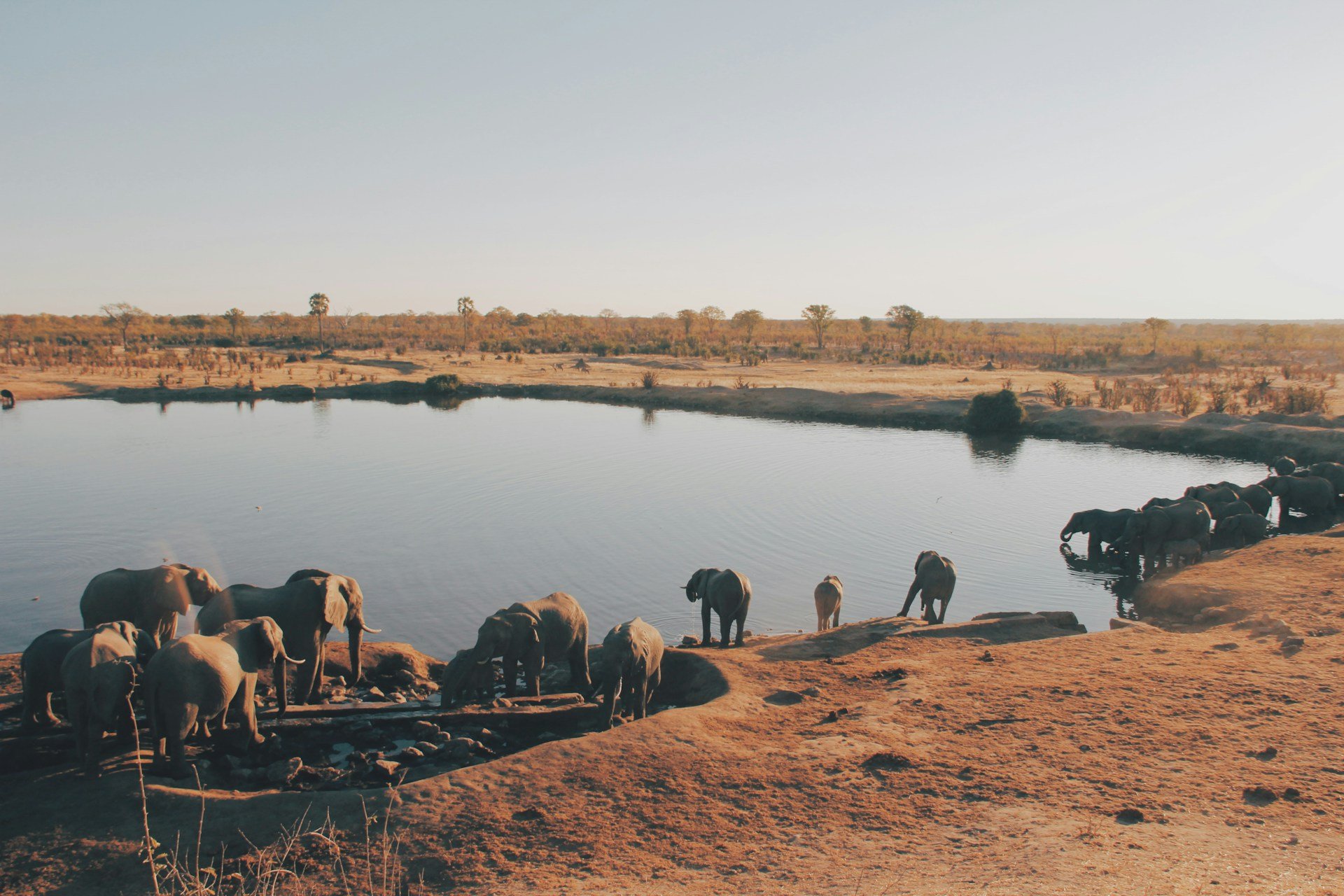
Zimbabwe's largest national park and home to Africa's largest elephant population — estimated at 45,000–50,000 animals, a number that is itself controversial because it strains the park's carrying capacity. In the dry season (June to October), Zimbabwe National Parks and private concessions pump water into artificial waterholes, and the concentration of wildlife around them at dusk is one of Africa's great spectacles: herds of 200 or more elephants converging from different directions, lions drinking alongside zebras in the failing light, the completely manageable chaos of a major African watering hole at golden hour. The private concessions in Hwange (Linkwasha, Little Makalolo, Somalisa Acacia) operate low-volume, high-quality camps comparable to Zambia's better operators. The National Parks accommodation at Main Camp and Sinamatella is very basic but cheap and functional for budget self-drivers.
Matobo Hills National Park
The Matobo Hills south of Bulawayo are a landscape unlike anything else in Zimbabwe — a vast field of granite domes and balanced boulders sculpted by 2 billion years of weathering into shapes that look deliberate and theatrical. Cecil Rhodes is buried at the top of a granite hill he called "World's View," an irony that Zimbabweans navigate with varying degrees of grace. The real reason to come is the white rhino tracking. Matobo has one of Africa's most accessible rhino populations and the guided tracking walks on foot — two hours through the boulders following fresh spoor until you're 30 to 50 meters from an animal that is theoretically one of Africa's most dangerous — is one of the continent's most genuinely thrilling wildlife experiences. The same guides have often been tracking the same individual rhinos for years and know them by name.
Great Zimbabwe Ruins
The largest ancient stone structure in sub-Saharan Africa covers 722 hectares and reaches 11 meters at its highest walls. At its peak around 1400 CE it housed an estimated 18,000 people. The three main sections — the Hill Complex (the oldest, used for religious ceremonies), the Valley Ruins, and the Great Enclosure (whose outer wall is 250 meters in circumference and built without mortar) — take 3–4 hours to walk properly. The site is rarely crowded, which makes the experience of wandering through 600-year-old granite passages alone, with the sound of hornbills above you, genuinely affecting. The nearest town is Masvingo, 30km away. There are a few guesthouses close to the site but most visitors come as a day trip from Bulawayo (4 hours) or en route between Bulawayo and Harare.
Mana Pools National Park
On the Zambezi in northern Zimbabwe, Mana Pools is a UNESCO World Heritage Site and one of the most genuinely wild places in southern Africa. The annual Zambezi flood deposits nutrient-rich sediments across a floodplain where fig trees have grown enormous, elephants stand on their hind legs to reach the fruit, and wild dogs denning in the area make regular appearances. Canoe safaris here — paddling past swimming elephants and hippo pods with the escarpment above you — are the signature experience. Walking is permitted in the park without a guide, which is unusual in Africa and means the encounters feel unmediated and real. Getting to Mana Pools requires either a long drive on rough roads or a charter flight. The camps (Ruckomechi, Chikwenya, Little Ruckomechi) are exceptional.
Bulawayo
Zimbabwe's second city and the historical capital of Matabeleland has a faded colonial elegance that Harare lacks — wide tree-lined avenues, a downtown grid of Victorian buildings, and a slower pace that reflects both its history and its current economic quietness. The Natural History Museum is Africa's best natural history museum south of the Sahara and genuinely excellent. The Railway Museum (Bulawayo was a major railway hub) has a functioning steam engine collection. Bulawayo is the base for Great Zimbabwe (4 hours east) and Matobo Hills (45 minutes south) and makes more sense as a circuit base than Harare for these destinations.
Nyanga & Chimanimani
Zimbabwe's eastern border with Mozambique runs through a mountain range that feels entirely unlike the rest of the country. Nyanga's peaks reach 2,592 meters, the highest point in Zimbabwe, and the landscape is misty, forested, and cool in a way that contradicts most people's expectations of southern Africa. Chimanimani National Park has some of the best mountain hiking in the region — two to three day trails through sandstone gorges and heath-covered ridges. Both areas have been affected by infrastructure damage from Cyclone Idai in 2019 and recovery has been ongoing. Check current access conditions before planning a visit.
Harare
Harare works as a transit hub and has moments of genuine interest if you engage with it rather than passing through. The National Gallery of Zimbabwe on Julius Nyerere Way has the best collection of Shona sculpture — a tradition of stone carving that emerged in the 1960s under the influence of Frank McEwen and is considered one of Africa's most important contemporary art movements. The Mbare Musika market is the largest and most chaotic market in Zimbabwe, not for the faint-hearted but extraordinary for an hour if you're accompanied by someone who knows it. Harare's northern suburbs have good restaurants and the city is safer in the daytime than its reputation suggests.
Culture & Etiquette
Zimbabwe has 16 official languages — a constitutional recognition of the country's remarkable ethnic diversity. The main groups are the Shona (approximately 70% of the population, concentrated in the east, centre, and north) and the Ndebele (about 20%, in the southwest around Bulawayo and Matabeleland). English is the language of government, education, and formal commerce, and it is spoken fluently by a very high proportion of the population. Zimbabwe's education system, even through the worst of the economic crisis, maintained one of Africa's highest literacy rates. You will encounter a higher proportion of well-educated, widely-read people in casual conversation in Zimbabwe than in most African countries, and they will have opinions they are happy to share.
Zimbabweans are generally formal in initial greeting and warm once acquaintance is established. The colonial legacy has left a layer of particular courtesy that can initially read as reserve. Scratch that surface and the directness and humor emerge quickly. Politics is a subject people discuss with striking candor once they've assessed that you're listening rather than judging.
"Good morning / afternoon / evening" is the correct opening for any interaction, from buying bread to asking directions. Skipping the greeting is considered rude. The response will be equally formal and equally warm.
Receiving money, food, or gifts with both hands — or with your right hand and your left touching your own right wrist — signals respect, particularly to elders or people senior to you.
Zimbabwe's Shona sculpture tradition is one of Africa's genuinely significant contemporary art movements. Buying from sculptors directly (Tengenenge Sculpture Community outside Harare is the best place) puts money into one of the country's few thriving creative industries.
$1 and $5 bills are essential. Sellers, guides, and market vendors often cannot change $20 or $50 bills. Running out of small bills strands transactions entirely. Arrive from the ATM with lots of ones.
Safari guides, hotel staff, and drivers depend on tips significantly more than in a functioning economy. The industry standard is $10–20 per day per guide for safari activities. Pay in USD; ZiG is less useful to recipients.
Strictly prohibited and enforced. This includes Parliament, State House, military installations, police stations, and border facilities. The camera confiscation risk is real and the questioning can be lengthy and unpleasant. Do not photograph even from moving vehicles.
Freedom of expression is legally constrained in Zimbabwe and the POSA (Public Order and Security Act) has been used to detain people for statements considered seditious. In private conversations with trusted people, Zimbabweans speak with remarkable candor. In public settings with strangers, be circumspect with political opinions.
Load shedding (scheduled power cuts) in Zimbabwe can run 12–18 hours per day outside of tourism areas. This affects ATMs, charging, restaurants, and hotel facilities. Always charge devices when power is available. Keep cash on hand. Budget accommodation may have no generator.
Harare's daytime risks for tourists are manageable. After dark in areas outside the northern suburbs (Borrowdale, Avondale, Greendale) the risks increase substantially. Use taxis or ride-hail apps in the evening without exception.
Road quality outside major routes varies from good to very poor. ATMs run out of cash or go offline. Some restaurants close without notice. Mobile data is unreliable in many areas. Build in more time and flexibility than you would in Europe. Things take longer. People compensate with remarkable helpfulness.
Shona Sculpture
One of Africa's most significant contemporary art movements emerged in Zimbabwe in the 1950s and 60s under the encouragement of art director Frank McEwen at the National Gallery. Working in springstone, opalstone, serpentine, and verdite — stones unique to the Zimbabwean geological landscape — Shona sculptors like Henry Munyaradzi, Bernard Matemera, and John Takawira created a body of work that entered major international collections. The Tengenenge Sculpture Community in Guruve district north of Harare has hundreds of working sculptors and is the most authentic place to buy directly.
Mbira & Music
The mbira dzavadzimu — a thumb piano with 22 to 28 metal keys mounted on a soundboard inside a resonating gourd — is central to Shona spiritual and ceremonial life, used in all-night bira ceremonies to communicate with ancestral spirits. It also became the foundation of the chimurenga music tradition popularized internationally by Thomas Mapfumo, who used traditional mbira melodies embedded in electric band arrangements to create a musical language for the liberation movement. Mapfumo's records from the late 1970s are worth knowing before you visit.
Braai Culture
Zimbabwe shares the southern African braai (wood-fire grilling) tradition with South Africa, Zambia, and Botswana. An invitation to someone's home braai is a significant social gesture. The standard accompaniment is sadza (the Shona version of nshima — stiff white maize meal), roasted meat, and greens. If you are invited to a Zimbabwean family braai, go. The food is secondary to the conversation, which will be wide-ranging, well-informed, and frequently funny.
Literary Tradition
Zimbabwe has produced a remarkable literary tradition — Chenjerai Hove, Yvonne Vera, Dambudzo Marechera, NoViolet Bulawayo. The work of these writers engages directly with the colonial experience, the liberation war, the Gukurahundi massacres in Matabeleland in the 1980s, and the post-independence disillusionment. Reading NoViolet Bulawayo's "We Need New Names" or Yvonne Vera's "Nehanda" before visiting gives the landscape layers it wouldn't otherwise have.
Food & Drink
Zimbabwean food shares the same starchy, substantial foundation as Zambia's — sadza (stiff white maize meal) is the national staple, eaten with relish of meat, greens, beans, or dried fish. The difference is in the accompaniments. Zimbabwean cooking has a slightly richer tradition of fresh vegetable relishes, and the influence of the colonial settler culture has left a reasonably functional restaurant sector in Victoria Falls, Harare, and Bulawayo that produces good grilled meat and braai-style meals. The economic crisis drained much of the middle-tier restaurant culture from Harare, but recovery is visible.
Bush camp food in Zimbabwe's private safari lodges matches what you'd find in Zambia — three-course dinners in extraordinary settings. The main difference is price: Zimbabwe's camps are typically 20–30% cheaper than comparable Zambia camps, which matters on a multi-week safari budget.
Sadza
The national staple — stiff white maize meal cooked until it holds its shape, formed into balls and eaten with the right hand to scoop up relish. Functionally identical to Zambia's nshima and the rest of southern Africa's variations on the same food. The proper accompaniment for a Zimbabwean lunch is sadza with sour milk (lacto-fermented, called mukaka wakakora), dried kapenta fish, and rape or pumpkin leaves cooked with tomato and onion. Find this in Harare's Mbare Musika market or at any local restaurant away from tourist areas.
Nyama Choma & Braai
Grilled meat — goat, beef, or game — over a wood or charcoal fire is the dominant protein experience. In tourist areas, game meat features on most upscale menus: impala, warthog, kudu, and crocodile tail. Crocodile — farmed on the commercial crocodile farms along the Zambezi — is white-fleshed, mild, and genuinely good. The Boma Restaurant in Victoria Falls does a game meat buffet that is simultaneously touristy and excellent. Order the crocodile.
Muriwo & Relishes
Muriwo — collard greens, also called chomolia — cooked with tomato and onion is the standard vegetable relish across Zimbabwe. Blackjack (a leafy weed that grows prolifically and is harvested before it turns bitter), pumpkin leaves, and sweet potato leaves all appear seasonally. The sour milk combination with sadza is an acquired taste with a yogurt-like tang that's deeply satisfying on a hot day after a long morning in the bush.
Crocodile Tail
Zimbabwe's commercial crocodile farming industry — established originally for the leather trade — produces surplus meat that ends up in upscale restaurants and game lodges. Crocodile tail steak, properly prepared, has a texture somewhere between chicken and firm white fish, mild in flavor and takes marinades well. The Boma in Victoria Falls, Amanzi Restaurant, and most camp menus near the Zambezi carry it. Order it once. The conversation it produces is worth it regardless of the taste.
Street Food
Harare and Bulawayo have good street food cultures despite the economic pressures. Mahewu (fermented maize drink, mildly sour and filling) from street vendors. Roasted mealies (corn cobs) along main roads. Maputi (roasted maize kernels eaten like popcorn) in small paper bags everywhere. The best version of all of these is found in the Mbare and Makorokoza market areas — chaotic, authentic, cheap, and genuinely good.
Drinks
Zambezi lager is Zimbabwe's national beer, named after the river, brewed reasonably well, and cold when the power has been stable. Chibuku — the opaque sorghum beer in cartons — crosses the border from Zambia. Zimbabwe's wine industry is small but functional, based in the Eastern Highlands. Castle Lager and Lion Lager are the secondary options. The sundowner — cold beer or gin and tonic at dusk while watching wildlife at a waterhole — is taken as seriously here as in Zambia and is the most important drink in Zimbabwe for exactly the same reason.
When to Go
The dry season from May to October is optimal for wildlife — animals concentrate around water, vegetation opens up, and the roads in the parks are manageable. Victoria Falls is most dramatic June to August when the Zambezi runs full. The tradeoff is that the falls spray at peak flow can make photography at the Zimbabwe walkway near impossible — you spend the visit wet and squinting. The green season (November to April) brings lush scenery and lower prices. Mana Pools is only accessible May to October; it closes during the rains.
Peak Dry Season
Jul – OctWildlife at waterholes is spectacular, especially in Hwange in September and October. Mana Pools at its best. Cooler mornings in July-August, very hot afternoons in October. Book camps 6–12 months ahead for July-August.
Early Dry Season
May – JunVictoria Falls at maximum volume — the most dramatic views from the Zimbabwe walkway. Wildlife already concentrating as water sources dry out. Pleasant temperatures. The beginning of peak season; book ahead.
Shoulder Season
Nov, AprNovember sees the first rains arrive and the landscape turning dramatically green. April is the end of the wet season with lush scenery and lower prices. Wildlife is more dispersed but Matobo rhinos and Great Zimbabwe are excellent year-round.
Wet Season
Dec – MarHeavy rains make many park tracks impassable. Mana Pools closes. Victoria Falls is spectacular but the walkway spray reduces visibility. Malaria risk highest. Hwange and Matobo remain accessible but wildlife sightings are harder. Prices are lower and crowds minimal.
Trip Planning
Ten to fourteen days is the practical minimum for a Zimbabwe circuit beyond Victoria Falls. The distances are manageable compared to Zambia — you can self-drive between Victoria Falls, Hwange, Bulawayo, and Matobo Hills without domestic flights, though the roads require attention. Adding Great Zimbabwe extends the circuit but the roads are reasonable on the Bulawayo-Masvingo route. Mana Pools always requires a flight or a very long drive and is best added as a separate segment.
The most important Zimbabwe planning point that most people miss: the combination with Zambia using the KAZA Univisa. Getting the full Victoria Falls experience requires seeing both sides. The KAZA Univisa makes this logistically simple and cost-effective. Build at least a day trip to the Zambia side into any Victoria Falls visit.
Victoria Falls
Fly into Victoria Falls Airport. Day one: Zimbabwe side walkway, get soaked at peak flow or catch the rainbows at lower water. Day two: KAZA Univisa day trip to the Zambia side — the difference between the two views is worth experiencing in the same visit. Day three: Zambezi sunrise canoe, helicopter flight over the falls, or white-water rafting in the Batoka Gorge.
Hwange National Park
Drive or transfer to Hwange (2 hours). Four nights. Morning and afternoon game drives with a private concession or through Zimbabwe National Parks. The Nyamandhlovu Pan floodlit waterhole at night is essential. By day three you'll have seen the elephant concentrations, the lion pride, and probably the wild dogs. Day seven: transfer back to Victoria Falls for departure flight.
Victoria Falls
Three nights. Both sides of the falls across two days using the KAZA Univisa. A Zambezi sunset cruise. The Victoria Falls Hotel terrace afternoon tea on day three.
Hwange National Park
Three nights. Game drives and the Nyamandhlovu Pan evening session. Hwange in three days gives you the essence without overstaying.
Bulawayo & Matobo Hills
Drive from Hwange to Bulawayo (3 hours). Day in Bulawayo: Natural History Museum, Railway Museum. Two nights based at a Matobo Hills lodge. Day eight: white rhino tracking on foot — the guide gets you to 30 meters from the animals. Day nine: San rock art caves and the World's View panorama.
Great Zimbabwe & Return
Drive from Bulawayo to Great Zimbabwe via Masvingo (4 hours). Afternoon at the ruins — Hill Complex, Great Enclosure, Valley Complex. Overnight near the site. Day eleven: morning walk through the ruins at opening time before tour groups arrive. Return to Harare (3 hours) for evening. Day twelve: fly out from Harare.
Victoria Falls & Zambezi Activities
Four nights. Both sides of the falls. A full-day white-water rafting trip on the Batoka Gorge (one of the world's great commercial rafting runs, Grade 5). Helicopter. Sunset cruise. A slow morning at the Victoria Falls Hotel. The Livingstone Island experience on the Zambia side if September-December.
Hwange National Park
Four nights. Split between a National Parks camp and a private concession if budget allows — the difference in guide quality and vehicle exclusivity is significant. Full day at Hwange's pumped waterholes in October is one of the most memorable wildlife experiences available.
Mana Pools National Park
Fly from Hwange to Mana Pools (charter, via Kariba). Four nights at Ruckomechi or Chikwenya. Canoe safari on the Zambezi. Unguided walking in the park at dawn. The fig trees and the elephants standing for the fruit. This is Zimbabwe's greatest wilderness experience and worth the logistics.
Bulawayo, Matobo & Great Zimbabwe
Fly from Mana Pools to Bulawayo. Two nights and a full rhino tracking day in Matobo. Drive to Great Zimbabwe for two nights. Return to Harare and fly out. This final section is the cultural and historical backbone of Zimbabwe that most visitors miss.
Vaccinations
Yellow fever vaccination required if arriving from or transiting through a yellow fever endemic country — check your routing carefully. Malaria prophylaxis strongly recommended for all areas below 1,800m (most of the country). Hepatitis A, Typhoid, and routine vaccines should be current. See a travel medicine clinic 6–8 weeks before departure.
Full vaccine info →Connectivity
Econet Wireless and NetOne are the main operators. SIM cards available at Harare and Victoria Falls airports with your passport. Data is adequate in Victoria Falls and Harare; patchy to non-existent in Hwange, Mana Pools, and rural areas. Download offline maps before entering any national park. An Airalo Zimbabwe eSIM is a pre-arrival option.
Get Zimbabwe eSIM →Power & Plugs
Zimbabwe uses Type G (UK-style) plugs at 240V, with some older Type D also found. Load shedding runs 12–18 hours per day in many areas outside tourist camps. Charge everything whenever power is available. A high-capacity power bank is essential. Safari camps run on generator or solar — power windows are finite.
Currency Reality
The Zimbabwe Gold (ZiG) was introduced in 2024 but USD remains the practical currency for tourism. All major purchases — hotels, safari camps, park fees, activities — are priced and paid in USD. Carry clean, post-2009 dollar bills. Small denominations ($1, $5) are essential — change for larger bills is often impossible. ATMs in Victoria Falls and Harare dispense USD but run out. Carry more cash than you think you need before entering any park.
Travel Insurance
Essential. Medical evacuation from Hwange or Mana Pools to Harare or Johannesburg costs $10,000–50,000. Ensure your policy covers safari activities (game drives, walking safaris, canoe safaris) and has emergency evacuation. CEGA and Specialty Assistance Africa handle evacuations in Zimbabwe. Know your policy number before entering any national park.
Malaria
Malaria is present in most of Zimbabwe below 1,800m — which includes all the main safari areas, Victoria Falls, and the Zambezi valley. The central plateau (Harare, Bulawayo, Great Zimbabwe) is lower risk but not risk-free in the wet season. Take prophylaxis seriously, use DEET repellent at dusk, and sleep under treated nets. The Eastern Highlands above 1,800m are malaria-free.
Transport in Zimbabwe
Zimbabwe's main tourist circuit — Victoria Falls, Hwange, Bulawayo, Great Zimbabwe — is actually manageable by self-drive in a way that Zambia's more remote parks are not. The A8 highway from Victoria Falls to Bulawayo via Hwange is paved and in reasonable condition. The Bulawayo to Masvingo road and Masvingo to Harare are serviceable. A standard sedan (not 4WD) handles these routes in the dry season. Inside the national parks, 4WD is recommended and essential in the wet season. Mana Pools always requires a 4WD or a charter flight.
Domestic Flights
$100–250 one-wayAir Zimbabwe and Fastjet connect Harare to Victoria Falls and Bulawayo. Charter flights reach Hwange's Sinamatella strip, Mana Pools, and Kariba. Domestic flights are unreliable by European standards — always carry a buffer day before an international connection.
Self-Drive
$60–100/dayThe most flexible option for the main tourist circuit. Victoria Falls to Bulawayo via Hwange is 440km on a mostly good road. Fuel is available in main towns but carry extra if going off main routes — fuel shortages are periodic. International driving permit plus home license required.
Intercity Coaches
$20–45Intercape, Pathfinder, and Citiliner connect Harare to Bulawayo and Victoria Falls on reasonably reliable schedules. The Harare-Bulawayo coach (around 6 hours) is the most used by budget travelers. No coaches reach national parks directly.
Safari Vehicle Transfer
Camp-arrangedPrivate safari lodges arrange all transfers within their concessions. If you're on a package, the camp picks you up from the nearest airstrip or road transfer point. The guide and vehicle are typically included from that point forward.
Canoe (Mana Pools)
Included in camp packageThe Zambezi canoe safari at Mana Pools is organized through your camp. Multi-day river camping routes are the premium experience. Half-day and full-day paddles are available from camps on the river. Professional guides manage wildlife encounters from the water.
Taxis & Ride-Hail
$5–20 in citiesVaya Africa (ride-hailing) operates in Harare and is more reliable than street taxis. In Victoria Falls, taxi services from hotels are standard. Always agree on a price before getting in. Harare after dark — use Vaya or arrange through your hotel, not street taxis.
Victoria Falls Bridge
KAZA Univisa $50The Victoria Falls Bridge crossing to Zambia is easy and quick with the KAZA Univisa. Walking, cycling, or taking a transfer vehicle across is standard practice for day trips. The bridge bungee jump ($160) is run from the middle of the bridge itself — a location you will not forget.
Train
$20–40The overnight train between Harare and Bulawayo operates a few times a week in varying states of reliability. Sleeper carriages exist in theory. The railway infrastructure dates from the colonial era and receives minimal maintenance. The train is an adventure rather than a transport solution. If it runs on time, consider it a bonus.
Accommodation in Zimbabwe
Zimbabwe's accommodation spectrum is wide and the safari camp sector competes directly with Zambia's — premium concession camps in Hwange and Mana Pools match the best in Africa at prices 20–30% lower than equivalent Zambia properties. Victoria Falls has the best range of any destination in the country, from quality backpacker hostels to the iconic Victoria Falls Hotel. The Zimbabwe National Parks accommodation (chalets and camping at Main Camp, Sinamatella, and Robins in Hwange) is basic, cheap, and functional for self-drivers with their own camping equipment and food.
Premium Safari Camps
$400–900/night all-incl.Linkwasha, Little Makalolo, and Somalisa Acacia in Hwange; Ruckomechi and Little Ruckomechi at Mana Pools. Small (8–16 guests), all-inclusive, expertly guided. Zimbabwe's best camps are genuinely competitive with the best in Africa and notably cheaper than equivalent Zambia properties.
Victoria Falls Town Hotels
$80–300/nightVictoria Falls has excellent accommodation across all price points. The Victoria Falls Hotel (colonial landmark, genuine luxury, above-gorge position) at the top. Shearwater's Explorers Village and Pamusha Lodge at the mid-range. Shoestrings Backpackers for budget. The town is small enough that most places are walkable from the falls.
National Parks Camps
$15–40/nightZimbabwe National Parks chalets and campsites in Hwange, Mana Pools, and Matobo Hills are the budget safari option. Very basic — bring your own food, camping equipment, and be self-sufficient. The Nyamandhlovu Pan hide at Hwange's Main Camp is adjacent to some of the best budget wildlife viewing in Africa.
Harare & Bulawayo Hotels
$60–180/nightHarare's northern suburbs (Borrowdale, Avondale) have the best mid-range hotels. Meikles Hotel in central Harare is the city's historic flagship. Bulawayo's Nesbitt Castle is an extraordinary colonial-era property in a genuine castle building that costs less than a basic Harare hotel and is absurdly atmospheric.
Budget Planning
Zimbabwe is consistently 20–30% cheaper than Zambia for comparable safari experiences, which is significant when the numbers are already substantial. Park fees are lower, camp rates are lower, and the domestic flight market is more competitive. A Victoria Falls plus Hwange plus Matobo week can be done at mid-range for $250–400 per person per day. Budget travelers can do Victoria Falls and National Parks camps at $100–150/day. The premium lodge experience runs $500–1,000/day all-inclusive. The cash economy in USD is the constant across all tiers.
- Backpacker lodges or National Parks camps
- Self-catering or local restaurants
- Self-drive with own camping equipment
- National Parks entry fees ($15–20/day)
- Falls entry ($30) and public walkways
- Mid-range safari lodges (meals included)
- Guided game drives and activities
- Domestic flights on some segments
- Victoria Falls activities
- Hwange and Matobo combinations
- Premium all-inclusive concession camps
- Charter flights between camps
- All activities, drinks, laundry included
- Mana Pools canoe safari
- Victoria Falls Hotel and helicopter flights
Quick Reference Prices (USD)
Visa & Entry
Most visitors need a visa for Zimbabwe. The standard single-entry visa costs $30–75 depending on nationality — US citizens pay $30, most European citizens pay $75. The KAZA Univisa ($50) is the smart choice for Victoria Falls visitors: it covers both Zimbabwe and Zambia simultaneously, allows day trips across the Victoria Falls Bridge, and is available on arrival at Victoria Falls Airport, the Falls border post, and online in advance.
Some nationalities (including South Africa, Singapore, and several others) enter visa-free. Check the Zimbabwe Immigration Department website for your specific passport before booking.
Single entry $30–75 (nationality dependent). KAZA Univisa $50 covers Zimbabwe + Zambia — strongly recommended for Victoria Falls visitors. Available at Victoria Falls Airport, Victoria Falls border post, and Harare Airport.
Family Travel & Pets
Zimbabwe works well for families with children old enough to engage with wildlife and history — broadly 8 and older for game drives, 12 and older for walking activities in the bush. Victoria Falls is appropriate for all ages and delivers genuine awe at any age level. Great Zimbabwe and the Natural History Museum in Bulawayo are accessible and interesting for children from about 10 up. Matobo rhino tracking has a minimum age of typically 12 at most operators.
The Victoria Falls town itself is safe, walkable, and has a good range of family activities beyond the falls — the crocodile farm and snake park on the edge of town, the elephant interaction experiences (choose operators carefully, researching their practices), and the Zambezi sunset cruise are all family-appropriate. Most safari camps have minimum age policies — confirm before booking.
Victoria Falls for All Ages
The Zimbabwe walkway is accessible for all ages and abilities. The spray and the scale produce genuine reactions from children who've never experienced anything like it. The rainforest pathway created by the permanent spray is magical for children. Build in a complete change of clothes for everyone — the closer viewpoints drench you in seconds during peak flow.
Hwange Game Drives
Game drives are suitable for children 6 and up at most Hwange camps. The elephant concentrations at waterholes are so dramatically close and numerous that the experience registers for children of any age old enough to understand what they're seeing. The Nyamandhlovu Pan night viewing is appropriate for children who can stay awake and quiet. Most camps set a minimum age around 6 for vehicles.
Great Zimbabwe for Older Children
Children aged 10 and above who have some historical context (either briefed beforehand or with a good guide explaining as you walk) will find Great Zimbabwe genuinely compelling. The scale of the walls and the mystery of the abandoned city translates well to children who respond to archaeology and story. Younger children will find it less engaging — it's primarily a walking and imagination experience rather than a sensory one.
Malaria for Children
All children visiting Zimbabwe's safari and Zambezi areas need malaria prophylaxis appropriate for their age and weight. Consult a paediatric travel medicine specialist. DEET-based repellents are safe for children over 2 months. Bed nets are non-negotiable at all accommodation outside the malaria-free highlands. Zimbabwe's malaria season peaks November to April but the risk exists year-round in low-altitude areas.
Power Cuts with Children
Load shedding adds a practical challenge to traveling with children — device charging, refrigeration for medications, and air conditioning all become unreliable. Bring a large power bank for device charging. Pack snacks that don't require refrigeration for travel days. Safari camps handle load shedding with generators but urban accommodation may not.
Food for Families
Victoria Falls restaurants cater well to family dining with standard international menus available. Safari camp kitchens accommodate children's preferences — pasta, grilled chicken, and simple proteins are universally available alongside the more adventurous options. Carry snacks for long driving days between destinations. Local food (sadza and relish) is mild and accessible for adventurous children.
Traveling with Pets
Zimbabwe is not a practical destination for pet travel. National parks regulations prohibit domestic animals within park boundaries. Safari camp policies universally exclude pets. Importation requires a microchip, rabies vaccination, a health certificate from an accredited veterinarian, and prior approval from Zimbabwe's Veterinary Services Department — a process requiring months of advance preparation. Even completing the process, the accommodation options with a pet in Zimbabwe's main tourism areas are extremely limited. Leave pets at home.
Safety in Zimbabwe
Zimbabwe's safety reputation among tourists is significantly better than its political and economic reputation would suggest, and this matters because the two reputations tend to bleed together in people's minds. Violent crime specifically targeting tourists is rare. The main tourist areas — Victoria Falls, Hwange, Matobo Hills, Great Zimbabwe, and Mana Pools — are safe with standard precautions. Harare requires more awareness than the tourist areas. The political situation is the most significant variable: demonstrations and political events can escalate unpredictably and should be avoided entirely.
Tourist Areas
Victoria Falls, Hwange, Matobo Hills, Great Zimbabwe, and Mana Pools are generally safe for tourists with standard precautions. These areas have significant security infrastructure around tourism. Violent crime against visitors is genuinely uncommon.
Harare Safety
Harare requires more active management. The northern suburbs (Borrowdale, Avondale, Highlands) are relatively safe during the day. The central CBD and areas around Mbare and central bus stations require awareness. After dark, use Vaya Africa app or hotel-arranged transport. Do not walk alone in any unfamiliar area after dark.
Political Events
Political demonstrations in Zimbabwe can escalate quickly. Police response to demonstrations has historically been forceful. Avoid any political gatherings, demonstrations, or areas where large groups are assembling around political events. Monitor local news during your visit — social media and the Zimbabwe Independent newspaper are useful sources.
Wildlife Risk
The same applies in Zimbabwe as Zambia: hippos, crocodiles, elephants, and lions are genuinely dangerous and encounters outside controlled safari settings should be treated seriously. Do not leave designated walking areas in national parks. Follow your guide's instructions without discussion. At Mana Pools where unguided walking is permitted, assess your experience level honestly before going alone.
Road Safety
Road accident rates are high. Night driving on any road outside major urban areas is high risk due to unlit vehicles, pedestrians, livestock, and pothole hazards. Do not drive after dark if avoidable. Instruct any hired driver of the same expectation. The A8 between Victoria Falls and Bulawayo is the main exception — reasonable condition, well-used, and manageable by day.
Healthcare
Harare's Avenues Clinic and West End Hospital handle standard medical care. Victoria Falls has a small clinic adequate for minor issues. For serious illness or injury anywhere in the country, evacuation to Harare or Johannesburg is the correct response. Travel insurance with medical evacuation is non-negotiable for Zimbabwe safari travel.
Emergency Information
Embassies in Harare
Most embassies are in the Avenues and Belgravia districts of Harare.
Book Your Zimbabwe Trip
Everything in one place. These are services worth actually using.
More Than Its History
Every Zimbabwe traveler eventually has the conversation — usually with a taxi driver in Harare or a guide in Hwange — about what happened and what it meant. Zimbabweans engage with their country's recent history with a directness and sophistication that comes from having lived through it and having thought hard about it. They will tell you what they remember of 1980, what it felt like when the economy collapsed, what they think of the current government, and what they hope for next. These are not complaints. They're the conversations of people who take their country seriously and expect you to as well.
In Shona, the phrase kugara nhaka means to inherit the legacy — to take responsibility for what came before and what comes after. Zimbabwe is a country that has been inheriting difficult legacies for a long time and has not stopped. The falls still thunder. The elephants still come to the water at dusk. The stone walls at Great Zimbabwe still stand after 600 years. There is an endurance in Zimbabwe that the economic charts don't capture, and it's the thing that stays with you after you've left.