
Sudan
Africa's third-largest country — home to more ancient pyramids than Egypt, to the Kingdom of Kush that once conquered the pharaohs, to the confluence of the Blue and White Nile, and since April 2023 to the world's largest displacement crisis. Twelve million people driven from their homes. A genocide in Darfur. Two generals destroying a country that civilians had risked their lives to try to save in 2019. This is that story, and it is not over.
What Is Happening
Sudan's civil war began on 15 April 2023 in Khartoum, when fighting broke out between two factions that had, until that moment, jointly controlled Sudan's military government: the Sudanese Armed Forces (SAF), led by General Abdel Fattah al-Burhan (Sudan's de facto head of state), and the Rapid Support Forces (RSF), led by General Mohamed Hamdan Dagalo, known as "Hemedti." Both men had cooperated in the October 2021 coup that destroyed Sudan's civilian transitional government. Now they were at war with each other, with the rest of Sudan caught between them.
The RSF — a paramilitary force of approximately 100,000 fighters — moved rapidly to seize Khartoum and other major cities. Within weeks, they controlled most of the capital and had launched offensives across Darfur, Kordofan, and Gezira state. The SAF, Sudan's regular army, initially lost ground badly but regrouped and mounted a counteroffensive in late 2024. In March 2025, the SAF recaptured most of Khartoum — the government, which had relocated to Port Sudan, returned to the capital in January 2026. Fighting continues in Kordofan, Darfur, and Blue Nile state. In early 2026, the conflict in Kordofan intensified, with near-daily drone strikes causing substantial civilian casualties.
The scale of the humanitarian catastrophe is almost incomprehensible. The former US envoy for Sudan estimated as many as 400,000 deaths; the IRC puts the figure at over 150,000. The UN records at least 11,300 civilians killed in 2025 alone — nearly triple 2024's figure, in a single year of a war already ongoing for two years. Twelve million people have been displaced — more than any other conflict in the world. Four million have fled to neighboring countries: Chad (which received so many Sudanese refugees it closed its border with Sudan in early 2026), Ethiopia, South Sudan, Egypt, and Libya. Over 30 million people inside Sudan need humanitarian aid. The World Food Programme has described it as the world's largest hunger crisis. International aid has been chronically underfunded — only 36% funded for 2025.
Both sides have committed war crimes. The RSF has targeted civilians, ethnic minorities, and aid workers; committed systematic rape and sexual violence; attacked hospitals, markets, and refugee camps. The SAF has conducted indiscriminate airstrikes and barrel bombings, including on civilian areas in Khartoum, Kordofan, and other contested zones; blocked humanitarian access; and used allied militias against civilians. In July 2025, the RSF announced the formation of a parallel government, raising fears of Libya-style state fragmentation. The SAF's government has rejected any negotiations that don't begin with full RSF disarmament — an unrealistic starting point while the RSF controls half the country.
The UAE has been widely accused of supplying the RSF with weapons through Chad and Libya, sustaining the conflict. Saudi Arabia and Egypt back the SAF. The war has effectively become a regional proxy conflict layered on top of a genuine power struggle between two men who together dismantled Sudan's democratic transition in 2021 and who are now destroying the country that they fought over.
Khartoum & Central Sudan
Khartoum was a war zone from April 2023 until the SAF's recapture in March 2025. The city is now under SAF control but heavily damaged — mass displacement, looted civilian homes, collapsed services, bodies still being recovered. The government has returned but basic infrastructure is still largely non-functional. Not accessible or safe for civilian visitors.
Darfur
Genocide is occurring. The RSF controls most of Darfur. El Fasher, the last major city not under RSF control, fell in October 2025 — what followed was described by the UN as "carnage that claimed thousands of lives, amounting to war crimes and possible crimes against humanity." The Zamzam refugee camp — the largest in Sudan — has been attacked repeatedly. Do not enter Darfur under any circumstances.
Kordofan
Active fighting between SAF and RSF as of early 2026, with near-daily drone strikes on civilian areas, markets, and health facilities. Famine conditions confirmed in Kadugli. Both sides have attacked civilians. Not accessible.
Port Sudan & East Sudan
Port Sudan served as Sudan's government seat during the war. The RSF has conducted long-range drone attacks on Port Sudan's airport, military facilities, and power infrastructure since May 2025. No longer a safe refuge even in the northeast. Khartoum International Airport remains closed to commercial flights; Port Sudan Airport has limited commercial service.
Blue Nile & South Sudan Border
Active fighting between SAF and SPLM-N (North) forces along the South Sudan border. Border areas are dangerous from multiple directions: the Sudan civil war, South Sudan's own instability, and cross-border armed groups.
Entire Country
There is no safe area in Sudan for international visitors. Even organizations with extensive security infrastructure (INGO staff, UN personnel) face extreme risks. Aid workers have been killed, kidnapped, and forced to suspend operations. The healthcare system has more than 50% of facilities out of service. Landmines are present in former and current conflict zones.
Sudan at a Glance
Darfur
Darfur is Sudan's western region — the size of France, home to approximately 9 million people from 36–80 distinct ethnic groups. The word "Darfur" means "home of the Fur," referring to the region's largest indigenous African ethnic group. Since 2003, Darfur has been the site of two phases of mass atrocity, separated by a decade of partial, unstable peace.
The first phase began in 2003 when Darfuri rebel groups — the Sudanese Liberation Army (SLA) and the Justice and Equality Movement (JEM) — rose against the Khartoum government, protesting the systematic economic and political marginalization of Darfur's non-Arab African population. The government's response was to arm and deploy the Janjaweed — Arab tribal militias — against not just the rebels but against Darfuri civilian communities. Janjaweed attacks on villages followed a pattern: aerial bombardment by the SAF, followed by ground attacks by Janjaweed horsemen and camel riders who killed men, raped women, burned crops and homes, and drove survivors into the desert to die. Approximately 300,000–400,000 people were killed between 2003 and 2010; over 2.5 million were displaced. The International Criminal Court issued arrest warrants for President Omar al-Bashir — the first ICC warrant for a sitting head of state — charging him with genocide, war crimes, and crimes against humanity.
The connection between the first and second phases of Darfur's suffering is direct and specific: the RSF is the organizational successor to the Janjaweed. Hemedti himself — the RSF commander now fighting the SAF — commanded Janjaweed units during the Darfur genocide. The RSF was formalized out of the Janjaweed by Bashir as a loyal counterweight to the regular army; it is now using the same tactics against the same communities — but with modern weapons, drones, and greater scale.
In January 2025, US Secretary of State Antony Blinken formally determined that the RSF and allied militias are committing genocide in Darfur. The UN fact-finding mission has described the situation around El Fasher as exhibiting "clear hallmarks of genocide" against the Zaghawa and Fur communities. When El Fasher fell to the RSF in October 2025, witnesses described RSF fighters killing civilians, committing mass rape, and destroying what remained of the city's civilian infrastructure. UN Security Council sanctions have been imposed on RSF commanders including Hemedti's brother Abdul Rahim Dagalo.
The Darfur genocide is not a historical event. It is ongoing.
Sudan's History
Sudan is one of humanity's oldest civilized landscapes. The Nile corridor through what is now northern Sudan was inhabited continuously from at least 40,000 BCE. Around 3800 BCE, the A-Group culture developed sophisticated civilization in lower Nubia. By 2500 BCE, the Kingdom of Kerma — centered just south of the Nile's third cataract — was one of the most powerful states in Africa, trading with Egypt and controlling gold routes to sub-Saharan Africa. The Egyptians called this land "Kush" and contested it for centuries.
The relationship between Nubia and Egypt is one of the longest, most complex, and most misunderstood in ancient history. Egypt at various periods controlled Nubia — as a colony, a vassal, a trading partner. But around 750 BCE, a Kushite king named Piye reversed the direction of power: he marched north, conquered Egypt, and established the 25th Dynasty of pharaohs — the "Black Pharaohs" of Kush. For nearly a century, the most powerful rulers of ancient Egypt were Nubian. The Kushite rulers built pyramids — steeper than Egyptian pyramids, more numerous, covering the landscapes of Meroe, Nuri, and El-Kurru. There are more ancient pyramids in Sudan than in Egypt. Most of the world has never heard of them.
After the decline of Meroe (c. 350 CE), the successor Nubian kingdoms converted to Christianity and maintained Christian kingdoms — Nobatia, Makuria, Alodia — for over a millennium, from the 6th to the 14th centuries. Arabic-speaking Muslim nomads and traders gradually moved into the region, and by the 15th century most of Sudan had converted to Islam. The Funj Sultanate (1504–1821) united much of Sudan under Muslim rule before the Egyptian conquest of 1821 brought Sudan under Mohammad Ali's expansionist empire.
British control came through the Anglo-Egyptian Condominium established in 1899 — a joint British-Egyptian administration that in practice meant British rule, with Egypt as junior partner. The British administered north and south Sudan separately, driving the economic and cultural divide that would produce two civil wars after independence. Sudan became independent on 1 January 1956. What followed was a pattern of alternating civilian governments and military coups, with two of the coups — by Nimeiry in 1969 and by al-Bashir in 1989 — lasting decades. The Nimeiry period produced the imposition of sharia law in 1983 and the reignition of the southern civil war. The al-Bashir period produced the Darfur genocide and — ultimately — the 2019 revolution.
Between al-Bashir's rule, the 2019 revolution, the 2021 coup, and the 2023 civil war, Sudan has cycled through every permutation of military and civilian governance — and the result is a country in which, as the USHMM notes, more than 2.5 million people have been killed as a result of conflicts since independence.
One of sub-Saharan Africa's first major civilizations develops in the Nile corridor of what is now northern Sudan. Gold, ivory, and slaves flow along trade routes. Egypt calls this land "Kush."
Kushite King Piye conquers Egypt and establishes the 25th Dynasty of pharaohs — Black Nubian rulers controlling the most powerful civilization on earth. Sudan's rulers govern Egypt for nearly a century. Meroe becomes the center of an empire producing more pyramids than Egypt.
After the decline of Meroe, three Christian kingdoms — Nobatia, Makuria, Alodia — rule the Nile corridor for nearly a millennium. The Cathedral of Faras is painted with extraordinary frescoes. Islam arrives gradually from the 7th century and becomes dominant by the 15th century.
The Anglo-Egyptian Condominium establishes British-controlled Sudan. North and south are administered separately, widening the economic and cultural gap that drives two civil wars. Sudan becomes independent 1 January 1956.
Independent Sudan cycles through civilian governments and military coups. Nimeiry's 1983 imposition of sharia law reignites the south Sudan war. Two civil wars in total — north vs. south — kill approximately 2.5 million people total before the 2005 Comprehensive Peace Agreement.
Omar al-Bashir seizes power. A 30-year military-Islamist dictatorship begins. The south Sudan war continues. Osama bin Laden is briefly sheltered in Khartoum in the 1990s. Sudan is placed on the US state sponsor of terrorism list.
Darfuri rebel groups rise against Khartoum's marginalization of non-Arab communities. The government arms the Janjaweed — Arab tribal militias — to terrorize civilian populations. 300,000–400,000 killed; 2.5 million displaced. The ICC indicts al-Bashir for genocide — the first such warrant for a sitting head of state.
South Sudan votes 98.83% for independence, becoming the world's newest country. Sudan loses approximately 75% of its oil revenues with the southern territory.
Mass protests across Sudan demand Bashir's resignation. Hundreds of thousands fill the streets. On 11 April 2019, Bashir is deposed by his own generals. A civilian-military transitional government is formed, promising elections within 39 months. The Sudanese people celebrate.
General al-Burhan (SAF) and General Hemedti (RSF) jointly stage a coup against the civilian transitional government, arresting Prime Minister Hamdok and dissolving civilian institutions. International aid is suspended. Mass protests are violently suppressed.
Fighting breaks out between the SAF and RSF in Khartoum. The two generals who cooperated in the 2021 coup are now at war with each other. Sudan enters its worst crisis in modern history: 12+ million displaced, 150,000+ dead, genocide in Darfur, the world's largest humanitarian emergency.
After nearly two years of RSF control, the SAF retakes most of Khartoum by March 2025. The government returns from Port Sudan to Khartoum in January 2026. El Fasher falls to the RSF in October 2025 with massacres of thousands. Fighting continues across Kordofan, Darfur, and Blue Nile state. No end in sight.
Sudan's Archaeological Heritage
Sudan contains some of the most extraordinary and least-visited archaeological sites in Africa. Before the war, a small but growing number of adventurous travelers were discovering what archaeology had long known: that ancient Nubia — the territory along the Nile between today's Aswan and Khartoum — contains a civilization of world-historical importance that has been underappreciated for centuries, partly because of Egypt's cultural dominance and partly because Sudan was difficult to visit.
These sites are not currently accessible. They are listed here because they are part of Sudan's identity, because they will exist after this war ends, and because understanding them is part of understanding why Sudan matters beyond its current catastrophe.
Meroe — The Black Pharaohs' Capital
The most photogenic archaeological site in Sudan: approximately 200 steep-sided pyramids rising from the desert sand about 200 kilometers north of Khartoum. These were the royal tombs of the Kushite kings and queens who ruled from Meroe from approximately 300 BCE to 350 CE — a civilization that flourished for 600 years, traded with Rome and India, and had its own writing system (Meroitic) which has not yet been fully deciphered. The pyramids are smaller than Egyptian ones but steeper and more numerous — and in the 1830s, Italian treasure hunter Giuseppe Ferlini blew the tops off 40 of them searching for gold. UNESCO World Heritage. Between approximately 2005 and 2019, small numbers of visitors were reaching Meroe; the civil war has made access impossible.
Nuri, El-Kurru & the Royal Cemeteries
Nuri (on the west bank of the Nile opposite the Jebel Barkal mountain) is where the most powerful Kushite pharaohs — including Piye, who conquered Egypt — were buried. El-Kurru is an earlier royal cemetery; Nuri has 19 royal pyramids. Jebel Barkal itself — a flat-topped mesa rising from the desert — was considered sacred as the home of Amun by both Egyptians and Kushites; its temple complex at the mountain's base is one of Sudan's most significant sites. UNESCO World Heritage.
Faras & Dongola
Faras — the capital of the Christian Nubian kingdom of Nobatia — was excavated in the 1960s before Lake Nasser flooded it (the frescoes were removed to the Sudan National Museum in Khartoum and the Polish National Museum in Warsaw). Old Dongola, capital of Makuria, has one of the finest medieval Christian cathedrals in Africa, still partially standing. These sites document a largely unknown chapter of African Christian history that lasted nearly a millennium.
Khartoum — The Confluence
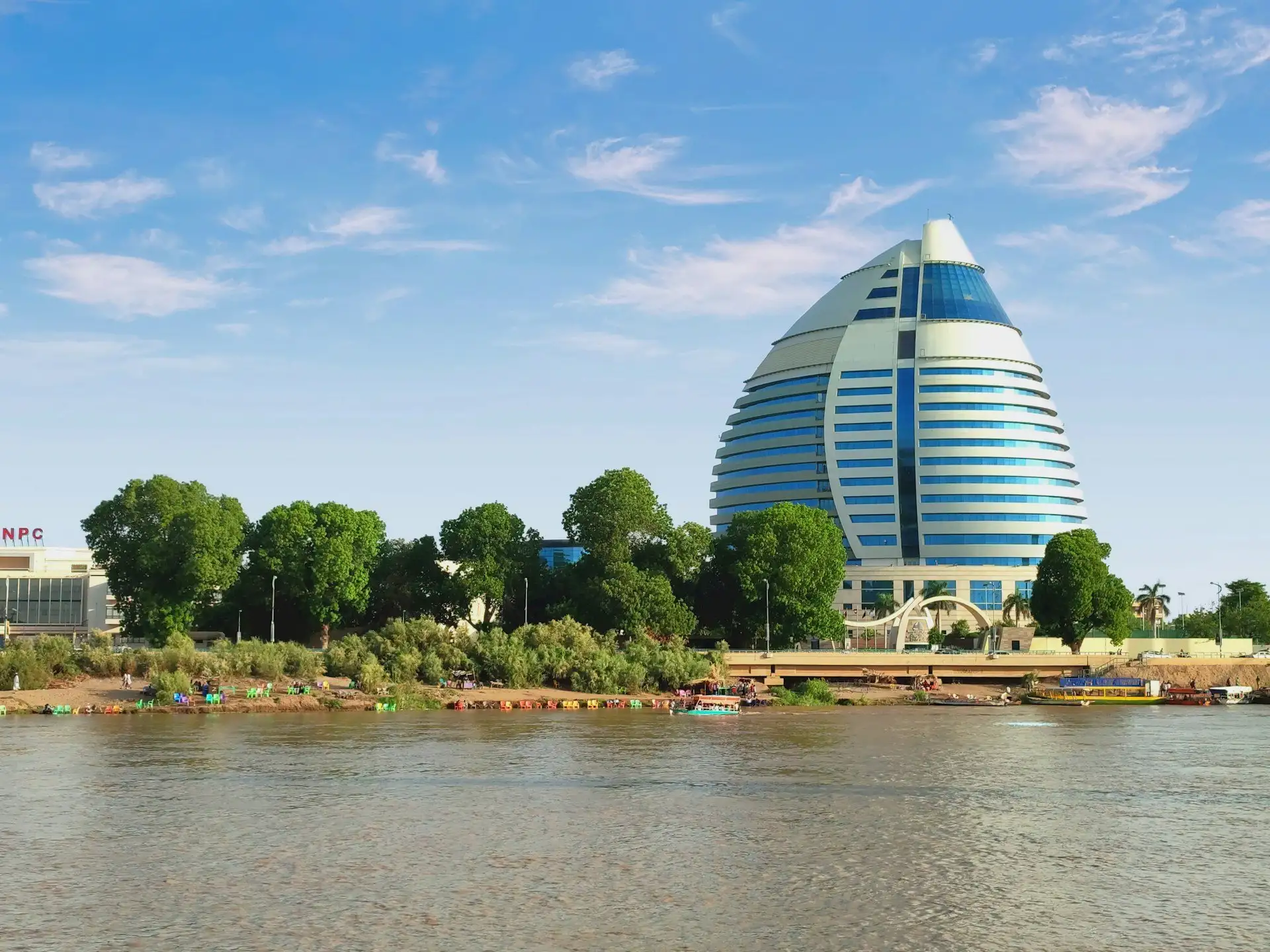
Khartoum sits at one of geography's great moments: the point where the Blue Nile (from Ethiopia) and the White Nile (from Uganda and South Sudan) join to form the Nile that flows north through Sudan and Egypt to the Mediterranean. The confluence — visible from Khartoum's river embankments and from the air — was one of the city's defining attractions. The city itself, with its history as an Ottoman and British colonial center and as the capital of independent Sudan, had a distinctive Arabophone urban culture that is now being rebuilt from the ruins of two years of war.
The 2019 Revolution
In December 2018, ordinary Sudanese people began protesting in the streets. The immediate trigger was rising bread prices — the government had cut subsidies and the cost of basic food had become unsustainable for most families. But the protests quickly became something more: a general demand for the end of Omar al-Bashir's 30-year dictatorship, for civilian government, for the kind of country that the Sudanese Professional Association — doctors, engineers, lawyers, teachers, journalists — had been trying to build through legitimate channels for years.
The Sudanese Professional Association was remarkable: a cross-sectional civil society organization that organized and led the protests not with revolutionary slogans or armed cadres but with remarkable nonviolent discipline. Women were central from the beginning — the image of Alaa Salah, a Sudanese woman in a white thobe standing on top of a car with her fist raised at a Khartoum protest, became one of 2019's most reproduced photographs, circulating globally as a symbol of Sudanese women's political leadership. The protests continued for months. The regime responded with violence, with arrests, with internet shutdowns. People kept coming back.
On 11 April 2019, al-Bashir was removed from power by his own generals — Burhan and Hemedti, the two men who would later go to war with each other. The military established the Transitional Military Council. Protesters celebrated in the streets — but also understood that the military was not their ally. They continued occupying the square outside the military headquarters in Khartoum, demanding civilian rule. A civilian-military power-sharing agreement was eventually reached, establishing the Sovereignty Council with a plan to transition to full civilian government within 39 months.
On 3 June 2019, the RSF and allied security forces conducted the Khartoum Massacre: they stormed the sit-in at military headquarters and opened fire. At least 118 people were killed. Seventy people were raped. Hundreds were beaten and injured. Bodies were thrown into the Nile. The international community condemned it. The protesters organized an immediate general strike. The negotiations continued and the civilian-military deal was signed. Prime Minister Abdalla Hamdok — an economist who had worked for the UN — was appointed to lead a civilian government.
That government lasted two years. On 25 October 2021, Burhan and Hemedti staged a coup — arresting Hamdok at his home at 4am, detaining civilian officials, dissolving the transitional institutions. The international community condemned it again. The US and World Bank suspended aid. Protests resumed immediately. Hamdok was briefly reinstated, resigned, and left Sudan. The military governed alone — until the two generals began fighting each other in April 2023.
The people who had put their bodies in the streets for months in 2018–2019, who had run toward tear gas and bullets to demand a civilian government, watched as the generals they had deposed staged a coup and then destroyed the country in a civil war. This is the context that makes the current catastrophe not just a military conflict but a betrayal of specifically extraordinary magnitude — because the Sudanese people had demonstrated, with remarkable courage and organization, that they wanted something different. The generals took that away from them.
If You Are Going to Sudan
This section is for aid workers, journalists, humanitarian staff, and those with compelling personal reasons to be in Sudan. Sudan is not accessible to tourist visitors under any circumstances. The following is practical information for people who must enter despite the extraordinary risks.
Entry Points
Khartoum International Airport is closed to commercial traffic. Port Sudan International Airport has limited commercial service but has been targeted by RSF drone strikes. Wadi Halfa (Egyptian border crossing) is periodically accessible. Most humanitarian organizations entering Sudan are using Port Sudan with security protocols. No tourist entry is viable.
Health
Yellow fever vaccination mandatory. Malaria is endemic throughout — prophylaxis essential. Cholera and other waterborne diseases widespread. More than half of health facilities out of service as of May 2025. Medical evacuation to Cairo or Nairobi is the only option for serious cases — ensure coverage explicitly. Bring a comprehensive medical kit. All medications needed for the full trip duration.
Full vaccine info →Communication
Electrical and communication disruptions occur continuously. Mobile networks and internet fail without warning. Satellite phones are essential for anyone operating outside major cities. Register with your embassy upon arrival. UNDSS provides security briefings to INGO staff. Follow embassy alerts and ACLED mapping for real-time security situation.
Money
Sudanese Pound (SDG) — severely devalued. USD widely used. Banking system severely disrupted. ATMs often non-functional. Carry significant USD cash. The gold trade continues to flow out of Sudan; the country's economy has essentially collapsed for most citizens.
Security
Only enter Sudan through an organization with security infrastructure specific to Sudan. Checkpoints (legal and criminal) proliferate on all roads. Vehicles have been carjacked at checkpoints. Aid workers have been killed and kidnapped. Both the SAF and RSF have targeted journalists and blocked humanitarian access. Sudan has no safe areas for independent travelers.
Visa
Sudan's visa system is severely disrupted by the war. Before the war, visas required advance application and a journalist permit for media workers. Current requirements are unclear and conditions are rapidly changing — check with the Sudanese Embassy in Cairo (+20 2 2794 9661) or your organization's in-country contacts for current entry requirements.
Emergency Contacts
Emergency services in Sudan are essentially nonexistent. Hospitals are largely non-functional. There is no reliable national emergency number. Western embassies have evacuated non-essential staff and have severely limited capacity to assist citizens. If you are in Sudan, your primary contacts are your organization's security team and the nearest UN office.
Key Emergency Contacts
The Doctors and the Generals
The photograph was taken in April 2019. Alaa Salah is standing on top of a car in Khartoum in a white thobe, her fist raised, her head covered with a traditional Sudanese winding cloth. Thousands of people surround her. She is chanting. The people chant back. She became, in that photograph, the visual emblem of a revolution — a young Sudanese woman in traditional dress leading a crowd against a 30-year military dictatorship. The photograph circulated in 100 countries.
She was not a politician. She was an architecture student. The revolution she was part of was organized and led not by a political party or an armed movement but by the Sudanese Professional Association — a coalition of doctors, engineers, teachers, and lawyers who had decided that it was finally time. They organized sit-ins, general strikes, and civil disobedience that lasted for months. Women were in the front rows. When security forces fired live ammunition into crowds, protesters kept coming. When the internet was shut down, they organized offline. When al-Bashir declared a state of emergency, they ignored it.
On 11 April 2019, Omar al-Bashir was deposed. His own generals — Burhan and Hemedti — removed him and established the Transitional Military Council. The protesters knew immediately that this was not what they had come for. They stayed in the square outside military headquarters, demanding civilian rule. They negotiated for months. They reached an agreement.
On 3 June 2019, Hemedti's RSF stormed the protest camp and opened fire. One hundred and eighteen people were killed. Seventy were raped. Bodies were thrown into the Nile.
The protesters organized a general strike the next day. They kept going. They eventually got their civilian-military transition government, their Prime Minister Hamdok, their promise of elections within 39 months. Hamdok was arrested at 4am on 25 October 2021, when Burhan and Hemedti staged their coup. Two years later, on 15 April 2023, those same two generals began fighting each other and destroyed what was left of the country their 2021 coup had already broken.
Twelve million people have been displaced. The world's largest humanitarian crisis. Genocide in Darfur. The Kingdom of Kush's pyramids stand silent and inaccessible in the desert north of Khartoum, 200 steep-sided ancient monuments that most people in the world have never heard of, built by the Black pharaohs who once ruled Egypt, outlasting everything that has happened since. The Blue and White Nile still meet at Khartoum. The revolution is not over because the people who made it are still there — in Sudan, in diaspora, in refugee camps in Chad, in universities in Cairo and London and Toronto, holding onto what they were trying to build.
The doctors and engineers who organized in 2018 knew something that the generals who destroyed what they built do not seem to understand: that what was being built was worth more than any war.