
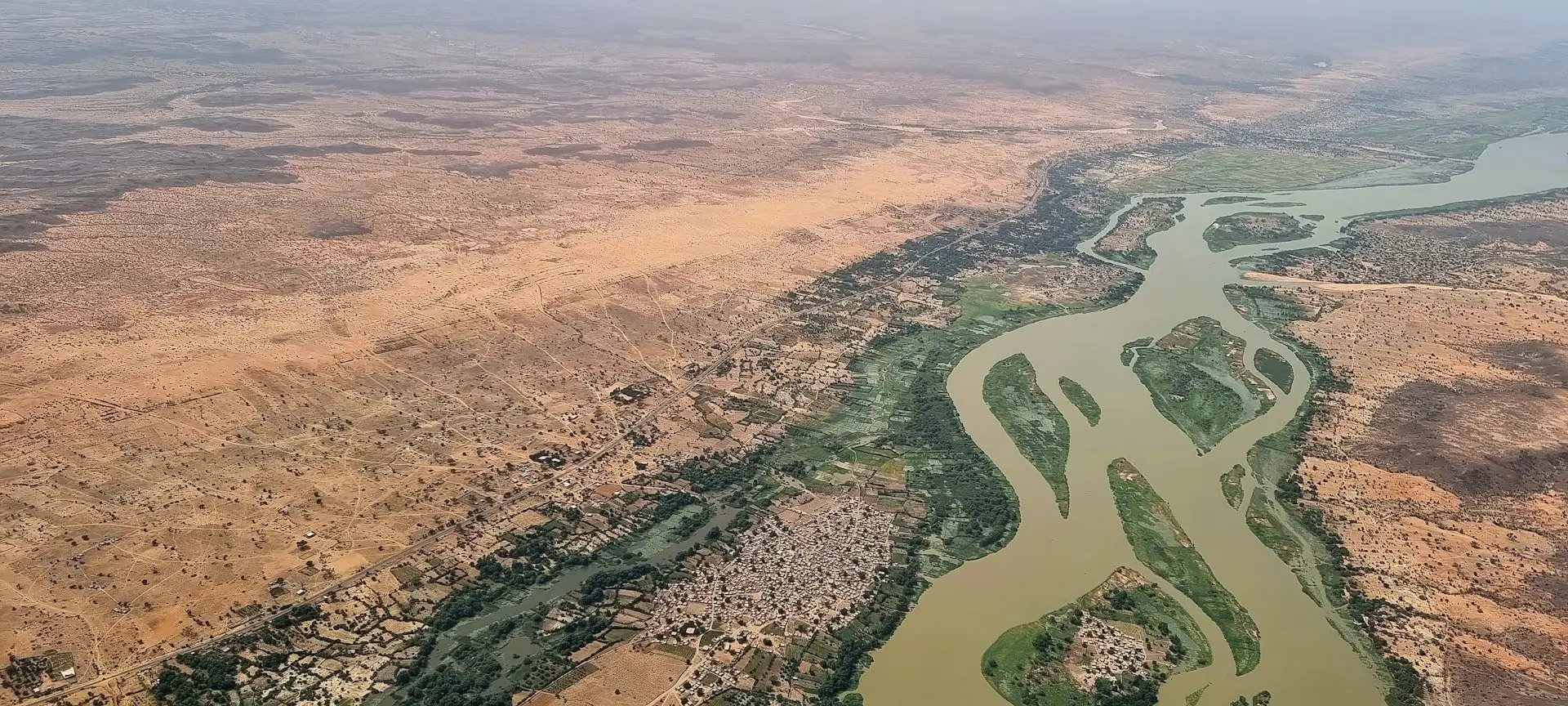
Niger
Niger carries the highest travel advisory level issued by every major Western government. Active jihadist groups, a military junta, kidnappings in the capital, and a state of emergency across most of the country make this one of the world's most dangerous places for foreigners right now. This page exists to explain what Niger is — the ancient Saharan crossroads, the Tuareg, the Air Mountains, the 600-year-old UNESCO city of Agadez — and what happened to it.
The Situation
Niger is not a travel destination in 2026. This is not a nuanced regional assessment of the kind that applies to Mozambique, where the north is dangerous and the south is fine. The situation applies to the whole country. Five separate jihadist organizations operate within Niger's borders. A military junta has held power since the July 2023 coup. A state of emergency is formally in place across Tillabéri, Tahoua, Diffa, and Agadez regions — covering most of the country's territory. Nigerien authorities require military escorts for any foreigner traveling outside Niamey, including US government personnel. Foreigners have been kidnapped in Niamey itself: a US citizen was taken from his home in October 2025. Two Chinese nationals were kidnapped in February 2025. Five Indian nationals were ambushed in Tillabéri.
On 30 January 2026, the US State Department ordered the departure of all non-emergency government employees and their families from Niger, citing safety risks. The US government cannot offer routine or emergency services to US citizens outside Niamey. The UK provides consular support remotely from Lagos. France expelled its troops and closed its embassy in 2023. The European Union has severely reduced its presence.
This page exists because Niger — specifically the north, specifically Agadez — was one of the world's most extraordinary travel destinations before the security situation closed it. The ancient mud-brick city, the Tuareg culture, the Air Mountains, the trans-Saharan caravans, the Festival in the Desert that drew musicians from across the Sahel — all of it is inaccessible right now. Understanding what was lost, and why, is part of understanding what Niger is.
- USA: Level 4 — Do Not Travel. Non-emergency embassy staff ordered to leave January 2026.
- UK: Advise against all travel. Consular support from Lagos only.
- Australia: Do Not Travel (highest level). "Our ability to provide consular assistance is extremely limited."
- Canada: Avoid all travel. State of emergency in Tillabéri, Tahoua, Diffa, Agadez regions.
- EU: Non-essential staff evacuated. Severely reduced presence in Niamey.
Niger at a Glance
What Niger Was
Niger sits in the geographic center of Africa's Saharan world. Over 80% of its territory is desert. The north — the Agadez region, the Air Mountains, the Tenere — is one of the most spectacular and historically significant landscapes on earth. For more than a thousand years, it was the central corridor of trans-Saharan trade: the route connecting the wealthy kingdoms of West Africa (Kano, the Hausa cities, the Songhai Empire) to North Africa and the Mediterranean. Gold, slaves, salt, ivory, and kola nuts moved north along these routes. Cloth, copper, horses, and manufactured goods moved south. The people who controlled and guided these routes — the Tuareg — built the city of Agadez at the crossroads of it all.
Niger's tourism industry, before it collapsed in the late 2000s and never recovered, was built almost entirely on the north. Agadez was the draw: the UNESCO mud-brick city, the 27-meter minaret of the Grand Mosque, the Sultan's Palace, the camel market, the silver craftsmen producing the geometric Agadez Cross pendants that are the Tuareg's most recognizable object. Beyond the city, the Air Mountains offered some of the most dramatic trekking in the Sahara — a 2,000-meter massif rising from the desert, with prehistoric rock art, seasonal waterfalls, oasis villages, and a micro-climate that made the highlands unexpectedly green. The Tenere desert to the east — one of the Sahara's most remote and desolate regions — had its own terrible beauty: the Tree of Tenere, once the most isolated tree on earth before a drunk truck driver knocked it over in 1973, stood alone for hundreds of kilometers as a landmark for caravans.
The Festival in the Desert — held near Agadez and later near Timbuktu in Mali — was one of Africa's great cultural events: three days of Tuareg music, dance, and camel racing in the Saharan sand, attracting musicians including Tinariwen (the Tuareg blues band that became globally famous after the festival launched their international career), Robert Plant, Carlos Santana, and visitors from across the world. It ran from 2001 until security conditions made it impossible in 2012. It has not been held since.
This is what was lost. The people of Agadez who made their living from tourism — the guides, the silver craftsmen, the hotel owners, the desert camp operators — lost it in stages as each successive security crisis closed one more route, one more region, one more season. As of 2025, Agadez's tourist economy is essentially gone. A July 2025 Al Jazeera report described silver craftsmen with no customers, former guides with no work, the camel market that once attracted foreign visitors running only on local trade.
Agadez
Agadez is a UNESCO World Heritage City 740 kilometers northeast of Niamey, at the southern edge of the Air Mountains. It was founded before the 14th century as a Hausa trading settlement, then grew into the seat of the Sultanate of Agadez in 1405 — a Tuareg political institution that still exists today in non-sovereign form, its Sultan continuing to mediate disputes and represent Tuareg community interests within Niger's modern state structure.
At its peak in the 15th and 16th centuries, Agadez had a population around 30,000 people — a significant city for its time and location — and was a genuinely cosmopolitan place: Tuareg, Hausa, Arab, Songhai, Fulani, and Berber merchants and scholars converged here, making it one of the most diverse urban centers in the Saharan world. The architecture reflects this: the city's historic center is organized around 11 irregularly-shaped quarters, following the boundaries of the original Tuareg encampments, with mud-brick residential compounds, the Sultan's Palace, and the Grand Mosque rising from the flat-roofed mass of the old city.
The Grand Mosque's minaret — 27 meters of mud brick reinforced with protruding wooden beams that serve both as structural support and as permanent scaffolding for the regular replastering that keeps the structure intact — is the tallest mud-brick minaret ever built. It was constructed in the 16th century, rebuilt after collapses and repairs, and remains one of the most distinctive architectural forms in Africa. The replastering ritual, conducted annually by community members, is a living expression of the same building tradition that has maintained the structure for five centuries.
The camel market at Agadez was, for travelers who reached it, one of those experiences that defied expectation — the scale of the Sahara becoming suddenly intimate and human, with hundreds of camels being traded, herded, and argued over by Tuareg and Hausa pastoralists in the dust of the desert edge. Salt caravans from Bilma, still operating in the ancient pattern, arrived periodically from the east. The city held skilled silver craftsmen working in the Agadez Cross tradition. Leather workers, dyers, potters. Music in the evenings from musicians playing Tuareg guitar, the haunting electric blues that Tinariwen made internationally famous. All of it is there, still — in a city that foreigners cannot currently reach safely.
What Agadez holds
Grand Mosque Minaret
The world's tallest mud-brick minaret at 27 meters. Built in the 16th century, maintained by annual community replastering. A singular architectural achievement of the Saharan world. The wooden beams protruding from its surface are not decoration — they are permanent scaffolding, always ready for the next repair.
The Sultanate
Founded in 1405, the Sultanate of Agadez has survived Songhai conquest, French colonization, independence, five coups, and the current crisis. The Sultan still holds court in the palace beside the mosque. The institution continues to mediate between communities and represent Tuareg interests — one of the oldest continuously functioning political institutions in West Africa.
Salt Caravans
The Azalai — the annual salt caravan from Agadez to the mines at Bilma — still operates. Hundreds of camels carrying salt slabs across the Tenere, following routes used for centuries. One of the last functioning long-distance camel caravans in the world. A 2,000-kilometer round journey through the deepest Sahara.
Tuareg Music
Agadez and the Air region produced Tinariwen, Bombino (Omara Moctar), and Group Inerane — musicians who created a genre of electric blues from Tuareg traditional music that circulates globally. The music emerged directly from the Tuareg rebellions; the guitar was played in exile camps in Libya and Algeria, songs carrying coded messages. All three groups now tour internationally.
The Tuareg
The Tuareg are a Berber people who have inhabited the central Sahara for millennia, traditionally semi-nomadic pastoralists and caravan traders whose territory spans what are now Niger, Mali, Algeria, Libya, and Burkina Faso. In Niger they make up roughly 9% of the population, concentrated in the Agadez region. Modern national borders cut across their traditional territory — the 19th-century French and British partition of Africa drew lines through landscapes where the Tuareg had moved freely for centuries, and the resulting constraints on movement, land use, and resource access have been the source of recurring conflict ever since.
Tuareg society is organized around a system of social classes: noble warriors (imajaghan), religious scholars, craftspeople (inadan), and historically enslaved people (ikelan) — a social hierarchy whose legacies remain visible in Agadez's neighborhood structure today. The craftspeople hold a particular cultural role: blacksmiths and silversmiths, they are the makers of the objects that define Tuareg material culture — the Agadez Cross, the leather bags and amulets, the silver and copper jewelry worn by both men and women.
The Tuareg are perhaps most recognizable to outsiders for two things: the tagelmust — the indigo-dyed cloth that men wrap around their heads and across their faces, leaving only their eyes visible, in a tradition the opposite of the Islamic veil (in Tuareg culture, it is men who cover their faces, not women) — and the Agadez Cross, a silver pendant in a geometric cruciform design, with different regional variations, that fathers give to their sons at coming of age. The words that traditionally accompany the gift are: "I give you the four corners of the world, because we do not know where you will die." A compass. A farewell. An acknowledgment that a Tuareg life is lived in motion.
Niger's Tuareg have staged multiple rebellions against the central government — in the 1990s and again from 2007 to 2009 — primarily over the distribution of revenues from uranium mining in their traditional territory and the government's failure to deliver on development commitments. The 1990s rebellion produced a peace agreement that was never fully implemented. The 2007 rebellion, led by the Movement for Niger Justice (MNJ), closed Agadez to tourism again. Each rebellion ended in negotiation; each settlement produced grievances that fed the next round of tensions. The uranium beneath Tuareg land — mined for decades by French companies, providing 7–8% of the world's supply — has generated enormous revenue while the Agadez region has remained one of Niger's most impoverished.
The Coup & Its Aftermath
On 26 July 2023, members of Niger's presidential guard arrested President Mohamed Bazoum at his official residence in Niamey. General Abdourahamane Tchiani — the commander of the presidential guard, who had reportedly learned he was about to be replaced — proclaimed himself leader of the National Council for the Safeguard of the Homeland and suspended the constitution. It was Niger's fifth coup since independence from France in 1960, and its first since 2010.
Bazoum had been, until that moment, one of the few remaining pro-Western leaders in the Sahel. Niger was hosting approximately 1,100 US troops, including at the $100 million Air Base 201 near Agadez built for drone surveillance of jihadist groups, and 1,500 French troops who had been repositioned from Mali and Burkina Faso after coups there. Niger had been the West's last remaining significant security partner in the central Sahel. The coup destroyed that relationship in days.
ECOWAS demanded Bazoum's reinstatement and threatened military intervention. The deadline expired without action. ECOWAS imposed economic sanctions — cutting off most of the electrical power supply (Nigeria had provided 70–90% of Niger's electricity) and closing borders. The junta responded by expelling France's ambassador and demanding the withdrawal of all 1,500 French troops. France complied by December 2023. The junta then revoked the US military accord in March 2024; American forces withdrew by September 2024. Niger joined Mali and Burkina Faso in the Alliance of Sahel States — a mutual defense pact explicitly designed as an alternative to ECOWAS and Western security frameworks — and the three countries left ECOWAS together in January 2025.
The junta dissolved all political parties in early 2025 and announced a five-year transition plan — one that, notably, permits the coup leaders themselves to contest future elections. Former President Bazoum remained in detention at the presidential palace as of early 2026, more than two years after his arrest. His detention has been condemned by every relevant international body. No trial date has been announced. The junta moved to nationalize SOMAIR, the French uranium company's operating subsidiary, in June 2025 — a direct assertion of resource sovereignty that reflects the junta's broader strategy of breaking with Western economic arrangements while deepening ties with Russia.
Presidential guard arrests elected President Bazoum. General Tchiani proclaims himself leader. Niger's fifth coup since independence in 1960.
ECOWAS threatens military intervention; deadline passes without action. Sanctions imposed. France expels its ambassador and announces troop withdrawal. French embassy closed.
All 1,500 French troops withdraw. The French nuclear firm Orano's uranium mining license is suspended. French influence in Niger effectively ends.
Niger revokes US military accord in March. American forces including Air Base 201 near Agadez (the $100M drone base) shut down and withdraw by September 2024.
Niger, Mali, and Burkina Faso formally leave ECOWAS. The Alliance of Sahel States becomes a confederation. A new regional bloc without Western partnerships.
The junta dissolves all political parties and adopts a flexible five-year transition plan permitting coup leaders to run in future elections. Hausa replaces French as official language.
A US citizen kidnapped from his Niamey home in October. Two Chinese nationals taken in February. Five Indian nationals ambushed in Tillabéri. The US designates the entire country Level 4.
The US State Department orders non-emergency government employees and their families to leave Niger. US government cannot offer emergency services outside Niamey.
Security in Detail
Understanding Niger's security situation requires understanding the geography. The country is the size of France, Germany, Spain, Portugal, Italy, and Belgium combined. Much of it — particularly the Tillabéri region in the west along the Mali and Burkina Faso borders, and the Diffa region in the southeast near Nigeria and Lake Chad — has been a conflict zone for years. But the 2023 coup and the resulting collapse of the Western security partnership has worsened conditions even in areas that were previously more stable.
Active Jihadist Groups
Five organizations operate in Niger: JNIM (Jama'a Nusrat ul-Islam wa al-Muslimin, Al-Qaeda affiliate), ISIS in the Greater Sahara (ISIS-GS), Boko Haram, ISIS West Africa, and associated splinter groups. They are active in Tillabéri, Tahoua, Agadez, and Diffa regions. They target civilians, security forces, and foreigners. They use kidnapping for ransom as a systematic business model.
Kidnapping Risk — Including Niamey
The US State Department notes that kidnapping risk applies throughout Niger, including the capital. A US citizen was taken from his home in Niamey in October 2025. Kidnappers conduct extensive planning, leverage local networks, and have executed hostages. Foreign nationals connected to infrastructure or extractive projects are specifically targeted, but the risk extends to any foreigner.
State of Emergency
A state of emergency is in place in Tillabéri, Tahoua, Diffa, and Agadez regions — covering the vast majority of Niger's territory outside Niamey. Movement is restricted. Nigerien authorities require military escorts for any foreigner traveling outside the capital. US government personnel are subject to mandatory curfew. All restaurants and open-air markets are off-limits to US government employees.
Collapse of Western Consular Support
The US cannot offer emergency services outside Niamey. The UK provides support remotely from Lagos. France has no embassy. EU presence is severely reduced. If something goes wrong outside Niamey, there is effectively no Western government able to help you. Most standard travel insurance policies do not cover Niger. Specialized high-risk insurance is available from a small number of providers at significant cost.
No Tourism Infrastructure
The US State Department advisory explicitly notes: "Niger lacks most standard services to support a tourism sector. Paved roads and formal transportation services are limited. Tourists participate in activities at their own risk. Emergency response and medical treatment is not available." This is not a cautionary warning about inconvenience. It is a description of an absent infrastructure.
Landmines
Off-road driving north of Agadez is explicitly warned against due to landmine presence. The conflicts of recent decades have left uncharted ordnance across remote areas. This applies to the Tenere region, the Air Mountains tracks outside established routes, and areas near the Malian and Libyan borders.
Niamey
Niamey, on the Niger River in the country's southwest, is where most of the country's foreigners (aid workers, NGO staff, diplomats) are concentrated. It has a small but functional diplomatic quarter, a few hotels that serve the international community, and a riverfront with a market and some restaurants. Before the coup it was a functional West African capital with a modest but pleasant character — the Grand Marché (fire-damaged in 1988 but rebuilt), the National Museum with its remarkable collection including a living zoo of local animals and one of West Africa's best traditional crafts collections, the Kennedy Bridge over the Niger.
The city of roughly 1.5 million people is not a war zone in the conventional sense. But the kidnapping of a US citizen from his home in October 2025 is a reminder that Niamey's relative stability within Niger does not mean safety by any standard measure. The US government's mandatory curfew for its own staff, the prohibition on visiting open-air markets and restaurants, and the full departure of non-emergency embassy personnel in January 2026 tell the real story. Niamey is the safest place in Niger. That is a statement with very limited reassurance.
If You Must Travel to Niger
This section is not for tourists. No responsible travel guide recommends visiting Niger right now, and this one does not. This section exists for aid workers, journalists, researchers, people with family ties, and others who may have professional or personal reasons to travel despite the advisory. It is not a loophole or an encouragement. It is practical information for people who have already made a serious decision after weighing the real risks.
Register with Your Embassy
Enroll in your government's traveler registration program before departure (STEP for US citizens at step.state.gov). This is the only mechanism by which your government can contact you in an emergency. Given the consular limitations in Niger, it is more important here than almost anywhere else.
Specialist Security Briefing
Get a current security briefing from a specialist risk firm (Control Risks, Kroll, GardaWorld, G4S) before departure. The situation changes faster than any published guide. A current briefing will tell you which routes are active, which areas have seen recent incidents, and what the current kidnapping patterns look like.
Military Escort Outside Niamey
Nigerien authorities legally require military escorts for foreigners traveling outside Niamey. Arrange this through your organization, your local contact, or the relevant government ministry. Do not travel outside the capital without this escort. This is not bureaucratic formality — it is the minimum mitigation against the real risk of kidnapping and attack on the road.
High-Risk Medical & Evacuation Insurance
Standard travel insurance does not cover Niger. You need specific high-risk coverage that explicitly includes medical evacuation from Level 4 advisory countries. SOS International, ISOS, and a handful of specialist providers offer this. Confirm in writing that your policy covers Niger and includes emergency airlift to a full medical facility (minimum: Accra or Nairobi).
Low Profile
Avoid displaying symbols of Western organizational affiliation in public. Vary your routes and schedules. Do not publicize your itinerary on social media. The October 2025 kidnapping of a US citizen from his home suggests that foreigner residences are being surveilled. Routine predictability is a vulnerability.
Independent Departure Plan
Have a plan to leave Niger that does not depend on your government's assistance. Identify commercial flight options out of Niamey (Air France, Ethiopian Airlines, Turkish Airlines have served the route at various times). Know the overland border options and their current status. Have cash reserves in XOF and USD. Tell someone outside Niger your departure plan and check-in schedule.
Emergency Information
Key Contacts
The Agadez Cross
Every Tuareg region in the central Sahara has its own cross: the Cross of Agadez, the Cross of In-Gall, the Cross of Tahoua, the Cross of Timbuktu. Silver pendants, each in a distinctive geometric form — a different arrangement of arms and angles that tells you, if you know how to read them, where the person wearing it is from. A map encoded in jewelry.
The Agadez Cross is the most famous. It is given by a Tuareg father to his son when the boy comes of age, with words that vary slightly in the telling but carry the same meaning: "I give you the four corners of the world, because we do not know where you will die."
This is a remarkable thing to say to your child. It is an acknowledgment that a Tuareg life is a life of movement — across the Sahara, between pastures, through the caravans, from place to place across a landscape that does not respect the borders drawn through it in the 19th century. It is also an acknowledgment of mortality delivered without sentimentality: we do not know where you will die. The cross is a compass for that uncertainty. A talisman for a life lived in motion across one of the world's most demanding environments.
The silver craftsmen who make Agadez Crosses still sit in the workshops of the old city. The camel market still runs. The minaret still rises 27 meters above the flat roofs of the mud-brick city, its wooden scaffolding-beams waiting for the next replastering. The Sultanate still holds court. The salt caravans from Bilma still arrive. The music that came out of this city — Bombino's guitar, the raw electric blues that carries the sound of the desert wind — still circulates around the world, reaching audiences in venues that the musicians' grandparents could not have imagined.
None of this has gone anywhere. What has gone is the safety to witness it directly. That may change. It has changed before, in both directions. The north of Niger was inaccessible in the 1990s, then opened, then closed again, then opened briefly, then closed. The Agadez Cross is a compass for uncertainty. Niger is a country that requires the patience to hold that uncertainty without resolving it prematurely.