
Namibia
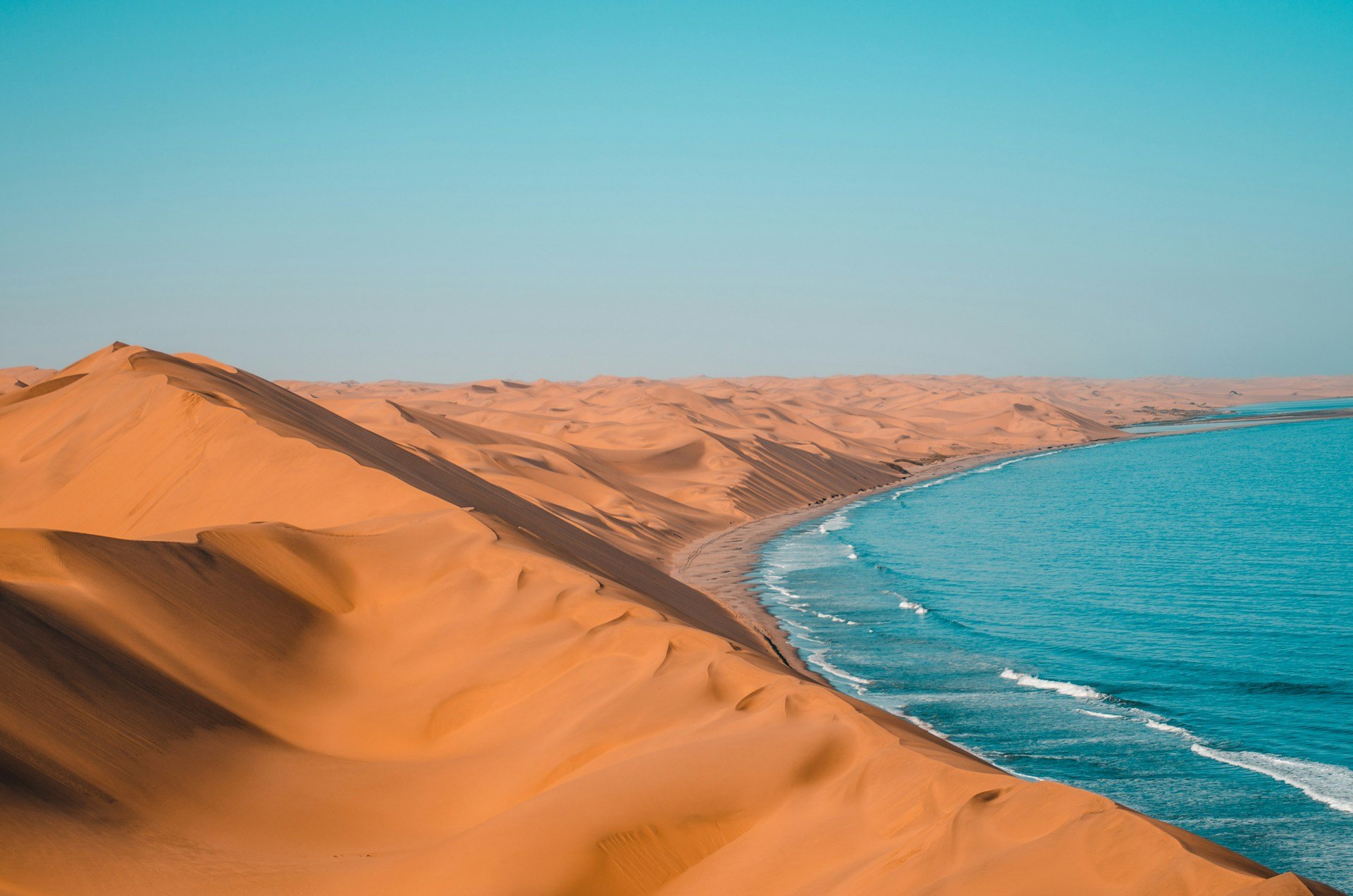
The world's oldest desert. 700-year-old trees perfectly preserved by aridity, standing black against white clay and orange sand. A coast of shipwrecks and whale bones. Lions at floodlit waterholes at midnight. The darkest skies in Africa. Namibia is one of the world's great road trips, and the distances between extraordinary things are themselves extraordinary.
What You're Actually Getting Into
Namibia is roughly twice the size of Germany with a population of about 2.5 million people. That ratio — enormous land, minimal people — defines the experience. You drive for three hours through landscapes that have not changed since before humans existed, with nothing on the horizon, on roads that are better than most of Europe's, and arrive at a place that most of the world will never see. The Namib Desert, which runs along the entire Atlantic coast, is the oldest desert on earth — around 55 million years old. The sand dunes at Sossusvlei are the world's tallest. The Etosha salt pan is so large it can be seen from space.
This is Africa at its most visually dramatic and logistically manageable. Namibia's infrastructure — roads, fuel stations, lodges, national park facilities — is excellent by African standards. English is widely spoken. The crime rate is low by regional comparison. Self-driving here, which is the only way to truly experience the distances and the solitude, requires preparation but not expertise. Dozens of countries' visitors make the loop each year and describe it as transformative. The self-drive itinerary is Africa's best road trip, full stop.
Namibia also carries a history that is inseparable from the landscapes. The Herero and Nama genocide of 1904 to 1908 — carried out by German colonial forces, widely recognized as the 20th century's first genocide — happened in this same desert. The Omaheke, the sandveld into which the Herero were driven to die of thirst, is the same sand you walk through at Deadvlei. The German colonial architecture in Swakopmund and Lüderitz is beautiful and troubled in equal measure. Walking through this country without knowing that history is walking through it half-blind.
Namibia at a Glance
A History Worth Knowing
The San (Bushmen) have lived in these landscapes for tens of thousands of years — among the oldest continuous cultures on earth, their rock art found throughout Damaraland and the Brandberg mountain. The Nama, Damara, Herero, and Ovambo peoples were established in different ecological zones when European contact began: the Nama in the south, the pastoral Herero in the central highlands, the Ovambo in the north's better-watered flood plains, the Damara scattered across the interior.
Germany formally colonized the territory in 1884, naming it German South West Africa. The colony attracted German settlers who displaced Indigenous peoples from land, water sources, and cattle — the foundations of Herero and Nama wealth. Tensions built through the 1890s and early 1900s. In January 1904, the Herero under Chief Samuel Maharero rose against German colonial rule. The rebellion initially succeeded. Germany's response was to dispatch General Lothar von Trotha with 10,000 soldiers and an explicit extermination order — the Vernichtungsbefehl, issued October 1904, stated that every Herero in the territory was to be shot. After the Battle of Waterberg, von Trotha drove the Herero east into the Omaheke Desert, sealing the water holes behind them. Tens of thousands died of thirst.
The Nama rose the same year. Their survivors joined the Herero in concentration camps established along the Skeleton Coast — at Lüderitz's Shark Island, where up to 80% of prisoners died. Between 40,000 and 80,000 Herero (roughly 80% of their pre-war population) and 10,000 Nama (about half) were killed. Most historians now recognize this as the 20th century's first genocide. The tactics used — death marches, concentration camps, execution orders — directly influenced the Nazi apparatus 30 years later. Dr. Eugen Fischer conducted racial experiments on mixed-race children born in these camps; his work later informed Nazi racial pseudoscience, and his student Joseph Mengele took those methods to Auschwitz.
Germany acknowledged the genocide in 2021 and offered €1.1 billion in development aid. Herero and Nama leaders rejected the agreement as inadequate, noting that they were excluded from negotiations and that development aid to all Namibians does not constitute reparations to the specific communities destroyed. The land dispossession that began in 1884 has never been fully remedied — a significant portion of Namibia's agricultural land is still owned by white descendants of German and Afrikaner settlers.
South Africa administered the territory as South West Africa from 1915 (after taking it from Germany in World War I) through the apartheid era. SWAPO (the South West Africa People's Organization) fought a liberation war from 1966. Namibia gained independence on 21 March 1990 — one of the last African countries to do so. Sam Nujoma became its first president. The country has since been a stable democracy, though SWAPO has held power continuously since independence and questions about land reform remain central to its politics.
The San people leave some of Africa's finest rock art at Twyfelfontein, the Brandberg, and throughout Damaraland. These images are 2,000 to 6,000 years old.
Germany formally claims South West Africa at the Berlin Conference. Settlers arrive, displacing Herero and Nama from their land and cattle.
The Herero and Nama uprisings are met with extermination. 40,000–80,000 Herero (80% of the population) and 10,000 Nama die. The 20th century's first genocide.
A worker finds a diamond near Lüderitz. The rush creates Kolmanskop, a boom town that will be abandoned within decades and swallowed by sand.
South Africa takes the territory in WWI and administers it under apartheid as South West Africa. SWAPO's liberation war begins in 1966.
Namibia becomes independent on 21 March 1990. Sam Nujoma becomes the first president. One of Africa's last and most celebrated independence moments.
Germany formally recognizes the genocide and offers €1.1 billion in aid. Herero and Nama leaders reject the deal as inadequate and exclusionary.
Top Destinations
The classic Namibia self-drive circuit — Windhoek, Sossusvlei, Swakopmund/Skeleton Coast, Damaraland, Etosha, back to Windhoek — covers the country's essential highlights in 10 to 14 days. It is one of the world's great road trips. Every day ends at a lodge or camp in a landscape that looks like nowhere else on earth. The driving is genuinely part of the experience.
Sossusvlei & Deadvlei
The most photographed landscape in Africa and — when you see it in person — the photographs don't lie. Deadvlei is a white clay pan, formed when the Tsauchab River last flooded 700 to 900 years ago. The camel thorn trees that grew in that wet period died when the dunes cut off the water. They have stood ever since, perfectly preserved by the extreme aridity, their dead black wood against the white pan, the orange dunes rising 325 meters behind them, and the blue sky above them. Arrive at first light. The colors shift minute by minute as the sun rises. Dune 45, 300 meters high, is worth climbing for the views across the dune sea. "Big Daddy," the highest accessible dune, drops directly into Deadvlei — run down its face and land in the clay pan. The experience is so good it seems implausible until you're there.
Etosha National Park
Etosha's secret is the waterhole. The pan itself — a vast 4,800 square kilometer salt flat, visible from space — is largely empty of wildlife except birds. But the waterholes at its edge, particularly in the dry season, are the most reliable wildlife-watching in Africa. Animals have no choice but to drink. Elephant herds arrive at dusk. Lions walk in at 10pm in the floodlight. Black rhino — critically endangered — appear at midnight, drink, and vanish. Giraffe splay their front legs in the awkward ballet required to get their long necks to the water. You sit in the floodlit enclosure at Okaukuejo Camp or Halali Camp and watch, sometimes for hours, as the parade continues through the night. No game drive delivers this concentrated encounter. Book camps inside the park for night access.
Skeleton Coast
The San called it the Land God Made in Anger. Portuguese sailors called it the Gates of Hell. The cold Benguela current sweeps up from Antarctica, meeting warm desert air and creating a perpetual fog bank that wrecked hundreds of ships — their rusting hulks still lie half-buried in the dunes. Over 250,000 Cape fur seals haul out at Cape Cross, their smell reaching you long before you see them, their noise a constant roar. The southern section of the Skeleton Coast (accessible by road from Swakopmund) has the shipwrecks, the seals, and the haunting quality of a place where the desert simply runs into the cold Atlantic and there is no logic to either. The northern wilderness area requires fly-in specialist tours and is one of Africa's most remote environments.
Damaraland
The northwest's ancient volcanic landscape — red rock formations, dry riverbeds, desert-adapted plants — is home to desert-adapted elephants and black rhino that roam without fences across enormous territories. Twyfelfontein, a UNESCO World Heritage Site, holds the largest concentration of San rock engravings in Africa — over 2,500 images of animals, human figures, and abstract forms carved into sandstone over thousands of years. The Spitzkoppe granite inselbergs, rising from the desert floor like something from Mars, are among Namibia's most dramatic landscapes and are excellent for camping, walking, and, at night, world-class stargazing.
Swakopmund
A German colonial seaside town on the Atlantic coast where the Namib Desert meets the cold Benguela current. The architecture is Bavarian: half-timbered buildings, a lighthouse, a railway station with a clock tower. The food is wiener schnitzel and Namibian oryx steak and fresh Benguela oysters. The activities are quad biking over desert dunes, sandboarding at 80km/h, kayaking with seals, skydiving over the desert-ocean junction. Swakopmund is the adventure sports capital of Namibia and also, improbably, a place you can spend a restful afternoon eating strudel at a German bakery. It makes more sense in context than it sounds.
Kolmanskop
A diamond mining town built in the middle of the Namib Desert in 1908, abandoned in the 1950s when the diamond deposits moved south. The dunes are reclaiming it, room by room, drifting sand waist-high through broken windows, building up in corners. The German buildings — hospital, ballroom, skittle alley, bakery — are perfectly preserved except for the sand. Early morning light through the windows of a dune-half-filled room is one of Namibia's most photogenic experiences. Near Lüderitz, 10km from the town. Guided tours only — book in advance.
Fish River Canyon
The second-largest canyon on earth after the Grand Canyon: 160 kilometers long, 27 kilometers wide, 550 meters deep. The five-day Fish River Canyon hiking trail (May to September only, permit required, one of Africa's great multi-day hikes) takes you through the entire floor of the canyon along the river. The viewpoints on the rim, accessible without the multi-day commitment, provide views that occupy a peculiar scale — the canyon is so big it doesn't quite look real from any single vantage point.
NamibRand & Stargazing
The NamibRand Nature Reserve, adjacent to the Namib-Naukluft National Park, is Africa's only International Dark Sky Reserve — the largest such reserve in the southern hemisphere. With no light pollution for hundreds of kilometers, the Milky Way is visible as a physical presence, a solid band of light across the sky. At &Beyond Sossusvlei Desert Lodge and several other properties in the area, beds face glass skylights or open roof panels so you can watch the sky. Namibia's low population density means almost the entire country has exceptional stargazing. Even a campsite in Etosha far from the floodlit waterhole delivers skies that most visitors have never experienced.
The Self-Drive Circuit
Namibia is Africa's best self-drive destination. This is not debated by anyone who has done it. The roads are excellent (most of the main tourist circuit is paved or well-graded gravel), the signage is clear, traffic is essentially absent outside Windhoek, and the distances — which are vast — are themselves the experience. Understanding a country whose population density is 3 people per square kilometer requires sitting in those silences between settlements, watching the landscape change over hundreds of kilometers, arriving at the next extraordinary place without having been rushed through the one before.
Choose Your Vehicle
A standard 2WD sedan handles 70% of the tourist circuit. But a 4x4 with high clearance handles all of it — including Sossusvlei's final sandy section, Damaraland's tracks, the Skeleton Coast road, and any rough diversions. Book a 4x4 if your budget allows. Always request two spare tires. Fuel range matters: some stretches have 200+ km between stations.
Water & Fuel
Carry at least 5 liters of water per person at all times. Carry extra fuel (a 20-liter jerry can minimum) for remote stretches. Not all marked fuel stations are reliably open. The rule: fill up whenever you see a station, even if you're not close to empty. Running out of water or fuel in the Namib Desert is a genuine emergency.
Book Accommodation Far Ahead
Namibia lodges and national park campsites fill months in advance for the peak May to October window. NamibRand and Sossusvlei properties sell out by February for the following dry season. NWR (Namibia Wildlife Resorts) manages the national park camps — book directly on their website. Private lodges need 3–6 months advance booking in peak season.
Gravel Road Technique
Most gravel roads in Namibia are well-maintained. The risk is washboard corrugations — rippling surface patterns that shake vehicles apart at slow speeds. The correct technique is counterintuitive: drive at 80–100 km/h and the vehicle skims across the top. Slow down for corners, blind rises, and passing other vehicles. Never swerve sharply on gravel — you will roll.
Wildlife on Roads
Oryx, springbok, zebra, kudu, warthog, and jackals cross roads constantly, especially at dawn, dusk, and night. Drive no faster than 100 km/h on gravel for this reason. After dark, reduce to 60 km/h maximum in unfenced areas. A collision with an oryx at speed is a totaled vehicle and potentially fatal. The "no driving at night" advice applies in Namibia as strongly as anywhere.
Connectivity
Phone signal is excellent in Windhoek and Swakopmund, reasonable in Etosha and along the B1 highway, and absent across much of the Namib-Naukluft and Skeleton Coast. Download offline maps (Maps.me or OsmAnd) before leaving cities. A dedicated GPS with Namibia maps loaded is worth the rental fee. The NWR app has park maps and waterhole information.
Culture & People
Namibia is more culturally complex than its sparse population suggests. Thirteen distinct ethnic groups are recognized, from the Ovambo (the largest, concentrated in the north and dominant in politics) to the San, who have lived in these landscapes for 40,000 years and face severe marginalization. German Namibians — descendants of the colonial settlers — number around 20,000 and maintain their language, food, and architecture particularly in Swakopmund and Lüderitz, in a cultural presence that sits uneasily alongside the history of the genocide. Afrikaner farmers own much of the agricultural land in the south. Windhoek is a genuinely cosmopolitan capital with a functional middle class and an active arts scene.
The Herero Victorian Dress
Herero women in Namibia wear Victorian-era dress — full-length skirts, puffed sleeves, elaborate fabric headpieces — in vivid, saturated colors. The style was adopted from German missionaries in the 19th century and became, after the genocide attempted to erase Herero identity, a defiant assertion of survival and continuity. Seeing a Herero woman in full ceremonial dress against the desert landscape is one of the most visually striking encounters in Namibia. The outfit is not a performance for tourists — it is everyday dress for many Herero women. Ask before photographing and expect to be asked to pay a small fee, which is entirely reasonable.
The Himba
The Himba people of the Kunene region in northwest Namibia are pastoralists who have maintained traditional semi-nomadic life more intact than almost any other group in southern Africa. Himba women cover their skin and hair with otjize — a mixture of ochre and butterfat — giving them a distinctive red-orange color. Their architecture, jewelry, and cattle-keeping practices are connected to a complex cosmological system. Visiting Himba communities requires approaching with genuine respect, using a local guide from a reputable operator, and understanding that these are not museum exhibits but communities navigating the same pressures of modernity as everywhere else. The Himba Cultural Village near Opuwo is one starting point; community-based operators are the better option.
San Rock Art
Namibia holds some of Africa's finest rock art — primarily San (Bushmen) engravings and paintings spanning thousands of years. Twyfelfontein's 2,500+ engravings on the flat sandstone surface are UNESCO-listed and the most visited; the Brandberg Mountain's White Lady painting is the most famous single image. The art encodes spiritual and ecological knowledge in abstract animal imagery, therianthropes (half-human, half-animal figures), and geometric forms that scholars are still interpreting. Visit with a knowledgeable guide who can explain what is known — the sites look sparse without context and become extraordinary with it.
German Cultural Legacy
Swakopmund and Lüderitz have German bakeries, beer halls, Lutheran churches, and architecture that would not look out of place in Bavaria. The tension between this charming colonial heritage and the genocide that made the colony possible is real and not fully resolved in public discourse. The Namibian national museum in Windhoek addresses the history directly. The Genocide Memorial in Windhoek is worth visiting. Walking through the German architecture of Swakopmund after visiting the memorial gives both places their full weight.
This is especially important with Himba and Herero communities, but applies everywhere. A direct, respectful ask costs nothing and completely changes the interaction. Many community members will agree with grace; some will ask for a small fee, which is entirely fair for their time and presence.
Namibia's parks run on an honor system — there are few rangers patrolling vast areas. Off-road driving destroys fragile desert soil crusts that take decades to recover and disturbs wildlife. Stay on tracks. This is both law and ethics.
Card machines are unreliable outside cities and parks. Roadside crafts, small lodges, community campsites, and park entry at remote gates often require cash. Namibian Dollars and South African Rand are both accepted everywhere.
"Goeie dag" (Afrikaans, good day) or "Wa lala po?" (Oshiwambo, how are you?) get genuine responses of delight. English works everywhere in tourism contexts. The effort of a greeting in the local language matters.
Illegal throughout Namibia. The beach between Swakopmund and the Skeleton Coast is not a road. Fines are significant and the environmental damage to nesting seabirds and fragile shore ecosystems is real.
Namibia is unfenced in most areas outside the national park's internal camp perimeters. The animals you encounter are genuinely wild. Desert-adapted elephants can be highly aggressive when surprised. Stay in your vehicle unless you are in a designated walking area with a guide.
Summer desert temperatures (November to March) regularly exceed 40°C. The Namib in December is not uncomfortable — it is dangerous for anyone unprepared. Dehydration happens faster than most people expect at these temperatures. Three to five liters of water per person per day is not excessive.
Remote campsites have no waste collection. You pack out what you bring in. This is the baseline etiquette for all wilderness camping in Namibia and most visitors follow it naturally — but it's worth stating explicitly.
Food & Drink
Namibian food is a reflection of its settler and indigenous history: German-influenced meat culture in Swakopmund and Windhoek, Ovambo millet and mahangu dishes in the north, game meat everywhere, and seafood along the Benguela coast that is among the best in Africa. The game meat is genuinely special — oryx (gemsbok) steak is lean, flavorful, and unlike any farmed beef, and served at most lodges and restaurants throughout the country.
Game Meat
Oryx (gemsbok) is the flagship — a large, lean, deeply flavored antelope whose meat is served grilled, as steak, or in stew throughout the country. Kudu, springbok, and warthog also appear on menus. Most lodge restaurants serve game meat as the default rather than the exotic option. The Namibian standard of a braai (barbecue) with game steaks, Namibian beer, and a desert sunset is one of the great simple pleasures of the road trip.
Benguela Oysters & Seafood
The cold Benguela current produces exceptionally rich, nutrient-dense oysters and langoustines off the Namibian coast. Walvis Bay's oyster farms supply the best — served on ice at the lagoon-side restaurants for around NAD 120–180 for six. The seafood restaurants in Swakopmund (Tiger Reef, Kücki's Pub) are excellent. A plate of fresh Benguela oysters with lemon and Tabasco after a morning of sandboarding is one of Namibia's great combination pleasures.
Kapana
Grilled meat street food, sold from charcoal braziers in informal markets throughout Namibia's towns. Beef or game meat, chopped and grilled with salt and chili, served wrapped in paper with chili sauce. Windhoek's Katutura township is the spiritual home of kapana — the Sunday morning kapana market in Katutura, where locals buy freshly grilled meat by weight and eat it standing around the braziers, is one of Windhoek's best experiences. Cheap, good, and entirely local.
German Bakeries
Swakopmund and Lüderitz have proper German bakeries producing sourdough bread, strudel, pumpernickel, and Black Forest cake in the middle of the Namib Desert. The Konditorei Swakopmund and Café Treff are reliable. After days of lodge-braai food on the road, a German pastry with proper coffee is a significant pleasure. The cultural dissonance is part of it.
Mahangu & Oshifima
Mahangu (pearl millet) is the staple grain of northern Namibia — grown in the Ovambo flood plains and ground into porridge (oshifima), brewed into opaque beer (oshikundu), or cooked with milk and sugar. The grain and the beer are rarely on tourist menus but appear at roadside stands in the Kavango and Ovambo regions. The oshikundu is a milky, slightly fermented drink that tastes like nothing else and is deeply refreshing in the heat.
Tafel Lager & Windhoek Lager
Namibia Breweries produces two excellent lagers — Windhoek Lager (the premium, made to German Purity Law standards since 1920) and Tafel Lager (lighter, more popular in rural areas). Both are cold and fine after a long drive. A chilled Windhoek Lager and an oryx steak at a desert lodge as the sun goes down is the Namibia meal that every return visitor describes first.
When to Go
May to October is the dry season and the best overall window. June to September is peak: wildlife at Etosha waterholes is at maximum concentration, the desert is cool enough for comfortable dune climbing, and skies are consistently clear. The summer rainy season (November to April) brings green landscapes and migratory birds, but also occasional road closures, extreme heat in the desert, and much lower wildlife visibility. For the Fish River Canyon hike, May to September is the only permitted window (it is too dangerous in summer heat).
Jun – Sep
Peak Dry SeasonPeak wildlife concentration at Etosha waterholes. Cool, dry conditions for dune climbing (15–25°C at Sossusvlei). Clear skies everywhere. Cold nights in the desert — bring a layer. Peak season; book everything months in advance.
May & Oct
ShoulderExcellent conditions, slightly warmer and less crowded than peak. May is the first dry month — vegetation still green from rains, good for photography. October heats up but wildlife is still concentrated. Good value on accommodation.
Dec – Feb
Peak SummerTemperatures at Sossusvlei and Fish River Canyon exceed 40–45°C. Dune climbing is dangerous or impossible in midday heat. Wildlife disperses from Etosha waterholes. Some roads close after rain. Only Etosha in the north (which is more temperate) and Swakopmund (foggy and cool year-round) work well.
Trip Planning
Ten to fourteen days is the minimum for the classic circuit. Less than a week means choosing between the desert (Sossusvlei) and the wildlife (Etosha) and missing the full experience. Three weeks allows Fish River Canyon, the far north, Damaraland, and the Caprivi Strip (Zambezi Region) — the verdant eastern panhandle where Namibia borders Botswana and Zambia, with very different wildlife and landscape to the arid west.
Windhoek
Arrive, pick up your 4x4. Afternoon in Windhoek: National Museum, Independence Memorial, the German cathedral. Evening at Joe's Beerhouse — Namibia's most famous restaurant, with game meat and cold lager at outdoor tables. Get an early start in the morning.
Sossusvlei & Deadvlei
Drive to Sesriem (350km, 4 hours). Day 2: arrive, check in, Sesriem Canyon in the late afternoon. Day 3: wake at 5am, drive to Deadvlei, arrive at sunrise. Climb Big Daddy, run down into the pan. Spend 2 hours in Deadvlei. Climb Dune 45 on the way back. Hot air balloon if pre-booked. Evening: stargazing is extraordinary here.
Swakopmund & Skeleton Coast
Drive north via Solitaire (stop for pie, fill up). Arrive Swakopmund. Day 5: morning kayaking at Pelican Point with the seals, then sandboarding in the afternoon. Drive north for a half-day to Cape Cross seal colony (250,000 seals — extraordinary and pungent) and the Skeleton Coast shipwrecks. Return to Swakopmund.
Damaraland
Drive inland through the Erongo Mountains to Damaraland. Afternoon: Twyfelfontein UNESCO rock engravings with a guide. Day 7: desert-adapted elephant tracking in the morning (guided walk), afternoon free in the surreal rock landscape. Spitzkoppe is an optional detour with the best camping in Namibia.
Etosha National Park
Three nights inside Etosha — stay at Okaukuejo for the floodlit waterhole. Day drives in the park: lion, elephant, giraffe, zebra, oryx, kudu all easily seen at Etosha's density. Every evening: waterhole until midnight. On day 10, drive back to Windhoek (5 hours on B1) for departure the next morning.
Windhoek + South
Day 1: Windhoek. Day 2: drive south to Keetmanshoop and the Quivertree Forest — a landscape of giant aloes at sunset, also with a Dark Sky reserve certificate. Overnight near Fish River Canyon area.
Fish River Canyon + Lüderitz
Day 3: Fish River Canyon rim viewpoints — 550 meters deep, 160 km long. Day 4: drive to Lüderitz via the diamond coast; visit Kolmanskop ghost town in early morning (pre-book guided tour). The German colonial architecture of Lüderitz at sunset over the harbor is striking.
Sossusvlei
Two days at Sossusvlei — one for Deadvlei, one for a hot air balloon and helicopter flight over the dunes. The helicopter view of Sossusvlei from above is incomparable to the ground experience and worth the cost.
Swakopmund + Coast
Three days on the coast: adventure sports, Walvis Bay oysters, Cape Cross, the Skeleton Coast road north. The flamingo lagoon at Walvis Bay (thousands of flamingos in a shallow coastal bay) is extraordinary in morning light.
Damaraland
Two nights: Twyfelfontein rock art, Brandberg Mountain (closest access to the White Lady rock painting), desert elephant tracking, Spitzkoppe overnight camping.
Etosha
Three full nights in Etosha across two camps (Okaukuejo and Halali both have floodlit waterholes). Day 14: drive back to Windhoek, final game drive on the way out, evening flight.
Vaccinations
No mandatory vaccinations for most visitors (yellow fever required if arriving from a yellow fever risk country). Recommended: routine vaccines up to date, Hepatitis A. Malaria risk exists in the Kavango, Caprivi/Zambezi regions, and northern Etosha border areas from November to April. The main Namib/Sossusvlei circuit has no malaria risk. Confirm with your doctor based on your specific route.
Full vaccine info →Money
The Namibian Dollar is pegged 1:1 to the South African Rand — both are accepted everywhere. Credit cards work at lodges and in towns. Carry cash (NAD or ZAR) for remote fuel stops, small lodges, park entrance gates, and craft purchases. ATMs in Windhoek and Swakopmund are reliable; outside these, less so. Bring enough cash before leaving a city.
Sun Protection
Namibia's desert altitude (most of the country is above 1,000m) and clear skies make UV radiation exceptionally high. SPF 50+ sunscreen, a wide-brim hat, UV-blocking sunglasses, and long sleeves for hiking in midday are not optional in summer. Even in peak season (June-September), the desert midday sun at altitude is significantly stronger than it feels. Drink more water than you think you need.
Connectivity
MTC and Telecom Namibia are the main carriers. Signal is good in Windhoek, Swakopmund, Etosha main camps, and along the B1. Absent in most of the Namib-Naukluft, the deep Skeleton Coast, and large parts of Damaraland. Download offline maps and all bookings before leaving cities. A paper backup of your accommodation list is worth having.
Power
Namibia uses the South African Type M (large round three-pin) plug. Type D (Indian three-pin) also works in some sockets. Many lodges have solar power with limited overnight charging capacity — charge devices in vehicles during the day and confirm charging availability at your lodge before arriving. A multi-outlet power bank is worth its weight.
Stargazing Preparation
Check the lunar calendar before booking Namibia — a full moon significantly reduces the dark sky experience. New moon periods in June-September are the best stargazing conditions on earth at this latitude. The NamibRand area near Sossusvlei and Spitzkoppe are the two best sites. Download a stargazing app (SkySafari, Stellarium) before you lose signal.
Transport in Namibia
Self-drive is the definitive Namibia transport option. Everything else — guided tours, fly-in safaris, buses — exists for specific needs, but the soul of Namibia is the gravel road and the horizon. Rent a car in Windhoek and drive.
International Flights
Via Johannesburg mainlyHosea Kutako International Airport (WDH), 45km east of Windhoek. Air Namibia suspended operations; currently served by South African Airways, Airlink, Ethiopian Airlines, Lufthansa, and others via Johannesburg (1 hour), Frankfurt (10 hours), and London (13 hours via Joburg).
Rental Car (Self-Drive)
$60–150/dayThe essential Namibia experience. 4x4 recommended (required for Sossusvlei's last section and Damaraland). Book through Avis, Hertz, or local operators like Asco or Odyssey. Confirm two spare tires. Minimum rental age usually 23. International license accepted. Drive on the left.
Domestic Flights
$120–300 one-wayWestair Aviation and smaller charter operators serve Swakopmund (WVB), Sossusvlei airstrip, Lüderitz, Etosha camps, and Kaokoland. Flying saves time on the Windhoek–Swakopmund–Sossusvlei loop. Scenic and practical but pricey.
Intercity Buses
$15–40/routeIntercape runs Windhoek to Cape Town and Windhoek to Johannesburg. Minibuses serve Windhoek to Swakopmund and major towns. Not suitable for accessing the key tourist attractions (Sossusvlei, Etosha, Damaraland) independently — all require a vehicle.
Guided Tours
$200–500+/dayFull guided circuits from Windhoek are run by many operators — ideal for those who don't want to drive, prefer expert interpretation, or are on shorter timeframes. Wilderness Safaris, &Beyond, and local operators like Namibia Experience and Africa in Focus are well-regarded.
Helicopter & Hot Air Balloon
$150–400/personHot air balloon over Sossusvlei at dawn (operated by Namib Sky Balloon Safaris, book months in advance) is one of Namibia's signature experiences. Helicopter flights over the dunes, Swakopmund coast, and Skeleton Coast are offered by several operators and transform the visual scale of the landscape.
Accommodation in Namibia
Namibia's accommodation is one of its great pleasures. The private lodge sector has been exceptional for decades — small, owner-operated properties with personal service, extraordinary food, and locations chosen for the landscape rather than proximity to a town. National park camps are functional and well-positioned. Budget camping in Namibia is outstanding — some of the most beautiful campsites in the world, often with no one else nearby.
Luxury Desert Lodges
$400–1,200+/night all-inclusive&Beyond Sossusvlei Desert Lodge (glass-ceiling rooms, Dark Sky Reserve, outstanding), Little Kulala (private plunge pools in the dunes), Hoanib Valley Camp (Damaraland, fly-in), Onguma The Fort (Etosha). Each is genuinely among the best lodges in Africa. Book 6+ months ahead in peak season.
National Park Camps (NWR)
$80–200/nightOkaukuejo (floodlit waterhole, black rhino), Halali (another waterhole), and Namutoni (Etosha) are the key NWR camps. Also Desert Camp (Sesriem) and Sossusvlei Lodge. Book through NWR website. The camps are functional — not luxury — but the waterhole access is unbeatable. Camp sites also available from $25.
Mid-Range Lodges
$120–350/nightNamibia's mid-range is excellent: Elegant Desert Lodge (Sesriem area), Olive Grove (Windhoek), Swakopmund Luxury Suites, and dozens of private farm lodges along the main routes. These are typically owner-operated, personal, and excellent value. Most include dinner and breakfast.
Bush Camping
$15–40/nightSpitzkoppe Community Campsite is Namibia's finest — private campsites among the granite boulders, a view of the Milky Way unmatched on the continent, braai facilities and basic ablutions. The Fish River Canyon NWR campsites, Etosha's in-park campsites, and dozens of farm campsites offer the same quality of solitude. Bring your own food, firewood, and water.
Budget Planning
Namibia is mid-range to expensive by African standards. The main costs are the rental car (unavoidable), accommodation, and fuel. Food is very reasonable compared to Europe. The luxury lodge end is genuinely expensive — comparable to Kenya or Botswana. But a self-drive camping trip in Namibia is one of the world's best adventures at a reasonable price.
- Bush camping and NWR campsites
- Self-catering (buy at supermarkets)
- Standard 4x4 rental split with travel partner
- National park entry fees
- Kapana and local restaurants
- Mid-range lodge accommodation (B&B)
- Mix of self-catering and lodge dinners
- 4x4 rental
- NWR camps with waterhole access
- One guided activity per destination
- &Beyond or Wilderness Safaris lodges
- All-inclusive (meals + activities)
- Hot air balloon over Sossusvlei
- Private guides and charter flights
- Helicopter excursions
Quick Reference Prices
Visa & Entry
Important change: From 1 April 2025, Namibia introduced a visa requirement for most nationalities including the US, UK, EU, Australia, and Canada. Visitors can obtain a visa on arrival at designated ports of entry or apply in advance through the e-visa system. The standard fee is N$1,600 (~$90 USD) for non-African Union nationals.
US, UK, EU, Australian, Canadian citizens, and most others now require a visa (N$1,600, ~$90). Available on arrival or via e-visa at eservices.mhaiss.gov.na. Apply in advance for a smoother arrival.
Safety in Namibia
Namibia is one of Africa's safer countries for visitors. Political stability is strong, violent crime against tourists is uncommon, and the country's infrastructure and law enforcement are reliable by regional standards. The main risks for self-drive travelers are environmental rather than security-related: the desert, the heat, the distances, and animals on roads at night.
Overall Safety
Namibia is rated among Africa's safer countries. The US rates it Level 1 (Exercise Normal Precautions). Violent crime against tourists is low. The country has a stable democracy, functional police, and a low-crime tourist infrastructure outside the main cities.
Petty Crime in Cities
Windhoek's Katutura township and downtown areas have opportunistic theft, particularly after dark. Don't walk alone at night in unfamiliar areas. Use hotel safes for passports and valuables. Swakopmund and Lüderitz are very low crime. The tourist circuit outside cities is essentially crime-free.
Desert Hazards
The primary risk for most travelers. Running out of water or fuel in the Namib Desert is a life-threatening emergency. The heat in summer is genuinely dangerous. Stick to the rules: carry 5+ liters of water per person, carry extra fuel, never drive at night, and tell someone your itinerary before leaving for remote areas.
Wildlife on Roads
Oryx, kudu, and other large animals on roads at night cause serious accidents. The "no driving after dark" rule in rural Namibia exists for this reason. Animals appear suddenly, are poorly reflective, and a collision at speed is often fatal. Drive at maximum 100 km/h on gravel in daylight; 60 km/h if forced to drive after dusk.
Solo Women
Namibia is consistently rated as one of Africa's most comfortable destinations for solo female travelers. Outside Windhoek's urban areas at night, harassment is uncommon. The self-drive circuit, with its lodge-to-lodge structure and minimal random social encounters, is particularly manageable solo. Standard urban precautions apply in Windhoek.
Malaria
Only present in the far north and northeast (Kavango, Caprivi/Zambezi, northern Etosha border zone) during the rainy season (November to April). The Namib Desert, Sossusvlei, central Namibia, and Swakopmund have no malaria risk. Confirm your specific route with a travel medicine clinic before deciding on prophylaxis.
Emergency Information
Key Contacts in Windhoek
Book Your Namibia Trip
Everything in one place for planning and booking Africa's greatest road trip.
The Sand Remembers
The Omaheke is the name for the sandveld — the arid Kalahari borderland east of Namibia's central highlands, between the Waterberg Plateau and the Botswana border. In August 1904, General Lothar von Trotha drove the Herero people into it after the Battle of Waterberg, sealed the water holes behind them, and waited for the desert to do the work his army had not finished. Tens of thousands of people walked into that sand and did not come back out. The Herero called it the death march. Historians call it the first genocide of the 20th century.
The sand at Deadvlei, glowing orange in the first light of a June morning, is not the Omaheke. But it is the same ancient desert. The Namib has been here for 55 million years. It was here for the Battle of Waterberg and it will be here long after every human story involving it has been told and forgotten and told again. The 900-year-old dead trees in the clay pan were alive and growing when the Namib was already older than human civilization. They will stand there, black and perfectly preserved, long after the questions of reparations and land reform and historical justice are resolved or not resolved.
This is worth knowing when you stand at Deadvlei at sunrise and feel the scale of the place compress your sense of time. The beauty and the history are not separate things. The same extraordinary landscape held both. Walking through Namibia without that knowledge is walking through it with one eye closed.
But you should also simply walk through it. The dunes are genuinely among the most extraordinary things on the surface of the earth. The black rhino at the waterhole at midnight is genuinely among the most extraordinary animals you will ever see this close. The Milky Way over the NamibRand at 2am is genuinely among the most extraordinary skies anyone living today will see without special equipment. These things are true at the same time as the history is true. Namibia does not make you choose.