
Mozambique
2,400 kilometers of Indian Ocean coastline. Whale sharks you can swim alongside. A national park that lost 90% of its wildlife in a civil war and built it all back. A UNESCO island city on a coral outcrop that barely anyone visits. Mozambique is one of Africa's most underappreciated destinations — and the people who find it tend to return.
What You're Actually Getting Into
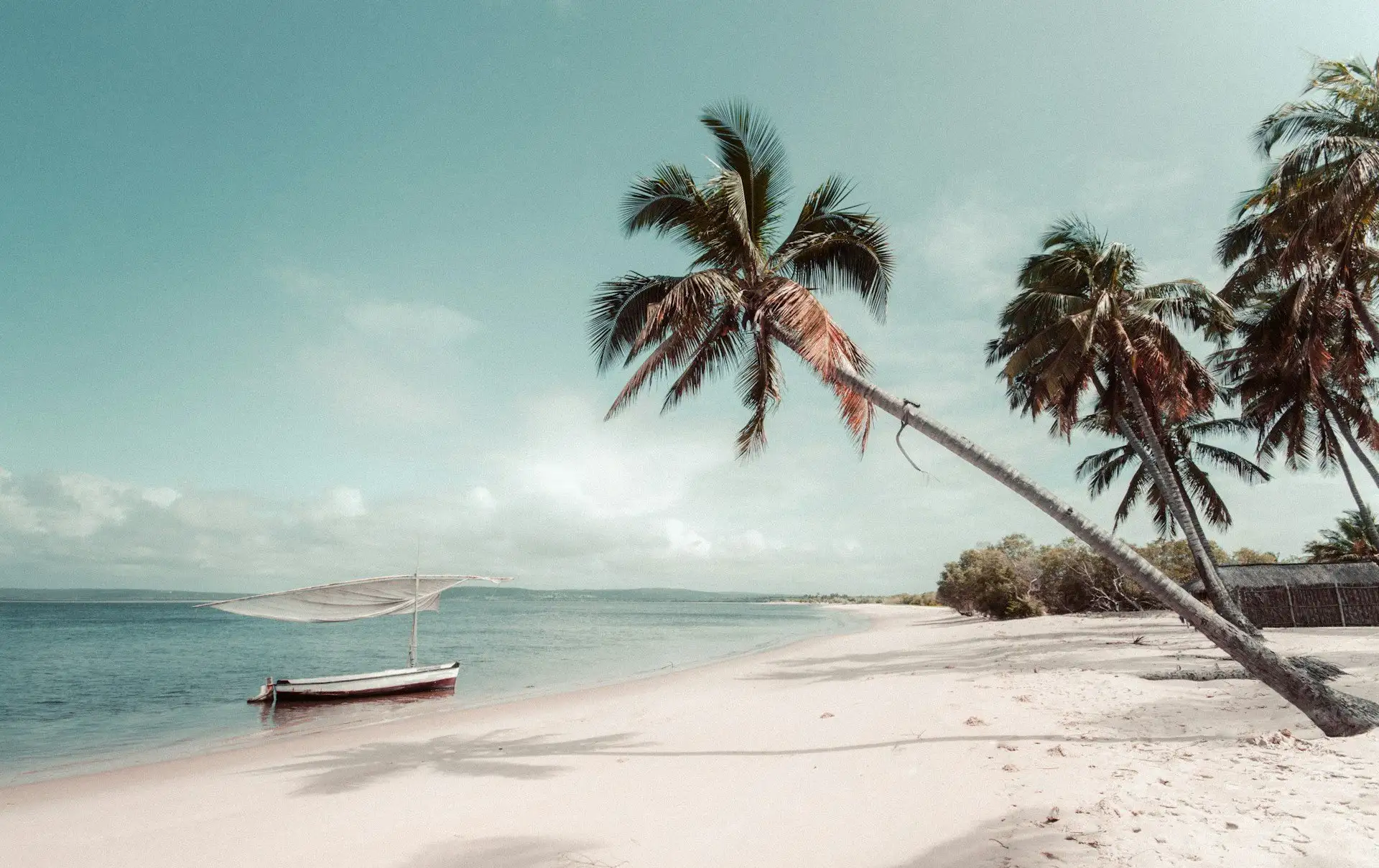
Mozambique is a long, thin country pressed against the Indian Ocean. It runs nearly 2,000 kilometers from the Tanzanian border in the north to South Africa and Swaziland in the south, with the Mozambique Channel — one of the world's richest stretches of ocean — running along its entire eastern flank. The coastline is extraordinary: 2,400 kilometers of it, including offshore archipelagos, coral reef, remote beaches backed by coconut palms, mangrove estuaries, and fishing villages unchanged in their basic character for centuries.
The country's tourism reputation rests on three pillars. First, the ocean: the Bazaruto Archipelago's pristine reef and island eco-lodges, Tofo beach's whale shark and manta ray encounters, the dugongs that graze in Bazaruto's shallow seagrass meadows (one of very few viable populations left on earth), and the humpback whale migration that runs the full length of the coast from June to October. Second, the bush-and-beach combination: Gorongosa National Park in the center, whose wildlife recovery from near-total destruction during the civil war is one of Africa's great conservation stories, pairs naturally with a few days on the coast. Third, Maputo: an underrated capital city with genuine art deco architecture, a vibrant live music scene, excellent seafood restaurants, and a Portuguese-influenced culture that makes it distinctly unlike anywhere else in southern Africa.
What draws people back — beyond the diving and the beaches — is the quality of the experience itself. Mozambique is less developed and less visited than Kenya, Tanzania, or South Africa. The beaches are emptier, the lodges are smaller and more personal, and the encounter between traveler and place is less mediated. A wooden dhow sailing into a pink sunset over the Mozambique Channel, a plate of piri piri prawns at a beach table, a first whale shark encounter in clear warm water — these are experiences that Mozambique does as well as anywhere on earth.
Mozambique at a Glance
A History Worth Knowing
The Mozambique Channel has been a trade highway for over a thousand years. Between the 7th and 11th centuries, a series of Swahili port towns developed along the coast, trading with Arab, Persian, Indian, and later Chinese merchants. Gold from the Zimbabwe plateau, ivory, and enslaved people moved through these ports outward; cloth, ceramics, and glass moved inward. The name "Mozambique" comes from one of those ports — Ilha de Moçambique, a small coral island off the northern coast that hosted one of the most important trade stops in the western Indian Ocean.
Vasco da Gama arrived in 1498 on his way to India, found the island trading post, and understood what he was looking at. Portuguese settlement followed in 1505. The Portuguese spent the next 470 years in Mozambique — the longest European colonial presence in Africa — building forts, establishing sugar and cotton plantations, trading in enslaved people, and extracting resources. Their presence was uneven: concentrated in coastal towns and river valleys, thin in the vast interior. The legacy they left is visible everywhere: in Portuguese as the only language that crosses all ethnic communities, in piri piri (the bird's-eye chili that the Portuguese spread from South America to Africa and back), in the tile-faced art deco buildings of Maputo's city center, and in Ilha de Moçambique's 16th-century fort — the oldest European building in the southern hemisphere.
Mozambique gained independence on 25 June 1975, after a ten-year armed liberation struggle led by FRELIMO against the Portuguese colonial state. The transition was abrupt — Portugal's Carnation Revolution in 1974 overthrew the Estado Novo regime and accelerated decolonization. Over 250,000 Portuguese settlers left almost overnight, most taking what they could carry. FRELIMO, under President Samora Machel, established a Marxist-Leninist one-party state.
Within two years the country was at civil war. RENAMO — armed and funded by Rhodesia and then South Africa, whose apartheid government was threatened by an independent socialist neighbor — fought FRELIMO from 1977 to 1992. Over one million people died. Five million were displaced. Infrastructure was destroyed across the country. Gorongosa National Park, which had been one of Africa's finest wildlife destinations, was used as RENAMO's headquarters; its animals were poached to feed soldiers, and 90% of its large mammal population was killed. The park was essentially gone by 1992.
Peace came with the 1992 Rome Peace Accords, brokered by the Italian Community of Sant'Egidio. Mozambique held its first multiparty elections in 1994. The country has since made remarkable economic and social progress — one of the fastest-growing economies in Africa in the 2000s and early 2010s, with significant reductions in poverty. The conservation story is part of this: Gorongosa was rebuilt from near-zero starting in 2004, when American philanthropist Greg Carr partnered with the Mozambican government. Lions, elephants, buffalo, and hippo populations have recovered to hundreds of animals each. The park is now genuinely world-class and still adds new wildlife every year.
The complication is Cabo Delgado in the far north, where an Islamist insurgency began in 2017 and has destabilized the province. The insurgency is real, violent, and has driven hundreds of thousands of people from their homes. It exists in a completely different geography from the tourist south — Cabo Delgado is nearly 2,000 kilometers from Maputo — but it shadows the country's reputation and is addressed directly in the safety section below.
Port towns develop along the coast, connecting the African interior's gold and ivory to Arab, Indian, and Persian merchants. Ilha de Moçambique becomes a key stop.
Vasco da Gama passes through in 1498. Settlement begins 1505. Portugal remains for 470 years — the longest European colonial presence in Africa.
FRELIMO fights a ten-year guerrilla war for independence. Portugal's Carnation Revolution ends colonial rule. Independence declared 25 June 1975.
RENAMO, backed by Rhodesia and South Africa, fights FRELIMO. Over one million dead, five million displaced. Gorongosa National Park destroyed. The country is devastated.
The war ends. Mozambique holds its first multiparty elections in 1994. The long reconstruction begins. One of Africa's most remarkable economic recoveries follows.
Greg Carr and the Mozambican government begin rebuilding the park. Lions and elephants return. A story of what conservation looks like when it works from near-zero.
Islamist insurgency in the far north. Hundreds of thousands displaced. The situation remains active and is entirely separate from the tourist south.
Top Destinations
Mozambique's length means there is no single "Mozambique experience" — the country is different things at different latitudes. The south is the most accessible from Johannesburg (the main hub for international connections) and holds the classic beach-and-luxury itinerary. The center has Gorongosa and the Bazaruto Archipelago. The north holds Ilha de Moçambique, a UNESCO island of extraordinary history and beauty — and, much further north, Cabo Delgado, which is closed to tourism. Most visitors build their trips around the south and center, which is entirely the right call.
Tofo Beach & Inhambane
A 500 kilometers north of Maputo, Tofo is a relaxed beach town built around one of the world's most exceptional marine environments. The submarine topography — a steep continental shelf dropping from shallow reef to deep ocean within minutes of the shore — creates a feeding ground that concentrates whale sharks, giant manta rays (wingspan up to 7 meters), reef mantas, hammerhead sharks, turtles, and dolphins in numbers rarely seen together. Whale sharks are present year-round; the highest concentrations are September to February. Manta rays aggregate particularly at "Manta Reef" off the nearby Barra Peninsula. Multiple licensed operators run morning ocean safaris — typically a 45-minute speedboat ride, then a snorkel or scuba alongside whatever appears. Tofo itself is a working fishing village with a surf break, a handful of backpacker lodges and mid-range eco-lodges, and the best casual seafood on the coast.
Bazaruto Archipelago
Five islands — Bazaruto, Benguerra, Magaruque, Santa Carolina, and Bangué — in a marine national park off the central coast near Vilanculos. The Bazaruto Archipelago holds one of the world's last viable dugong populations (the gentle, seagrass-grazing sea mammals that were once abundant across the Indian Ocean), over 2,000 species of fish representing 75% of all species in the Indian Ocean, pristine coral reef, towering sand dunes, freshwater lakes, and some of the clearest water in Africa. The islands have no permanent settlements beyond the lodge workers and their families. Access is by light aircraft or speedboat from Vilanculos. The eco-lodges — Azura Benguerra, &Beyond Benguerra, Anantara Bazaruto — are among the finest in the Indian Ocean, their prices reflecting both the quality and the controlled access that keeps the islands uncrowded.
Gorongosa National Park
In 1977, Gorongosa had 2,000 elephants, 5,500 buffalo, 3,000 hippos, and hundreds of lions. By 1992, 90% of its large mammals had been killed — poached for ivory to buy weapons or butchered to feed soldiers. The Carr Foundation-Mozambique government partnership began rebuilding in 2004. Today Gorongosa has 800+ elephants, recovering buffalo, returning lion prides, leopard, hippo, and over 500 bird species. Game drives, walking safaris, and night drives in a park that receives a fraction of the visitors of Kenya or Tanzania are genuinely extraordinary. The park also runs extensive community programs in the surrounding areas — Girls Club, healthcare, education — that are as interesting to visit as the wildlife itself.
Maputo
One of southern Africa's most underrated cities. The Portuguese colonial center — with its tile-faced art deco buildings, the 1895 Maputo Central railway station (an Eiffel-designed wrought-iron structure), the Polana Serena Hotel terrace overlooking the bay — gives Maputo an architectural character unlike anywhere else in the region. The fish market on the waterfront is extraordinary: fresh prawns, crabs, and lobster sold by weight, grilled on the spot and eaten at plastic tables. The live music scene is excellent, particularly on weekend evenings. Violent crime risks exist (addressed in the safety section) but the city rewards two or three days of careful exploration.
Ilha de Moçambique
A three-kilometer-long coral island off the northern coast, connected to the mainland by a bridge. The island was the capital of Portuguese East Africa from 1507 to 1898 and remained one of the Indian Ocean's most important ports for centuries. Its stone town — Fort São Sebastião (the oldest complete fort in sub-Saharan Africa, built 1558), the Governor's Palace, the Church of the Misericordia — is a UNESCO World Heritage Site, layered with Portuguese, Arab, Swahili, and Indian cultural traces. Almost nobody goes. The poverty is visible and real. But as a place where the entire Indian Ocean trade world passed through for 400 years, and where the evidence is still standing in crumbling ochre walls, it is extraordinary.
Vilanculos
The mainland town that serves as the gateway to the Bazaruto Archipelago. In itself it's a pleasant beach town with a good bay, several decent lodges, dhow-filled harbor, and the Mozambican normalcy of kids playing football on the beach while fishing boats come in. The light aircraft flights to Bazaruto depart from Vilanculos airport. Several lodges in town offer good value compared to the island resorts. The beach and bay are beautiful, the prawns are excellent, and the town feels like Mozambique rather than a resort bubble.
Ponta do Ouro & Ponta Mamoli
The southernmost point of Mozambique, accessible from South Africa by a good road through the border at Kosi Bay. Ponta do Ouro ("Point of Gold") is popular with South African divers and sun-seekers — the reef diving here is excellent, with dolphins and large shark species. Ponta Mamoli, slightly north, is quieter and holds the White Pearl Resort, one of Mozambique's finest luxury properties with 360-degree whale watching views in winter. The drive from South Africa through the coastal dunes into these villages is one of the most scenic border crossings in southern Africa.
Maputo National Park
Just 70 kilometers from the capital, Maputo National Park offers the unusual combination of land safari and ocean safari in the same day. Elephants, giraffes, antelopes, hippos, and rare African wild dogs in the bush in the morning; dolphins and turtles in the warm shallows in the afternoon. The Maputo Elephant Reserve (now part of the broader park) protects one of southern Mozambique's most important elephant herds. Several excellent eco-lodges including Machangulo Beach Lodge make this a practical first-night stop from the capital.
Culture & Etiquette
Mozambique's culture is a layered product of its history: Bantu-speaking communities who have lived here for two millennia, Arab and Swahili trade influences along the coast, four and a half centuries of Portuguese colonial presence, Indian and Goan communities in the urban centers, and the particular resilience of a population that survived one of Africa's most destructive civil wars and built something remarkable from the aftermath. Portuguese is the official language and the only one that crosses all 60-plus Bantu language groups, but most Mozambicans speak their mother tongue at home and Portuguese as a second language. English is spoken at lodges and in tourism areas; French comes before English in many rural contexts due to proximity to former French colonies.
Marrabenta Music
Marrabenta is the signature music of Mozambique — a fast, syncopated dance music born in Maputo's suburbs in the 1930s and 1940s, combining the acoustic guitar patterns of urban Ronga music with Portuguese colonial rhythms. It is the musical equivalent of what Mozambican identity became: something that absorbed many influences and produced something entirely its own. Maputo's weekend music bars and the annual Fast Forward Festival carry the tradition. The most famous marrabenta musician, Orchestra Marrabenta Star de Moçambique, still performs.
The Capulana
The capulana — a brightly colored cotton wrap cloth worn by Mozambican women as a skirt, wrap, baby carrier, or head covering — is as emblematic of the country as anything. The fabrics were originally imported from India via Arab traders and Portuguese ships; the patterns evolved over centuries into distinctly Mozambican designs. Capulanas are sold at every market, used in every context, and make the best practical souvenir you can buy in Mozambique. Buy from market stalls, not hotel gift shops, where the markup is significant.
Football
Football is the national obsession. The Portuguese football influence runs deep — most Mozambicans support a Portuguese club as well as a local one. Matches at Estádio do Zimpeto in Maputo draw passionate crowds. Eusébio, widely considered one of the greatest footballers of the 20th century, was born in Maputo (then Lourenço Marques) and grew up playing in its streets before becoming the star of Benfica and Portugal's 1966 World Cup team. His connection to Mozambique is felt there still.
The Dhow Tradition
The wooden sailing dhow has been the transport of the Mozambique Channel for over a thousand years. Dhows connected the island trading posts, carried goods between the mainland and the islands, and ferried people along a coast with almost no roads until the 20th century. On the Bazaruto islands and along the Inhambane coast, traditional dhows still sail and are used for tourist excursions — sunset dhow trips, fishing dhow charters, island hops between Bazaruto's islands. The craftsmanship is passed down within families. A sunset dhow trip in the Bazaruto lagoon is one of the great simple pleasures of Mozambique.
Beachwear stays at the beach. In Maputo, Inhambane, and rural villages, covered shoulders and knees are appropriate. Muslim communities along the coast are more conservative; women should carry a scarf for mosque visits or market walks in these areas.
"Bom dia" (good morning), "Obrigado/a" (thank you), "Com licença" (excuse me), "Tudo bem?" (all good?). Portuguese gets you far in Mozambique and is received with warmth when visitors make the effort. French also works as a fallback in some areas.
Police may ask to see identification. Keep your original in the hotel safe and carry a clear photocopy. Being stopped without ID can result in time-consuming situations. Having a notarized copy reduces friction significantly.
Prices for taxis and informal market goods are negotiable and often pitched at "tourist" level. Know the general going rate (ask your lodge), agree before the journey or transaction, and maintain good humor throughout.
The single most consistent safety advice from every operator and every government advisory. Unlit roads, livestock, pedestrians, and poor road surfaces make night driving genuinely dangerous throughout the country. Plan journeys to arrive before dark. This is not excessive caution — it is the rule that prevents most accidents.
A common scam where police stop drivers and demand payment for an alleged traffic violation. Always request an official written ticket and offer to pay at the nearest police station. Paying on the spot in cash fuels the practice.
Some stretches of the Mozambican coast have strong currents, rip tides, and unpredictable surf, particularly after storms. Ask your lodge about the specific swimming conditions at your beach before entering the water. Not all beaches are safe at all times.
Not safe to drink throughout Mozambique. Use sealed bottled water for drinking and brushing teeth. Even at resorts, filtration standards vary. Dehydration and waterborne illness are among the most common visitor health issues.
Food & Drink
Mozambican coastal food is extraordinary: a fusion of Bantu cooking traditions, Arab spice routes, Portuguese techniques (particularly the use of piri piri, the bird's-eye chili that Mozambican cooks have elevated into an art form), and the abundance of the Indian Ocean itself. The prawns are the headline — large, sweet, grilled over charcoal with piri piri butter and served with rice and matapa — but the entire seafood pantry of the coast is available at prices well below what you'd pay for equivalent quality elsewhere in the world.
Camarão Piri Piri
The national dish in practice if not in law. Large Mozambican prawns — caught that morning in most coastal restaurants — marinated in a sauce of piri piri (bird's-eye chili), garlic, lemon, and butter, grilled over charcoal and served whole on a plate with rice, matapa, and fresh bread for mopping up the sauce. The best versions are at beach restaurants in Tofo, Vilanculos, and Maputo's fish market. Order a full kilo. Share nothing.
Matapa
Shredded pumpkin or cassava leaves slow-cooked in a sauce of ground peanuts, coconut milk, and sometimes clams or prawns. One of the oldest dishes in Mozambique, deeply rooted in the Makua and Tsonga cooking traditions. A thick, nutty, slightly sweet stew that is served as the accompaniment to almost everything. Once you've had a good matapa, you will measure all subsequent matapa against it for the rest of your trip.
Frango à Cafreal
Spatchcocked chicken marinated overnight in a paste of piri piri, garlic, cumin, coriander, lime, and green herbs, then grilled slowly over charcoal. The Portuguese brought the technique from Goa; Mozambique made it its own. You will find it everywhere from street grills in Maputo to upscale restaurants in Vilanculos. The charcoal-grilled version is significantly better than the oven-baked alternative that some restaurants use for convenience. Ask if it's grilled.
Lagosta & Caranguejo
Lobster and crab, available along the whole coast. The Mozambican rock lobster is firm, sweet, and available grilled or in curry. Crab — often mud crab from the mangrove estuaries — is traditionally cooked in a rich tomato and coconut sauce. Both are expensive by local standards but reasonable compared to any European or North American lobster price. Order them at Tofo or at the Maputo fish market for the freshest possible result.
Xima & Local Staples
Xima (or n'chima — a stiff maize porridge, Mozambique's version of the southern African staple) is the base of most inland meals, eaten with relishes of green vegetables, beans, dried fish, or whatever meat is available. Along the coast it gives way to rice. In Maputo's local restaurants and market stalls, a full xima meal with stew costs $1–3 and is the most authentic way to eat in the country.
2M Beer & Tipo Tinto
2M (Dois Emes) is Mozambique's national lager — light, cold, and entirely appropriate after an ocean safari or a long beach day. Tipo Tinto is the local cane spirit, fermented from sugar cane and rougher than the name suggests — the local version of aguardente. Stolichnaya vodka is oddly ubiquitous in Maputo, a Cold War legacy from the Soviet period. Caju (cashew) juice from local cashew apples is excellent when available — sweet, slightly fermented, and entirely Mozambican.
When to Go
Mozambique's seasons are primarily defined by the rainy season (November to March, cyclone risk January to March) and the dry season (April to October). The best overall time is May to October — dry, warm, and with the best whale watching. Each activity has its own optimal window.
May – Oct
Dry SeasonThe dry season is ideal for Gorongosa (wildlife concentrates around water), all beach activities, and humpback whale watching (June–October). Diving visibility is excellent. Cooler evenings, lower humidity, no malaria risk elevation. Peak season — book lodges early, especially Gorongosa and the Bazaruto islands.
Sep – Nov
Shoulder + Whale SharksSeptember to November is the best window for whale sharks at Tofo (September to February peak). October and November are warm, pre-rains, with excellent ocean clarity. Good value on accommodation as peak season ends. Turtles begin arriving to nest on beaches from October.
Dec – Mar
Rainy SeasonHot, humid, occasional afternoon downpours. Cyclone season January to March — significant storms occur most years and can disrupt coastal plans for several days. January to March also has turtle nesting and excellent fishing. Lower prices. Whale sharks remain present. Gorongosa is less accessible due to flooded roads.
Trip Planning
Ten days to two weeks is the standard for combining the main highlights. The most natural circuit: arrive Maputo (2 nights), drive or fly to Inhambane/Tofo (2–3 nights), continue to Vilanculos (1 night as transit) and fly to Bazaruto (2–3 nights), then add Gorongosa (2–3 nights) on the way back north. Alternatively: combine Mozambique with a Kruger safari from Johannesburg — Vilanculos and Bazaruto are an easy connection.
Maputo
Arrive. Afternoon: Maputo's city center — the railway station, the fort, the municipal market. Evening: fish market for piri piri prawns at a plastic table by the bay. Day two: Polana Hotel for breakfast, then the Natural History Museum (remarkable colonial building), the Núcleo de Arte gallery. Evening: live music bar.
Tofo Beach
Drive or bus to Inhambane (8 hours, or fly in 1 hour). Three nights at Tofo. Day one: arrive, settle, evening ocean safari briefing. Day two: morning ocean safari — whale sharks and manta rays (best before 10am). Afternoon: learn to surf, or go diving. Day three: another dive or ocean safari, afternoon at leisure.
Vilanculos + Bazaruto
Drive or fly to Vilanculos. Afternoon: sunset dhow trip in the bay. Day seven: day trip to Bazaruto Island by speedboat — snorkel on the reef, climb the sand dunes, search for dugongs in the shallow grass beds. Return to Vilanculos for the flight home.
Maputo + Maputo National Park
Day one in Maputo: city, fish market, music. Day two: drive to Maputo National Park (70km) for a morning land safari (elephants, wild dogs), then an afternoon ocean excursion — dolphins in the bay. Return to Maputo.
Tofo & Inhambane
Fly to Inhambane or drive (8 hours). Three nights: two ocean safaris (whale sharks and mantas), one dive at Manta Reef, one afternoon exploring Inhambane's old Portuguese town and the wooden dhow builders' workshop. Sunset drinks at a beach bar on night three.
Bazaruto Archipelago
Fly to Vilanculos, then light aircraft or speedboat to Benguerra or Bazaruto Island. Three nights at an eco-lodge. Activities: snorkeling on the reef, dhow sailing to neighboring islands, searching for dugongs, deep-sea fishing, sunset watching from the dune top. Pure barefoot Indian Ocean luxury.
Gorongosa National Park
Fly Vilanculos to Beira (or drive from the EN1 highway junction). Two days in Gorongosa: morning game drives (lions, elephants, hippos), afternoon walking safari, night drive. Visit the Girls Club education program and the park's community outreach facilities. Return to Maputo via Beira for departure.
Vaccinations & Health
Malaria is endemic throughout Mozambique and is the most serious health risk. Prophylaxis is essential. Also recommended: Hepatitis A, Typhoid, Yellow Fever (required if arriving from a yellow fever country). Medical facilities are basic outside Maputo — medical evacuation insurance is non-negotiable. Serious cases are evacuated to South Africa.
Full vaccine info →Money
The Metical (MZN) is the local currency. USD are widely accepted at lodges and preferred for island properties. ATMs in Maputo and larger towns. Cash (USD or Rand) is essential outside cities. Credit cards accepted at upmarket lodges; not at local restaurants, markets, or smaller towns. Carry significant USD cash for any island or remote stay.
Malaria Prevention
Malaria risk is year-round but highest in the rainy season (November to April). Take prophylaxis as directed, use DEET repellent every evening, and sleep under a mosquito net at all non-air-conditioned accommodation. If you develop a fever within three months of return, seek medical attention immediately and mention Mozambique.
Insurance
Medical evacuation insurance is not optional. Mozambique's facilities cannot handle serious medical emergencies — evacuation to South Africa is the realistic plan for anything significant. Confirm your policy explicitly covers Mozambique and includes medical evacuation. Also ensure it covers ocean activities if diving or doing ocean safaris.
Connectivity
mCel and Vodacom Mozambique are the main carriers. Coverage is good in Maputo and major towns, variable along the coast, minimal in Gorongosa and remote areas. Buy a local SIM on arrival in Maputo — data is cheap. Download offline maps and book confirmations before leaving cities.
Night Driving
Don't do it. Unlit roads, pedestrians, cyclists, livestock, and potholes make night driving one of the most consistent causes of serious accidents in Mozambique. Plan all inter-city drives to arrive at your destination by sunset. If you can't, stay where you are and drive in the morning.
Transport in Mozambique
Transport is one of Mozambique's genuine challenges. The road network is limited, domestic flights are expensive but often the only practical option for reaching coastal destinations without a multi-day drive, and the distances are significant. Plan your connections carefully and build buffer time — things run late in Mozambique.
International Flights
Via Johannesburg mainlyMaputo International Airport (MPM) is the main hub. LAM (Mozambican Airlines), South African Airways, Ethiopian Airlines, Kenya Airways, and several others connect via Johannesburg, Nairobi, and Addis Ababa. A direct Johannesburg–Maputo flight is 1 hour. Most European visitors connect through Joburg.
Domestic Flights
$80–250 one-wayLAM serves Maputo–Vilanculos, Maputo–Inhambane, Maputo–Beira, and other routes. Charter operators (Pelican Air, Safari Air) serve Gorongosa and the Bazaruto island airstrips. The flights are expensive but save days of difficult driving. Bazaruto island lodges include flights in their packages for good reason.
Self-Drive / Rental Car
$50–100/day4x4 recommended for anything off the main EN1 highway. The EN1 from Maputo north is tarred and reasonable. Side roads to the coast are often sand or dirt. Drive on the left. Only during daylight. Avis and local operators in Maputo. The Ponta do Ouro route from South Africa requires a 4x4 and confidence in sandy coastal tracks.
Chapa & Express Bus
$3–15/routeChapas (minibus taxis) operate everywhere and are very cheap. Nagi and Oliveiras express buses run Maputo to Inhambane, Vilanculos, and Beira. Slow (8+ hours to Inhambane) but functional for budget travelers. Leave early morning to maximize daylight hours on arrival.
Boats & Dhows
VariesSpeedboats transfer from Vilanculos to the Bazaruto islands (30–45 minutes). Dhows are used for excursions and fishing. The MV Rovuma ferry occasionally serves island routes but is unreliable — check current status. For the Bazaruto islands, speedboat or light aircraft are the practical options.
Uber & Taxis (Maputo)
$3–15/journeyUber operates in Maputo and is the safest option for getting around the capital, particularly at night. Official yellow taxis are also available — negotiate the fare first. Avoid unmarked private cars that offer rides. The safety difference between registered taxis and random lifts is significant.
Accommodation in Mozambique
Mozambique's accommodation ranges from backpacker beach camps at Tofo to some of the finest eco-lodges in the Indian Ocean at the Bazaruto islands. The island lodges are notably expensive — prices reflect the cost of flying in everything and the deliberately controlled guest numbers that keep the experience exclusive. On the mainland, excellent mid-range and budget options make a very good Mozambique trip possible without the island price tag.
Island Eco-Lodges (Bazaruto)
$600–2,000+/night all-inclusiveAzura Benguerra, &Beyond Benguerra, Anantara Bazaruto, and a handful of others. All-inclusive (meals, activities, boat transfers). Genuinely world-class. The price includes everything and the isolation justifies the cost. Book directly or through a specialist Africa operator for best rates.
Safari Lodges (Gorongosa)
$250–500/nightChitengo Camp and the newer lodge options in Gorongosa are modest but atmospheric. The park is managed by the Gorongosa Project — all revenue goes back into conservation and community programs. Game drives and walking safaris included. Book through the Gorongosa Project website directly.
Beach Lodges (Coast)
$80–300/nightMassinga Beach Lodge, Bahia Mar (Vilanculos), Turtle Cove (Tofo), Sava Dunes (Tofo), White Pearl (Ponta Mamoli). Excellent mid-to-upper range options with direct beach access, good food, and ocean activity operators on site. This is the most value-competitive segment in Mozambican tourism.
Budget Beach Camps
$15–60/nightTofo has the strongest backpacker scene: several camps with dorms, chalets, and camping directly on or near the beach. Liquid Dives, Bamboozi Beach Lodge, and others. Community-oriented, sociable, and the best way to meet other divers and ocean safari enthusiasts. Food quality varies but the ocean is free.
Budget Planning
Mozambique's budget range is enormous — from backpacker beach camps at $15 a night to Bazaruto island lodges at $1,500 a night. The mid-range is where the real value lies: excellent coast lodges, all-inclusive activities, and outstanding seafood at prices well below comparable quality in Mauritius or the Maldives. The main budget driver is transport — internal flights are expensive and often necessary.
- Backpacker camps at Tofo
- Local restaurants and market food
- Chapa buses between towns
- Self-organized ocean safaris
- Camping in Gorongosa
- Mainland beach lodges
- Mix of local and lodge dining
- Domestic flights between hubs
- Guided ocean safaris and diving
- Chitengo Camp (Gorongosa)
- Azura Benguerra or &Beyond (all-inclusive)
- Private charter flights to islands
- Private guided ocean safaris
- Deep sea fishing charters
- Helicopter excursions
Quick Reference Prices
Visa & Entry
Mozambique's visa situation is more complex than most African countries its size. Many nationalities enter visa-free for 30 days with a small fee paid at the border; others require an e-visa in advance. The situation is actively evolving — an ETA (Electronic Travel Authorization) pre-registration system was announced in 2025 but suspended due to technical issues. Confirm current requirements with the Mozambican embassy or consulate for your nationality before booking.
US, UK, EU, South Africa, Australia, and most other countries can enter for 30 days (extendable to 90) with payment of ~650 MZN (~$10) at the port of entry. Keep your receipt. An ETA pre-registration system may be reintroduced — check current status before travel.
Safety in Mozambique
Safety in Mozambique is highly regional and should be understood as such. The country cannot be assessed as a single risk profile. The south and center — where nearly all tourist itineraries are based — carry a Level 2 (Exercise Increased Caution) US advisory. The far north of Cabo Delgado carries Level 4 (Do Not Travel). These two realities belong to different Mozambiques, separated by nearly 2,000 kilometers.
South & Center (Tourist Areas)
Maputo, Inhambane, Tofo, Vilanculos, Bazaruto, and Gorongosa are considered safe for tourism with standard precautions. Violent crime against tourists is not systematic. Most visitor challenges are logistical rather than security-related. Organized tours and established lodges provide the most reliable experience.
Urban Crime (Maputo & Cities)
Maputo has an active petty theft and opportunistic robbery scene, particularly at night, in the Baixa (downtown), and at beaches and markets. Mugging can occur in daylight. Don't walk alone at night outside well-lit tourist areas. Use Uber rather than taxis after dark. Don't display valuable equipment or phones in the street.
North — Cabo Delgado
Active jihadist insurgency. Level 4 Do Not Travel. This applies to the entire province of Cabo Delgado and the Niassa Special Reserve. Not part of any standard tourist itinerary. If you have specific professional reasons to travel here, consult current security intelligence from specialist firms.
Road Safety
The primary risk for most travelers. Night driving is genuinely dangerous — don't do it under any circumstances. Livestock, pedestrians, and potholes in unlit conditions cause serious accidents. The main EN1 highway is adequate by day. Secondary roads require a 4x4 and local knowledge.
Malaria
Endemic throughout Mozambique, year-round. The most serious health threat to visitors. Take prophylaxis as directed, use DEET-based repellent every evening, and sleep under nets where provided. If you develop a fever within three months of return, tell your doctor you were in Mozambique and ask for a malaria test.
Ocean Safety
Some Mozambican beaches have strong currents and rip tides, particularly on exposed stretches and after storms. Ask your lodge about specific conditions at your beach. Stick to designated safe swimming areas. Ocean safaris with whale sharks and manta rays should always be done with licensed operators who know the sea conditions.
Emergency Information
Key Contacts in Maputo
Book Your Mozambique Trip
Everything in one place for planning and booking your Mozambique trip.
The Capulana
The capulana — the brightly patterned cotton wrap that Mozambican women wear in every combination of purpose and color — was made in India. It was carried here by Arab dhow traders and Portuguese supply ships over centuries of Indian Ocean commerce, sold in the port markets of Ilha de Moçambique and Sofala and Maputo, and absorbed so completely into Mozambican daily life that it is now as Mozambican as anything. Nobody thinks of it as an import. It is simply the cloth of this coast, printed in the colors of the ocean and the market and the evening sky.
That is a small way of describing what Mozambique is. A place that was on the Indian Ocean trade routes for a thousand years before any European arrived. A place where Arab, Swahili, Indian, Portuguese, African, and Goan cultures met and merged over centuries until the result was something entirely its own — with a distinct music (marrabenta), a distinct food (piri piri cooked this way, matapa, xima), a distinct language that is Portuguese but inflected with all the Bantu languages underneath it. Then a 16-year liberation war and a 15-year civil war and the loss of almost everything, followed by one of the more remarkable reconstructions in African history. The elephants that came back to Gorongosa. The whale sharks still circling off Tofo as they have for millions of years, unchanged.
You will probably eat piri piri prawns at a plastic table with sand on your feet, cold beer in hand, watching a dhow come in as the sun goes down over the Mozambique Channel. This is one of the simpler and better things travel has to offer. But if you can, go also to Gorongosa and watch the elephants at dusk on the floodplain, and understand what it cost to get them back. And if you can, find Ilha de Moçambique and walk the crumbling streets of the oldest fort in sub-Saharan Africa, where five centuries of Indian Ocean trade passed through fourteen steps and went out into the world.
The capulana comes from India. It belongs to Mozambique.