
Madagascar
It broke off from the rest of the world 160 million years ago and has been doing its own thing ever since. The lemurs, the baobabs, the razor-stone Tsingy — none of it exists quite like this anywhere else. The roads will humble you. Worth every kilometer.
What You're Actually Getting Into
Scientists call it the eighth continent and they are not being poetic. Madagascar split from the African mainland around 160 million years ago and from the Indian subcontinent around 88 million years ago, and in the intervening time its wildlife evolved in almost complete isolation. Around 90% of its reptiles, 89% of its plant life, and 92% of its mammals exist nowhere else on earth. That includes more than 100 lemur species, over half the world's chameleon species, the fossa — Madagascar's cat-like apex predator, which is more closely related to a mongoose than anything else — and the baobab tree in six of its eight global species. Before you get there, the numbers are impressive. Once you're standing in a forest watching a family of indri lemurs — the largest living lemur, tailless, the size of a four-year-old, singing a haunting territorial call that sounds like something between a foghorn and a whale — the numbers stop mattering.
The thing that nobody tells you first, and that you will think about constantly once you're there: the roads. Madagascar is slightly bigger than France. It has roughly 1% of France's paved road length. The RN7, the main artery south from the capital Antananarivo to Toliara — the best road in the country — still averages 40–50 km/h in places and takes 14–16 hours to drive in full. Everything off the RN7 is worse. "Do not be misled by the distances" is the most important sentence in any Madagascar travel guide, and it belongs right here at the top.
The other thing to know: Madagascar is also one of the poorest countries on earth. The warmth and hospitality of Malagasy people is genuine and striking. So is the poverty. Approach it with awareness and without the lens of a wildlife safari where humans are scenery. The communities around the national parks are the ones who make conservation work, and many tour operators genuinely support them. Choosing an ethical operator matters here more than almost anywhere.
Madagascar at a Glance
A History Worth Knowing
For an island this close to Africa — just 400 kilometers off the Mozambique coast — Madagascar's founding story comes from an unexpected direction. The earliest settlers arrived not from the African mainland but from Southeast Asia, specifically from the Borneo region, sometime between 200 BCE and 500 CE, navigating the Indian Ocean in outrigger canoes across several thousand kilometers of open water. The Malagasy language is closest to Maanyan, a language spoken in southern Borneo today. You can hear it in the rhythm of the words. The nearest African languages barely register.
Over subsequent centuries, Bantu-speaking peoples arrived from the African mainland — bringing zebu cattle, iron tools, and their own cultural practices — followed by Arab traders from the 7th century onward who introduced Islam in the north and the sorabe alphabet (Arabic script adapted for Malagasy). Europeans arrived in the 1500s, with the Portuguese sighting the island in 1500. By the 17th century, the island had become a base for pirates operating in the Indian Ocean — the pirate graveyard on Île Sainte-Marie, where the remains of Captain Kidd's ship were discovered, is a visible remnant of this era.
The story of the highlands is the story of the Merina kingdom. From a base in the central plateau around what is now Antananarivo, Merina rulers — particularly King Andrianampoinimerina in the early 1800s and his son Radama I — unified most of the island under a single highland monarchy. Radama I invited British missionaries and opened the kingdom to Western trade. His successor, Queen Ranavalona I, reversed course dramatically: she expelled missionaries, banned Christianity, and executed hundreds of converts. Her reign left its mark on Malagasy historical memory — she appears in local oral tradition as both tyrant and protector of sovereignty depending on who is telling the story.
France took Madagascar as a colony in 1896 after two wars with the Merina. Colonial rule lasted until June 26, 1960 — Independence Day, still the country's most important public holiday. What followed was a series of political upheavals: a socialist republic under Didier Ratsiraka from 1975 to 1993, democratic elections, a 2009 coup that isolated Madagascar internationally for several years, and continued political instability punctuated by cyclones and economic crises. A strongman sacked his government in early 2026, a reminder that the political climate can shift faster than the travel advisories update.
The deforestation story runs alongside all of this. Madagascar has lost an estimated 90% of its original forest cover since humans arrived. The slash-and-burn agricultural practice called tavy is the main driver. The national park system — now covering around 3 million hectares — represents a genuine effort to protect what remains. When you pay park entry fees, you are directly funding that protection.
Austronesian sailors from Borneo reach Madagascar across the open Indian Ocean. The language they bring becomes Malagasy.
Bantu peoples bring zebu cattle and iron. Arab traders introduce Islam in the north and the sorabe writing system.
Portuguese navigator Diogo Dias sights the island. Pirates follow, using Madagascar as an Indian Ocean base for two centuries.
King Andrianampoinimerina and son Radama I bring most of the island under highland Merina rule. Antananarivo becomes the capital.
After two wars, France annexes Madagascar and exiles the Merina queen. Colonial rule lasts 64 years.
June 26: Madagascar becomes the Malagasy Republic. Still the most important national holiday.
Political instability continues. So does some of the most remarkable biodiversity on the planet, protected imperfectly but actively.
Top Destinations
Madagascar divides roughly into four travel corridors: the RN7 south from Antananarivo (the classic wildlife and landscape route), the east coast and rainforest parks, the west for Tsingy and Baobab Alley, and the north and islands for beaches and marine life. A first trip realistically covers one corridor well or two in a rush. Don't try to do all four in two weeks. You'll spend it in a car.
Andasibe-Mantadia
Three hours east of Antananarivo on one of Madagascar's better roads. Home to the indri — the largest living lemur, black and white, the size of a small child, and capable of a territorial call that carries for kilometers through the rainforest. It sounds like a cross between a foghorn and a whale song. You will hear it before you see it. Dawn is the best time: the forest is cool, the indri are active, and everything feels like it's on the edge of the world. Andasibe also holds the Vakôna Forest Lodge's Lemur Island, where four species of rescued lemurs have been habituated to human visitors — worth a morning, especially for families.
Baobab Alley, Morondava
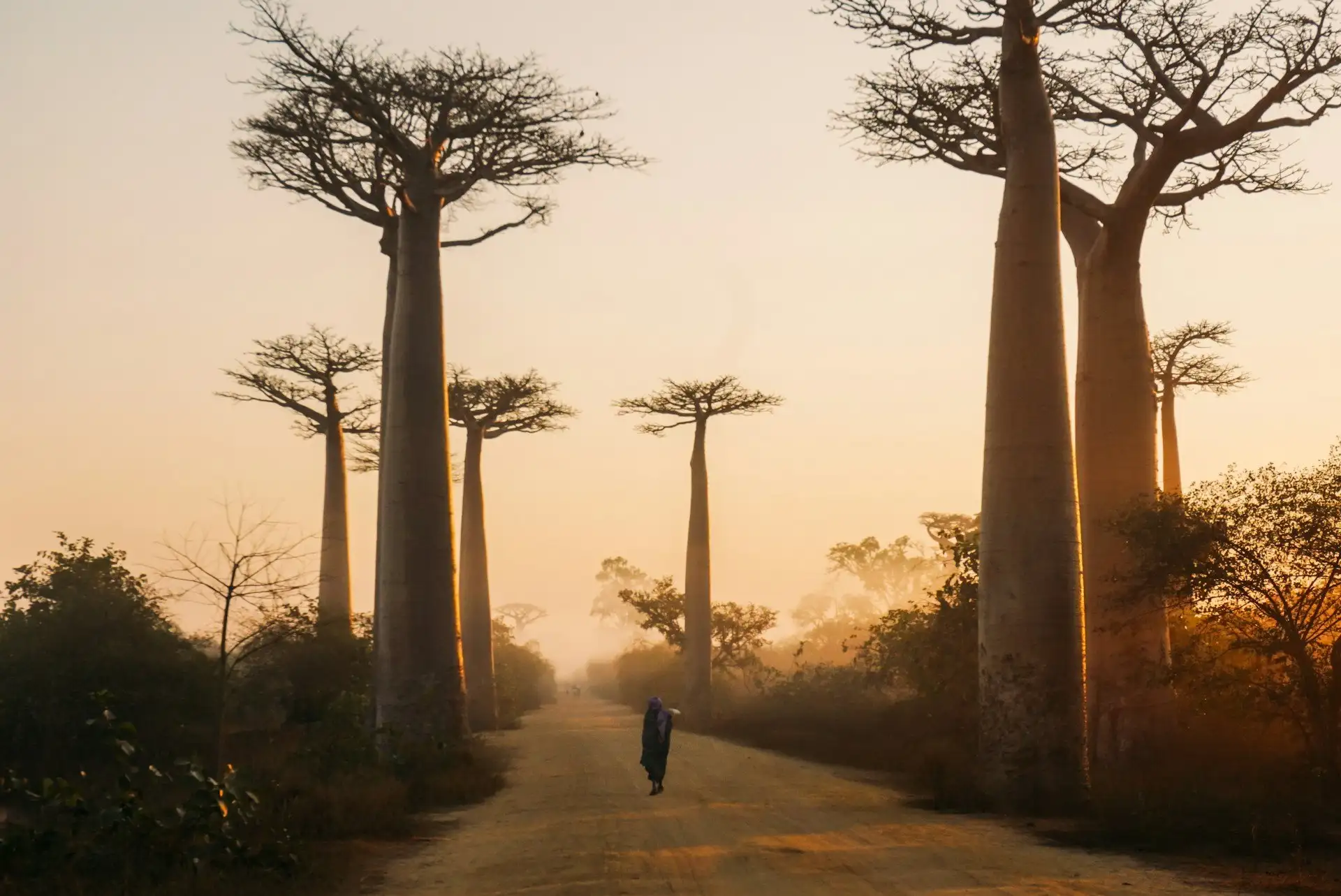
A dirt road lined with ancient baobabs — some over 800 years old, 30 meters tall, trunks wide enough for several people to embrace — outside the town of Morondava on the west coast. At sunset, when the light goes sideways and turns the trunks gold and the sky behind them goes purple and orange, it's the most photographed image in Madagascar and still genuinely spectacular. Plan your arrival for 90 minutes before sunset. Morondava is also the access point for Kirindy Reserve, where multiple lemur species and the elusive fossa can be found, particularly at dawn and dusk.
Tsingy de Bemaraha
A UNESCO World Heritage Site in western Madagascar: a vast limestone karst forest of razor-sharp stone needles up to 30 meters high, connected by rope bridges and via ferrata, harboring its own entirely isolated ecosystem of lemurs, birds, and reptiles that evolved inside the spikes. The name "tsingy" in Malagasy means roughly "where one cannot walk barefoot." The hike to the Grand Tsingy requires a full day and good physical fitness. Getting there from Morondava takes a brutal full-day drive on an unpaved track, or a domestic flight to Maintirano followed by a shorter but still rough drive. Worth every minute.
Ranomafana
On the RN7, about seven hours south of Antananarivo. A steep, misty rainforest park cut by the Namorona River, famous for the golden bamboo lemur — a species discovered here in 1986 that lives almost entirely on bamboo shoots and tolerates cyanide levels that would kill most animals. Night walks reveal sleeping chameleons lit up like ornaments on the branches, leaf-tailed geckoes so well camouflaged you stare at them for a full minute before they resolve into lizard shape, and frogs in quantities and colors that make no evolutionary sense. Hot springs in the village below the park. Stay two nights.
Isalo National Park
Sandstone canyons, natural swimming pools fed by cold clear water, ring-tailed lemurs picking their way along canyon ledges, and sunsets that turn the rock formations from orange to deep red as the light falls. Isalo is on the RN7, about 700 kilometers south of Antananarivo, and it's a completely different landscape from the rainforest parks — dry, dramatic, almost Arizonan. The natural pool hike is the classic. The canyon of the Makis is the best half-day walk for lemur encounters. Base yourself in Ranohira for two to three nights.
Nosy Be
Madagascar's main beach destination: a small island off the northwest coast with white sand, warm water, diving, snorkeling, and the most developed tourism infrastructure in the country. From July to September, humpback whales pass through the Mozambique Channel and can be seen on boat trips from Nosy Be. The lemur sanctuary on neighboring Nosy Komba has brown lemurs habituated to visitors. Fly from Antananarivo — the overland route north is genuinely punishing and takes multiple days.
Île Sainte-Marie
Off the east coast, a long thin island that was a 17th-century pirate base and still carries that atmosphere in its old coves and graveyard. The bones of pirate Captain Kidd's ship Adventure Galley were found in the shallow bay here. Humpback whale watching from July to September. Small fishing villages. A relaxed pace that makes it a natural end point for an east coast circuit. Getting here is an adventure in itself: fly from Tana, or arrive via boat from the coast at Manambato after a drive from the capital.
Antananarivo (Tana)
You'll start and probably end here. The capital spreads across twelve sacred hills, a city of terraced rice paddies, corrugated iron, church towers, and the ruins of the Rova palace on the highest point. The Analakely Market on a Wednesday or Saturday morning is one of the great chaotic covered markets in the Indian Ocean world: vanilla, zebu horns, handwoven silk, every vegetable Madagascar grows. The Zoma market. The old colonial quarter around the Indira Gandhi Avenue. Give it two days — most visitors give it two hours and miss it entirely.
Culture & Fady
Madagascar has 18 recognized ethnic groups — Merina, Betsimisaraka, Betsileo, Sakalava, Tsimihety, and thirteen others — each with its own dialect, traditions, and food customs. The cultural landscape shifts as you move around the island. The highlands have one set of practices; the coast has another; the south another still. Your guide is your primary source for understanding what's expected where you are.
The concept that shapes almost everything is fady: local taboos that can apply to foods, actions, places, days, and people. Fady are not superstition to Malagasy people — they are respected obligations to the ancestors, and breaking them in someone else's community is genuinely offensive. The good news: Malagasy people don't expect foreign visitors to know the local fady. They do expect you to ask, and asking is taken as a sign of respect rather than ignorance.
Begin every interaction — especially in villages — with a proper greeting. "Manao ahoana" (hello) and asking how someone is doing comes before any question or request. Skipping this to get straight to what you want is considered rude across all Malagasy cultures.
Every new region, every new village — ask. Fady vary widely. What's acceptable in one place can be taboo in the next. Your guide knows; asking them shows that you take the culture seriously.
Pointing with an extended index finger, especially at a tomb or grave, is fady across most of Madagascar. Use your whole open hand to gesture direction, or a bent finger if pointing at something specific.
Greet older people first. Listen when they speak. Don't interrupt. The respect for elders and ancestors is the foundation of Malagasy social culture, and showing it costs you nothing and earns genuine goodwill.
Particularly in villages and highland communities. Modest dress — covered shoulders, longer trousers or skirts — is expected and appreciated. Beach resorts and tourist towns are more relaxed.
Well-intentioned but harmful. It creates dependency and incentivizes families to pull children out of school to stand on roadsides. If you want to contribute, give through your operator's community program or to an established local charity.
Lemurs as pets are illegal. Any souvenir made from a protected species — chameleon skin, tortoise shell, rare wood — is illegal to export and contributes to the extinction pressure on the very things you came to see. This is enforced at the airport.
Malagasy families invest more in their tombs than their homes. The zebu horns and painted decorations on the outside of tombs are sacred. Don't touch them. Don't lean on the walls. Don't photograph inside without explicit permission.
Bandits operate on rural roads after dark, consistently. This is not an exaggerated risk. Most local drivers refuse to drive after sunset, and you should listen to them without argument.
Doing so can lead to detention and confiscation of your equipment. There is nothing at a government building that needs photographing. Ask before pointing a camera at anything that looks official.
Famadihana
The "turning of the bones" — a highland ceremony held roughly every five to seven years where families exhume their ancestors' remains, wrap them in fresh silk, and celebrate with music, dancing, and shared food. It is joyful, not morbid. If you are invited to attend one, go. It is one of the most profound cultural experiences Madagascar offers. July and August are the main months in the highlands.
Zebu Culture
Zebu cattle — the humped cattle that appear on everything from coins to road signs — are not just livestock in Madagascar. They are wealth, status, and spiritual currency. Zebu horns decorate tombs. Zebu are sacrificed at ceremonies. A Malagasy family's standing is often measured by the size of their herd. On the RN7 south, zebu share the road constantly. You learn to be patient.
Language Reality
Official languages are Malagasy and French. French is useful in cities and tourist areas but becomes unreliable in rural areas where only Malagasy is spoken — and Malagasy dialects vary significantly by region. English is limited outside of higher-end hotels and tour operators. A few Malagasy words go a long way: Misaotra (thank you), Azafady (excuse me/please), Salama (hello).
Mora Mora
"Slowly, slowly." The philosophy of life in Madagascar, applied to everything from road speeds to restaurant service to meeting times. It is not laziness. It is a genuinely different relationship with time. Fighting it makes you miserable and makes nothing faster. Accepting it makes the whole trip better. Build extra time into every schedule and use the slower pace to actually look at where you are.
Food & Drink
Malagasy food is built around rice. Not as a side dish — as the main event, eaten three times a day, with everything else playing a supporting role. The Malagasy word for "to eat" is literally "to eat rice." Accompanying the rice are stews, greens, meat, and sauces that reflect the island's mixed heritage: Southeast Asian spicing traditions meeting African ingredients meeting French colonial influence. The result is subtle and satisfying rather than loud.
In national park areas and tourist towns, menus expand to include French-influenced cooking, grilled zebu steak, fresh seafood on the coast, and increasingly good coffee — Madagascar grows excellent Arabica in the highlands. Street food in Antananarivo is excellent and cheap. In very remote areas, meals are whatever is available, and flexibility is part of the deal.
Rice & Laoka
Every meal is rice with laoka — the accompaniments. Stewed greens, zebu meat, small fish, beans, or eggs. The national dish romazava is a clear beef and leafy greens broth, mild and restorative, eaten with mountains of rice. Ravitoto — crushed cassava leaves cooked low and slow with pork fat — is richer, earthier, the kind of food that makes sense after a long day on difficult roads. Budget $2–4 at a local restaurant.
Zebu
Grilled zebu steak is the special-occasion food across Madagascar, and when it's good — which in the highlands and RN7 corridor it often is — it's genuinely excellent: lean, slightly gamey, served with rice and a small salad. The zebu market in Ambalavao on the RN7 (Wednesdays) is one of the most vivid market scenes in the country, thousands of cattle traded by herders who have walked days to get there.
Coastal Seafood
On Nosy Be, Île Sainte-Marie, and along the east and west coasts, the seafood is the thing to eat. Freshly caught lobster, grilled with butter and garlic, costs a fraction of what it would anywhere else. Grilled fish with coconut rice and fresh lime. Crab in Morondava. The rule is simple: eat seafood near the sea, eat zebu and rice in the highlands.
Street Food
Mofo gasy — rice pancakes cooked on griddles at dawn, sold from roadside carts around Antananarivo for about 200 MGA each (five cents). Koba, a dense banana and peanut cake wrapped in banana leaf, available on the RN7. Samosas and fried dough balls at morning markets throughout the country. Eat from the carts with the most locals around them.
Coffee & Vanilla
Madagascar grows excellent Arabica coffee in the highlands and is the world's leading producer of natural vanilla. The vanilla from the northeast — the Sava region around Sambava — is the benchmark for the world. You can buy it in Antananarivo's markets at prices that feel impossible compared to home. Good coffee is available in Antananarivo and tourist towns; in remote areas it may be instant.
Three Horses Beer & Rum
Three Horses Beer (THB) is Madagascar's ubiquitous lager, cold and reliable. Local rum distilled from sugarcane — toaka gasy — is cheap, strong, and variable in quality. Litchel, a lychee liqueur, is lighter and widely available in season. Drink only bottled water and sealed drinks. Don't add ice unless you trust the source.
When to Go
The dry season, April to November, is the clear choice. September and October are the sweet spot: wildlife is active, crowds are lighter than peak July–August, and temperatures along the RN7 are comfortable for hiking. Avoid December through March: cyclone season brings heavy rain, many secondary roads become completely impassable, and parks like Tsingy de Bemaraha close entirely. The RN7 stays open year-round but becomes significantly slower and more difficult after November.
Sep – Nov
Dry, fewer crowdsExcellent wildlife viewing. Dry trails in all parks. Tsingy accessible. Baobab Alley clear. Lighter visitor numbers than peak July–August. The highlands are cool and green. Best overall window for a first trip.
Apr – Jun
End of rains, lushThe landscape is at its greenest after the rains. Waterfalls are running. Fewer tourists. Mornings can be misty in the rainforest parks, which adds atmosphere rather than inconvenience. Good value season.
Jul – Aug
Peak seasonThe most popular months, especially for European visitors. Whale watching at Nosy Be and Île Sainte-Marie peaks. Parks are busy by Madagascar standards (which is still not very busy). Book accommodation and flights well in advance. Humpback whale season at its height.
Dec – Mar
Cyclone seasonHeavy rain. Cyclones. Roads flooded and impassable. Tsingy and many western parks close. Leeches in rainforest zones. Trail conditions in Ranomafana become genuinely unpleasant. Unless you're specifically interested in amphibian season (frog species peak), skip this window.
Trip Planning
Two weeks is the realistic minimum for seeing Madagascar properly. Ten days is survivable if you pick one route and don't deviate. Three weeks opens up combinations of corridors. The island is large enough and slow enough that every extra day pays off. The single most important planning decision is your routing: RN7 south, east coast/rainforest, west for Tsingy and baobabs, or north and islands. Pick one or two as your focus and resist the temptation to do everything.
Antananarivo
Arrive, recover, explore. Analakely Market if it's Wednesday or Saturday. The Rova at dusk. A good dinner at one of the restaurants near the Haute Ville. Don't fly out the day you arrive — the capital deserves a proper look.
Andasibe
Three hours east. Two mornings of indri tracking at dawn, one night walk for chameleons and frogs. A half-day at Vakôna's Lemur Island. The forest sounds at night are their own experience.
RN7 South to Ranomafana
Drive south through Antsirabe (thermals, pousse-pousse rides, craft workshops) and Ambositra (wood carvers). Arrive Ranomafana. Two days: morning trek for golden bamboo lemurs, afternoon at the hot springs, night walk. Fianarantsoa on day seven — the wine region of Madagascar, the old colonial hilltop town.
Anja Reserve + Isalo
Stop at Anja Community Reserve (ring-tailed lemurs at arm's reach, local-run, excellent value). Continue to Ranohira and Isalo National Park. One full day in the canyons: natural pool hike and the Canyon des Makis for ring-tailed lemurs at dusk.
Return or Fly Home from Toliara
Continue to Toliara on the coast and fly back to Tana for departure, or take a domestic flight from Toliara direct if available. The drive back north takes two full days minimum — build accordingly.
Antananarivo
Two full days: markets, Rova, Tsimbazaza Zoo for a wildlife preview, and a proper meal at a highland restaurant. Day two: day trip to Ambohimanga — the most sacred royal hill, 21 kilometers from Tana, UNESCO World Heritage Site.
Andasibe-Mantadia
Three nights: two in Andasibe for indri and night walks, one night at Mantadia for the wilder, more demanding forest where sightings feel genuinely earned.
RN7: Ranomafana + Fianarantsoa
Drive south via Antsirabe and Ambositra. Two nights in Ranomafana. One night in Fianarantsoa — the wine town, the old city, the narrow-gauge train to Manakara for those with extra time.
Anja + Isalo + Ifaty
Anja Community Reserve stop. Two nights in Isalo for canyons and lemurs. Continue to Ifaty on the coast — a small fishing village with an excellent spiny forest and reef diving. Rest day.
Toliara + Fly Back
Explore Toliara's fish market and colonial quarter. Fly Toliara to Antananarivo (1 hour). Overnight before international departure.
Antananarivo + Andasibe
Full Antananarivo exploration including Ambohimanga. Three nights in Andasibe with full park access and the optional Mantadia extension for experienced hikers.
Full RN7 South
Antsirabe, Ambositra, Ranomafana (two nights), Fianarantsoa, Ambalavao zebu market, Anja Community Reserve, Isalo (two nights), Ifaty coastal spiny forest. This is the classic RN7 circuit done at the right pace.
West: Morondava + Tsingy
Fly Toliara to Morondava. Baobab Alley at sunset (day 12). Kirindy Reserve for fossa and nocturnal lemurs (day 13). The drive to Bekopaka and Tsingy de Bemaraha (days 14–15): one full day on the Grand Tsingy via ferrata, one on the Petit Tsingy circuit. Return Morondava day 16.
North: Nosy Be
Fly Morondava to Nosy Be via Antananarivo. Four nights: diving, whale watching (July–September), Nosy Komba lemur sanctuary, a day trip to the Lokobe Reserve on Nosy Be's own rainforest. Fly back to Tana for international departure.
Vaccinations & Health
No mandatory vaccinations, but strongly recommended: Hepatitis A, Typhoid, and routine vaccines. Malaria is present throughout Madagascar, including highland areas. Anti-malarial medication is strongly recommended — discuss chloroquine resistance with your travel doctor. Rabies vaccination for wildlife-focused trips near bats and carnivores.
Full vaccine info →Driver-Guide
The most important booking you make. A good driver-guide navigates impossible roads, knows the park staff by name, speaks Malagasy with local villages, and turns a frustrating logistics exercise into an education. Tip $5–10 EUR per person per day. They earn it. Find one through a reputable Antananarivo operator rather than at the airport.
Cash
ATMs exist in Antananarivo and major towns but are unreliable in rural areas. Bring enough euros or US dollars for your entire trip and exchange as needed. Park fees, community reserves, and most guesthouses outside tourist hubs are cash only. Euros are the preferred foreign currency.
Connectivity
Buy a local SIM (Orange or Telma) at the airport in Antananarivo — data is cheap. Coverage is good in cities and along the RN7, patchy in national parks, absent in remote western and northern areas. Download offline maps (Maps.me works well in Madagascar) before leaving Tana.
Travel Insurance
Medical facilities outside Antananarivo are minimal. Medical evacuation to South Africa or Réunion is the realistic option for serious illness or injury. Insurance with evacuation coverage is essential. World Nomads and AXA both cover Madagascar adequately.
What to Pack
Layers for the highland mornings (cold) and coast afternoons (hot). Waterproof hiking shoes — trails in rainforest parks are genuinely muddy. High-DEET insect repellent. A headlamp for night walks and power cuts. Motion sickness tablets for winding mountain roads. A 20kg luggage limit applies on domestic flights.
Transport in Madagascar
There is one rule: do not underestimate the distances. Madagascar is almost twice the size of the UK and has roughly 1% of its paved road length. The RN7 — the best road in the country, running 900 kilometers south from Antananarivo to Toliara — averages 40–50 km/h in many sections. Everything off the RN7 is worse. A GPS showing a 200-kilometer drive does not tell you anything useful about how long it will take. Ask your driver.
Domestic Flights
$80–200 one-wayThe practical solution for Madagascar's distances. Tsaradia and Madagasikara Airways serve Antananarivo, Morondava, Nosy Be, Toliara, Île Sainte-Marie, and other regional airports. Schedules are limited and cancellations happen. Book early, arrive early, and build a buffer day on either side of domestic connections.
4x4 with Driver
$80–150/day all-inThe standard and correct way to travel overland. Your driver handles navigation, vehicle breakdowns (bring a contract that includes replacement), and local knowledge. Do not self-drive off the RN7 under any circumstances. Even on the RN7, self-driving is not recommended for first-timers.
Taxi-Brousse
$3–15/routeShared bush taxis (typically converted minivans packed far beyond capacity) that leave when full from central taxi-brousse stations in each town. Slow, cheap, uncomfortable, and culturally immersive. They leave when full, not on a schedule. Budget travelers use them along the RN7. Not recommended for tight itineraries.
Boats & Ferries
VariesEssential for island access: ferries to Nosy Be from Ankify on the mainland, boats to Île Sainte-Marie from the east coast. The Pangalanes Canal on the east coast can be navigated by pirogue or slow boat — an extraordinary journey through lagoon villages if time allows.
FCE Train
~$15The narrow-gauge train from Fianarantsoa to Manakara on the east coast: a 12-hour journey through highland and rainforest scenery, stopping at villages that have no road access. Runs twice a week when operational. A bucket-list experience when it's running; check schedules before planning around it.
Pousse-Pousse
500–2,000 MGARickshaws pulled by men on foot, used for short distances within towns like Antsirabe and Toliara. Negotiate before you get in. They are a reminder that transport in Madagascar exists at every scale, from 45-minute domestic flights to someone running you three blocks.
Accommodation in Madagascar
Madagascar's accommodation ranges from excellent eco-lodges in the national parks to very basic guesthouses in small towns along the RN7. Power cuts are a fact of life everywhere outside Antananarivo — bring a headlamp and a power bank. Water pressure is intermittent. Hot water is a bonus. The trade-off is that some of the eco-lodges in the parks are genuinely lovely: wooden bungalows in the forest, meals made from local ingredients, guides who have been working the same trails for decades.
Eco-Lodges (Park Areas)
$60–200/nightThe best accommodation experiences in Madagascar. Andasibe has Vakôna Forest Lodge and Feon'ny Ala. Ranomafana has Setam Lodge. Isalo has Isalo Rock Lodge. These are worth spending for — they're close to the parks, employ local guides, and have the best access to wildlife at dawn.
Hotels (Antananarivo)
$40–150/nightThe capital has a range of options from basic guesthouses to the Radisson Blu. The Haute Ville area (upper town) is most convenient for sightseeing. Colbert Hotel is a reliable mid-range choice with a good restaurant and central location.
Beach Resorts (Nosy Be)
$80–300/nightNosy Be has Madagascar's most developed beach tourism infrastructure. Andilana Beach and Ambatoloaka have resort hotels with pools and restaurants. Quality varies significantly — check recent reviews before booking.
Budget Guesthouses (RN7)
$10–30/nightAlong the RN7 in towns like Ambalavao and Ranohira, basic but clean guesthouses cover the essentials. Cold water showers, generator power, simple meals. They're fine for a night between wildlife days. Your driver knows which ones to trust.
Budget Planning
Madagascar is cheap on the ground — food, local transport, and guesthouses are genuinely affordable — but the costs stack up in the logistics: international flights are expensive because few airlines serve Antananarivo, domestic flights are not cheap by regional standards, and hiring a 4x4 with driver for two weeks adds up fast. The sweet spot for most visitors is a mid-range budget that gets you a reliable driver, decent lodges, and good guide access in the parks.
- Budget guesthouses along the RN7
- Taxi-brousse for overland transport
- Street food and local restaurants
- Self-organized park visits
- No domestic flights
- Private 4x4 with driver-guide
- Mix of eco-lodges and decent hotels
- Restaurant meals + local food
- Park fees and local guides
- 1–2 domestic flights to save time
- Best eco-lodges in each park
- All domestic flights between regions
- Expert specialist guides
- Nosy Be resort for beach days
- Organized tour with ethical operator
Quick Reference Prices
Visa & Entry
Madagascar has one of the more visitor-friendly entry systems in Africa. Virtually all nationalities receive a visa on arrival at Ivato International Airport in Antananarivo, paid in cash in USD or euros. You can also apply for an e-visa before departure at evisamada-mg.com (processed within 72 hours), which speeds up arrival formalities. The process at the airport is straightforward but slow — allow 1–2 hours for immigration on busy arrival days.
Available to virtually all nationalities at Antananarivo airport and other international entry points. Pay in USD or EUR cash. E-visa also available online before departure.
Safety in Madagascar
Madagascar is broadly safe for travelers who take sensible precautions. Violent crime against tourists is uncommon. The biggest day-to-day risks are petty theft in Antananarivo, road accidents (vehicles in poor condition on poor roads), and the health risks of malaria and contaminated water. Political instability — including the 2009 coup and ongoing tensions — is a background factor worth monitoring before travel but has not significantly disrupted tourism in recent years.
General Safety
Violent crime against tourists is rare. Malagasy people are genuinely friendly and non-threatening in almost all contexts. The atmosphere in rural areas and national parks is relaxed and welcoming.
Antananarivo City
Petty theft and pickpocketing occur in crowded markets and the Basse Ville (lower town). Don't display valuables. Be cautious at the Analakely Market during peak hours. Evening walking alone in unfamiliar areas is not recommended.
Night Road Travel
Bandit activity on rural roads after dark is a real and documented risk. Drivers know this and will typically refuse to continue after sunset. Do not pressure them to drive after dark. This is the rule that matters most.
Malaria
Present throughout Madagascar including highland areas. Take anti-malarial medication as prescribed. Use DEET repellent and mosquito nets, particularly in lower altitude areas and on the coast.
Cyclones
Cyclone season runs December to March. Direct cyclone hits cause road damage, flight cancellations, and flooding. Madagascar sees several significant cyclones per year. Avoid travel in this window unless flexibility is built in.
Wildlife Safety
Unlike mainland Africa, Madagascar has no large dangerous predators. The fossa is the largest carnivore and doesn't threaten humans. Walking in the parks without vehicle protection is normal. The main wildlife hazard is the odd over-curious lemur stealing your lunch.
Emergency Information
Key Embassies in Antananarivo
Most foreign missions are located in Antananarivo's Ambohijatovo and Tsaralalana districts.
Book Your Madagascar Trip
Everything you need. The driver-guide and the flights are the two decisions that determine most of the trip.
The Island That Went Its Own Way
Most places you travel to exist in dialogue with somewhere else — shaped by trade routes, invasions, cultural exchange. Madagascar went quiet for 160 million years and did something else. The lemurs that evolved here in the absence of competing primates, the chameleons that diversified into a hundred forms because nothing was stopping them, the baobabs that grew to improbable sizes because the conditions happened to favor it: none of this was planned. It just happened, slowly, in isolation, while the rest of the world was looking elsewhere.
There is a lesson in that, and you feel it most clearly on the road — not when you're at the famous viewpoint photographing the famous baobab at the famous hour, but somewhere in between, when the car breaks down on a red-dirt track 40 kilometers from anywhere and your driver gets out without particular urgency and starts looking at the engine while a zebu cart trundles past and children appear from nowhere and stand at a polite distance watching you, and you realize that whatever schedule you were running is now entirely irrelevant and the only thing to do is be where you are.
The Malagasy call it mora mora. Slowly, slowly. It turns out to be excellent advice for an island, and for most things.