
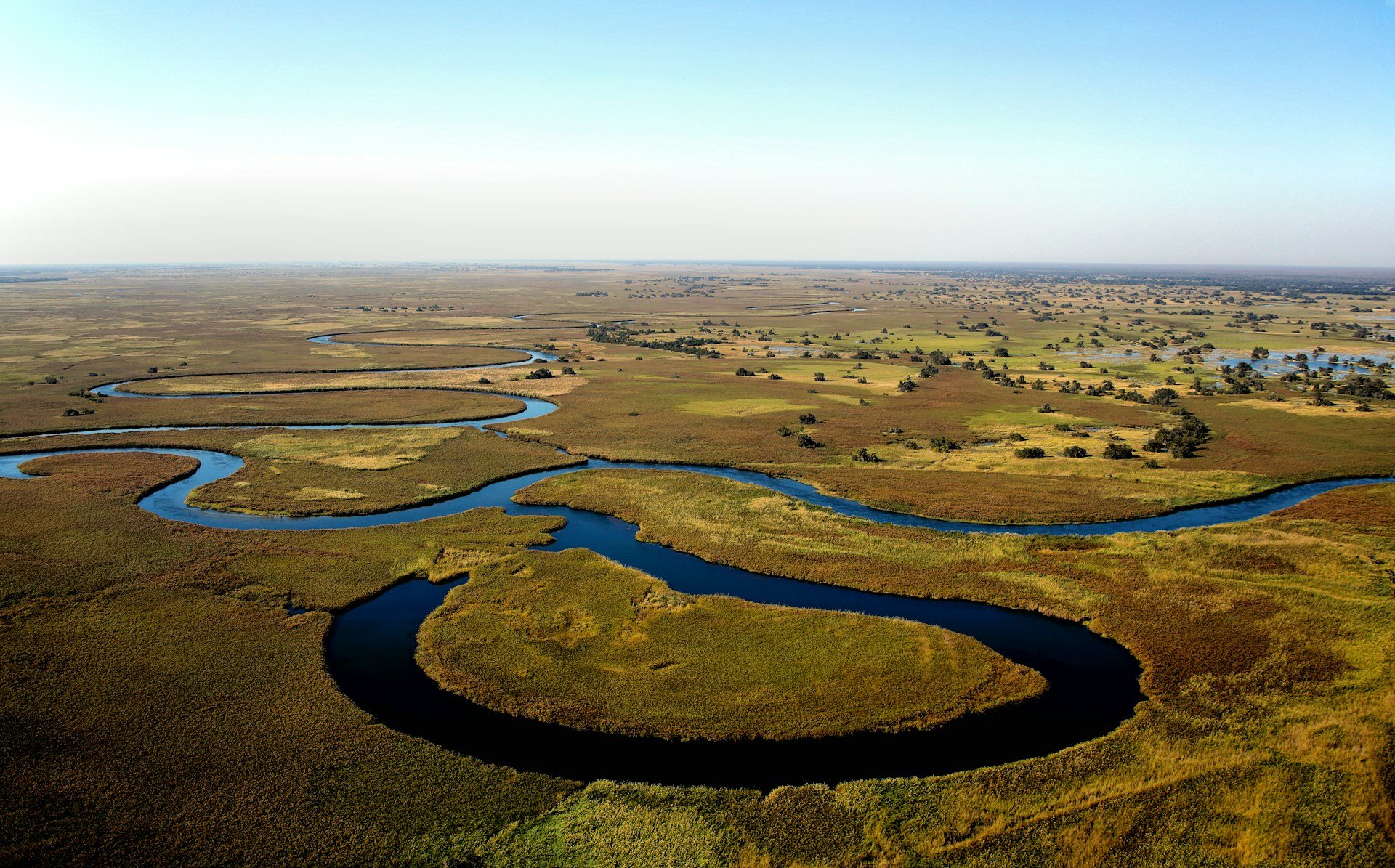
Botswana
The world's largest inland delta. Over 130,000 elephants. Wild dogs hunting on open floodplains. Salt pans so flat and white they double as runways. Botswana decided decades ago that its wildlife was worth more alive than dead, and then built the policies to prove it.
What You're Actually Getting Into
Botswana is expensive, landlocked, mostly flat, largely desert, and home to some of the finest wildlife experiences available anywhere on earth. The country made a decision early in its post-independence history: use the diamond revenues to protect the wilderness rather than sell it off, keep tourist numbers low and prices high, and make the environment the economic asset rather than something that competes with economic activity. That model has worked well enough that Botswana now has more elephants than any country on earth and a wildlife sector that other African nations study and occasionally resent.
The Okavango Delta is the headline, and it deserves to be. When the rains fall in Angola, the Okavango River swells and flows southeast into the Kalahari, flooding a system of channels and islands that creates, for a few months, one of the world's great wetland ecosystems. No other delta on earth ends in a desert. The animals know the timing: hundreds of thousands of animals move in annual cycles between the floodplains and the drier interior, and watching those movements from a mokoro (dugout canoe) or a small research camp is what Botswana is for.
Chobe is the other major draw. The Chobe River in the northeast is one of Africa's great elephant highways, with herds that number in the thousands drinking at the river in the late afternoons. A boat safari on the Chobe is Africa at its most productive: elephants swimming the channel with calves on their backs, hippos yawning at each other, crocodiles sunning on the banks, and so many birds that the serious birders run out of page in their notebooks.
What Botswana is not: cheap. The top Delta camps charge $1,000 to $2,000 per person per night all-inclusive, and they have waiting lists. Mid-range options exist and are very good. Budget travel by self-drive 4x4 and camping is genuinely viable but requires preparation, a properly equipped vehicle, and a comfort level with being a long way from anything. Decide your budget tier before you plan anything else, because it determines which Botswana you're going to.
Botswana at a Glance
A History Worth Knowing
The San people — known in older literature as Bushmen, a term some communities still use and others do not — have lived in the Kalahari for at least 20,000 years, making them among the oldest continuous inhabitants of any region on earth. Their rock art appears across Botswana's hills and caves, and their relationship with the land, as hunters and gatherers who left almost no physical mark on the landscape, is the oldest layer of human presence in the country. Today San communities in the Central Kalahari Game Reserve are fighting for the right to continue living on land their ancestors occupied for millennia: legal battles over resettlement programs have dragged through Botswana's courts for decades, with mixed outcomes.
The Tswana-speaking peoples arrived in the region from the north over several centuries, establishing a series of chiefdoms across the southern and eastern parts of what is now Botswana. Their governance system, the kgotla — a community assembly where all adult members could speak and decisions required broad consensus — is one of southern Africa's most distinctive political institutions and is still formally integrated into Botswana's governance today.
The 19th century brought European missionaries (David Livingstone traveled extensively through Botswana), hunters who began the slaughter of Botswana's wildlife that would take a century to repair, and eventually the threat of annexation by the Boer republics expanding from the south. The Tswana chiefs made a remarkable political calculation: in 1885 they petitioned Britain directly, travelling to London to request British protection. They got it — the territory became the Bechuanaland Protectorate — and crucially negotiated terms that preserved their authority and, they hoped, kept out the settlers and mining companies that were transforming South Africa at the time. It mostly worked.
Independence came in 1966. What followed is one of the most discussed stories in African development: a country that was among the world's poorest at independence, with 12 kilometers of paved road and 22 university graduates, discovered diamonds two years later. The government of Seretse Khama and his successors made the revenue work rather than allowing it to be captured by elites: investment in education, infrastructure, and health across a small, sparse population. By the 1990s Botswana was routinely cited as Africa's economic success story. The HIV/AIDS epidemic of the late 1990s and 2000s was devastating — Botswana had one of the world's highest infection rates — but the government's response, including free antiretroviral treatment for all citizens from 2002, was one of Africa's most effective public health interventions.
Botswana today is a multiparty democracy that has had peaceful transfers of power, a functioning rule of law, and an environmental policy that has made it the most important wildlife destination in sub-Saharan Africa. The San land rights issue remains contested and unresolved. The elephant population, now over 130,000 and growing, has renewed debates about trophy hunting (banned in 2014, partially reinstated in 2019) and human-wildlife conflict in farming communities. None of these are simple stories, and understanding them makes the game drives more meaningful.
The San people establish hunter-gatherer communities across the Kalahari. Among the oldest continuous human presences on earth.
Tswana-speaking peoples establish chiefdoms across southern and eastern Botswana. The kgotla governance system takes shape.
Livingstone arrives, begins decades of exploration. His accounts open the region to European attention — not always a good thing.
Tswana chiefs petition Britain. The territory becomes a protectorate, keeping out Boer annexation and preserving chiefly authority.
Botswana independent on September 30, 1966. One of Africa's poorest countries: 12km paved road, 22 university graduates.
Orapa diamond deposit found. Managed well, it transforms the national economy within a generation.
One of the world's highest infection rates. Free ARV treatment from 2002 — one of Africa's most effective public health interventions.
130,000+ elephants. Stable democracy. The continent's most imitated wildlife management model, with ongoing debates about hunting and San land rights.
Top Destinations
Botswana's major destinations are spread across a large, sparsely populated country and the distances between them are significant. Most visitors plan a circuit combining two or three areas: Chobe in the northeast pairs naturally with Victoria Falls (over the border in Zimbabwe or Zambia) and is often a first or last stop given Kasane's airport. The Okavango Delta, accessed through Maun, is the centrepiece of any serious safari itinerary. The Kalahari and Makgadikgadi are deeper Botswana — quieter, less dramatic by headline standards, and among the most profound wilderness experiences on the continent.
Okavango Delta
A UNESCO World Heritage Site covering roughly 15,000 square kilometers of channels, lagoons, papyrus beds, and palm-studded islands in the northwest of Botswana. The delta floods annually when rains fall in the Angolan highlands, and the water pulse takes months to reach the interior — meaning the peak flooding and the peak wildlife season overlap in the dry southern winter between June and August. You access it by small Cessna from Maun to a private airstrip, then mokoro or game drive from there. There are no roads into the interior delta worth the name. The camps sit on islands where elephants wander through at night, lions call across the water, and the dawn sky fills with birds in numbers that seem impossible. There are many ways to do the Okavango. The right way is with time — three nights minimum at any single camp, long enough for the rhythm of the place to settle into you.
Chobe National Park
The Chobe riverfront near Kasane in the northeast has one of the greatest concentrations of wildlife in Africa. Afternoon boat safaris on the Chobe River deliver elephants in herds of hundreds swimming across the channel, hippo pods occupying every deep bend, crocodiles at every sandbar, and a light — that particular late-afternoon southern Africa light, orange and horizontal — that makes everything look like it was staged by someone who knew what they were doing. The Savuti area of Chobe, a four-hour drive inland, is a different ecosystem: dry woodland and savanna where lion and cheetah hunt and wild dogs denned here in recent years. If you only have three days, the Chobe riverfront. If you have a week, add Savuti.
Moremi Game Reserve
Occupying the eastern edge of the Okavango Delta and the dry-land Mopane woodland between the delta and Chobe, Moremi is one of Africa's most species-diverse game reserves. The Khwai community concession on Moremi's northern boundary is among Botswana's best wild dog habitat. Chief's Island in the middle of the delta, reached by small plane, has the densest large predator concentration in the ecosystem. Self-drive is possible in Moremi — unlike the deep delta — but requires a proper 4x4 and a willingness to navigate deep sand and river crossings.
Makgadikgadi Pans
Twenty thousand years ago, the Makgadikgadi was the largest lake in Africa. Today it is a salt pan the size of Switzerland, absolutely flat, blinding white in the dry season, and one of the most disorienting landscapes on earth. Stand in the middle in July and the horizon is a perfect circle around you with nothing vertical in it. In the green season, the pans flood shallow and attract one of Africa's largest flamingo concentrations. Jack's Camp on the Makgadikgadi is one of Botswana's legendary safari camps: walks with habituated meerkats at dawn, quad bikes across the salt pan surface at sunset, and fossil beds where you can find evidence of the lake that was here 20 millennia ago.
Central Kalahari Game Reserve
The second-largest game reserve in the world at 52,000 square kilometers. Not the "game reserve" of popular imagination — this is arid Kalahari scrub with widely dispersed wildlife, ancient fossilized riverbeds (called pans), and a scale that makes everything feel small and quiet. In the green season after rains, the Kalahari grass turns green and herds of gemsbok, springbok, and wildebeest move in their thousands. The rare black-maned Kalahari lion lives here. The Central Kalahari is also the ancestral homeland of San communities whose legal battles over resettlement are ongoing. Visit with that knowledge.
Linyanti & Kwando
The Linyanti marshes and Kwando River system in the far northwest of Chobe district sit between the main Chobe park and the Okavango and form one of Africa's most exclusive and wildlife-dense safari areas. The private concessions here — Duma Tau, Selinda, Kwando Lebala — are among the continent's finest camps, with the kind of lion and wild dog activity that justifies the prices. This is where serious wildlife photographers go when the main areas feel too busy. Accessible only by small plane from Maun or Kasane.
Gaborone
Gaborone is a functional rather than spectacular city, built after independence with efficiency rather than grandeur in mind. The National Museum gives a good introduction to Botswana's history and ecology before you go into the bush. The Main Mall is the social hub. The Gaborone Game Reserve at the city's edge has giraffe, zebra, and various antelope within 10 minutes of the CBD, which is the kind of thing that still surprises first-time visitors. Most international visitors pass through briefly and head north and west to the wildlife areas.
Maun
Maun is the gateway to the Okavango Delta and one of Africa's great safari towns. The Thamalakane River runs through town, and the airstrip — one of the busiest in southern Africa by aircraft movements — dispatches small planes into the delta every morning. Audi Camp and Island Safari Lodge are the budget bases. The town has enough restaurants, gear shops, and outfitters to sort out any last-minute logistics. Spend a night, have the briefing, fly in the morning.
Culture & Etiquette
Botswana's national identity is built around the concept of Botho — the Setswana equivalent of the Ubuntu philosophy that runs across southern Africa. Botho means something like: your humanity is expressed through your treatment of others; you are who you are because of and through your community. It shows in the particular patience and courtesy of interactions across the country, in the way disagreements are handled (through conversation rather than confrontation), and in the almost universal good humour toward visitors even in difficult service situations.
English is the official language and is spoken almost everywhere, which removes the language barrier that makes some African travel more challenging. Setswana is the most widely spoken national language and a few phrases — "Dumela" (hello), "Ke a leboga" (thank you), "Tsamaya sentle" (go well, a farewell) — open conversations with a warmth that pure English doesn't.
"Dumela rra" (to a man) or "Dumela mma" (to a woman) before any interaction. This matters here. Launching into a question without greeting first is considered rude in a way that English-speakers often don't expect in a country where English is the official language.
The kgotla — community assembly space — is a sacred civic institution. If you're ever near one when it's in session, observe quietly from a respectful distance. Don't interrupt or photograph proceedings without explicit permission.
In game areas, your guide's word is not a suggestion. When they say stop, you stop. When they say don't get out, you don't get out. When they say speak quietly, you whisper. They are managing your safety around animals that kill people regularly.
In rural villages and towns, conservative dress is appropriate: covered shoulders and knees, particularly for women. In safari camps and lodges the dress code is relaxed. In Gaborone it's smart casual. In the bush it's neutral-coloured practical clothing — green, khaki, brown. No white or bright colours on game drives.
Safari guides are skilled professionals who have spent years building wildlife knowledge that nobody else can replicate. The standard tip is $15 to $20 per person per day for your main guide, and similar amounts for the camp staff as a group. It matters significantly to their livelihoods.
Animals in Botswana's game areas have learned that a vehicle is a non-threatening entity. A person standing up in or getting out of a vehicle changes the silhouette and the calculation. Sit down, stay still, let the animal decide when it's done with you.
Sounds carry differently in the bush. The animals are active at night. The other guests are trying to sleep so they can be up at 5am for the dawn drive. Keep it quiet after dinner.
Visits to San communities in the Central Kalahari and elsewhere should be arranged through established community organisations, not ad-hoc. These are real communities navigating genuine hardship and dispossession, not living museums. Approach it as a privilege, not a tourist activity.
You cannot leave your vehicle in Botswana's national parks without a licensed guide. This is law, not guideline. The penalties are real and the reason is genuine: lion, buffalo, hippo, and elephant kill people who mistake a national park for a nature walk.
Botswana's craft traditions — particularly the Ngamiland baskets woven by women in the Okavango region — represent real skilled work. The prices are already modest. Aggressive haggling over items that took days to make is not a local custom here and is not welcome.
Ngamiland Basket Weaving
The coiled basketry produced by women around the Ngamiland (Okavango) region is among Africa's finest traditional crafts. Woven from mokola palm and dyed with natural materials, the baskets carry geometric patterns with names rooted in local cosmology — the forehead of a zebra, the tears of a giraffe, the uterus of a warthog. They appear on Botswana's banknotes. Buy directly from weavers through the Nhabe Museum in Maun or the Okovango Craft cooperative where more of the sale price reaches the maker.
Music and Dance
Traditional Tswana music centers on the segaba (a one-stringed bowed instrument), the setinkane (thumb piano), and the moropa (drum). The national dance, tsutsube, is performed at celebrations and cultural events. The most widely heard music in contemporary Botswana blends these roots with South African township styles — kwasa-kwasa, kwaito, and gospel — in ways that feel specifically Batswana even when the form is shared. The Maitisong Festival in Gaborone in March is the country's main performing arts event and worth timing a visit around.
Conservation Culture
Wildlife conservation is not background to a Botswana trip — it is part of the national identity and something Batswana discuss and argue about with genuine engagement. The debates around trophy hunting resumption, elephant population management, and San land rights in the Central Kalahari are live political conversations. Your camp guides will have views. Listen to them seriously rather than as talking points in a tourist briefing.
The Kgotla
The kgotla is the traditional governance structure of Tswana communities: an open meeting space, usually under a large tree, where community members gather to debate, settle disputes, and reach consensus decisions. Chiefs preside but cannot override the community. It is not a museum piece: the kgotla system is formally recognized in Botswana's constitution and local kgotla decisions interact with the formal legal system. Passing through a village, you will likely see the kgotla space — an open area with a simple structure and seating. It is the center of the community in a way that's not architectural but political.
Food & Drink
Botswana's cuisine is not the reason people come, and that's fine. It is honest, filling food built around sorghum, maize, beans, and meat — particularly beef, which is central to the culture in a way that's also central to the economy. Botswana is one of Africa's major beef exporters and the quality of the beef, particularly in traditional preparations, is genuinely good. Safari camps provide full-board meals that range from competent to excellent, and bush dinners eaten around a fire under the Kalahari sky tend to taste better than they would in a restaurant regardless of what's on the plate.
The dining in Gaborone has improved significantly over the past decade. There are several genuinely good restaurants in the capital serving Botswana beef in modern preparations, alongside the Indian, Chinese, and South African food that forms the cosmopolitan layer of most southern African cities.
Seswaa (Pound Meat)
The national dish. Beef, goat, or lamb boiled for hours with salt and onion until it falls apart, then pounded with a wooden pestle until it shreds into a dense, fibrous mass. Served with pap (maize porridge) or bogobe (sorghum porridge). It sounds simpler than it tastes: the long cooking concentrates the flavor and the texture is unique. You'll find it at every community gathering, wedding, and cultural event. It is what Botswana tastes like.
Bogobe and Pap
Bogobe is sorghum porridge, slightly sour from fermentation, cooked thick and eaten with seswaa or stewed vegetables. Pap (maize porridge, also called mealie pap from the South African tradition) is the more widely eaten starch and appears at almost every meal. Both are eaten from a communal pot, broken off in pieces and used to scoop up the accompanying dish. Bogobe is distinctly Botswanan; pap crosses the whole of southern Africa.
Mopane Worms
The caterpillar of the Emperor moth, harvested from mopane trees across central and southern Africa. In Botswana they are dried or smoked and eaten as a protein snack, or cooked in a tomato-onion sauce with pap. The dried version tastes like a very intense, slightly bitter jerky. The cooked version is more approachable. They are nutritionally excellent and the harvest supports rural livelihoods across the Kalahari region. Try them. Start with the cooked version.
Morogo (Wild Spinach)
Leafy wild plants — several species called collectively morogo — collected from the bush and cooked with onion, tomato, and groundnuts. Nutritious, slightly bitter, deeply good with pap. The knowledge of which plants to collect and how to prepare them is held by older women and is being slowly lost as urban diets replace traditional food knowledge. Eating morogo at a family home is eating Botswana's actual food system rather than a performance of it.
St. Louis Lager and Shake Shake
St. Louis is Botswana's national beer, light and cold and perfect for drinking on a lodge veranda watching elephants at a waterhole. Chibuku (locally called Shake Shake) is a traditional opaque sorghum beer sold in cardboard cartons and drunk communally. It is acquired taste territory — slightly sour, chunky, and fermenting actively in the container. It is also a genuine social institution and the correct way to participate in a community celebration when you're handed a carton.
Bush Braaing
The braai (South African/southern African barbecue) is common across Botswana and at its best in the bush: beef sosaties (skewers), boerewors (spiced sausage), and thick steaks over a wood fire on a clear cold Kalahari night. Safari camps do this with varying degrees of formality, from a proper bush dinner setup to a simple grill beside the campfire. The combination of excellent Botswana beef, wood fire, and the sound of lions calling in the dark is one of the better meals available on earth regardless of what's actually being cooked.
When to Go
Botswana's seasons are clearly defined and each offers something distinct. The conventional advice — go in the dry season from May to October — is correct for maximum wildlife visibility but incomplete. The green season has its own advocates and its own logic. The key variables are: the Okavango flood (peaks June to August), elephant concentrations at Chobe (peak dry season), and budget (green season rates are often 30 to 50 percent lower).
Mid Dry Season
Jul – SepThe Okavango flood peaks and the delta is at its fullest. Chobe's elephants congregate at the river in massive herds. Vegetation is sparse, making wildlife easy to spot. Nights are cold — 0 to 5°C at Makgadikgadi and the Kalahari. Prices are at their highest and lodges book out months in advance. Book at least six months ahead for top camps.
Early Dry Season
May – JunSlightly lower prices than peak. The vegetation is thinning, water sources are shrinking, and wildlife is starting to concentrate. The Okavango flood is rising. Shoulder season with excellent game viewing and better availability. This is arguably the smartest window if you can be flexible.
Late Dry Season
Oct – NovVery hot — 35 to 40°C in the Kalahari and Makgadikgadi. Wildlife at permanent water is dense. The first rains begin in November, bringing baby animals and greenery. Chobe elephant concentrations remain very high. Some camps close or reduce rates. A good window for Chobe; harder going elsewhere.
Wet Season
Dec – AprThe landscape transforms: Kalahari grass turns green, Makgadikgadi floods with flamingos, baby animals appear everywhere. Prices drop 30 to 50 percent. The downside: the Okavango interior is at its lowest, some tracks are impassable, and wildlife is dispersed. Best for Makgadikgadi and Central Kalahari in the rains. Dramatic thunderstorm photography.
Trip Planning
Botswana rewards planning more than spontaneity. The best camps book out a year in advance in peak season. Domestic flights between areas are essential and sell out. Self-drive safaris require significant preparation. The logistics are real, but they're manageable: Botswana's tourism infrastructure, while expensive, is professional and reliable in a way that makes it easier to plan than many African destinations.
The first decision is budget tier, because it determines everything else. High-end fly-in circuit, mid-range combination of camps and self-drive, or budget self-drive camping in your own 4x4 are genuinely different trips. Settle this before planning anything else.
Ten days is the minimum for a meaningful Botswana trip. Two weeks is the standard. Three weeks opens up the combination of the main areas plus the less-visited Kalahari and Makgadikgadi in depth.
Arrive Maun — Okavango Delta fly-in
Fly into Maun. Brief overnight (Audi Camp or similar if arriving late). Morning departure by Cessna to your Delta camp. Two nights minimum in the Delta — three is better. Mokoro at dawn on day two.
Okavango Delta
Three full days of game drives, mokoro, and walking safaris. Let the rhythm settle. The best sightings often happen when you're not trying hard — drifting on the water at 6am when the light is amber and the hippos are already in the channel.
Chobe National Park
Fly Maun to Kasane. Two nights at a Chobe riverfront camp. Afternoon boat safari on day six is non-negotiable. Day seven: full game drive into the park — the Ngwezumba area for lion, the riverfront for the elephant spectacle. Day eight: sunrise walk along the Chobe riverbank before your flight.
Victoria Falls extension
Kasane to Livingstone, Zambia or Victoria Falls, Zimbabwe is a two-hour drive. Two nights beside the falls works well as a finale, or fly home directly from Kasane if the falls are for another trip.
Okavango Delta
Four nights in the Delta. Two different camps if budget allows — one in the permanent Delta for water-based activities, one on Chief's Island or in the Moremi area for terrestrial game. Flying between camps in the Delta is a genuinely beautiful experience.
Moremi / Khwai
Fly to Khwai or drive into Moremi. Three nights in the community concession area for wild dog and lion. The Khwai community campsites are a significant step down in comfort from the Delta camps and a significant step down in price. The wildlife doesn't notice.
Chobe
Kasane base for Chobe. Two nights riverfront, one night in the Savuti area if it's worth the additional drive. Afternoon boat safaris are mandatory. Day nine: full day in the park from before dawn. Day ten: explore the Caprivi Strip border area for a different perspective on the Chobe ecosystem.
Makgadikgadi Pans
Drive or fly to Makgadikgadi. Two nights at Jack's Camp or a budget alternative near Gweta. Meerkat walk at dawn, quad bikes on the pan surface, and the particular silence of standing on an ancient lake bed at sunset. Fly home from Maun.
Okavango Delta in Depth
Five nights across two or three camps. The deep Delta interior for water-based activities, Moremi for terrestrial game, and possibly Linyanti or Kwando for the most exclusive and wildlife-intense experience. Budget for a mix: one luxury night and four mid-range nights, or the full fly-in luxury circuit if resources allow.
Moremi + Khwai
Four nights in and around Moremi. Self-drive 4x4 if experienced, or a community camp. Wild dog dens in the Khwai concession in the dry season. Lion territories around Third Bridge. The kind of game viewing that requires patience and rewards it.
Chobe + Savuti
Four nights at Chobe. Split between the riverfront and the Savuti area to experience both the river ecosystem and the dry Savuti woodland where Botswana's most famous lion prides operate. The Savuti cheetah coalition has been well-documented; if it's still active, this is worth the detour.
Makgadikgadi + Nxai Pan
Nxai Pan National Park, just north of the main Makgadikgadi complex, has a small population of cheetah and was the childhood home of the gemsbok herds that Deception Valley made famous. Four nights between the two pans covers the full ecosystem.
Central Kalahari
The deep desert. Self-drive or a specialist camp in the CKGR. Deception Valley for the fossils and the Kalahari predators. Sunday Pans at the height of the green season for the annual herds. This requires preparation: the CKGR is remote, roads are challenging, and the rewards are commensurate with the effort.
Vaccinations
Yellow Fever vaccination required if arriving from a yellow fever endemic country. Hepatitis A, Typhoid, and routine vaccines recommended. Malaria prophylaxis is recommended for the Okavango Delta, Chobe, and the north. The Kalahari and Gaborone have negligible malaria risk. Consult a travel health clinic specifying your exact itinerary.
Full vaccine info →Malaria
Present in the Okavango, Chobe, and northern areas, particularly during and after the rains. Use prophylaxis appropriate for your itinerary, DEET repellent at dusk and dawn, and sleep under a net in camps without screening. Malaria risk is lower than central or west Africa but is real and requires taking seriously.
Connectivity
Orange/BTCL and Mascom are the main local operators. Coverage is good in Gaborone, Maun, Kasane, and along main roads. The Delta interior has zero signal. Offline maps are essential for self-drive. Most camps have satellite internet now but assume it will be slow and unreliable. This is a feature, not a bug.
Get Botswana eSIM →Self-Drive Requirements
Self-drive in Botswana requires a proper 4x4 with high clearance, a second spare tire, recovery gear (sand ladders, high-lift jack, tow strap), at minimum 20 liters of extra fuel, and water for two days. The Central Kalahari and remote Moremi tracks require all of this plus navigation experience. Never attempt remote tracks without telling someone your planned route and ETA.
Travel Insurance
Essential and must include medical evacuation. Botswana's private medical facilities in Gaborone are good. In the Delta and Kalahari, the plan for any serious medical event is immediate evacuation to Maun, then Gaborone or Johannesburg. Your camp will organize this if needed, but your insurance needs to cover it. MARS (Medical Air Rescue Service) operates across the region.
Power and Charging
230V, Type D/G/M plugs. Camps in the Delta often run on solar and generator with limited charging windows (usually at meals). A power bank for camera batteries is essential. The Delta is not the place to discover your adapter doesn't fit. Check your plug type before leaving home. The UK three-pin (Type G) is commonly available in Botswana.
Transport in Botswana
Botswana's internal transport divides clearly into two worlds: the paved road network connecting Gaborone, Francistown, Maun, and Kasane, which is functional and well-maintained; and the dirt and sand tracks that penetrate the wildlife areas, which require 4x4 capability and judgment. The Okavango Delta interior has no roads: the only access is by small plane or boat.
Domestic Flights
$100–300/routeMack Air, Wilderness Air, and several other operators fly small Cessna and Caravan aircraft between Maun, Kasane, and bush strips throughout the Delta and Linyanti. This is the only way to access the deep Delta. Flights are 20 to 45 minutes and spectacular — the view of the Delta from 500 meters altitude is one of the first extraordinary things you'll experience. Book with your camp; they coordinate the transfers.
Self-Drive 4x4
$80–200/day (rental)The way to access Chobe, Moremi, Makgadikgadi, and the Central Kalahari independently. Maun and Kasane have 4x4 rental companies. Budget for a proper vehicle: a 2x4 is useless for sand tracks. Avis, Hertz, and local operators all rent suitable vehicles. Download the Maps.me app offline and carry paper maps of national park roads as backup.
Intercity Buses
$5–25/routeBuses connect Gaborone, Francistown, Maun, and Kasane reliably. Useful for getting between major towns cheaply. Not useful for getting into any wildlife area. The Gaborone to Maun run takes around seven hours and is comfortable on Bakwena or Seabelo coaches. Book at the bus rank the day before.
Taxis and Combis
$3–20/tripGaborone has metered taxis and combi minibuses running fixed routes. In Maun and Kasane, shared taxis and private taxis serve town needs. None of this gets you into a game area; it's for urban navigation. Bolt is operational in Gaborone and more reliable than flagging a street taxi.
Mokoro (Delta)
Included in camp packagesThe traditional dugout canoe of the Okavango, poled through shallow channels by a local guide. The mokoro at dawn, with mist on the water and the sound of hippos somewhere close but invisible, is one of Africa's iconic experiences. Most camps include mokoro activities. The skill of the poler — reading the channels, the currents, the reed beds — is what makes it work.
Boat Safaris (Chobe)
$40–80/personMotorized boat safaris on the Chobe River are bookable from any Kasane hotel or lodge. Morning and afternoon departures. The afternoon session, when the elephants come to drink, is the one to prioritize. Several operators run from Kasane town directly; most camps include their own boat activities.
Accommodation in Botswana
Botswana's accommodation tiers are wide and honest. The top-end luxury camps in the Okavango Delta — Mombo, Duba Plains, Jao, Vumbura — are among the finest wildlife lodges anywhere on earth and charge accordingly. They are all-inclusive, impeccably run, and the guiding standards are the best in southern Africa. Below them is a strong mid-range tier of camps and lodges that offer excellent guiding at significantly lower rates. Budget camping is genuinely viable for self-drivers with the right equipment. Each tier is Botswana — just a different version of it.
Luxury Fly-in Camps
$800–2,000/person/nightMombo, Duba Plains, Sandibe, Vumbura Plains, Jao — the Delta's luxury tier. All-inclusive with alcohol, activities, and exceptional guiding. Private vehicles mean you're not sharing game drives with other guests. These are bucket-list properties with bucket-list prices. Book a year in advance for peak season.
Mid-Range Camps
$300–600/person/nightMoremi Crossing, Khwai River Lodge, Nata Lodge, and similar operations offer very good guiding in excellent wildlife areas at significantly reduced prices. Shared vehicles on game drives, simpler facilities, and guides who are usually from the local community. Often the sweeter spot for value.
Public Campsites
$15–35/person/nightBotswana's national park campsites — Chobe, Moremi, CKGR — are unfenced, basic, and operate on the assumption that you know what you're doing. A 4x4, camping equipment, all your food and water, and genuine competence in the bush. The reward: more time, fewer people, and the full sound of wild Africa at night.
Town Hotels
$60–150/nightMaun's Audi Camp and Island Safari Lodge are the standard stopovers. Kasane's Chobe Safari Lodge is the classic riverfront option. Gaborone has international business hotels. None of these are the point of Botswana, but they serve well as transit stops and orientation bases.
Budget Planning
Botswana is expensive by any standard and deliberately so. The government's high-value, low-volume tourism policy was a political decision to maximize revenue per visitor while minimizing environmental impact. A week in the Okavango Delta at a top camp with flights from Maun costs more than two weeks in Southeast Asia. This is a feature of the model, not a flaw. The alternative — cheap mass tourism — would destroy the ecosystems that make Botswana worth visiting.
That said, the budget tier is real. Self-drive camping through Chobe, Moremi, and the Kalahari, with a rented 4x4 and your own food, costs $100 to $150 per person per day including park fees. Not cheap, but dramatically less than the lodge circuit, and the wildlife doesn't charge a premium for self-drivers.
- 4x4 rental split between 2+ people
- Camping at public park campsites
- Self-prepared food and supplies
- Park entry fees ($15–25/person/day)
- Requires: proper vehicle, equipment, experience
- Mid-range camps, all-inclusive
- Shared game drive vehicles
- Domestic flights between areas
- Guided activities included
- Good guiding in excellent areas
- Private luxury fly-in camps
- Private vehicle and guide
- All food, drink, and activities
- Charter flights between camps
- The highest guiding standards in Africa
Quick Reference Prices
Visa & Entry
Botswana is one of Africa's most accessible countries for Western passport holders. Citizens of most major tourist-sending nations — US, UK, EU countries, Australia, Canada, New Zealand — do not require a visa for stays up to 90 days. Entry at Maun and Kasane airports and at main land borders is straightforward. The process is genuinely fast by African standards.
If you're combining Botswana with Zimbabwe (Victoria Falls) or Zambia, the KAZA UniVisa is worth considering: it covers both Zimbabwe and Zambia for $50 and is available on arrival at major entry points. Botswana is not part of the KAZA visa but sits between the two, making day trips between the three countries straightforward with proper documentation.
US, UK, EU, Australian, Canadian, and New Zealand passport holders among many others do not need a visa. Entry stamp issued on arrival. Confirm your specific nationality's status at the Botswana Department of Immigration before travel.
Family Travel & Pets
Botswana with children is excellent for the right age group and genuinely unsuitable for the wrong one. Most luxury camps in the Okavango Delta have a minimum age of 12 or sometimes 16 for guests on game drives — this is a safety rule, not a policy whim, and reflects the reality that young children in open vehicles near elephant, lion, and buffalo create dangerous situations that guides cannot fully control. Some family-specific camps waive these restrictions and are well set up for younger children. Do your research before booking.
Teenagers who are genuinely curious about wildlife and can sit quietly in a vehicle for three hours are among the best companions for a Botswana safari. The experience tends to produce the kind of perspective shift that parenting books promise but travel actually delivers.
Chobe for Families
The Chobe boat safaris are the most accessible safari experience in Botswana for children of any age: you're on a stable boat, at water level, with elephants 20 meters away and hippos closer than seems sensible. No minimum age, no requirement to stay still in a vehicle, and the sheer density of wildlife makes sightings immediate rather than requiring patience. Most children who've done a Chobe boat safari declare it the best thing they've ever seen. They're not wrong.
Makgadikgadi Meerkats
The habituated meerkat groups around Jack's Camp and Planet Baobab on the Makgadikgadi pans are universally beloved by children. Dawn walks with meerkats who use your legs as a sentry tower while surveying the horizon for eagles are the kind of wildlife encounter that lodges specifically in childhood memory. No minimum age. Accessible to any mobile child.
Family Camps
Several Okavango camps specifically accommodate children below the standard 12-year minimum: Sango Camp at Moremi, Wilderness Safaris' family itineraries, and several community camps around Khwai. Research age policies carefully before booking any camp: arriving with a 9-year-old at a camp that restricts under-12s is a situation nobody wants.
Education Value
Safari guiding in Botswana is among the most sophisticated natural history education available anywhere. A good Okavango guide will explain ecology, predator-prey dynamics, plant adaptations, and conservation policy with a depth that makes most school biology irrelevant. Teenagers who come out skeptical often leave genuinely changed. Pack a field guide and use it together.
Malaria for Children
Pediatric malaria prophylaxis dosing requires specific advice from a travel health clinic. Some prophylaxis options are not suitable for young children; Malarone (atovaquone-proguanil) is generally preferred. Start the conversation with your travel health clinic at least six weeks before departure. DEET concentration guidelines for children differ from adults. Take this seriously.
Heat Management
October and November Botswana reaches 35 to 40°C. Game drives in direct sun at these temperatures, even with hats and water, are taxing for children. Dry season mornings are cold, afternoons are warm, and the combination requires clothing layers that can be removed and replaced. Pack adaptable, neutral-coloured clothing. Factor in rest time at camp during the midday heat.
Traveling with Pets
Pets are not permitted in Botswana's national parks and game reserves. This is absolute and enforced: the risks to both your pet and the wildlife are obvious. Import requirements for bringing pets into Botswana include a microchip, current vaccinations, a veterinary health certificate, and, for dogs, a rabies certificate and Brucellosis clearance. The documents must be issued within a specific window before travel and need to be in English or with certified translation. Contact Botswana's Department of Veterinary Services for current requirements.
The practical advice: leave pets at home for a Botswana safari trip. No accommodation within game areas accepts pets. Gaborone has pet-friendly hotels, but you did not travel to Botswana to spend it in Gaborone hotels. Pet care at home for the duration is the correct solution.
Safety in Botswana
Botswana is one of Africa's safest and most stable countries by virtually every measure. Violent crime against tourists is rare. The political situation is stable. The main safety considerations are ecological rather than human: wildlife encounters in game areas, road conditions in remote areas, and the heat in late dry season. These are real considerations and require real preparation, but they are manageable with competent guiding and sensible behavior.
General Security
Botswana has very low violent crime by regional and international standards. Gaborone, Maun, and Kasane are all safe for tourists with standard urban precautions. Petty theft exists but is not a significant problem in the towns or safari areas.
Political Stability
Botswana has had peaceful democratic governance since independence. No areas of the country have security risks related to political instability or conflict. Border areas with Zimbabwe and Zambia are straightforward and heavily used by tourists.
Wildlife Safety
The animals in Botswana's game areas are genuinely dangerous and have killed people. Elephant, buffalo, hippopotamus, lion, and crocodile all require specific behavioral protocols. Follow your guide precisely. Do not approach animals on foot without a professional guide. Do not leave your vehicle in national parks. Hippos are responsible for more human deaths than any other large African mammal — stay clear of water edges at night.
Remote Road Conditions
Remote sand tracks in the CKGR, Moremi, and the Kalahari are challenging even in good conditions. Getting stuck, getting lost, or having a mechanical failure in a remote area is a serious situation. Always file your route, carry a satellite communicator, bring double the water you think you need, and have recovery gear. Don't attempt remote tracks in a single vehicle if avoidable.
Heat and Dehydration
Late season (October–November) temperatures in the Kalahari reach 40°C and above. Heat exhaustion and heat stroke are genuine risks for people who don't drink enough water and manage their exposure. Drink 3 to 4 liters per day minimum in hot conditions. Recognize the signs: cessation of sweating, confusion, rapid heartbeat. Get to shade and a cool environment immediately.
Road Safety
Botswana's main paved roads are good but have hazards: animals crossing at night (kudu, cattle, donkeys), large potholes in places, and long empty stretches that produce fatigue. Do not drive at night outside towns. The risk of a significant animal strike at night on rural roads is real and has killed people.
Emergency Information
Your Embassy in Gaborone
Most embassies are in the central and Government Enclave areas of Gaborone.
Book Your Botswana Trip
Everything in one place. These are services worth actually using.
The Country That Decided Its Wildlife Was Worth More Than Its Silence
At some point on a Botswana safari — it might be when a herd of 200 elephants moves across the Chobe floodplain at dusk, or when a wild dog pack fans out across the Moremi grassland to hunt, or when you're sitting in a mokoro at 6am and the only sound is a hippo exhaling somewhere in the papyrus ahead — you understand what it cost to have this. The decisions made in the 1960s and 1970s, when diamond revenue could have gone many ways, were not inevitable. They were choices. Specific people chose to protect the wilderness and build an economy around protecting it rather than consuming it.
The Setswana word pula means rain. It is on the currency, in the national motto, shouted at celebrations. In a semi-arid land where rain means life, crops, and the filling of waterholes that keep everything alive, it is the most powerful word in the culture. When someone shouts "Pula!" at a ceremony and the crowd roars it back, they are saying: may there be abundance. May things live. May what matters continue. That seems like the right way to leave.