
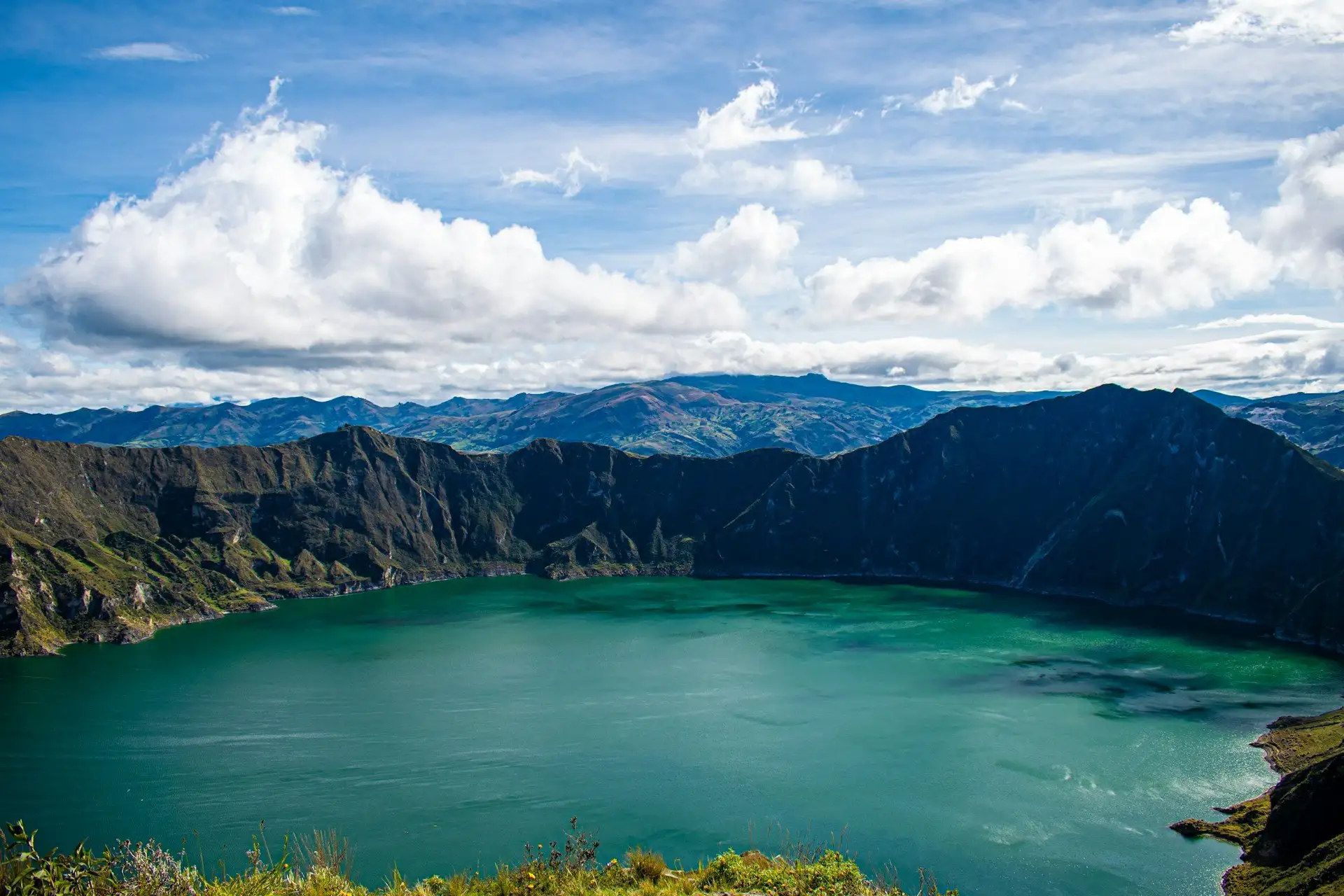
Ecuador
The Galápagos, the Amazon, the Andes, and the Pacific coast all in a country smaller than Nevada. Plus the only place on earth where sea lions use you as a pillow and nobody thinks this is remarkable.
What You're Actually Getting Into
Ecuador is the country that makes geographers reach for superlatives. It straddles the equator — the name is not subtle — and packs four completely distinct ecosystems into a space roughly the size of Nevada or the UK. The Andean Sierra with its line of volcanoes and colonial cities. The Costa with its Pacific beaches and mangrove estuaries. The Oriente, the headwaters of the Amazon, with primary rainforest and indigenous communities that have lived there for millennia. And then, 1,000 kilometers offshore, the Galápagos Islands — where the animals have never learned to be afraid of humans and where Charles Darwin found the evidence that changed how we understand life on earth.
The practical advantage of this compression is that you can experience genuinely different worlds within a single trip of two weeks. Wake up at 2,850 meters in Quito with Cotopaxi visible from the street. Take a bus down the spine of the Andes through the Avenue of the Volcanoes. Descend into the Amazon basin to spend three days in primary rainforest. Fly to the Galápagos. This itinerary exists without a single impractical connection.
The honest complications: Ecuador's security situation has worsened considerably since 2022, driven by a surge in organized crime linked to drug trafficking. Guayaquil, the largest city and the main gateway to the coast, has seen significant violence. Several other areas near the Colombian border and along trafficking corridors have elevated risk. The tourist circuit — Quito, the highlands, the Amazon, and the Galápagos — remains substantially safer than the affected areas, but the change from Ecuador's previously more benign security reputation is real and worth acknowledging before you book. Read the safety section carefully.
Come for the Galápagos. Stay for everything else. Most visitors who come for the islands discover that mainland Ecuador is a destination in its own right, not just the place you transit through on the way to the wildlife.
Ecuador at a Glance
A History Worth Knowing
Ecuador's human story is at least 10,000 years old. The Valdivia culture on the Pacific coast, dating to around 3500 BCE, produced the oldest-known pottery in the Americas — small ceramic figurines and vessels that predate contemporary Mesopotamian pottery and suggest an independent development of ceramic technology in South America. This detail tends to surprise people because Ecuador doesn't feature prominently in the standard narrative of early civilizations, which tends to focus on Egypt and Mesopotamia.
By the 15th century, the northern Andes of what is now Ecuador were home to a sophisticated confederation of peoples — the Cañari in the south, the Quitu-Cara in the highlands around modern Quito, and others — when the Inca expansion under Tupac Yupanqui and his son Huayna Capac reached the region in the 1460s and 1470s. The conquest was hard-fought; the Cañari in particular resisted for years. When it was finally absorbed, the northern territories of the Inca empire (called Quitu or Tomebamba) became so important that Huayna Capac based himself there rather than in Cusco, and upon his death around 1527 the empire split between his two sons — Huáscar in Cusco and Atahualpa in Quito — triggering the civil war that the Spanish arrived to exploit in 1532.
Atahualpa, the Quito-based ruler who had just won the civil war, was captured by Francisco Pizarro at Cajamarca in 1532 in one of history's more audacious military gambits: 168 Spanish soldiers and cavalry, in a carefully orchestrated ambush, captured the Inca emperor and held him for ransom. The ransom — a room full of gold and two rooms full of silver — was paid and then Atahualpa was executed anyway in 1533. The conquest followed with devastating speed, the Inca administrative system repurposed for colonial extraction.
The territory that became Ecuador was part of the Viceroyalty of Peru, then the Viceroyalty of New Granada, and finally the Real Audiencia de Quito. Quito's colonial architecture — the historic center that UNESCO declared the first World Heritage Site in 1978 — dates from the 16th-18th centuries and is among the best preserved in the Americas. The churches and convents were built with indigenous labor under the encomienda system and decorated by indigenous and mestizo artists who created a synthesis style (called the Quito School) that blends European Baroque with indigenous iconography in ways that become visible once you know to look for them.
Independence came in 1822 as part of the wider South American liberation campaigns. Ecuador was briefly part of Gran Colombia (the republic that Bolívar envisioned uniting Venezuela, Colombia, and Ecuador) before becoming fully independent in 1830. The 19th and 20th centuries brought political instability in the form of a rapid turnover of governments, territorial losses to Peru, and the oscillation between liberal and conservative politics that defined much of Latin American governance in this period. The discovery of oil in the Oriente in the 1960s transformed the economy and produced both development revenues and an ongoing conflict between extraction interests and indigenous communities whose territories sit above the oil.
Rafael Correa's presidency (2007-2017) was the most transformative recent political period: aggressive social spending, infrastructure investment, a rewritten constitution that granted rights to nature (a first anywhere in the world), and a confrontational posture toward the IMF and foreign oil companies. His successor Lenín Moreno reversed many of Correa's policies. The current security deterioration — a significant rise in gang violence tied to Ecuador's emergence as a cocaine transit country between Colombian production and global markets — has dominated politics since the early 2020s and produced a state of emergency that was declared in 2024.
Oldest-known pottery in the Americas on Ecuador's Pacific coast. An independent development of ceramic technology.
Tupac Yupanqui conquers the northern Andes. The region becomes the second center of the Inca empire.
Pizarro captures and executes Atahualpa. The Inca empire falls within months.
HMS Beagle spends five weeks in the islands. Darwin's observations form the foundation of "On the Origin of Species," published 24 years later.
Quito's historic center becomes one of the first two sites inscribed on the UNESCO World Heritage List.
Ecuador becomes the first country on earth to grant constitutional rights to nature under the Correa government's new constitution.
State of emergency declared amid surge in organized crime. Ecuador navigates its most significant security challenge since independence.
Top Destinations
Ecuador's four regions each deserve dedicated time. Most visitors spend their mainland days in the Sierra (Quito and the highlands), add an Amazon jungle lodge visit, and fly to the Galápagos for the finale. The Pacific coast is increasingly risky in some areas — verify current conditions before including Guayaquil in your itinerary.
Quito
Quito is the second-highest capital city in the world at 2,850 meters and has one of the best-preserved colonial historic centers in the Americas. The Centro Histórico, a UNESCO World Heritage Site since 1978, is a compact district of baroque churches, convents, plazas, and market buildings from the 16th-18th centuries. La Compañía de Jesús is the most lavishly decorated church — 7 tons of gold leaf on the interior, every surface carved or gilded. The Basilica del Voto Nacional, on the hill above the old city, has towers you can climb for views of the crater lakes, volcanoes, and the city spreading in all directions. Budget two full days. The altitude will make you slow down anyway.
Avenue of the Volcanoes
Alexander von Humboldt named it when he traveled through in 1802: a 200-kilometer corridor along the inter-Andean valley between two parallel mountain ranges, flanked by snow-capped volcanoes on both sides. Cotopaxi (5,897m) is the world's highest active volcano and its near-perfect cone is visible from Quito on clear mornings. Chimborazo (6,268m) is the highest peak in Ecuador and, due to the earth's equatorial bulge, the point on earth's surface farthest from the center — making it, technically, the closest mountain peak to outer space. You don't need to climb them. Looking at them from a bus window while eating a freshly made empanada at a roadside stop is its own form of overwhelming.
Cuenca
Ecuador's third city and its most elegant. Cuenca sits in a valley at 2,550 meters, warmer and sunnier than Quito, with a colonial center that is better preserved and less touristed. The Cathedral of the Immaculate Conception — whose blue domes define the skyline — took over 90 years to build and the original church still stands directly behind it. The market at Plaza Rotary on Thursday and Saturday mornings has indigenous vendors from across the surrounding highlands and is one of Ecuador's best living market experiences. Cuenca is also the center of Panama hat production — the correctly named sombrero de paja toquilla, which is Ecuadorian, not Panamanian.
Tena & Amazon Jungle
Ecuador's Oriente — the Amazon-draining eastern slopes and lowlands — is accessible in under 4 hours from Quito by road. The town of Tena is the main gateway for kayaking, rafting, and jungle lodge stays. Yasuni National Park, deeper in the Amazon and accessible by air to Coca then river boat, is one of the most biodiverse places on earth (more tree species in one hectare than in all of North America) and home to the Waorani people. The lodges along the Napo River offer guided wildlife walks, canoe trips, and stays with indigenous communities. Two to three nights is the minimum to start sensing the forest's rhythm.
Baños de Agua Santa
Baños ("baths") sits in a valley between the Andes and the Amazon, at the foot of the active Tungurahua volcano, at the confluence of rivers tumbling down from the highlands. It is Ecuador's adventure sports capital: white-water rafting, canyoning, zip lines, mountain biking down the famous "Route of the Waterfalls," and soaking in the thermal baths that give the town its name. The town is energetic, slightly chaotic, heavily geared toward backpackers, and very good at what it does. The taffy (melcocha) pulled on iron hooks outside the candy shops on the main street is the local food institution.
Montañita & Manta
Ecuador's Pacific coast has legitimate surf beaches (Montañita is the main surf town), whale watching (June to September when humpbacks arrive), and the mangrove estuaries of the Chocó bioregion. The city of Manta is the tuna fishing capital of South America and has good ceviche as a direct consequence. Important caveat: security in several coastal areas, particularly around Esmeraldas and some corridors near the Colombian border, carries elevated risk. Check current conditions specifically for any coastal destination before traveling. Montañita and Manta themselves are generally manageable but the picture changes; verify before booking.
Otavalo
Two hours north of Quito, the town of Otavalo hosts the largest indigenous market in South America every Saturday morning. The Plaza de los Ponchos fills with textiles, jewelry, ceramics, and crafts from the Otavaleño people — who have been weaving and trading in this valley for centuries and whose distinctive dress (white trousers, blue poncho, long black hair for men; embroidered blouses and shawls for women) is worn as contemporary everyday clothing, not for tourists. The animal market at dawn on Saturday, 10 minutes from the main plaza, is attended almost exclusively by locals and is one of Ecuador's most genuine market experiences.
Mitad del Mundo
The Middle of the World monument 24 kilometers north of Quito marks the calculated equatorial line from 18th-century French geodesic mission measurements — and is slightly off. The actual GPS equator is 240 meters north, at the Inti Ñan Solar Museum, where guides demonstrate equatorial phenomena: water draining without the Coriolis spin, eggs balanced on nailheads, and the measurable difference in weight at the equator. Both sites charge entry and both are worth the half-day trip from Quito for the combination of historical context and genuinely strange physics demonstrations.
The Galápagos Islands
There is nowhere else on earth like the Galápagos. The islands were never connected to a continent, so every species here arrived by chance — carried by wind, ocean current, or the feet of seabirds — and then evolved in isolation for millions of years. The marine iguana is the world's only sea-going lizard. The flightless cormorant is the world's only cormorant that has lost the ability to fly. The Galápagos tortoise can live 150 years and weigh 250 kilograms. The blue-footed booby performs its courtship dance three feet from you and has no concept that this requires distance.
The more important thing than any of this: the animals have no fear of humans. There were no land predators in the Galápagos before humans arrived, so the animals never developed flight response. A sea lion will swim directly at you underwater out of curiosity. A hawk will land on your daypack. A marine iguana will walk across your shoes. This is not the result of taming or conditioning. It is the baseline behavior of animals that have never had a reason to be afraid. It changes how you experience wildlife permanently — after the Galápagos, a zoo feels like the wrong kind of relationship.
Cruise vs Land-Based
A liveaboard cruise reaches the outer islands — Fernandina, Española, Genovesa, Marchena — that are inaccessible from Santa Cruz on day trips. These have the most dramatic and least disturbed wildlife. Cruise prices: $250-500/day mid-range, $500-1,000+/day luxury. A land-based trip from Puerto Ayora on Santa Cruz runs $150-250/day with good day trips covering Seymour Norte, Bartolomé, Santa Fe, and the highlands. Both approaches deliver extraordinary wildlife. The cruise wins on access to outer islands; land-based wins on price and flexibility.
Wildlife Calendar
The Galápagos is good year-round but the wildlife calendar matters for specific animals. Sea lion pups: July to November. Marine iguana nesting: January to April. Blue-footed booby courtship dances: year-round but most active May to January. Giant tortoises in the highlands: year-round. Whale sharks near Darwin and Wolf islands: June to November. Waved albatross on Española: April to December. Ask your cruise operator which species you prioritize and choose your months accordingly.
What It Actually Costs
The $200 National Park entrance fee is mandatory for all visitors, paid at the airport on arrival. Round-trip flights from Quito or Guayaquil to the Galápagos cost $350-600 depending on how far ahead you book. A week in the Galápagos: land-based budget is roughly $1,500-2,500 total excluding flights; a mid-range cruise runs $3,000-5,000+ for the week. This is one of the few places where the cost genuinely delivers — the experience is unlike anything else and that has a price.
Rules & Ethics
The National Park has strict rules enforced by naturalist guides who accompany all visits to protected sites. Stay on marked trails. Never touch wildlife (sea lions excepted when they touch you, which they will). No food outside designated areas. No collecting anything, including shells or lava rock. These rules are the reason the wildlife is as unafraid as it is — they have been enforced since 1959 when the park was established. Follow them as a matter of principle, not just compliance.
Santa Cruz & Puerto Ayora
The tourist hub and the best base for land-based visits. The Charles Darwin Research Station has a giant tortoise breeding program and is where you see the famous tortoises up close. The highlands above Puerto Ayora have wild tortoises roaming freely in farmers' fields — you can walk among them. Tortuga Bay beach (20 mins walk from town) has marine iguanas, sharks in the shallows, and a lagoon with flamingos. The best fish market in the archipelago is in Puerto Ayora — the pelicans and sea lions wait for scraps from the dock every morning.
Seymour Norte & Bartolomé
Seymour Norte is arguably the best single day trip in the Galápagos: frigatebirds in full courting display (the males inflate bright red throat pouches the size of a soccer ball), blue-footed boobies dancing, sea lions everywhere. Bartolomé has the most iconic view in the Galápagos — the Pinnacle Rock rising from the sea with the black lava landscape behind it — and a snorkeling site where Galápagos penguins swim past you in the warm water, which is wrong in the best possible way.
Española (Hood Island)
The southernmost island and accessible only by cruise. Home to the only nesting colony of waved albatrosses in the world (April to December) and the most dramatically concentrated wildlife in the archipelago. The blowhole at Punta Suárez sends water 30 meters in the air. The sea cliff at the colony's edge has albatrosses launching themselves into flight over a drop of several hundred feet. This is what the outer island cruise delivers that the land-based trip doesn't.
San Cristóbal
The administrative capital of the Galápagos and the second tourist hub. The Interpretation Center has the best exhibit on Galápagos natural and human history in the archipelago. The beach at La Lobería has the most relaxed sea lion colony in the islands — they've claimed the beach entirely and will ignore you with magnificent confidence. San Cristóbal is the arrival airport for some flights from Guayaquil and a common cruise start/end point.
Culture & Etiquette
Ecuador is a deeply layered country — indigenous communities that maintained significant autonomy through the colonial period and into independence, a mestizo majority, Afro-Ecuadorian communities on the coast and in the north, and a small white elite whose cultural dominance the Correa-era constitutional changes explicitly challenged. What you encounter as a tourist depends heavily on where you are: the indigenous markets of the highlands, the coastal fishing communities, the Afro-Ecuadorian music and food culture of Esmeraldas, and the urban professional culture of Quito are genuinely different worlds.
Ecuadorians are generally warm but somewhat more reserved than Colombians or Brazilians in initial interactions. The warmth is real; it just arrives at a slightly slower pace and with more formality in opening encounters.
Quito at 2,850 meters will affect you. More in some people than others, but almost everyone feels something in the first 24-48 hours. Rest, hydrate, skip alcohol the first day. Ecuadorians are used to visitors needing a slow start and this is not a source of embarrassment — it's just altitude.
At the Otavalo market and at craft markets throughout the highlands, buying directly from the maker rather than an intermediary stall means the full price goes to the community. Ask who made it. The Otavaleños in particular are expert weavers with a tradition that predates Spanish contact and the work is genuinely fine craft.
Particularly at indigenous markets. Some vendors are happy to be photographed; others are not and have been photographed without consent for so many years that the patience has worn thin. Ask. Accept refusals gracefully. The question alone is often appreciated.
Ecuador uses USD, which simplifies currency exchange but creates the same small-change problem as Bolivia. Dollar bills in small denominations (ones, fives, tens) are essential at markets, local restaurants, and bus stations. Nobody can change a $20 for a $3 meal without real difficulty.
The National Park rules are enforced by naturalist guides and are the reason the wildlife is as extraordinary as it is. Stay on marked trails, never touch wildlife (except sea lions who touch you — you cannot control this), take nothing from the islands. These rules have been protecting the ecosystem since 1959.
The security situation in Ecuador has increased the risk of express kidnapping via unofficial taxis. Use app-based services (InDriver, the official radio taxi apps) or ask your accommodation to call a licensed taxi. Do not hail from the street, particularly at night or near bus terminals.
Guayaquil's security has deteriorated significantly. If you need to transit through Guayaquil airport, go directly between the airport and your next destination. If you plan to visit the city itself, check the most current government travel advisory and plan accordingly with up-to-date local knowledge.
Phone theft and opportunistic robbery are more common than in previous years across Ecuador's cities. Keep your phone in your pocket between uses. Don't wear visible jewelry or expensive watches outside your accommodation. This applies more in larger cities; the highlands towns and Galápagos islands are significantly calmer.
Not that this needs saying for most visitors, but it bears emphasis: feeding any Galápagos animal is strictly prohibited and potentially harmful to the specific animal and the broader ecosystem. The animals come this close because they are wild. Keep them wild.
The Amazon lodges are excellent but going into the jungle without rubber boots, DEET repellent, and appropriate clothing is a bad time. Pack long sleeves, long trousers, closed shoes, and enough repellent. Your lodge will supply rubber boots; bring your own repellent in adequate quantities.
Panama Hats (They're Ecuadorian)
The hat known globally as the Panama hat has been made in Ecuador for centuries — primarily in Montecristi and Cuenca. It got its misleading name when thousands were shipped through Panama during the canal construction in the early 1900s, where workers wore them. US President Theodore Roosevelt was photographed wearing one at the canal and the association stuck. A genuine Montecristi fino — the finest grade, woven so tightly it can hold water — takes weeks to make and sells for $200-1,000. The tourist market versions for $10 are machine-made or loosely woven. Know the difference before buying.
Music & Pasillo
Ecuador's defining musical tradition is the pasillo — a melancholic waltz-derived form that developed in the 19th century as a distinctly Ecuadorian style. Its most celebrated interpreter was Julio Jaramillo, known as "El Ruiseñor de América" (The Nightingale of the Americas), whose recordings from the 1950s-70s remain a national cultural touchstone. Hearing a live pasillo in a Quito peña (folk music bar) in La Ronda neighborhood is one of those experiences that tells you something specific about how a country processes emotion.
Flower Industry
Ecuador is the world's third-largest cut flower exporter and the largest producer of roses. The flower farms in the valleys around Quito — particularly in the Cayambe area — produce roses that are sold on Valentine's Day in the US and Europe. The combination of high altitude, equatorial sunlight, and cool temperatures produces unusually large, long-stemmed roses with colors that don't travel in photos. The price at source: a bunch of 20 roses costs about $3 at the Cayambe road market.
Indigenous Rights & Oil
Ecuador's 2008 constitution was the first in the world to grant rights to nature — Pachamama — as a legal entity that could be represented in court. This was not abstract philosophy: it was directly related to the ongoing conflict over oil extraction in the Oriente, where indigenous communities have been fighting petroleum companies and the government over pollution and territorial rights for decades. Understanding this context makes the Oriente visit more meaningful than it would otherwise be. The Cofán, Siona, Secoya, and Waorani peoples are not just wildlife backdrop.
Food & Drink
Ecuadorian food is honest, specific, and underrated. The coastal and highland cuisines are as different as two cuisines in the same country can be. The coast runs on seafood, plantain, and rice; the highlands run on potato, corn, and roasted meat. Both are good. The Amazon contributes ingredients — palm heart, chontacuro grubs, various jungle tubers — that give the country's food range a biological depth most national cuisines lack.
The ceviche deserves particular attention. Ecuadorian ceviche is not Peruvian ceviche. Where Peruvian uses citrus to "cook" the raw fish in a technique called leche de tigre, Ecuadorian ceviche uses tomato juice as the base, includes shrimp as the primary protein, and is served with tostadas and chifles. It is gentler, slightly sweet, and excellent. The argument about which is better is ongoing and both sides have merit.
Ceviche de Camarón
Ecuador's defining dish: shrimp in a tomato-citrus base with onion, cilantro, and lime, served with tostadas and plantain chips in a plastic cup or deep bowl. Served cold, eaten immediately. The quality correlates directly with how recently the shrimp left the water — the best is in the coastal cities and market stalls. Inland versions are fine. Coastal versions at a good market stall are the standard against which all others are measured. The Manta version, from the tuna fishing capital, uses fresh yellowfin tuna and is a completely different experience.
Llapingachos
Fried potato patties — thick, slightly crusty on the outside, soft inside — served with chorizo, fried egg, avocado, and curtido (pickled vegetables) on the side. The definitive highland breakfast or almuerzo accompaniment. They appear at almost every Andean meal table in some form. A plate of llapingachos with chorizo and egg at a market comedor costs about $2.50 and constitutes the full caloric requirements for a morning of altitude hiking.
Hornado & Fritada
Two pork preparations that define highland market food. Hornado is whole roasted pig, slow-cooked overnight, with crackling skin and tender meat, served with mote (hominy corn), llapingachos, and curtido. Fritada is fried pork pieces — chunks cooked in their own fat until golden. Both are served at the large wooden-table market restaurants that fill every highland market town on Sundays. The best hornado in Ecuador is at the Riobamba market. Locals and experts agree on this and are prepared to discuss it at length.
Caldo de Gallina
Chicken soup, Ecuadorian style. Made with entire free-range chicken pieces (including feet, which impart gelatin), yellow potatoes, noodles, cilantro, and hard-boiled egg. Served as the first course of every almuerzo and eaten alone as a restorative for illness, hangovers, altitude sickness, and general emotional distress. The version at a market comedor will have had three to four hours of simmering behind it. The resulting broth is dark gold and deeply flavored in a way that stock cubes have no relationship to.
Fruit & Juices
Ecuador's position between Andean highlands and tropical lowlands produces an extraordinary fruit range. Naranjilla (a sour, citrusy Andean fruit with no adequate English translation) makes the best juice in the country. Tomate de árbol (tree tomato) is sweet-tart and makes exceptional juices. Maracuyá (passionfruit), guanábana (soursop), and taxo (banana passionfruit) are all available fresh in market juice stalls for under $1 a glass. The fruit diversity here rewards deliberate trying — order whatever the vendor recommends and work through the list.
Colada Morada & Drinks
Colada morada is a thick purple drink made from black corn, fruits, and spices — sweet, spiced, and specific to Día de los Muertos (November 2) when it's served with guaguas de pan (bread figures shaped like people). The rest of the year you find it at specialty stalls. Chicha is fermented corn or yuca, consumed in indigenous communities and at festivals. Ecuadorian hot chocolate — made with local Arriba Nacional cacao — is excellent and served with queso fresco melted in the cup at traditional higuerilla places in Quito's old city.
When to Go
Ecuador's timing depends entirely on which region you're prioritizing. The highlands (Quito, the Avenue of the Volcanoes, Cuenca) have two dry seasons: June to September and December to January. The Galápagos is good year-round with different wildlife highlights by season. The Amazon is accessible year-round but drier months (November to February) are more comfortable. The Pacific coast's best beach season is December to April.
Dry Season
Jun – SepBest conditions for Quito, the volcano corridor, Otavalo markets, and highland hiking. Clearest views of Cotopaxi and Chimborazo. The dry season also corresponds to the Galápagos cool season when seas are rougher but snorkeling visibility is superb and marine life is most active.
Warm Season
Dec – AprThe Galápagos warm season: calmer seas, warmer water for swimming, nesting sea turtles. Best for the Pacific coast beaches. Quito has more afternoon rain but the mornings are clear. The sea lions and marine iguana nesting on the Galápagos are active in this window.
Second Dry Season
Oct – NovA shorter dry window in the highlands with generally good conditions. October and November are transitional months with mixed weather. The Amazon is entering its drier period, which improves wildlife viewing. Fewer tourists than June-September.
Wet Season
Feb – MayHeavy afternoon rains in the highlands, particularly March-April. The volcanoes are often cloud-covered. Road conditions can deteriorate. However, the Galápagos warm season continues, and the Amazon is lush. Not a write-off, but the highland landscapes are better appreciated in drier conditions.
Trip Planning
Two weeks is the classic Ecuador trip: Quito and highlights, the highland circuit, the Amazon, and the Galápagos. Three weeks adds Cuenca and the southern highlands or a longer Galápagos cruise. The country's compact size means no leg requires more than a day's travel and domestic flights are short and reasonably priced.
Quito
Day one: acclimatize. Centro Histórico walk, La Compañía church, Basílica tower. Day two: Mitad del Mundo half-day, back for lunch at a market comedor, evening in La Ronda for pasillo music and canelazo (hot sugarcane spirit with cinnamon).
Galápagos
Fly Quito or Guayaquil to Baltra or San Cristóbal (1.5-2 hours, $350-600 return). Five days: land-based from Puerto Ayora with day trips to Seymour Norte, Bartolomé, the highlands tortoise farms, and Tortuga Bay. The $200 National Park fee is paid on arrival. Book accommodation in Puerto Ayora before departure.
Quito & Otavalo
Two days in Quito plus a day trip to Otavalo — time the market for Saturday if possible. The drive north passes Cayambe with views of the snowcapped volcano and the rose farms. Back to Quito for the evening.
Avenue of the Volcanoes & Baños
Bus south from Quito through the volcano corridor. Stop at Cotopaxi National Park for the parking lot views of the volcano and a short hike toward the glacier (you don't need to summit to be impressed). Continue to Baños for the night and afternoon/evening activities.
Amazon (Tena/Napo)
Bus from Baños to Tena (3 hours, spectacular road descending from the Andes into the jungle). Book a lodge on the Napo River for two nights through a Tena operator. Guided jungle walks, canoe trips, and a visit to an indigenous community. Return to Tena for the bus back to Quito.
Galápagos
Fly from Quito to the Galápagos for six days. At this duration, consider a 5-day/4-night budget cruise departing from Puerto Ayora which reaches several outer islands that day trips don't access. Alternatively, five land-based days with all the Santa Cruz day trips plus a one-night excursion to San Cristóbal.
Quito Extended
Add the day trip to Papallacta hot springs (an hour east of Quito, thermal pools at 3,300m with views of Antisana volcano). Add a visit to the Museo del Banco Central for the best pre-Columbian collection in Ecuador. Take the TelefériQo cable car up Pichincha volcano for views over the entire city from 4,050 meters.
Northern Highlands: Otavalo & Ibarra
Saturday Otavalo market plus two days exploring the lakes and markets around Cotacachi. Cuicocha crater lake. The leather town of Cotacachi. Train from Ibarra to Salinas, an Afro-Ecuadorian community famous for marimba music and chocolate production.
Cotopaxi & Baños
Full day in Cotopaxi National Park with a guided high-altitude acclimatization hike to the José Rivas refuge at 4,864m (no climbing experience needed but good fitness required). Baños for two nights with the Route of the Waterfalls cycling and the Tungurahua night views.
Cuenca & Southern Highlands
Bus from Baños to Cuenca via Riobamba (the Devil's Nose train section is worth the extra time). Two days in Cuenca: Panama hat workshop at Homero Ortega, Thursday market, the Museo del Pumapungo. Day trip to the Inca ruins at Ingapirca — the best-preserved Inca site in Ecuador.
Amazon & Galápagos
Fly Cuenca to Quito, then fly to Coca and take the river to a Napo Wildlife Center or similar Yasuni-area lodge for three nights — the deepest Amazon experience in Ecuador. Return to Quito, fly to the Galápagos for five days including a budget cruise. Fly home from Quito or Guayaquil.
Vaccinations
Yellow fever vaccination required for Amazon regions and for the Galápagos if entering from or through yellow fever areas. Hepatitis A, Typhoid, and routine vaccines recommended. Malaria prophylaxis for the Amazon lowlands. Check current advice 6-8 weeks before departure.
Full vaccine info →USD Cash
Ecuador uses US dollars — no exchange required if arriving from the US. ATMs in Quito and Cuenca work reliably with international cards. The Galápagos is increasingly card-friendly but carry $300-400 in cash for the National Park fee and smaller transactions. Small bills are essential everywhere.
Connectivity
Buy a Claro or CNT SIM at Quito's Mariscal Sucre Airport. Data packages cost $15-25 for 30 days. Coverage is good in cities and along main highways. In the Amazon jungle and remote Galápagos islands, coverage is limited or absent. Download offline maps before any rural excursion.
Get Ecuador eSIM →Galápagos Park Fee
The $200 USD National Park entrance fee is paid in cash at the Baltra or San Cristóbal airport on arrival in the Galápagos. Bring USD cash specifically for this — card payment is not always accepted and the amount is non-negotiable. The fee supports park management and is why the islands are as pristine as they are.
Travel Insurance
Good private hospitals in Quito and Cuenca. The Galápagos has only basic medical facilities — serious emergencies require evacuation to the mainland. For Amazon jungle activities, make sure your policy explicitly covers adventure activities. Medical evacuation coverage is essential.
Amazon Essentials
For jungle stays: DEET repellent (40%+ concentration), long-sleeve lightweight shirts and trousers, rubber boots (your lodge provides these but check), a headlamp with spare batteries, and rain gear. The jungle is wet, the insects are persistent, and the right preparation is the difference between a good time and a miserable one.
Transport in Ecuador
Ecuador's land transport system is comprehensive and inexpensive. The Pan-American Highway runs the length of the country through the highlands, and buses cover virtually every route several times daily. Domestic flights connect Quito to Guayaquil, the Galápagos, and Coca (Amazon gateway). Road quality is generally good on main routes; the dramatic descents from the Andes into the Amazon basin are spectacular regardless of conditions.
Domestic Flights
$80–200/routeLATAM Ecuador and Avianca Ecuador connect Quito and Guayaquil with the Galápagos, Coca (Amazon), Cuenca, Loja, and Manta. The Quito-Galápagos flight is 1.5-2 hours. Book ahead for the Galápagos route — it fills. Guayaquil is slightly cheaper for Galápagos flights but requires the security calculation mentioned above.
Intercity Bus
$3–15/routeEcuador's bus network is extensive, cheap, and generally reliable. The main bus terminals (Terminal Terrestre) in Quito, Guayaquil, and Cuenca serve all regional routes. Quito to Cuenca: 8-9 hours, $10. Quito to Baños: 3.5 hours, $5. Quito to Tena: 4.5 hours, $6. Book at the terminal window on the day of travel — advance booking is only necessary for peak holiday periods.
App Taxis (Quito)
$3–10 within the cityInDriver is the main app-based taxi service in Quito. Cabify also operates. Both show the fare before you confirm. Do not hail unmarked taxis from the street in Quito — the security situation makes this risky. Your accommodation will call a licensed radio taxi if apps aren't working.
Devil's Nose Train
$30–35 returnThe Nariz del Diablo (Devil's Nose) — a section of the old Guayaquil-Quito railway that descends the Andes in a series of switchbacks, the train going forward and backward alternately to descend a cliff face — is one of Ecuador's classic experiences. The Alausí to Sibambe section is the dramatic one, about 40 minutes each way. Book at the Alausí station or through Ecuador's Ferrocarriles del Ecuador website.
Amazon River Transport
$20–60/dayFrom Coca on the Napo River, river boats access Amazon lodges, Yasuni National Park, and indigenous communities. Lodge transfers are arranged by the lodge operators. Independent navigation is possible with a guide but not recommended without local knowledge — the river system is complex and the distances are large.
Galápagos Inter-Island
$30–50/crossingSpeed boats run between Santa Cruz, San Cristóbal, and Isabela in 2-3 hours. The crossings can be rough in the cool season (June-November) — take seasickness medication if susceptible. Flights between islands are available but expensive. Most visitors to Isabela (the largest island) do the overnight boat from Santa Cruz.
Local Transport
$0.25–2Within smaller cities and highland towns, local buses cost $0.25. Motorbike taxis (mototaxis) cover short distances for $1-2. In Quito, the MetroBus and ecovía systems provide dedicated lanes at low cost. The TelefériQo cable car costs $8.50 return and goes to 4,050 meters on Pichincha volcano.
Car Rental
$40–80/dayUseful for the southern highlands (Cuenca to Ingapirca to Loja) and the Pacific coast. Less necessary for the main tourist route which buses cover well. International driving permit required. Road quality varies significantly — paved on main routes, unpaved and muddy in rural areas. Mountain roads deserve respect.
Accommodation in Ecuador
Ecuador's accommodation ranges from Amazon jungle lodges that are among the finest eco-lodge experiences in South America to simple highland guesthouses for $15-20 a night. Quito's La Mariscal district (the tourist neighborhood with the highest restaurant and nightlife density) and the historic Centro Histórico both have good accommodation across all price ranges. The Galápagos has everything from budget hostels in Puerto Ayora to liveaboard cruise ships — the choice depends on your Galápagos strategy.
Amazon Jungle Lodges
$150–400/night (all-inclusive)The Napo Wildlife Center, Sacha Lodge, and La Selva are Ecuador's top Amazon lodges — all on the Napo River with access to primary rainforest, excellent wildlife guides, and quality food. Rates include all meals, guided activities, and transfers. The experience justifies the price relative to other accommodation categories.
Historic Center Hotels (Quito)
$60–200/nightStaying in the Centro Histórico puts you in 16th-century colonial buildings that have been converted to small hotels. Casa Gangotena and the Hotel San Francisco de Quito are the best. The neighborhood is safe during the day and requires more care at night — your hotel will advise on evening movement.
Galápagos Accommodation
$80–200/night (land-based)Puerto Ayora on Santa Cruz has the widest range: from backpacker hostels at $25/night to mid-range hotels at $80-150. The Finch Bay Eco Hotel is the most comfortable land-based option with access to a private beach. Cruise accommodations are aboard the vessel and range from shared cabins to private suites.
Highland Haciendas
$80–300/nightThe converted haciendas along the Avenue of the Volcanoes — Hacienda San Agustín de Callo (built on Inca foundations), Hacienda La Cienega (Ecuador's oldest hacienda) — offer historical atmosphere with volcano views. These are the most distinctly Ecuadorian accommodation experience on the mainland.
Budget Planning
Ecuador sits at the affordable end of South American destinations on the mainland — bus travel is cheap, almuerzos are $3, and highland guesthouses are $20-40. The Galápagos is a completely different budget category: the $200 park fee, expensive flights, and high accommodation costs make it the most expensive part of any Ecuador trip by a significant margin. Budget separately for the islands.
- Hostel or basic guesthouse
- Almuerzo set lunch ($2.50-4)
- Local buses between cities
- Free or low-cost sights
- Local beer and fresh juices
- Boutique hotel or hacienda
- Mix of restaurants and market food
- Domestic flights for long routes
- Guided tours and day trips
- Amazon lodge (budget $1,000+ total for 3 nights)
- $200 National Park fee (one-time)
- $350-600 return flights from mainland
- Land-based: $150-250/day + day trips
- Budget cruise: $250-350/day all-in
- Luxury cruise: $500-1,000+/day
Quick Reference Prices
Visa & Entry
Ecuador has a generous visa-free policy. Citizens of the US, UK, EU nations, Australia, Canada, New Zealand, and most Latin American and Asian countries can enter without a visa for up to 90 days. This applies to both mainland Ecuador and the Galápagos — the islands don't require a separate visa, only the separate $200 National Park entry fee paid on arrival at the Galápagos airport.
Extensions beyond 90 days require application at the Ministerio del Interior. The maximum stay without residency is 90 days within any 12-month period for most nationalities, though some arrangements allow up to 180 days. Check current requirements at the Ecuadorian Ministry of Foreign Affairs before travel.
Most Western nationalities qualify. The Galápagos requires the same passport entry but also charges the $200 National Park fee in cash on arrival. No separate visa for the islands.
Safety in Ecuador
Ecuador's safety situation has changed significantly since 2022. The country was previously considered one of South America's safer destinations. The rise of organized crime linked to Ecuador's emergence as a major cocaine transit route has changed the picture, particularly in Guayaquil and along certain coastal corridors. The situation reached a point of national crisis in January 2024 when the government declared a state of emergency. The tourist circuit — Quito, the highlands, the Amazon, and the Galápagos — is substantially safer than the worst-affected areas, but the overall security environment requires more active awareness than it did five years ago.
Quito Historic Center & Mariscal
Safe during the day with normal urban awareness. The Centro Histórico requires more care at night — stay in well-lit areas, use app taxis after dark, and ask your accommodation specifically which streets to avoid after 10pm. The Mariscal district (tourist area) is generally fine but has its own street safety considerations.
Highlands & Galápagos
The highland towns (Otavalo, Baños, Cuenca), the Avenue of the Volcanoes, and the Galápagos Islands are the safest parts of Ecuador for tourists. The Galápagos particularly operates with essentially no urban crime — the islands are remote, population is small, and the tourist economy is the primary industry.
Guayaquil
Ecuador's largest city has experienced a dramatic increase in violent crime. Many Western governments advise against non-essential travel to certain neighborhoods. If transiting through Guayaquil's airport, do not venture outside the airport area without specific up-to-date local knowledge. Check your government's current advisory before including Guayaquil in any itinerary.
Coastal Areas Near Colombian Border
The Esmeraldas province and areas near the Colombian border carry elevated risk from organized crime activity. San Lorenzo and the northern coast specifically have been problematic. The tourist-facing coast further south (Montañita, Manta) is generally safer but verify current conditions for any specific coastal destination before traveling.
Unofficial Taxis
As in Colombia, unofficial taxi kidnapping is documented in Quito. Use InDriver, Cabify, or a radio taxi called from your accommodation. Never share a taxi with a stranger who "happens to be going your way." This specific precaution significantly reduces serious urban crime risk.
Natural Hazards
Ecuador sits on the Ring of Fire — Cotopaxi, Tungurahua, Pichincha, and other volcanoes are active and the country experiences earthquakes. The 2016 Pedernales earthquake killed over 650 people. The government's emergency alert system is effective. Download the ECU-911 app for emergency services throughout the country.
Emergency Information
Embassies & Consulates in Quito
Most embassies are in the González Suárez and República del Salvador neighborhoods of Quito.
Book Your Ecuador Trip
Everything in one place. These are services worth actually using.
What Stays With You
The thing the Galápagos does to you takes a few days to process. You come home and you try to describe a marine iguana walking across your foot, or a sea lion swimming straight at you underwater and veering off at the last second, or a blue-footed booby dancing two feet away — and none of it sounds like what it felt like, because the telling requires that the animal had no awareness of you as an audience and no concept that your presence was unusual. The wildlife isn't performing. This is just what they do. Every day. With or without you.
The Kichwa-speaking communities of the Ecuadorian Amazon have a concept called sumak kawsay — "good living," or "living well." It was incorporated into the 2008 constitution as a guiding principle for the state, alongside the rights of nature. Roughly: that wellbeing is collective and relational, not individual and material. That you live well by living in right relationship with people and with the land. Standing in the Amazon forest at 5am hearing a million things you can't identify, or watching a 150-year-old tortoise decide you're not interesting enough to notice — something about Ecuador keeps demonstrating this point in ways that outlast the trip.